




Abstract
Background:
Compared to able-bodied subjects, subjects with post-polio syndrome and poliomyelitis demonstrate a preference for weight-bearing on the non-paretic limb, causing gait asymmetry.
Objectives:
The purpose of this study was to evaluate the gait symmetry of the poliomyelitis subjects when ambulating with either a drop-locked knee–ankle–foot orthosis or a newly developed powered knee–ankle–foot orthosis.
Study design:
Quasi experimental study.
Methods:
Seven subjects with poliomyelitis who routinely wore conventional knee–ankle–foot orthoses participated in this study and received training to enable them to ambulate with the powered knee–ankle–foot orthosis on level ground, prior to gait analysis.
Results:
There were no significant differences in the gait symmetry index of step length (p = 0.085), stance time (p = 0.082), double-limb support time (p = 0.929), or speed of walking (p = 0.325) between the two test conditions. However, using the new powered knee–ankle–foot orthosis improved the symmetry index in step width (p = 0.037), swing time (p = 0.014), stance phase percentage (p = 0.008), and knee flexion during swing phase (p ⩽ 0.001) compared to wearing the drop-locked knee–ankle–foot orthosis.
Conclusion:
The use of a powered knee–ankle–foot orthosis for ambulation by poliomyelitis subjects affects gait symmetry in the base of support, swing time, stance phase percentage, and knee flexion during swing phase.
Clinical relevance
A new powered knee–ankle–foot orthosis can improve gait symmetry for poliomyelitis subjects by influencing step width, swing time, stance time percentage, and knee flexion during swing phase when compared to ambulating with a drop-locked knee–ankle–foot orthosis.
Background
Gait symmetry is an important factor in gait, particularly after contracting poliomyelitis. 1 Symmetry of the lower limbs during ambulation can provide information about the ability to control walking and may play an important role in guiding orthotic treatment options. 2 In addition, poor gait symmetry may be associated with inefficient walking, impaired balance control, or musculoskeletal injury to the sound lower limb.2,3
Post-polio syndrome (PPS) is a lower motor neuron disorder, which can affect poliomyelitis subjects several decades after the initial viral attack. 4 Poliomyelitis survivors experience gradual further weakening in muscles that were previously affected by the polio infection. The most common symptoms include slowly progressive muscle weakness, fatigue, and muscle atrophy,1,5–7 which can also cause psychological distress 8 and joint pain.9,10 Deterioration in motor ability is frequently reported in PPS patients;10,11 meaning mobility-related activities such as negotiating stairs, walking long distances, and performing other activities of daily living (ADLs) are adversely affected in most PPS patients. From an orthotic management point of view, the main aim of providing orthoses and assistive devices is therefore to improve walking ability by this patient group.6,7
Conventional knee–ankle–foot orthoses (KAFOs) and stance control knee–ankle–foot orthoses (SCKAFOs) are two types of orthoses which are used for ambulation by PPS subjects. These subjects have limited active flexion and extension of their knee on the affected side during walking, which means that when using a KAFO with locked knee joints to ambulate, compensatory gait deviations in the form of circumduction, vaulting, or hip hiking may occur. The facility to provide a greater sagittal plane range of motion (ROM) of the knee and subsequently decreased compensatory motions have been reported as being the main advantage of walking with SCKAFOs compared to conventional orthoses.12–16 Although the design of SCKAFOs facilitates knee stability during stance phase and an unlocked knee during swing phase, they usually do not provide active flexion and extension of the knee during both stance and swing phases. This means that use of a powered KAFO may prove useful as that it could provide active flexion and extension via the orthosis during walking, which may improve gait symmetry. A new powered SCKAFO was developed to potentially restrict knee flexion during stance phase, and actively flex the knee during swing and also to provide full knee extension prior to heel strike to prepare the lower leg in starting of the stance phase; which is not available in some SCKAFO designs. The feasibility of this new powered KAFO design has previously been evaluated on healthy subjects and a single subject with poliomyelitis.17,18
Significant differences have been reported between affected and unaffected limbs in pathological gait. For instance, shortened support times and decreased ground reaction forces have been reported for a prosthetic limb compared to the natural limb in subjects with lower limb amputation. 19 In other studies, lack of gait symmetry has been demonstrated in patients with an anterior cruciate ligament rupture. 20 The gait of hemiparetic patients has been characterized by producing slower walking speed and asymmetry on the unaffected leg compared to healthy persons.21,22 Gait asymmetries in patients with limb length inequality have also been demonstrated. 23 These studies show that gait asymmetry can be a direct result of abnormality. Provision of efficient and independent gait is therefore a primary therapeutic aim in this field. Compared to able-bodied subjects, PPS and poliomyelitis subjects demonstrate a preference for weight-bearing on the non-paretic limb, causing gait asymmetry. A reduced stance phase percentage time and reduced step length on the affected side plus reduced walking speed have been highlighted as the main spatio-temporal characteristics of poliomyelitis-affected gait. 1 Therefore, providing a symmetrical gait pattern is important for increasing independent mobility in PPS and poliomyelitis subjects. The purpose of this study was therefore to evaluate the differences in gait characteristics and gait symmetry of PPS patients ambulating with either a drop-locked KAFO or a new design of powered KAFO.
Methods
Subjects
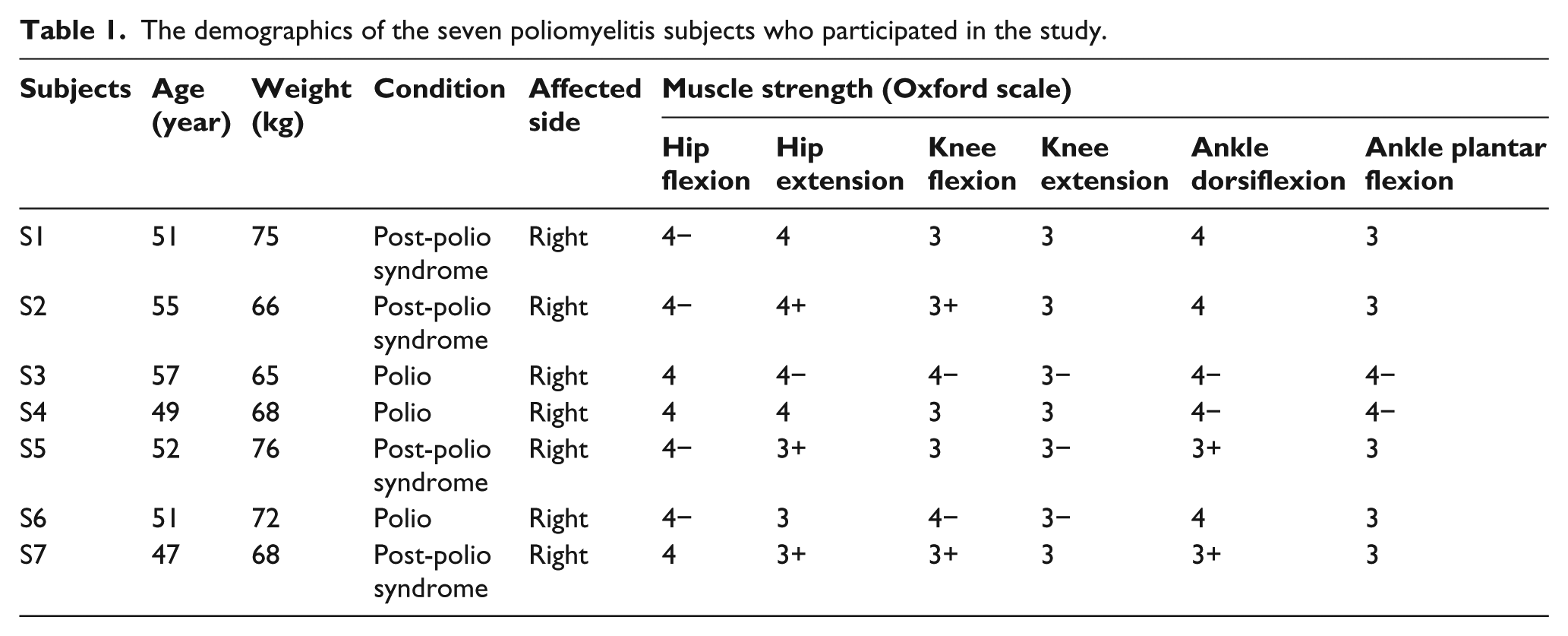
Table 1 shows the demographics of the seven poliomyelitis subjects who participated in this study. The powered knee joint mechanism incorporated within the KAFO was designed only for the right side, which meant only patients who were affected unilaterally on the right side participated in this study. The inclusion criteria consisted of evidence of subjects previously routinely using a KAFO with lockable orthotic knee joints, being able to walk a minimum of 50 m, and having sufficient hip flexor strength to advance the affected limb during swing phase. Muscle strengths were assessed manually on the affected side and were required to be at a minimum level equivalent to level 3 on the Oxford scale (full ROM against gravity). Exclusion criteria also included the existence of impaired cognition, poor balance, pain in the back or upper or lower limbs, or the existence of soft tissue contractures greater than 15° at the hip, 10° at the knee, or 5°at the ankle. All of the participants demonstrated a functional ability to ambulate with an orthoses. The trials were approved by the human ethical approval committee of the University of Social Welfare and Rehabilitation Sciences. Each patient read and signed an informed consent form before participating in the walking trials.
The demographics of the seven poliomyelitis subjects who participated in the study.
Interventions
Each subject was fitted with two custom-made cosmetic-type KAFOs by a certified orthotist. The KAFOs were manufactured with molded thigh cuffs and solid ankle–foot orthoses (AFOs). The powered KAFO utilized medial and lateral uprights manufactured in aluminum incorporating single-axis free knee joints (Figure 1). A 40 W electric actuator (“Maxon Motor EC max30”; Maxon, Brünigstrasse, Sachseln, Switzerland) with a planetary gearbox providing a reduction ratio of 111 was used to provide power, which was designed to restrict knee flexion in stance phase of gait, and when the foot progressed into the swing phase after push off, the actuator flexed the knee joint actively. The two KAFOs were identical except for the two designs of knee joint utilized, that is, one used a drop-locked joint and the other a powered joint.
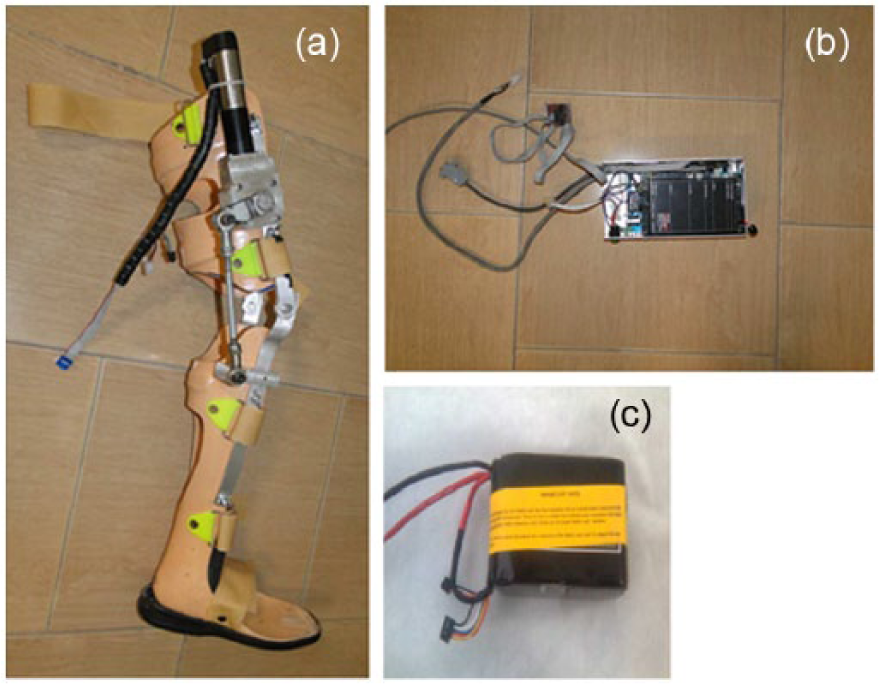
(a) The powered orthoses used in this study, (b) control unit, and (c) rechargeable 24 V battery.
After subjects were measured and fitted with the powered KAFO unilaterally, a supervised gait training program was commenced in a rehabilitation center under controlled and supervised conditions in order for the patient to achieve confidence and experience in balance, standing, and walking with the orthosis. They were trained to ambulate on level ground for 2 weeks, 3 days in week, for 2 h each day, so that they could walk independently prior to commencement of experimental testing.
Control of orthosis
A closed-loop position controlling system was employed in this powered orthosis. In order to recognize heel strike, an indirect torque meter was used based on electrical current consumption of the actuator. Initial loading on the leg, when the electrical current reached a predefined threshold, was recognized by the system as the point at which heel strike had occurred, which then activated the movement trigger, which restricted knee flexion and held the knee in the heel strike position during stance. Subsequently, after unloading of the leg was detected at the commencement of swing phase, the joint was actively flexed to its fully flexed position (45°) with a predefined velocity and acceleration. The end point of the flexion cycle during swing was recognized by the closed-loop position controlling system which was patient-specific based on their walking speed. After reaching the fully flexion position during swing, a definable delay (which was adjusted for the specific walking speed of each subject) was used to extend the knee in order to maintain a suitable swing phase duration for each subject. Consequently, the joint was returned to full extension for the next stride.
The advantages of the new powered KAFO over other SCKAFO devices included restriction of knee flexion during stance phase and active flexion and extension of the knee during swing to provide full knee extension prior to heel strike. The cost of the new SCKAFO is approximately US$4000. The durability of the system was not assessed in the study.
One rechargeable 24 V battery (Lipo Battery, Thunder Power RC G6 Pro Lite 25C 5400 mAh 6-Cell/6S) with 2 h of available continual working was used to provide power for the actuator. The battery and electronic unit of the new KAFO were situated on a waist belt worn by the subjects and weighed 0.7 kg. The additional components of the new powered KAFO (including the electronic motor and gearbox) added 0.8 kg of extra weight compared to the weight of the un-adapted KAFO. Figure 1 shows images of the orthoses used in this study.
Trial protocol
The subjects initially answered a questionnaire to confirm previous clinical interventions and medical history, which included questions regarding gender, age, height, weight, date of initial poliomyelitis infection, scoliosis, details of previous orthopedic surgery, current walking aids, plus previous prescriptions regarding orthopedic shoes.
Passive reflective markers were placed bilaterally over the jugular notch, on the spinous process of the seventh cervical vertebrae, bilaterally over the acromio-clavicular joints, the anterior superior iliac spine, on the greater trochanter, on the lateral condyle of the femur, on the head and lateral malleolus of the fibula, on the calcaneus, and on the dorsum of the foot over the second metatarsal head. The motion of the patient was captured using a 6-camera system (Vicon 460; Oxford Metrics Group, Oxford, UK) at a frequency of 100 Hz. All the subjects walked three times at their self-selected comfortable speed along a 6-m-long marked walkway in a gait analysis laboratory. Reflective markers were placed on the orthosis and the skin of the subjects. Each subject used the drop-locked KAFO and the new powered KAFO for walking in a randomized order.
Data processing
Data were processed at 100 Hz with Vicon BodyBuilder (Oxford Metrics Group) using the standard lower limb model included in the software. The data were then analyzed using MATLAB (MathWorks, Natick, MA, USA). The symmetry index (SI) for stance, swing, and double-support durations and the step length and base width were calculated according to the following equation 24
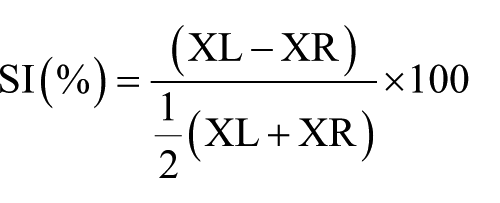
where XL and XR are the means of a spatial or temporal parameter of the left and right legs, respectively. A SI value of zero represents complete symmetry. The degree of asymmetry could range from −200% to +200% as the difference between the two sides is reported against their average value.
Statistical analyses
Statistical analyses were performed using SPSS 16.0 (SPSS, Chicago, IL, USA). Normality of walking data was approved by Kolmogorov–Smirnov test. The paired t-test was used to analyze the SI between the two walking conditions. The statistically significant level was considered as α ⩽ 0.05.
Results
Table 2 demonstrates the mean and standard deviation of primary outcome measures and the comparison of SI values between the two walking conditions in this study.
The mean, standard deviation, and comparison of the SI of various parameters in the two walking test conditions.
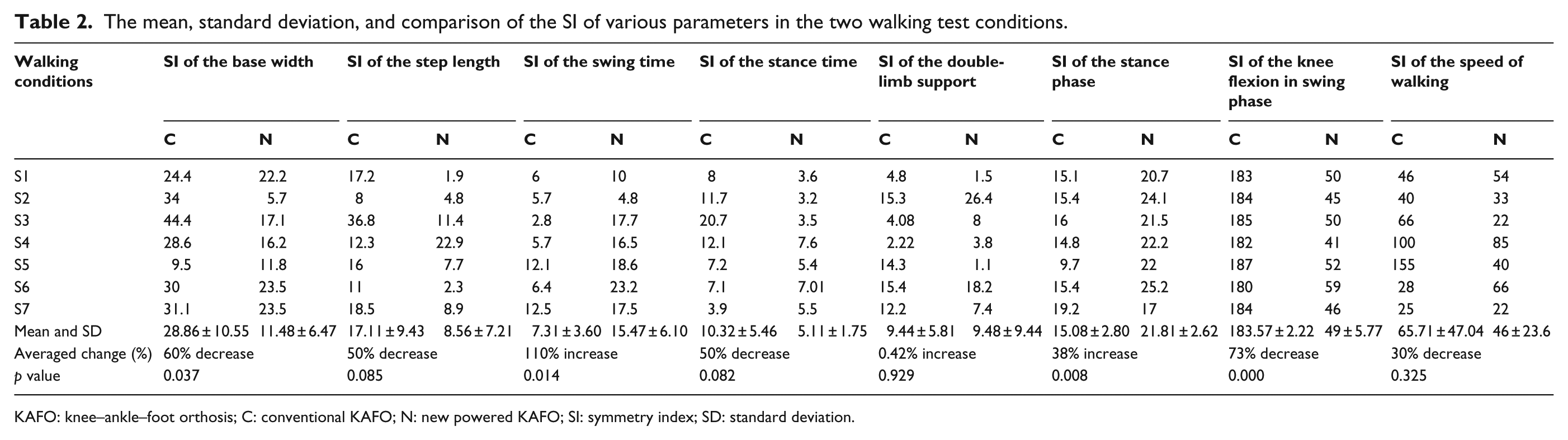
KAFO: knee–ankle–foot orthosis; C: conventional KAFO; N: new powered KAFO; SI: symmetry index; SD: standard deviation.
There were no significant differences in the SI of step length (p = 0.085), stance time (p = 0.082), double-limb support time (p = 0.929), and speed of walking (p = 0.325) between walking with the powered KAFO and the drop-locked knee joint KAFO. A different speed was calculated for each leg. The SI based on walking speed using the drop-locked KAFO was higher when compared to walking with the powered KAFO (average SI: 65.71 ± 47.04 and 46 ± 23.6, respectively); however, the difference was not statistically significant.
Using the new powered KAFO decreased the gait SI when applied to the base width (p = 0.037), swing times (p = 0.014), stance phase percentage (p = 0.008), and knee flexion during swing phase (p ⩽ 0.001) compared to walking with the drop-locked KAFO. The SI of base width when using the drop-locked KAFO was significantly higher when compared to walking with the powered KAFO (average 28.86 ± 10.55 and 11.48 ± 6.47, respectively). Walking with a drop-locked knee joint only allowed 2.7° of knee flexion, while using powered KAFO this was increased to 40° of flexion in the affected limb. There was therefore significant difference in this parameter in comparison between two types of KAFO.
Discussion
Slow walking speeds, reduced cadence, long stride times, plus long stance and double-limb support duration, with short swing and single support durations, plus short step lengths are the main characteristics of walking with assistive devices by PPS subjects. The variability and range of SIs in these parameters have been shown to be very high. The results of this study demonstrate the immediate effect of ambulating with a powered KAFO in improving gait symmetry in poliomyelitis subjects compared to when walking with a drop-locked KAFO. This was achieved when analyzing base width, swing time, and percentage of stance phase.
The term “gait symmetry” defines walking with no statistical difference between gait parameters bilaterally.22,25,26 Asymmetry of the right and left limbs has previously been demonstrated in walking speed,27,28 step length, 29 stride length, 30 foot placement angle, 31 maximum knee flexion, 29 range of joint motion, 32 and the initial and terminal double-support periods 33 in healthy subjects. According to a previous study in this field, the SI of a PPS subject when walking without an assistive device was reported as being as follows: step time—(20.1 ± 8.8), stance duration—(14.6 ± 6.1), swing duration—(34.4 ± 12.9), double support—(26.4 ± 19.9), step length—(30.9 ± 29.0), and base width—(9.4 ± 7.8). In comparison with normal gait patterns, PPS inter-subject variability was greater and significant differences were evident in most of the spatio-temporal parameters and SI. 1 Portnoy and Schwartz 1 demonstrated that walking of the poliomyelitis subjects is characterized by slower speed of walking and cadence, prolonged stance duration, and shorter step lengths.
The SI of width of the base (60%), step length (50%), stance time (50%), knee flexion (73%), and speed of walking (30%) was reduced, but during stance phase (38%), the SI of the double-limb support time (0.42%) and the swing time (110%) was increased when the powered KAFO was used. The subjects may have been imbalanced during walking with the drop-locked KAFO when swinging the leg forward, so transferring their entire body load to the stance leg. The weakness of the muscles may be responsible for this observation.
Walking with the aid of a drop-locked KAFO caused gait asymmetry in temporal spatial parameters. Portnoy and Schwartz in evaluation of PPS subjects reported that the gait of these patients was characterized by a high SI, an extremely slow speed of walking, decreased cadence, long stride time, stance and double-support durations, short swing and single support durations, and short step lengths. They demonstrated that PPS subjects who do not need a KAFO and/or walking aids walked with better symmetry in stance and swing compared to PPS patients who needed these assistive devices. 1 A powered KAFO is a new generation of orthosis that can be used for ambulation in poliomyelitis subjects. Incorporation of an actuator in this type of orthosis can provide active flexion and extension in walking and therefore can provide flexion during swing phase. This characteristic is one of the main differences between walking with these two types of orthoses in this study.
According to the improvement of the swing phase flexion demonstrated with the powered KAFO, improvement of gait symmetry during swing may be expected. Wearing the new orthosis improved symmetry in poliomyelitis subjects in this study and also made the swing time and percentage of stance phase predictable. The poliomyelitis subjects who volunteered for this study ambulated with a wide base of support when walking with a drop-locked KAFO. Walking with new orthosis significantly improved this parameter and also provided symmetry by producing less compensatory motion and the ability to walk with knee flexion in swing phase.
Slower speed of walking in poliomyelitis subjects compared to normal walking has consistently been reported in the literature when using an orthosis and this was confirmed in this study. Use of a powered KAFO had no effect on improvement of this parameter in this study. Learning to walk with new orthosis may be time-consuming and subjects had only 2 weeks of gait training as an accommodation period with the new orthosis.
Limitations
The small sample size is the major limitation of this study, which reduces the generalizability of our study. Since all participants in this study were male, the applicability of our results to a general poliomyelitis subjects is limited. Only two weeks of gait accommodation time in gait training with powered orthosis was utilized in this study and a study with a longer period of gait training would have been beneficial. This new orthosis is in its developmental phase and, therefore, it was heavier and bulkier than the drop-locked knee joint and also needed periodic recharging. The powered KAFO design needs to be scaled down in size and weight to fit under clothing in future development. It was not possible to compare this orthosis with known commercial SCKAFO joint designs at the time of testing, and a comparison between this new KAFO and a commercially available SCKAFO would be beneficial.
Conclusion
The results from this study show the effect of a new powered KAFO for walking in patients with poliomyelitis results in improving temporal gait symmetry compared to walking with a drop-locked KAFO. The use of a powered KAFO for ambulation by poliomyelitis subjects did not affect gait symmetry in step length, stance time, double-limb support time or walking speed, but the significant improvement in the base of support, swing time, stance phase percentage and knee flexion during swing phase were demonstrated. The short time used for gait training with this new powered orthosis may be the cause of these results. Consequently, the findings from this study highlight the need for additional investigations into the role of powered devices in achieving rehabilitation goals to provide gait symmetry in poliomyelitis subjects.
Footnotes
Author contribution
All authors contributed equally in the preparation of this manuscript.
Declaration of conflicting interests
The authors declared no potential conflicts of interest with respect to the research, authorship, and/or publication of this article.
Funding
The author(s) disclosed receipt of the following financial support for the research, authorship, and/or publication of this article: We thank the deputy of research and technology of University of Social Welfare and Rehabilitation Sciences for financial support for this study.