




Abstract
England’s planning deregulation, through the 2013 Permitted Development Rights modification, has seriously affected London’s housing landscape. This deregulation has been effective—from a market perspective—in converting vacant offices and increasing housing supply, but has also aggravated housing precarity. Despite a growing literature on deregulation and Permitted Development Rights, few studies integrate commodification and deregulation as intertwined drivers of housing precarity. This study’s pivotal question is how housing precarity is structurally encouraged through Permitted Development Rights. Integrating semi-structured interviews, policy analysis, and secondary sources, I explain how state-led deregulation, driven by neoclassical economics, has commodified office-to-residential conversions by legitimising the removal of housing quality requirements, enabling owners to prioritise profit over standards. This deregulation allowed the neoclassical rationale of utility maximisation and “highest and best use” to dominate, producing precarious housing outcomes that were not inevitable but structurally encouraged. This study critically unpacks the structural mechanisms that fuel this policy modification and stresses the urgent need to roll back deregulation policies, particularly Permitted Development Rights, to address London’s housing shortage without jeopardising basic quality standards for its residents.
Introduction
Framed within an extensive deregulation process of the planning system (Lord and Tewdwr-Jones, 2012), the 2013 Permitted Development Rights (PDR 1 ) modification expanded the possibilities for land use conversion, allowing developers to bypass the Local Planning Authority’s (LPA) detailed evaluation (Clifford et al., 2019; Ferm et al., 2021), resulting in serious implications for housing quality (Clifford et al., 2020). Within this context, office-to-residential (OTR) conversion under PDR demands a more profound scrutiny of the ties between deregulation, housing commodification, and the precarity and inequalities they produce. The 2013 PDR modification aimed to increase housing supply in England and repurpose empty offices for productive use (Department for Communities and Local Government [DCLG], 2013). Initially, the government proposal was intended to last 3 years, but in 2015, it was made permanent. Studies investigating PDR in England have examined the deregulation and planning perspectives (Canelas et al., 2021; Holman et al., 2018), the impact on the dwellers’ health (Marsh et al., 2020; Pineo et al., 2024), the price effects on the remaining office market (Cheshire and Kaimakamis, 2022), their relationship with Built-to-Rent developments (Buyuklieva et al., 2024), the PDR drivers for understanding the geographical distribution (Del Canto, 2025), and their adequacy and affordability attributes as a housing alternative (Chng et al., 2023). Despite the contributions to the topic made by the mentioned studies, no studies explain the relationship between a neoclassical-inspired policy, commodification, and deregulation, and how their interplay contributes to housing precarity.
To respond to this gap, this article questions whether it was inevitable that Permitted Development Rights, inspired by neoclassical economics, would produce housing precarity through OTR conversion in London. To answer this, I grounded semi-structured interviews with LPA officers and Real Estate agents, secondary insights from academic research, and the 2013 Impact Assessment produced by the Department for Communities and Local Government (DCLG). Together, these sources provide a sound methodological strategy to contextualise different data sources and techniques. Despite the 2013 PDR modification being a national policy, this study focuses on London, where drivers for conversions are particularly pronounced due to the city’s extreme rent gaps between residential and office values—the highest in the country (Del Canto, 2025). This focus allows for a clearer understanding of how ideology interacts with planning and the market and its consequences for housing outcomes.
This article contributes a theoretical unbundling of the justifications and policy responses behind the 2013 PDR modification while critically assessing its consequences. It reveals how state-driven deregulation, inspired by neoclassical economic theories such as the Efficient Market Hypothesis and the Bid-Rent theory, sought to address the oversupply of second-hand office space and increase housing delivery. Nevertheless, although OTR conversions can also be commodified under full planning permission, I investigate how deregulation, alongside commodification, permits housing precarity. This study seeks to demonstrate that while there are examples of good quality housing under PDR, what produced precarity is the removal of quality rules, which allowed a wider behavioural response from owners: they could or could not follow quality guidelines, neglecting how neoclassical principles such as maximising private utility and “highest and best use” would prevail over housing quality.
The article unfolds as follows: The following section provides a literature review focusing on neoclassical economics and the rationales of critical urban theory. This is followed by an outline of the methodological approach, which combines interview data, policy documents, and academic research, and details the ethical procedures. The analysis then turns to the theoretical neoclassical framework that justified the 2013 PDR modification amid broader deregulation in the English planning system. Building on this, the subsequent section explores the interplay between planning deregulation, commodification, and precarity as a housing outcome of the 2013 PDR modification. This section is developed in two parts: first, addressing housing precarity in the context of deregulated office-to-residential conversion; and second, by analysing the commodification of that precarity. The discussion synthesises the previous sections to answer the research question. Finally, the conclusion outlines the theoretical implications and suggests possible future research.
Literature review
Neoclassical economics rationale and critical urban theory
Neoclassical economic theory is fundamentally based on decision-making that aims to maximise private utility (Boelhouwer, 2011); its underpinning assertion is that models that illustrate rational behaviour also characterise human behaviour (Thaler, 1987). This theory aims to explain how equilibrium prices, outputs, and incomes are determined through demand and supply analysis. It builds a framework upon the micro-foundations of “methodological individualism,” meaning economic phenomena are explained by studying the behaviour of individuals (Andrew, 2012). Applying the neoclassical rationale to land uses, the Bid-Rent theory follows these precepts that highlight efficiency and rational behaviour. The Bid-Rent Theory, modelled by Alonso, Muth, and Mills, proposes that land value reflects the most economically productive use—prioritising land’s exchange value over its use value. It assumes the idea of a perfect market in which land would naturally shift toward higher land value uses (e.g. from office-to-residential). Following this logic, Narvaez et al. (2013), add that property types such as retail and commercial tend to pay a premium for central locations, where population density and activity levels are higher. Ahlfeldt (2011) states that Alonso’s studies frame the city as a product of spatial trade-offs, in which competition for location determines land use patterns. The theory posits that landowners are willing to pay higher rents for more accessible locations, particularly those closer to centres of socio-economic activity. This creates a spatial ordering of land values, where distance from the city centre is associated with lower land rent. Notwithstanding the monocentric city model, which has been consistently criticised, Ahlfeldt (2011) argues that the core of Alonso’s theory remains relevant: the trade-off between accessibility and commuting cost.
Opposing a market-driven rationale where the exchange value prevails over the use value, the Rent Gap Theory further analyses the idea of the “highest and best use” present in the Bid-Rent Theory. This theory offers a critical framework for understanding urban development, particularly where state policy and structural disinvestment interact to create profit opportunities (Krijnen, 2018; Risager, 2022). The theory explains how the difference between capitalised ground rent—based on the current use of land—and potential ground rent, tied to land’s “highest and best use,” drives reinvestment and gentrification (Smith, 1979). Rent gap theory also explains that in contexts of prolonged disinvestment, land remains underutilised until conditions shift—through area improvements or regulatory changes—opening up a profitable gap between existing and potential values. Smith (1996) later expanded the theory to account for scenarios where rent gaps arise not only from declining capitalised rent but also from rising potential values (Teresa, 2019).
Deregulation in planning
Historically, English planning has undergone significant changes in relation to varying degrees of market regulation. After the 2008 financial crisis, governments prioritised economic growth, streamlining regulations with the National Planning Policy Framework (NPPF) and introducing incentives such as the New Homes Bonus (Raco et al., 2022). However, this supply-side approach created increased complexity, favoured large developers, and ultimately exacerbated spatial inequalities, often failing to meet diverse social needs. Moreover, since 2010, deregulation in planning has been an especially relevant issue, through a neoliberal view that the planning system is a regulatory barrier to development (Sykes and Sturzaker, 2023). This neoliberal agenda has prompted reforms that have reshaped planning from a regulatory to a more permissive function (Lord and Tewdwr-Jones, 2012). Yet increased consent has not translated into significantly more new dwellings, challenging the core ideological premise that deregulation boosts supply (Inch and Shepherd, 2020).
Within this context, in 2013, the government allowed OTR conversion without requiring permission from the Local Planning Authority—on the basis of the office space oversupply and the need to increase the housing supply (DCLG, 2013). This led to undermining the LPAs’ control and capacity. Whereas conclusive planning literature on this topic is critical of the neoliberal notion of planning (Dunning et al., 2023; Ferm et al., 2021; Inch et al., 2020; Raco et al., 2022), some studies (Cheshire and Kaimakamis, 2022) still allege that planning regulations are an impediment to surging the housing supply.
The commodification of housing
The process by which objects, goods, services, or valued attributes become tradable and commensurable in the market is known as commodification (La Grange and Jung, 2004). Since housing is an essential aspect of social life, modern capitalism has extended market logics to it (Kadi and Musterd, 2015), turning housing into a global investment asset (Aalbers, 2017; Madden and Marcuse, 2016). The state plays a central role in stimulating housing markets, stirring processes such as “promote gentrification, capital switching to the built environment, securitization, asset-based welfare, commodification of housing” (Aalbers and Christophers, 2014: 426). As such, commodification of housing can be understood as the process through which housing is redefined from a basic place to live into a tradable asset, valued predominantly for its potential to generate profit rather than for meeting people’s need for shelter. The focus of the commodification of housing in this study will be on how, alongside planning deregulation, it produces housing precarity.
Understanding what the commodification of housing entails, then, involves two essential interrelated notions. First, the idea of transforming a need-based vital service into a market commodity, allocated by market pricing and private payment capacity (Debrunner and Gerber, 2021; Fenton et al., 2013). Second, this shift from “use value” to “exchange value” creates commodified relations that are present in all aspects of social life, driven by competitive accumulation, an inherent characteristic of capitalism. Simply put, the shift from use value to exchange value transforms human experiences into market items (Forrest and Williams, 1984; La Grange and Jung, 2004).
As a consequence of housing commodification, inequalities arose. Fenton et al. (2013) noted that the “right to the city” is jeopardised, as rising housing values force vulnerable populations into outer urban areas, whereas Debrunner and Gerber (2021) warned that the commodification of housing fosters gentrification and inequalities, disproportionately affecting disadvantaged communities. Overall, commodification—intensified since the 1980s through deregulation and financialisation of housing—has prioritised profit over habitability, driving rapid increases in homeownership rates and house prices that far outpace income growth, and making housing access increasingly dependent on the market, with profound impacts on lower-income households (Furman and Hadjri, 2025; Hochstenbach and Ronald, 2020).
Housing precarity as an outcome of commodification
Whereas the neoliberal “pro-growth” agenda has sought to commodify housing through deregulation of planning, emerging studies have warned of potential risks to the built environment and housing precarity in this context. When in urban areas, developments are constrained vertically by green belts, developers have explored alternatives to expand their investments within the urban fabric, seeking new markets to extract value. Some of these alternatives include land use conversion or renovation of existing housing stock. Whether conceptually different, related concepts are being studied across Europe, such “predatory housing commodification” (Polanska et al., 2024), “renoviction” (Richard et al., 2025), or urban regeneration (Alves et al., 2023), researchers have identified a link between the commodification, social inequalities, and different forms of inner city transformations to expand or enter the housing market. In this study, I delved specifically into the concept of housing precarity, based on Hochstenbach et al.’s (2025) conceptualisation, and focusing on certain housing conditions that affect vulnerable populations. The authors explain how closely tensed by class stratification and how the concept of precarity now involves considering wider potential disadvantages to its dwellers, going further than solely an opportunity to create financial gain, such as short-term contracts and weak tenants’ protection, overcrowding, and substandard dwelling quality (Clair et al., 2019; DeLuca and Rosen, 2022, see Hochstenbach et al., 2025). Among these potential disadvantages of housing precarity, in the case of OTR conversion in London, I highlight the standard of dwelling quality.
Among the different consequences of substandard housing quality on people, one of the most concerning is its impact on physical and mental health. In England, particularly in London, several researchers have highlighted the poor quality of living conditions in which thousands of people live in OTR schemes (Canelas et al., 2021; Clifford et al., 2019, 2025; Ferm et al., 2021; Madeddu and Clifford, 2023). Since the 2013 PDR modification severely reduced quality requirements, OTR conversions have been a focus of studies examining the effects of deregulation on dwellers (Marsh et al., 2020; Pineo et al., 2024). Using online surveys and semi-structured interviews, Pineo et al. (2024) found relationships between low well-being and scarce residential space, cooling options, and issues with windows. Lastly, the authors underscored issues with outdoor aspects, such as inadequate local amenities and a modest perception of safety.
Conceptual framework
This study is theoretically framed by the concepts of neoclassical economics, deregulation in planning, housing commodification, and precarity. Applied to the OTR conversion case, these concepts are anchored in the tense interface of planning and the market, landing this complex relationship with a specific policy modification that introduced an alternative to deliver housing from previous office space. Traditionally, in the English planning system, OTR conversion must follow the full planning permission process under the Change of Use procedure (Clifford et al., 2019). Whereas Change of Use is still active, the 2013 PDR modification granted an additional pathway to deliver land use conversion, known as Prior Approval. Prior Approvals consider only a limited notification to the LPAs, including minimal impacts related to highways, pollution, and flooding (Del Canto, 2025); whereas Change of Use assesses the development’s design (site and floor plans), environmental (conservation area consent, Environmental Impact Assessment), and legal requirements, plus two important contributions: Section 106 agreements 2 and the Community Infrastructure Levy (CIL 3 ). For Prior Approvals, 106 agreements are not demandable, whilst CIL can technically still be liable depending on the time period during which the building has been “completely vacant.” Given the substantial differences in terms of planning procedures and housing outcomes, I will refer to the Change of Use as the regulated conversion, and to Prior Approvals as the deregulation form of OTR conversion (Figure 1).
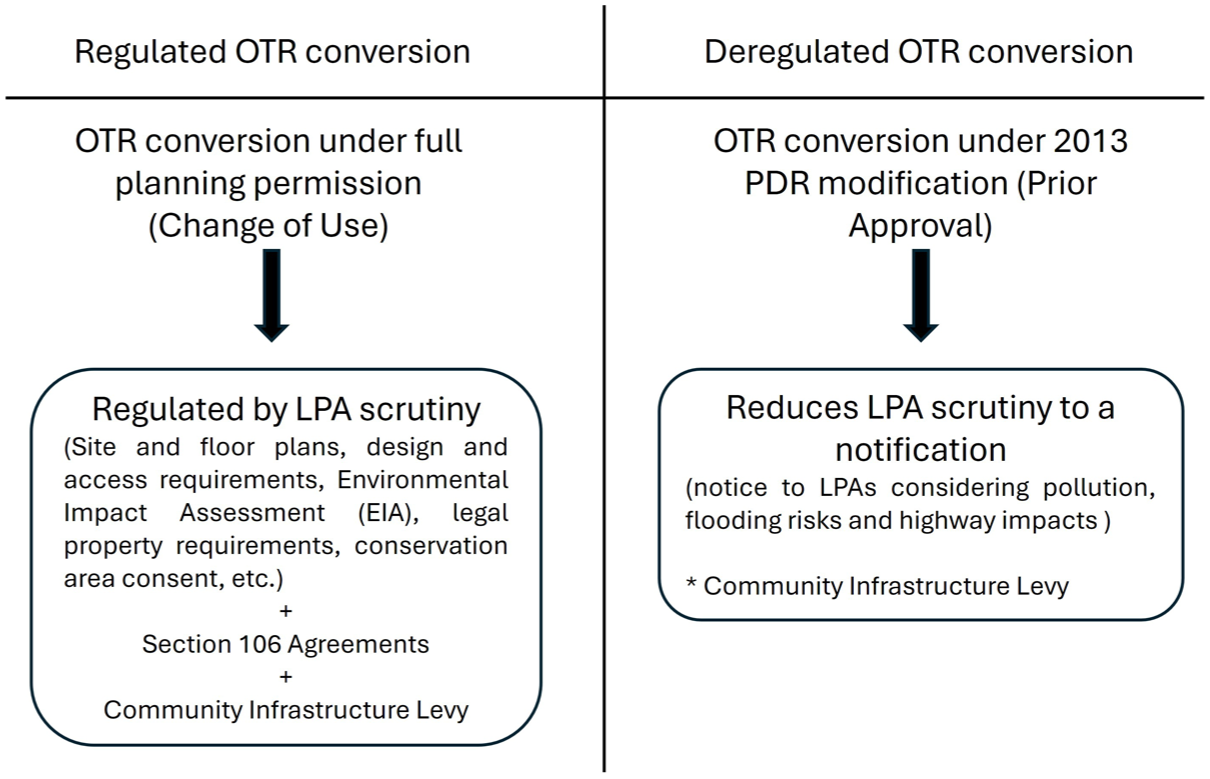
Change of use and prior approval pathways.
Between 2020 and 2024, new PDR modifications came into force (Rankl, 2024). In 2020 and 2021, new modifications to the Prior Approval regulations were made, incorporating minimal quality requirements for conversions via Prior Approval. In 2020, the provision of natural light in all habitable rooms became mandatory. In addition, impact assessments were required for noise from commercial premises, proximity to heavy industry, waste management and storage, and availability of health centres. In 2021, meeting the Nationally Described Space Standards (NDSS 4 ) was made compulsory. In that year, Class “O,” which was previously designated for OTR conversions, was replaced by Class “MA.” This new Use Class expanded the land uses eligible for conversion to housing to include commercial, business, and service uses. In 2024, a new modification affected the eligibility of buildings to be converted under Class MA (Rankl, 2024). Despite being introduced in 2021, the prohibition that only buildings that had been vacant for at least 3 months and whose cumulative floorspace did not exceed 1500 m2, in 2024, this requirement was removed, facilitating conversions of large buildings.
Methodology
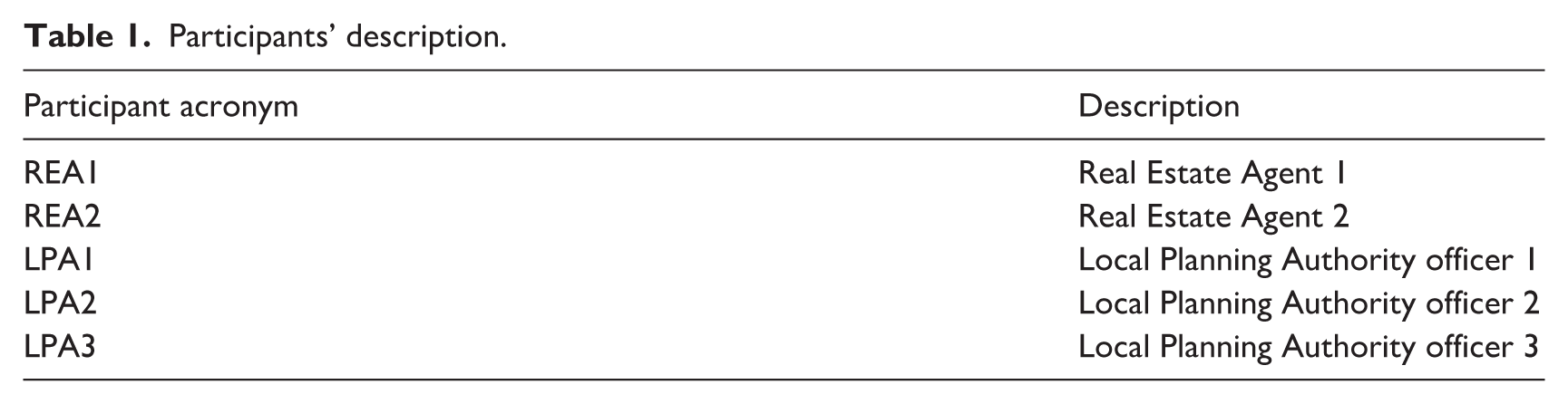
To answer the research question—how is housing precarity structurally encouraged through Permitted Development Rights in London?—I first conducted five semi-structured interviews with staff from Local Planning Authorities and Real Estate agencies (Table 1). Interviewees were recruited targeting specific criteria. I contacted LPA staff from London boroughs where PDR schemes showed higher figures, then I sought more senior planning officers who worked at the institution in 2013 or in the years that followed, where the impact of PDR had been visible. For real estate agents, I targeted managerial staff who confirmed relevant knowledge of the 2013 PDR modification and its impact on the market. Planning officers provided insights into the implementation of PDR in their boroughs, while real estate agents offered perspectives on developers’ motivations, market logic, and strategies concerning OTR schemes. Second, I integrated findings from prior academic research to frame the analysis within established scholarship. Third, to incorporate the policy rationale and intended impacts, I examined the Impact Assessment elaborated by the Department for Communities and Local Government (DCLG, 2013), which supported the PDR 2013 modification. This methodological approach enables a comprehensive understanding of how PDR favoured housing precarity under a neoclassical-design policy (Kern, 2018).
Participants’ description.
Regarding the ethics of the semi-structured interviews, the participants were first approached via email, and both the Participant Information Sheet and Consent Form were sent. These materials described the study’s aims, the interview’s structure and estimated length, the data collection recording methods, and the intended use of information. They also emphasised the voluntary nature of participation and the interviewee’s right to withdraw at any moment. Assurances of confidentiality and anonymity were provided. The interviews were conducted remotely through video conferencing, with recording beginning only after verbal consent was obtained. All data was handled with strict adherence to ethical standards and data protection protocols.
The neoclassical theoretical fundamentals for deregulating Permitted Development Rights
The 2013 PDR modification arose in a context in which the office market was experiencing pronounced vacancy rates in low-grade offices, also known as the second-hand office market. This market corresponds to buildings built in the second half of the 20th century, especially between the 60s and 80s (REA1). In London, increasingly since the last decade, the office market trend has been to improve office quality by investing facilities to a higher standard (Grade A). Additionally, office owners faced more financial concerns. For instance, energy performance standards are higher for offices than for homes, so office owners face the dilemma of selling or upgrading, which is more expensive (CBRE, 2013). Therefore, there are low incentives to convert the old office space into a brand-new one.
Together with the office’s market context, England’s housing crisis, particularly sharpened in London, introduces a second important element that PDR aimed to address. Gallent et al. (2017) acknowledge that there is broad agreement across the political spectrum that England’s housing crisis, centred on London, is rooted in housing under-supply and that the planning system is often presented as the principal cause of the “market failure” in supply. However, they argue against this singular focus. Instead, they contend that housing supply is one of many aspects in the housing market that needs to be fixed. Their analysis demonstrates that the crisis is fundamentally driven by intensifying demand-side pressures, the financialisation of housing, and the impact of credit liberalisation and the deregulation of banks’ money creation on housing demand and prices. Then, in this context, the 2013 PDR modification was used to weaken the planning system and—hypothetically—boost the housing supply.
The Impact Assessment framed the 2013 modification’s need with the following statement: “We are all aware of office blocks lying empty, even in areas with buoyant commercial markets, with many becoming dilapidated. However, the clearest evidence of this oversupply is in the relative land values of commercial and housing land – in some cases housing land is twice the price of that for commercial uses.” The theoretical precepts underpinning this modification originate in neoclassical views of urbanism, such as the Bid-Rent Theory.
As the 2013 Impact Assessment shows, the government advocates for a change in the planning system, promoting “complete freedom” between land uses. In this view of planning, strongly influenced by libertarianism, reducing regulations will unlock a positive response by the market, correcting imbalances such as the housing shortage. The document supports the idea that removing the LPA-granted application will decrease costs and processing period, enhance economic efficiency, and encourage the market to create more developments (DCLG, 2013): This price differential (office and residential values) has grown over time, which suggests that factors other than market forces are having an impact. In some areas, the market response is to demolish old buildings and replace them with new property where the market can command a higher rent yield. The planning system, and in particular controls over change of use, are clearly a part of this. If there was complete freedom to change between uses, over time, supply would simply adjust to the price differences, resulting in more land for housing, where there was sufficient demand. (Source: DCLG, 2013)
The following text adds the idea that, assuming a perfect market, price differentials indicate misallocated land use caused by the planning system’s inefficiency, targeting a “free market” where no price differentials would exist due to the adjusted supply. It suggests that the planning system then acts as a distortion of the market. These ideas align with the Efficient Market Hypothesis, which holds that markets are efficient when housing prices incorporate all available information (Fama, 1995). In the absence of controls the market would allocate land according to its most valuable use reflecting the underlying demand for what can be done with the land (. . .) it is the price differential between sites in different uses which illustrates the scale of the efficiency gain possible (. . .) Urban economics shows that in the absence of controls land in different uses is more valuable for the closer to it is to town centres (. . .) in a free market such differences would not exist over the long-run as supply adjusted to the price differences. (Source: DCLG, 2013).
Rational assumptions, acutely embedded in neoclassical urban economics theories (Thaler, 1987), have been densely contested (Inch et al., 2020; Raco et al., 2022). However, their application is not always met, as will be shown in the next sections. Another example of rational premises in the PDR Impact Assessment concerns the location of conversions. The government’s rationale indicated that OTR conversion was unlikely to occur at industrial sites because they were not attractive to developers, which did occur.
It may be argued that the proposals would result in more houses being located in unsustainable locations, such as industrial sites. However, this risk is minimal as these locations are unlikely to represent an attractive option for housing providers. (Source: DCLG, 2013).
The outcome of the 2013 PDR modification: Housing precarity and its commodification
Housing precarity and deregulated OTR conversion
To thoroughly understand the housing precarity of OTR conversion under PDR, I stressed the findings of a comprehensive study (Clifford et al., 2020) and interviews described in the methodology section. Clifford et al.’s (2020) study compares housing outcomes in more than 600 conversions delivered under PDR and full planning permission across 11 LPAs. They identified dramatic differences between the two types of conversions. Regarding compliance with the NDSS, only 22.1% of dwellings created by PDR met the NDSS, compared with 73.4% of schemes developed under full planning permission. A similar trend was found when comparing the adequacy of natural light in dwelling units. They warned about the limited mix of housing units, as PDR schemes tend to offer studios or one-bedroom units. Additionally, they found that PDR schemes faced several issues with communal amenities within the developments and were more likely than full planning permission schemes to be located in areas not suited to residential use, such as business and industrial parks. These figures illustrate the profound differences between conversions that follow the full planning permission process and those under deregulated PDR schemes, which, given their substandard dwelling quality, constitute a form of housing precarity.
Precarity driven by OTR can be discernible in at least two ways. First, from the dwellers’ perspective, the consequences of the housing quality lifting requirements affect dwellers. Although no dwellers were interviewed, this assertion is analytically reconstructed from the empirical findings and secondary sources on dwelling quality produced by PDR. Second, from the perspective of the LPAs, the 2013 PDR modification compromised their financial capacity by limiting the CIL obligation and bypassing the developer’s obligation to consider affordable housing under the Section 106 agreements. These two forms of precarity are related as the PDR modification diminished the LPAs’ capacity to fund infrastructure that should be made alongside any development, especially to provide an adequate built environment in the surrounding conversion areas. In relation to the first form of precarity, studies acknowledge the consequences for people’s health resulting from deregulated policy (Marsh et al., 2020; Pineo et al., 2024). One of these consequences is the noise impact of nearby road traffic on dwellers, which has also been identified by participants (LPA3) and previous studies (Marsh et al., 2020; Pineo et al., 2024). A striking example can be found in the Borough of Barnet, where “The Exchange” development is situated between two motorways (Figure 2).
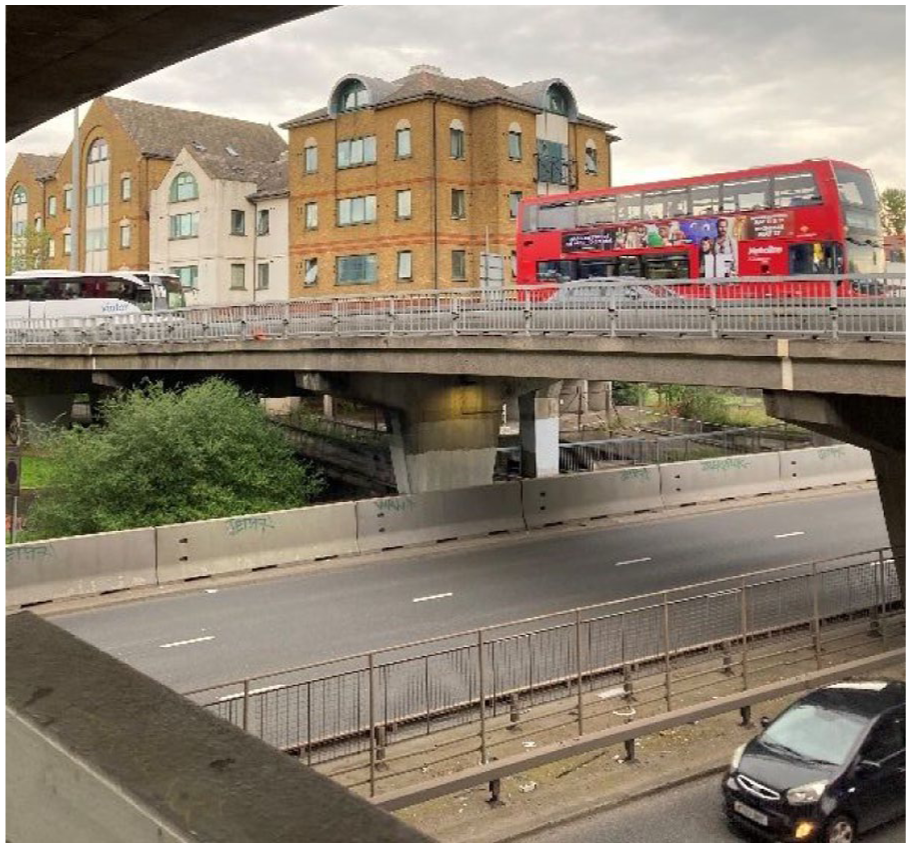
“The Exchange” residential project in the London Borough of Barnet.
In relation to the second form of precarity—the financial limitation of LPAs to provide suitable built environments to conversions—participant LPA1 corroborates the negative impact on the LPA finances to plan for new infrastructure for the new dwellings: (. . .) these developments and not just affordable housing, but typically with large where lots of people moving to the area, the council would request financial contributions, all sorts of things like healthcare and education. Open space, transport, public improvements. These are all things that aren’t collected under this process. So basically, that it’s really a profit driven thing for the developer because they don’t have to make any contributions to mitigate the impact that developments inevitably going to have on an area. So ordinarily that would be secured through like a legal agreement, a section 106 agreement where we would request financial contributions. Sometimes and on the larger scale things they they’re introducing 200 homes into a new area. But they’re making no contribution whatsoever. (Source: LPA1)
As described in the Conceptual Framework, in response to the extremely low-quality housing resulting from the 2013 PDR modification, the government implemented new PDR modifications in 2020 and 2021. They incorporated minimal requirements for housing quality, such as access to light for all habitable rooms and the compliance with the NDSS (Rankl, 2024)—echoing a limited share of the concerns raised by research on OTR schemes delivered under PDR (Clifford et al., 2020). Planning officers succinctly valued the modifications for providing “a few improvements.” However, they still admit that these modifications were unable to deliver an adequate planning assessment. LPA3 stated they were obliged to approve Prior Approvals “as long as they have a window.” Currently, they state that it is less common to receive Prior Approvals for OTR conversions, and that the ones they continue to receive are small conversions for one or two units, not whole-building conversions. Yet, between 2013 and 2021, LPA planning capacity was heavily undermined, highlighting the major quality issues faced by OTR schemes: (. . .) some of the earlier impacts were before the legislation changed (2021 modification) . . . there was no minimum floor size required; that came later. So, we were getting proposals for studio flats of 12 or 13 sqm, which was frankly ridiculous, but we had no ability under that legislation to resist them (. . .) some don’t have windows (. . .) the conversion building is facing directly onto a motorway, and the electrical system aren’t properly done, so everyone’s ventilation system don’t work, so they can’t open their windows and they have no ventilation. (Source: LPA3)
Lastly, while more evidence is needed to establish a causal link between the 106 agreements lost and the extreme need for affordable housing, since the modification came into place, neighbouring local authorities of London have identified that many OTR scheme residents who dwell in the lowest-quality schemes come from London. The participant stated: “these people aren’t even from this council” (LPA2), acknowledging that they commute daily to the capital but live in these surrounding areas. They warned that PDR schemes in their LPA serve as housing for the less wealthy in some London boroughs, raising concerns about educational and health infrastructure pressures and the overall housing dynamics in the region.
The commodification of housing precarity
Once offices were converted to residential units, they were mostly rented out. The poor investment added to the conversion made lower-income households or students their primary markets (REA1, REA2). Within the Private Rented Sector (PRS), most interviewees acknowledged that the OTR schemes were targeted mainly at the “low-end” market: “people who might not have cars and didn’t have any other alternative for housing or older people stuck in the low rental market” (LPA2). According to LPA2, the rental tenure and its price were the main characteristics of the OTR units: (OTR conversions) are the entry level rental product into that market; so, they might be quite small units. They will not have the greatest level of light, but they will be cheaper than renting a purpose-built flat or a house within the same locality. So, they tend to attract tenants at the lower end of the market, which would be students, or possibly people of some form of housing benefit; so, it’s not a huge amount of choice for those particular tenants. (Source: LPA2)
The OTR conversions were mainly carried out by office owners, freeholders, or developers with a small portfolio, but not by prominent real estate developers (REA1). Office owners struggled with rising vacancy rates and upgrade costs, which placed financial constraints on the second-hand office market (CBRE, 2013). The value of a considerable share of London’s office market was progressively obsolete. Therefore, when the 2013 PDR modification was enabled, the low-unappealing value drove the attention from owners who knew empty offices could be transformed into higher residential value (REA1): What we saw was living (residential) developers outbidding office investors for that stock, you know, this market changed in terms of who was buying them, and also the fact that suddenly there was more of these on the market; there was fewer office investors, so actually opened up the opportunity for some of these living (residential) developers to move to that sector. (Source: REA1)
Real estate agents also recognised that the second-hand office market has heavily diminished in London in the last 5 years (REA1, REA2). Owners achieved higher residential values and a higher probability of finding tenants after struggling with low office vacancy rates for years. Furthermore, real estate agents suggested that some developers were only interested in financial gain rather than delivering good-quality homes (REA1). In the context of former office owners suffering income losses as vacancy rates rose, there was less demand for office space. Thus, facilitated by deregulation, the conversion of offices to residential managed to offset this loss of income (LPA3) while commodifying precarity housing on the low-end market.
In London, many OTR conversions are for temporary accommodation. Aware of the high demand for housing, landlords of lower-income households have little incentive to address issues on their converted properties; thus, if raised, “landlords will ask them to leave” (REA1). In extremely derelict buildings, demolition could be feasible, as operational costs could be lower than investing in the quality of the conversion (REA2). However, the following quote indicates that, since many of the converted buildings are already 50 years old, demolition will soon become financially feasible. The participant (REA1) exposes how OTR conversions could be an “interim solution” until financial revaluations in the coming decades lead to demolishing the sites for new developments: There may be a situation in the not-too-distant future, where either they reconvert again into larger, better-quality units, or potentially the site is cleared and something else is done with it (. . .) A lot of these offices weren’t necessarily built to stand for a hundred years, particularly offices that were built in the seventies and eighties. The expectation was that they would, after 30, 35 years, they would be knocked down and something new would be built on that site (. . .) It may well be that actually the fabric of the building needs significant work (. . .) so, actually the solution will be to knock them down eventually (. . .) some landlords may be thinking, well, these (conversions) are an interim solution for the next 10 years, and then I’ll re-evaluate, which is not great for the tenants in that period of time, because probably they’re living in pretty poor quality. (Source: REA1)
How housing precarity is structurally encouraged through Permitted Development Rights in London?
The methodological strategy, grounded in semi-structured interviews with LPA officers and real estate agents, secondary sources from relevant research, and policy documents used by the 2013 Government to justify the PDR modification contribute to a distinct approach to understanding OTR conversion. As displayed in Figure 3, I focused on the heated housing market of London to explain how the problem was situated, under which theoretical lenses this problem was analysed, what mechanisms mediate the theory-outcome interaction, and how the policy response made for “fixing” a market “inefficiency” has caused severe consequences for thousands of people.
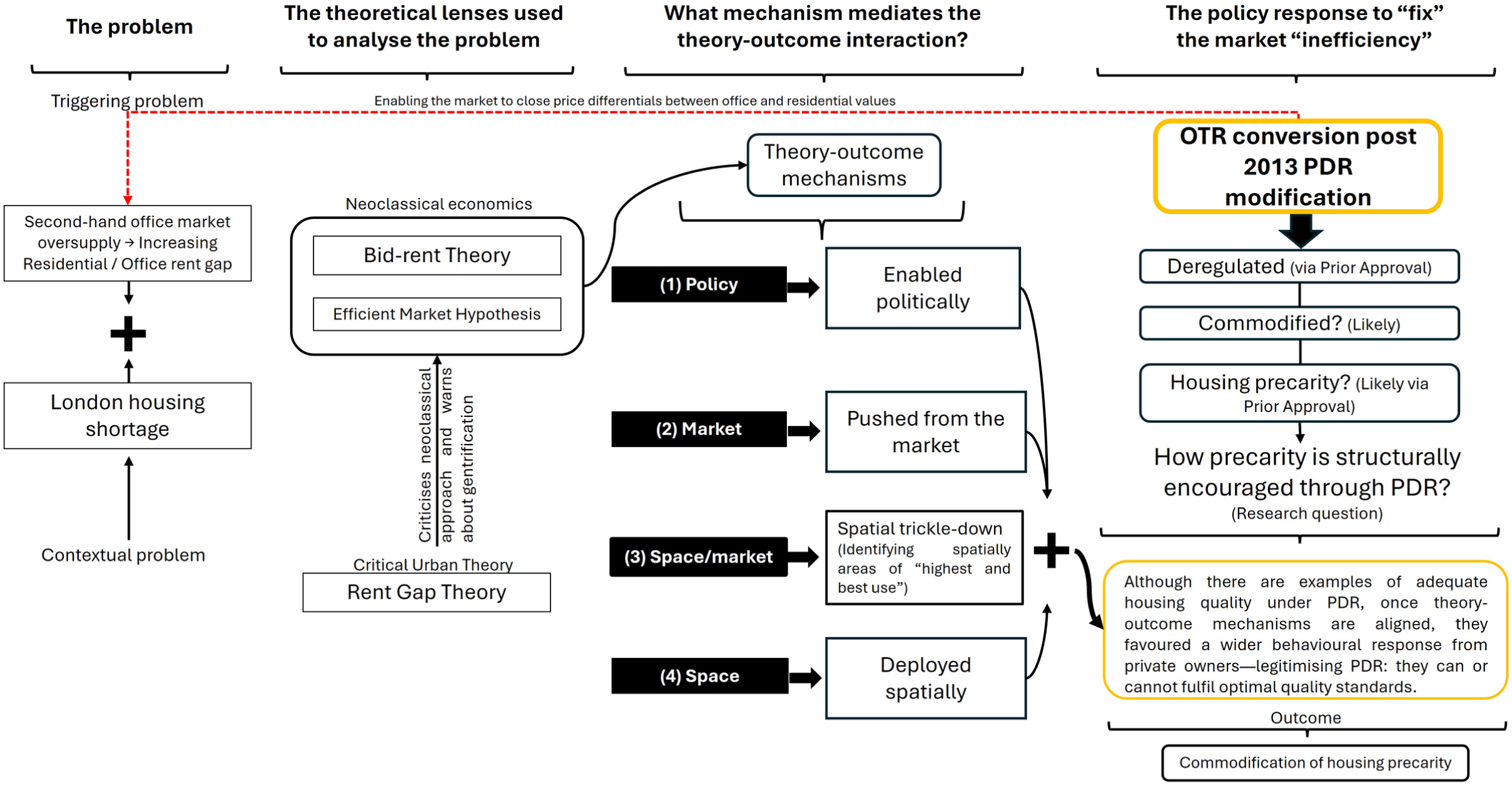
Conceptual diagram involving contextual and theoretical approaches used to answer the research question.
I elucidated why the conservative government advocated a PDR modification to address the oversupply in the second-hand office market, its effect on increasing price differentials between residential and office values (triggering problem), and the need to boost housing supply amid a severe housing shortage (contextual problem). Within this context, policymakers inspired by neoclassical economics elaborated a modification to the land use conversion regulation that enabled the market to pursue the “highest and best use” by easily converting empty or derelict office space to residential use. The PDR modification lifted quality and planning requirements, assuming that the market would “correct” the price differentials between residential and office values, assigning residential values, which reflect the most economically efficient use (DCLG, 2013), while hypothetically contributing to reducing the housing shortage.
While full planning permission conversions could also be commodified, the introduction of the deregulation component in the 2013 PDR modification increased the likelihood that these conversions would create precarity conditions. In between theory inspiration and policy outcomes there are four mediating mechanisms that help to understand how precarity is structurally encouraged through PDR. The first is a policy mechanism: while Prior Approval previously exempted certain minor developments from the LPA planning permission process (Clifford et al., 2019), the 2013 PDR modification expanded eligibility to OTR conversions. Thereby, the modification consolidates an “exemption” mechanism as a norm, reducing the so-called “planning obstacles,” previously required by the full planning permission (especially in terms of planning scrutiny). In a nutshell, planning scrutiny was not formally abolished, but disincentivised by the neoclassical underpinning of efficiency.
The second mechanism relates to how PDR is pushed from the market as a particular commodification process, which intensifies short-term and low-investment housing. This commodification process not only has a market logic, but rather amplifies housing precarity as an outcome. These characteristics demonstrate how housing was conceived not for durability, adaptability, or long-term occupancy, but for rapid monetisation.
The third intermediate mechanism between market and space is the spatial “trickle down” observed in the geographical deployment of OTR conversions across London. This operates by identifying areas of “highest and best use” prone to OTR conversions, and thus the process spills over from boroughs with the highest residential-office rent differentials to those with lower differentials, and eventually to neighbouring local authorities outside of London.
The fourth is the spatial mechanism. This mechanism involves how the housing and built environment effects of OTR conversions are spatially deployed in London. This deployment has not been equal across the city but has been predominantly concentrated in deprived areas. The spatial deployment of OTR schemes reflects the geography surrounding them, characterised by poor environmental quality and unsuitability for residential use.
Once these theory-outcome mechanisms were defined, I analysed the elements that made the deregulated form (Prior Approval) distinct from the regulated form (Change of Use) of OTR conversion. The first component analysed was planning deregulation. I explained the context in which the alternative of converting offices to housing using PDR was considered from different perspectives, not only from the market perspective (the issue of oversupply of second-hand offices and London’s housing shortage), but also the political roots that supported the 2013 PDR modification.
The second component was commodification. Here, it is important to note that although all types of housing can ultimately be commodified, in this study, I focused on the commodification of housing precarity created by OTR conversions—particularly in the private rented sector—and on how the central government regulation enables profitability. Small office owners, rather than large developers, capitalised assets by converting low-value office stock into residential units for the low-end market (REA1, REA2). The expected profit from these schemes is temporary, as reflected in how “quick” conversions were made, the prominence of the rented tenure, how dwellers might see them as temporary places to live, and the short-term future approaching for many of the converted buildings. Since some owners made little investment even for buildings erected nearly five decades ago, and current residents will leave as soon as they can afford better housing options, they are flexible for owners and transitory for users, but, ultimately, they will keep existing as long as they remain profitable for owners (Ferreri and Sanyal, 2025).
The third analysed component is housing precarity. Notably, I argue that precarity could not have been possible without the previous two components: deregulation and commodification. For OTR conversions, precarity must be understood in two ways. First, from the dwellers’ perspective (analytically derived from empirical findings and prior studies), the lifted quality requirements directly affected them. Second, from the LPAs’ view, the 2013 PDR modification weakened their financial capacity by restricting the CIL and bypassing developers’ obligation to provide affordable housing. Concerning the first type of precarity, literature warns that housing precarity can expand into social and spatial inequalities, aggravating its consequences for its dwellers. Residential precarities extend beyond market returns, where substandard dwelling quality and other inequalities are key issues (Hochstenbach et al., 2025). OTR conversions illustrate this, where deregulation removed quality requirements, harming residents’ health and well-being (Clifford et al., 2019; Pineo et al., 2024). As such, housing inequalities (or precarities as referred to in this study) transform into spatial and socio-economic inequalities, triggering a domino effect, as they are strongly influenced by market forces. This means that housing encourages the “low-end market” to remain confined to ill-suited accommodations, job opportunities, and neighbourhood quality. This way, the housing precarity observed in OTR-converted schemes permeates spatial and socio-economic inequalities.
Lastly, the red dashed line in Figure 3 represents the 2013 PDR modification as a policy that, hypothetically, aimed to address the oversupply in the second-hand office market and to fuel housing supply. This study can conclude that, far from providing a housing solution, it rather deepens the ideological project (Inch et al., 2020) of the conservative government. It can be framed within a broader attempt to weaken planning (Lord and Tewdwr-Jones, 2012; Sykes and Sturzaker, 2023), where deregulation and commodification have spawned housing precarity. Acknowledging evidence of good-quality OTR conversion (Clifford et al., 2020), precarity is explained by deregulation that removed quality requirements, which favoured a broader behavioural response from private owners. Since the 2013 modification offered an alternative to bypass quality rules, owners could opt freely to fulfil quality standards or not, rendering commodifying housing precarity accounted in London’s OTR conversion, overlooking the tendency for neoclassical principles—such as the maximisation of private utility and the pursuit of “highest and best use”—to take precedence over considerations of housing quality.
This study also uncovers a theory-outcome framework to analyse the translation of theory into policy and its built environment outcomes, showing how neoclassical ideas become actionable through planning deregulation. I identify a theoretical rationale (neoclassical economics), show how it is embedded in a policy modification, and explain the causal pathway to built environment and housing outcomes. While I illustrated the theoretical rationales, the four mechanisms that mediate between theory and outcomes help explain the conditions under which precarity becomes likely. Then, precarity is structurally encouraged through PDR once these mechanisms are aligned, as they legitimise quality standards compliance as optional, thereby making the differences between the regulated (Change of Use) and deregulated (Prior Approval) forms of OTR conversions clear.
Future modifications to OTR conversions are still relevant. Yet, it is difficult to envisage whether deregulation will be heightened or reduced. The projected remaining empty office space in England could still deliver around 43,000 new homes (REA1), which represents a significant share for developers interested in conversions, given that between 2015 and 2023, 89,207 units were delivered through OTR conversions under PDR (Del Canto, 2025). Whereas the scope of this study is limited to London, other European cities, such as Zurich, have also struggled with vacant space, which has become commodified by the housing market (Debrunner and Gerber, 2021). Zurich’s case illustrates how actors can behave differently in response to regulations that deepen the commodification of housing, and not necessarily follow what could be labelled as “rational behaviour.”
Conclusion
To comprehensively understand the conversion of offices to residential use in England, it is necessary to use different theoretical lenses carefully. Whereas in other countries, OTR conversion has been applied as a genuine housing delivery alternative through adaptive reuse (Geraedts and Van der Voordt, 2007; Remøy and Van der Voordt, 2014; Remøy and Wilkinson, 2012), in England, deregulation processes have led to serious consequences by commodifying housing precarity. While previous studies have delved into the deregulation dimension and the low-quality effect on residents has been researched (Madeddu and Clifford, 2023; Pineo et al., 2024), in this study, I analysed how deregulation and commodification processes, fuelled by neoclassical policies, managed to extract the “highest and best” value out of the weakened second-hand office market in London.
The inexhaustible struggle for space is one of modern cities’ major drivers and is even more pronounced in urban areas with highly demanded housing markets, such as London. The opportunity owners felt to extract higher values led them to take advantage of every possible asset. Whilst in most of the literature about conversions, the remodelling of structures is typical, new forms of temporal and flexible conversions seem to prevail when conversions become an expression of informality. In this context, the main objective is to boost profit and reduce liability from upcoming risks (Ferreri and Sanyal, 2025). Hence, the 2013 PDR modification delivers a tailor-made regulation for both aims. If the 2013 modification increased wealth, it was also “successful” under neoliberal lenses, as it inevitably led to the displacement of the population unable to afford London housing prices outside the city. This is exemplified by the LPA neighbour of Greater London, which identified a poor population moving from London to access lower-value areas.
This study offers a critical perspective on the 2013 PDR modification, which unbundles the theoretical justifications and their policy response. While the government sought to “correct” market inefficiencies in the office sector by enabling conversion to residential uses, the analysis reveals that it served as a mechanism to commodify housing precarity. Stirred by neoclassical economics, the policy assumed that deregulation and market “efficiency” would increase housing supply and price differentials between office and residential values. However, deregulation had serious consequences for dwellers. Integrating interviews with LPAs and real estate agents alongside policy and academic sources, this study demonstrates that the precarious housing outcomes resulting from the 2013 PDR modification were not inevitable, as good-quality OTR schemes do exist (Clifford et al., 2020). The removal of quality regulation allowed former office owners to make conversions that could fulfil quality requirements at will, meaning that if they did not make necessary quality measurements, they faced no consequences. The 2013 PDR did not merely provide an alternative to compliance—it actively legitimised the bypassing of housing standards, opening the door to the commodification of precarity in London’s OTR conversion market. Such outcomes are not accidental but symptomatic of an ideological agenda shaped by neoclassical commandments, wherein the maximisation of private utility and the “highest and best use” pursuit systematically outweigh the protection of housing quality—ultimately transforming OTR conversion into a form of informal housing in the Global North (Ferreri and Sanyal, 2025).
Future research could investigate the potential spillover effects of office-to-residential conversion on other types of land use conversion to residential, particularly their implications for housing precarity and socio-spatial inequalities in extremely high-demand contexts, such as London. Additionally, it would be relevant to compare the differences and similarities between the commodification processes of “high-end” markets, such as rental housing products for mobile talents (Uyttebrouck and Paccoud, 2026) and “bottom-end” markets, as the one studied here for OTR conversions. By comparing these processes and how commodification operates across different markets, studies on housing inequality will gain vital insights. Overall, this study highlights the urgent need to roll back the 2013 PDR modification, removing any land use conversion to residential use. Regardless of whether reaching a housing target for the home population is an evident priority in the current context, the cost of this goal cannot be at the expense of affecting the quality of the housing delivered. While this study, building on several others (Canelas et al., 2021; Chng et al., 2023; Clifford et al., 2019; Dunning et al., 2023; Ferm et al., 2021), has supplied forceful evidence on the negative consequences of the 2013 PDR modification, if OTR conversion and other types of land use conversion to residential remain active under PDR, it will mean prevailing the commodification of housing precarity.
Footnotes
Acknowledgements
The author would like to thank Richard Dunning for his generous and dedicated guidance throughout the elaboration of this study, the interview participants for their willingness to share their time and perspectives, and, lastly, the reviewers for their careful reading and constructive comments.

Funding
The author disclosed receipt of the following financial support for the research, authorship, and/or publication of this article: This research was supported by the North West Social Science Doctoral Training Partnership, funded by UK Research and Innovation (Economic and Social Research Council) [Grant reference: ES/P000665/1].
Declaration of conflicting interests
The author declared no potential conflicts of interest with respect to the research, authorship, and/or publication of this article.