




Abstract
In this article we discuss the precarities induced by the threat of home demolitions in occupied Palestine. Drawing on fieldwork from four separate sites, the discussion begins by showing how the threat of demolition exposes Palestinians to a powerfully affective future of a violence that will arrive at an uncertain time. From this we develop the notion of ‘affectual demolition’ to describe how the anticipatory affective dimensions of demolition structure the present and the ways that precarities are embodied in Palestinian communities living under the threat of demolition. The discussion then moves on to further consider how anticipatory affects relate to different practices, including ways of acting on and against induced vulnerabilities and insecurities. We thus argue that the continued threat of home demolitions evokes precarities that are (politically) induced and (ontologically) productive and that they hold significant world-making and -annulling capacities.
‘In one minute, the whole life of a house ends’
– from the poem The House Murdered by Mahmoud Darwish (2006)
Introduction
Between 1988 and 2016 Israel issued a total of 16,085 demolition orders for Palestinian-owned structures located in Area C 1 of the occupied West Bank (B’Tselem, 2013; OCHA, 2017). Most demolition orders are issued as a result of the tight and unjust permit regimes Israel maintains in East Jerusalem and Area C of the West Bank towards the appropriation of land for construction of the separation wall, settlement and infrastructure expansion, and the growth of restricted military zones (Berda, 2017; Gordon, 2008: 37–38). In such areas, the denial of Israeli-issued permits has left many Palestinians with little option but to build, most often on their privately owned lands, without an Israeli-issued permit (UNRWA, 2017; see also Falah, 2003; Wari, 2011). Of particular note is that up to 2016, a significant portion of the 16,085 demolition orders were either ‘in process’ (57%) or ‘on hold due to legal proceedings’ (18%), while less than a quarter of orders were either ‘executed’ or ‘ready for demolition’. In the period 2014–2016, only 12% of orders were executed (OCHA, 2017). This is not to forget the devastating effects of those demolitions that do take place – 1628 Palestinians were displaced by the work of IDF (Israeli Defence Forces) bulldozers in 2016 alone – but the low proportion of implemented demolition orders is indicative of a situation in which most orders are kept pending for years, even decades. Such slow-motion administrative procedures have led to a situation in which Palestinians are forced to wait under highly stressful and precarious conditions, often for considerably long periods of time, without knowing when the bulldozers will arrive (Berda, 2017; Joronen, 2017b). These procedures hence place Palestinians in great precarity, where the threat of demolition – as an issued order, or by more ‘informal’ modes of intimidation and threat – engender fears and anxieties about the future loss of home.
In this article we discuss the precarities induced by the continued threat of home demolitions, and the politics they produce in the context of insecure, affective futures. While house demolitions in Palestine have been studied in relation to broader modes of settler colonial erasure and violence – including unjust permit regimes (Berda, 2017); the ‘creeping apartheid’ of urban planning (Jabareen, 2010; Yiftachel, 2009); the architecture of occupation (Makdisi, 2010; Meade, 2011); slow-motion bureaucratic processes (Joronen, 2017b); and collective punishment (Gordon, 2008: 267–268) – our focus here is concentrated on the affective dimensions of attacking homes. Drawing on fieldwork in the West Bank, we develop the idea of ‘affectual demolition’ in particular to describe how anticipatory affects structure the present around the violent future event and to consider the embodied dimension of colonial precarities that the continued threat of demolition impose on Palestinian bodies. In doing so we wish also to problematise the relationship between precarity, affect and waiting so as to acknowledge and explore the affirmative affectual capacities that are evident and crucial for people living with the threat of home demolition. We thus seek to make two important contributions: one, to understandings of affect, specifically on the powerfully affective dimension of threat (Anderson and Adey, 2011) and the question of how research on affect must be ‘sensitive to power geometries’ (Tolia-Kelly, 2006: 214); and two, to an ethical imperative in scholarship on Palestine that refuses to reproduce Palestinians as mere ‘victims’ of colonial power without an agency, voice and spaces of their own (Kotef and Amir, 2011). On this latter point we share and follow the concerns of many that the home (Brickell, 2012: 576), Palestinian homes in particular (Harker, 2009: 329), and informal settlements (Vasudevan, 2015: 347) are too often discussed in terms of violence and dispossession without proper attention to the ways in which homes and dwellings also constitute sites for emergent politics and new social forms of collaboration and solidarity. To this end, we draw focus on the interplay between determinacy and indeterminacy of threatened demolition – the simultaneous certainty that the demolition will happen alongside an uncertainty of when – and how precarious futures not only evoke violence but also affirm Palestinian life and agency to resist the violence of the occupation.
We begin the paper by showing how the threat of demolition exposes Palestinians to a powerfully affective future of a violence that will arrive at an uncertain time. Such exposure to the suspended violence of ‘affectual demolition’ plays out, in important ways, on the level of the body: fears, threats and anxieties characterise the affective anticipation of pending demolition and the futures they render (un)certain. We continue by showing how these anticipatory affects connect both to anxious fear around vulnerability and a resoluteness to act on and against induced vulnerabilities and insecurities (for instance, through rebuilding and using waiting as tactic of resisting). This, we argue, shows how precarities can be (politically) debilitating and (ontologically) productive, and that they thus hold significant world-making and -annulling affectual capacities, which are often forgotten in discussions explicating the relationship between affect and precarity (e.g. Anderson, 2014). Our discussion of demolitions thus evidences the embeddedness of affects in precarity and how (un)certain futures subjugate and disable but also affirm and engender Palestinian capacities to act, resist and ‘get by’ under the precarious conditions imposed by the Israeli occupation.
Affectual demolitions: Anticipating the threatening moment
Since 2011, Um-Al-Khair, a Bedouin village in the South Hebron Hills with a population of around 110, has seen 25 demolitions that have taken the homes of 154 people. 2 In 2014 alone, the community was subject to 8 visits by IDF bulldozers that demolished 10 structures (2 community structures, 8 dwellings), displacing a total of 48 people, while 2016 saw 13 further residential structures razed and 66 people displaced. At the time of writing, all but two of Um Al-Khair’s permanent structures have been served with pending demolition orders. The prevalence of demolitions in Um Al-Khair is largely owed to the growth of Carmel, an Israeli settlement that is – literally, and too often – a stone’s throw over the hill. Carmel began as an unauthorised outpost in 1984 and has since become a conurbation of more than 700 settlers, with plans to more than double in size and eventually enclose Um Al-Khair on three sides, leaving only a narrow corridor for passage to the wider West Bank (see Figure 1). Crucially, this will reduce the size of the village’s grazing lands and greatly restrict access to the little of it that remains. The two communities are currently separated by a series of walls and two coils of razor wire. Um Al-Khair was established in 1948 when Bedouin communities were driven north from Al Naqab (Negev in Hebrew) during the Naqba and purchased land from the nearby city of Yatta. Despite having documentation of this purchase, and a clear case of ‘primary status’ on the land (Yiftachel, 2002: 224), the village is one of more than 200 ‘unrecognised’ villages in the South Hebron Hills (in comparison to 11 recognised villages) – a bureaucratic status that means the Israeli Civil Administration excludes Um Al-Khair from infrastructure and services provision while also prohibiting construction and designating residents as ‘illegal’ dwellers (Human Rights Watch, 2008; Yiftachel, 2009). As such, it provides a case par excellence of how Israeli settler colonial violence operates not simply via state-led and coherent strategies of elimination and erasure (Hammami, 2016; Joronen, 2017b; Zureik, 2016) but actually, as we show in detail below, through the broadly coordinated acts of different civil and military bodies along with (and alongside) Zionist settlers. The result of such a coalition for Um Al-Khair in recent years has been a rise in tensions as the Bedouin residents feel continually threatened by the appropriation of and expulsion from their homes, lands and community.
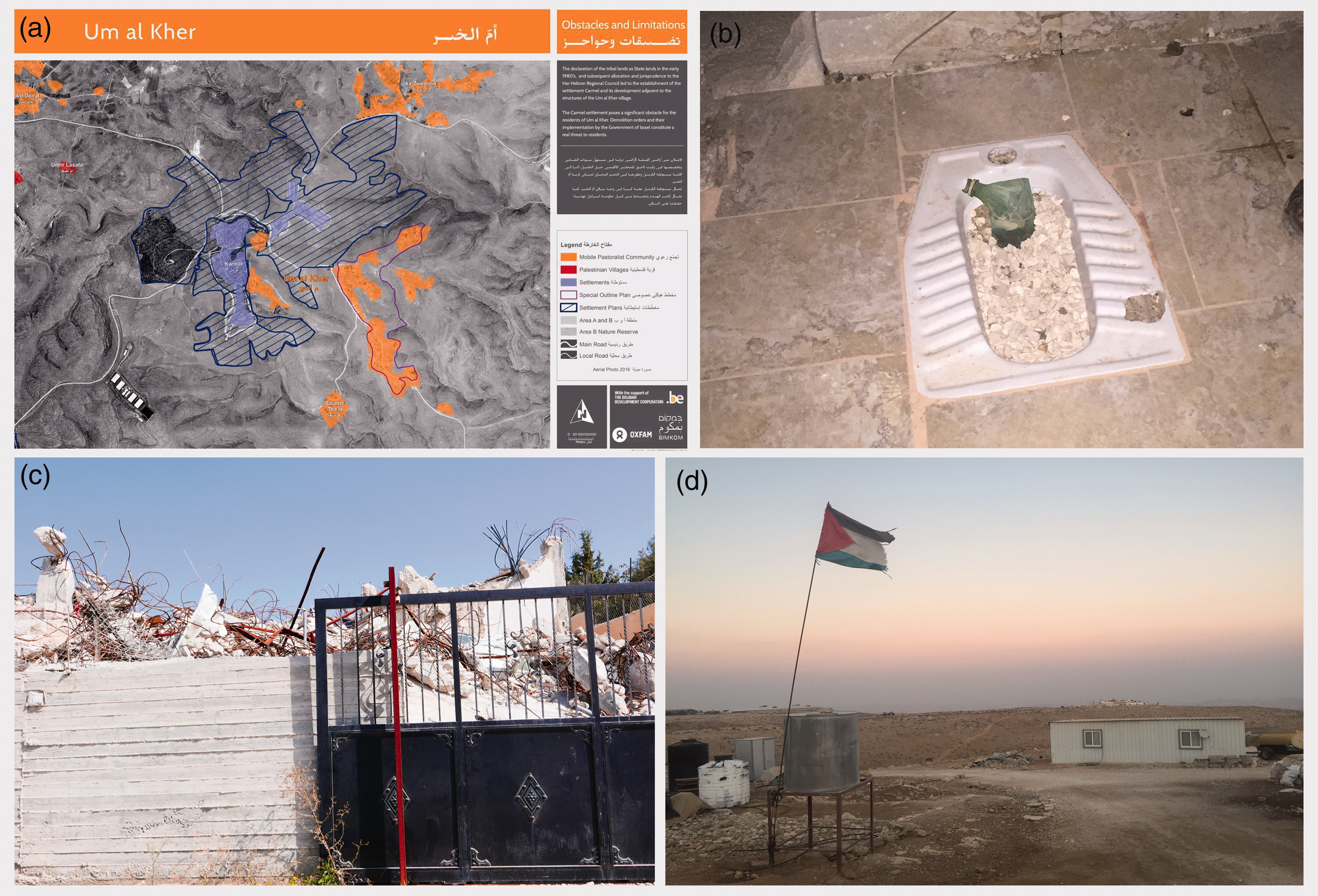
Map of Um Al-Khair (a), recently demolished oven in Um Al-Khair (b) and house in Al-Walaja (c), and a rebuild house in Um Al-Khair (d).
Our fieldwork 3 in Um Al-Khair was facilitated by the Palestinian NGO ‘Holy Land Trust’ whose reports on demolitions in the village capture something of the threat faced by the community: ‘the Israeli military do it at a time and date that is not specified. The army demolition unit could come tomorrow, the week after, next year. There is no certainty in this place’ (Holy Land Trust, 2017, emphasis added). During the fieldwork, residents acknowledged a lack of certainty as integral to the threat posed by demolition. Ahmed, for instance, commented ‘I come back from work every day and think if I have a house’, while Faris talked of how the pending demolitions mean that ‘we don’t know when it [the demolition] will happen, we never know. Every morning we expect to be homeless people’. The meeting with Ahmed and Faris took place in a communal space constructed of tarpaulin provided by the European Union which has also been issued with a demolition order, of which Faris said: ‘one day they come to take even this, we won’t have even a place to talk anymore’. The reflections of Faris, Ahmed and the NGO on the prospect of demolition are thus marked by a simultaneous certainty that something will happen alongside an uncertainty of when. Demolition in these cases thus constitutes a temporally indeterminable threat that hangs over residents of Um Al-Khair.
A significant aspect of demolition in Um Al-Khair, therefore, is an indeterminate moment of when and demolition, it follows, functions not simply through physical loss of property but an affective presence of a seemingly inevitable yet indeterminable future. While some work in geography and cognate disciplines has focused on demolition beyond material loss (Ó Tuathail and Dahlman, 2006) and the complex ‘unmaking [of ] homes’ (Baxter and Brickell, 2015), there has not been a sustained focus on demolition as a future threat – as a relationship between affects of anticipated loss and the politics of material destruction. One notable exception is the work of Nadera Shalhoub-Kevorkian (2009, 2015), who argues convincingly that the anticipatory fear of losing one’s house – its protective materiality of walls and roof – can, in effect, demolish the very conditions that constitute one’s home. This ‘demolition before the demolition’ – a phrase used by Palestinian women in Shalhoub-Kevorkian’s research (2015: 101–103) – therefore creates an anticipatory insecurity, where the fears and anxieties related to a future threat of losing home shape the conditions and relations that make a house a home in the first place. There is, then, a significantly affective dimension to the threat of demolition and the precarisation it induces that requires further exploration. To this end, before returning to demolitions in Um Al-Khair and other sites in the West Bank, we wish to further explore the links between affect, precarity and demolition. In particular, we develop the notion of ‘affectual demolition’ that, it is proposed, emerges in two primary ways: through the embodied dimension of structural precarity induced by the occupation, and the affective conditions of Palestinians living with the continued threat of future demolition and the violence this produces.
As the discussion above indicates, crucial to the idea of affectual demolition is the relationship between time and threat. As with all threat, the affective dynamics of threatened demolition rest on the capacity of anticipation to collapse time such that a(n undesirable) future plays out in the present. Brian Massumi (2005a: 35) terms this temporal effect of threat a ‘quasicause’: ‘a futurity with a virtual power to affect the present quasicausally’. Importantly, Massumi (2005b: 8) points out elsewhere, it is the very indeterminacy of a prospective future that constitutes the threat, where a ‘future/event’ threatens ‘indifferent to its actual occurrence’ so that ‘the event’s consequences precede it’. Massumi’s writing in this area has been of great influence for thinking affect and futurity (e.g. Anderson, 2006) and it can also provide an important lens on the threat of demolition, particularly on understanding how ‘demolitions before the demolition’ (Shalhoub-Kevorkian, 2015) work by unmaking the home before the material loss of shelter and place. In cases such as that of Um Al-Khair, however, it is not the indeterminacy of if but of not knowing of when that connects to affective states of fear and anxiety. Future demolitions are thus not about an ‘eventuality that may or may not occur’, to borrow Massumi’s words, but, in those of Faris, more about a ‘not know[ing] when it will happen’ – today, tomorrow, or in another moment in the future. The distinction lies in the interplay between determinacy and indeterminacy of threatened demolition: Faris’s (and others') simultaneous certainty that the demolition will happen alongside an uncertainty of when.
Taking us further from Massumi’s and others’ accounts of threat is the fact that while the futurity of threat may orientate around the indeterminacy of terror (Massumi, 2005a) and the ‘unthinkable’ event of ‘apocalyptic proportions’ (Adey and Anderson, 2012: 107), in stark contrast, Faris, Ahmed and the entire community of Um Al-Khair are all too familiar with the futurity of demolition, not only having experienced it before, but also of knowing its implementation is a mere matter of time. For them, demolition can be imagined all too readily and, importantly, it can be anticipated with a relative surety of what will happen. As the Holy Land Trust (the NGO mentioned above) has documented: when they do come, it is usually a dawn operation. The inhabitants are awakened by soldiers rapping on the door of the house […] with the butt of their machine guns. The head of the household is informed that his house will be demolished. He then has a few minutes to get his family out and salvage as many possessions as he can. The house is demolished, and the army leaves. (Holy Land Trust, 2017)
It is crucial to notice that it is the waiting and anticipation of the event – the ‘when’ – that casts an unsettling shadow over the present. This anticipation of future threat temporalises what Ariella Azoulay and Adi Oprih (Azoulay et al., 2005) insightfully discuss as the interplay between a ‘spectacular outburst of violence’ and ‘suspended violence’ by making the outbursts of future violence – the material demolition of home – an affective condition of present. Here the prospect of demolition becomes itself, long before the soldiers arrive to raze a structure, an affective form of violence against Palestinian dwellers. It is thus here, we contend, that the future moment – the when – becomes a source for inducing political precarity: a ‘quasicause’ facilitating ‘affectual demolitions’, where life under the threat of demolition becomes filled with fears and anxieties about the unsettling future and the violence it holds. The politics of ‘affectual demolition’ thus operates by facilitating anticipatory fears and anxieties, that are grounded on the vulnerable prospect of loss induced by the governing functions of the occupation regime.
As the discussion so far begins to show, the notion of ‘affectual demolition’ not only reveals our fundamental vulnerability to moods, but also brings forth the political promotion and use of such vulnerability as a tool of governing. ‘Affectual demolition’ thus signifies our capacity to be affected by modes of distributing what Judith Butler describes as the ‘political notion of precarity’ (Butler, 2006; see also Griffiths and Joronen, 2019; Joronen, 2016; Lorey, 2015). Following Butler’s formulation, it is not our claim that precarity constitutes an ‘affective condition’ that names a ‘disposition that discloses a ‘predictably unpredictable’ future without guarantees’ (Anderson, 2014: 125, 129); it is rather that the threat of demolition is used to allocate precarity and all manner of anxieties and fears follow (as in the case of Faris, above). As such, precarity precedes affect, and induces embodiments, such as anxiety and fear. With this, however, we do not mean certain affects, anxiety and fear in particular, somehow belong to the structure of precarity as consecutive conditions (cf. Virno, 1992: 31–32). Precarity does not automatically cause specified affects, but instead denotes a political framing of a condition of existing (precariousness) that in itself is open to multiple affects and agential capacities. Accordingly, precarious conditions engendered by the violence of impending demolitions do not merely subsume but can also create affirmative capacities and affects. This is an important distinction that not only helps in understanding the ambiguity in how affects work in relation to futurity, but above all guarantees the irreducibility of precariousness to any form of politics or embodiment, whether subjugating or affirming, debilitating or capacitating (see Athanasiou, 2016). As we now move on to discuss in the following section, this aspect of precarity is crucial for recognising instances where home demolitions do not simply debilitate or dominate subjects, but, conversely, catalyse and affirm political agencies, capacities and resistance (see also Griffiths, 2014, 2017; Hammami, 2016; Joronen, 2017a).
Fears, anxieties, enactments: Embodiment and demolition
In this section we return to the case of Um Al-Khair and three similarly threatened sites in the West Bank – particularly the border-village of Al-Walaja in West of Bethlehem – to further consider the affective dimension of home demolition threats.
During the research visit to Um Al-Khair in October 2017, we were fortunate to be hosted by the community an evening of discussion and tea followed by dinner. Faris and Ahmed, two cousins who act as spokespeople for the village, played hosts and told a detailed history of Um Al-Khair and home demolition, 4 translating the words of others so that visitors such as us might ‘tell the story to the world’. As Faris and Ahmed made clear, Israeli actions frustrate and humiliate the community because ‘you are not allowed to build, or maintain [buildings]… because they want to expand Carmel [the neighbouring settlement]’. Faris translated from one of the older men in the group: ‘there was less violence before the razor wire’. The consensus of the group was that military presence and intervention – the construction of a watchtower, the razor wire, and the threat of demolition – has ratcheted up tensions within the Bedouin community to a particular end: ‘they make the action and they want you to react, that’s what they want. We respond and we’re terrorists’. In particular, it is demolitions and the threat of demolitions that have heightened affectual tensions. As Faris pointed out, he has not slept well ‘for a long time’ and especially in the last months because of ‘constant of stress and anxiety’, acknowledging the collective dimension by adding this was ‘common for the people living there’.
Amid the affects around waiting the moment of demolition (the when), the demolition itself is a violent and abrupt disruption. At the meeting in Um Al-Khair, different members of the community also gave first-hand accounts of these operations. Faris, for instance, recounted his personal experiences of demolitions from his earliest memory: ‘in February 2007, for the first time they came with bulldozers, then in 2008 to destroy 6 and then 2 houses … in 2016, last year, they destroyed 13 houses’. He then paused for a short moment and made a significant point: ‘we don’t have to talk about numbers, we have to talk about the suffering’. He went on to tell in quite shocking detail: ‘I remember 2012 very well because it was raining, in the middle of winter – in the middle of January – and they came to my mother’s house. It was cold and really early in the morning’. He told of how the bulldozers arrived, the commander told his family to leave the house and, in less than five minutes, they razed the structure in which he had spent his childhood. Understandably, the reduction of his family home to a pile of rubble has caused a traumatic memory for Faris: ‘it was horrible, horrible, one of the only days of the year when it was raining, I thought they [must have] waited for the rain to make it more horrible’.
Despite being visibly moved, Faris did not pause for effect. Instead, he began to talk about his brother Bilal’s house and of how his nephew, Mohammed, who was only three years old, was set out in the rain – once again – when they demolished another of his family’s homes: Bilal was working with a permit to work in Israel. He left at 3AM and returned in the evening to a pile of rubble. The European Union donated materials to rebuild [and] they [the IDF] confiscated the tents, even the tents!
There were similarly disabling affective dimensions to our fieldwork in Al-Walaja, a village at the western end of Bethlehem district. Although the techniques and rationalisation of demolitions vary between Um Al-Khair and Al-Walaja – the former is classified (somewhat paradoxically) as an ‘unrecognised’ village, while in the latter homes are targeted under the pretexts of security (i.e. construction of the Separation Wall), bureaucracy (lack of building permit) and the discriminatory Jerusalem planning (see Chiodelli, 2017; Joronen 2019) – the two communities face somewhat similar conditions of strangulation and extreme precarisation. As a village council member in Al-Walaja explained, during the last 30 years Israel has ordered approximately 150 demolition orders in the village, with most of them for homes on the northern edge (Ain Jawaizeh) that was annexed as part of the Jerusalem district in 1967. Of the 150 demolition orders that have been issued, 90 are still pending to the effect that more than half of families living in the Jerusalem part of the village live under the threat of home demolition (FAW, 2017; see Figure 1). The village councillor spoke of how the threat of demolition in the future affects the lives of people there: when you live in the fear, it is really hard to plan for the future, because you will always be afraid of something happening. People here don’t make big future plans, or dream like people dream elsewhere, because it is just too risky.
Exposure to the threat of demolition, as the cases from Al-Walaja and Um Al-Khair indicate, has rendered the future a powerfully affective figure. From here we can recognise that anxious fears, along with other powerful affects related to the threat of demolition (anger, humiliation, desperation), are emergent through the vulnerabilities that the occupation regime imposes on the occupied population by making a threatening future part of the present. Such an embodied dimension to governing is by no means novel, especially in the contexts of ‘neoliberal precarisation’ (Southwood, 2011), the ‘postcolonial state’ (Comaroff and Comaroff, 2005), security infrastructure (Griffiths and Repo, 2018), and the ‘War on Terror’ (Anderson and Adey, 2011). However, as we have so far set out, it is the precarity evoked through the threatening affective future, which has the capacity to engender such debilitating embodiments in the present. The ‘target’, or the ‘object’, of governing (see Anderson, 2012), is thus not necessarily affective capacities as such, but the distribution of precarities, through which threatening futures are consequently embodied via anxiety and fear.
However, for all the anxiety and fear around house demolition, it must be further recalled that for even those most profoundly affected by the threat of demolition these precarities did not only debilitate, but actually pushed threatened subjects to build (again), even in the knowledge that structures will be destroyed. At the very least, such practices lay bare the simple fact that the body is always ‘an unstable object of governance’ (Anderson, 2007: 162), but by the same fiat, we are obliged to recognise that while debilitating affects are tied intimately with precarisation, precariousness itself cannot mean that subsequent affirmative movement is blocked. Such a position would merely pathologise the affects of those in vulnerable positions, thus victimising their bodies and delimiting their agential capacities in situations where they are perhaps most needed (see Marshall, 2014; McManus, 2011). As Judith Butler (2016: 26) underlines, precariousness itself is a constitutive feature of both the way body is affected and acting. Denying this would misunderstand the potentials that precariousness contains for both governing and resisting, and for debilitating and affirming affects (Joronen, 2017b; Rose, 2014). For Bilal, and a number of others in our fieldwork, however, precarity and concomitant affective attunements orientated also in productive ways: instead of mere world-nullifying or debilitating unhomeliness (Virno, 1992: 33–34), 5 the precarities around threatening futures also brought forth practices of solidarity, resoluteness, co-operation, resistance, and ways of (re)building. Or, put differently: threats of home demolitions also open up a space for affirmative affectual and agential capacities.
The continued threat of demolition does not, then, straightforwardly follow the debilitating and precarising functions of settler colonial governing. As further evidence from our fieldwork shows, rebuilding and resoluteness to stay in vulnerable sites – in homes – is a crucial part of living under the threat of home demolition. For instance, one interviewee, Asseem, from a particularly vulnerable part of the West Bank, 6 pointed out to us that ‘maybe you have noticed that none of the houses here are built in a good way, [that’s] because we do it in a rush’. Asseem referred to both the building of new properties and the rebuilding of ones that have been demolished, and continued: ‘we usually take the time of Jewish holidays to build as quickly as possible … [then] if they come to your house and you are already living there, it is harder for them to give a demolition order’. Hamza, from a different village in the same district, spoke of a similar tactic, explaining that ‘originally we built everything quickly here. But we try to add something small and unnoticeable every year, even this place we are sitting in now [a room, originally a veranda] was not originally there’. In Um Al-Khair, Ahmed in turn talked of the demolition of the community oven in 2014: ‘they had no legal permission to demolish the oven, so we rebuilt it, three times’. The oven was demolished after a group of settlers in Carmel filed a suit of 300,000 Shekels (£60,900) in medical bills, claiming that the smoke from its chimney was making them sick. The suit was unsuccessful but it had the effect of condemning the structure to repeated demolition. After the third time the oven was razed, the IDF commander threatened: ‘if you rebuild it again we will come to all your houses and destroy them’. For the moment, in place of the oven is a hole in the ground (see Figure 1), but it is not a given that it will remain that way. As we have seen above, the residents of Um Al-Khair have become – out of necessity – quite used to building structures ‘knowing [they] will go again’ (Bilal, Um Al-Khair). What these instances suggest is that despite the powerfully affective threat of demolition, the communities of Asseem, Ahmed and Bilal continue to find new ways of coping with, resisting and getting-by under the violence of home demolition.
This is not, however, a static arrangement of oppression and oppressed: just as Palestinians show an ability to adapt through tactics to cope or resist, so too does the Israeli state and its settlers through evolving tactics of surveillance and threat. Such tactics, both formal and informal, were evident in a disturbing development in Um Al-Khair where, Ahmed and Faris explained, the situation has recently worsened because of ‘new settlers [who are] so violent’ and actively involved with the right-wing NGO Regavim. This has brought a new dimension to the continued threat of demolition. Regavim flies drones over the ‘quiet occupation’ presented by the ‘Arab settlements in Judea and Samaria’
7
where, according to the organisation, ‘the Jewish People is being robbed of the Land of Israel’ (regavim.org).
8
In this skewed reality, Regavim and its members envisage an ‘Arab’ occupation in which ‘cement mixers have replaced tanks’ and they take action by documenting, in Um Al-Khair for instance, ‘visual evidence of construction or repairs to damaged buildings’ (see Figure 1). For the community in Um Al-Khair, this recent activity has ‘made a huge difference in demolition orders: settlers send drone videos to the military to obtain military orders for demolition’ (Ahmed) and, consequently, the settler-organised surveillance has changed the community’s capacities to find new ways of coping with and resisting home demolition. ‘In the past we built and covered with a tent and that would not be discovered for 2–3 years but now we can’t do this, they bring drones once a week and see everything’, Ahmed added. Similar ways of appropriating new occupation tactics also came forth during our fieldwork in Al-Walaja. As one of the older villagers, Abu Farid, explained in 2016, a new way that they [IDF] are doing is that they come at night, put the papers [final demolition orders] somewhere that maybe people don’t see them, or the paper will go with the wind, and they say ‘we gave you a warning and you should have known by now’. So, people did not even see the paper, their house is demolished and they didn’t even know that they had a demolition order.
The back-and-forth between practices of resisting and adaptive occupation techniques – the ways of being affected and affecting – evidence the ways that precarious conditions create new forms of solidarity and co-operation. The precarisation of Palestinian communities in these cases does not simply debilitate victimised subjects by pathologising them with only certain crippling affects (cf. Southwood, 2011; Virno, 1992) but, as one of our interviewees explained: there is a story for every family here, the ones where people were arrested or their houses were demolished, or the ones about families who lost someone… Every family has a different story, so we all push ourselves to help each other and other families. (Rabeh, Al-Walaja, our emphasis) for some this is the only place they have. So, they cannot leave their houses and lands – they cannot just move, so they are staying and resisting. In the end we have the right to this place, we own the lands.
Conclusion: Precarity, affect, and the loss of home
The continual threat of demolitions places Palestinians in great precarity that, as we have shown here, engenders anticipatory fears and anxieties about the future loss of home. Palestinians living with such threats are thus subject to what we call the violence of ‘affectual demolition’, part of the embodied dimension of the precarities induced by the occupation. Precarities of living under pending demolition orders, however, are not defined by debilitating embodiments alone – the fear, anxiety, humiliation, stress, frustration, despair – but are also marked by affirmative political agencies and practices of resisting. As the discussion here has shown, precarisation and the prospect of losing one’s home are also formative of agential capacities – solidarity, hope, rebuilding, and a resoluteness to stay and resist often by simply being-there (see also Hammami, 2016; Joronen, 2017a). Such capacities are not merely about ‘bad sentiments’ leading ‘us out of dominant, alienating social forms’ and into a ‘generatively energetic revolutionary force… of the cynical, bitter, hostile, despairing and hopeless’, as Lisa Duggan has written (Duggan and Muñoz, 2009: 279, original emphasis). Rather, it is the waiting under precarious conditions that itself produces the capacitating affects with affirmative actions. It is this dynamic of waiting that thus enables those Palestinians whose testimonies we document here to ‘go on’, the interplay between the debilitating prospect of a future without home and a certain practice of remaining that is imbued with a subtle but firm and necessary practice of solidarity, resoluteness, co-operation, resistance, and ways of (re)building.
As we have argued, the fluctuation between crippling affects and agential capacities is a condition intrinsic to precariousness itself – for the way it constitutes conditions for bodies to be both affected and acting. As Athena Athanasiou (2016: 274–275) has also argued, such a notion of agential capacity is not grounded in an autarchic and sovereign understanding of the acting subject, who heroically and omnipotently overcomes the vulnerabilities inherent for all living beings, but rather implies modes of being and acting that are already traversed by power relations, capacities and affectual debilitations engendered around unevenly distributed precarities (see also Puar, 2009). This also feeds into an ethical concern of studying precarious waiting of demolitions, not only as it operates as an embodied form of settler colonial violence, but also in terms of how the precarities around anticipating the future threats – the unknown moments, the ones in which the bulldozers arrive – are affirmed in Palestinian life. Such understanding has a wider relevance for looking at precarity in varying contexts, from humanitarian aid work (Pascucci, 2019) to urban (Muñoz, 2018) and refugee spaces (Khosravi, 2017), in a manner that pays attention to precarity’s complex spatialised relationships to affect, power and action. Most notably, this enables a critique of different ways of unmaking home – the ‘domicide’ – through war (Ó Tuathail and Dahlman, 2006), trauma (Shalhoub-Kevorkian, 2009), dispossession (Brickell et al., 2017), gendered loss (Gorman-Murray et al., 2014) and the deprivation of informal dwellings (Vasudevan, 2015) outside the frames of victimhood and apolitical understandings of the ways in which precarity affects and effects marginalisation, dispossession and displacement.
Footnotes
Acknowledgements
We wish to thank the editors of the Society and Space and the three anonymous reviewers for their supportive feedback. We would also like to thank Derek Ruez, Marijn Nieuwenhuis and Aya Nassar for commenting the earlier drafts of the paper.
Declaration of conflicting interests
The author(s) declared no potential conflicts of interest with respect to the research, authorship, and/or publication of this article.
Funding
The author(s) disclosed receipt of the following financial support for the research, authorship, and/or publication of this article: The research in this paper was funded by the Northumbria University MDRT: Global and Environmental Justice and is part of the project ‘Power of precarity: everydayness of government and resistance in the occupied West Bank’ funded by the Academy of Finland (no. 308228).