




Abstract
This paper examines how geographical proximity affected interregional co-patenting links in various technologies in the USA from 1836 to 2010. We classify technologies by their complexity and test whether it moderates the impact of distance on collaboration. Contrary to the ‘death of distance’ hypothesis, distance still matters for knowledge creation and exchange. Moreover, we show that the role of complexity has changed over time. In the 19th century, interregional collaborations within complex technologies were more sensitive to distance than within simple ones. This pattern reversed in the late 20th century, and such collaborative relations became more resilient to distance than simple ones.
Introduction
In the 1990s, prominent authors proclaimed the ‘end of geography’ (O’Brien, 1992) and the ‘borderless world’ (Ohmae, 1999) of modern economic activities. This eventually culminated in the ‘death of distance’ (Cairncross, 2001) hypothesis, suggesting that geographic distance had become close to meaningless, due to technological inventions substantially dropping communication and transport costs. The rise of telecommunication and the internet further fueled the idea that they had freed knowledge exchange from its historical spatial constraints (Friedman, 2005).
The rejection of this hypothesis has been widespread. The prominence of the proximity framework and relational approaches underscore the role of space in knowledge creation and exchange (Bathelt and Glückler, 2003; Boschma, 2005). Empirically, economic and innovation activities are shown to concentrate in space strongly, and this concentration seems to increase (Audretsch and Feldman, 1996; Florida et al., 2008; Sonn and Storper, 2008). The global distribution of knowledge is clearly ‘spiky’ (Broekel et al., 2023; Florida, 2005), and the adverse effects of geographic distance on knowledge-related interaction and information diffusion are well documented (Abbasiharofteh and Broekel, 2020; Abbasiharofteh and Maghssudipour, 2024; Balland et al., 2013; Broekel, 2015; Makkonen et al., 2018).
However, knowledge domains are not homogeneous, and just looking at the average across all knowledge domains, as many studies do, may blur the differentiated effect of geographic distance. Researchers have started to investigate this issue. Most prominently, Balland and Rigby (2017) show that over the past 40 years, more complex knowledge domains have experienced stronger spatial diffusion constraints than simpler ones. van der Wouden (2020) observed a similar pattern from 1836 to 1975. Yet, both studies differ in their conceptualization of knowledge-based interaction (citations vs co-patenting), empirical approximation of complexity (method of reflection vs NK-model) and modelling of geographic distance (continuous vs within/between-city interactions).
Consequently, we still do not know much about how geographic distance affects knowledge exchange in different technologies and levels of complexity. We also do not know if this effect has changed over time, as almost all knowledge domains have become more complex. This gap motivates the present paper, which examines how distance and complexity affect co-patenting activities in the USA from 1836 to 2010. We compared the association between distance and interregional collaborative ties across more than 600 technologies with different levels of complexity. We utilized gravity regression models and identified a stable and negative association between distance and collaboration, despite the substantial advances in communication and transportation technologies.
Moreover, we observed significant variation across technologies related to their complexity. Interestingly, we found a reversal of the relationship between complexity and distance over time. In the 19th century, distance hindered the interregional diffusion of complex technologies more than it did ‘simple’ ones. In the late 20th century, distance affected interregional knowledge exchange on complex technologies less. Many technologies even show a positive distance coefficient, perhaps suggesting that modern transport and communication technologies, economic incentives and transformed organizational structure help overcome spatial barriers.
The paper’s structure is as follows. Section ‘Knowledge exchange over space and time’ presents a brief review of the literature on knowledge network formation, particularly focusing on the proximity approach. Section ‘Empirical approach’ describes the patent database and the research method we employed. Section ‘Results and discussion’ presents and discusses the findings. Section ‘Conclusion’ concludes the paper.
Knowledge exchange over space and time
In the 1990s, the rise of electronic communication technologies and the fall in communication costs led prominent authors to proclaim the ‘death of distance’ (for a review, see Rietveld and Vickerman, 2003). This conjecture challenged the widely accepted view of geographical proximity as one of the most critical factors shaping the production and diffusion of knowledge in space and time. The relevance of geographical proximity lays at the heart of prominent concepts in national and regional innovation systems (Cooke et al., 1997), localized knowledge spillovers (Jaffe, 1989; Sonn and Storper, 2008), and (regional) knowledge networks (Bianchi and Bellini, 1991). Empirical works provide overwhelming support for the importance of geographical proximity alongside other types of proximity (Broekel and Boschma, 2012; Broekel and Hartog, 2013; Jaffe et al., 1993; Simensen and Abbasiharofteh, 2022; Ter Wal, 2014).
The scholarly debate did not end, as researchers developed additional hypotheses, qualifying the importance of geographic distance for innovation and knowledge-sharing activities. The first was that geographical proximity remained an obstacle to interaction and knowledge exchange, but its impact had become less relevant. Ground-breaking inventions improved transport and communication in the 19th and 20th centuries (Gordon, 2016; Taylor, 1989). Overland and overseas transport became significantly faster, more secure and more reliable. In addition, the expansion of railway networks made more places accessible, such as the U.S. Midwest in the mid-19th century and the country west of the Mississippi River by the end of the 19th century (Atack et al., 2010).
In more recent decades, the possibilities of digital communication and air transport have further eased interactions and exchanges across space. Ter Wal (2014) tracked the development of the patent co-inventor network in the German biotechnology sector for more than 30 years. His results support this hypothesis; he found that the effect of geographical distance on knowledge exchange interactions decreased. van der Wouden’s (2020) study on U.S. co-inventor networks between 1836 and 1975 points in a similar direction.
In contrast, Balland et al. (2013), studying the video game industry covering 20 years, observed the formation of knowledge relations becoming increasingly sensitive to geographical distance. Menzel et al. (2017) explored the changing properties of the patent co-inventor network in the U.S. Research Triangle Park over 20 years. Their empirical results suggested a relatively stable influence of geographical distance over time. Consequently, how the effect of geographical distance on interaction and knowledge exchange has developed over time is unclear, motivating our empirical investigation. Similar to van der Wouden’s (2020) findings in a longer and broader study, we expect that distance matters less for knowledge-based interaction in recent decades.
H1: The negative association between geographic distance and knowledge-based interaction diminishes over time.
However, the impact of geographic distance (and its change over time) may not be homogeneous across technologies. While technologies differ across multiple dimensions, recently, their complexity has received increasing attention (Balland et al., 2020; Balland and Rigby, 2017; Broekel, 2019; Mewes and Broekel, 2022). Due to the cumulative nature of knowledge, technological advancement and innovation seem to have become increasingly harder to accomplish. The creation of each generation of technologies and knowledge is based on what its predecessors have established (Hidalgo, 2015; Howitt, 1999; Nelson and Winter, 1982). They also expand their range of functions. For example, ‘[d]igital control systems [of aircraft engines] interact with and govern a larger (and increasing) number of engine components than [previous] hydromechanical ones’ (Prencipe, 2000: 904). The tight integration of modern technologies into multi-technology systems adds further complexity, implying that the corresponding research and development (R&D) must cover and consider multiple technologies (Fai and von Tunzelmann, 2001).
Advancing complex technologies requires more intensive collaboration than simple ones need (Balland and Rigby, 2016; Broekel, 2019; Hidalgo and Hausmann, 2009) because their inherently greater knowledge diversity necessitates interactions between specialized experts (Carbonell and Rodriguez, 2006; Pavitt, 1998). While collaboration has generally increased (e.g., Wuchty et al., 2007 ), the complex cases show the most pronounced growth in collaboration (Broekel, 2019; van der Wouden, 2020). Large knowledge shares of these technologies are generally tacit (Balland and Rigby, 2017). R&D processes related to complex technologies also involve greater uncertainty, ambiguity, failure and experimentation (Broekel, 2019). Thus, having necessary competencies co-located or at least easily available is advantageous. Consequently, geographic distance can predictably constitute a greater obstacle for (joint) R&D in complex technologies than in simpler cases, which existing research also supports (Balland and Rigby, 2017; van der Wouden, 2018).
Moreover, the importance of such intra-region collaboration for complex technologies has intensified over time (van der Wouden, 2020). This finding supports the idea that geographic distance is a significant obstacle to knowledge interactions in more complex technologies. However, at the same time, the author showed that between 1835 and 1975, the percentage of inter-city collaboration rose from about 3% to almost 12.5%, and the average distance between co-inventors located in different cities grew from less than 200 km to more than 750 km (van der Wouden, 2020). Furthermore, he observed a non-linear association between complexity, geographic distance and collaboration. For lower levels of complexity, the distance between inventors located in different cities increases before it seems to decrease for higher levels of complexity. Yet, he did not perform a rigorous empirical test of the related hypothesis. He also did not cover the time of advanced telecommunication and the internet, which motivates our paper’s next two hypotheses. We follow his reasoning that developing more complex technologies promises more economic benefits (Mewes and Broekel, 2022). Consequently, complex technologies may offer more significant incentives to collaborate across greater distances. Mewes and Broekel (2022) point out that cross-city collaboration’s benefits may only partially compensate for obstacles induced by high levels of complexity translating into relatively lower inter-city collaboration. This implies that high levels of complexity should go hand in hand with geographical distance in constituting a significant obstacle to collaboration (for similar arguments, see Balland and Rigby, 2017; Sorenson et al., 2006).
Hence, the relationship between geographic distance and its influence on knowledge-based interactions will likely differ between simple and complex technologies that may have changed over time. More precisely, we argue that lowering communication and transportation costs may have impacted complex technologies more, for three reasons. First, developing complex technologies implies bringing together a greater diversity of expertise, usually unlikely to be found in just one location, and making interactions across space necessary. Second, expertise in complex technologies tends to be sparser and, consequently, more valuable (Broekel, 2019; Kogut and Zander, 1992). This specificity puts experts in these fields into a stronger negotiating position and reduces the incentives to move to places with a concentration of expertise. Third, only a few places provide the conditions for competencies in complex activities to emerge and thrive (Hidalgo and Hausmann, 2009). If one requires such competencies, and one's location is outside such a place, collaboration (no matter the distance) may be the only possibility to access the capability one needs.
Consequently, due to technological developments, interacting across space becoming easier and cheaper has a greater impact on complex technologies. This is because they require this activity to a greater extent than simpler ones. Here is an extreme illustration: In the past, the high frequency of required interaction combined with substantial costs associated with an individual interaction, implied very high absolute costs 1 that made distant collaboration for technology development in complex domains highly unlikely. The recent advancements in transportation and communication technologies have not reduced the need for frequent (face-to-face) interactions, but the costs associated with it have dropped substantially. Consequently, the absolute costs may have fallen to levels where such arrangements are attractive. In the case of simple technologies, such arrangements were always feasible because the required frequency of interaction was lower, implying that absolute costs might never have been prohibitively high.
H2: Geographic distance poses a greater challenge to knowledge-based interactions in complex technologies than in simpler ones.
H3: The negative association between geographic distance and the intensity of knowledge-based interactions utilizing complex technologies strengthens over time.
Empirical approach
Data
We relied on patent data to model knowledge generation and exchange. Analysing patents (in addition to R&D alliance networks and scientific publications) has become one of the most straightforward methods for studying collaborative innovation processes (Cantner and Graf, 2006; e.g. Jaffe et al., 1993; Ter Wal, 2014). Co-patenting implies collaborations in the development of novel products or processes. These collaborative efforts usually entail substantial knowledge exchange and mutual learning (Ter Wal and Boschma, 2009) and hence, meaningful knowledge (exchange) relations.
We used two patent databases: (1) HistPat (Petralia et al., 2016a), which covers historical patents that the United States Patent and Trademark Office (USPTO) registered from 1790 to 1975 2 ; and (2) the USPTO digital database, which covers patents from 1975 onwards (Li et al., 2014). These two databases are complementary, and users can merge them (Petralia et al., 2016b). The result provides a database covering more than 170 years of data, with information on the patent’s grant date, its technological classes and its places of origin. We used 3,220 Federal Information Processing Standards (4-digit FIPS) as unique identifiers of U.S. counties, to systematize the places of origin. 3 However, whether these locations refer to the applicant or the inventor is unknown. Unlike modern patent data, geographic locations are not inventor- or applicant-specific but a mix of both. This issue was unlikely to be a problem in earlier years, when applicants and inventors were likely identical because most patents were granted to individuals. In later years, this changed with an increasing share of patents granted to firms, implying that inventor and application locations do not necessarily coincide geographically. Lacking a way to identify inventors and applications, we could not resolve this drawback at this time and it remains a major limitation of the present study.
Moreover, as we could not differentiate distinct actors located within regions, we had to focus exclusively on interregional relations. Therefore, we had to follow an established practice in the field (Broekel and Hartog, 2013; Hoekman et al., 2009), modeling proximities at the regional level, despite the underlying rationale at the individual and organizational levels.
We chose FIPS as the spatial units of our analysis, implying that they constitute the network nodes, with links being different counties co-occurring on patents. For each decade, we aggregated all patents with an application date falling within the period (t−9 to t), generating 18 non-overlapping time-windows (between 1830 and 2010) of U.S. interregional co-inventions. For the sake of simplicity, we refer to each time-window with the most recent year in the corresponding time-window. For instance, time-window 2010 refers to inventive activities between 2001 and 2010.
Figure 1 provides an overview of the spatial distribution of interregional collaborative ties and their intensity over time. In the 19th century, interregional inventive activities primarily concentrated on the East Coast. Scholars acknowledge the early 20th century as a time of significant transformation in the structure and efficiency of the United States’ innovation economy (Lamoreaux and Sokoloff, 1996). In the early 20th century, the Midwest region contributed significantly contributors to the co-inventive network, and collaborative ties between the East and West Coasts started emerging. Teaford (1994) explains the decline of the Midwest from the 1950s onward, where previously prosperous cities, such as Detroit, Chicago and Cleveland, became known as the ‘Rust Belt’.
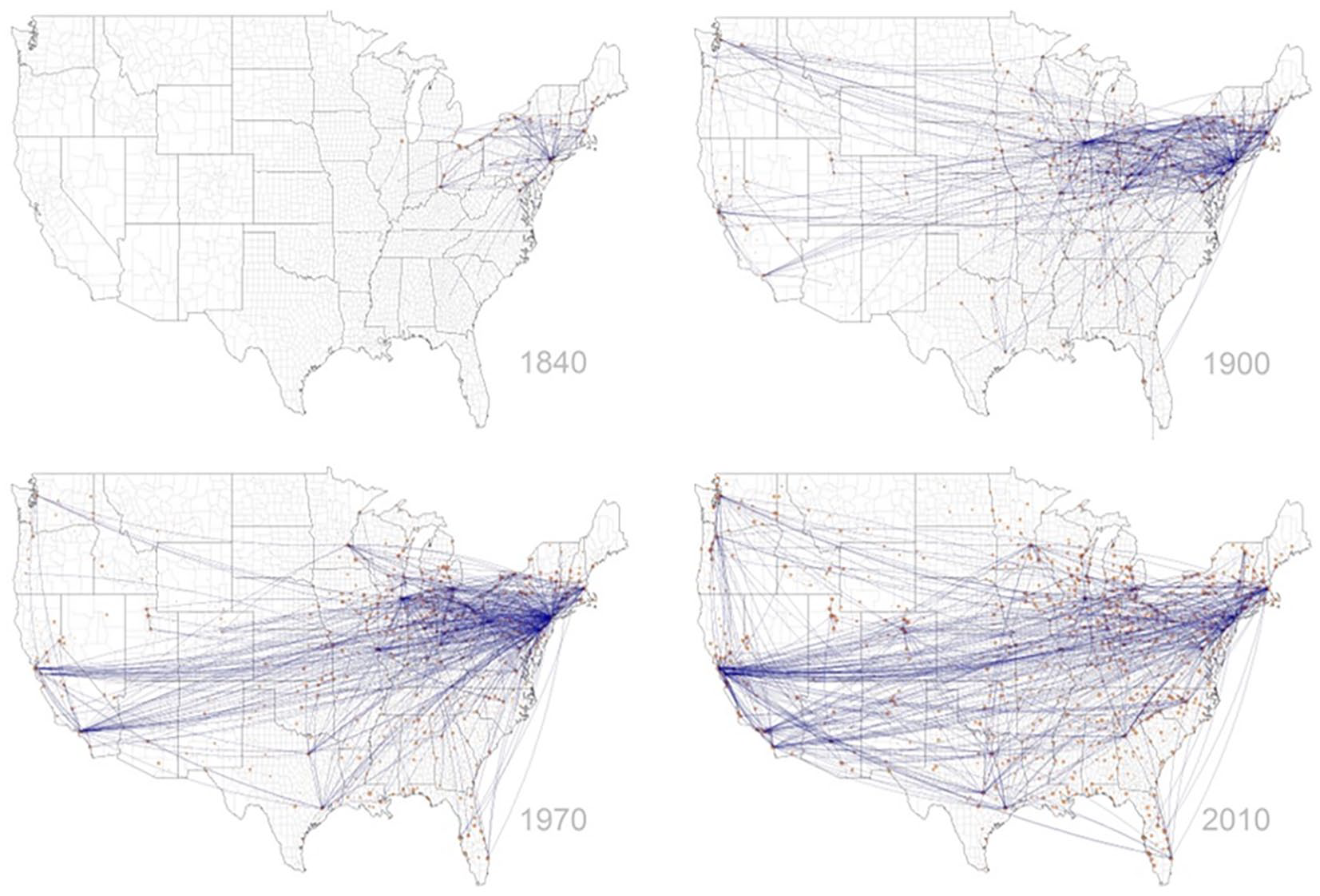
Interregional co-invention network in four time-windows.
The dots correspond to the number of patents in each county, and the lines represent the 600 most-repeated interregional collaborations (the first map demonstrates all collaborations in the 1840 time-window).
In contrast, California experienced population growth and emerged as the most populous U.S. state since the 1960s. Toward the end of the 20th century, intensified interregional relations between California, Texas and Washington regions and regions on the East Coast became visible. In contrast, connections between Midwestern regions and others decreased.
Figure 2 depicts the number of patents, joint patents and interregional collaborative ties. All three variables show an overall increase, with a stagnation period in the early- and mid-20th century, due to the impact of World Wars and the Great Depression. Notably, Figure 2 shows that inventive activities increasingly required joint work (Wuchty et al., 2007), most likely due to their growing complexity (Broekel, 2019; van der Wouden, 2020).
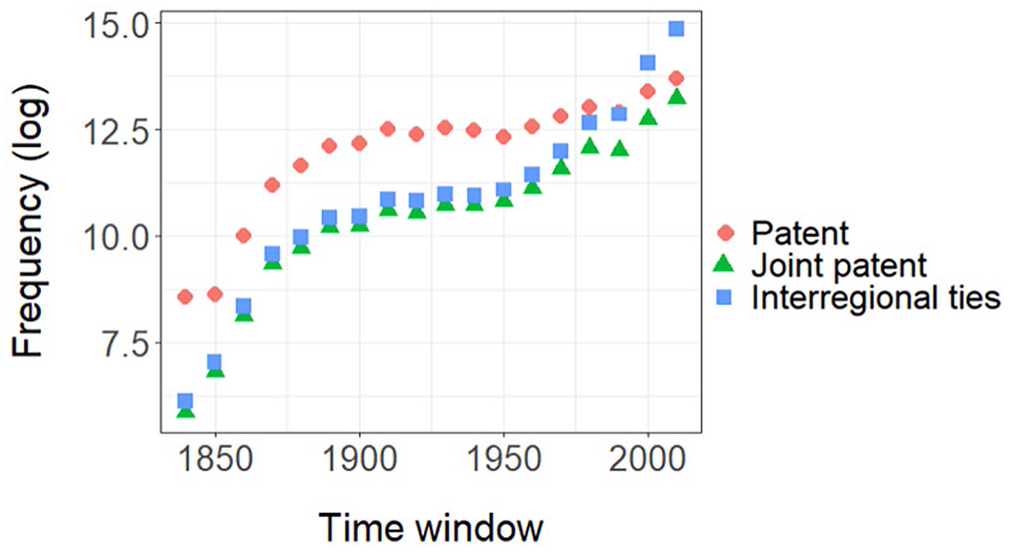
The number of patents, joint patents and interregional collaborative ties (region-pairs) between 1840 and 2010.
Alongside the shifting geography, the USA experienced continuous growth of its transportation system, which frequently did not ‘just’ replace existing connections but actually ‘put new locations [like San Francisco] on the map’ (Atack, 2017). Figure 3 illustrates this continuous expansion in the case of the railroad system. Train connections fostered interregional trade and people’s mobility, thereby facilitating spatial knowledge diffusion and exchange. Not surprisingly, the first significant increase in East Coast–West Coast patent collaborations in U.S. history (from about 50 in 1860 to about 300 in 1880) occurred when the first railways connected the two coasts. Similar patterns emerged with the establishment of regular air transport connections, and low-cost carriers. Air transport altered the ranking of places’ reachability and is likely to have reduced and shuffled the effect of geographical proximity. For instance, at the end of the 1930s, New Yorkers could reach Los Angeles by plane in 18 hours but had to travel over land for a full day to reach Philadelphia (Paullin, 1932).
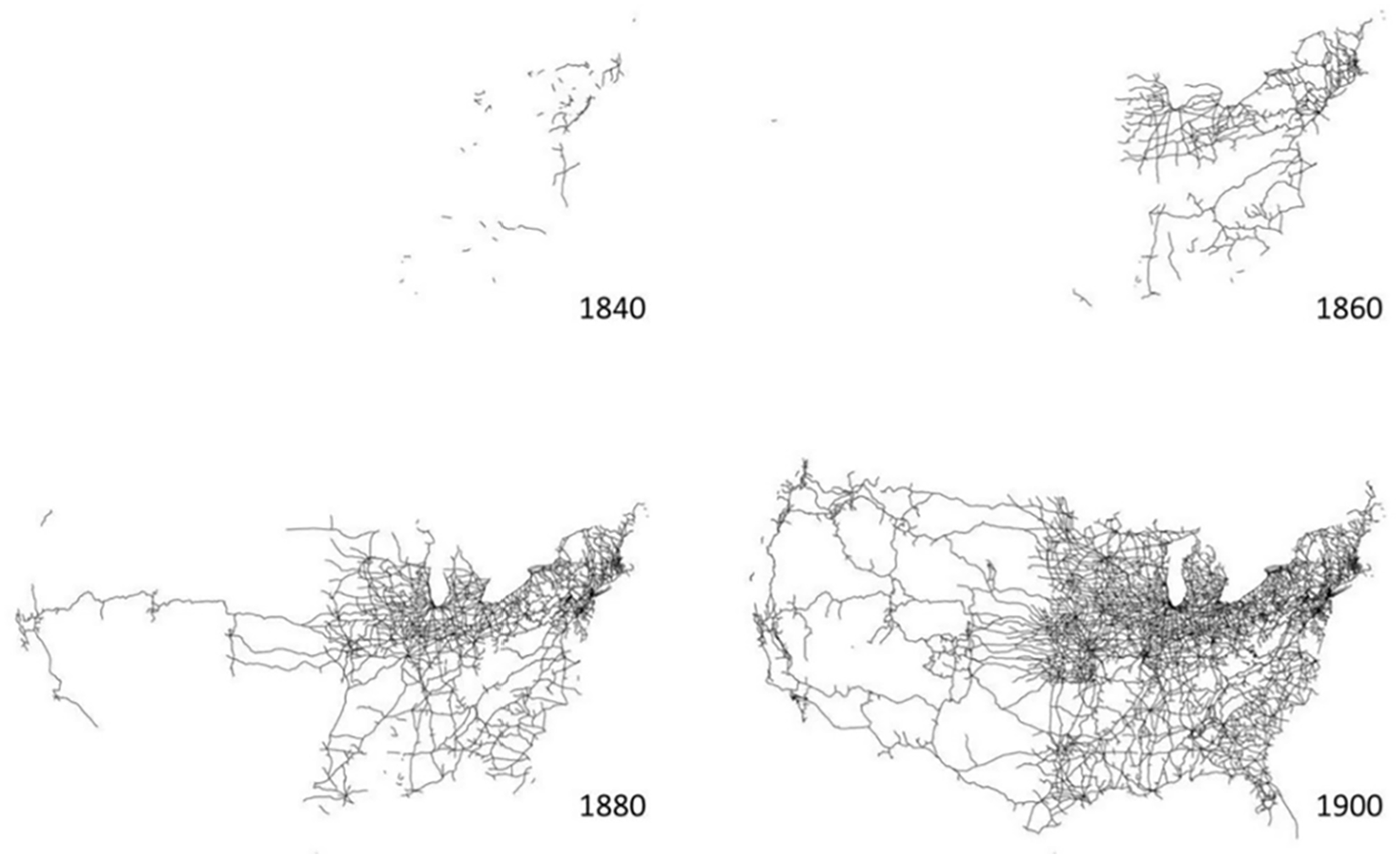
The expansion of the railroad system in the USA.
Variables
Dependent variables
The unit of analysis is region-pair potential relations. Given the number of regions (n = 3,220) and technologies (c = 654), this results in 3,389,413,860 potential region-pairs-technologies [(n × n−1)/2] × c, where n denotes the number of regions and c the number of technologies. Inventive interregional activities occurred between relatively few regions in the past 170 years (the mean of realized interregional relations: 15,421 of more than 3 billion potential ones), leading to zero-overdispersion, that is, a dominating share of zeros. This issue is well-known in trade studies. Prominently, Burger et al. (2009) argue that ‘a distinction can be made between pairs of countries with exactly zero probability of trade, pairs countries with a non-zero trade probability that still happen not to be trading in a given year, and pairs of countries that are trading’ (p. 175). Translating this to our situation, it means that a crucial differentiation of zeros, representing the absence of interregional patenting between two regions that have zero probability for such type of patenting, and zeros indicating the absence of a link (although, theoretically, a positive probability of such a link could exist). We argue that when regions are not part of any interregional patenting at a given time, this indicates the absence of the general capability of such activities. For instance, in the early periods, many regions lacked any (patenting-related) inventive activities, a prerequisite for interregional patenting. But even in later periods, there are regions with documented inventive activities but no interregional linkages. We interpret both cases as indications that basic conditions for interregional collaboration were unmet (e.g. insufficient infrastructure). To avoid this (directly) unobservable factor biasing our results, we restricted the sample of observations to those regions with at least one interregional tie in a given technology within each 10-year time-window. The minimum of one existing interregional tie thereby represents the documented ability of regional inventors to engage in interregional patenting. As a result, the number of observations substantially decreases and dynamically changes over time.
On this basis, we construct our dependent variable as a dummy variable that takes the value of one if at least one collaborative tie is recorded for a region-pair in a given technology, and zero otherwise.
Figure 4 shows that the number of observations (region-pairs across all technologies) substantially varies over time, generally tending to increase until WWI. Subsequently, they decreased before they continued growing after WWII. The figure clearly shows the disruptive effect of the World Wars and the period in between.
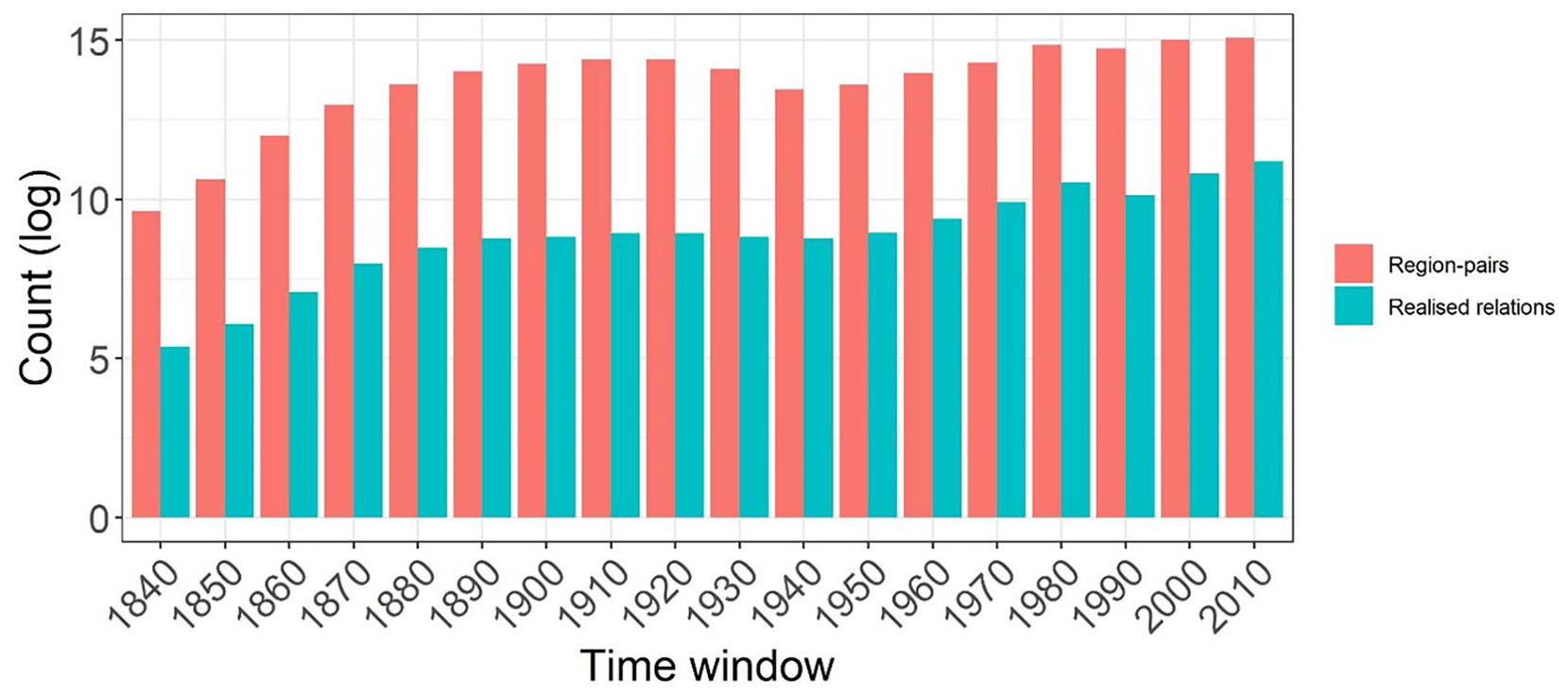
The number of region-pairs (including regions with at least one interregional relation) and realized interregional relations.
Realized interregional relations correspond to the number of region-pairs whose inventors collaborated to develop at least one invention. The maximum number of realized interregional relations is equal to that of region-pairs.
We observed a positive correlation between the population of regions and the diversity of their technological portfolios, which the entropy index approximated (the Pearson correlation coefficient: 0.74). However, the correlation between population and the number of interregional ties is relatively weak (0.19). Furthermore, there is no substantial correlation between the diversity of technological portfolios and the number of interregional relations (0.1). Conversely, there is a positive correlation between the number of patent applicants in each region and the number of collaborative interregional ties (0.69).
Relational explanatory variables
The core explanatory variable is geographic distance. We defined DIST by taking the logarithm of the Euclidean distance between regions in kilometres. As an alternative, we created the variable STATE, taking a value of one when two regions are located within the same U.S. state, and zero otherwise. The second variable, however, has two interpretations, as it captures both geographic and institutional distance (differences in state-specific regulations and legal frameworks). Consequently, it primarily functions as a robustness test. In contrast to the other variables that appear below, the values of these two variables are time-invariant.
Relational control variable
We followed the literature and used the Spearman rank correlation of the patent portfolios of regions to approximate the ‘cognitive’ distance between two regions 4 (Abbasiharofteh et al., 2023b; Broekel and Brenner, 2007). The correlation coefficients indicate how similar interacting regions are regarding their technological schemes. We multiplied the variable by minus one to express the result in terms of distance (TECH). 5 Although the number of technologies and regions involved in co-inventorship increases, Figure 5 shows that the average technological distance between collaborative regions does not substantially vary over time. More interestingly, Figure 5 suggests while the interquartile ranges of distance between collaborative regions overlap across most time-windows, the median and maximum values of geographic distance show a four-fold increase. For instance, in 1840, the maximum distance of interregional relations was less than 2000 km. In the last time-window (2010), we observed a collaboration between inventors from Honolulu County (Hawaii) and Newport County (Rhode Island), more than 8000 km apart. This observation aligns with this section’s description of the evolution of economic and co-inventive activities in the 19th and 20th centuries.
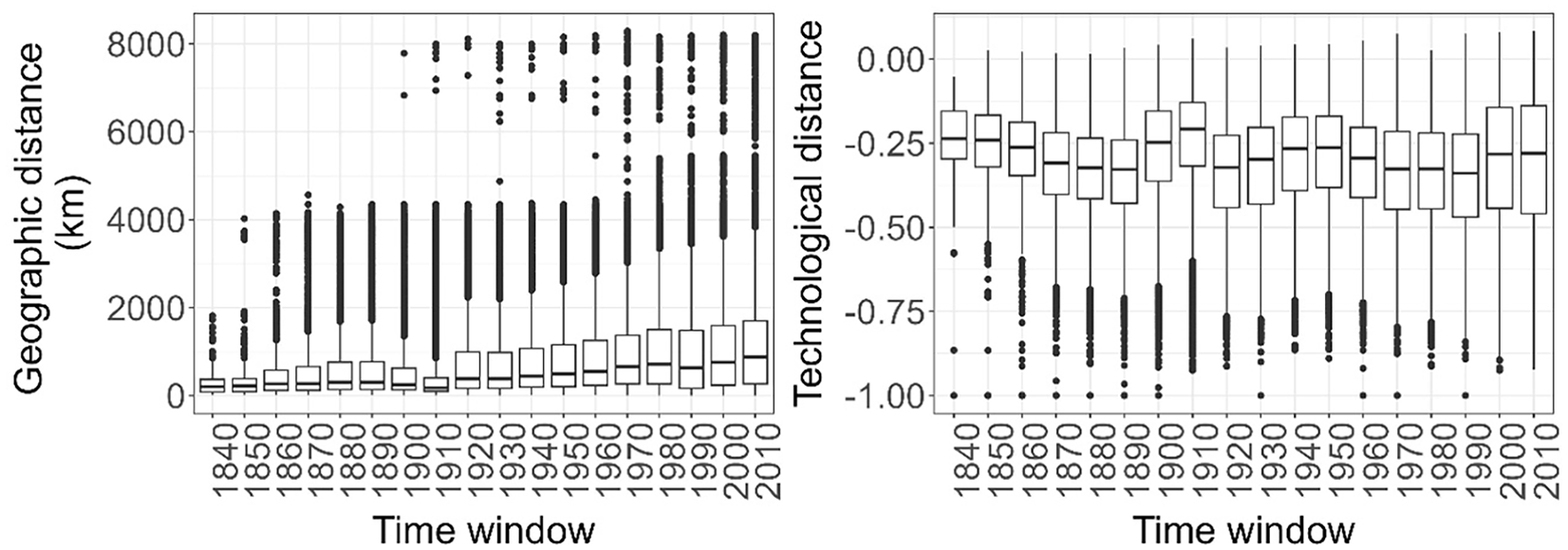
The geographic and technological distance of interregional co-inventive relations.
Technological complexity
To approximate technological complexity, we relied on the measure of structural diversity that Broekel (2019) proposed. The measure captures the heterogeneity of relational structures among technologies’ (knowledge) elements, the so-called combinational network representation of technologies. The greater this heterogeneity is, the larger the information content of technologies’ combinatorial networks is, and the more complex the associated technology is. Broekel (2019) applied this approach to estimate the complexity of patent classes (as an approximation of technologies). For each 4-digit technology class (CPC 6 ), he constructed an individual combinatorial network based on 10-digit CPC codes’ co-occurrence on patent documents. Their structural diversity is measured with the Network Density Score (NDS), created by Emmert-Streib and Dehmer (2012).
To assign complexity scores to technologies, we calculated the technological complexity of patents associated with a specific 4-digit CPC code, following the procedure Broekel (2019) described. 7 Then, we averaged the annual values for each technology in each time-window, to avoid potential biases that annual patent number fluctuations introduced. 8
The complexity indices suggest that technologies associated with Machines or engines for liquids (CPC code: F03B) were the most complex and Book covers (B42D) were the least complex technologies in 1840. In 2010, Ship-lifting devices or mechanisms (E02C) and the Propulsion of electrically-propelled vehicles (B60L) were the least and the most complex technologies, respectively. Figure 6 provides descriptive statistics of the obtained complexity scores of technologies. Importantly, when a new technological code is added to the previous ones, the USPTO re-defines all existing patent classes (e.g. CPC codes) (Petralia, 2020). This fact implies that the number of technologies (with non-zero complexity scores) varies across time-windows. The variable COMPLEXITY represents a time-varying continuous value at the level of technologies. The difference between the units of analysis (i.e. region-pairs and technologies) calls for a specific empirical approach that the next section presents.
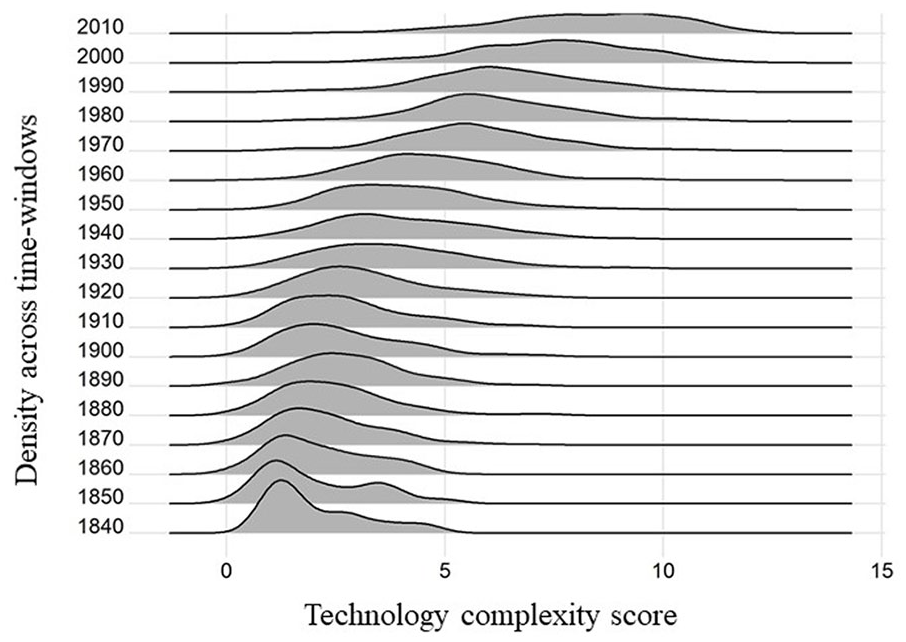
Kernel density estimate of technology complexity scores across 18 time-windows.
Technology complexity scores quantify the diversity of relational patterns within the constituent sub-classes of technologies, represented as combinational networks. Higher levels of heterogeneity indicate greater informational content within the networks and correspondingly increased complexity of the associated technology. Broekel (2019) utilized this methodology to assess the complexity of patent technological classes (CPC codes).
Estimation strategy
We employed a spatial-interaction model (also known as the gravity model) to test the hypotheses. In the 1960s, this model became popular for analysing trade between countries (e.g. Hasson and Tinbergen, 1966). We followed recent applications in using the model to account for the establishment and intensity of interregional co-invention (Maggioni et al., 2007; Scherngell and Barber, 2011). 9 The model is designed to deal with relational observations (i.e. region-pairs). It features variables at the region-pair levels (e.g. geographic distance between two regions).
Although researchers often use logit models to estimate models with binary dependant variables, we utilized Linear Probability Models (LPM) for two reasons. First, including dummy variables as fixed effects in a non-linear model can lead to biased results (Gomila, 2021). This problem motivates using LPM, which the relatedness literature has widely used to model the entry of regions into new economic activities (for instance, see Boschma et al., 2023). Second, given the size of the data and the number of fixed effects, conducting logistic regressions is prohibitively expensive, due to computational time and resource requirements. 10
Notably, the model includes both time-variant and time-invariant explanatory variables. In other words, the variables DIST and STATE do not change across 18 time-windows, whereas TECH varies over time for a given region-pair.
To test the first hypothesis, we operationalized the spatial-interaction model by estimating LPM, where Pij,t,c denotes the probability of at least one collaborative tie between inventors located in regions i and j in time-window t utilizing technology c. The LPM model is defined as follows:

To control for unobserved heterogeneities, we include ωc, ξi and αj, which are technology (CPC codes), region i and region j fixed effects, respectively. The error term is εij,t,c.
Equation (1) does not feature the complexity dimension because the (time-variant) variable COMPLEXITY is undefined at the regional and the relational level. Therefore, we opted for a two-stage approach to test the second and third hypotheses. In the first step, we estimated an individual interaction model for each time-window.

The coefficients of DISTij × CPC are the basis for the second step, the meta-regressions. We investigated the interplay between the effect size of DISTij × CPC coefficients and the complexity of technologies with a meta-regression analysis. This method is ‘the regression analysis of regression analyses’ (Stanley and Jarrell, 1989: 161). Medical and psychological studies have frequently used it, but increasingly it also finds applications in regional and urban studies (De Groot et al., 2007; Melo et al., 2009).
We estimated mixed-effects meta-regression models using a residual maximum likelihood approach (REML) (Viechtbauer et al., 2015). Various studies have widely used the mixed-effects approach, due to its flexibility in allowing for within- and between-period variations (Benjamini, 2020).
We estimated meta-regressions with COMPLEXITY as the main predictor and the effect sizes of interest as the dependent variable (coefficients of DISTij × CPC denoted as yk,c below). The regression coefficients indicate whether the associations with geographic distance are conditioned on COMPLEXITY and, if so, the extent to which these associations change over time. We denote the meta-regression model as follows:

where yk,c is the meta-dependent variable corresponding to the effect size of DISTij × CPC coefficients that the kth model, which estimates the association of interregional tie formation in technology c (i.e. CPC codes), reports. The meta-independent variable COMPLEXITYc captures the technological complexity of technology c in a given time-window. We control each technology’s size (the logarithm of the number of patents) in each time-window (i.e. PatentNumberc). The random effects capture between-studies variability, denoted as Wk,cY. In our case, it is equivalent to the between-time-period variability since the individual ‘studies’ are the individual estimations for each time-window. The coefficient of this regression model expresses the correlation between the coefficients of geographic distance and the degree of complexity of the underlying technology. 11
Results and discussion
The preceding section describes the number of observations in each time-window reflecting the extent to which inventors in various regions engage in interregional co-inventive activities. Notably, a negative correlation exists between the number of observations and the goodness of fit of the estimated models (Figure 7). A probable reason for this observation is that the number of potential relations grows much more than that of the realized relations, as the co-inventorship network features more regions (see Figure 4). This inflation of the number of zeros in the dependent variable (no ties between pairs of regions) reduces the goodness of fit. 12 We visualize the coefficients of the variables and their upper and lower margins of error, to trace their development over time.
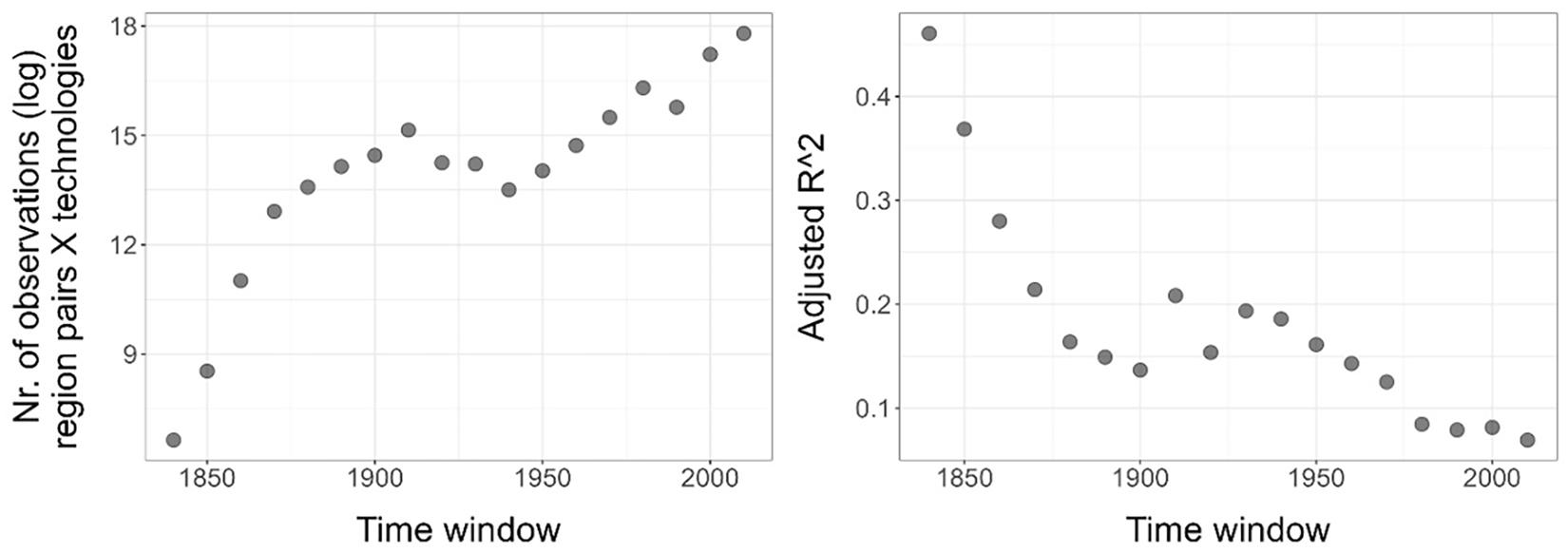
The number of observations (left) and models’ goodness of fit across time-windows and 654 technologies (right).
The first interesting finding concerns one of our control variables, namely: technological distance. As the continuously negative coefficient shows (left panel in Figure 8), initiating collaboration between two technologically distant regions is less likely than for two proximate regions. This finding aligns with similar findings for European regions (Morescalchi et al., 2015) and contrasts with that of other studies, such as Lata et al. (2017). Given the different empirical approaches and data sources these studies used, finding the source of this inconclusiveness would require further investigations. Nevertheless, our investigation adds evidence that technological distance has negatively influenced the likelihood of spatial interaction for a long and continuous time.
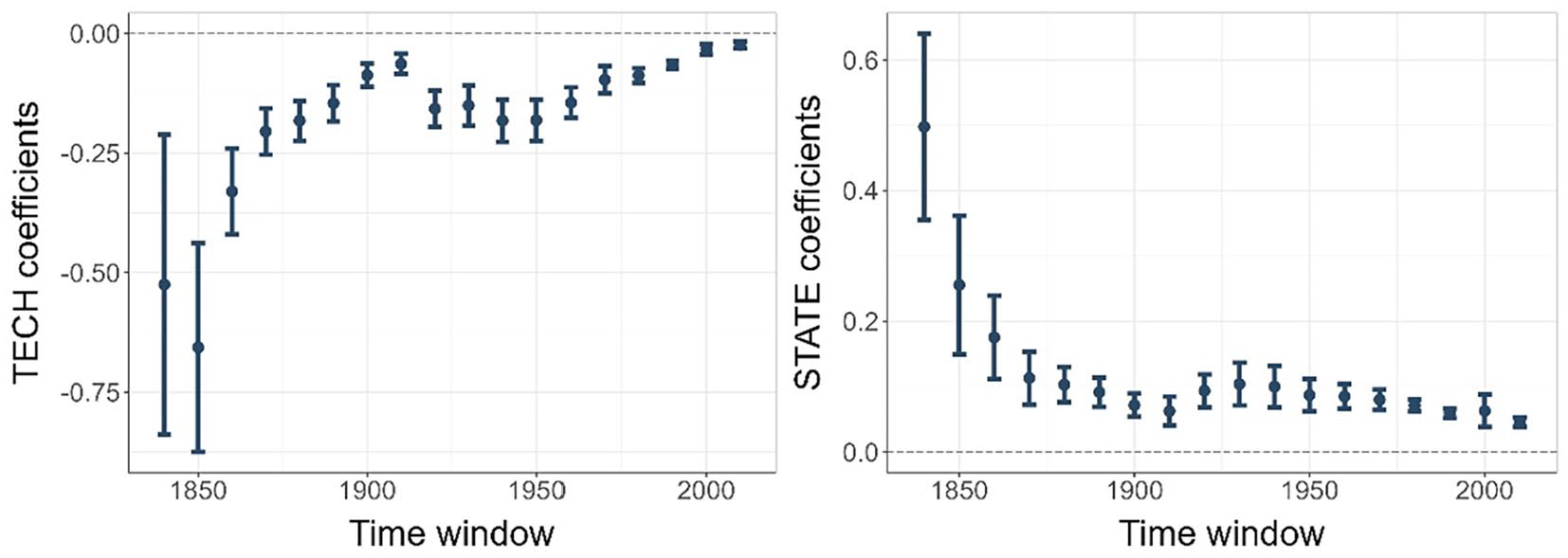
The estimated coefficients for technological distance (TECH) and co-location of regions in the same state (STATE) with the corresponding margin of errors.
We now turn toward our main research interest, namely, the role of geographical distance. Figure 8 [right] features the results concerning inventors’ co-location in the same U.S. state (STATE). We observe significantly positive coefficients for this variable in all periods. Co-location in the same state increases the likelihood of collaborative tie formation. Yet, the magnitude of the coefficients is somewhat lower in recent years than those in the late 19th century, suggesting that in the past, being in the same state was of greater importance for establishing interregional collaborations. However, this variable has a less clear interpretation than geographic distance because it might also capture institutional proximity. Therefore, the remainder of the paper focuses on the results for geographic distance (Figure 9), primarily using STATE as a control for institutional distance.
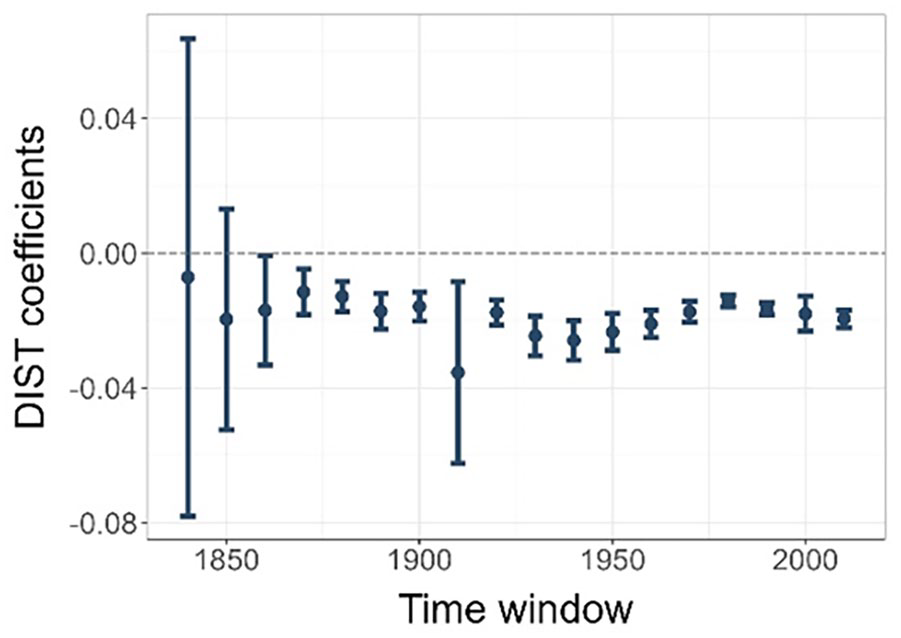
The estimated coefficients for geographic distance (DIST) with the corresponding margin of error.
Figure 9 illustrates the coefficients obtained for the geographic distance variable (DIST). All coefficients except those of the first two time-windows are significantly negative, implying that we can clearly reject Hypothesis H1. Geographical distance has not become less of an obstacle for interregional inventor collaborative relations. Two robustness checks substantiate this finding (see Supplemental Appendix A).
Potentially, this may be due to transportation costs not having fallen much further and remaining relatively stable in more recent years, at least concerning airfares, the most relevant mode of transportation for inventors in the USA in recent times (Perry, 2014).
van der Wouden’s (2020) study also examines the historical aspect of inventors’ collaboration on U.S. patents from 1836 to 1975. His finding demonstrates that patenting has increasingly become a collaborative work that concentrates in large cities. Our results complement van der Wouden’s (2020) findings by showing that the collaboration-facilitating role of geographic proximity does not stop at city boundaries. Even beyond theses, location near other inventors still increases chances of collaboration.
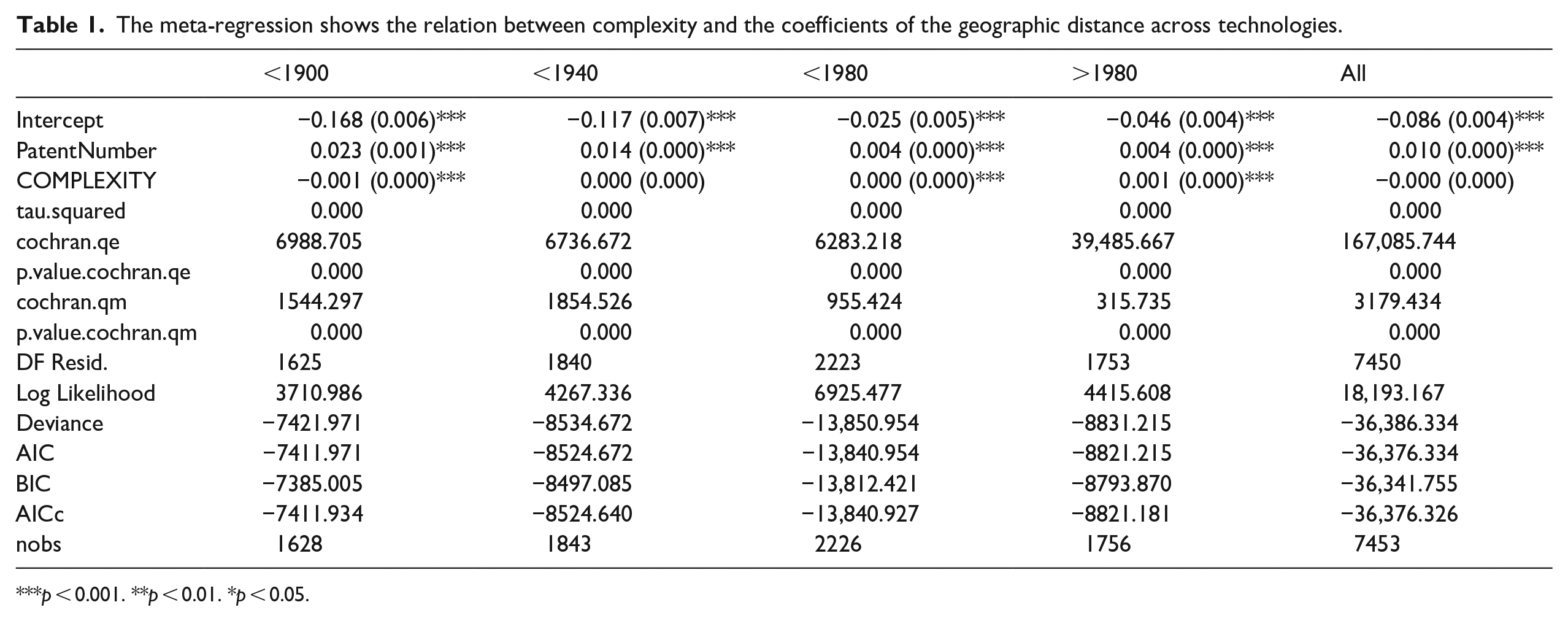
The result raises the question about the cause of this development. That is, why does geographic distance impede cross-region relations, despite all improvements in transportation and communication that have excelled in reducing interactions across space? As the theory section discusses, one reason might be the growing technological complexity that requires more intense interactions facilitated by geographical proximity (Balland and Rigby, 2017; Broekel, 2019). In line with our hypotheses, we expect that the coefficients of the geographic distance variable DIST relate negatively to technologies’ complexity in each period (H2), and the relationship grows stronger over time, implying that the slope of this relationship becomes steeper over time (H3). We tested the two hypotheses employing the second-stage meta-regression. The result shows the association between coefficients of the interaction term (i.e. the geographic distance variable multiplied by technology dummies: DISTij × CPC) and the levels of technological complexity (Table 1).
The meta-regression shows the relation between complexity and the coefficients of the geographic distance across technologies.
p < 0.001. **p < 0.01. *p < 0.05.
Our results show that the relationship between the complexity and the geographic distance of interregional collaborations varies in both sign and magnitude. The hampering effect of geographic distance on distant collaboration between inventors was larger for simple than for complex technologies. Accordingly, H2 is only confirmed for the 19th century. For the 20th century, we must reject it since we find that the opposite holds true. The distances of interregional collaboration tend to be larger for complex technologies than for simpler ones. The latter also implies that we must reject H3. Over time, geographic distance has lost its hampering effect on collaboration for complex technologies, the opposite of our expectations.
The change in the sign of the complexity variable in the meta-regression between the 19th and the early and mid-20th centuries likely relates to the fundamental shift in inventive activities in the U.S. during the Second Industrial Revolution. That revolution shifted the nation’s economy from agriculture to manufacturing and services. The analysis by Hartog et al. (2022) of inventive activities between 1850 and 1940 highlights engineers taking over a pivotal role in innovation, and inventions becoming collaborative teamwork. Moreover, new organizational structures such as R&D labs, enabled connections between inventors across various locations.
Esposito (2023) and van der Wouden (2020) confirmed the growing significance of large collaborative teams at the local level, most prominent in disruptive technological domains. Our findings suggest that the high demands of complex technologies, in terms of complementary competencies and knowledge and the higher economic returns, extend these collaboration activities beyond regional boundaries. As competencies associated with complex technologies are spatially less ubiquitous (Hidalgo and Hausmann, 2009) it seems likely that, in many cases, they will not be in the same location, forcing inventors to collaborate across multiple (distant) locations. Add to this the economic benefits of complex technologies that, in contrast to the smaller ones of simple technologies, outweigh the costs of overcoming larger geographic distances. Given the change in the coefficient’s sign in the second half of the 20th century, we suspect that specifically cheap interstate air travel and improved communication technologies in the 1970s contributed to this development. For instance, Southwest Airlines started interstate service in 1979, whereby inventors could meet face-to-face to troubleshoot and discuss complex technical issues.
Our findings resonate with Esposito’s (2023) work. He highlights that since 1975, distant inventors located in US cities with diverse technological domains would more likely introduce high-impact patents, thereby facilitating an unconventional combination of technologies. While van der Wouden (2020) reported the opposite. However, he considered intra-regional collaboration. Therefore, it seems plausible that the lower impact of geographic distance on collaboration in the case of complex technologies is restricted to the scenarios of long-distance collaboration. 13
Conclusion
Many studies have analysed the role of geographic distance in forming and developing knowledge-based interactions. Prominently, Friedman (2005) argued that major political changes (e.g. the fall of the Berlin Wall) and technological advances (e.g. the invention of the internet) had created forces that ‘flattened’ the world, implying that geographic distance had lost (or, at least, was losing) its relevance as an obstacle to interaction and collaboration (see also the ‘death of distance’ debate). This conjecture stimulated the emergence of a rich literature seeking to understand if and how the effect of geographic distance changes over time and across various contexts (Balland et al., 2013; Broekel, 2015; Ter Wal, 2014).
However, until recently, this discussion and the literature have rarely considered the heterogeneity among technologies, which may mediate the relevance of geographic distance for knowledge-based interactions. Balland and Rigby (2017) prominently argued that higher levels of technological complexity might make geographic distance a more significant obstacle to technological diffusion in space. van der Wouden (2020) investigated this argument for 1836 and 1975, observing complex technologies relying strongly on intra-city collaboration.
Our study adds to this literature by investigating the evolution of the interregional co-inventor network of U.S. regions between 1836 and 2010. Its focus was on the (changing) relationship between geographic distance and the formation of interregional collaboration. Our findings clearly show that geographical distance, at least in interregional collaboration over the last 170 years, has kept its importance as obstacle, despite all advances in transport and communication technologies. The empirical results also challenge previous findings in the literature (Balland and Rigby, 2017; van der Wouden, 2020) by suggesting that higher levels of technological complexity do not make distance a greater obstacle to collaboration, at least in the second half of the 20th century. We conjecture that this phenomenon arises due to the inherent knowledge requirements of complex technologies that require drawing upon a broader range of expertise and offering significant economic gains through collaboration. Additionally, the advancements in transportation and communication infrastructure have significantly reduced the costs of knowledge-based interactions, making such collaborations more feasible and lucrative for complex technologies than for simpler ones. Importantly, the precise reasons for this observation remain speculative and require more investigations in the future.
Having reviewed our study’s main findings, we acknowledge our research’s limitations. Most importantly, we lack information on intra-regional knowledge-based interactions. Our analysis relies on patent data, known to reflect only a fraction of innovation and collaboration activities. However, this drawback was unavoidable; no other available data source covers such time spans.
However, another issue that future studies might overcome is the aggregation at the regional level. Currently, no information on inventors or applicants and the spatial structure of multi-locational firms is available for the HistPat database; that restricted us from exploring collaboration patterns between regions. This issue introduces the danger of ecological fallacy and neglecting crucial organizational heterogeneity. We encourage researchers to replicate our study using recently published firm-level data, such as trademark and web-text and hyperlink data (Abbasiharofteh et al., 2022, 2023a, 2023c; Nathan and Rosso, 2015). Similarly, we acknowledge that county-specific regulations and legal frameworks may serve as catalysts or obstacles to interregional relations. Due to the temporal scope of our investigation spanning 170 years, we could not ascertain the level of institutional proximity at the county level.
Nevertheless, our findings raise questions for future research. For instance, the USA experienced several waves of immigration over the last 200 years. Empirical studies suggest that regions in which most immigrants settled during the 19th and the early 20th centuries have enjoyed economic prosperity in the long run (Rodríguez-Pose and von Berlepsch, 2015). In this light, studying the impact of immigration on knowledge diffusion and interaction will improve our understanding of how sociocultural diversity influences spatial interactions and knowledge diffusion (Diodato et al., 2022).
Moreover, Sokoloff’s (1988) findings on the impact of railways on the innovative activities of distant areas in the early 19th century call for an examination of the influence of roads and air transport development on interregional collaborations, to better understand how and why interregional collaborations emerge and intensify.
Our empirical results are not only crucial for advancing our understanding of the interplay of technological complexity, collaboration and geography. They are also essential for the sectoral and mission innovation policy design, which increasingly seeks to stimulate collaboration (Broekel and Graf, 2012; Janssen and Abbasiharofteh, 2022). Our empirical findings shed some light on whether to support local or interregional collaboration in different technological contexts, which motivates further research today and, we hope, informs new policies tomorrow.
Supplemental Material
sj-docx-1-epn-10.1177_0308518X241255525 – Supplemental material for The role of geographic distance and technological complexity in U.S. interregional co-patenting over almost two centuries
Supplemental material, sj-docx-1-epn-10.1177_0308518X241255525 for The role of geographic distance and technological complexity in U.S. interregional co-patenting over almost two centuries by Milad Abbasiharofteh, Tom Broekel and Lars Mewes in Environment and Planning A: Economy and Space
Footnotes
Declaration of conflicting interests
The author(s) declared no potential conflicts of interest with respect to the research, authorship, and/or publication of this article.
Funding
The author(s) received no financial support for the research, authorship, and/or publication of this article.

Supplemental material
Supplemental material for this article is available online.
Notes
References
Supplementary Material
Please find the following supplemental material available below.
For Open Access articles published under a Creative Commons License, all supplemental material carries the same license as the article it is associated with.
For non-Open Access articles published, all supplemental material carries a non-exclusive license, and permission requests for re-use of supplemental material or any part of supplemental material shall be sent directly to the copyright owner as specified in the copyright notice associated with the article.
