




Abstract
A vital ingredient for the success of interorganizational collaboration projects is strong personal relationships among the partners. Their formation is structured by geographical distances between partners. In the corresponding research, it is assumed that geographic distance inhibits face-to-face interactions, which are highly effective for tie-formation. However, findings from adjacent fields of research suggest that greater distances can also be conducive to the development of personal relations. In this paper, we unravel these contradictions. Empirically, we examine the development of 2132 personal ties between individuals from 20 government-funded interorganizational innovation projects using a mixed-method design. Statistical analysis of the data reveals a U-shaped correlation between geographical and social proximity. Contrary to common assumptions, large geographical distances are found to be particularly conducive to forming relationships. The qualitative data explains this finding by identifying and systematically relating five practices which are associated with specific distances and which are (differently) effective for tie-formation.
Keywords
Introduction
In research on interorganizational collaboration, different forms of proximity have proven to be crucial (Boschma, 2005; Knoben and Oerlemans, 2006). After initially considering forms of proximity separately, recent research addresses the interrelationship between them by exploring the effects of different proximity combinations (Balland et al., 2015; Broekel and Boschma, 2012; Mattes, 2012; Santos et al., 2020). However, it is still not clear how different forms of proximity dynamically interact with each other in the course of collaboration projects.
Such interactions are particularly interesting when they relate to social proximity. Social proximity is defined in terms of the strength of personal ties between actors from different organizations (Boschma, 2005: 66). Tie strength is a function of “the amount of time, the emotional intensity, the intimacy (mutual confiding), and reciprocal services that characterize the tie” (Granovetter, 1973: 1361). Because strong personal ties induce trust, facilitate understanding, and increase motivation, they have been shown to be crucial for successful collaboration (Heringa et al., 2014; Ooms et al., 2018). Because personal relationships can develop over the course of collaboration projects, social proximity is dynamic and interaction effects between it and other forms of proximity are likely. In particular, the impact of geographical on social proximity has been highlighted (Kornberger and Clegg, 2004; Small and Adler, 2019). It is argued that the formation of strong personal ties becomes linearly less likely with increasing spatial distance. Inherent in this is the assumption that the frequency of face-to-face contact decreases with increasing distance and that such contact is important for tie formation (Knoben and Oerlemans, 2006; Nilsson and Mattes, 2015).
In research on the interplay of social and geographical proximity, space is considered independent of social processes. However, concepts of space informed by practice theory suggest that the effect of spatial arrangements is closely linked to social practices entangled with them (Beyes and Steyaert, 2012; Cnossen and Bencherki, 2019; Löw, 2008). Hence, spatial impacts can only be fully understood when practical references to space are taken into account. We argue that this also is true for the effect of spatial distances in the development of personal ties in interorganizational projects. We follow this argument to disentangle the nexus of geographical and social proximity.
In the paper, we first review the state of research on the relevance of different forms of proximity in interogranizational collaboration projects and on the relationship between geographical and social proximity. Subsequently, we will elaborate this relationship drawing on a practice-theoretical conception of space. We will argue, that different spatial distances are associated with different practices that have different effects on the development of ties—either facilitating or hindering. To understand the link between social and geographic proximity both through concrete practices and statistically, we examine the development of 2132 interpersonal ties from 20 state-funded, inter-organizational projects in Germany using a mixed-method design (Small, 2011), which we present in the methods section. In the findings section, we present five distance-related practices, that we identified on the basis of the qualitative interview data. It is shown that relationship-promoting practices exist not only for geographical proximity, but also for geographical distance. In accordance with this finding, the quantitative analysis of developed tie strengths and geographical proximity shows that practices related to large distances promote the development of personal ties even more than high proximity does, while medium distances prove to be most obstructive. Thinking social practices and spatial distances more closely together thus enables an elaboration of our understandings of the interconnection between geographical and social proximity in interorganizational innovation projects.
Proximity in interorganizational innovation projects
Innovation attempts are increasingly realized in interorganizational innovation projects (Hansen and Mattes, 2018; Majchrzak et al., 2015). The pronounced heterogeneity of the partners in such projects holds particular potential for innovation, as it becomes possible for different perspectives and knowledge to be creatively combined (Powell and Grodal, 2005; Uzzi et al., 2013). At the same time, the temporary and organizationally loose collaboration of heterogeneous partners is associated with considerable challenges. Along with the potential for innovation that the heterogeneity of the partners holds, it also tends to make it more difficult to communicate efficiently and to connect the different knowledge stocks. Due to the embeddedness in different social, formal, and material structures, there are multiple frictions between organizations that need to be overcome in order to collaborate successfully (Roth and Diefenbach, 2021). Interorganizational innovation projects accordingly combine particularly innovation potential with powerful barriers to its realization.
In recent decades, economic geographers have developed a differentiated vocabulary for analyzing interorganizational projects. They distinguish five types of proximity, namely cognitive, organizational, institutional, geographical, and social proximity (Boschma, 2005; Knoben and Oerlemans, 2006; Mattes, 2012). Cognitive proximity describes the similarity of actors’ knowledge. The greater the cognitive distance between actors, the greater the potential for learning and innovation. However, an excessive cognitive distance can also lead to a lack of knowledge connectivity and to difficulties in communication (Nooteboom, 2007). Organizational and institutional proximity describe formal and informal rules of conduct. The greater the proximity in both cases, the more smoothly collaboration transacted (Cunningham and Werker, 2012). However, too little friction leads to operational blindness and thus hinders innovation. Geographical proximity describes the spatial distance between actors. Higher geographic proximity facilitates collaboration primarily because it facilitates face-to-face encounters, which are particularly favorable for the transfer of knowledge (Knoben and Oerlemans, 2006; Nilsson and Mattes, 2015). Social proximity describes the strength of personal ties which is especially given “when they involve trust based on friendship, kinship and experience.” (Boschma, 2005: 66). Because it promotes mutual understanding, commitment and trust, social proximity is generally conducive to knowledge transfer and collaboration (Broekel and Boschma, 2012; Heringa et al., 2014; Leszczyńska and Khachlouf, 2018). The few exceptions to this generally favorable relationship relate to very extreme forms of social proximity that lead to lock-ins and power asymmetries (Hansen and Mattes, 2018; Ooms et al., 2018) and hence impact collaborations negatively. However, these instances remain seldom and hence negligible for the argument of this paper.
The five proximity–distance relationships can be used to identify both innovation potential and collaboration barriers between partners (Boschma, 2005; Knoben and Oerlemans, 2006). It is important to note that the various forms of proximity must be considered in their specific combination (Hansen, 2015; Huber, 2012; Mattes, 2012). Innovation potentials that are given by favorable distances on one level (especially cognitive, organizational, and institutional) can be successfully leveraged because proximity is given on other levels (especially geographical and social).
Interorganizational innovation projects are typically composed with regard to the partners being cognitively, organizationally and institutionally distant enough from each other to have a significant potential for innovation (Ooms et al., 2018). Larger geographic distances between partners arise, for example, because partners with specific competencies are sought that are not available regionally or because the involvement of companies competing in the same regional markets is avoided. Additionally funding programs may requires partners to originate from different countries or regions (Huber, 2012; Ooms et al., 2018). In order to successfully leverage the innovation potentials given by the different distances, there is a need for a growing proximity between the partners in the course of the projects (Heringa et al., 2014; Ooms et al., 2018). Because the first four forms of proximity are comparatively static, the development of social proximity is the most important factor for the success of the projects (Broekel and Boschma, 2012; Ooms et al., 2018).
Social and geographical proximity
Social proximity is based on personal ties and these are grounded in person-related knowledge that is shared (casually) between persons through interactions (Simmel, 1908: 337). To say that two actors are related is to say that they have a history of past and an expectation of future interaction and that this shapes their current interactions. (Crossley, 2012: 28)
Interorganizational collaboration projects typically aim to share and creatively recombine knowledge and other resources among heterogeneous partners (Knoben and Oerlemans, 2006; Majchrzak et al., 2015). Research shows that strong personal ties are critical to the success of such collaborations in three ways (Hahn, 2013; Phelps et al., 2012; Santos et al., 2020). First, the development of personal ties is inherent in getting to know each other. Knowing the characteristics of partners, their expressions can be better interpreted. Relationships thus facilitate mutual understanding and thus successful collaboration (Majchrzak et al., 2015; Phelps et al., 2012). Second, the successful communication and cooperation of heterogeneous partners requires a high level of commitment from the actors involved. Because the success of innovation projects is generally precarious, it is also unclear for the actors to what extent increased commitment will pay off. However, a high level of commitment increases the chances of success. Commitment is driven, among other factors, by strong personal ties between partners, because these encourage them to feel obligated to each other and because confidence in the potential value of partners’ contributions grows with the strength of ties (Borgatti and Cross, 2003; Inkpen and Tsang, 2005). Strong relationships serve as social capital, enabling people to benefit from the resources of their partners (Lin, 1999; Nooteboom, 2007). It is notable that personal sympathies and thus rather private dimensions of relationships are significant for the attribution of competence and instrumental value (Casciaro and Lobo, 2015). Third, trust is a success factor for collaboration in interorganizational innovation projects. Trust is understood as the intention or willingness to accept vulnerability based on positive expectations of the intentions or behavior of others (Nilsson and Mattes, 2015: 231). Collaboration benefits from the greatest possible openness between the partners. However, openness is accompanied by the risk of making oneself or one's own organization vulnerable to attack. The greater the trust between partners, the greater the willingness to collaborate openly. Personal relationships foster trust (Das and Teng, 2002; Inkpen and Tsang, 2005). Strong personal ties are therefore pivotal to the success of interorganizational innovation projects.
Considering their impact, there is great interest in understanding the formation of strong personal ties. Several important studies have shed light on how they develop and which factors structure this process (Ahuja et al., 2012; Majchrzak et al., 2015). Accordingly, we know a lot about the dynamic interplay of social and other forms of proximity in the course of collaboration projects (Hansen, 2015; Steinmo and Rasmussen, 2016). One of the well substantiated findings is that the development of social proximity is structured by the geographic proximity between partners (Broekel and Boschma, 2012; Grabher et al., 2018; Small and Adler, 2019).
Research in this area describes a positive linear relationship between geographic and social proximity (Hansen and Mattes, 2018; Knoben and Oerlemans, 2006; Small and Adler, 2019). The closer partners are located to each other, the more likely they are to develop personal social relationships. This correlation is explained by arguing that geographically close partners tend to have more face-to-face contact with each other, since face-to-face contact is less costly and more likely to occur unplanned (Fitjar et al., 2016; Santos et al., 2020). Because face-to-face interactions are richer, tacit and person-related knowledge can be conveyed better than through communication media (Bathelt and Turi, 2011; Daft and Lengel, 1986). Partners who have more face-to-face contact thus find it easier to interact satisfactorily, get to know each other better, and more easily build trust in each other (Nilsson, 2019; Sonn and Storper, 2008; Torre and Rallet, 2005). Thus, geographic proximity is considered to promote the development of social proximity in a linear or exponential shape because it causes more face-to-face contact (Boschma, 2005; Capello and Caragliu, 2018; Knoben and Oerlemans, 2006).
Although this depiction of the nexus between geographical and social proximity is consensus in the proximity-literature, we see reason to challenge this view for two reasons. First, in some seminal papers, practices and events are identified that promote relationship formation between geographically more distant partners through temporary co-presence (Bathelt and Henn, 2014; Faulconbridge et al., 2009; Grabher et al., 2018). Examples are trade fairs or temporary project sites (Grabher, 2004; Torre, 2008). For some of these forms of temporary co-presence, large geographical distances between the actors cause rather than hinder them (Grabher and Ibert, 2013). However, the relationship-enhancing effects of geographic distance mediated by these practices are not systematically considered in the proximity literature. Accordingly, it is unclear how exactly such practices and events are related to specific geographical distances. Second, studies that take a nuanced look at the effect of relationship-building interactions show that different face-to-face interaction situations are conducive to relationship building to varying degrees (Bathelt and Henn, 2014; Roth, 2022c). Thus, in addition to the quantity of face-to-face contact addressed in previous research on the effect of geographic proximity, the quality of interaction situations also appears to be an important factor. For example, highly formalized meetings with many participants are less suitable for getting to know each other personally than informal meetings in small groups. If temporary co-presence in particular produces interaction situations that are highly effective for relationship building, this would also challenge the linear correlation. Therefore, a systematic consideration of the different interaction quality of practices and events associated with different geographical distances is needed. Taken together, the two findings point to the possibility that practices and events associated with larger geographic distances may be highly effective for relationship development. This possibility challenges the linear relationship between geographic and social proximity. We therefore argue that it is necessary to examine more closely which practices and events are associated with which distances and how effective each is for developing ties. Only the comparative analysis of relationship-effective practices and their systematic linkage to specific geographic distances can reveal a sophisticated and robust understanding of the nexus between geographical and social proximity (Bathelt and Henn, 2014; Faulconbridge et al., 2009).
Spatial proximity and social practice
In order to be able to empirically unfold the relationship-promoting practices and their association with geographical distances, we propose the application of an institutionalist concept of space (Löw, 2008). In research on economic collaboration and space, institutionalist approaches have proven to be highly productive (Amin, 1999; Bathelt and Glückler, 2014). These approaches enable us to decipher the social rules of economic activity on the basis of concrete practices and to understand them relationally (Bathelt and Glückler, 2014; Jones and Murphy, 2011). Here, institutions are considered in their spatial embeddedness. A further step in our understanding of the nexus between institutions and space is taken by primarily sociological research showing that space itself is constituted by institutions (Cnossen and Bencherki, 2019; Löw, 2008). Here it is emphasized that space does not become effective in itself, but through its specific involvement in social practices. Hence, spatial structures enable certain actions and constrain others. However, space is not deterministic, because actors usually have a higher scope of action. How actors close the scopes of action offered to them by spatial constellations can, however, be explained with reference to social rules. Current theories of space hence draw on the concept of institution, arguing that actors’ space-related practices follow specific social rules (Cnossen and Bencherki, 2019; Löw, 2008).
This is underlined by studies highlighting how different collaboration motives work best in different spatial settings: while spatial proximity matters for interaction in innovation projects, long-distance relations work well for accessing markets and reducing costs (Hansen, 2014). We claim that even interaction relations may work well in the spatial distance. In order to understand this practical meaning of space, the institutionalized patterns of the corresponding practices must be taken into account accordingly.
Hence, the concept of institution is fundamental to these approaches. Institutions are thereby defined as “regulative, normative and cultural-cognitive elements that (…) provide stability and meaning to social life” (Scott, 2008: 48). Institutions emerge when practical knowledge is shared and taken for granted (Berger and Luckmann, 1966). Practical knowledge comprises more or less reflexive schemes of perception, thought and action (Bourdieu, 1972). Institutions stabilize patterns of practice, first, because taken-for-granted knowledge is applied routinely and thus unquestioned. Second, actors form mutual expectations based on shared knowledge and orient their actions to them (Bathelt and Glückler, 2014). They do so because actions that conform to expectations are more likely to be socially rewarded and actions that deviate from them are more likely to be socially sanctioned (Mead, 1934; Scott, 2008). Accordingly, institutions structure action both routinely and reflexively (Giddens, 1979). As a result, social practices are assumed to follow specific patterns reliably.
Space is interwoven with institutionalized practices in two ways (Löw, 2008). First, space is socially constituted by humans spatially arranging themselves and objects according to institutionalized rules. Second, spaces are perceived and practices are oriented thereon on the basis of knowledge that is shared and taken for granted. To speak of a duality of space is to express the idea that spaces do not simply exist but are created in (generally repetitive) action, and that, as spatial structures embedded in institutions, they guide action. (Löw, 2008, S. 40)
Accordingly, the formation as well as the impact of space follows institutionalized patterns of practice. It therefore seems insufficient to analyze the social effect of space without systematically including the practices referring to it.
These ideas have already been applied to the development of ties. Recent studies show that the interlocking of spaces and institutionalized practices can explain why tie-forming interactions emerge from some face-to-face encounters and not from others (Cnossen and Bencherki, 2019; Fayard and Weeks, 2007; Roth, 2019). Thus, the concepts are applied to the spatial environment immediately perceivable by actors. And this is also the typical application of the concepts beyond research on social ties. However, the institutionalist concept of space has not yet been applied to the spatial distances that are central in the research on tie development. In consequence, a rather simplistic mechanism (proximity favors face-to-face interaction) and a linear relationship (geographical distance hinders tie formation) have so far been assumed. Drawing on the institutionalist concept of space, however, we are able to disentangle how different spatial proximities are stably associated with different practices, and how these practices promote or hinder tie formation in distinctive ways. Subsequently, we challenge the assumption of a linear correlation between geographical and social proximity.
Figure 1 illustrates our argument. The dashed lines mark three interacting levels. Geographic proximity structures the formation of personal relationships (social proximity) as specific geographic distances (brackets on the lower level) are associated with specific institutionalized practices (e.g., specific forms of temporary co-presence) that promote the formation of relationships (social proximity). The number of practices and their association with specific distances have been randomly made to illustrate the connection.
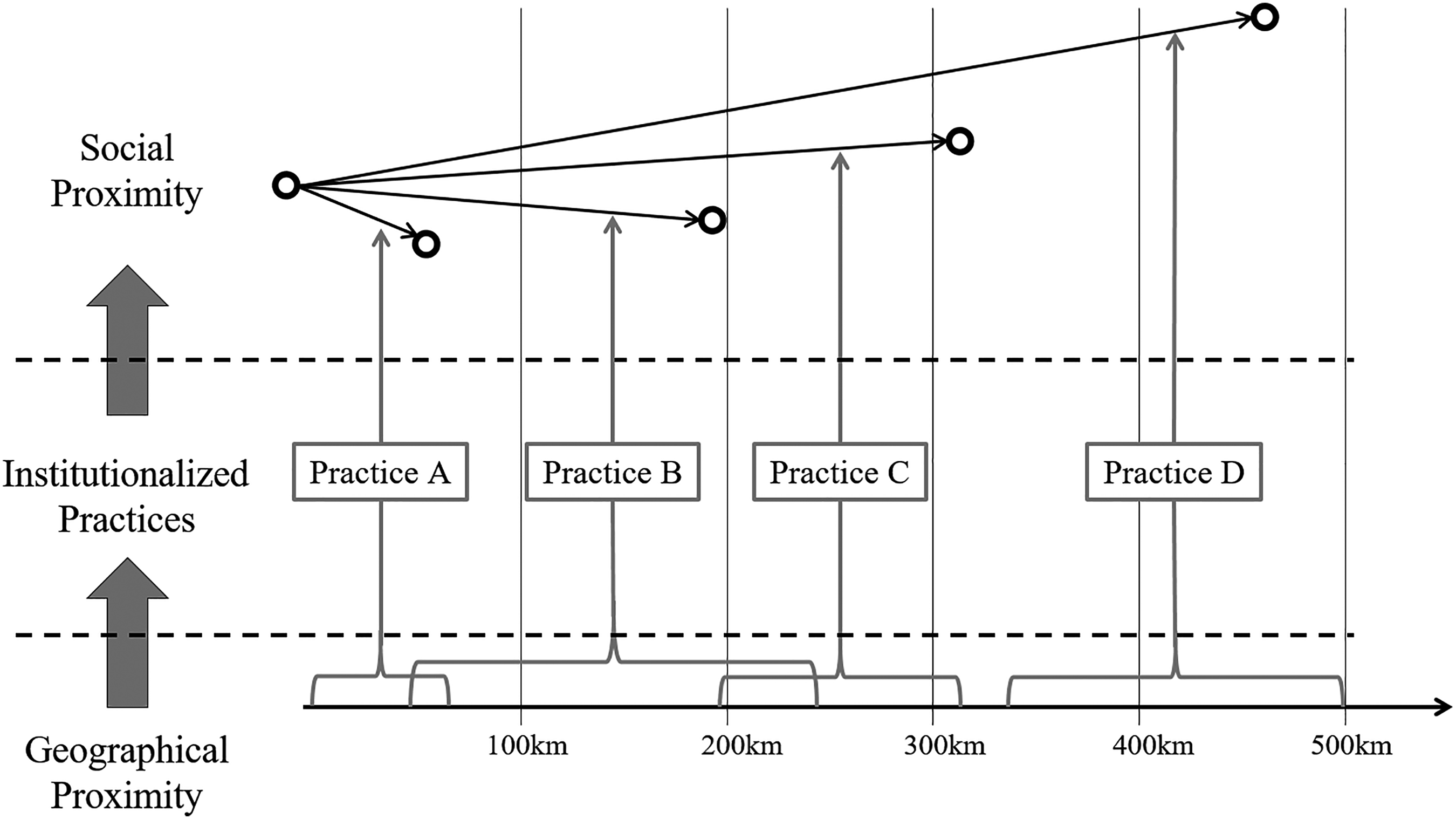
Geographical proximities are institutionally associated with specific practices that are constitutive for tie formation.
In the following, we will empirically investigate the link between geographical and social proximity among the partners of interorganizational innovation projects. To do so, we will first draw on qualitative data to identify practices institutionally linked to specific proximities and their impact on tie formation. For each practice, we will inductively derive a proposition. Summarizing these, we will formulate a hypothesis that postulates a U-shaped correlation according to which great proximity but also great distance is conducive to tie development. Finally, we will quantitatively test and confirm this hypothesis.
Methods
Empirical setting
The empirical study examines the development of personal ties in 20 innovation projects, funded by the German Federal Ministry of Education and Research, in which German-based companies and research organizations work together for three years. On average, the consortia consist of six organizations, each represented by two individuals. In all cases, the innovations relate to the digitization of organizational processes in the companies. The consortia were built on the initiative of the participating organizations.
The 20 projects considered here are a selection from over 100 project proposals. The selection was made by an expert committee. An important criterion for the selection of projects, which was clearly stated in the call for proposals, is the composition of the consortium. A prerequisite for consideration of the project proposals is that the consortia represent a balance of organizations from research and industry. In the 20 selected projects, the average ratio is approximately 60% companies to 40% research organizations. In addition, the research partners must represent distinct disciplines. The consortia must be composed in such a way that the individual partners clearly differ but complement each other in a meaningful way with regard to the innovation goals. We expect that, as a result of these selection criteria, the consortia display medium cognitive, organizational, and institutional proximities (Ooms et al., 2018). All partners are located in Germany. The mean geographic distance between partners is 122 km and the standard deviation is 132 km. The low social proximity before project initiation (cf. also section Linking geographical and social Proximity) and the large variance in geographic distance between partners are favorable for the here intended investigation on the influence of geographic proximity on the development of social proximity.
Data collection
The data was collected as part of an accompanying scientific project on the development of personal ties in the 20 projects of the state funding program [blinded project information]. Data collection was carried out in all projects after about one year of the project's duration. This was possible because the projects started in a staggered manner. The mixed-method data collection in 17 projects was completed before March 2020 and in the three remaining projects a little later, so that the possibilities for personal encounters were only marginally affected by Covid-19 restrictions. All project employees were recruited to participate in the study. The funding ministry communicated the expectation of taking part, which made it possible to include the full sample. We ensured that the data would be anonymized at both the personal and project level.
Social proximity was surveyed in a standardized way using a digital relationship questionnaire (Wasserman and Faust, 2014). This involved asking each person about every other person from their own project. Among other questions, participants were asked how well they knew other project partners or to what extent professional or private communication had taken place. In order to trace the development of relationships during the project, it was further asked how well the partners knew each other before the initiation of the project. The questions were answered using a 7-point Likert scale. All 245 requested persons completed the questionnaire. In total, 2132 seven-dimensional, directed and weighted (from 0 to 6) personal relations were collected in this way.
Geographical proximity was defined as the linear spatial proximity between partners. These were calculated on the basis of the address data available to us for the participating organizations. Because the locations are connected to each other by different transport infrastructures, the travel costs associated with the same linear distances can vary (Torre and Rallet, 2005). We therefore considered determining the travel distances and travel times for all 2132 ties. Considering the high density of the German road network, which suggests a low variance between linear distance and travel times. To double-check this expectation, we determined a layered random sample (20 relations from each of the four distance groups defined below) and tested how strong the correlation between linear distance and driving distance and between linear distance and driving time is in the sample on hand. The statistical analysis shows a Persons R above 0.9 for every single group, so that a very strong correlation between the different forms of distance can be assumed. We therefore use linear distances between the partners as a proxy for geographical distance in the following. We thereby work with the organizations’ addresses and not with the home address of the project members. Even though this might not reflect the exact number of kilometers traveled, distances between home address and work place tend to be rather low in Germany (Pütz, 2020), which makes the deviation negligible.
Practices that were instrumental in the development of the relationships were captured with qualitative interviews conducted by telephone. In light of the spatial, social, and organizational relations, qualitative interviews were conducted with 243 persons lasting on average 27 min. In these interviews, the development of personal social relationships was reconstructed (Hollstein, 2011). To this end, we first asked which specific events and practices were important for the development of the relationships depicted in the relationship questionnaire. Subsequently, the structural causes for this were explored by asking openly about how they came about in detail. Finally, in addition to spontaneous follow-up questions for clarification, the relevance of factors such as characteristics of individuals and organizations, existing direct and indirect relationships, the organization of the project, or situational or geographic spatial conditions was also questioned.
Data analysis
In order to identify the practices that make spatial distances effective for tie formation, the interview data were analyzed using qualitative content analysis (Gläser and Laudel, 2013; Miles et al., 2014). For this purpose, codes were first deductively derived from our theoretical considerations and then inductively differentiated and supplemented using the empirical material. The codes describe the (communicative) practices found in the interviews. In addition, codes were developed that describe the preconditions and consequences of the practices. For the question of interest here, the focus was on those cases in which geographical proximity was addressed. Comparing all these cases, we formed a typology of practices relevant to tie formation and related geographical proximity. In doing so, we aimed to keep the number of types as manageable as possible while adequately representing all significant differences.
In the second step of the analysis, the practices were assigned to specific geographical distances. For this purpose we identified thresholds for the distance categories based on the qualitative data. To this end, we collected concrete statements about conditions for certain practices from the interviews. Even if no exact linear distances were stated, information on acceptable travel times, for example, could be translated into such. Furthermore, we looked up geographical distances in our quantitative data where relevant practices were described without reference to distances. This was possible because both datasets contained the IDs of the actors. Finally, we arranged the practices based on spatial distances, identifying thresholds relevant to tie formation and categorized them into four distance-based groups. The resulting groups are 0–10 km, 10–100 km, 100–220 km, and more than 220 km. The first threshold is a linear distance of 10 km and marks the limits within which actors move on a daily basis and within which spontaneous meetings can be realized easily. Up to a distance of 100 km, smaller trips are required, but these can be accomplished easily by regional train or car. From 220 km linear distance, trips reliably take longer than three hours, according to our investigations. This is roughly the limit that causes actors not to travel back on the same day. These thresholds and the resulting groups contain some fuzziness but, because they were developed inductively from the material and thus reflect the social meaning of specific geographic distances, seem to be much more appropriate than thresholds that are numerically symmetric.
In the third step, the five propositions that we derive from the qualitative analysis are summarized in a hypothesis and tested statistically on the basis of the standardized data on social and geographical proximity. Since it is assumed here, following the institutionalist concept of space, that distances do not have a direct and linear effect on relationship formation processes, but are typified and associated with practices according to institutionalized rules, distance is treated as a nominally scaled variable, despite the fact that the variable could also be interpreted rationally scaled. For this purpose, the thresholds identified in the qualitative analysis were used to divide the dyads into four distance-based groups. As a result of this theoretically based scaling, an analysis of variance and not a regression analysis was calculated (Tabachnick et al., 2019).
Findings
The findings are organized into three sections. The first section presents five space-related and tie-forming practices that we identified on the basis of the qualitative interview data: Meeting face-to-face, Unplanned encounter, Business meeting in gastronomic facilities, Traveling together, and Overnight stay. The practices identified here are well known in research, as we will indicate with literature references. The value of the analysis conducted here lies in mapping them systematically and empirically founded. Beyond describing the practices, we will formulate corresponding propositions in each case and address how strongly the practice is coupled to the associated spatial distance and how effective the respective practice is for the formation of personal ties. Effectiveness accordingly describes the extent to which practices are conducive to the formation of strong personal relationships and coupling how reliably and unconditionally the geographic distance between partners induces the associated practices. We will describe the correlations in concise propositions. Further, we will indicate the effectiveness by the number of “+” signs (maximum three) and the strength of the coupling by the saturation of these (gray for weak and black for strong).
In the second section, we will map these practices to linear distances in preparation for the quantitative analysis of the interrelationship between geographic and social proximity that we will present in the third section. Finally, we will discuss the results of the statistical analysis and examine the extent to which the results correspond to the expectations we developed based on the qualitative data.
Meeting face-to-face
The empirical data reflects the advantages of proximity as assumed in the literature (Nilsson, 2019; Small and Adler, 2019). The greater the geographical proximity, the more likely is it that necessary communication will be carried out face-to-face. If we hadn't had such short distances, no one would have made the effort to meet in person for the second meeting. Because then there's the whole journey, getting there and back. That would have been more likely to be solved via a conference call. (I127)
Especially when the physical distance is greater, we try to do that via email or phone or any Skype meetings or something like that. So that's why we're not there quite as often. (I23)
Since projects continuously generate needs for coordination and a preference for face-to-face meetings is widespread, geographical proximity between partners reliably results in more personal contact, which is why we regard the short spatial distance (0–10 km) as strongly coupled to the practice of face-to-face contact. However, the effect of these encounters on relationship building tends to be small, as they are usually severely limited in time and focused on a specific, work-related objective. They therefore offer little scope for getting to know each other better on a personal level.
The shorter the spatial distance, the more frequently meetings are held face-to-face.
Unplanned encounter
If the geographical proximity is high (0–10 km), it further happens that people meet each other unplanned (Irving et al., 2020; Toker and Gray, 2008). That happened two or three times that we ran into each other and stopped and then something like ‘oh I wanted to write you an email anyway’ came up and then you stood there for ten minutes. And then maybe you said two sentences that also went beyond the project and were of a private nature, which you only do when you are face-to-face and not if I had written an email. (I59)
Because there is no agenda for the unplanned meetings, but it is nevertheless obvious to talk to each other, conversations are likely in these situations, that go beyond the necessary project communication.
Although they are usually rather brief, these encounters are thus effective for relationship building. However, their link to spatial proximity is weak. Spatial proximity alone hardly leads to coincidental encounters. In addition to serendipity, shared foci, such as working out in the same gym, are crucial for their occurrence.
Partners in the same city are more likely to meet unplanned and thus get to know each other better.
Business meetings in gastronomic facilities
If partners have a shorter journey and one partner is clearly defined as the host, it is a matter of course that the meetings take place in the host's office space (10–100 km). When partners are located in the same city (0–10 km), however, it happens that they decide to place work-related meetings not at the workplace, but in gastronomic facilities localized between the partners. One time we went to the beer garden, the other time we went to the Christmas market together, where we discussed the professional topics, but of course also exchanged a lot of private information. The communication that had to take place professionally was a bit of an introduction to this private exchange, so that we also got to know each other very well. (I127)
These meetings differ from chance encounters, which in principle could also take place in gastronomic facilities, in that they are explicitly planned as business meetings. Because of the atmosphere, private topics are more likely to be discussed in such places and the partners get to know each other better (Cabral-Cardoso and Pina e Cunha, 2003; Pina e Cunha et al., 2008).
However, since these meetings are embedded in the daily schedule of the partners, the time frame is usually tight and the possibility to deepen topics beyond the project is limited. Furthermore, even if the spatial requirements are met, moving meetings to such locations and especially combining them with a break or after-work time is rather rare and requires, in addition to spatial proximity, a high degree of sympathy.
Partners localized in the same city are more likely to move
project-related meetings to gastronomic facilities and thus get to know each other better.
Traveling together
Long distances (100 km+) have an indirect effect on tie formation when partners who are close to each other (0–10 km) have to overcome them at the same time. Then it happens that travels are undertaken together. We took him with us in the car, simply because he also lives in the city. And on a three-hour drive like that, you also talk about private things. (I73)
I don't really have any other points of contact with Mr K in the project. But I went to A with Mr K on the train, you travel for a very long time and there I exchanged ideas with Mr K about projects, what else his company was doing, I told him about our company's projects and that's something we still approach today when we see each other in person and we ask about the other's projects again. (I59)
The joint trips have a strong relationship-promoting effect because the people involved are more detached from their daily work routine and spend several hours in close proximity to each other (Faulconbridge et al., 2009; Whillans et al., 2021). It is obvious that conversations will then arise, if only to avoid awkward silences. The interviews show that in this context private topics are often discussed beyond the scope of the project.
Because the long-lasting conversation situations are anticipated and can seem unpleasant, it happens that partners consciously decide against it. Other factors such as sympathy therefore influence whether trips are taken together. Accordingly, the high effectiveness of this practice is contrasted by a rather weak coupling to distance.
When partners from the same region have joint project appointments at a
distance, they may undertake the trips together and get to know each other better.
Overnight stay
Finally, long distances (220 km+) favor getting to know each other because they require overnight stays and it is then common for hosts and guests to spend evenings together (Faulconbridge et al., 2009; Torre, 2008). That was the first inventory [interviews at the company]. That was three consecutive days. And there, of course, you're on site and of course you have to spend the night there. It starts at 8 in the morning and then it runs until 5 pm. So with company A it was like that and I stay there overnight. At company B it's different because they are close by and I can drive there from home. And there it was also divided into two different dates on different days. So there was no overnight stay necessary. (I124)
It made a difference that we were sitting together in the evening having a beer in the brewery. Of course you also talk about how things went during the day. But in this atmosphere, more topics beyond the project are addressed and also much more private things. People talk about topics differently in the evening than they do at work. You really find a different way of connecting with each other. (I157)
Evening get-togethers in restaurants or bars appear to be extremely favorable for getting to know each other. Three aspects in particular are pivotal here. Because the guests are released from most private and business obligations that presuppose their presence at the place of residence, the get-togethers are (1) extended in time more than, for example, shared lunch breaks. Unlike the business meetings in restaurants, which are sometimes held by partners in the same city, they take place after work in a narrower sense. As a result, they are (2) much more open to non-project-related and also private topics. An open and private exchange is further stimulated and (3) by the atmosphere and the consumption of alcohol. Joint evening activities are therefore extremely effective for relationship building.
Because joint evening activities with partners who stay overnight are highly institutionalized, such activities are a matter of course for all partners involved. Accordingly, they are almost independent of any other preconditions, such as personal sympathy. They reliably come about if the distance between partners is great enough and the project gives cause to meet, which is often the case. The practice described therefore combines high effectiveness for tie formation with a strong coupling to a great distance.
Long distances cause overnight stays and shared
dinners, which promote becoming acquainted.
Linking practices and distances
Assigning the five practices to the distance categories derived from the qualitative data results in the pattern shown in Figure 2.
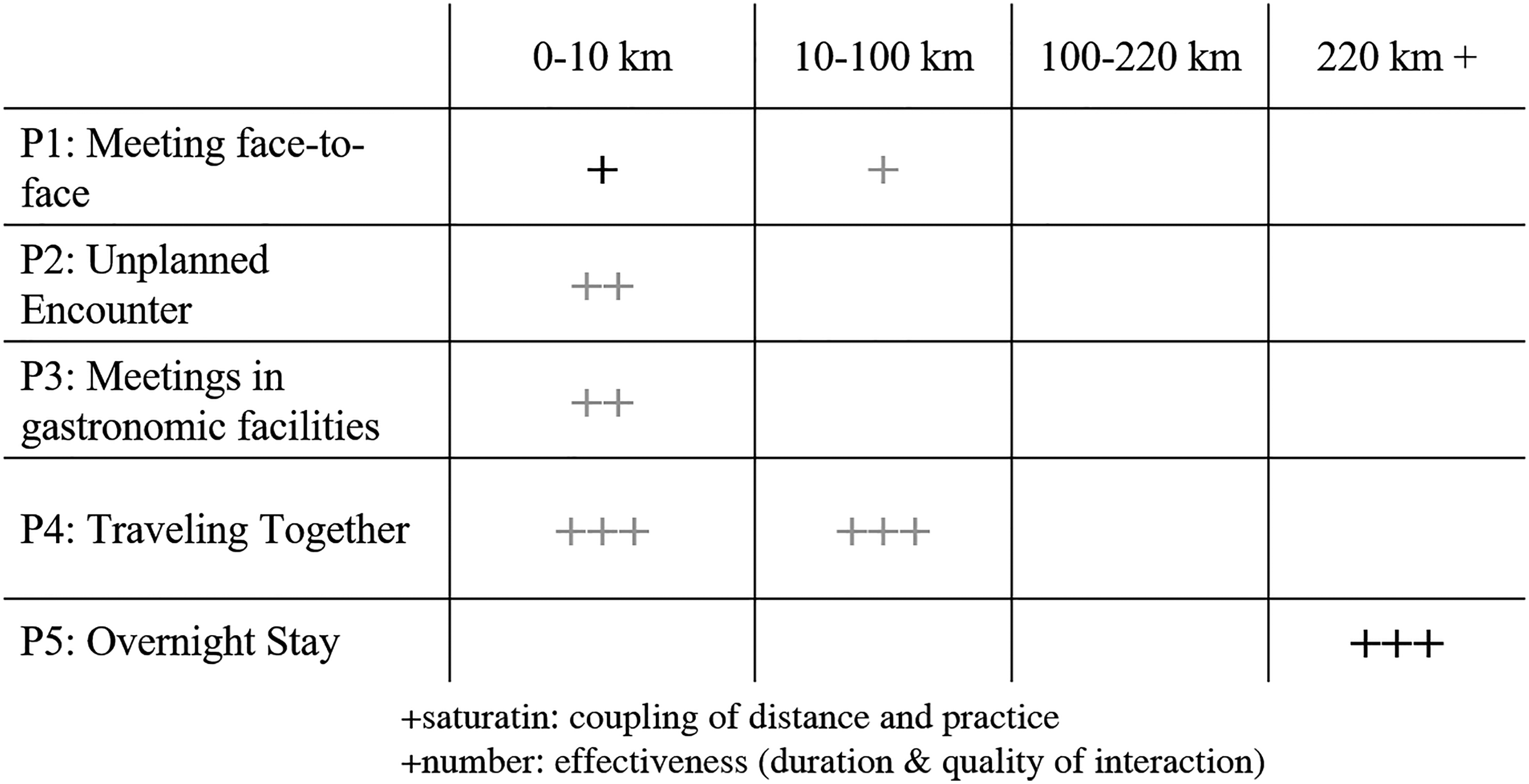
Juxtaposition of the five practices including distance reference, effectiveness, and coupling.
Even short distances (0–10 km) enable several relationship-building practices. However, the occurrence of unplanned encounters, joint trips, and meetings in gastronomic facilities is comparatively dependent on preconditions. They are therefore only loosely linked to geographical distances. The most important effect seems to be that a larger share of the necessary project coordination is done face-to-face. Because the participants remain involved in their everyday activities at the same time, however, these appointments are strongly focused on work content and are not particularly well suited for getting to know each other. Both private and professional topics beyond the project are hardly addressed and mutual knowledge remains rather superficial. In contrast, particularly large distance (220+km) appears to be beneficial for forming ties, because it goes along with practices like overnight stays and shared evenings, and these are particularly conducive to getting to know each other. Overall, then, it can be expected that very close and very long distances are favorable for tie formation in this context, whereas medium distances offer no advantages.
The hypothesis derived from this analysis thus is: Social proximity between national collaboration partners is particularly promoted by geographic proximity below 10 km and above 220 km, so that the relationship corresponds to a U-curve.
Linking geographical and social proximity
To statistically test the presumed interrelationships, it is important to have a sufficient number of ties in the data set for all four distance groups. Figure 3 shows that we found a good distribution in the data with respect to this.
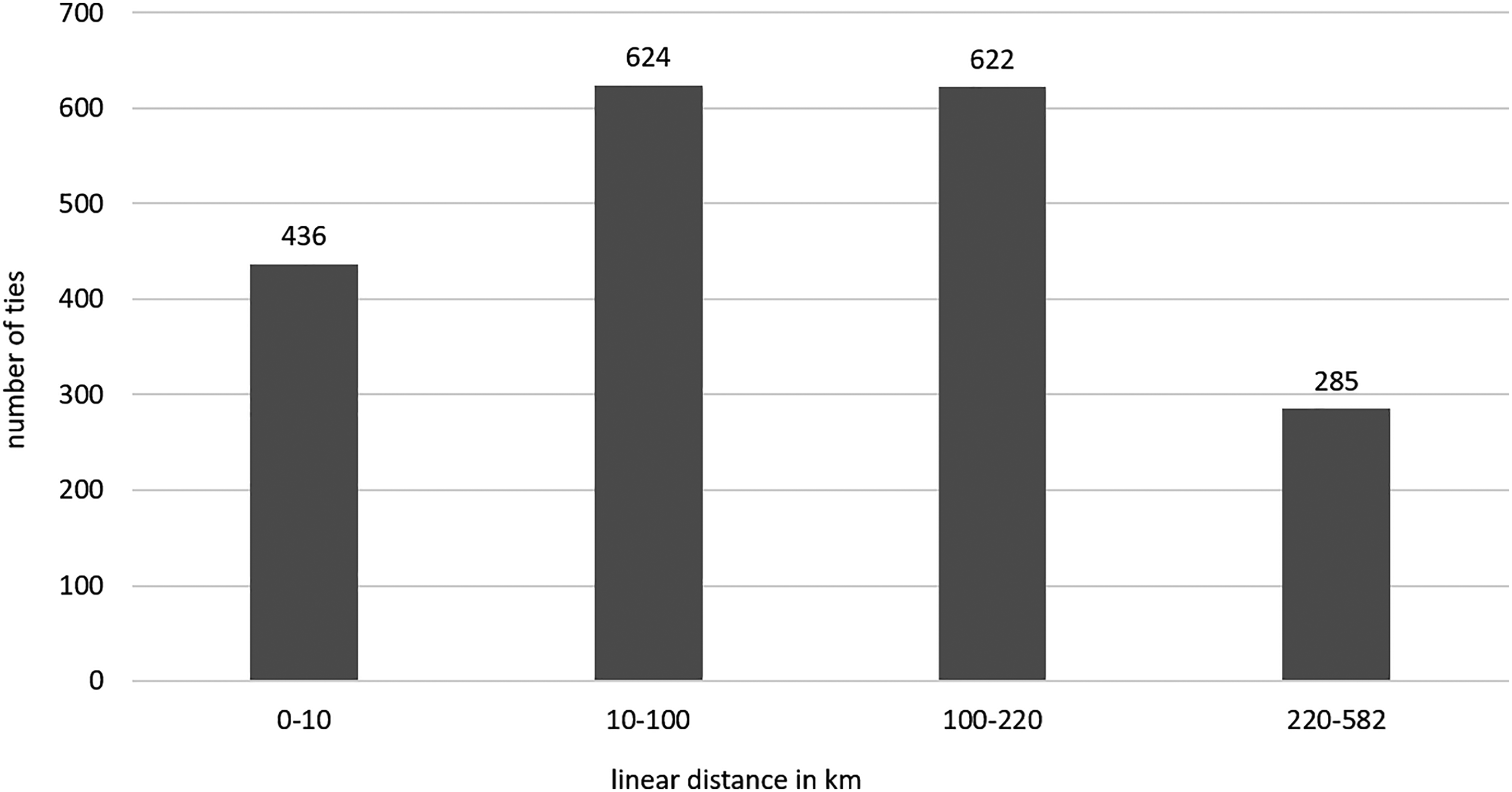
Ties in the sample grouped by spatial distance (number of ties at the top of the bars).
Furthermore, it is important here to consider the extent to which relationships already existed between the partners in the different distance groups before the projects. Overall, our data here shows that only 7% of the partners already had a personal relationship with each other before the project. Comparing the average strength of pre-existing relationships in the four distance groups, we find a relatively balanced distribution on a low level with a slight tendency toward more and stronger pre-existing ties between partners in geographic proximity. While the mean strength of existing relationships between partners no more than 10 km apart is 1.8, it is 1.7 for partners in the group between 10 and 100 km and 1.4 in the two further groups. Due to the overall low level and the slightly higher level of existing relationships between geographically close partners, this baseline provides a suitable basis for our analysis.
The statistical analysis of the data on relationships developed during the projects and the geographical distance between partners reveals a U-curve, with a strong peak at large distances (see Figure 4) and this pattern becomes even more pronounced when we consider that partners less than 100 km apart were most likely to have had relationships with each other before the project began. 2 This picture is in high accordance with the formulated hypothesis. The fact that the spike is smaller in the case of great proximity (0–10 km) than in the case of great distance (220 km+) is plausible: the practices associated with great proximity are weakly coupled in that they have other prerequisites or are not very effective for relationship building because they are strongly focused on the completion of specific project-related tasks. In contrast, great distance probably leads to practices that are particularly conducive to forming strong personal ties. Thus, the data show the benefits of high geographic proximity for relationship formation as described in the literature. However, in sharp contrast to this and in line with our qualitative analysis, we observe that large geographical distances are even more conducive to relationship building due to the associated practices.
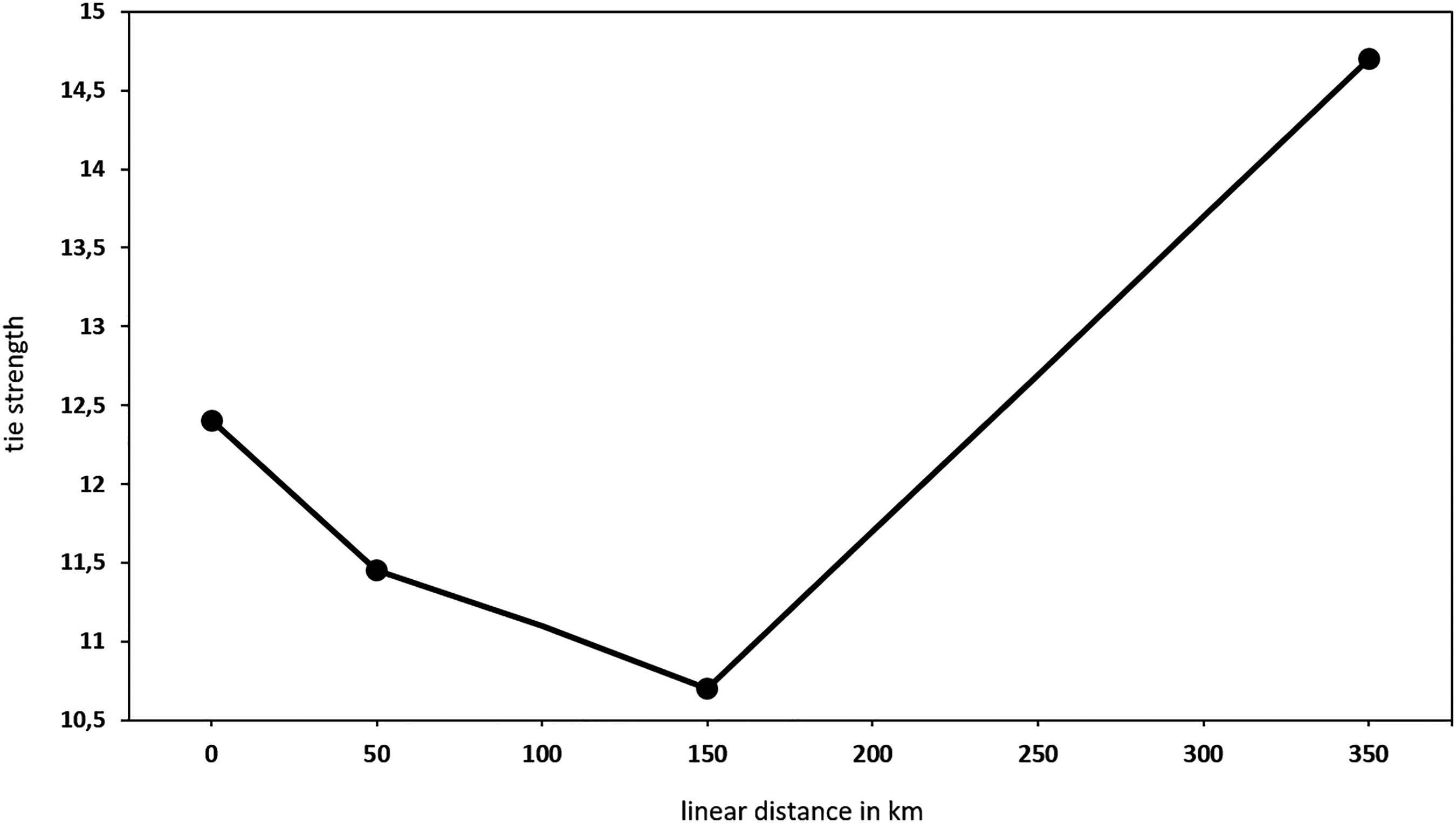
Relation between tie strength (calculated as index of acquaintance, professional exchange and private exchange) and linear distance between partners (n = 1967).
Further consistent with these considerations is that the positive effect of close proximity relates primarily to professional rather than private exchange (Figure 5), which takes place more in the social practices associated with large distances.
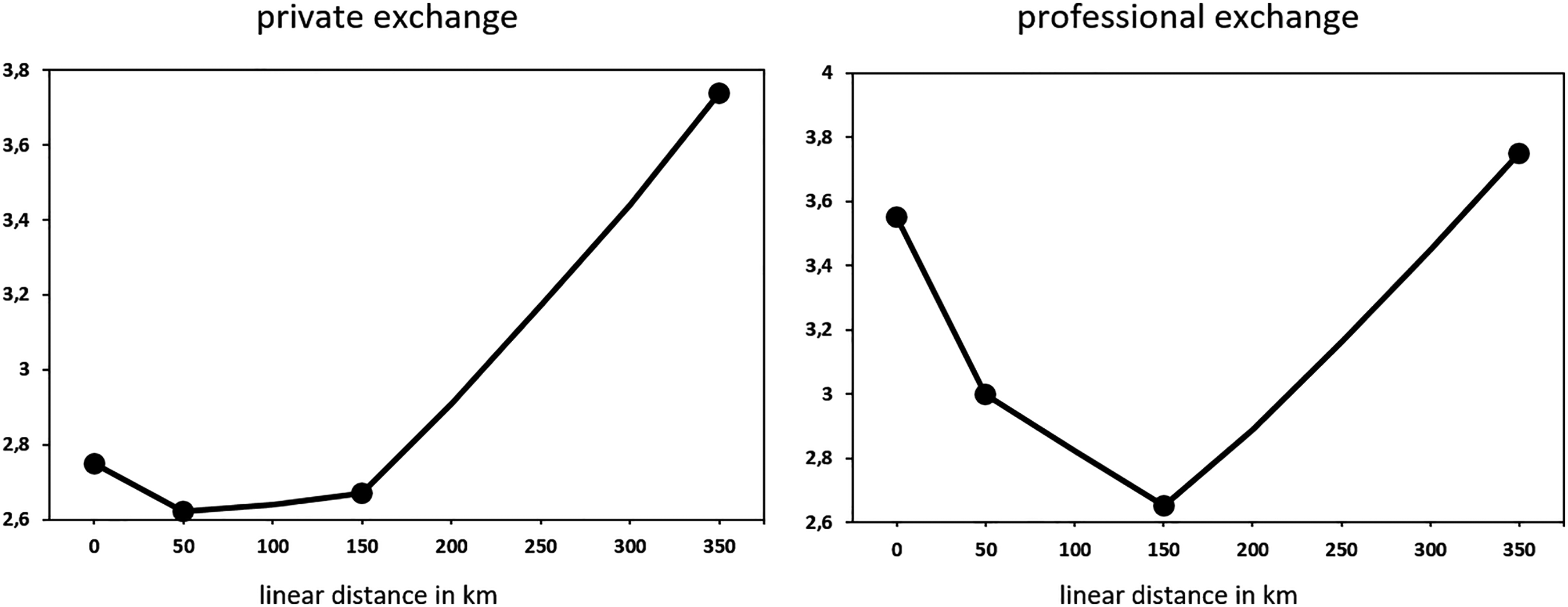
Comparison of professional and private exchange in dependence of spatial distance (n = 1967).
This again underlines the outlined relationship expected because the face-to-face meetings that neighboring partners realize are usually strongly focused on professional exchange while the extended meetings between distant partners offer more opportunities for private exchange.
Discussion and conclusion
The notion that social relations are constituted by practices and that their formation is structured by the spatial relations in which actors stand to each other is well established (Roth, 2019; Small and Adler, 2019). However, until now it has not been systematically applied to the nexus of spatial distance and the formation of personal ties between collaborators. This paper starts from this research gap. We identified five relationship-enhancing practices that are coupled to specific spatial distances between partners. Considering the strength of their coupling and their effectiveness, we expected that, in addition to large geographic proximity, large geographic distance would be particularly conducive to tie-formation. In the statistical analysis of 2132 dyads, these expectations were confirmed.
Contributions
In previous research, it has been possible to demonstrate interrelationships between different forms of proximity among interorganizational collaboration partners (Balland et al., 2015; Broekel and Boschma, 2012; Mattes, 2012). However, it is still unclear how different forms of proximity interact dynamically in time. Our first contribution is to have elaborated on such interactions between social and geographical proximity. We have shown by which practices geographical proximity becomes effective for tie formation and have been able to provide statistical evidence for the relationships expected on this basis. With this microfoundation, our findings offer a deeper and more dynamic understanding of the interplay between geographical and social proximity. Furthermore, the microfoundation provides a solid basis for the organization of interorganizational collaboration, and it reveals not only abstract relationships, but also the concrete practices involved. For example, the organization of project meetings can stimulate carpooling through appropriate requests and overnight stays by selecting appropriate venues.
Second, we have shown that large distances are particularly conducive to tie formation in collaboration projects. Previously, greater distances between partners have been described as productive insofar as they can promote independence and objectivity in the collaboration (Boschma, 2005; Grabher and Ibert, 2013; Hansen and Mattes, 2018). With regard to the development of personal ties between collaboration partners, however, it was previously assumed that face-to-face contact decreases with increasing geographical distance, making it more difficult to build trust and share knowledge that is constitutive for relationships (Nilsson and Mattes, 2015; Ooms et al., 2018). Our findings confirm this assumption. They complete the picture, however, by showing that greater distances are even more beneficial for tie formation because they induce overnight stays away from home, which are particularly conducive to getting to know each other.
These novel findings were facilitated by introducing a practice-theoretic (Giddens, 1979) conceptualization of the nexus between geographic and social proximity and operationalizing it by a mixed-method design (Small and Adler, 2019). Our results demonstrate the merits of this approach. The paper thus contributes thirdly to the conceptual and methodological development of the research field.
Limitations and future research directions
Our findings also act as a starting point and pave the way for further research. First, we have set a narrow focus on the relationship between just two proximities, geographic and social proximities. However, previous research suggests that there are also interactions between other forms of proximity, whose form and microfoundation have not yet been investigated in detail. To us, it seems extremely promising to apply the approach used here in further research on the interaction of other forms of proximity in order to better understand the dynamic interplay between them (Balland et al., 2015).
Second, as our statistical analysis was limited to dyadic proximity, we did not take into account indirect effects. These are however highly probable: For example, our qualitative analysis revealed that doing joint trips together is conditioned by having a third partner allocated in a more distant position. These third-party effects could be considered more systematically in further research. To do so, it would be necessary to put the geographical distances between individual partners in relation to those of all other project partners. Future work could develop adequate procedures to be able to statistically validly trace these interrelations.
Third, we have focused strongly on practices and their (spatial) preconditions, treating actors as equals. The different characteristics, resources and competencies of the actors remained underexposed. However, it seems quite conceivable to us that these are relevant for who accomplishes which relationship-building practices with whom. Extensive research already shows that, for example, the tendency to homophily causes personal characteristics such as age, gender, ethnicity, or hierarchical position to influence who engages in which relationship-promoting practices (such as joint after-work drinking) with whom (Ibarra, 1993; Roth, 2022a). Accordingly, the effects of geographic distances might be moderated by the partner constellation. It seems extremely promising to us to shed more light on such aspects of diversity in further research. The practices we have identified here provide a suitable framework to inform research in this area.
Fourth, our study refers to national research projects within Germany. Apart from more subtle differences between countries, this directly affects the generalizability of the results in three ways. First, due to the size of Germany, the largest distance included in the sample is 582 km. We are therefore not able to show how significantly larger geographic distances between collaborators affect the development of social proximity. Second, Germany is characterized by a specific transport infrastructure. However, how quickly and comfortably geographical distances can be overcome influences their effect on the development of social proximity (Torre and Rallet, 2005). Third, we argued that the relationship between geographic and social proximity is mediated by institutionalized practices. However, institutions differ across cultures (Thornton et al., 2015). Whether geographic distances are equivalent in different cultures with respect to the practical formation of relationships is therefore an open question. Replicating our study in other countries and comparing the results therefore seems extremely fruitful.
Our findings highlight the considerable value of face-to-face contact in situations that tend to occur at the margins of work (Roth, 2022b; Sonn and Storper, 2008). In light of the virtualization of collaboration associated with the Covid-19 pandemic, such have become highly marginalized and first research shows that the development of personal ties declines accordingly (Roth and Göbel, 2022; Whillans et al., 2021). Alongside this, however, it seems conceivable that humans will develop new, media-mediated practices for relationship formation. In further research, therefore, the extent but also the qualitative transformation of the practices underlying tie formation in collaboration projects remain promising fields of research.
Footnotes
Acknowledgments
We thank Handling Editor Henry Yeung, three anonymous reviewers, Sören Petermann, Michael Grothe-Hammer, Raimund Hasse, Laura Göbel and Ronja Rieger for encouraging, precise, and wise feedback on earlier versions of this paper.
Declaration of conflicting interests
The authors declared no potential conflicts of interest with respect to the research, authorship, and/or publication of this article.
Funding
The authors disclosed receipt of the following financial support for the research, authorship, and/or publication of this article: This work was supported by the Bundesministerium für Bildung und Forschung, European Social Fund (grant number 02L17C000).
