




Abstract
The evolution of knowledge networks has recently received a lot of attention from researchers. Empirical studies have shown that different types of proximities and network structural properties play a decisive role in tie formation. The present paper contributes to this literature by arguing that while these are crucial, they do not capture the full range of localities’ influence on the evolution of knowledge networks. We support our argument with an empirical study on the development of the biotechnology knowledge network of Berlin from the early 1990s till 2016. The network was created by combining data on co-patenting, co-authorship and joint R&D projects. Forces driving the evolution of the network were identified with separable temporal exponential random graph models (STERGM). In addition to the ‘usual suspects’ (main proximity dimensions and structural factors), we found that the network is still developing in the ‘shadow of the wall’. The different social contexts in the different parts of the city of Berlin still hamper the establishment of collaborative ties between the former East and the former West Germany even 30 years after reunification.
Introduction
The development of the former East and West Germany after reunification has been studied from a wide range of perspectives (Hardy et al., 2019; van Hoorn and Maseland, 2010; Vogel et al., 2017; Wenau et al., 2019), with the reoccurring observation of limited economic convergence (Maier and Cavelaars, 2004). One can argue that the underperformance of the innovation system in former East Germany limits firms’ and regions’ opportunities to diversify into economically attractive sectors and to develop competitive products and services (e.g. Wagner, 2016). The underperformance of the East German innovation system is a consequence of the lower level of R&D activities (Broekel, 2012; Fritsch and Slavtchev, 2011). However, the two systems seem to have failed to converge in other dimensions as well. Jun et al. (2016) show that the East German knowledge network was much more centralised than its West German counterpart before reunification. These differences disappeared slowly as few direct ties between the two parts were established in the first 20 years after reunification. Rather, organisations outside Germany functioned as bridges in the early years (Jun et al., 2016). While the integration of the two networks (and thereby innovation systems) has continued, it seems to have slowed down significantly since the mid-1990s (Jun et al., 2017). Consequently there are still substantial differences between the former East and West Germany, which, for instance, is shown in differences in the embeddedness of regions in interregional knowledge networks (Fritsch and Graf, 2010).
Contemporary studies emphasise the importance of different types of proximity and network structural properties for the spatial evolution of knowledge networks (Boschma, 2005; Glückler, 2007). While these also find consideration in the present study, we argue that in addition it is important to consider context as an additional explanatory dimension. In doing so, we hope to reanimate the discussion on the importance of localities (Cox, 1998) and the geo-history of places (Paasi, 1991). We put forward that these can complement the focus of contemporary studies on dominant proximity dimensions (i.e. geographical, social, cognitive, organisational and institutional) and network dynamics, as they may give rise to unique and place-specific ‘social foci’ (Feld, 1981), which in turn shape the evolution of knowledge networks.
This study presents an analysis of the evolution of the knowledge network of the biotechnology industry in Berlin between 1992 and 2016. For the empirical construction, we combine relational information on patents, scientific publications and R&D projects. In addition, we use a separable temporal exponential random graph model (STERGM) to identify factors facilitating tie creation and those contributing to their persistence.
Our results confirm that in addition to basic organisation-level characteristics and network structural effects, geographical, institutional as well as social proximities played a role in the evolution of the network. Moreover, their relevance varies over time. Crucially, our findings highlight that the existence of different social contexts in the city is reflected in the dynamics of the knowledge network.
This paper is organised as follows. Section 2 gives an overview of common theoretical approaches used to explain the evolution of knowledge networks, with a focus on the proximity framework and network theoretical arguments. This section also presents an additional approach that complements these rather universal factors. Section 3 provides a brief overview of the Berlin biotech sector. Section 4 concentrates on the empirical part of the study by introducing the data and method employed, as well as the construction of the empirical variables. Section 5 presents and discusses the findings. Section 6 concludes the paper.
Driving forces of network evolution
Disentangling how organisations and individuals establish collaborative (knowledge) ties has become a flourishing line of research. Its motivation can be found in empirical studies that provide evidence on collaborative ties substantially contributing to combinatorial processes whereby organisations put knowledge pieces together to increase the odds of novelty and innovation (Ahuja, 2000; Giuliani, 2007; Giuliani, 2013; Powell et al., 1996; Weitzman, 1998).
In recent years, the proximity framework has gained a prominent position as a theoretical basis for explaining the evolution of knowledge-exchange networks. The concept of proximity is closely related to that of homophily and focuses on the degree of similarity between organisations in one or several dimensions. Boschma (2005) condenses these into five proximity dimensions, which are argued to increase the likelihood of two organisations establishing a collaborative tie. The five dimensions are geographical, cognitive, social, organisational and institutional proximity.
While additional types of proximity have been discussed in the literature, the five proximity dimensions have particularly stimulated the emergence of a rich set of empirical studies investigating the relative importance of the five dimensions in the evolution of knowledge networks. For instance, Balland et al. (2015) empirically confirm the positive impact of a number of proximity dimensions on business and on technical knowledge ties. Capone and Lazzeretti (2018) demonstrate that proximities’ effects vary in magnitude for triggering the establishment of ties, with social proximity being the most influential one. Interestingly, Molina-Morales et al. (2015) and Belso-Martínez et al. (2017) report a negative impact of cognitive and institutional proximities on tie formation.
In complementarity with the proximity framework, network science contributes theories and empirical findings to the study of knowledge networks. This literature particularly highlights two endogenous network effects, namely cohesion and status. 1 Cohesion effects refer to the inclination of individuals and organisations to create new ties based on their actual embeddedness in social networks. This tends to increase the number of cliques and the overall network density as new ties are created through reciprocity and triadic closure (Boschma and Frenken, 2010; Giuliani, 2013). The ubiquity of cohesion effects reflects the significance of trust and the need to have a higher degree of control over the exchange of valuable knowledge (Uzzi, 1997). Status effects, which are also known as preferential attachment, refer to the establishment of ties driven by the number of ties that organisations have already established. In many networks, this leads to a small number of organisations becoming more central at the expense of the majority of organisations, which occupy peripheral positions (Barabási and Albert, 1999).
While both literatures (proximity framework and social network theories) have received substantial attention in the literature on knowledge networks (Balland et al., 2013; Boschma, 2005; Glückler, 2007; Torre and Rallet, 2005), we argue that they do not fully take into account the importance of place-related factors. Put differently, by underlining the importance of the abovementioned general forces, they tend to overlook more place-specific factors that are nevertheless helpful for our understanding of the evolution of networks. Such place-specific factors are related to, but go beyond, the concept of cultural proximity, which captures the commonalities and differences among individuals embedded in places with various historical events and institutional settings (e.g. Accetturo et al., 2019; Ji et al., 2019).
As we put forward in the following section, context represents a complementary analytical dimension. We argue further and show that its explanatory power can only be assessed and isolated by considering the more ‘universal’ factors (the main proximity dimensions and network structural effects) in empirical studies.
Crucially, context is not free of theory. In particular, insights from the ‘social foci’ literature (Feld, 1981) appear to be a powerful complement to the five proximity dimensions and network theories when it comes to considering context in the evolution of (social) networks. In the social foci literature, it is argued that specific social environments stimulate the creation of ties among organisations when they share common or similar ‘social foci’. Thereby, a social focus is ‘any social, psychological, or physical entity around which joint activities of individuals are organized’ (Feld, 1981: 1025). In other words, it is a kind of frame that keeps groups of individuals together. This idea is similar to Heider’s (1946) balance theory, according to which ‘sentiments’ among individuals need to be in harmony to make ties between them last. Feld (1981) argues further that social ties are established and sustained based on the compatibility of foci in which individuals are embedded. This implies that transitive relations do not necessarily result from having a common third; they may rather have their basis in the compatibility of pre-existing foci.
The social foci literature argues that, in contrast to most proximity measures at the dyad level, the interplay among individuals with specific entities influences their interactions. That is, organisations may interact relatively independent of any kind of shared characteristic or intervention of other individuals. Workplaces, families and voluntary organisations are typical examples of such foci (Feld, 1981). The difference from (social) proximity becomes clearer when considering that two individuals can jointly participate in multiple foci to different degrees, while social proximity is conceptualised in a rather one-dimensional way. In the social foci framework, individuals can simultaneously have different types of relations depending on the context they are in. For instance, they might be very close at work but distant in their private lives. Hence, social foci include content-specific and multilayer (and multilevel) relations that are insufficiently represented by one-dimensional proximity conceptions.
By considering multilayered relations, the social foci theory explains, for instance, the observation that social relations tend to deviate from the strong separation into cliques that are to be expected when homophily/social proximity are the sole drivers of the evolution of networks (Feld and Grofman, 2011). Like proximities and network structural effects, social foci have a temporal dimension. While the joint participation of individuals and organisations in common or compatible foci stimulates new ties, these may in turn facilitate the emergence of new foci.
While the conceptual framework of social foci is used and perceived as helpful in empirical works in sociology and management (Feld and Grofman, 1990, 2011), it has so far received little attention in the study of (spatial) knowledge networks. In part, this may be due to its conceptualisation at the individual level, while in the literature on (spatial) knowledge networks, the focus is mostly on interorganisational relations. However, we argue that it can be used to link the traditional ‘localities debate’ in economic geography, which highlights the relevance and specificities of places (Cox and Mair, 1988, 1991) to the contemporary literature on networks and proximities. Concepts such as industrial districts (Scott, 1985), the spatial division of labour (Massey, 1984) and moral communities (Damer, 2011) are based on the idea that localities have to ‘be conceptualized as a structure of local social relations in the realist sense’ (Cox, 1998: 28). In the present study, it is therefore argued and empirically shown that social foci matter for the evolution of interorganisational knowledge networks. We thereby underline that social contexts are important and need to be taken into consideration when studying knowledge networks, as otherwise place-specific factors might get overlooked or condensed into general factors.
The Berlin biotech sector
While Germany is home to several large pharmaceutical companies (e.g. Hoechst, Schering, Bayer and BASF), a disadvantageous legal environment and an unsupportive social context hampered the diversification of large companies and the emergence of biotech spin-offs and start-ups for a long time (Lehrer, 2005). The severity of this is reflected in the share of biotech patents filed by new German technology-based firms (3%) and the relatively low number of active biotech firms in Germany (13 times fewer than the one in the USA) in the early 1990s (Lehrer, 2005).
A shift in policy changed this situation. First, new support programmes made an effort to encourage and promote biotech start-ups, which clustered around large companies and publicly funded research institutes in the mid and late 1990s (Dohse, 2000). For instance, the BioRegio competition in 1995 gave rise to 17 incubators in German regions (including in Berlin). These supported the private biotech sector and stimulated a wide range of interactions between start-ups, venture capitalists, banks and publicly funded research institutes (BMBF, 1996). Second, to overcome the long-lasting effects of the East–West divide, complementary programmes at the EU and the national level were created to integrate peripheral and central regions within Germany and Europe (e.g. the European Framework Programmes for Research and Technological Development).
In Berlin, universities and public research institutes acted as the focal points and building blocks of this new sector. From the late 1990s onwards, the new policies started to become effective and the number of small and medium-sized biotech enterprises grew in Berlin. Eventually, Berlin became one of Germany’s five biotech clusters (Ter Wal, 2014). Figure 1 shows the geographic position and the name of the most important actors, and Figure 2 illustrates collaborative ties between organizations in the Berlin biotech industry. Various departments and clinics affiliated with the Charité Medical School (Humboldt University and Free University Berlin) as well as several departments of the Technical University of Berlin (TU Berlin) are the most productive publicly funded actors residing in Berlin Mitte and Charlottenburg respectively. This presence of such organisations, private companies and university spin-offs appears to have created a relatively dense micro-cluster in the centre of the city stretching to both sides of the former Berlin Wall. In addition, Adlershof represents a second micro-cluster within the borders of the city (East Berlin). In that cluster, in particular the Institute of Chemistry and Physics of the Humboldt University and several research centres of the Leibniz Association agglomerate.
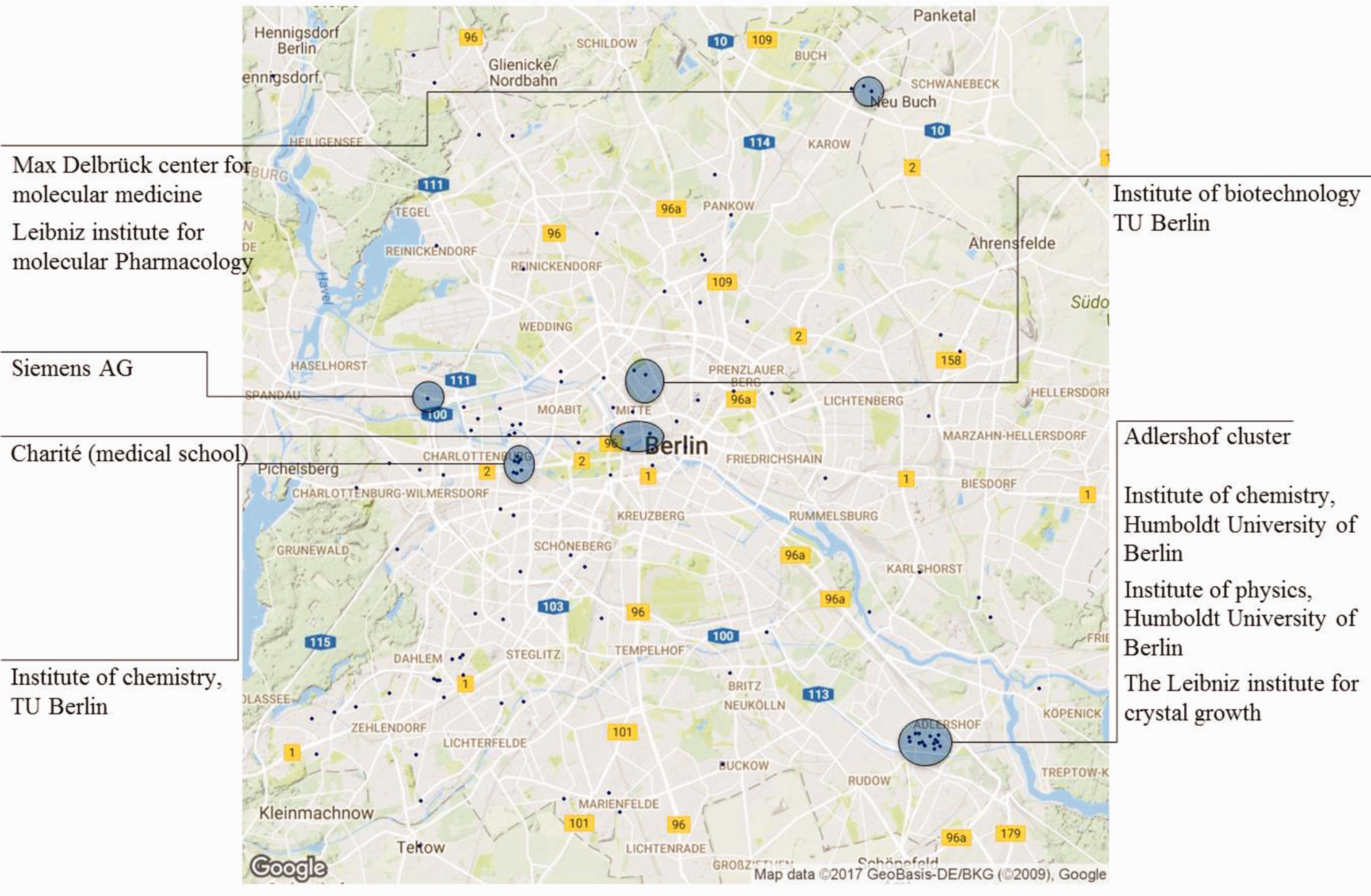
The distribution of firms and organisations (dots) in the biotech sector in Berlin.
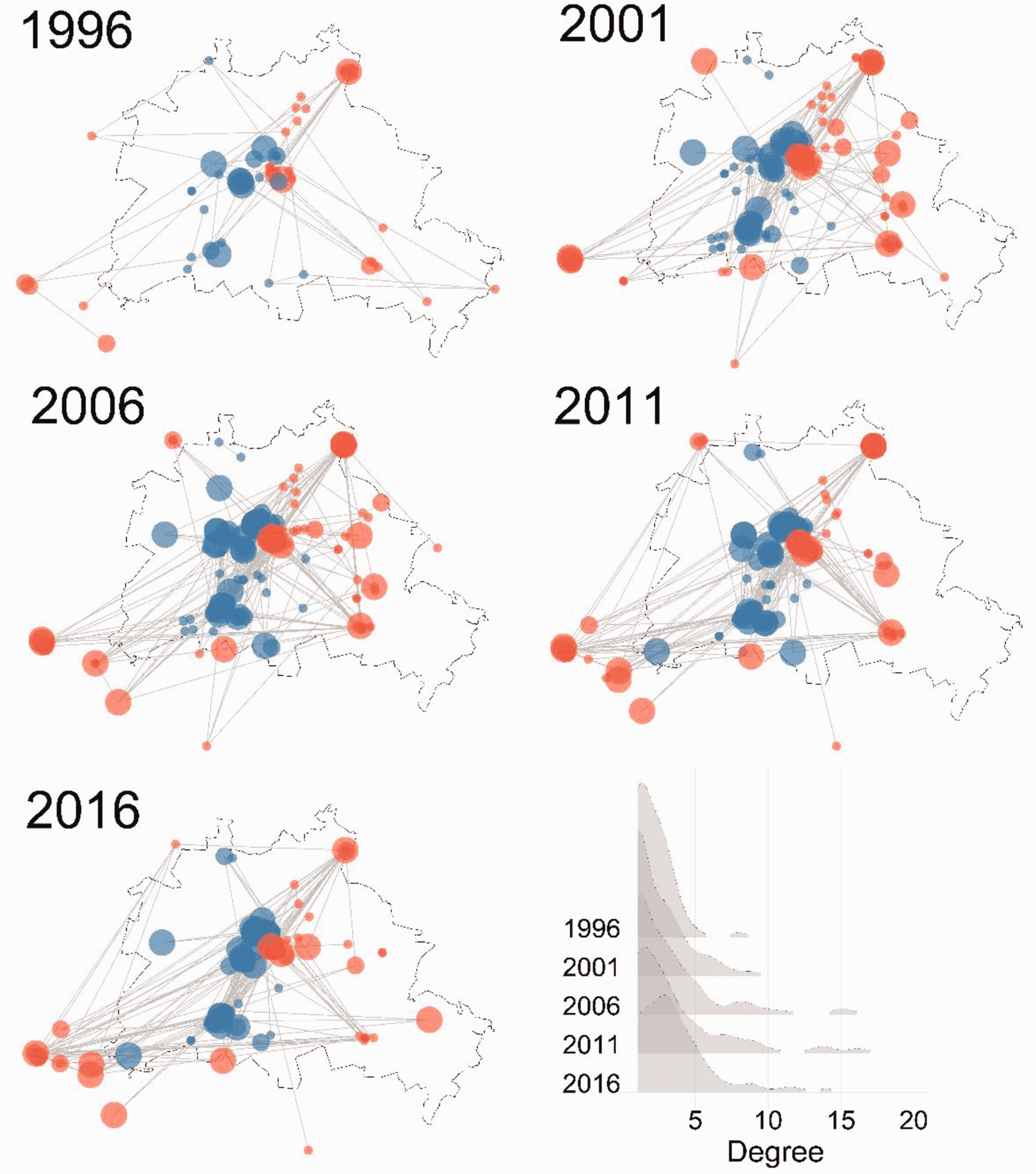
The Berlin biotech knowledge network over time and its degree distribution (bottom right).
The emergence of the cluster falls into the growing phase of the biotech sector, in which the explorative approach was replaced by knowledge integration as a dominant mode of innovation activity in the late 1990s (Nesta and Saviotti, 2006; Ter Wal and Boschma, 2011; Abbasiharofteh, 2020). However, the local biotechnology innovation system in Berlin faced difficulties in integrating and overcoming the East–West divide. For instance, Kulke (2008) investigated the case of Adlershof and found that although this location has succeeded in attracting a large number of firms, universities and public research institutes, it has failed to develop local collaborative ties and intensive knowledge sharing activities.
In sum, the biotechnology sector in Berlin did not emerge on its own or via private initiatives, but was largely stimulated through top-down policies (Dohse, 2000). While this was successful in helping the growth of the sector in the city, existing research does not suggest the existence of a vibrant local milieu and a strong local knowledge network (Kulke, 2008). This raises two important questions. First, what does the knowledge network in this city look like and how did it develop over time? Second, what were the factors that shaped its evolution and to what extent did the history of Berlin as a divided city play a role in this? Given the fact that the biotechnology sector in Berlin only started to develop after the mid-1990s, the wall did not directly impact or prevent knowledge-sharing activities. However, we argue that there is still a ‘shadow of the wall’ in the form of an East–West difference in knowledge sharing activities 30 years after reunification. This ‘shadow’ is hypothesised to be rooted in the city’s specific context that has created distinct social foci and identities in the East and West part of the city, which are still shaping the evolution of the interorganisational knowledge network. While part of this context-specificity can be captured by the different proximity dimensions, abstracting it as such implies losing out on many interesting insights and implications.
Empirical approach
Data
Knowledge networks are frequently approximated using secondary data, for example patent data, publications and R&D projects (Autant-Bernard et al., 2014). 2 Each source entails a number of advantages and disadvantages (for a review, see Hagedoorn and Cloodt, 2003). However, few studies offer a more complete picture of collaboration networks by integrating different data sources and hence building so-called multiplex networks. Notably, Breschi and Catalini (2010) conduct an explorative study by combining data on co-invention and scientific co-authorship in three knowledge-intensive fields (semiconductors, lasers and biotechnology). Similarly, de Stefano and Zaccarin (2013) use information on co-authorship and co-invention as well as an exponential random graph model to infer about the drivers of tie formation (clustering and the status effect) in the Trieste area. In addition, there are other studies that utilise, but do not combine, multiple data sources for the construction of knowledge networks (see, e.g., Lata et al. 2015). In the present article, we created a multiplex knowledge network between organisations based on collaborations that include at least two collaborating organisations in Berlin or its surrounding regions at the NUTS-3 level. More precisely, we combined the information on knowledge-related interactions in the Berlin biotech cluster from the following three databases.
Patent data. We used the OECD REGPAT database. The database contains information on granted patents such as: the date of a patent application, its technological classes and its involved inventors and applicant(s). We focused on patents granted after 1990. 3 Information concerning patenting in biotech was refined by selecting patents assigned to International Patent Classification (IPC) codes for biotechnological activities. 4 To locate the collaboration networks in space, we retrieved the addresses of inventors (not assignees). This inventor-principle usually ensures that locations correspond to where inventive activities take place, and not to organisations’ headquarters that might be located elsewhere. 5 We assumed that there is a knowledge tie between two given organisations when they worked on a patent. It is worth noting that organisations (nodes) mostly consist of firms and university departments where researchers co-locate in the same building. Although two university departments in Berlin are organisationally proximate, we defined them as two separate nodes because researchers in these two departments do not interact daily.
Scientific publication. For knowledge-related interactions based on co-publications, we made use of the Web of Knowledge. 6 From this, we extracted all scientific articles with at least two authors affiliated to organisations in Berlin or its surrounding NUTS-3 regions. The search was further limited to publications classified into the research area ‘Biotechnology and Applied Microbiology’. Information on authors’ affiliations were obtained through an advanced search on the Web of Science. We considered a knowledge-related relation to exist when at least two authors of an article are listed as working at two distinct firms or university departments.
Subsidised joint R&D projects. Lastly, we collected information on subsidised joint R&D projects from the so-called subsidies catalogue. 7 This database lists all R&D projects that are subsidised by one of the following German federal ministries: the Ministry of Education and Research (BMBF), the Federal Ministry of Economics and Technology (BMWi), the Federal Ministry of the Environment, Nature Conservation and Nuclear Safety, the Federal Ministry of Food and Agriculture, the Federal Ministry of Transport and Digital Infrastructure and the Federal Ministry of Justice and Consumer Protection (for a detailed review, see Broekel and Graf, 2012). As we are exclusively interested in interorganisational relations, we concentrated on joint projects, 8 excluding all individual projects. As with the above data, we filtered for projects in the field of biotech with at least two participants residing in Berlin or its surrounding NUTS-3 regions. 9
We combined the different information at the organisational level, whereby universities were split into departments. The data represents a multiplex two-mode network with organisations being affiliated to patents, publications and subsidised joint R&D projects. We projected this two-mode network to a binary one-mode network indicating knowledge-related interactions between organisations.
The starting date of collaboration is not given for patents and scientific articles. Therefore, we followed a common approach in the literature and assumed that each observed article and patent is the result of five years (t-4 to t) of prior teamwork (Li et al., 2014; Menzel et al., 2017; Ter Wal, 2014). In contrast to patents and publications, the database on subsidised R&D projects includes information on the start and end date of projects. It allows us to consider the actual run time of each project.
Since we were interested in investigating the evolution of the biotech collaboration network after the fall of the Berlin Wall, the first time window should correspond to the date of the fall of the Berlin Wall (1989). However, there were few collaborative ties in the Berlin biotech sector in these early years. Consequently, we considered the first period to start when sufficient information on collaboration activities are available, which is the case in 1992. Accordingly, the first time period of observation ranges from 1992 to 1996, the second from 1997 to 2001, the third from 2002 to 2006, the fourth from 2007 to 2011 and the fifth from 2012 to 2016 (hereafter, we will refer to each time period with its final year). Table 1 presents descriptive statistics on the characteristics of the collaboration network in the five time periods.
Descriptive statistics.
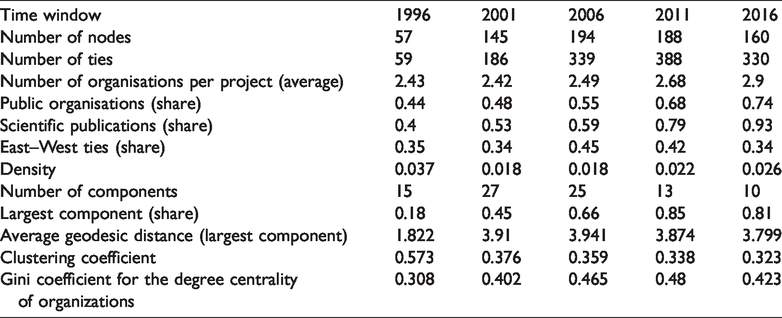
Figure 3 visualises the share of links between organisations, disaggregated by location and type (publicly or privately funded organisation). The figure provides initial insights into how the collaboration network in the Berlin biotech cluster evolved with respect to the integration of the Eastern and Western innovation systems. The share of East–West collaboration increased until the early 2000s. However, this pattern reversed from the mid-2000s onwards until it eventually evolved back to the one observed in the early 1990s. A closer look at the visualisation also reveals that the share of collaborations between public organisations in the two parts of Berlin increased at the expense of ties between public and private as well as those between private organisations in East Berlin. Conversely, the share of ties in West Berlin constantly increased over time. This observation supports the argument of Dohse (2000) that the increase in the relative number of East–West ties might be more of a sign of specific policies than of an actual integration of two innovation systems.
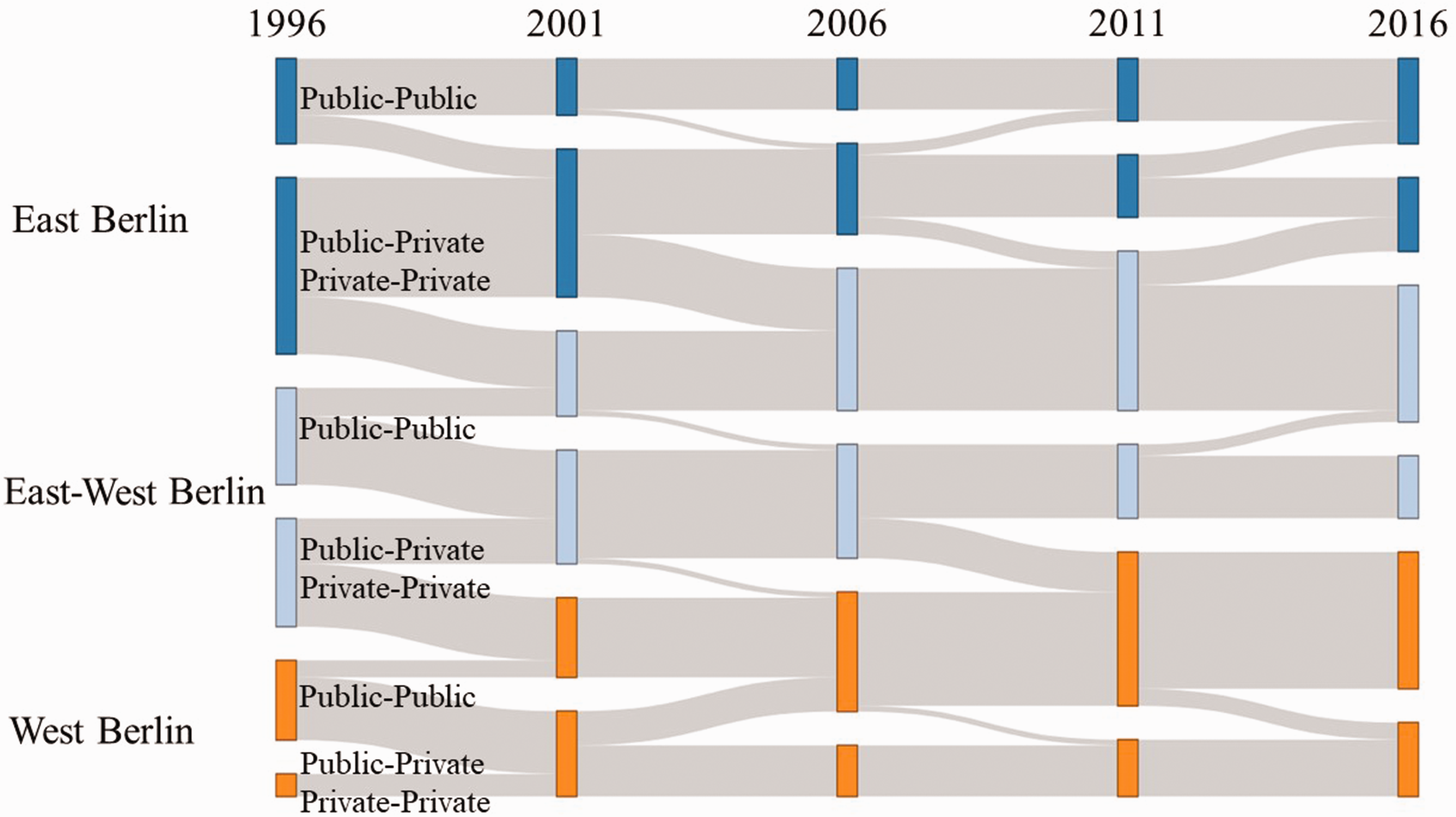
The share of collaborative ties based on the geographic position and types of involved organisations. Public–Public represents the share of ties between public organisations; Public–Private and Private–Private represent the share of ties between public and private, and private organisations.
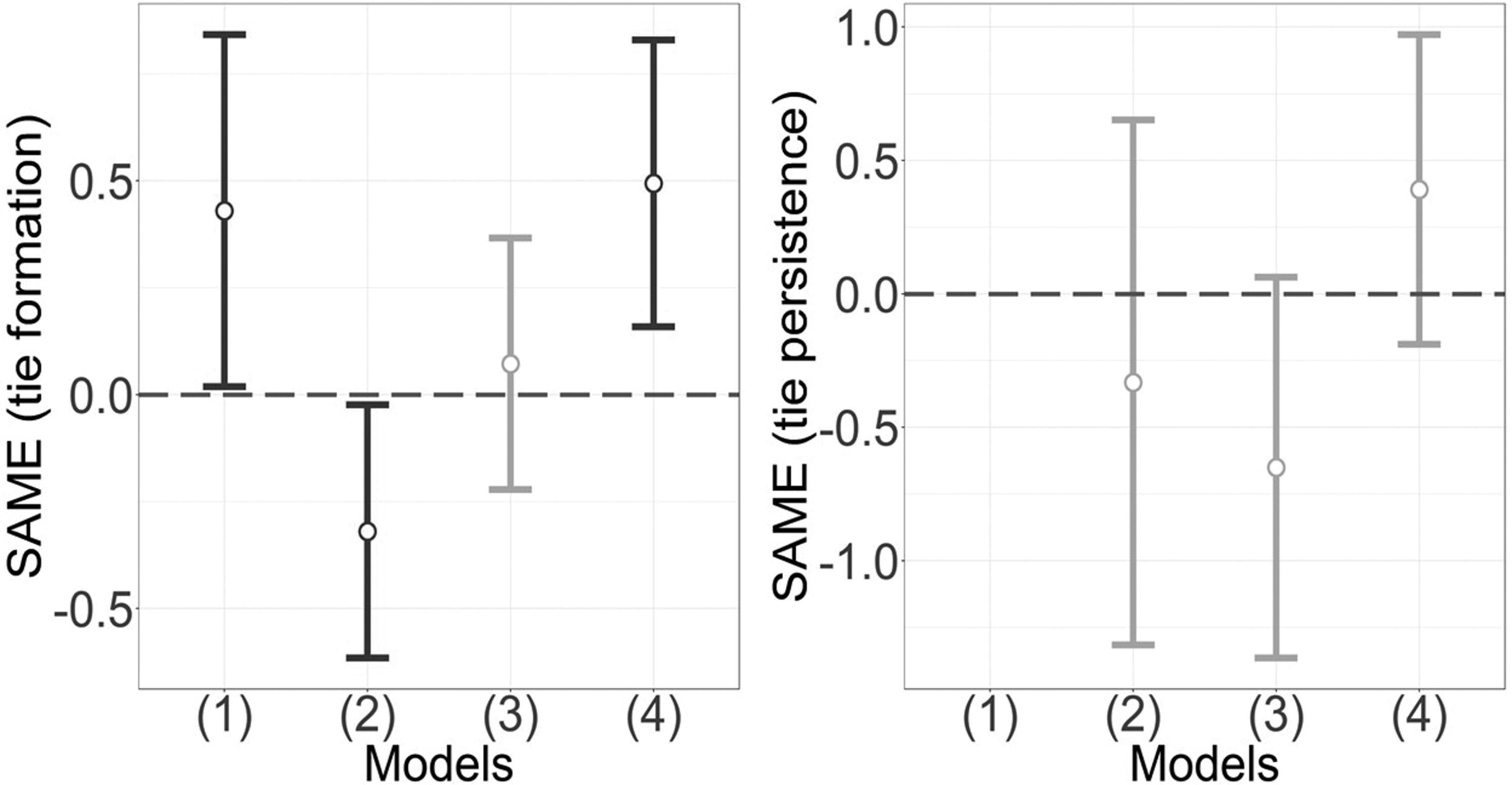
Coefficients of SAME with a 95% confidence interval.
Variables
Contextual-level variable
As argued above, the East and West Berlin represent different social foci and are more likely to show distinct collaboration behaviours, especially with respect to collaboration across the former border. The dyad-level variable SAME takes a value of one if both organisations are from former East Germany or both are from former West Germany. Otherwise it takes the value of zero. The variable captures the extent to which collaborations are more likely to be formed (or to be more persistent) between organisations located in the same part of Berlin (East or West).
Node- and dyad-level variables
Size is one of the most critical factors determining the capabilities of organisations to collaborate and innovate (Tether, 2002). We defined organisation size based on the numbers of employees. We followed the literature (e.g., see, Buchmann and Pyka, 2014) and defined three variables representing distinct size categories: SIZE.1 (small): fewer than 50 employees; SIZE.2 (medium): between 50 and 250 employees; and SIZE.3 (large): more than 250 employees. SIZE.1 served as a benchmark in the estimations, implying that SIZE.2 and SIZE.3 entered the model as binary variables.
We made a distinction between public research organisations and private companies. Private companies aim at maximising their economic returns and try to enhance their competitiveness through patenting and secrecy. In contrast, public organisations (universities and public research institutes) orientate themselves towards the free dissemination of their knowledge. This distinction implies differences in routines and behaviours. Similar to Broekel and Boschma (2012), we defined institutional proximity on this basis. INST is a binary dyad-level variable, which is one for pairs of organisations of the same kind (public research or private) and zero otherwise. We also approximated geographical proximity by the opposite of log-transformed physical distance between two organisations measured in kilometres (GEO).
Organisations rely on routines that they have developed in the course of their activity or inherited from parent organisations (Boschma and Martin, 2010). Hence, age and the number of already existing projects are likely to play a significant role in how organisations form and preserve ties. In particular, young firms show different knowledge-sourcing patterns as compared to experienced firms (Ilaboya and Ohiokha, 2016). Young firms tend to take more risky decisions to compensate for their lack of absorptive capacity and financial resources. We captured this with the log transformed number of years of organisations’ existence (AGE) and the log transformed number of previously acquired subsidised R&D projects (PROJ).
Network-level variables
Motivated by sociology and network theory, we considered a range of structural network factors in the Separable Temporal Exponential Random Graph Model (STERGM) that will be used as empirical model and is explained in more detail in the subsequent subsection. The first is the variable EDGES, which should always be included in such models. It adds the number of observed ties in the network as a statistic to the model. It enhances the ability of the model to fit the simulated network to the observed one (Broekel and Hartog, 2013). Existing social relations are known to have a strong impact on the way organisations establish future relations. We captured this effect of friends of friends tending to be friends as well, with a measure of triadic closure (for a review, see Robins et al., 2009). More precisely, we used the geometrically weighted edgewise shared partner (GWESP) statistic (for technical details, see Hunter et al., 2008). We set the decay parameters to 0.4 and 0.5, respectively. It accounts for the fact that, empirically, having few shared partners is more common than having many. It also reduces the likelihood of model degeneracy (Hunter, 2007). Triadic closure captures the strength of social relations and the density of communities (Ter Wal, 2014). Accordingly, lacking a more direct measure, we interpreted it as a very rough approximation of social proximity (for a technical overview see Appendix 1).
In addition, we considered preferential attachment as structural network effect, as it has been shown to be a driving force of change in networks (Barabási and Albert, 1999). Preferential attachment implies that networks evolve by new nodes entering that are more likely to establish ties to nodes with higher degrees of centrality. The geometrically weighted degree (GWDEG) statistic captures the ‘anti-preferential attachment’ effect (Hunter, 2007). We fixed the corresponding decay parameter at 0.1, which gives the best model fit.
Results and discussion
Empirical modelling approach
To investigate the evolution of the collaboration network, we analysed the network in four models (five-year time windows). More precisely, we ran a separate STERGM for each transition from one period to another. 10 In contrast to the alternative approach of simultaneously including all time periods into a single STERGM, this greatly improved the ability of the model to fit the empirical data, especially as the network changes rather drastically. The STERGM also requires that the network has the same number of nodes in each two consecutive time periods. We therefore included only nodes (organisations) in each model with at least one tie in one or both (consecutive) time periods.
It is important to note that the evolution of the network is driven by forces of tie formation and dissolution. While the former has been of primary interest in empirical studies, factors that spur tie dissolution have been less studied (Broekel and Bednarz, 2019). However, this does not mean that the latter are less important. Fortunately, the STERGM model considers both processes and provides two sets of coefficients: one set for the contribution of factors to tie formation and one for tie dissolution (persistence). 11 However, for the first model (Model 1) we excluded the dissolution (persistence) part due to the small number of dissolved ties between the first two time periods.
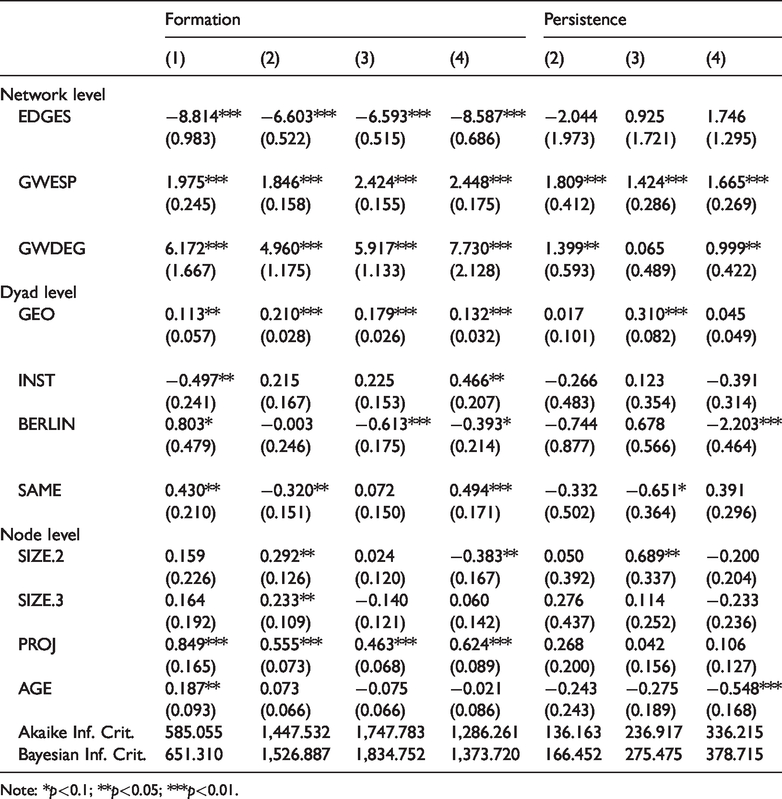
To assess the goodness of the models, we evaluated attributes of the simulated networks (the degree distribution, edgewise shared partner and minimum geodesic distance) against those of the observed network (Hunter, Goodreau, et al., 2008). Appendix 2 provides the corresponding graphics for the formation and persistence parts of all models. The graphics indicate that the estimations are reliable, as the observed network statistics mostly fall within the confidence intervals obtained using the simulated networks. Accordingly, our empirical approach models the evolution of the observed network well, and hence can be used to assess the relevance of explanatory factors. Table 2 provides STERGM coefficients with corresponding statistics for tie formation models (formation 1 to 4) and for tie persistence models (persistence 2 to 4).
STERGM results.
Note: *p<0.1; **p<0.05; ***p<0.01.
Node-level factors and proximity dimensions
Before we addressed our main research questions, we checked the relevance of the control variables. In this study, control variables capturing the effect of the size and age of organisations and companies were of crucial importance because these are not equally distributed in Berlin and surrounding municipalities. For instance, Humbolt University – which is located in East Berlin – was founded in 1810, whereas two large research organisations (Technical University of Berlin and Free University of Berlin) were established after the Second World War.
At the node level, SIZE.2, which approximates medium-sized organisations (50 to 250 employees), and SIZE.3, which represents large organisations (more than 250 employees), gain insignificant coefficients in most models for tie formation. Similarly, the effects of SIZE.2 and SIZE.3 are also mostly found to be insignificant regarding the persistence of ties. This comes as a surprise, as the size of organisations is correlated with their inclination to create and sustain collaborative ties in other empirical studies. This might be the result of defining nodes at the level of departments, which ignores their access to additional resources from other parts of their mother organisation.
We find positive and statistically significant coefficients for PROJ, which indicate organisations with success in acquiring subsidised projects are more likely to establish collaborative ties. Alternatively, less experienced organisations might tend to establish ties with more experienced ones (older and more successful in getting grants). They thereby seek to tap into these organisations’ skills and know-how bases (Lucena-Piquero and Vicente, 2019). A similar effect is not observed for the coefficients of PROJ on the persistence of ties. Furthermore, the coefficients of AGE are found to be insignificant in most models in both the formation and persistence parts.
At the dyad level, we were particularly interested in the effect of the different types of proximities. Our findings confirm the relevance of geographical proximity (GEO) over time and challenge those of Ter Wal (2014), who reports a decreasing relevance of geographical proximity over time in the biotech sector in Germany. In contrast to this, our results suggest that geographical proximity has played a significant role in knowledge sourcing in the Berlin biotech cluster. Interestingly, the impact of geographical proximity on tie persistence is not as robust as the one on tie formation: a positive and statistically significant coefficient for this variable is only obtained in Model 3. This implies that while geographical proximity is a crucial factor for the establishment of ties, it does not necessarily assure the persistence of collaborations. Using an alternative measure of geographical proximity based on the co-location of organisations in Berlin (BERLIN) further confirms the negative impact of this variable on tie formation and tie persistence. 12
Two potential mechanisms might account for these results. Tanner (2018) theoretically argues and empirically shows that geographical proximity is always a crucial factor for driving tie formation. Yet, this form of proximity changes over time, implying that the relevance of co-location in the same city is replaced by that of co-location in the same region. Alternatively, James et al. (2015) argue that organisations with a peripheral position gain a more central position in a local knowledge network through the process of knowledge anchoring. This causes a variation in knowledge-sourcing patterns, in which a larger number of organisations are prone to collaborate with the ones in the periphery to tap into new knowledge sources.
Institutional proximity is found to hamper tie formation in Model 1 and facilitate tie formation in Model 4. This partly confirms the findings of the studies by Lazzeretti and Capone (2016) and Belso-Martínez et al. (2017). Accordingly, organisations operating within the same institutional framework are less likely to establish lasting relations. We believe that this (somewhat unexpected) effect is related to public organisations’ strategy (e.g. university departments) to tap into different sources of knowledge, which translates into constantly changing collaboration partners (e.g. Trippl and Otto, 2009). In addition, given the fact that the network dynamics are partly driven by subsidised R&D projects, it is relatively uncommon for the same pairs of organisations (in biotech) to be awarded another joint grant in subsequent periods (Roesler and Broekel, 2017).
Network-level factors
At the network level, the variable EDGES obtains a significantly negative coefficient in all formation models, which is in agreement with most existing studies (Broekel and Hartog, 2013). It implies that the observed network tends to be less dense than a random network. Interestingly, this effect is not consistently observed in the persistence models (one exception is Model 3).
Our rough approximation of social proximity – triadic closure (GWESP) – is significantly positive in all models. 13 It suggests that social embeddedness is a strong explanatory factor for the establishment and persistence of collaboration. The finding supports a wide range of previous studies. For instance, Giuliani (2011, 2013) and Giuliani et al. (2018) show that triadic closure coupled with reciprocity is one of the most important endogenous network effects. Similarly, Juhász and Lengyel (2017), de Stefano and Zaccarin (2013) and Belso-Martínez et al. (2017) confirm its importance for tie formation. Our study adds to the limited evidence for this factor's importance on tie persistence (Juhász and Lengyel, 2017).
The variable GWDEG proxies an ‘anti-preferential attachment’ effect. A positive coefficient indicates a tendency of organisations to create knowledge ties to other organisations with similar numbers of existing ties. Our results reject the idea of preferential attachment driving the evolution of this knowledge network. This is in contrast with many works that report insignificant effects (Menzel et al., 2017; de Stefano and Zaccarin, 2013) or positive ones (Roesler and Broekel, 2017). Most likely, this is explained by the lack of a dominating organisation in the Berlin biotech sector and the generally low integration of the intra-city network, as local organisations rather tend to collaborate with partners outside the city.
In sum, our findings show that most factors influence the collaboration network according to our expectations or, if they diverge from this, there are good reasons for this. Therefore, we are confident that our empirical approach and models can be used to study the potential effects of the former Berlin Wall on the evolution of this network.
Still in the shadow of the wall?
Figure 4 shows that the variable SAME gains significance in three models for tie formation (Models 1, 2, and 4). Interestingly, the coefficient is negative in Model 2, which corresponds to the network transition from the time period 1997–2001 to the time period 2002–2006. In contrast, it is significantly positive in Models 1 and 4, which corresponds to transitions between 1992–1996 to 1997–2001 and from 2007–2011 to 2012–2016. Except for one time window, this implies that organisations are less likely to establish collaborations between the former East and West Berlin than within each part of the city.
As discussed in Section 3, it was a top-down political aim to develop the biotech sector in Germany in general (Dohse, 2000) and in Berlin in particular (Kulke, 2008). However, political support was gradually reduced in the early 2000s (Dohse, 2000). It is therefore plausible that the significantly negative coefficient in Model 2 and the insignificant coefficient in Model 3 are consequences of these changes in the top-down policies of the federal government that supported collaboration between organisations from the former East and West Germany in the mid and late 1990s. After the effects of this policy faded out, the initial East–West division of the knowledge network seems to have re-emerged. In consequence, the ‘shadow of the wall’ is very much present in the most recent period, that is, almost 30 years after the reunification.
Interestingly, we do not observe a similar effect in the persistence models. Potentially, once organisations have overcome the constraints of their East- and West-specific social foci, collaborations are kept in place over longer time periods. Our results also suggest that there are no structural reasons for East–West collaborations not to work. That is, there is no fundamental reason for organisations not to engage in such relations.
We tested the robustness of our findings in a number of ways. Firstly, we restricted the network to its main component. 14 The results did not change substantially. However, the coefficient of SAME changed. Organisations in the main component are mainly large firms and university departments, which can be expected to be more sensitive to policy measures. Consequently, in this setting, the effect of policies should become more visible, which is precisely what we observe. The results of this specification thereby support our arguments regarding the effects of the support policies. While Model 2 (corresponding to time periods with top-down policy interventions) provides a negative and statistically significant coefficient for SAME and indicates the dominance of East–West relations between mostly large and public organisations, the sign of SAME changes when the policy support was withdrawn. 15
As another robustness test, we controled for the affiliation of the most active publicly funded organisations in Berlin. That is, we considered if an organisation is a member of one of the large German research organisations, that is, if it belongs to the Leibniz Association, to the Max-Planck Institute or to the Charité Medical School (node-level variables Leibniz, Max.Planck, and Charite). Even when including these variables, the signs and significance of the coefficients of SAME (in the formation part) in Models 1 and 4 do not change. Consequently, the higher likelihood of East–East and West–West tie formation remains robust with respect to this specification. However, the coefficient of SAME (in the formation part) in Model 2 loses its significance. In contrast, the coefficients for two publicly funded organisations (Leibniz and Charite) are positive and significant (see Appendix 3). Accordingly, these organisations’ behaviour seems to have been (at least in parts) responsible for our finding. Given that these are publicly funded organisations that are highly responsive to public policies, we see this as futher support of our initial argument that the increase in East–West collaborative ties has likely been a consequence of the top-down subsidisation policies.
Conclusion
The aim of the present research was to study the driving forces behind the evolution of the interorganisational R&D collaboration network of the Berlin biotech cluster in the years after reunification. We modelled the network by considering information about patents, publications and subsidised R&D projects. Separable Temporal Exponential Random Graph models were employed to identify factors supporting the formation of ties and their persistence. We considered a range of proximity dimensions and structural network effects. However, our focus was on the potential effects of the former division of the city. More precisely, we argue that the 40 years of division have created distinct social foci that still influence the knowledge-sourcing behaviour of organisations. We also point out that such consequences of places’ histories are inadequately captured by the popular five proximity dimensions and structural network effects. Our empirical study confirms these arguments by showing that place specificities and universal factors complement each other in explaining the evolution of the network.
If not stimulated by R&D support schemes, ties between organisations located in the former East with those located in the former West Berlin tend to be less likely than ties between organisations located in the same part of the city. Given that 30 years have passed since reunification, the existence of substantial labour mobility within the boundaries of the city, and various support policies at the national and local level, this finding comes as a surprise. It seems that the biotech innovation system of Berlin is still not fully integrated, and that the former division of the city is continuing to hamper knowledge diffusion and collaboration.
The present study has several limitations that need to be pointed out. While we discuss the differences between the former East and West Germany, our empirical study was limited to the boundaries of the city of Berlin and surrounding NUTS-3 regions. Thus, future research should take our findings as a point of departure and conduct a similar but larger-scale study. Moreover, the structure and types of the three employed datasets impose some limitations. For instance, the REGPAT database does not provide complete information on all patents granted by the German Patent and Trademark Office. 16 Smaller firms and individual entrepreneurs are likely to be under-represented in this database. Consequently, our results might be slightly biased in favour of large and publicly funded organisations. Moreover, the R&D database includes projects funded mostly by two German federal ministries 17 (about 90% of projects) and it is not clear to what extent considering projects funded by other political authorities might change our results.
We believe that combining multiple data sources in the construction of the networks gives a more complete picture of the true network. Yet, this also implies that we do not know whether the observed effects are related to all or just one type of relation (co-patenting, co-authoring or joint participation in R&D projects). We tried to estimate models for networks based on only one type of information; however, none of these converged separately due to the networks’ high degrees of fragmentation. A similar limitation prevented us from using shorter time periods, and from including more than two time periods in one STERGM estimation. The latter point particularly highlights that ‘good’ network data are still hard to come by in economic geography. Consequently, future studies should try to include alternative information on inter-organisational interactions, such as labour mobility and economic relations, which influence collaborations (e.g. Buenstorf et al., 2016; Hjertvikrem and Fitjar, 2020; Maghssudipour et al., 2020).
Despite these shortcomings, our study has some important implications. It highlights that Germany remains divided after 30 years, as does its innovation system. Our findings moreover underline the effectiveness of support policies. Simply speaking, programmes that explicitly target this division are likely to succeed in overcoming it. However, what seems to be more challenging is, how to make their effects last. Accordingly, policy needs to make greater efforts and have greater patience when trying to overcome such deeply rooted social structures. As our study shows, this even applies to social structures within a single city. Hence, given the larger differences across European regions compared to those between East and West Berlin (Farole et al., 2011), even greater efforts and even more patience are needed when it comes to the integration of European regions.
Supplemental Material
sj-pdf-1-epn-10.1177_0308518X20933904 - Supplemental material for Still in the shadow of the wall? The case of the Berlin biotechnology cluster
Supplemental material, sj-pdf-1-epn-10.1177_0308518X20933904 for Still in the shadow of the wall? The case of the Berlin biotechnology cluster by Milad Abbasiharofteh and Tom Broekel in Environment and Planning A: Economy and Space
Footnotes
Declaration of conflicting interests
The author(s) declared no potential conflicts of interest with respect to the research, authorship, and/or publication of this article.
Funding
The author(s) received no financial support for the research, authorship, and/or publication of this article.
Acknowledgement
The authors thank Ron Boschma for helpful comments on an earlier version of this paper. We also would like to thank two anonymous reviewers for providing helpful comments. The support of the junior research group TRAFOBIT (The role and functions of bioclusters in the transition to a bioeconomy) is acknowledged.

Supplemental material
Supplemental material for this article is available online.
Notes
References
Supplementary Material
Please find the following supplemental material available below.
For Open Access articles published under a Creative Commons License, all supplemental material carries the same license as the article it is associated with.
For non-Open Access articles published, all supplemental material carries a non-exclusive license, and permission requests for re-use of supplemental material or any part of supplemental material shall be sent directly to the copyright owner as specified in the copyright notice associated with the article.
