




Abstract
The Accusecure Technique is a simplified wax indexing method developed to enhance the precision and efficiency of bonding lingual retainers. By creating a negative imprint of the lingual tooth surfaces using a thin wax sheet, the technique enables accurate pre-positioning of the multistranded wire outside the oral cavity. Composite resin is applied within the wax indentations to secure the wire, which is then transferred intraorally and bonded in place using light curing. This approach minimizes operator variability, reduces chairside time, and improves the adaptation of the retainer wire to the tooth surfaces. The Accusecure Technique offers a reliable and reproducible alternative to conventional freehand bonding methods, making it a valuable addition to routine clinical orthodontic practice.
Keywords
Introduction
The use of lingual bonded retainers is widely accepted in orthodontics to ensure post-treatment stability and prevent relapse, particularly in cases with a high risk of anterior crowding recurrence.1, 2 These retainers, typically made from multistranded stainless steel wire, provide passive retention without relying on patient compliance, making them a preferred choice over removable retainers. 3 However, their clinical success depends on precise wire adaptation, accurate bonding, and sufficient composite coverage to prevent debonding or wire deformation over time.4, 5
Traditional methods for bonding lingual retainers often involve freehand bonding, which is highly technique-sensitive and prone to inaccuracies in wire positioning. Even slight misplacement can lead to unwanted forces on teeth, affecting stability and possibly causing minor orthodontic relapse. 6 To improve precision, indirect bonding techniques using silicone indices, vacuum-formed templates, and digital computer-aided design (CAD)/computer-aided manufacturing (CAM) guides have been developed. 7
While these methods enhance accuracy, they may have drawbacks, including higher costs, additional laboratory steps, and material rigidity that may not accommodate minor adjustments required for individual anatomical variations. 8
Considering these challenges, the Accusecure Technique introduces a simple, cost-effective, and highly adaptable approach using a wax sheet to create a negative impression of the lingual surfaces of the indicated teeth. This wax-based method allows for precise wire positioning before intraoral bonding, significantly reducing chairside time while ensuring optimal retainer adaptation. The technique eliminates the need for additional lab procedures, making it a practical alternative for clinicians seeking efficiency and accuracy in lingual retainer bonding. This article presents the rationale, step-by-step methodology, and clinical advantages of the Accusecure Technique in comparison to existing approaches.
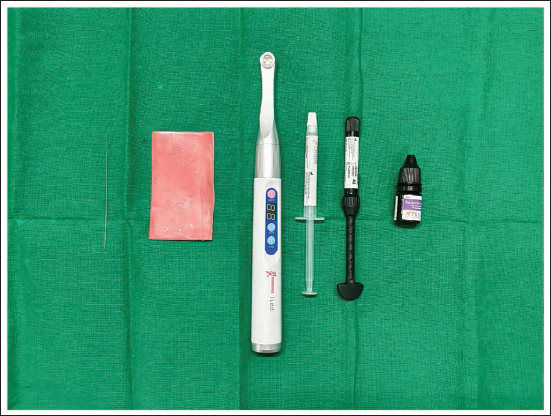
Materials and Methods (Figure 1)
Multistranded stainless-steel wire
Small wax sheet
Light-emitting diode (LED) curing light
Etchant (37% phosphoric acid)
Light-cured composite resin
Bonding agent
Multistranded Stainless-steel Wire, Small Wax Sheet, Light-emitting Diode (LED) Curing Light, Etchant (37% Phosphoric Acid), Light-cured Composite Resin, Bonding Agent.
Procedure
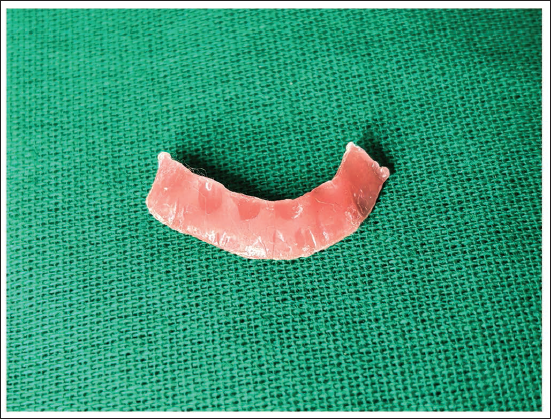
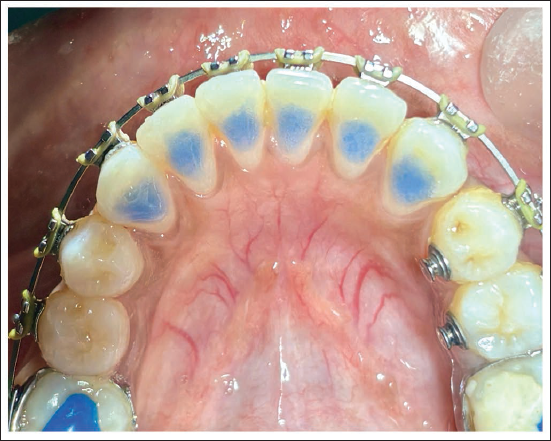
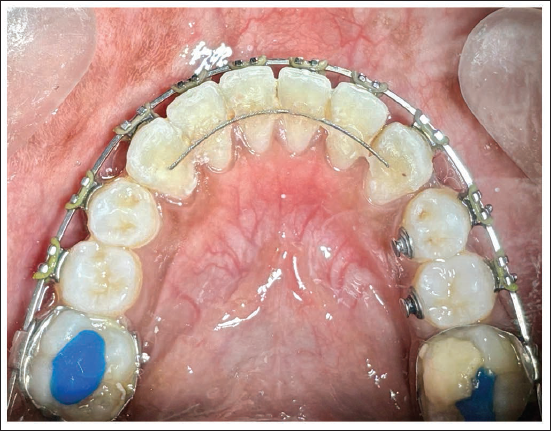
A small wax sheet is placed on the lingual surfaces of the selected teeth and pressed with finger pressure to create a negative impression. Excess wax is trimmed to retain only the intended retainer span (Figure 2) and further pressed to refine the negative imprint (Figure 3). The teeth are then etched (Figure 4), washed, and dried, followed by the application of a bonding agent. Composite blocks are placed in the wax indentations at the center of each tooth imprint (Figure 5), and the multistranded wire is adapted to the wax impressions, embedding it into the composite blocks (Figure 6). The wax sheet, with the embedded wire, is repositioned onto the lingual surfaces, ensuring a precise fit due to the negative impression (Figure 7). Light curing is performed from both buccal and lingual aspects. Finally, the wax is peeled off to reveal the secured retainer wire (Figures 8 and 9). Composite may be applied to areas where the wire is exposed, and any excess is finished using an air rotor.
Excess Wax is Trimmed to Include Only the Intended Retainer Span.
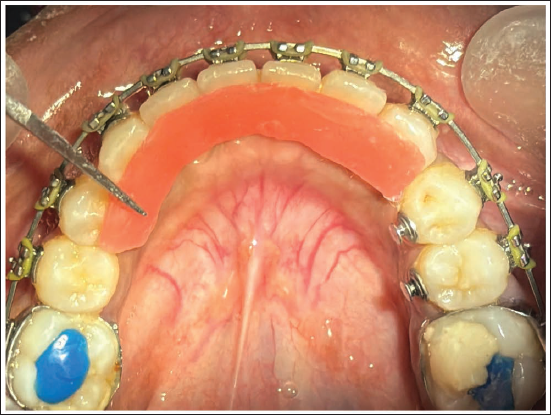
Negative Impression of Lingual Surfaces of Selected Teeth on Wax.
Etching the Selected Teeth for Retainer Placement.
Composite Blocks are Placed in the Wax Indentations at the Center of Each Tooth Imprint.
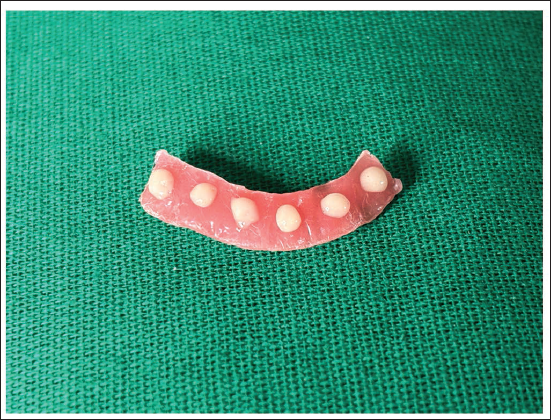
Multistranded Wire is Adapted to the Wax Impressions and Embedded into the Composite Blocks.
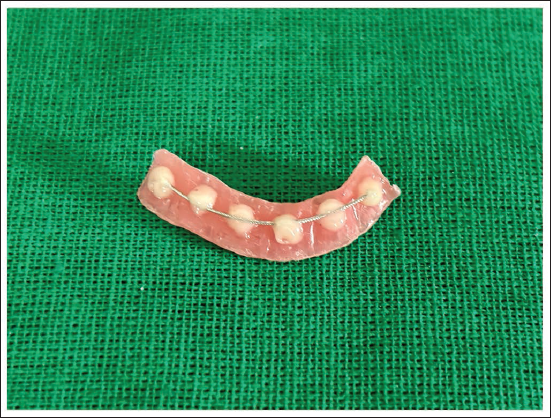
The Wax Sheet, with the Embedded Wire, is Placed Back onto the Lingual Surfaces, Fitting Precisely Due to the Negative Impression.
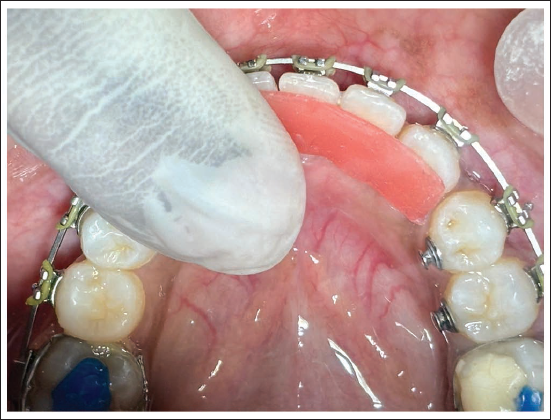
Wax is Peeled Off to Reveal the Secured Retainer Wire.
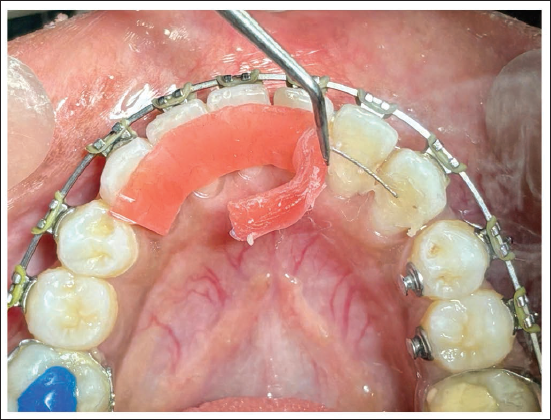
Retainer is Secured into Place.
Advantages
Precision in placement: The wax template provides a negative impression of the lingual surfaces, ensuring precise adaptation and accurate wire positioning.
Improved clinical efficiency: The technique reduces chairside time by minimizing the need for intraoral wire adjustments during bonding.
Simplicity and accessibility: Requires minimal additional materials and can be performed easily with commonly available orthodontic armamentarium.
Reproducibility: The standardized workflow offers consistent results across multiple operators, reducing variability in clinical outcomes.
Enhanced patient comfort: The indirect bonding process minimizes chairside manipulation and reduces discomfort often associated with freehand techniques.
Cost-effective: Avoids the need for complex digital setups or jigs, making it economical for routine practice.
Disadvantages and Limitations
Risk of wax deformation: If excessive finger pressure is applied while taking the impression, the wax may distort, compromising the accuracy of the retainer positioning. This necessitates careful handling during the initial step.
Limited applicability in irregular dentitions: In patients with significant lingual crowding, rotated teeth, or deep lingual anatomy, the wax may not adapt optimally. In such cases, alternative methods such as 3D-printed transfer jigs may offer superior adaptation and control.
Technique sensitivity: The accuracy of the result heavily depends on the operator’s care during the wax impression and placement steps, although this can be improved with experience.
Lack of large-scale validation: While the technique has shown promising results in routine clinical use, no large-scale clinical studies or controlled trials have been conducted to validate its long-term effectiveness. This presents an opportunity for future research and structured clinical evaluation.
Conclusion
The Accusecure Technique for lingual bonded retainers offers a simple, efficient, and precise method for wire positioning before bonding. By utilizing a wax index, this technique ensures accurate adaptation and reduces errors associated with manual positioning. It provides a cost-effective alternative to conventional indirect bonding techniques and can be easily incorporated into routine orthodontic practice.
Footnotes
Acknowledgment
The authors thank MIDSR Dental College for its infrastructure and support.
Declaration of Conflicting Interests
The authors declared no potential conflicts of interest with respect to the research, authorship, and/or publication of this article.
Ethical Approval
Not applicable.
Funding
The authors received no financial support for the research, authorship, and/or publication of this article.
Informed Consent
Informed consent was obtained from the patient prior to the initiation of orthodontic treatment and the acquisition of photographic records.
