



Abstract
One of the means of maintaining the incisor alignment after orthodontic treatment is by fixed lingual retainer. Over the decade’s various techniques have been advocated for bonding a lingual retainer wire. The most critical step to the orthodontist is stabilization of retainer wire in its stable position to prevent relapse. The purpose of this study is to introduce a custom-made device which is easy to fabricate and stabilizes the retainer wire to the contours of the palatal surface of the teeth without causing any iatrogenic damage to the adjacent soft tissues while bonding.
Introduction
The phase of retention in overall treatment procedure is crucial for the orthodontist to maintain the teeth in their stable position after active orthodontic therapy. 1 The teeth tend to return to their pre-treatment position, known as relapse. To prevent relapse orthodontic treatment often requires long-term retention. The majority of orthodontists believed that stability could be achieved by a fixed lingual retainer. 2
The use of a multistranded stainless steel wire (0.0175 inch in size) has an advantage in achieving stability, the passivity of the wire and allows the patient to perform proper oral hygiene measures. 3
Previous studies4–6 have demonstrated various methods in stabilizing the retainer wire. However, in some of these methods, there is a need for extensive laboratory procedures for the fabrication of devices. This study aims to illustrate the fabrication of a simple custom-made device that enables the orthodontist to perform better bonding procedure and reduces the chair-side time.
Technique
Prepare the working models with dental stone and adjust in maximum intercuspation.
Place the 0.0175-inch retainer wire in its desired position.
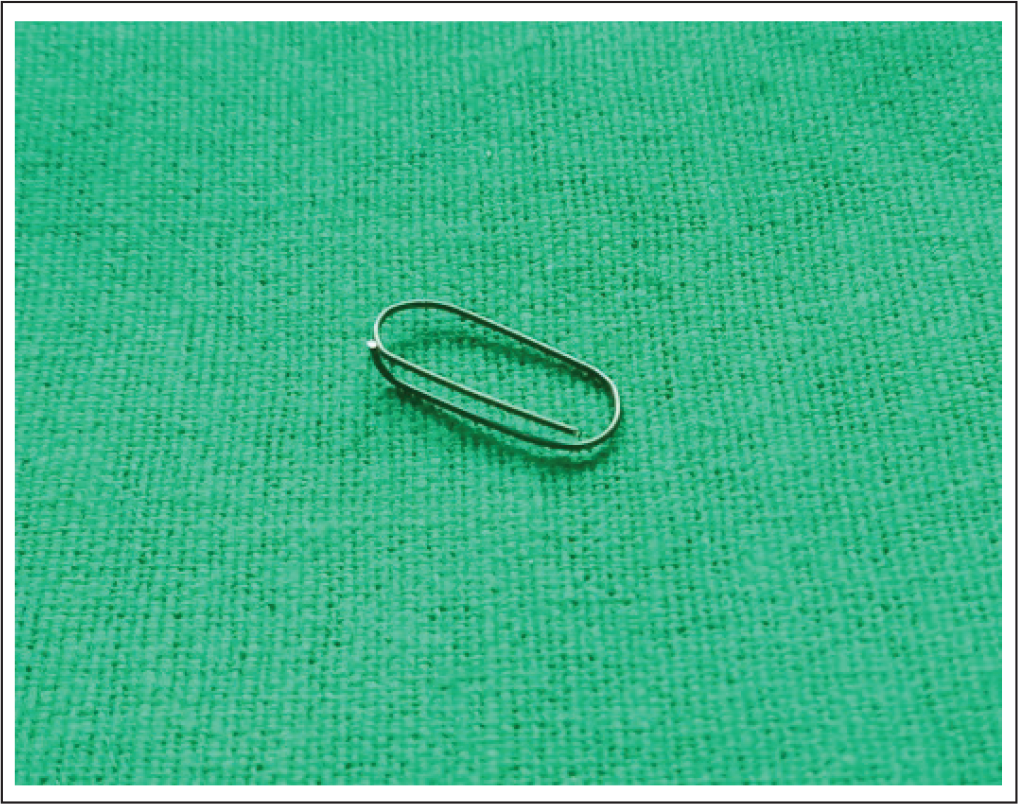
Fabricate the appliance with a 0.016-inch AJ Wilcock stainless steel wire in such a way that resembles “Paper pin-shaped.”
On the labial end, a retentive tag is positioned (Figure 1).
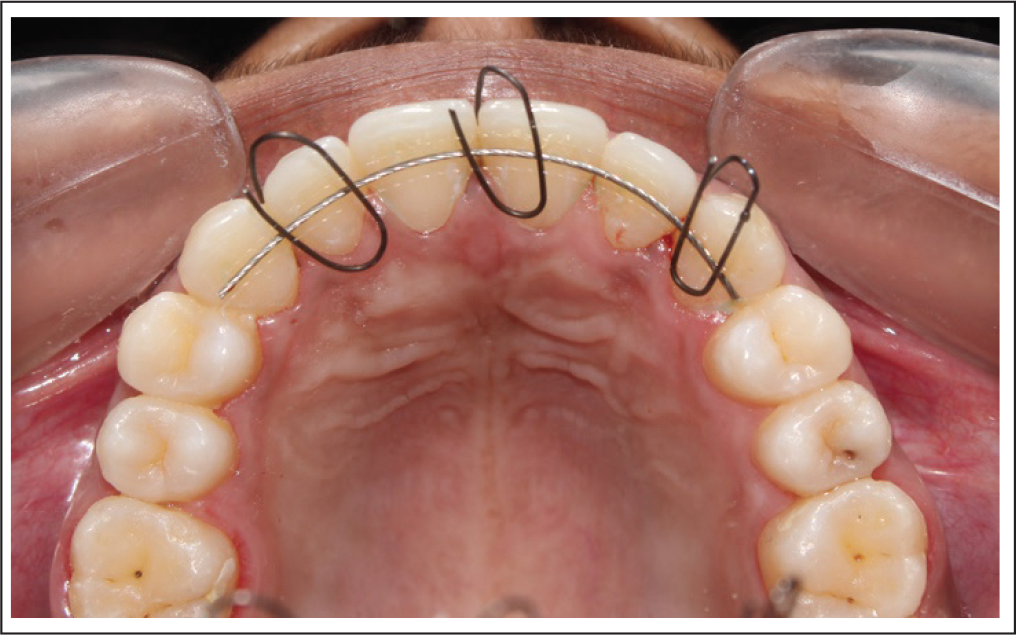
Now place the appliance on to the retainer wire in the patient’s mouth (Figure 2).
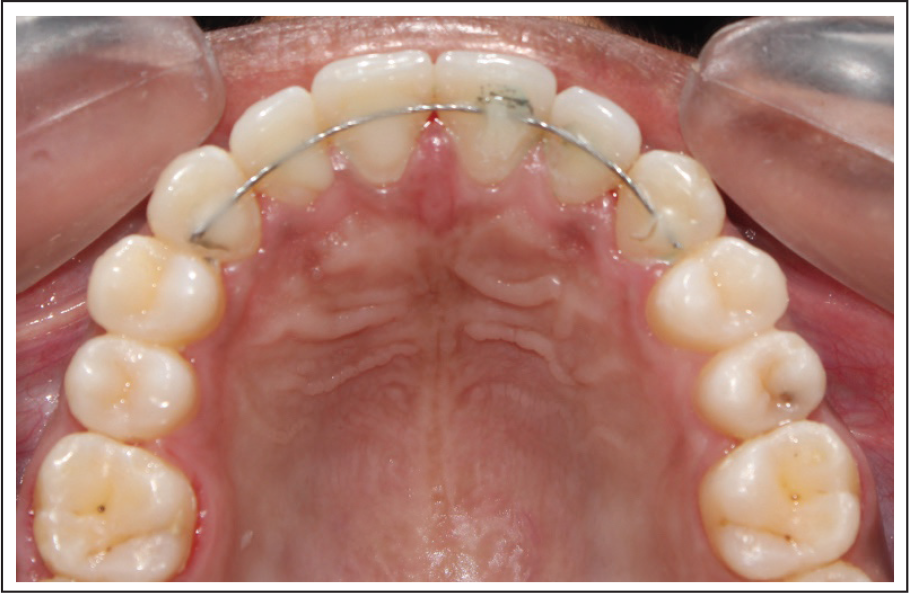
Follow through isolation and bonding procedure to enhance long-term stability of the retainer wire (Figure 3).
“Paper Pin Shaped” Device With Retentive Tag
Stabilization of Retainer Wire With the Device
After Bonding the Retainer Wire
Discussion
This custom made device is a simplified clinical innovation that holds the retainer wire in its stable position and enables the orthodontist to perform better bonding with reduced chair-side time and minimal patient discomfort. The significant advantage with this device is its simplicity; without any need for laboratory procedures chances of causing iatrogenic damage to the adjacent soft tissues is less.
Conclusion
This device holds the retainer wire to the contours of the palatal surface of the teeth and stabilizes the retainer wire in its desired position while bonding. This simple, innovative approach is easy to fabricate, effective, and reduces the chair-side time.
Footnotes
Declaration of Conflicting Interests
The authors declared no potential conflicts of interest with respect to the research, authorship, and/or publication of this article.
Funding
The authors received no financial support for the research, authorship, and/or publication of this article.