



Abstract
Accurate measurement of dental models plays a critical role in orthodontic diagnosis and treatment planning. Traditional measuring tools, such as dividers and calipers, often suffer from inconsistencies due to positioning errors and calibration issues, leading to inaccurate assessments. To address these issues and challenges, ACCUMEASURE, a modified orthodontic divider, has been developed to enhance measurement precision. This innovative tool incorporates a 0.15-mm stainless steel band material at its tips, ensuring stable and well-defined contact points. The modification reduces variability, improves reproducibility, and minimizes errors in model analysis. ACCUMEASURE allows for more precise assessments in space analysis, Bolton’s ratio calculation, and arch-width evaluation, enhancing clinical decision-making. Additionally, its simple design, cost-effectiveness, and ease of use make it a practical alternative to digital measurement tools. By providing orthodontists with a reliable and efficient method for obtaining accurate measurements, ACCUMEASURE contributes to improved diagnostic accuracy and optimized treatment outcomes in orthodontic practice.
Introduction
Accurate measurement of dental models is a fundamental aspect of orthodontic diagnosis, as it aids in space analysis, arch-width evaluation, Bolton’s analysis, and overall treatment planning.1, 2 Conventionally, dividers and calipers have been used to measure tooth dimensions and spacing on plaster and digital models. However, slight errors in positioning and calibration may lead to inaccuracies, impacting clinical decisions.3, 4
ACCUMEASURE is a modified orthodontic divider designed to enhance measurement accuracy by integrating a stainless steel band material (0.15-mm thickness) at the tips. This modification allows for a more stable and defined point of contact during measurements, reducing variability and improving reproducibility in model analysis.5, 6 The 0.15-mm stainless steel band was selected for its optimal balance between flexibility and resistance to deformation under pressure. This thickness ensures the divider tips maintain consistent alignment while allowing the device to engage narrow interdental spaces.
ACCUMEASURE addresses the common limitations of conventional dividers, such as inconsistent tip placement and difficulty in measuring small interdental spaces. By incorporating a fixed, calibrated measuring surface, this tool ensures that orthodontists obtain more precise and reliable data for diagnosis and treatment planning. Its ease of fabrication and practical application make it a cost-effective solution for improving orthodontic model analysis.7, 8 To our knowledge, this is the first adaptation of a traditional divider using stainless steel tips tailored for submillimeter model analysis, especially suitable for resource-limited settings.
Aim
To develop and evaluate ACCUMEASURE, a modified measuring tool designed to enhance accuracy, precision, and efficiency in orthodontic model analysis, specifically in space assessment, arch-width evaluation, and tooth-size measurement.
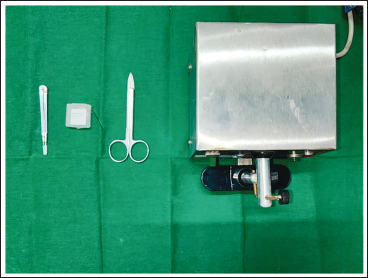
Materials and Methods (Figure 1)
Divider
Stainless steel band material (0.15-mm thickness)
Scissor
Welder
Divider, Band Material, Band Cutting Scissor, and Welder.
The fabrication process involves:
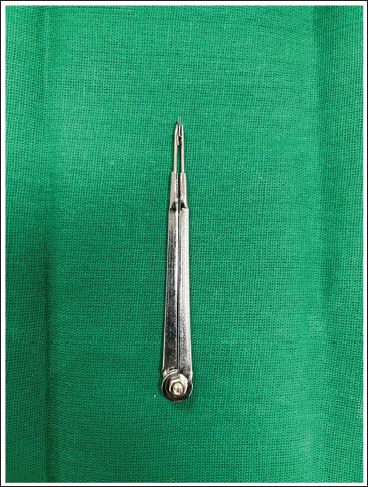
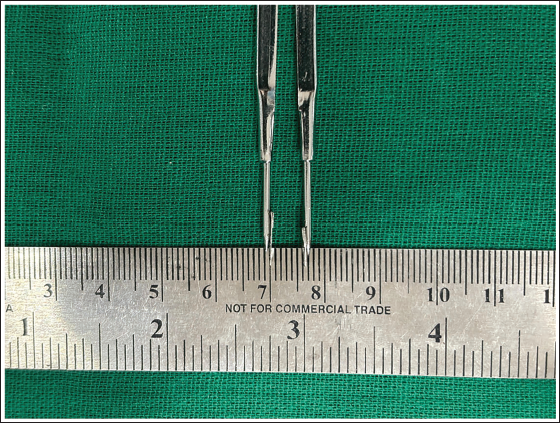
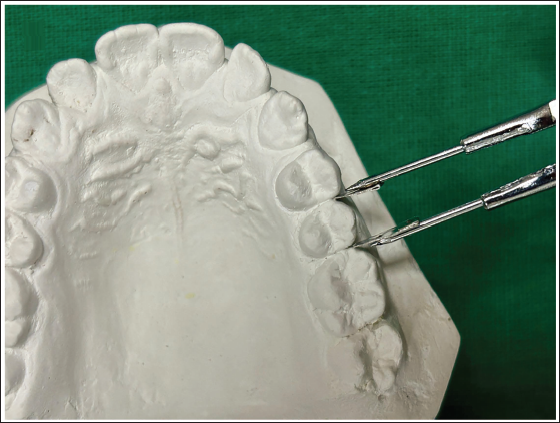
Selecting a high-quality orthodontic divider for modification. Using a band-cutting scissor, cut a small portion of stainless steel band material. Welding a stainless steel band material (0.15-mm thickness) to the inner side of both divider tips to refine precision (Figures 2 and 3). Ensuring proper alignment and finishing the edges for model use (Figure 4).
Stainless Steel Band Welded to Divider Tips.
Modified Divider Measuring Submillimeter Spaces.
ACCUMEASURE in Use on Orthodontic Model.
Validation and Reliability
To validate the ACCUMEASURE tool for use in model analysis, its accuracy and reliability were assessed through a comparison with standard digital vernier calipers.
A sample of 10 orthodontic study models was selected. Each model was measured independently by two calibrated operators using both:
The ACCUMEASURE tool, and
A standard digital vernier caliper (0.01-mm accuracy)
Measurements taken included mesiodistal width of incisors, canines, and first premolars. The intra-operator and inter-operator reliability were evaluated using the intraclass correlation coefficient (ICC) and paired t-tests to compare the tool’s consistency and agreement with the standard.
Results
The validation study demonstrated that the ACCUMEASURE tool exhibited a high degree of measurement accuracy and consistency when compared with a digital vernier caliper, which served as the gold standard. The intra-operator reliability, assessed by having the same operator repeat measurements on all 10 study models after a 24-h interval, yielded an ICC of 0.94, indicating excellent repeatability. This confirms that repeated use by the same clinician produces consistent results. The inter-operator reliability, measured by comparing readings taken independently by two calibrated clinicians, showed an ICC of 0.91, suggesting high agreement and reproducibility between different users. This supports the tool’s applicability in multi-operator clinical environments.
Comparisons between the ACCUMEASURE and digital caliper for mesiodistal tooth widths (incisors, canines, and first premolars) showed a mean difference of less than 0.2 mm, with no statistically significant difference detected (p > .05) through paired t-test analysis. These results indicate that ACCUMEASURE provides measurements that are statistically and clinically comparable to the digital caliper. Overall, the tool demonstrated strong validity and reliability, supporting its use as an accurate and repeatable device for model-based mesiodistal tooth measurements.
Advantages
Enhanced measurement accuracy—The stainless steel band modification provides a more stable and defined measuring point, reducing variability in measurements.
Improved reproducibility—Ensures consistent results in repeated measurements, leading to more reliable orthodontic analyses.
Better space assessment—Enables precise measurement of interdental spaces, arch width, and tooth size, crucial for treatment planning.
User-friendly design—Simple modification makes it easy to use without requiring additional training.
Cost-effective—Provides a low-cost improvement to traditional dividers without the need for expensive digital tools.
Limitations
While ACCUMEASURE improves precision and reproducibility compared to conventional dividers, it has some limitations. The minimum measurable limit is constrained by the 0.15-mm thickness of the stainless steel tips, which may limit the ability to perform more precise measurements. Additionally, the tool requires manual handling, which introduces the potential for operator-dependent variability. Further validation using digital calipers and intra- and inter-observer reliability testing is recommended to assess accuracy comprehensively.
Conclusion
ACCUMEASURE offers an innovative modification to traditional dividers, enhancing measurement precision in orthodontic model analysis. Its simplicity, ease of use, and improved accuracy make it a valuable addition to orthodontic diagnostic tools.
Footnotes
Declaration of Conflicting Interests
The authors declared no potential conflicts of interest with respect to the research, authorship, and/or publication of this article.
Ethical Approval
This data includes a clinical innovation used on a study model; hence, there are no human participants in this article.
Funding
The authors received no financial support for the research, authorship, and/or publication of this article.
Informed Consent
The participant has provided informed consent for the submission of the article to the journal.
