



Abstract
Objectives
To evaluate the efficacy of water irrigating devices, powered toothbrushes, and active repeated oral hygiene reminders on oral hygiene of fixed orthodontic patients.
Materials and Methods
This was a randomized, examiner-blind clinical trial involving fixed orthodontic appliance patients. Patients were recruited within six months of bonding on both the arches. Eighty patients were randomly assigned to four groups; groups 1 and 3 subjects received standard oral hygiene procedures and used manual orthodontic toothbrushes, and subjects in groups 2 and 4 used powered toothbrushes and water irrigators for oral hygiene maintenance during the study period. In addition, repeated oral hygiene reminders via SMS were sent to subjects in groups 1 and 2, whereas groups 3 and 4 subjects received only oral motivation. The principal investigator assessed the plaque index (PI) and gingival index (GI) at baseline (T0) and after 2, 4, 8, and 12 weeks, that is, T1, T2, T3, and T4, respectively.
Results
Group 2 and group 4 subjects showed statistically significant reduction in PI (p < .001) and GI (p < .001) scores at the end of study interval; however, the magnitude of decrease was less in group 4 in comparison to group 2. Intergroup comparisons between group 1 versus group 3 and group 2 versus group 4 were made to evaluate the efficacy of reminders. Statistically significant reduction was observed in group 2 as compared to group 4 at T4 (p < .001) when compared to T1 (p < .87).
Conclusion
Using powered toothbrushes and oral irrigators resulted in a statistically more significant reduction in plaque and gingivitis scores than conventional procedures. Active reminders had a catalytic effect in improving the oral hygiene.
Keywords
Introduction
Achieving optimal oral hygiene during fixed orthodontic treatment has always been difficult for patients, though it is the most important aspect for the success of treatment with fixed appliances. A fixed appliance greatly complicates tooth cleaning; the brackets and archwires act as barriers to toothbrush bristles, tending to accumulate plaque and debris around these attachments and predisposing the patients to adverse effects of plaque accumulation like gingivitis and development of white spot lesions. 1
According to the American Association of Orthodontists, more than 5 million people (in the United States in 2006) with fixed orthodontic appliances have experienced difficulties in achieving high levels of plaque control, which indicates that there is an obvious need for advanced oral hygiene aids with appropriate design features to aid in plaque removal, and for these potential advances to be assessed in comparative clinical studies. 2 The orthodontic appliances not only act as food traps that tend to inhibit the natural cleansing mechanisms of the mouth, but the placement of orthodontic attachments and archwires on the teeth of such patients also changes the environmental conditions of the oral cavity. All these factors combined make patients with fixed orthodontic appliances more prone to plaque-induced pathologic conditions like gingivitis and demineralization around the attachments. According to the studies, gingivitis becomes quite profound within 21 days of plaque accumulation and clinically detectable areas of enamel demineralization can be seen in 1 month’s time. Fortunately, these conditions are preventable and, if detected early, are entirely reversible, for example, signs and symptoms of developing gingivitis can be reversed in 5 days if proper oral hygiene measures are taken. 3 Because of the hindrance provided by fixed orthodontic attachments in maintaining oral hygiene, active plaque removal devices and other adjunctive aids are mandatory in maintaining and regaining oral health.
Powered toothbrushes have been introduced and refined in the recent past to improve the efficacy of mechanical plaque removal and patients’ acceptance. Today, many different designs of these brushes with varying modes of action are available and all are claimed to be more effective than manual toothbrushes. Oral irrigator (OI)/water irrigating device is another valuable adjunct to brushing. According to the Research, Science and Therapy Committee 2005, the OI is likely to provide particular benefit in terms of gingival health to a large part of the general public that does not clean the interproximal spaces on a regular basis. The effect is likely due to the flushing of the sub-gingival bacteria. 4
In addition, most of our orthodontic patients are adolescents who are rather careless in their oral hygiene regime. Therefore, to improve the compliance to oral hygiene in such patients, repeated motivation and regular follow-up are required at regular intervals of time till the end of treatment. Active reminders sent to the patients as personalized messages have a boosting effect on behavior modification of adolescents regarding their hygiene habits. 5 The use of an active reminder has both a motivational and a “Hawthorne effect” where subjects alter their usual oral hygiene practices in response to their awareness of being observed. 6
The present study was designed to investigate the efficacy of the powered toothbrushes and water irrigating devices and to evaluate the role of repeated oral hygiene reminders through short message service (SMS) in improving the oral hygiene of patients with fixed orthodontic appliances.
Materials and Methods
Trial Design
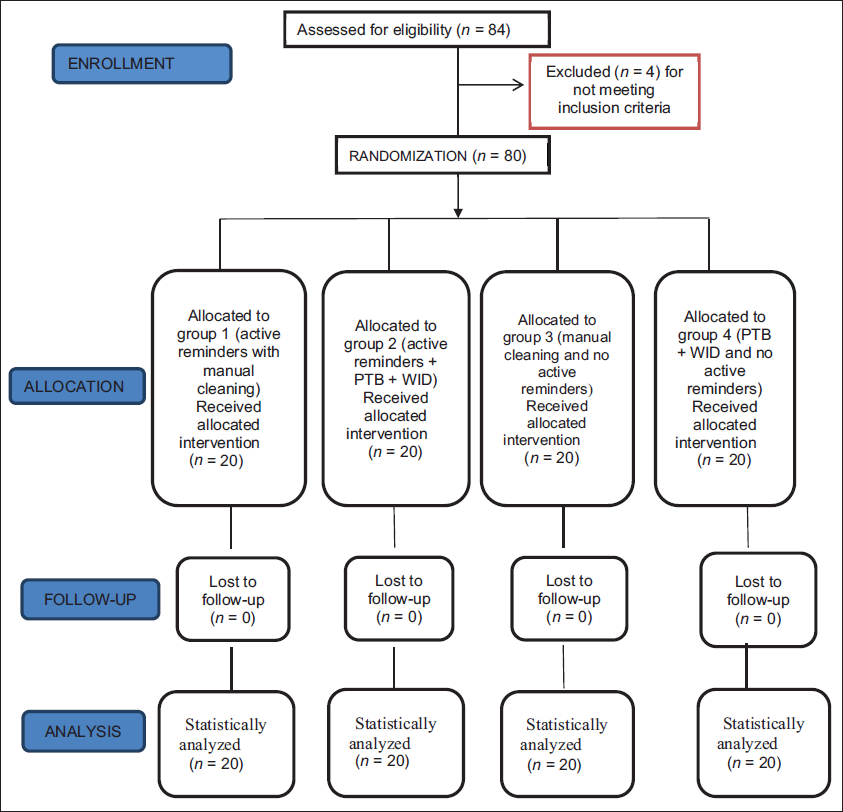
The present study was a single-blind, randomized clinical trial with four parallel arms. A total of 84 participants were assessed for eligibility criteria, of which 80 subjects (49 females and 31 males) who fulfilled inclusion criteria were selected. Each patient was randomly assigned to one of the four groups through randomization. None of the participants withdrew from the trial during the follow-up period (Figure 1).
Participants
The study was conducted at Department of Orthodontics and Dentofacial Orthopedics at JN Kapoor DAV Dental College, Yamunanagar, Haryana. Before the start of the study, the protocol was approved by an institutional review board (via Letter No. F/EC/1456/20), and written informed consent was obtained from the participants and their guardians.
Patients between 12 and 25 years of age who were undergoing fixed orthodontic appliance treatment in both arches (≤6 months) with good physical and mental health were included in the study. Patients with poor periodontal health, systemic/medically compromised conditions, history of smoking or alcoholism, and patients on antibiotics or other long-term medications were excluded from the study.
Intervention
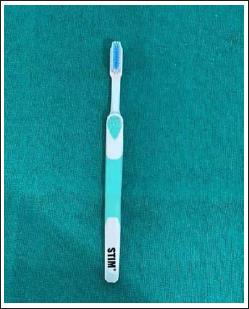
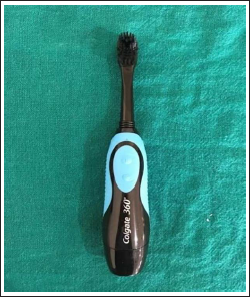
All the participants were randomly allocated to four groups. Subjects allocated to group 1 and group 3 were given manual orthodontic toothbrush (STIM® Ortho MB) (Figure 2) whereas in group 2 and group 4, each participant received powered toothbrush (Colgate® Charcoal 360) (Figure 3) combined with a water irrigator (ORACURA® OC001) (Figure 4). Additionally, active reminders in the form of SMS were sent to the participants in group 1 and group 2 only. At the beginning of the study, all the subjects were treated with phase I therapy, that is, supra-gingival scaling and root planing after collecting the baseline data. The subjects were demonstrated the correct method of tooth brushing (modified Bass technique) and irrigation to ensure proper usage of the products assigned and were advised to use the prescribed oral hygiene protocol twice daily. All the patients were evaluated at baseline (T0) and after 2, 4, 8, and 12 weeks after baseline, that is, T1, T2, T3, and T4, respectively. Oral hygiene instructions were given to all the subjects by the senior coordinator (ZB) at the various test intervals, that is, T0, T1, T2, T3, and T4.
Manual Orthodontic Toothbrush.
Powered Toothbrush.
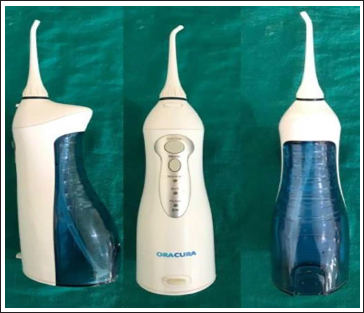
Water Irrigating Device.
Outcome
The principal investigator (SR) assessed the plaque index (PI) (orthodontic modification of Silness and Loe given by William et al.) 7 and gingival index (GI) (Loe Harald) 8 at the baseline (T0) and at all the follow-up time points. All the measurements for PI and GI were taken with archwires and ligatures in place.
Randomization
An allocation sequence was generated by the randomization software. Each participant was given an opaque sealed envelope containing the number of the group to which they had been assigned through simple randomization. The concealer preserved the allocation code and randomization sequence throughout the study until all the samples received interventions and data collection was complete. Generation of randomization sequence and participant allocation was carried out by senior coordinator (ZB). The principal investigator (SR) was blinded during the whole process.
Statistical Analysis
The statistical tests were performed with statistical software using SPSS version 20 (IBM SPSS Statistics Inc.) Windows software program. The level of significance was set at p ≤ .05. The normality condition of PI and GI data values was tested for each group at baseline using Kolmogorov–Smirnov and Shapiro–Wilk tests. One-way analysis of variance (ANOVA) was performed to compare PI and GI values among the four groups at baseline and other time intervals. Linear mixed model analysis was performed to analyze pairwise group comparisons for PI and GI scores at various time intervals.
Results
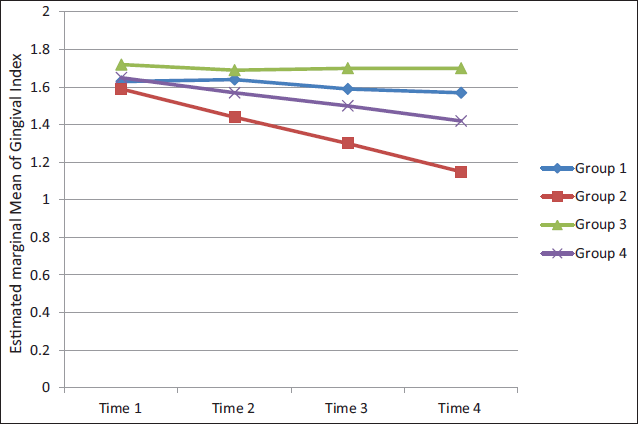
Figure 1 demonstrates the participant flow during the course of the study. Table 1 shows baseline comparison of mean PI and GI scores among the four groups. There was no significant difference found in the mean values of PI (p = .528) and GI (p = .741) at baseline. Figures 5 and 6 demonstrate PI and GI scores plotted against time in four groups at different time intervals. A significant decline in PI and GI scores was observed in groups 2 and 4 over time. In group 3, the mean PI value increased as compared to baseline at T3.
Comparison of Baseline Plaque Index (PI) and Gingival Index (GI) Scores Among Four Groups.
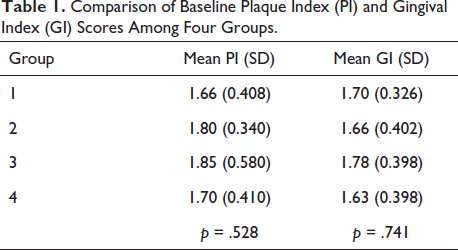
Diagram Showing Change in Estimated Marginal Mean Plaque Index (PI) Scores in the Four Groups Over Time.
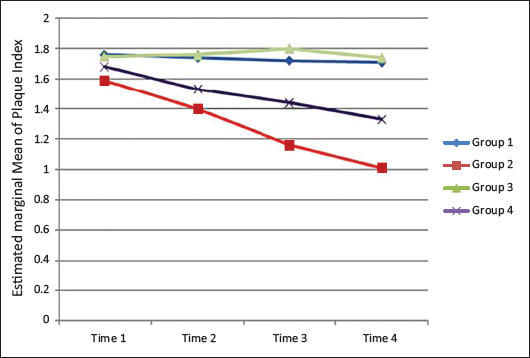
Diagram Showing Change in Estimated Marginal Mean Gingival Index (GI) Scores in the Four Groups Over Time.
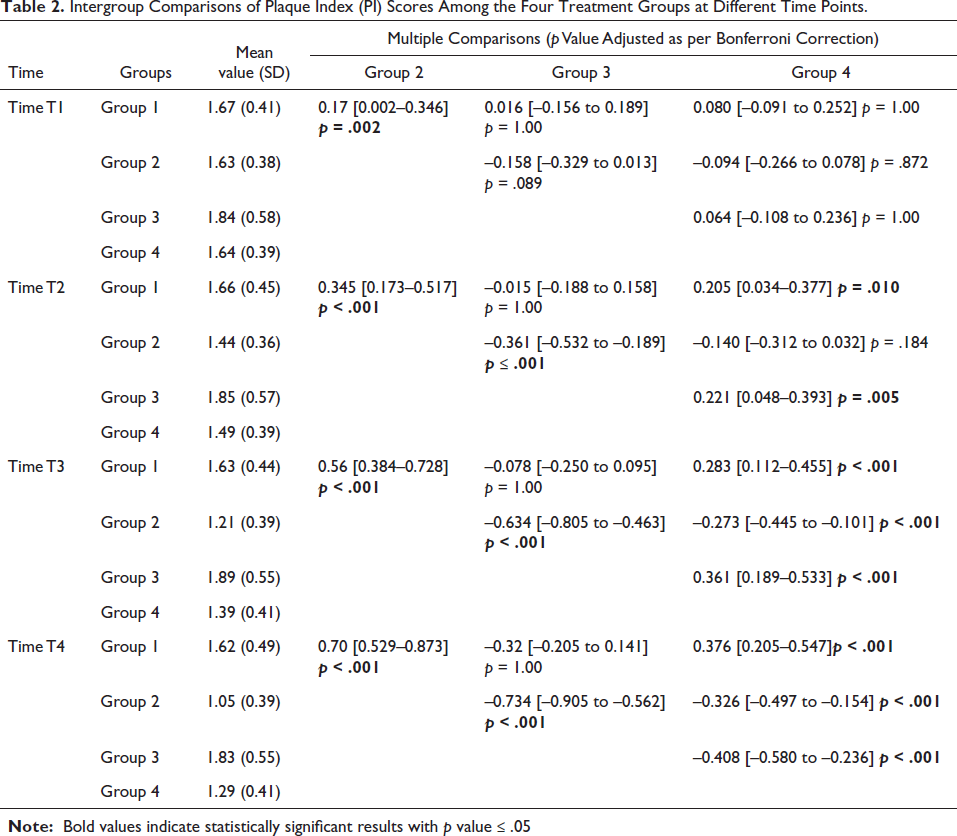
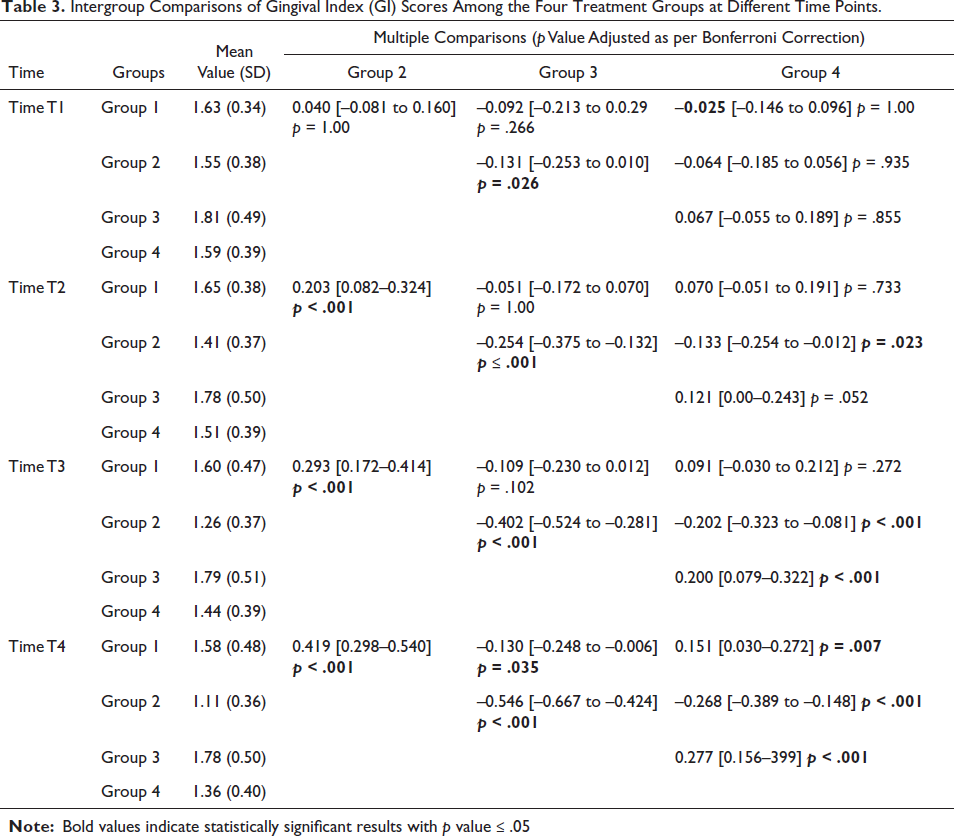
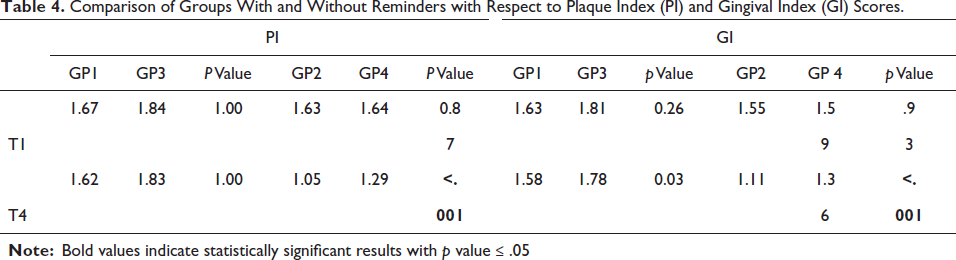
Tables 2 and 3 show group-wise comparison of PI and GI scores at various test intervals. Statistically significant differences were found in the mean PI and GI scores of groups 2 and 4 as compared to other groups at most of the time points. In Table 4, mean PI and GI scores have been compared between group 1 versus 3 and group 2 versus 4 to analyze the effect of reminders on oral hygiene performance. Statistically significant results were seen in group 2 versus group 4 comparison at T4 (p < .001) for both PI and GI.
Intergroup Comparisons of Plaque Index (PI) Scores Among the Four Treatment Groups at Different Time Points.
Intergroup Comparisons of Gingival Index (GI) Scores Among the Four Treatment Groups at Different Time Points.
Comparison of Groups With and Without Reminders with Respect to Plaque Index (PI) and Gingival Index (GI) Scores.
Discussion
The present study assessed the efficacy of powered toothbrushes and water irrigating devices as compared to conventional oral hygiene aids, that is, manual toothbrushes on oral hygiene performance of fixed orthodontic patients. Powered electric toothbrushes (Colgate® Charcoal 360) and water irrigator (ORACURA® OC100) were provided to half of the participants (groups 2 and 4) for daily oral hygiene regime, and the rest half of the study participants (groups 1 and 3) were provided with manual orthodontic toothbrushes (Stim® Ortho MB) specially designed for orthodontic patients with fixed appliances. In order to assess the effect of repeated oral hygiene instructions, participants in group 1 and group 2 were sent reminders with the help of SMS. However, verbal motivation was provided to all the participants at the baseline and subsequent follow-up visits.
Oral hygiene in the subjects was assessed with the help of PI and GI measured at baseline and at 2, 4, 8, and 12 weeks after baseline. The mean of PI and GI scores at baseline were found to be similar in all the groups without any statistically significant differences indicating uniformity among the groups at baseline. On further comparisons of PI and GI scores at various time intervals, group 2 and group 4 subjects demonstrated better performance at almost all the test intervals as compared to groups 1 and 3, indicating the superiority of motorized oral hygiene aids in maintaining the oral health of subjects with fixed orthodontic appliance. The results are in accordance with the study of Erbe et al. 9 in which significant reduction in PI, GI, and gingival bleeding index was noted in subjects who used powered brush along with dental irrigator as compared to the subjects receiving manual hygiene aids similar to our study.
Burch et al. 3 demonstrated similar results in their study in which significant reduction in plaque, gingival inflammation, and bleeding was noticed after 2 months of use of automatic toothbrush and water irrigating device as compared to the control group. Similarly, Clerehugh et al. 1 and Kossack et al. 10 evaluated the changes in PI and GI of orthodontic patients in two groups who either used a combined rotating/oscillating or a manual toothbrush, and found that the group using the electric brush had a significantly less interdental gingival bleeding. However, the results of studies conducted by Marinia et al., 11 Thienpont et al., 4 and Heasman et al. 12 are in contradiction to our study, which demonstrated no significant effect of the type of toothbrush used on the performance of oral hygiene.
According to the studies conducted by Burch et al., 3 Felo et al., 13 Cutler et al., 14 Al Mubarak et al., 15 Sharma et al., 16 and Chaves et al., 17 there was a reduction in plaque scores with the use of the OI as an adjunct to toothbrush (manual or powered) as compared to tooth brushing alone. Hence, the significant improvement in oral hygiene performance in subjects using powered toothbrushes and irrigators might actually be an effect caused by the irrigator only.
Evaluating the effect of repeated oral hygiene instructions with the help of text messages on the performance of oral hygiene in subjects revealed the following results.
With manual (groups 1 and 3) and motorized cleaning aids (groups 2 and 4), the subjects who received repeated instructions (group 1 and group 2) demonstrated better results in terms of mean PI and GI scores as compared to the subjects who did not receive repeated instructions (groups 3 and 4) as shown in Table 4. However, the results were not significant statistically at any of the time points in manual groups whereas in groups 2 and 4, where participants used motorized clinical aids and half of the participants received SMS, statistically significant improvement was observed in favor of repeated oral hygiene reminders. It can be contemplated from the above results that the repeated reminders influenced the study subjects’ oral hygiene performance. However, the magnitude of the effect was found to be small compared to what has been suggested in the literature.
The literature supports the positive effect of repeated reminders on oral hygiene performance and adherence to appointments in orthodontic patients. 18 In a systematic review, Mohammed et al. 5 reported statistically significant standard mean differences favoring plaque control and improved gingival and bleeding index scores in subjects receiving short- and long-term reminders. The subjects receiving reminders were less likely to develop white spot lesions and less likely to fail and cancel their appointments. The duration of treatment was less in these patients.
An important finding noticed in our study was that the magnitude of difference in the scores of PI and GI as compared to baseline increased with time between the groups receiving instructions as compared to the subjects not receiving the same, that is, group 1 versus group 3 and group 2 versus group 4. Thus, it can be stated that repeated reminders did positively influence the oral hygiene performance of subjects irrespective of the type of oral hygiene aids used.
Limitation of the present study is that the confounding factors like the method of ligation (ligature wires/e-module) and sex of the patient (male/female) were not taken care of. Therefore, a larger study with a bigger sample size is required to overcome these limitations.
Conclusion
Advanced oral hygiene aids like powered toothbrushes and water irrigating devices have a reminiscent effect on the oral hygiene performance of the subjects undergoing fixed orthodontic treatment.
Repeated reminders have a conducive role in improving the oral hygiene performance of fixed orthodontic patients.
Footnotes
Declaration of Conflicting Interests
The authors declared no potential conflicts of interest with respect to the research, authorship and/or publication of this article.
Ethical Approval
The ethical clearance was granted by the Institutional Ethical Committee for this study (Letter No. F/EC/1456/20).
Funding
The authors received no financial support for the research, authorship and/or publication of this article.
Informed Consent
The participant has consented to the submission of the article to the journal.
