




Abstract
Lip biting habit can cause severe malocclusions and should be intercepted early in age. The lip bumper device is a helpful treatment as it can stop the habit and prevent the resulting malocclusion. Lip biting habit is intercepted by removable or fixed lip bumper. A simplified appliance for lip biting habit that is easy to fabricate and is more accepted and comfortable for the patient was designed. It consists of a thermoplastic sheet with a labial acrylic pad as in a conventional lip bumper appliance. Improved patient compliance was noted with added advantage of ability to maintain better oral hygiene.
Keywords
Introduction
The extraoral muscles and tongue are usually in equilibrium which helps to stabilize the dentition. Any deleterious habit can alter the normal development of the orofacial structures by hampering this equilibrium. 1 Lip sucking is commonly seen during 6 to 9 years of age. According to the severity and frequency the malocclusion it may produce varies, but it is essential for normal development that the habit be eliminated. The lip bumper device is a helpful treatment as it can stop the habit and prevent the resulting malocclusion. Lip biting habit is intercepted by removable or fixed lip bumper. 2 Patient compliance is not favorable with removable lip bumper because of its rigidity, irritation to lingual mucosa, and excess salivation. For fixed lip bumper, child may not be cooperative for banding procedure and maintaining oral hygiene will be a difficult task. Since appliance is fixed, it will be difficult for child to eat with appliance or to have it in school. To overcome above difficulties, we fabricated a simple appliance to eliminate lip biting which has proven to show good compliance from patient.
Technique for Fabrication
Take an accurate well-extended Alginate impression of mandibular arch. Disinfect the impression and pour the working cast in dental stone.
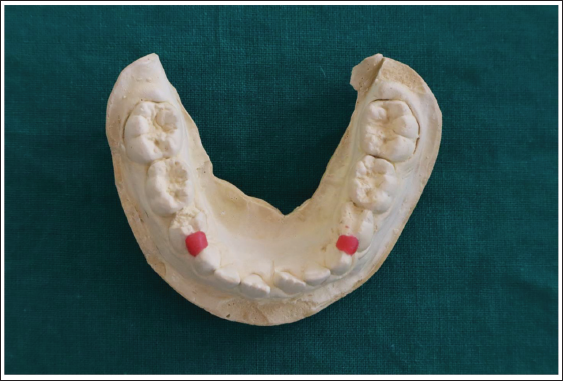
Add modeling wax between deciduous canine and deciduous first molar on occlusal surface. Wax will act as a spacer to insert molar tubes (Figure 1).
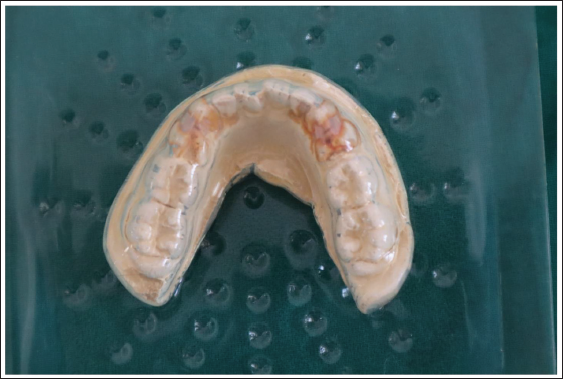
Over the cast make a 1.5-mm thermoplastic plate 1 from vacuum press machine (Figure 2).
Take the plate out from the cast and remove the wax remnant.
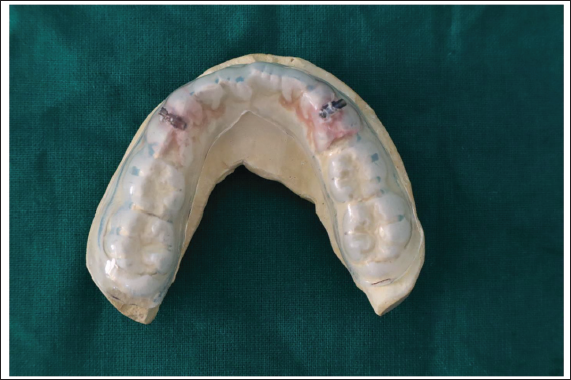
Heat the round molar tube 2 and pierce through the thermoplastic plate to place it between deciduous canine and first molar. Molar tube will prevent plate from tearing when patient will start wearing the appliance after fabrication (Figure 3).
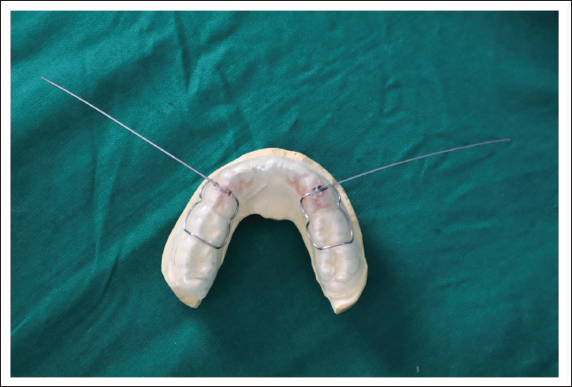
Pass 0.8-mm stainless steel wire in molar tube from labial to lingual and adapt the wire over thermoplastic plate on lingual side over the thermoplastic sheet following gingival contour. Extend the wire on occlusal surface to adapt it on the buccal side (Figure 4).
Add wax spacer in the anterior sulcus region and adapt the wire slightly away from it (Figure 5).
Engage the wire into acrylic forming a lip bumper (Figure 6).
After acrylic is set, remove the wax and polish the lip bumper (Figure 7).
Wax as Spacer.
Thermoplastic Sheet Adapted to Cast Using Vacuum Forming Machine.
Insertion of Heated Molar Tube Through Thermoplastic Sheet.
Adapted Stainless Steel wire.
Wax Spacer in Anterior Region.
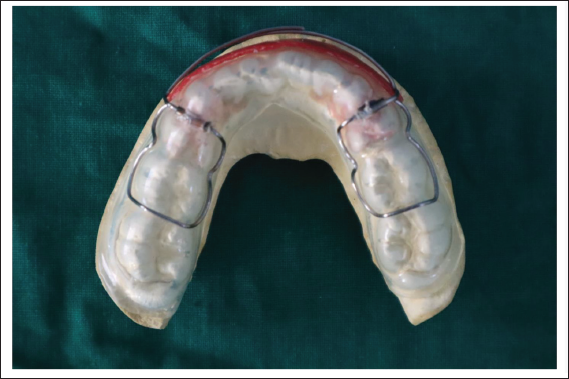
Acrylic Lip Bumper in Anterior Region over Spacer.
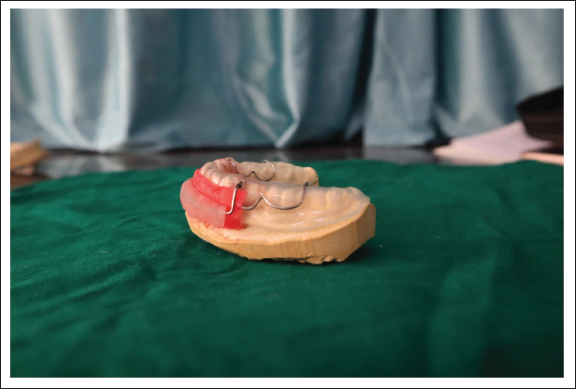
Finished and Polished Appliance Intraorally.
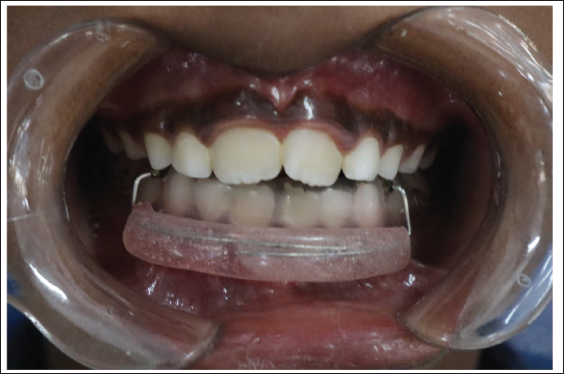
Advantage of the Appliance
This appliance fits snugly on the teeth.
The contoured wire on labial and lingual side provides added retention.
The appliance can be worn and removed easily.
Patient will not have difficulty in eating as appliance can be removed during meals.
No soft tissue laceration or impingement since thermoplastic sheet is well adapted to the teeth.
Patient compliance is good without obstructing oral hygiene or increasing caries susceptibility (as with banding of lip bumper).
The most important thing to remember about any intervention is that the child must themselves want to discontinue the habit for treatment to be successful. Therefore, if you can deliver a comfortable appliance, it will be more effective.
Footnotes
Declaration of Conflicting Interests
The authors declared no potential conflicts of interest with respect to the research, authorship and/or publication of this article.
Funding
The authors received no financial support for the research, authorship and/or publication of this article.
Statement of Informed Consent and Ethical Approval
Not applicable.
