




Abstract
Temporary anchorage device-assisted rapid maxillary expansion has widened the horizon to treat adults having maxillary transverse deficiency without any surgical procedure. Three-dimensional custom modifications have also been developed, but they can be expensive. A modification of Hyrax screw with the use of lingual sheaths is suggested for microimplant-assisted rapid palatal expansion, which can be an easy to fabricate in-office and economical option.
The introduction of the microimplant-assisted rapid palatal expansion (MARPE) appliances has opened up a new horizon for clinicians to treat adult and adolescent patients with maxillary transverse deficiency. Three-dimensional finite element analysis showed that these devices have more skeletal than dental effects. 1 The first such appliance was developed by Lee et al. 2 In this appliance, microimplants were placed through 4 helical hooks that were soldered on the base of a conventional Hyrax screw body. In this assembly, problem like breakage of solder joint between hooks and Hyrax body can occur. This would cause disassembling of the entire assembly to redo the solder joint. Another reason that could cause removal of the entire assembly and need of performing the whole process again is microimplant failure, which necessitates placement of bigger diameter of implant or change in the site of placement.
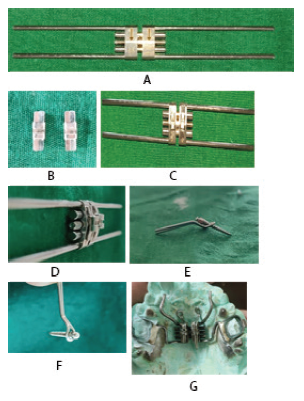
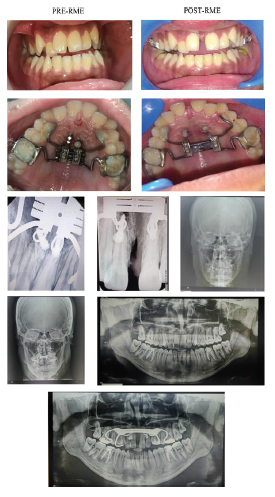
A modification is suggested to overcome probable problems mentioned with the solder joint and implant failure. Lingual sheaths (0.036″× 0.072″) are welded on the body of Hyrax (Figure 1 A-D). Keyhole-shaped hooks are made as per the microimplant diameter from round stainless steel (0.8 mm) wire (Figure 1[E]-[F]). A case has been shown as below with the appliance in the oral cavity (Figure 2). The whole assembly consisting of molar bands is cemented with removable hooks inserted into the lingual sheaths. Implants are then placed through these hooks and secured with resin. This ensures rigidity and no micromovement at the implant-hook interface. This mechanism eliminates removal of entire assembly from patient mouth in case of microimplant failure. New hooks can be prepared as per the new size of implant and reinserted into the lingual sheath with Hyrax being in place. The use of lingual sheaths, which are readily available in any orthodontic office, is a cost-effective and easy option for in-house fabrication of the appliance.
Shows the steps for fabrication of the appliance.
Footnotes
Declaration of Conflicting Interests
The authors declared no potential conflicts of interest with respect to the research, authorship, and/or publication of this article.
Ethical Approval
Necessary ethical clearances were received and obtained before initiating the study from all participants.
Funding
The authors received no financial support for the research, authorship, and/or publication of this article.
Informed Consent
Informed consent was not sought for the present study because no identifiable images were used.
