




Abstract
Retention is an important phase of orthodontic treatment for prevention of relapse. Over the years, many direct and indirect techniques have been practiced for placing a bonded lingual retainer. The use of rubber dam has become one of the most critical steps during fixed lingual retainer bonding procedure, as it prevents aerosols from spreading in operatory to a greater extent. This article describes a simple method of utilizing rubber dam clamps to assist in the stabilization of lingual retainer wire on teeth. It is easy, simple, reliable, timesaving, and economical as it does not require special equipment or transfer trays.
Introduction
Retention is an important phase of orthodontic treatment for prevention of relapse. Over the years, many direct and indirect techniques have been practiced clinically for placing a bonded lingual retainer.1-3 The composite adhesive technique allows a reliable positioning system for directly bonded retainers and does not influence the occurrence of carious lesions or demineralized spots on fixed teeth in long-term usage. 1 However, any bonding technique carries the risk of moisture contamination, which can lead to bond failures and subsequently to relapse2, 3. Placement of rubber dam is the proven and the most recommended moisture control method for dental procedures involving composite resins and adhesives 4 . Moreover, in the current COVID-19 pandemic conditions, the British Orthodontic Society has recently published the guidelines on the risk of aerosol generating procedures (AGPs) during orthodontic treatment. 5 Hence, during fixed lingual retainer bonding procedures, the use of rubber dam has become one of the most critical steps as it prevents aerosols from spreading in operatory to a greater extent. 5
This article describes a simple method of utilizing rubber dam clamps to assist in the stabilization of lingual retainer wire on teeth. This technique is suitable for placing a retainer after debonding of labial brackets as the rubber dam sheet may get torn due to brackets. This technique is recommended for both flat retainer wire and flexible twisted wire. It is easy, simple, reliable, and economical; because it does not require special equipment or transfer trays, it saves considerable chair side and laboratory time.
Techniques
On a plaster cast, adapt .0175″ stainless steel flexible twisted wire to the lingual surfaces of canine to canine.
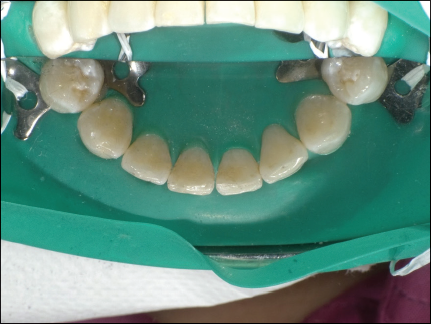
Apply the rubber dam in the lower arch exposing the left first premolar to the right first premolar with clamps fixed to right and left first premolars (Figure 1).
Place orthodontic elastics offering medium force between the lateral incisor and canine on both right and left sides.
Prepare the lingual surfaces of the anterior teeth for bonding as usual.
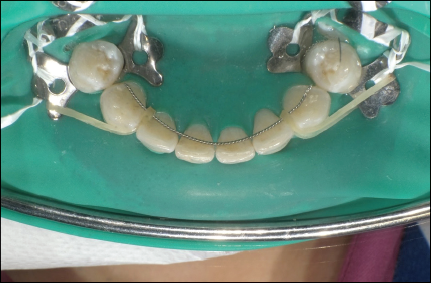
Pass the ends of the retainer wire through the elastics so that the anterior segment of the retainer is in passive contact with the lingual surfaces of the anterior teeth.
Stretch the elastics and engage in the rubber dam clamp on both sides (Figure 2).
Bond the retainer with a light-cured adhesive. Remove the adhesive flash from the tooth surfaces and take out elastics by cutting. Perform finishing and polishing procedure if needed.
Remove the rubber dam and evaluate patient’s perception on tongue movements for any possible sharpness of the retainer or bonding material.
Mandibular Teeth under Rubber Dam Isolation Prior to Lingual Retainer Bonding.
Lingual Retainer Wire Secured with Elastics Engaged in Rubber Dam Clamp.
Footnotes
Declaration of Conflicting Interests
Funding
The authors received no financial support for the research, authorship, and/or publication of this article.
Statement of Informed Consent and Ethical Approval
Necessary ethical clearances and informed consent was received and obtained respectively before initiating the study from all participants.
