



Abstract
Abstract
As the demand for esthetic orthodontic treatment has gained momentum in the past few years, orthodontists are looking for simple and cost-effective devices for precise lingual bracket placement. This short communication describes a versatile lingual jig that can be fabricated with ease by a clinician, allowing precise lingual bracket positioning.
Introduction
The demand for esthetic orthodontic treatment has gained momentum with the emergence of various aligner systems. However, orthodontists are still hesitant to use the lingual orthodontic technique because of its dependency on elaborate laboratory setups and bonding jigs. Predictable and reproducible 3-dimensional placement of the bracket on the lingual surface is of utmost importance. Most of the commercially available bracket bonding jigs either require multiple wires bending for each tooth or multiple jigs for individual anterior teeth. 1 Lingual bracket-positioning systems, such as TARG (Torque angulation reference guide) and CLASS (Custom lingual appliance setup service) machines, are accurate but expensive, time-consuming, and require specialized technical skills.2,3
This article describes a versatile lingual jig that can be fabricated with ease by a clinician, allowing precise lingual bracket positioning.
Armamentarium Needed
Tofflemire (API)
0.021″ × 0.025″ and 0.017″ × 0.025″ stainless steel (SS) wire
MBT (Mclaughling Bennett Trevisi) prescription brackets of 0.022 slot
Lingual brackets (0.018″ slot)
Graduated scale
Steps of Fabrication
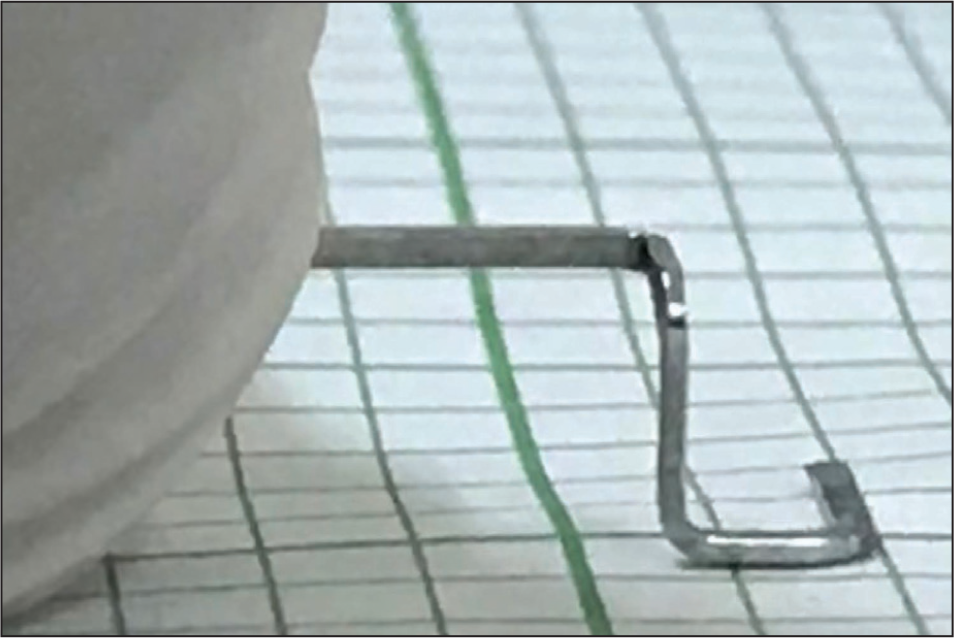
A section of 0.021″ × 0.025″ SS wire is soldered at the center of the base of the inner guidepost of tofflemire with the required wire bending so as to position the wire for insertion into the labial bracket slot (Figures 1 and 2).
Wire bending of 0.021 X 0.025″ stainless steel (SS) wire
Section of 0.021 × 0.025″ SS wire soldered to the inner guidepost of Tofflemire
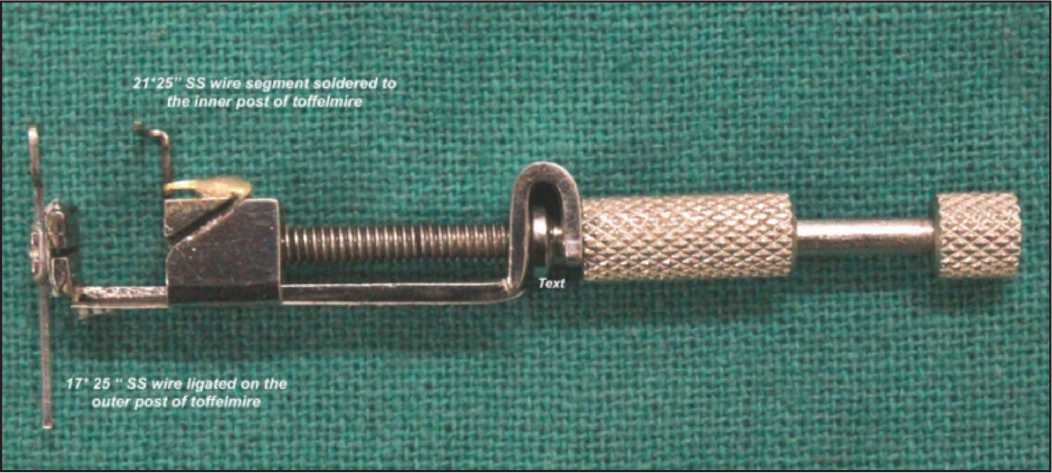
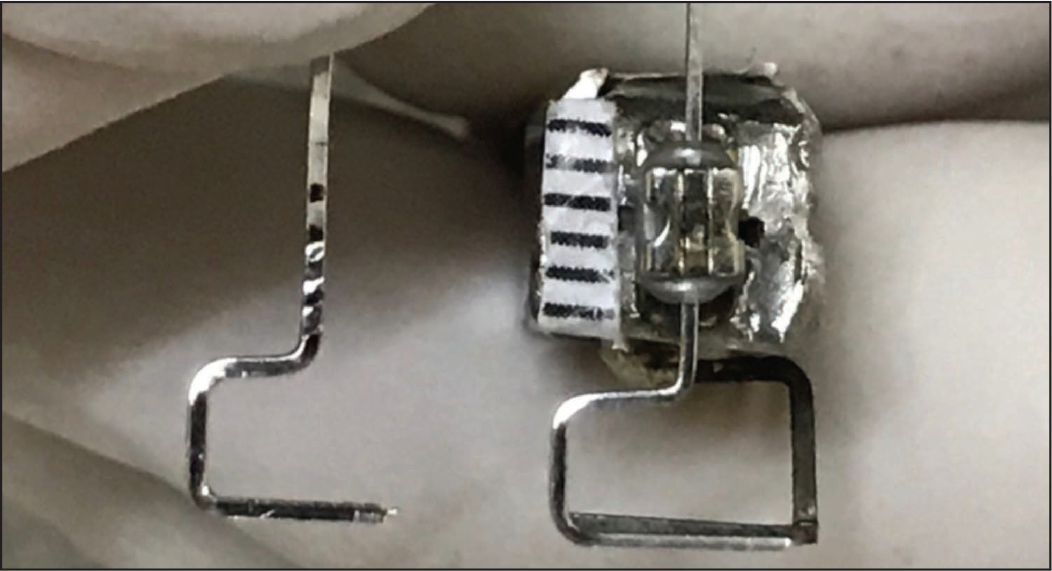
A 0.018″ slot standard edgewise molar tube is soldered to the front surface of the outer guidepost of tofflemire (Figure 3).
A section of 0.017″ × 0.025″ SS wire is secured with the help of a module into the edgewise tube on the outer post of tofflemire (Figure 3).
A millimetric graduated scale is pasted on tofflemire.
How to Use
MBT prescription brackets are bonded on the labial surface of teeth on the patient’s model (Figure 4).
The inner and outer wire segments to be inserted into the labial and lingual brackets, respectively, are kept in the same plane. Their lengths can be modified for short/long crown heights as needed.
The inner SS wire (0.021″ × 0.025″) is inserted into the slot of the bonded labial bracket.
As the 0.021″ × 0.025″ SS wire segment is inserted into the labial bracket, the torque is transferred to the 0.017″ × 0.025″ SS wire horizontal segment.
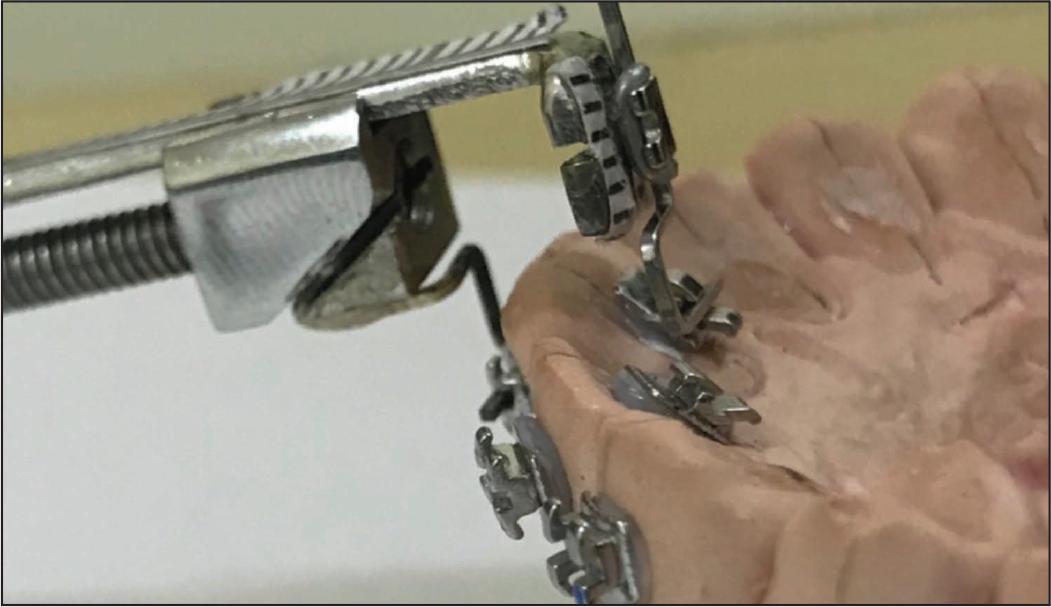
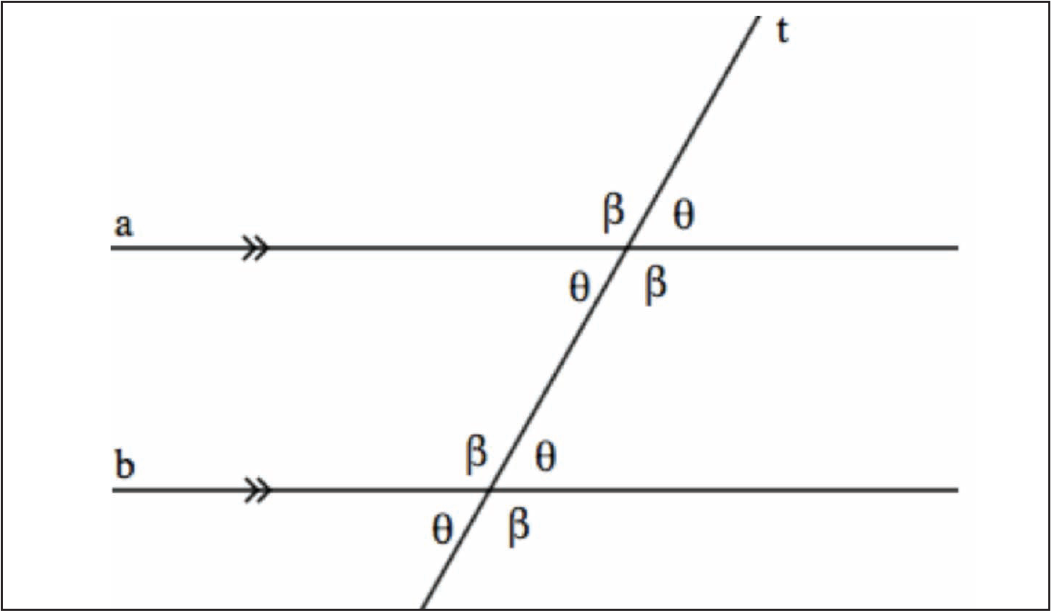
The lingual bracket is engaged on the outer SS wire of the jig (0.017″ × 0.025″) (Figure 5). The inner nut is screwed closed to achieve the required labiolingual position of the bracket. The vertical position is adjusted by moving the outer wire to the desired vertical height. This allows the adjustment of the vertical height for bonding brackets on long teeth with low cingulae or short crowns. 1 As the outer and inner arms are parallel and in the same plane, the slot angulation will be transferred as it is, in accordance with the concept of Euclidean parallelism (Figure 6). 4
The millimetric scale can be used to measure the first order (in-out) in the composite base thickness.
A section of 0.017 × 0.025″ SS secured to the edgewise molar tube on outer guidepost of Tofflemire
Labial MBT prescription brackets bonded on the model
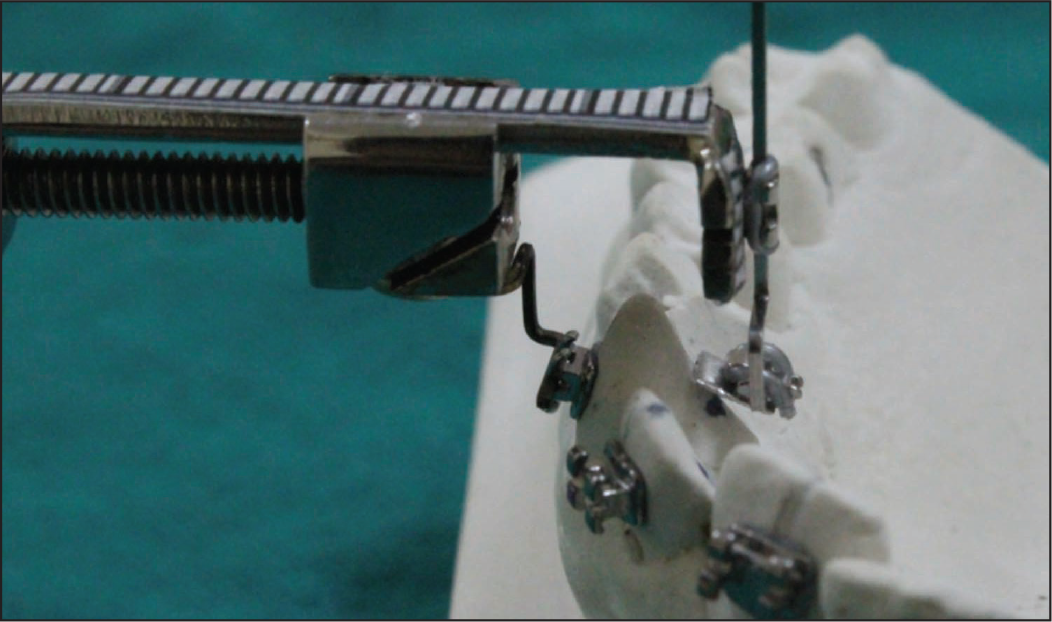
Inner and outer wire segments engaged in the bracket slots showing customised composite bracket base with labial torque incorporated
Parallel line concept of euclidean geometry - lines a and b are parallel. This can be proved because the transversal t produces congruent corresponding angles
Conclusions
The 3-dimensional versatile lingual jig is a simple and accurate lingual bracket-positioning gauge that can be self-fabricated by a clinician. This jig has its concept derived from lingual jigs previously published1,5 or in commercial use; however, the major advantage is its low cost and ease of use. It also eliminates the need for individual wire bending to fabricate the jig for each tooth. Labial brackets can be reused for a few cases to further reduce the inventory cost.
Funding
The authors received no financial support for the research, authorship, and/or publication of this article.
Declaration of Conflicting Interests
The authors declared no potential conflicts of interest with respect to the research, authorship, and/or publication of this article.