




Abstract
An electronic survey was conducted to determine the attitudes of veterinary pathologists toward forensic pathology and the adequacy of their training in the discipline. The survey was sent to 1933 diplomates of the American College of Veterinary Pathologists and 311 completed responses were analyzed. Of respondents, 80% report receiving at least 1 type of medicolegal case, with cases from law enforcement received most frequently. Most (74%) of the respondents indicated that their previous training did not prepare them adequately to handle forensic cases and almost half of the respondents (48%) indicated that they needed more training on serving as an expert witness. Relative risk ratios (RRR) and odds ratios (OR) were generated to determine the strength of a statistically significant association. Responses from a free-text entry question determining additional training needs could be grouped into 3 main categories: (1) veterinary forensic pathology science and procedures, (2) documentation, evidence collection and handling, and (3) knowledge of the medicolegal system. Last, a field for additional comments or suggestions regarding veterinary forensic pathology was completed by 107 respondents and many reinforced the need for training in the categories previously described. The survey highlights that a significant proportion of diplomates of the American College of Veterinary Pathologists are currently engaged in veterinary forensic pathology but feel their training has not adequately prepared them for these cases. Hopefully, the survey results will inform the college and residency training coordinators as they address the training requirements for an important emerging discipline.
Diplomates of the America College of Veterinary Pathologists (DACVP) are highly skilled, intensively and extensively trained anatomic and clinical pathologists. 11 Career paths diverge once training is completed and many pathologists continue with diagnostic pathology in academia or diagnostic laboratories. Most diagnostic submissions for postmortem are animals with spontaneous disease acquired due to exposure to biological or toxic hazards, endogenous natural diseases, or those that die due to accidental trauma. Although animal abuse and neglect have occurred since antiquity, 1 it is apparent that a tipping point in veterinary pathology has been reached and a new discipline of veterinary forensic pathology is emerging, 3 as evinced by an increase of forensic cases to veterinary diagnostic laboratories 7,9,12,13 and increased publications on veterinary forensic pathology 2,4,5,8,10 An added dimension to these cases is the possibility that abused animals are sentinels for human interpersonal violence. 14 Are veterinary pathologists prepared to undertake these cases where legal credibility is as equally important as scientific credibility? 5 A survey of ACVP diplomates was done to determine the attitudes of anatomic pathologists to veterinary forensic pathology cases prior to the half-day symposium on veterinary forensic pathology, at the 2015 ACVP annual meeting. The results of this survey will inform understanding of current attitudes toward veterinary pathology cases and identify areas that need to be addressed for continuing education and training in veterinary forensic pathology.
A 14 question electronic survey was sent to DACVP on behalf of the authors by ACVP administration in December 2014. The target population was anatomic pathologists who had diagnostic duties as part of their job. The survey was sent to a total of 1933 diplomates, of whom 1768 were anatomic pathologists. Answers remained anonymous. The survey closed December 31, 2014. A purposive survey was sent to 16 pathologists known to the principal author (BJM) in Canada, Portugal, and Brazil as a pretest to refine the survey before distribution to DACVP. This survey was certified for ethical acceptability of research involving human participants by the Research Ethics Board, University of Guelph (certificate REB#14JN031).
Statistical analysis was performed using Stata14 Statistical Software (StataCorp LP, College Station, TX). Multinominal and logistic regression were used for categorical and binary variables respectively, that were statistically significant with chi square tests. Relative risk ratios (RRR) and odds ratios (OR) were generated from these analyses. RRR and OR are measures used to determine the statistical strength of an association. Statistical significance is given at P < .05, and 95% confidence intervals (CI) are provided for RRR and OR.
Of the 1933 surveys to DACVP, 814 were opened, and 311 of the 334 surveys answered were totally completed. The response rate was 17% of all DACVP receiving the survey and 19% of DACVP anatomic pathologists. Respondents were from 13 countries and 5 continents. Three respondents were also diplomates of the European College of Veterinary Pathologists and 2 were diplomates of the Japanese College of Veterinary Pathologists. Of those who self-identified, 160 were male and 157 were female. Respondents had been pathologists for an average of 19.7 years (range 1 year to greater than 60 years) and 71% indicated that they had some diagnostic pathology duty. Most were employed at universities either in academia or as diagnostic pathologists (46%), in government diagnostic laboratories (10%) and private diagnostic laboratories (15%). Pathologists usually had both histopathology and postmortem duties (85%) although 15% were solely histopathologists.
Pathologists were asked to indicate the relative frequency of the various types of medicolegal cases they received, with 5 being the highest frequency and 0 indicating that they do not receive this type of case. Of pathologists who answered these questions, 80% received at least 1 of the 5 types of medicolegal cases that were collapsed into 3 categories (Fig. 1): infrequent (levels 1 and 2), moderately frequent (level 3) and frequent (levels 4 and 5). Law enforcement cases were more frequently received than other categories of medicolegal cases (Fig. 1). The definition of regulatory cases was noted to be ambiguous by some respondents who indicated that it was difficult to respond accurately to the question.
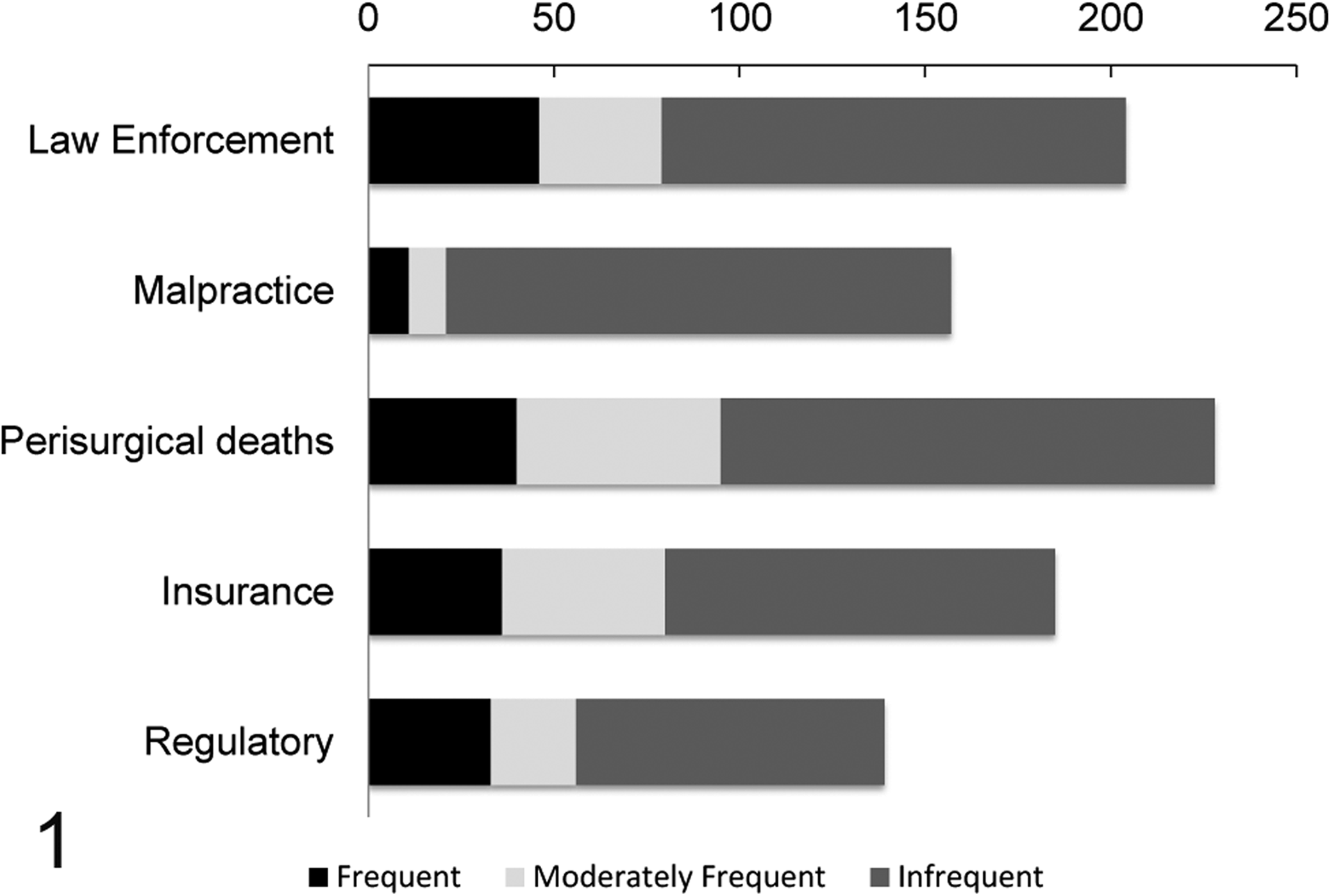
The frequency of 5 types of medicolegal cases received by respondents.
Given a choice, many (44%) pathologists prefer not to take cases of suspected animal abuse or neglect and only half indicated they were comfortable with these cases (Fig. 2). Almost half of the respondents (48%) indicated that they needed more training on being an expert witness and would feel more comfortable with forensic cases if they could take courses in this subject. A moderate number (28%) were comfortable with forensic postmortems and the documentation, but were nervous about going to court. One-quarter of the respondents agreed that the documentation of these cases takes an excessive amount of time and they did not receive enough information from investigators to arrive at a manner of death. Many (19%) were frustrated that despite the amount of work required for these cases, they were never informed of the final legal outcome and 17% of respondents attempt to avoid medicolegal cases entirely because they don’t want to attend court.
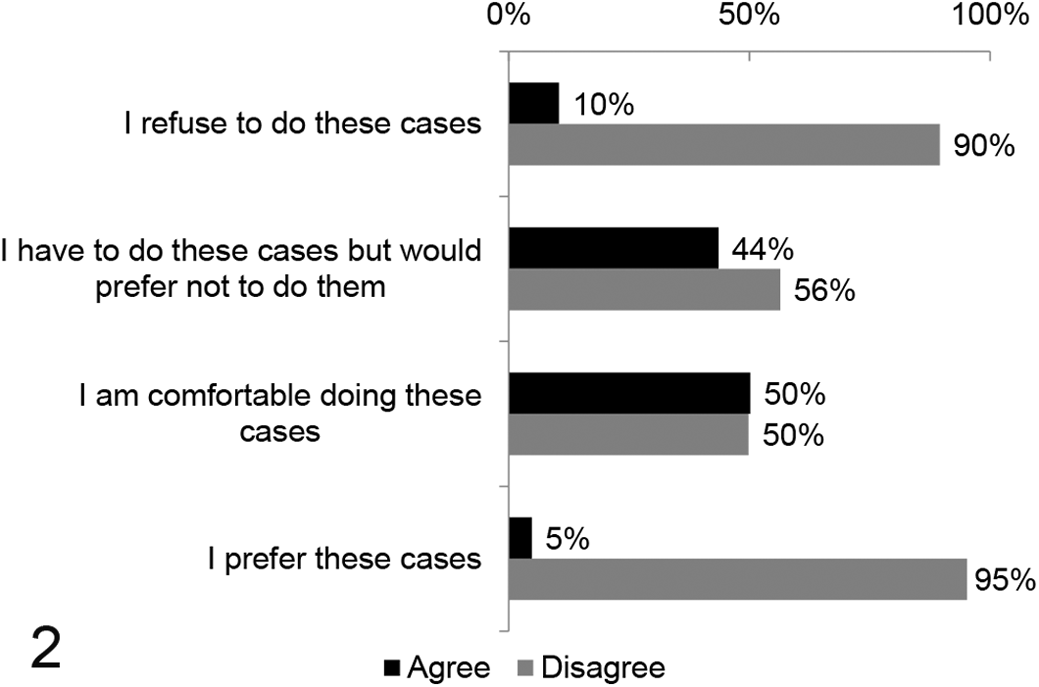
Percentage of respondents who agreed or disagreed with 4 statements on possible attitudes toward cases submitted from law enforcement agencies.
Most (74%) of the respondents indicated that their previous training did not prepare them adequately to handle forensic cases. Neither years being a pathologist, sex, place of employment or whether respondents preferred or refused to take medicolegal cases were statistically significant factors in the perception that training was inadequate. Pathologists who indicated they had adequate training were more likely to be confident in their ability to perform a thorough postmortem examination and generate an appropriate report for submissions from law enforcement (RRR = 9.7, 95% CI 2.89-32.69), regulatory cases (RRR = 4.7, 95% CI 1.59-14.29), peri-surgical deaths (RRR = 3.5, 95% CI 1.15-10.41) and malpractice cases (RRR = 2.9, 95% CI 2.12-7.12). Compared to adequately trained pathologists, those that thought they were inadequately trained preferred not to do these cases (OR = 1.82, 95% CI 1.03-3.2) and were more likely to be frustrated by the workload and lack of information regarding the final outcome (OR = 2.5, 95% CI 1.19-5.44). This group also identified a statistically significant need for expert witness training (OR = 2.1, 95% CI 1.9-3.37), additional training and courses in veterinary forensic pathology (OR = 2.7, 95% CI 1.57-4.55).
When asked to list areas of training for forensic pathology cases that would be beneficial, there were 488 responses. Although this was a free-text entry, the answers were remarkably consistent and were classified into 3 main categories: Veterinary forensic pathology Basic forensic pathology Identification and documentation of traumatic lesions and aging wounds Determination of the postmortem interval Procedures and guidelines for processing medicolegal cases Developing a network of resources Wildlife forensic pathology Ancillary testing: entomology, toxicology Documentation and Evidence Photography, report writing, procedures Evidence collection, retention and chain of custody Medicolegal system Legal procedures, laws, the court system Being an expert witness including knowing your rights Identifying the expectations of law enforcement and understanding what a crime scene investigation entails Dealing with questions about pain and suffering Dealing with lawyers
Other topics included liability, media relations, invoicing, and the laboratory resources required for these cases.
A field for additional comments or suggestions regarding veterinary forensic pathology was completed by 107 respondents. Many reinforced the need for training in the categories described above. Responses ran the gamut from “I really hate these cases” and “I refuse to do these cases” to those echoing the following: “No big deal, just like any other case. We will never be able to reproduce the ME [medical examiner] system.” A few pathologists commented on the emotional toll these cases may take on individuals: “Cases of animal cruelty involving intentional abuse/torture can also exact a personal emotional/psychological toll, with the potential for vicarious traumatization in members of a profession with a deeply ingrained commitment to the care and humane treatment of animals.”
This electronic survey was intended to target diagnostic anatomic DACVP to identify attitudes toward veterinary forensic pathology and determine training needs for this newly emerging area. Respondents were from 13 countries, almost equal numbers of male and females and on average, were employed as pathologists for 19.7 years. For logistical reasons, the survey was sent to all DACVP however, the target population was a subset of this group. The low response rate of 17% indicates selection bias and a nonrespondent survey was not performed. The reasons for those who responded to the survey are not known. Although it is speculative, the responses were likely biased toward those pathologists employed in institutions accepting medicolegal cases, and subsequently to those indicating a need for additional training.
Most pathologists felt that their albeit excellent training for board certification was inadequate for veterinary forensic cases and that additional training in forensic pathology, documentation, evidence collection, storage and handling combined with a better understanding the legal system would be beneficial. These are similar to findings in a European survey sent to 72 respondents pathology laboratories, institutes, and departments in 29 countries. 12
The ability to provide free-text comments at the end of the survey revealed that attitudes were a spectrum from those that refuse to do forensic cases to those that treat them no differently than those submitted for spontaneous disease. Additional comments on the possible psychological effects of these cases on individual pathologists highlighted an important issue omitted from the survey design.
The ultimate purpose of a forensic pathology examination is to “assist in the end point of the death investigation required by the state.” 6 We argue that a veterinary forensic pathology examination should serve the same purpose. To accomplish this, veterinary pathologists should have resources available to develop expertise in veterinary forensic pathology and understand the legal context from which these cases arise and where final decisions are made.
Based on the results of this survey, ACVP should consider taking positive actions to support the members of the college engaged in forensic veterinary pathology. Inclusion of a regular mini-symposium in forensic pathology would help with continuing education of current members and provide a framework of study for residents interested in the topic. Veterinary Pathology accepts forensic-pathology-focused articles, but a section devoted to forensic pathology that accepts original articles, brief communications, case reports, and diagnostic exercises would help strengthen the scientific rigor of the discipline. Finally, we strongly urge the ACVP to explore the possibility or instituting subspecialty certification and training in forensic pathology. The need for veterinary pathologists trained in the field of forensics is growing, and as we have asked before—if not us, then who? 8
Footnotes
Declaration of Conflicting Interests
The author(s) declared no potential conflicts of interest with respect to the research, authorship, and/or publication of this article.
Funding
The author(s) received no financial support for the research, authorship, and/or publication of this article.