



Abstract
The body of a deceased human and 4 deceased cats were found in a house while a fire was being extinguished. As a result of these findings, arson, homicide, and animal death investigations were opened. As part of the animal death investigation, all of the cats were submitted for veterinary forensic autopsies. All cats had soot on the fur and had soot deposits within the oral cavity, esophagus, and respiratory tract. Two cats had soot within the stomach. Cardiac blood was analyzed for carboxyhemoglobin using a CO-oximeter, and all cats had levels >65%. The cause of death was determined to be due to toxic smoke inhalation from the structure fire. Case findings support the potential use of CO-oximeter for determination of carboxyhemoglobin levels in cats and continued research in this area of forensic practice.
Arson is the intentional destruction of property for unlawful purposes using fire. 7 There are multiple reasons why people commit arson including financial gain, civil disorder, malicious intent, pyromania, terrorism, and covering up of other crimes. 5 When conducting a homicide and/or animal cruelty death investigation, there are instances where structure fires are simultaneously encountered because the offender(s) may commit arson to cover of the initial crime. In these instances, there will be a simultaneous arson investigation and death investigation. All animals found dead in a structure fire should have an autopsy performed to determine whether or not the animal was alive in the fire. In the veterinary literature, few scientific publications regarding the postmortem findings of animals exposed to smoke and fire have been published;9,13,17 however, none of these are specific to cats. This case series describes the findings from the forensic investigation of a group of cats found dead in a house fire.
Fire rescue crews were called to a home where a fire was occurring. Upon entering the house and extinguishing the fire, the mutilated body of a deceased female human was found in 1 room and the nonmutilated bodies of 4 deceased adult cats were identified in another room. The structure fire caused some damage to the home, and there was a thick layer of soot throughout the home. At this point, arson, homicide, and animal death investigations were opened. A forensic autopsy was performed on the human victim, and veterinary forensic autopsies were performed on the 4 feline victims. Cat No. 1 was an adult, spayed female, domestic shorthair; cat No. 2 was an adult, spayed female, domestic shorthair; cat No. 3 was an adult, spayed female, domestic shorthair; and cat No. 4 was an adult, castrated male domestic shorthair.
Autopsy findings were similar for all 4 cats, and none had evidence of burns anywhere on their bodies. There was black material (soot) deposited on the fur of all cats and similar black material within the nares and oral cavity. Oral mucous membranes of all cats were bright red (Fig. 1a). Examination of the respiratory system revealed deposition of a mixture of soot and mucus within the oropharynx, larynx, trachea (Fig. 1b), and primary bronchi. All of the cats had soot mixed with mucus within the esophagus (Fig. 1c), and 2 cats had small amount of soot within the stomach. Microscopic examination was performed and the trachea (Fig. 2), bronchi, and to a lesser degree the lungs contained black pigmented material (soot). No other significant findings were observed during the autopsies.
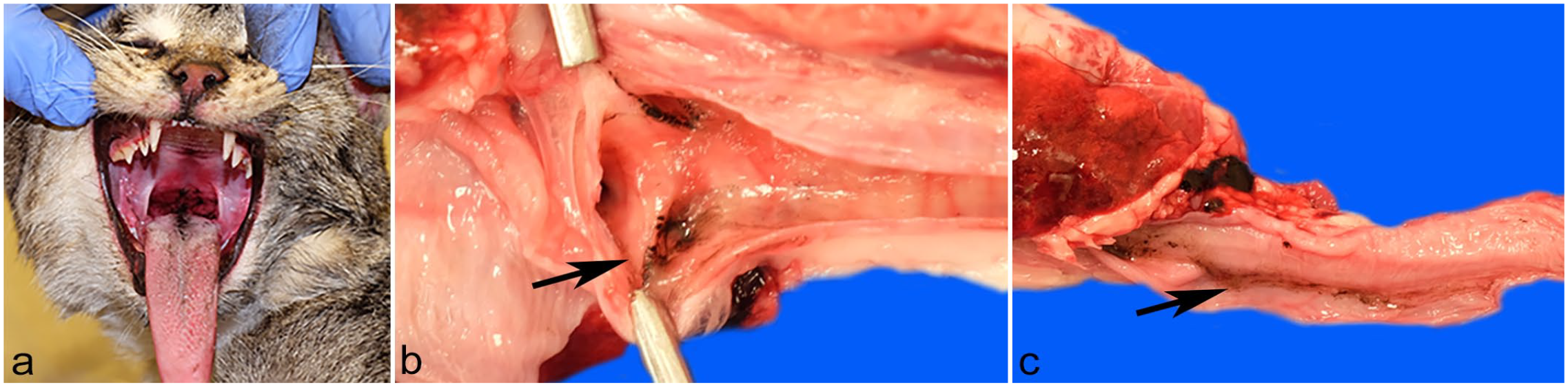
Gross lesions observed in cats found dead in a house fire, cat No. 3. (
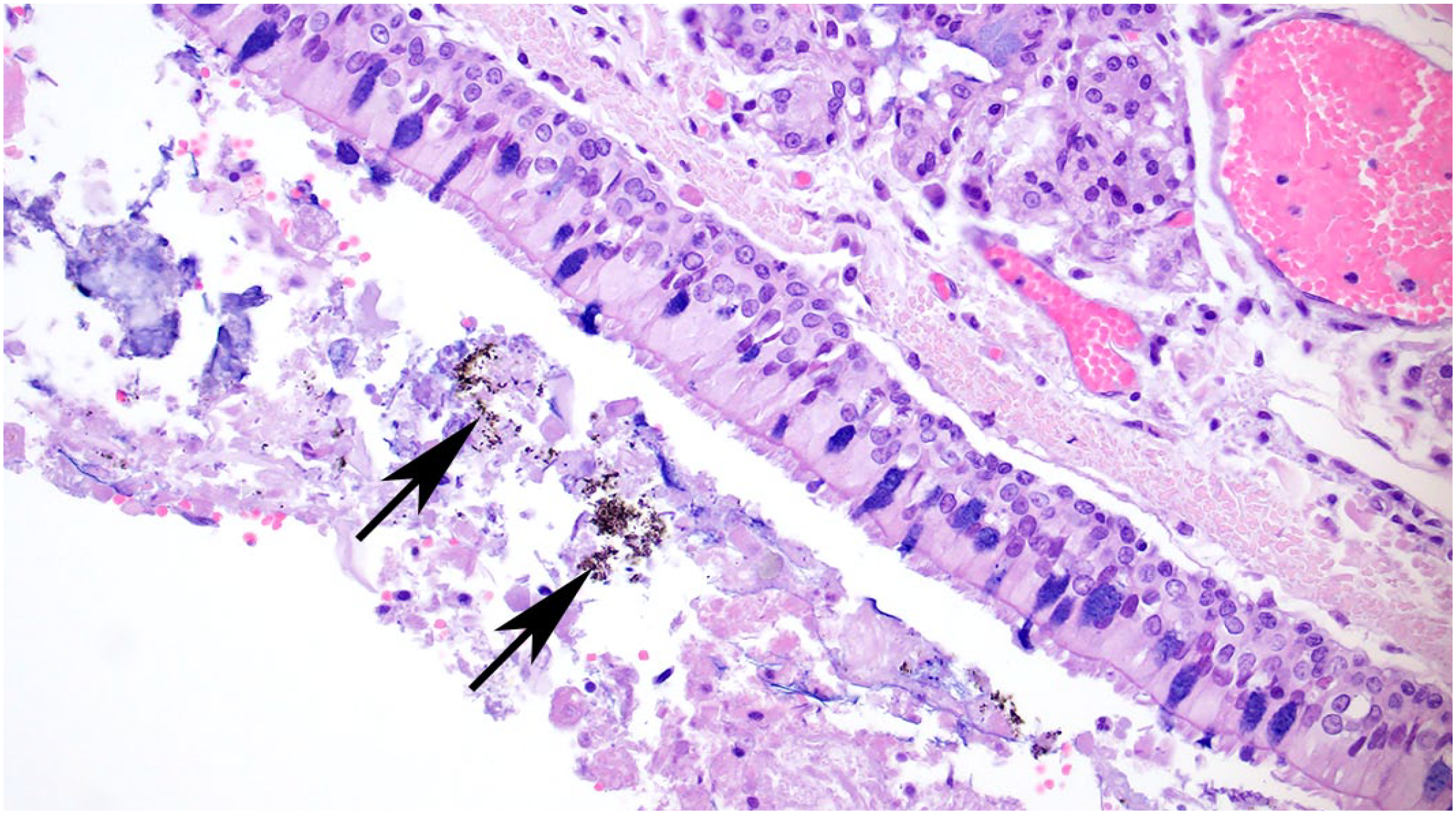
Trachea, cat No. 2. Black granular material deposited on sloughed epithelial cells (arrows). Hematoxylin and eosin.
Per standard operating procedure for fire-related death investigations within the University of Florida veterinary forensics laboratory, heart blood (right ventricle) was collected via aspiration (approximately 2 mL), put into ethylenediamine tetraacetic acid (EDTA) vacutainer tubes, and the blood was subsequently tested for carboxyhemoglobin (COHb) using a CO (carbon monoxide)-oximeter. Blood samples were stored at 4°C until analyzed (up to 4-hours post-collection). A CO-oximeter or multiwavelength oximeter is a device that uses multiple wavelengths of light to measure the hemoglobin in blood including oxygen-carrying hemoglobin, non–oxygen carrying hemoglobin, and dyshemoglobins (ie, COHb and methemoglobin). In these cases, COHb was determined using the AVOXimeter 4000 (Werfen, Bedford, Massachusetts), which is a patient side machine and most commonly is found in human emergency rooms. No sample preparation is needed to use the machine. Briefly, approximately 50 μL of blood was put into disposable cuvettes and then inserted into the machine. Results of the analysis of the blood revealed 73.3% (cat No. 1), 74.4% (cat No. 2), 67.9% (cat No. 3), and 66.9% (cat No. 4) COHb. There are no reference ranges for COHb in cats; however, reported ranges of COHb in 6 healthy dogs were 6.1% (5.6%–6.4%). 2 The cause of death of all 4 cats was similar and determined to be exposure to toxic fire fumes (specifically carbon monoxide) which was supported by soot deposition at multiple sites and elevated COHb levels.
In this case, fire rescue crews were able to put out the structure fire before it destroyed much of the home. Extinguishing the fire limited the destruction of evidence by the offender(s). The forensic autopsy of the human in this case determined that the cause of death was strangulation with postmortem dismemberment. It was determined that the fire was set after the homicide had been committed. The cause of death of the cats was due to toxic smoke inhalation because of the structure fire.
There are multiple reasons for deceased people to be found in purposefully set fires, which is known as arson-associated homicide. Arson-associated homicide has been categorized into 4 types: (1) homicides in which the victim was killed in an arson fire (ie, primary arson-associated homicide), (2) person set on fire (immolation), (3) arson committed after a murder (ie, secondary arson-associated homicide), and (4) a body burned after murder.1,4 Because the term homicide and murder are not used when referencing animals, “killing” can substitute for “homicide” and “murder,” which are legal definitions specific to people. According to a report from Australia, a higher proportion of offenders and victims in arson-associated homicides had a familial relationship (sibling, parent, cousin, grandparent) than in general homicides. 4 In the current case, the victim was the grandmother to the offender, and the cats were owned by the victim.
All the cats in this case had soot deposits within the oral cavity, respiratory tract, and esophagus, whereas only 2 cats had soot in the stomach. Soot found within the lower respiratory tract is a vital change and demonstrates that the cats were alive within the fire. Soot within the esophagus is a vital change and demonstrates that the cats were actively swallowing soot while alive in the fire. Soot deposits in this case are consistent with previous reports of humans and animals that were alive in an active fire.3,13,17 In a study reviewing 13 cases of the postmortem burning of human corpses, there was no soot in the lower respiratory or gastrointestinal tract except in 1 case with soot in the oropharyngeal region. 15 In addition to soot deposits with the respiratory and gastrointestinal tracts, elevated COHb in blood also supports the victim was alive in the fire. Pathologists can use COHb as a biomarker for CO because when inhaled, CO binds to hemoglobin to form COHb.3,11,17
It is theoretically possible for CO to be passively absorbed by the body when there is a large breach in a body cavity. In a study using stillborn piglets, cavity blood samples showed an increase in COHb levels to 12% ± 2.6%; however, this was not observed in heart blood samples. 14 Based on this study, caution should be exercised when interpreting COHb levels in cavity blood when there is a cavity breach. A plethora of toxic gases can be found in smoke produced by fires including CO, carbon dioxide, and cyanide. 17 CO is produced from the inefficient combustion of carbon-containing molecules. CO has greater than 240 times the affinity for hemoglobin compared with oxygen and readily forms COHb when absorbed by the body. 11 Ultimately, elevations in COHb result in tissue hypoxia due to reduced oxygen-carrying capacity of blood. 16 Postmortem COHb levels can be determined using multiple methods including headspace gas chromatography/thermal conductivity, ultraviolet/visible spectrophotometry, and CO-oximetry.6,8
There is limited information in the scientific literature regarding the analysis of COHb in cats. A single study described the analysis of COHb in 2 cats that died of CO intoxication. In that study, a Comopac electrochemical gas meter was used to analyze COHb levels, which were reported to be 41% and 57%. 12 The 4 cats in the current study all had COHb levels greater than the 2 previously reported COHb levels that were fatal to cats. COHb levels reported in 2 dogs that died in fires were 56% and 65%. 13 In a case series of dogs that survived a kennel fire, COHb levels ranged from 8.8% to 37%. 2 In CO-exposed humans, most fatalities occur when COHb is greater than 40%. 10 In the current study, we used the AVOXimeter 4000 to determine the COHb levels in the cats’ blood, and all were above 66.9%. The AVOXimeter 4000 has been shown to be useful for the routine analysis of postmortem blood for COHb in human forensic cases. 6
Given the limited published information pertaining to fire-related deaths and COHb analysis in cats, more research is needed. We need to continue the exploration of diagnostic modalities including the use of a CO-oximeter to determine both antemortem and postmortem COHb levels in cat blood, particularly for use during forensic investigations. The analysis of COHb can be useful not only in fire-related deaths but also in cases of CO intoxication resulting from faulty portable heaters, particularly during the winter months and when used during natural disasters.
In this case, all 4 cats were found to have succumbed to the exposure to CO as a result of secondary arson homicide. Based on the findings of the investigation, the cats died because of the fire and not by other natural or non-natural means. Ultimately, a single offender was identified, and he pled guilty to his crimes including homicide, arson, and mutilation of a dead body. While the death of these cats is covered by the state’s Animal Cruelty statutes, prosecutorial discretion (the power a prosecutor has to decide whether or not to charge a person for a crime and which criminal charges to file) prevailed and charges against the defendant for animal cruelty were not filed. Although animal cruelty charges were not filed in this case, the pathology findings provided facts that were important to the case and the lack of pursuing charges was not a reflection of the pathology investigation. While it cannot change the outcome in this case, an animal cruelty task force has been created in this jurisdiction to ensure all animal-related charges are prosecutable. The findings reported in the cats were similar to the postmortem findings observed in humans and dogs that died of exposure to toxic fire fumes. In addition, we described the use of a CO-oximeter to determine COHb levels using postmortem cardiac blood, which supported the fact that these cats were alive in the fire. It is imperative that veterinary pathologists assist in forensic death investigations and be aware of diagnostic tests that can be performed to provide further support of exposure to toxic gases such as CO. If a pathologist needs access to a CO-oximeter, they can contact their local hospital as this equipment is commonly found in emergency rooms.
Footnotes
Declaration of Conflicting Interests
The author(s) declared no potential conflicts of interest with respect to the research, authorship, and/or publication of this article.
Funding
The author(s) received no financial support for the research, authorship, and/or publication of this article.
