



Abstract
Prolactin (PRL) is a key hormone involved in canine mammary development and tumorigenesis. In this study, the influence of a single nucleotide polymorphism (SNP) in the PRL gene (rs23932236) on the clinicopathological parameters and survival of dogs with canine mammary tumors (CMTs) was investigated. A total of 206 female dogs with spontaneous mammary tumors were enrolled in this study and circulating blood cells were genotyped. This specific SNP was associated with larger size (>3 cm diameter) for malignant tumors (P = .036), tumors with infiltrative/invasive growth pattern (P = .010), vascular invasion (P = .006), and lymph node metastasis (P = .004). Carriers of the variant allele had a shorter overall survival compared to the wild-type population with an overall survival of 18.7 months and 22.7 months, respectively (P = .004). These findings suggest that SNP rs23932236 of canine PRL gene may be used as an indicator for the development of clinically aggressive forms of CMTs.
Prolactin (PRL) is a polypeptide hormone synthesized mainly by the anterior pituitary gland and, in some species, also at extrapituitary sites including the mammary epithelium, placenta, uterus, bone, and lymphocytes. 25 This protein is recognized as a regulator of mammary development and lactation, being detected in epithelial cells of the lactating mammary gland as well as in the milk secretion. 59 PRL is also involved in other biological processes including reproduction, behavior, growth and development, immunity, and metabolism. 2,4
Various studies have demonstrated the proliferative, anti-apoptotic, and angiogenic effects of PRL in human breast epithelium, also pointing to a presumptive pro-carcinogenic action. 1,17,48,54,60 –62 In fact, PRL serum levels have been correlated with human breast cancer development, 17,23,27,50,58 and some authors reported higher PRL and/or PRL receptor expression in malignant tumors than in adjacent normal mammary tissue. 36,44,49,54,63 Additional, genetic variation in human PRL gene has also been associated with breast cancer risk, specific clinicopathological features, and clinical outcome of the disease. 5,20,28,34,35,56,64 However, recently contradictory data were reported, raising some doubts regarding the role of PRL in human breast cancer development. 3,14,24,30,56
In bitches, different studies have reinforced the role of PRL in mammary gland carcinogenesis, 31,33,40,41,51 even though some recent contradictory investigations emerged. 4 Some authors described higher PRL serum levels in cases of mammary neoplasia compared to controls and associated higher levels of tissue PRL with malignancy, tumor relapse or distant metastasis. 40,41 On the other hand, other authors reported no association between PRL expression in canine mammary tumors (CMTs), and actually documented a decline in PRL receptors expression in malignant tumors compared to the benign counterparts. 4,31,33
Data regarding the influence of canine PRL genetic variation in CMTs is largely unknown. In a recent study, our group did not find a relationship between PRL genetic profile and the risk of development of mammary tumors. 10 To date, the influence of PRL genetic profile on the clinicopathological features and progression of CMTs has not been assessed. In this context, the aim of the present study was to investigate the association between single nucleotide polymorphism (SNP) rs23932236 in canine PRL gene and clinicopathological features, clinical progression, and survival of CMTs.
Materials and Methods
The study was conducted by enrolling 206 female dogs with histologically confirmed spontaneous mammary tumors. All animals were treated with radical unilateral and/or partial mastectomy. Informed consent was obtained from owners of animals that participated in this study including consent for surgery with curative intents, as well as for the use of the material for research purposes. Euthanasia, required by the owner or proposed by the veterinary clinician, was performed only in terminal stage of the disease using pentobarbital. This protocol was approved by the Ethics Committee of the Institute of Biomedical Sciences Abel Salazar, ICBAS–UP, University of Porto (P151/2016).
After surgery, mammary specimens were immediately fixed in a 10% buffered formalin solution and routinely processed for histopathological examination. For each case, clinicopathological features including age at the time of the diagnosis, tumor number, and size (corresponding to the largest diameter measured by a pathologist [ACS] during trimming) were recorded. The histological diagnosis was established by consensus of 3 pathologists (ACS, MS, and PDP) using the criteria of Goldschmidt et al (2011). 32 The growth pattern was evaluated in each malignant tumor and classified as expansive (cohesive and well-defined mass compressing the adjacent tissues) or infiltrative/invasive (less cohesive, indistinct borders with the surrounding tissues, and lymphatic or blood vessel invasion). In the subgroup of animals with multiple malignant tumors, a reference lesion was assigned for the statistical study based on peritumoral vascular invasion (primary criterion), highest nuclear pleomorphism (secondary criterion), or largest diameter (tertiary criterion). 8,46 Histological grading was assigned by consensus of the same 3 pathologists that diagnosed the tumors using the criteria of the Nottingham Histological Grading Method. 21 A veterinary adaptation of the human Nottingham Prognostic Index (vet-NPI) was also computed. 46 Vet-NPI was computed as [tumor size (cm) × 0.2] + NHG (1, 2, or 3, respectively, for grades I, II, and III) + evidence of vascular invasion/regional lymph node metastases (1 or 2 if absent or present, respectively)].
Follow-up data were obtained by consulting the medical records and by contact with the referring veterinarian. Disease-specific overall survival (OS) was calculated from the time of diagnosis to the date of the animal’s death/euthanasia due to the neoplastic disease. Animals that died or were euthanized for unrelated causes and those that were lost to follow-up were censored, respectively, at the time of death and at the date of their last clinical examination. Euthanasia was performed only in terminal stages of the disease. Necropsy examination was performed upon the owner consent.
Genomic DNA was extracted from peripheral blood samples (obtained by standard venipuncture) using High Pure PCR Template preparation kit (Roche). The DNA quality was evaluated by measuring the optical density and the quantity was assessed employing the NanoDrop 1000 Spectrophotometer using a full spectrum of 220 nm to 750 nm (Thermo Fisher Scientific). Only samples with a 260/280 and 260/230 OD ratio of DNA with at least 1.7 to 2 were included in the study. A minimal of 20 to 30 µl with a concentration of 15 ng/µl of DNA was used to perform SNP genotyping. SNP genotyping was performed using MassARRAY iPLEX Gold Technology at the Unidade de Genómica/Serviço de Genotipagem do Instituto Gulbenkian de Ciência (Lisbon, Portugal). This technology for SNP genotyping consists of an initial PCR reaction, followed by multiplexed primer extension (using mass-modified dideoxynucleotide terminators of an oligonucleotide primer), which anneals immediately upstream of the polymorphic site of interest. Additionally, the MALDI-TOF (matrix-assisted laser desorption/ionization–time of flight) mass spectrometry allows the recognition of the SNP allele by the different mass of the extended primer. 22,37
The studied SNP rs23932236 in PRL canine gene (Ensemble database) located in chromosome 35 (primer sequence: 5′- ACG TTG GAT GGG TTC TTA ATG ATC CGT CCC -3′) corresponds to a 3′UTR (untranslated region) variant (Fig. 1).
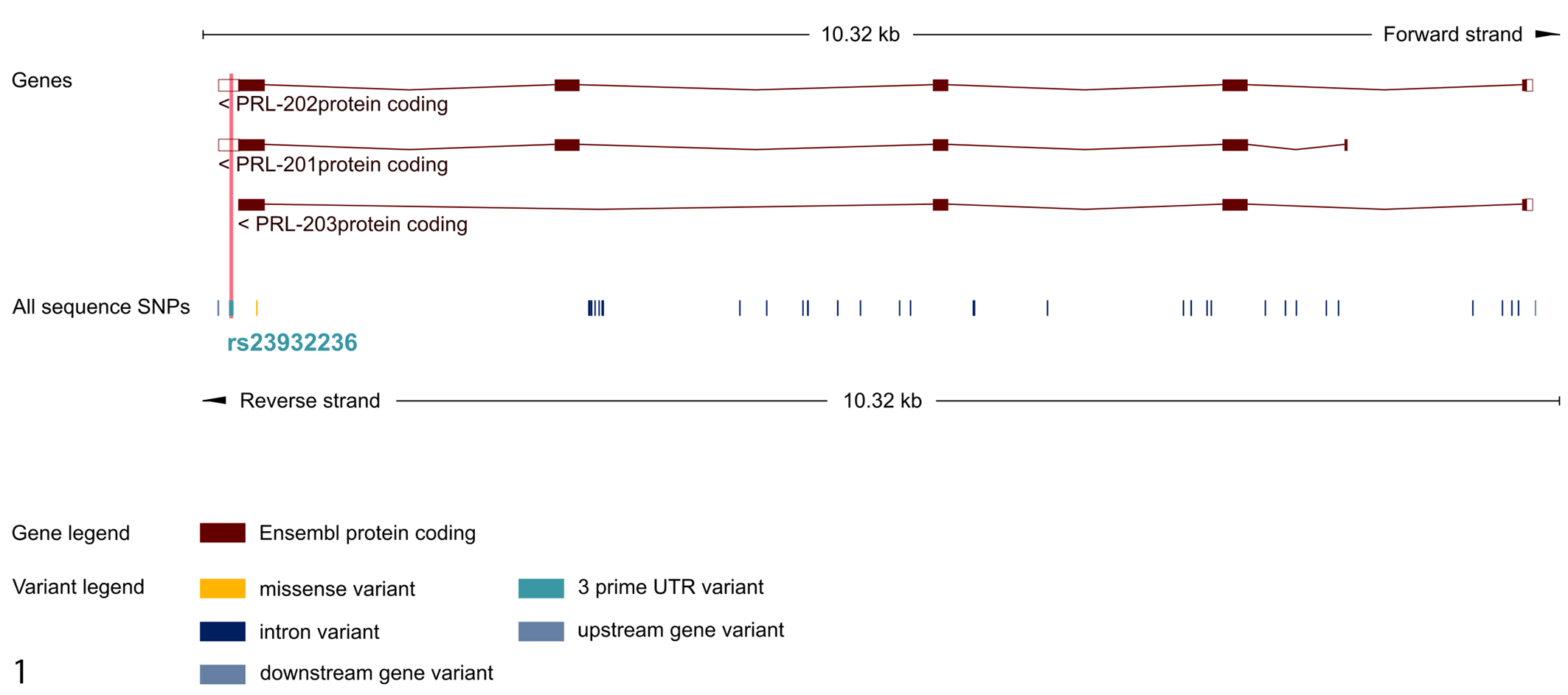
Schematic illustration of the SNP in the 3′ sequence of the PRL gene in chromosome 35. The position of the rs23932236 SNP is represented by the red line.
Statistical analysis of data was performed using the computer software SPSS for Windows (version 26). Chi-square analysis (or Fisher’s exact test, when appropriated) was used to evaluate the significance of the relationship between PRL SNP and the categorical variables. For statistical purposes and based on data from previous survival studies, malignant CMTs were divided according to different levels of aggressiveness. 8,13,42
The survival analyses were performed in cases with at least one malignant tumor for which follow-up data were available. Disease-specific survival curve was computed using Kaplan-Meier product-limit estimates method and the log-rank (Mantel-Cox) test. Cox proportional hazard regression models were used to evaluate the prognostic role of the studied SNP and clinicopathological variables in univariate analyses using the 95% confidence interval. As to the histological subtypes, only the categories with 8 or more cases were included in the statistical models. A 5% level was considered to define statistical significance.
Results
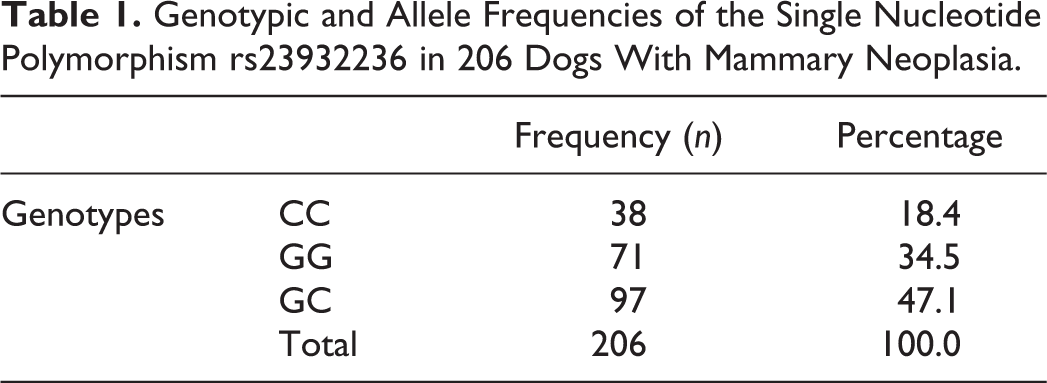
This study included 206 bitches with a mean age of 10.1 years old (range, 7–18 years old). For the population included in this study, the frequency of SNP rs23932236 was 34.5% for GG, 47.1% for GC, and 18.4% for CC (Table 1).
Genotypic and Allele Frequencies of the Single Nucleotide Polymorphism rs23932236 in 206 Dogs With Mammary Neoplasia.
Only benign tumors were diagnosed in 73 female dogs (mean age 9.68 years), while 133 female dogs presented at least one malignant tumor (mean age 10.4 years). Table 2 and Supplemental Table S1 present the histological subtypes of benign and malignant tumors diagnosed according to Goldschmidt et al (2011). Mixed benign and complex carcinomas were the most frequently diagnosed benign and malignant subtypes, representing 45.2% and 15.8% of the tumors, respectively. Multiple tumors were diagnosed in 65.5% of the cases. The mean tumor size for benign tumors was 2.1 cm (range 0.3 to 8.5 cm diameter) and for malignant tumors 3.7 cm (range 0.3 to 16.5 cm diameter).
Histological Subtypes of Benign and Malignant Mammary Tumors Diagnosed in 206 Female Dogs.
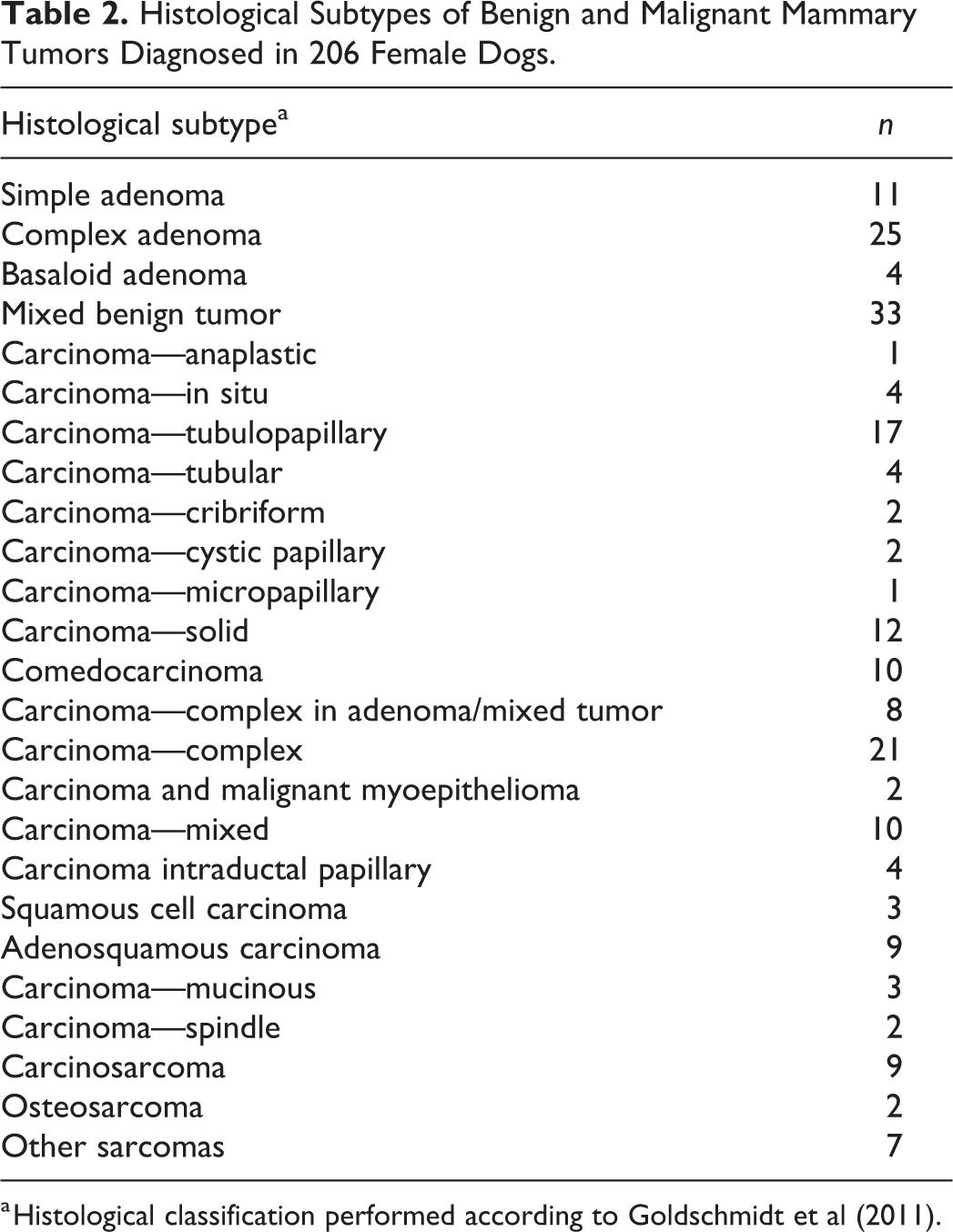
a Histological classification performed according to Goldschmidt et al (2011).
Based on the Nottingham Histological Grading Method 36/106 (34.0%) carcinomas were grade I, 47/106 (44.3%) were grade II, and 23/106 (21.7%) were grade III. Vascular invasion (assessed in 130 malignant cases) and lymph node metastasis (lymph nodes were collected during the macroscopic examination of the mammary specimens in 116 cases) were observed in 22/130 (16.9%) and in 31/116 (26.7%) of cases, respectively. Two-year follow-up data were available for 116 dogs with at least one malignant tumor. Of those, 57/116 (49.1%) were alive at the end of the follow-up period, while 31/116 (26.7%) died due to progression of the disease. From these 31 animals, 11 were necropsied upon the owner’s authorization; necropsy and microscopic findings confirmed disseminated metastatic disease in all those cases. Animals lost to follow-up and animals that died from causes not related to the mammary neoplasia (n = 28/116; 24.1%) were censored.
Table 3 presents results regarding the association between SNP rs23932236 and clinicopathological parameters. Carriers of the variant allele for SNP rs23932236 (ie, genotypes CC and GC) developed larger malignant tumors (>3 cm of diameter) than wildtype animals (P = .036), mostly with an infiltrative or invasive growth pattern (P = .010). Furthermore, a significant association was found between this genotype and vascular invasion (P = .006) and lymph node metastasis (P = .004). In fact, most of the cases with microscopic evidence of vascular invasion (90.9%) and lymph node metastasis (87.1%) had the variant allele. No significant associations were established between rs23932236 and the age of the animals, number of tumors, histological classification (regrouped), NGH histological grade and its corresponding parameters, or vet-NPI.
Association Between SNP rs23932236 in PRL gene (71 GG, 135 CC or CG) With Clinicopathological Variables in 206 Female Dogs With Mammary Tumors.
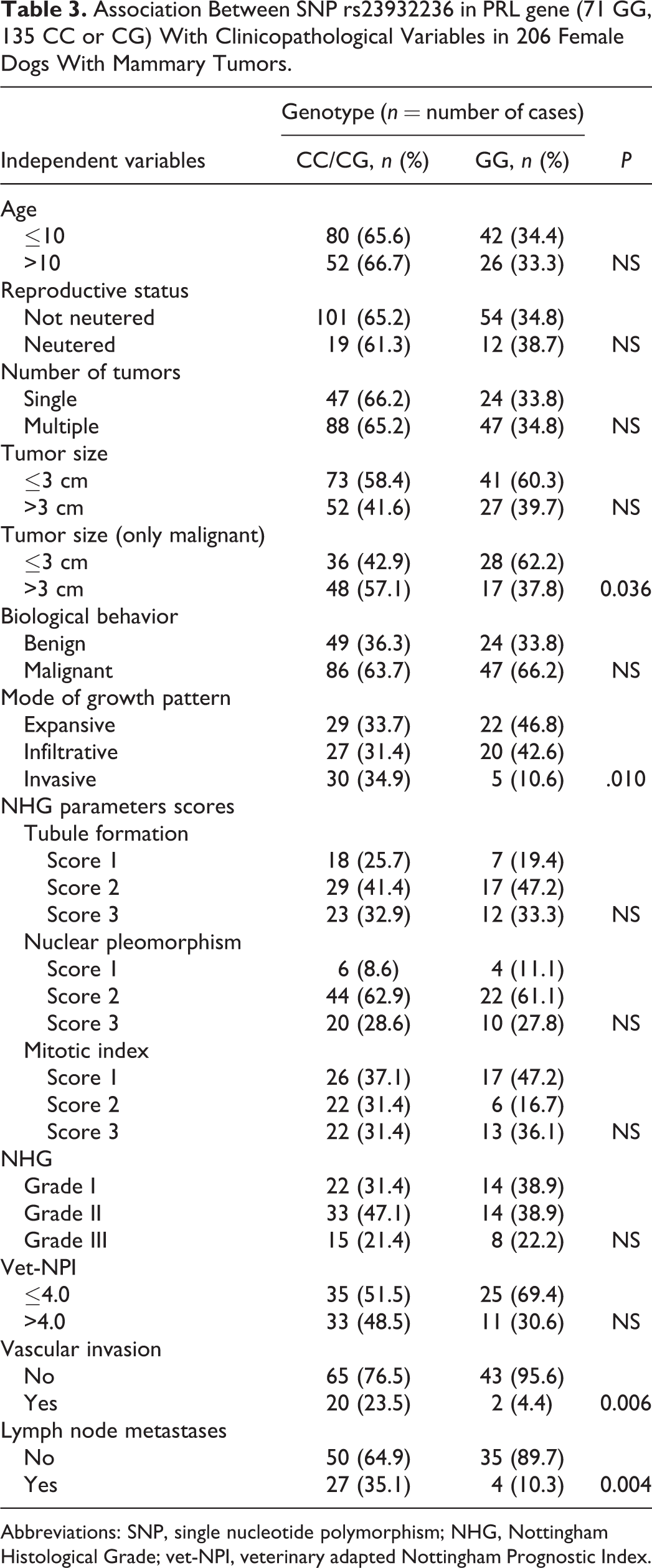
Abbreviations: SNP, single nucleotide polymorphism; NHG, Nottingham Histological Grade; vet-NPI, veterinary adapted Nottingham Prognostic Index.
The rs23932236 genotype was significantly associated with overall survival (Fig. 2). Carriers of the variant allele (ie, genotypes CC and GC) had a mean OS of 18.7 months (95% confidence interval [CI] 17.0–20.5 months) while the wild-type population (ie, genotype GG) had a mean OS of 22.7 months (95% CI 21.0–24.4 months; P = .004; Fig. 2). By Cox univariable regression analysis, the risk of death related to the neoplastic disease was 4 times higher (odds ratio = 4.11, 95% CI 1.43–11.76; P = .008) in cases with the genetic variant compared to the wild-type.
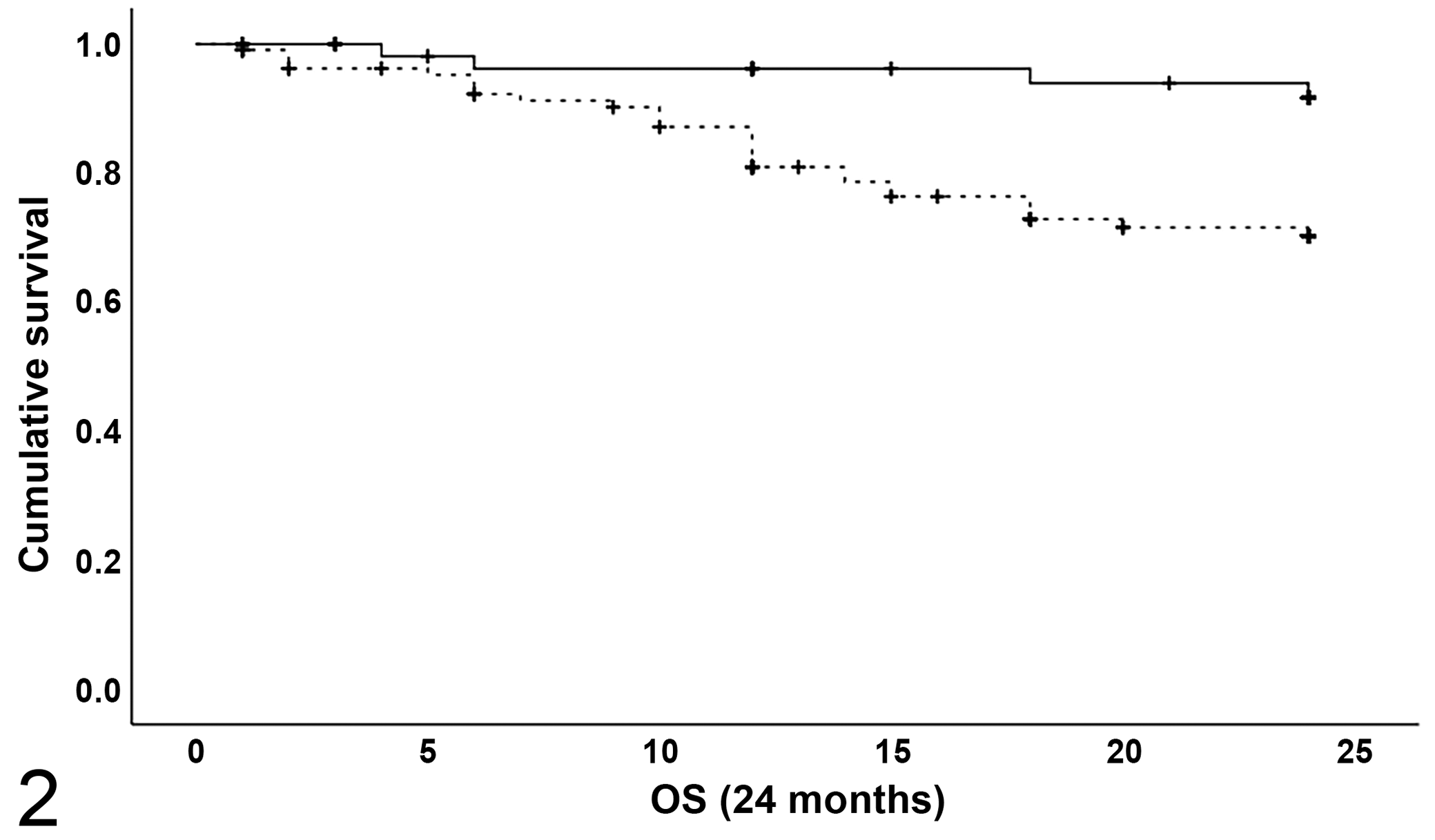
Kaplan-Meier plots of the estimate of the disease-specific overall survival for female dogs with malignant mammary tumors that have a single nucleotide polymorphism (rs23932236) of the prolactin gene (CC or CG genotype; dotted line) compared to the wildtype (GC genotype; solid line). Censoring is indicated by the + symbol.
Discussion
SNPs affect the risk, disease expression patterns, and prognosis of several types of human cancers including breast cancer and this may improve the development of personalized medicine. 26,29,38,53,55,57 In dogs, the genetic profile (including SNPs) have been associated with the risk, clinicopathological features, biological behavior, and prognosis of CMTs. 6,7,9 –13,18,19,45 The present study aimed to assess the influence of PRL gene SNP rs23932236 on CMTs features and outcome.
The rs23932236 is SNP in the 3′UTR (untranslated region) of the PRL gene. Although this flanking sequence is not translated into protein (and thus the SNP does not affect the protein sequence), it may affect gene expression 52 such as by effects on RNA stability, mRNA translation, and access to regulatory elements such as miRNA and RNA-binding proteins. These functional changes interfere with multiple molecular pathways, and may thus contribute to the development and/or modulation of the phenotype, onset, and outcome of diseases. 47,52
In a recent case-control study, we did not find a relation between the SNP rs23932236 and the development of CMTs. 10 Nevertheless, the present results demonstrated that, within the group of female dogs developing malignant tumors, cases with this SNP had shorter survival, and the SNP was significantly associated with other indicators of poor prognostic factors including larger tumor size, infiltrative/invasive growth, vascular invasion, lymph node metastasis.
The association between SNP rs23932236 in canine PRL gene and well-known poor prognostic features of CMTs, specifically large tumor size, infiltrative/invasive growth, vascular invasion, and lymph-node metastasis, was further substantiated by the survival analysis. Accordingly, variant allele carriers exhibited a significantly shorter OS and a 4 times higher risk of death related to neoplastic disease than the wild-type population. These results may allow the identification of a subgroup of cases that tend to develop aggressive disease and thus must be subject to rigorous surveillance protocols and clinical monitoring.
PRL has pro-proliferative and anti-apoptotic effects on the mammary gland. 17 It is speculated that canine genetic variants such as SNP rs23932236 might influence the anti-apoptotic effects of PRL on mammary tissues contributing to their amplification, thus perhaps resulting in increased tumor growth and a higher probability of larger tumor size. 39 PRL has also been implicated in enhanced motility of human breast cancer cells. 17 Furthermore, PRL may affect tumor neovascularization 15,16,43 by promoting release of pro-angiogenic factors by leukocytes and epithelial cells, enhancing intussusceptive angiogenesis (splitting angiogenesis) by increasing vessel density and tortuosity, inducing endothelial cell migration, and promoting tube formation of endothelial cells on in vitro devices. 43 Enhanced cell motility and invasiveness, combined with increased angiogenesis, favors vascular invasion by neoplastic cells and development of metastasis. These data find parallel with studies in human breast cancer that reported an association between genetic variation attributed to SNPs in PRL gene and the development of metastasis. 34 Further molecular and functional studies are needed in order to understand the mechanisms by which the SNP rs23932236 affects the progression and outcome of canine mammary neoplasia, and to evaluate the role of genetic epistasis and the hormonal environment, namely the interplay between PRL, estrogen, progesterone and PRL receptor genes.
In conclusion, genetic variation in the canine PRL gene was associated with the phenotypical features, progression, and outcome of malignant CMTs. The presence of the SNP rs23932236 identified a subgroup of animals prone to develop aggressive mammary tumors with poor survival that may thus benefit from the implementation of specific clinical monitoring protocols.
Supplemental Material
Supplemental Material, sj-pdf-1-vet-10.1177_03009858211022705 - Single Nucleotide Polymorphism in Prolactin Gene Is Associated With Clinical Aggressiveness and Outcome of Canine Mammary Malignant Tumors
Supplemental Material, sj-pdf-1-vet-10.1177_03009858211022705 for Single Nucleotide Polymorphism in Prolactin Gene Is Associated With Clinical Aggressiveness and Outcome of Canine Mammary Malignant Tumors by Ana Canadas-Sousa, Marta Santos, Rui Medeiros and Patrícia Dias-Pereira in Veterinary Pathology
Footnotes
Acknowledgements
The authors would like to thank Ricardo Pinto for his contribution for the gene map construction. We are also thankful to Veterinary Pathology Laboratory and Immunogenetic Laboratory (ICBAS, University of Porto) staff for technical support; to the clinicians Miguel França, Cristina Pereira, Jorge Ribeiro, Flora Tinoco, Raquel Vilaça, Maria João Silva, and Hugo Vilhena; to Helena Frias of Vila Nova de Gaia Kennel and Aanifeira animal association; to the animals and tutors involved in the study.
Author Contributions
ACS helped conceive the study and its design, collected the control and cases blood samples, carried out the DNA isolation, performed CMTs analysis, and drafted the manuscript. MS contributed to conceive the study and its design, performed CMTs analysis, and revised the manuscript. RM contributed to the SNP and haplotype association analyses, statistical analysis, and revised the manuscript. PDP conceived the study and its design, performed CMTs analysis, and drafted the manuscript. All authors read and approved the final manuscript.
Declaration of Conflicting Interests
The author(s) declared no potential conflicts of interest with respect to the research, authorship, and/or publication of this article.
Funding
The author(s) received no financial support for the research, authorship, and/or publication of this article.

Supplemental Material
Supplemental material for this article is available online.
References
Supplementary Material
Please find the following supplemental material available below.
For Open Access articles published under a Creative Commons License, all supplemental material carries the same license as the article it is associated with.
For non-Open Access articles published, all supplemental material carries a non-exclusive license, and permission requests for re-use of supplemental material or any part of supplemental material shall be sent directly to the copyright owner as specified in the copyright notice associated with the article.
