




Abstract
Veterinary pathologists are key contributors to multidisciplinary biomedical research. However, they are occasionally excluded from authorship in published articles despite their substantial intellectual and data contributions. To better understand the potential origins and implications of this practice, we identified and analyzed 29 scientific publications where the contributing pathologist was excluded as an author. The amount of pathologist-generated data contributions were similar to the calculated average contributions for authors, suggesting that the amount of data contributed by the pathologist was not a valid factor for their exclusion from authorship. We then studied publications with pathologist-generated contributions to compare the effects of inclusion or exclusion of the pathologist as an author. Exclusion of the pathologist from authorship was associated with significantly lower markers of rigor and reproducibility compared to articles in which the pathologist was included as author. Although this study did not find justification for the exclusion of pathologists from authorship, potential consequences of their exclusion on data quality were readily detectable.
In recent years, several factors have contributed to the expansion of scientific collaborations including improved access to the internet; increased scale, complexity, and costs of research studies; and changes in scientific training (ie, less breadth and more specialization). 8,21,27 Through multidisciplinary collaborations, team science has become more commonplace and results in increased scientific impact, novelty, productivity, and reach. 5 Not surprisingly, a common feature seen with the growth of team science has been an increased number of authors on publications (Fig. 1). 9
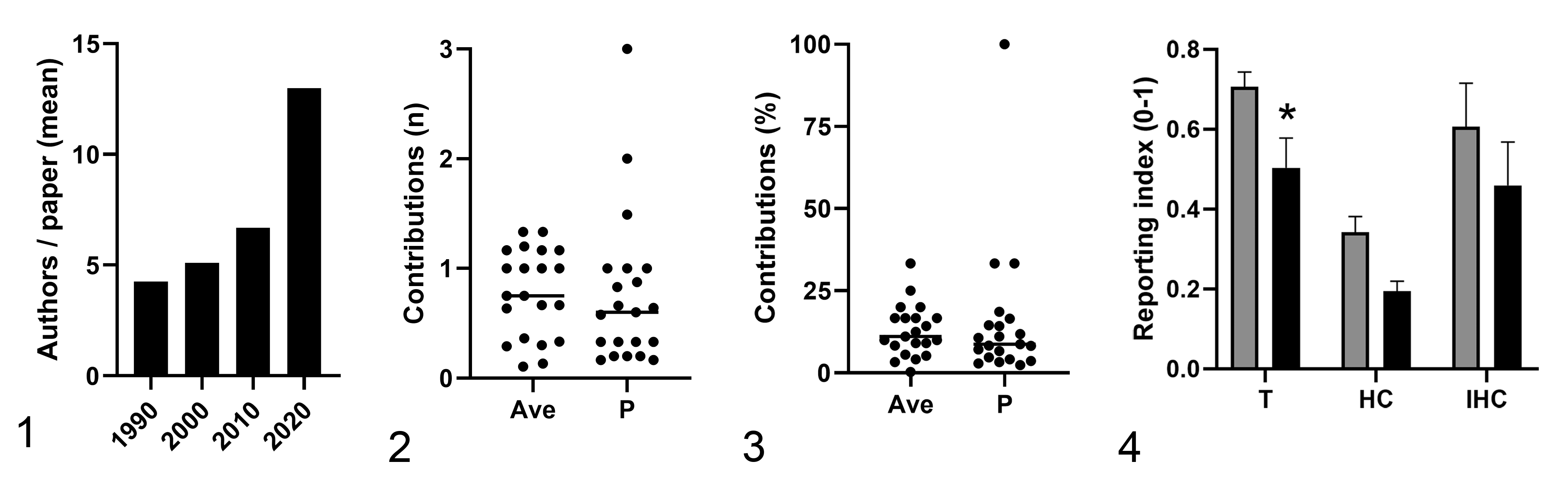
The mean number of authors per research paper that were published in the June issues (4-5 issues/month) of the journal Science for each respective year.
Veterinary pathologists are trained in veterinary medicine and comparative pathology across a range of different animal species. Their expertise and intellectual contribution are intrinsically valuable to team science and provide the necessary perspectives to study animal models in biomedical research. 1 –3,12 Unfortunately, veterinary pathologists have occasionally reported exclusion from authorship after generating data used in published scientific articles. The origins(s) and implication(s) of this exclusion from authorship have not been studied in detail, but this information would help better understand and possibly address the problem.
Veterinary pathologists (ie, the authors of this article) were asked to identify circumstances where pathologist-generated contributions (eg, data, figures, text, tables, expertise) were used for a project that resulted in a published article but the pathologist was not included as an author. This purposive sampling yielded 29 publications that formed the foundation for our subsequent analyses. These articles were published in journals with a wide range of impact factors (0.5–42.8, median 5.7), a common metric to rank journals. 16 These articles were classified as research studies (n = 26), case reports (n = 2), or review (n = 1). This distribution was likely a reflection of the occupation and interests of the pathologists involved in this study.
The context of pathologist participation in the 29 publications is summarized in Table 1. Direct contributions were defined as pathologist-generated data including images or figures, or text clearly identified within the article. In contrast, indirect contributions lacked discrete data or text within the publication, but the pathologist’s expertise was considered to have provided a foundational framework for the experimental design or goals of the study (Table 1). Examples of indirect contributions include detailed prosections to reproducibly isolate specific tissues or histopathologic classification of a cohort of tumors. These contributions often define the study groups for downstream analyses.
Context of Pathologists’ Participation to 29 Scientific Publications in Which the Pathologist Was Excluded as Coauthor.
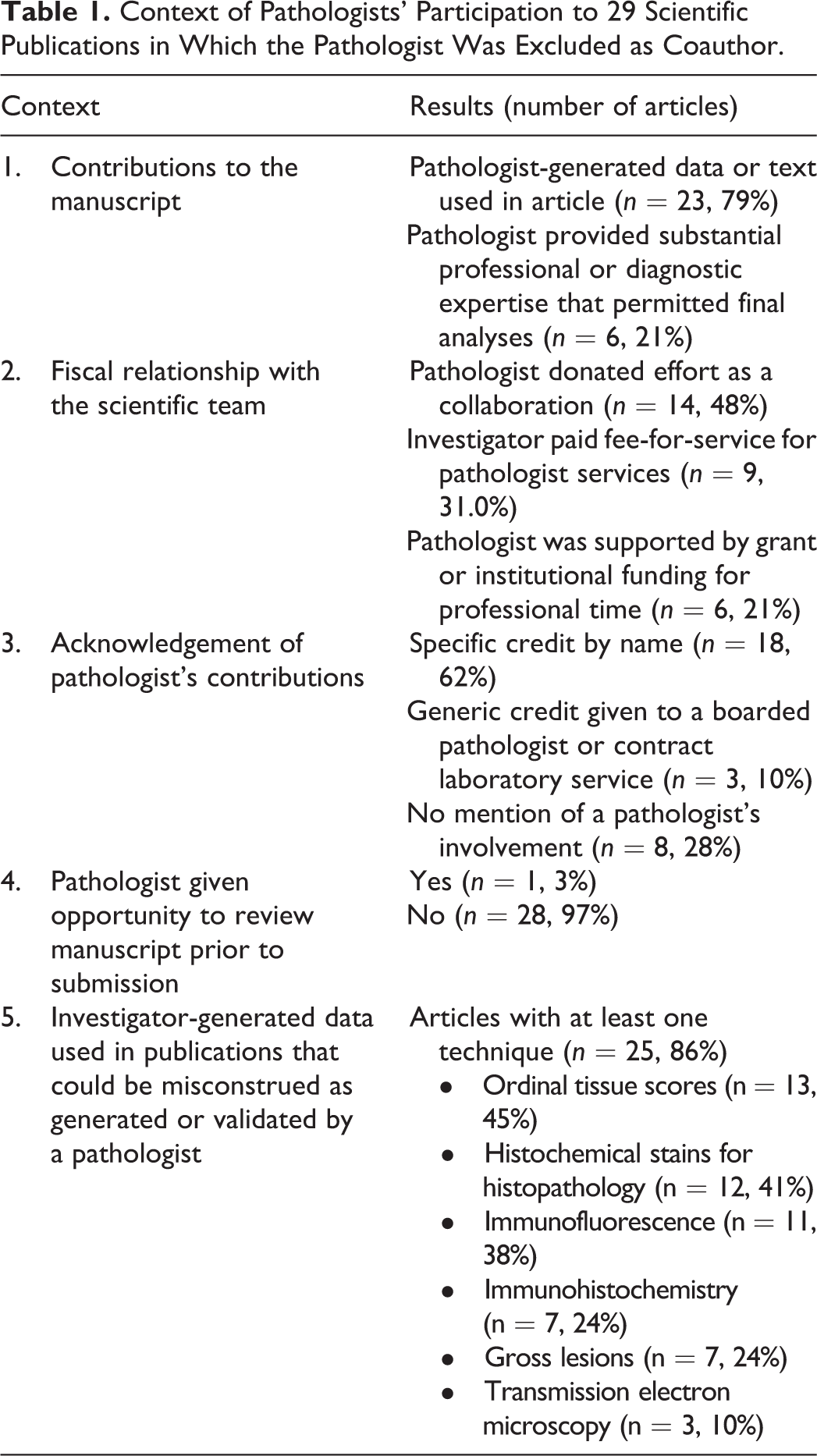
Exclusion from authorship was seen in multiple fiscal arrangements between the investigator and pathologist, including those defined as collaboration (Table 1). Recognition of the pathologist for their expert contributions (typically as an acknowledgement or listed in the Methods) yielded specific credit, generic credit, and absence of credit in publications (Table 1). The latter category of no credit for the pathologist can give the reader a misleading impression that the work was performed by the authors. Overwhelmingly, in these studies where pathologists were not included in the authorship, pathologists were not asked to review any draft of the manuscript to ensure pathology data had correct presentation, accurate interpretation, and fitting conclusions within the full context of the manuscript (Table 1). Of note, most of the articles also contained pathology-related data that were investigator-generated (n = 26, 86%, Table 1, row 5). These data could be misconstrued as being pathologist-generated (or at a minimum, pathologist-validated) data, especially when the pathologist was credited in the Acknowledgements.
A common explanation given by authors for exclusion of a pathologist from authorship is “insufficient” contributions to the manuscript. Given the findings of Table 1, we asked a simple and germane question: Were pathologists’ data contributions comparable to the average author contributions in articles? If pathologists’ contributions were significantly less, this would corroborate the authors’ assertion, whereas similar contributions between authors and pathologists would challenge the validity of the authors’ claim. To test this question, we identified 21 of the 29 articles from Table 1 in which data generated by the pathologist were directly reported in the published article. For consistency between different article organization styles, we chose to use each article’s enumeration of figures such that every numerical figure and data table had a cumulative value of “1” contribution. For composite figures (eg, subheadings A–E), each subheading was given a value proportional to the amount of subheading so that each figure summed to “1.” Using this approach, we calculated the average contribution per author by summing the contributions in each article. This value was then divided by the number of authors plus one (to account for the pathologist who contributed data but was excluded as an author). The average author contributions were compared in a pairwise fashion to the actual pathologist-generated contributions for each article (using similar enumeration methods above), no significant differences were observed in either the absolute number or percentage of the total contributions (Figs. 2, 3). Our results suggest that insufficient data contributions were not a valid factor for exclusion of the pathologist as a coauthor, as sometimes claimed by authors.
As evidenced in Table 1, pathology data can be produced by both pathologists and investigators. Investigators are not trained as pathologists; thus pathology methods and data can lack in transparency and are prone to diagnostic and interpretive errors (known as Do-It-Yourself pathology), 4,13 limiting the rigor and reproducibility of studies. We queried whether the exclusion of pathologists from authorship might have consequences on the scientific quality of published articles. We identified articles from Table 1 with the pathologist excluded as coauthor but with direct data contributions by the pathologist and a discrete Methods section (n = 19). As a comparison group, we identified a similar number of articles from PubMed (n = 19, www.ncbi.nlm.nih.gov/pubmed) that included the same pathologists as coauthor.
First, the full Methods section from each article was extracted and a pathologist (a coauthor of this article) masked to group assignment reviewed these for markers of reproducibility. 15,22 We examined 3 major categories: tissue handling (fixed or frozen tissues, fixation type, fixation method, fixation time, embedding medium, section thickness, observer masking), histochemical staining (stain type, procedure, validation, controls used), and immunohistochemistry (antibody details such as catalog number, antigen retrieval method, controls used). For each of the 3 main categories, a reporting index (values of 0–1) was given based on the proportion of subcategories that were reported in the methods. We found that the exclusion of the pathologist as an author was associated with decreased reporting indices in pathology data (Fig. 4).
Next, a pathologist (a coauthor of this article) masked to groups evaluated figures extracted from each article containing tissue scores, histochemical staining, or immunohistochemical staining data. The pathologist evaluated each figure and its associated legend at face value for data accuracy and proper interpretation (errors were termed “shortfalls”). In sum, 11 figures were identified to have obvious shortfalls and these were cross-validated by a second pathologist (coauthor of this article). The shortfalls were exclusively from investigator-generated data in the group that excluded the pathologist as coauthor. Shortfalls included failure to state lesions or tissues used for “pathology” scoring (n = 2) or figures had diagnostic errors (n = 5), staining misinterpretations (n = 3), or flawed identification of tissue (n = 1). These 11 shortfalls were found in a total of 8 articles lacking a pathologist coauthor (8 of 19 vs 0 of 19 in publications having a pathologist as authors, P = .003, Fisher’s exact test). In summary, these results are consistent with other reports of limited transparency, flawed interpretations, and overt errors in publications using pathology data, but lacking pathologists as coauthor. 17,23,24,26
It is important to mention 2 observations that were not included in the above analyses. First, in 2 publications, the original pathologist-generated ordinal scores were different in the final article with outliers being removed; it was not clear if these changes were due to a repeated study, erroneous data reporting or data manipulation. These changes were possible to detect only because our approach had access to original pathologist data. Second, in 2 other articles the excluded pathologists were trainees (postdoctoral fellow, resident) at the time of data generation. This is relevant to note as the inclusion of trainees and students, who have made appropriate contributions to authorship, has increasingly been emphasized as an important part of professional training. 6
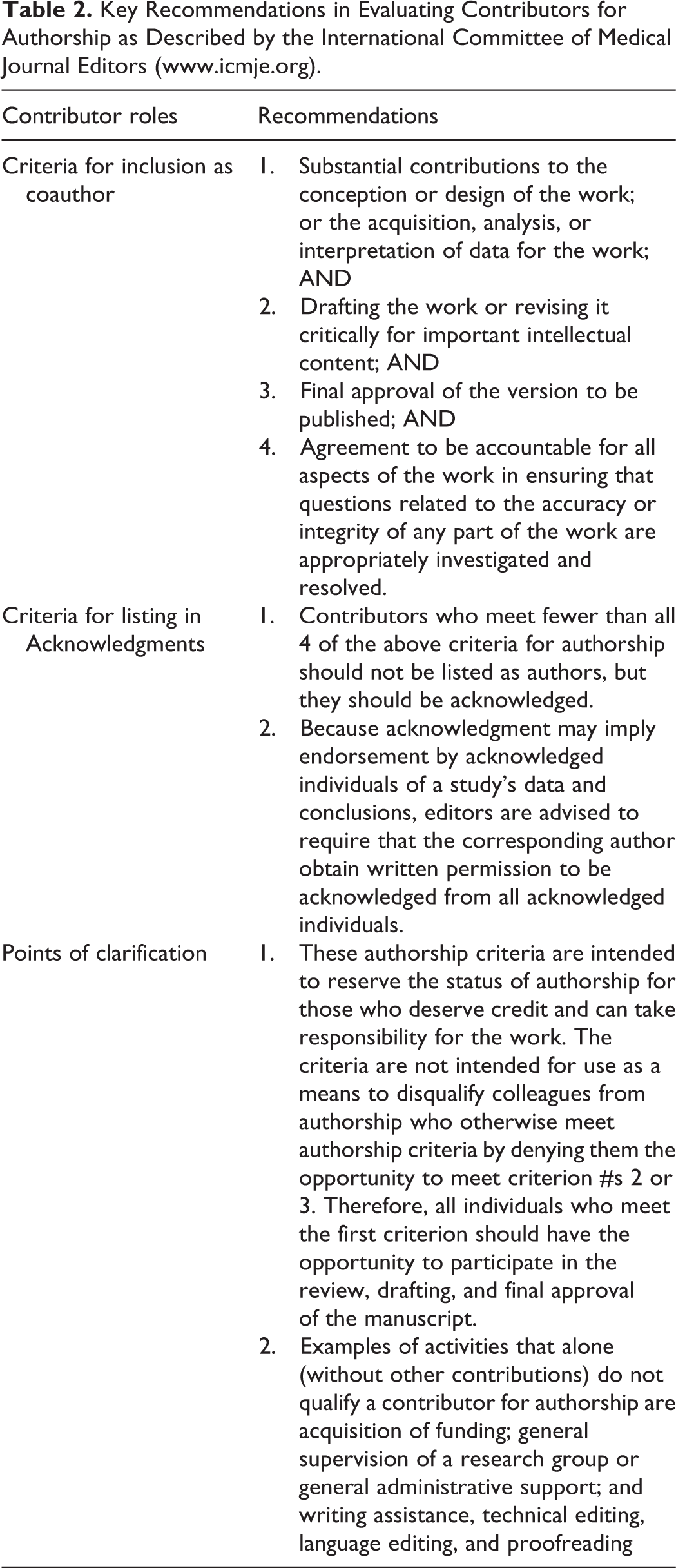
The International Committee of Medical Journal Editors (ICMJE; www.icmje.org) is a working group of medical journal editors that provides recommendations for publication standards (see Table 2). While scientists sometimes disagree on the merits of each authorship criterion proposed by the ICMJE, these criteria or their derivations are common at most journals. 7,21 The first ICMJE criterion for authorship is substantial contributions to the manuscript (Table 2). According to our results, pathologists often provide substantial data contributions that are similar in amount to the average contributions of other authors in publications (Figs. 2, 3). The last 3 ICMJE criteria for authorship involve the drafting and editing of manuscript, and approval of and willingness to be accountable for the integrity of the publication (Table 2). While contributing pathologists can often meet criterion 1, they are often excluded from participating in criteria 2 to 4, contrary to the ICMJE recommendations (Table 2).
Key Recommendations in Evaluating Contributors for Authorship as Described by the International Committee of Medical Journal Editors (www.icmje.org).
Scientific authorship is a tangible marker of academic productivity and professional accomplishment, factors often needed to recognize expertise and validate professional advancement. Unfortunately, authorship has become a commodity that is susceptible to occasional misuse. One way this occurs is through granting authorship when it is not justified (“honorary authorship”). Honorary (also known as “gift”) authorship is reportedly quite common in the literature and occurs when authorship is given to those who have not met the 4 criteria for authorship (Table 2). 7,11,25 Another form of authorship misassignment is by excluding authorship when it is deserved (“ghost authorship”). Ghost authorship is reportedly uncommon, but is a significant concern when an author of an article is excluded from a publication to prevent disclosure of potential conflicts of interest. 11,18,20 Abuse of authorship assignment has been described as tantamount to research misconduct. 21
This current study identified a new subtype of ghost authorship that is best described as “forsaken authorship,” in which expert contributors are forsaken at manuscript submission for seemingly unjustifiable and arbitrary reasons by the authors. In the context of our results and other reports, 7,11 there seems to be an uncomfortably high failure rate by senior authors to understand and/or comply with authorship guidelines (Table 2). Veterinary pathologists are not the only victims of forsaken authorship: physician pathologists and radiologists are also commonly underrecognized as authors on clinical and scientific studies. 10,14 While our study does not specifically identify any underlying motives or negligence by authors in excluding pathologists as an author, at a minimum it highlights that there is significant room for improvement. Common sense and a goal for high-quality publications provide strong reasons to include a pathologist contributor as author.
Our study has limitations and advantages. Limitations include a relatively small number of publications that were mostly research studies and may have inadequately sampled clinical studies or case reports. Furthermore, we cannot exclude that the initial purposive sampling of articles by pathologists or the possibility of recall bias could have influenced our data. 19 Advantages of the our study include the development of a novel bottom-up approach that tracked pathologist-generated data through to its final placement in published articles. Through this unique approach, we were able to identify a new type of authorship misassignment termed forsaken authorship.
How can ethical and equitable authorship become the ambition and goal of the whole scientific community? Unlike the “Wizard of Oz” there is no distinct yellow brick road to reach the Emerald City. While journals have created layers of guidelines and checklists at submission to increase the awareness and compliance by senior authors, there continues to be problems with authorship assignment in scientific publications. Recently, veterinary pathologists have reported success in team science through honest and informative discussions with investigators. 12 Communicating the advantages of ethical authorship and disadvantages of forsaken authorship might help illuminate the impactful consequences of these decisions to investigators, the research team, and their publications.
Footnotes
Editor’s Note
This commentary was not peer-reviewed.
Declaration of Conflicting Interests
The author(s) declared no potential conflicts of interest with respect to the research, authorship, and/or publication of this article.
Funding
The author(s) received no financial support for the research, authorship, and/or publication of this article.
