



Abstract
Although it is the obligation of the veterinary forensic pathologist to be competent in identifying, collecting, and preserving evidence from the body, it is also necessary for them to understand the relevance of conditions on the crime scene. The body is just one piece of the puzzle that needs to be considered when determining the cause of death. The information required for a complete postmortem analysis should also include details of the animal’s environment and items of evidence present on the crime scene. These factors will assist the veterinary forensic pathologist in the interpretation of necropsy findings. Therefore, the veterinary forensic pathologist needs to have a basic understanding of how the crime scene is processed, as well as the role of the forensic veterinarian on scene. In addition, the veterinary forensic pathologist must remain unbiased, necessitating an understanding of evidence maintenance and authentication.
Keywords
As the public has become more aware of animal abuse and the connection to human violence, society is demanding that these crimes be investigated. Law enforcement and attorneys require experts trained in veterinary forensic medicine to assist them in building strong cases and in exonerating the innocent. For most veterinary pathologists, abuse rarely appears on their list of differential diagnoses. However, a veterinary pathologist may be called on by law enforcement to examine animal evidence, acting in a capacity similar to that of a human medical examiner. A forensic necropsy is essential in prosecuting a case of animal abuse involving a deceased victim. Similar to a human autopsy, care must be taken to ensure the integrity of each item of evidence, as everything must be done with the ultimate goal in mind, to withstand scrutiny in the courtroom. The veterinary forensic pathologist (VFP) must recognize that his or her duty is to the court, assisting the trier of fact in understanding the evidence and in effect acting as an advocate for the truth.
Most veterinary pathologists have little to no training in forensic science but must at least have an understanding of how to identify, collect, and preserve evidence before undertaking a forensic necropsy. It is also important to not extend beyond one’s skill set. Instead, recognize when to utilize other forensic professionals as needed. Most veterinary forensic cases will involve a multidisciplinary approach—including assistance from other specialists such as toxicologists, entomologists and osteologists. The VFP may also work closely with a forensic veterinarian, as cases often involve both clinical as well as pathological aspects of veterinary forensic medicine. The forensic veterinarian may even conduct all or a portion of the postmortem investigation, consulting with a pathologist and referring as necessary. 4
Evidence: What Is It?
Generally, evidence is defined as anything that can prove or disprove a fact in contention. 3 Such facts may be anticipated based on the applicable laws, as well as prior experiences. More specifically, evidence is used to prove guilt or innocence, to identify victims, and to identify suspects. The evidence linkage diagram is used to illustrate how each piece of evidence is a means of linking the scene, physical evidence, the victim, and the suspect (Fig. 1). 3,5 This concept is based on the Locard exchange principle, which holds that whenever there is contact with another person, place, or thing, there will be a mutual exchange of matter between them, in essence “every contact leaves a trace.” 3
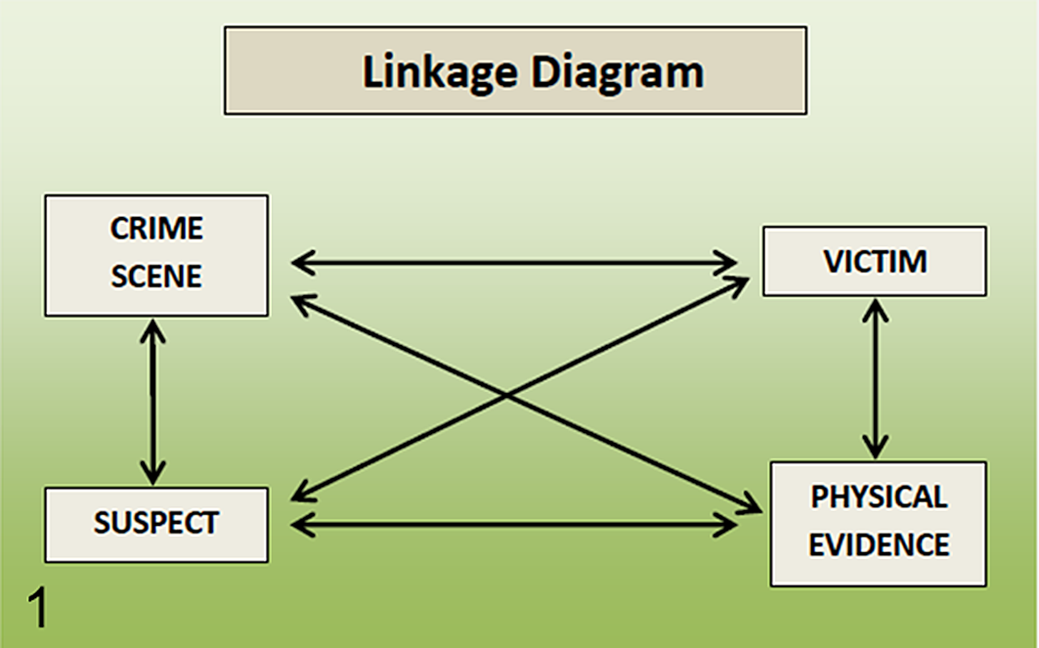
The evidence linkage diagram demonstrates the various routes through which the scene, physical evidence, victim, and suspect can be linked.
It should be understood that the desire to collect an item does not make it automatically available for collection. For an item to be considered legally obtainable as a piece of evidence, it must be included in the search warrant obtained by law enforcement. This is often another area where forensic veterinarians can be of assistance to the lead agency. For example, there have been many situations when bodies that were excavated from the ground were determined to be inadmissible in court because the search warrant did not include areas “below ground.” In addition, any evidence gleaned from the body, like a projectile, would also be considered inadmissible as the result of a legal doctrine called “Fruit of the Poisonous Tree.” This doctrine holds that evidence gathered from illegally obtained information will also be excluded from trial. In addition to legal collection, items must also fall within other criteria to be accepted as evidence into a court of law. In 1975, the US Congress created the Federal Rules of Evidence. The use of these rules is only mandatory for federal courts; however many states have also adopted them in an effort to establish consistency with the federal courts. There are 2 basic criteria that the forensic veterinarian and pathologist should be aware of. First, an item must be relevant to the case (Rule 402). This is generally covered by the search warrant, as a judge will not typically sign a warrant that includes irrelevant items. Second, an item must meet conditions of authentication (Rule 901) to be accepted as evidence in a court of law. This simply means that some form of proof will have to be given to show that the item in question is in fact what it is claimed to be. This is typically obtained through testimony of a witness with knowledge.
There are 3 categories of evidence to be considered. First is testimonial, which is based on the statements made by witnesses and suspects. Because it is provided by humans who are open to error, testimonial evidence cannot always be trusted. Stories can be altered through intentional deceit or forgetfulness, and people often interpret the same information differently. Testimonial evidence should not be ignored, but it should be supported by tangible facts rather than left to stand on its own. 3 It is not uncommon for information collected from a postmortem examination to be used to prove or disprove testimonial evidence, rather than the testimonial evidence being used to prove or disprove other facts.
Situational evidence (or transitory effects) includes elements of the scene that may or may not change. Lighting conditions, weather conditions, odors, sounds, and temperatures are all considered situational evidence. This type of evidence will likely never solve a crime; however it may help to clarify details. For example, an individual calls law enforcement because he found his dog deceased in the house with its throat incised. The owner states that he was only gone from the home for 30 minutes and found the dog upon his return; however, the dog is in full rigor mortis. Documenting the extent of rigor mortis and the ambient temperature of the house would be very important, not necessarily to prove the owner guilty, but to indicate that the evidence does not match his story.
Physical evidence encompasses any tangible object that can establish that a crime has been committed, or can provide a link between a crime and its victim or a crime and a suspect. It can identify or eliminate a suspect and prove or disprove a statement. The best characteristic of physical evidence, however, is that it cannot lie. 3 It may be misinterpreted or the analyst may be dishonest about test results, but the physical evidence will always tell the truth. Physical evidence can be large or minute and may require processing at the scene or packaging for transport. Depending on the type of physical evidence, it may not always be necessary to collect an item. In some situations documentation with photographs and sketches may be sufficient. 3
Most items of evidence will have characteristics that will define their class or individualization. Class characteristics are properties that can only be associated with a group and never a single source. While it may not be possible to individualize the item of evidence, class characteristics can be helpful in eliminating possible suspects. For an item to be compared to and identified to a specific source, individual characteristics are necessary. These characteristics are ones that can be attributed to a common source with an extremely high degree of certainty. One of the most familiar types of evidence with both class and individual characteristics would be blood. While the blood type is the class characteristic which could eliminate potential donors, the DNA would be the individual characteristic that allows the blood to be identified to a specific individual. Although it is not always possible for an item of evidence to be identified as having come from a single source, this does not diminish the importance of the information it can offer. It is important to recognize the needs of the case and how the information that is available can be utilized.
Importance of the Crime Scene Investigation
A forensic necropsy, like an autopsy, begins at the crime scene. 2,6 Knowledge of the scene may be crucial to interpreting findings at necropsy and determining the cause of death, making it preferred for a VFP to examine the scene in every case he or she assists in investigating. 4 However, in many cases this is impractical. Although reviewing crime scene photographs and law enforcement reports is beneficial, the information that can be gleaned from examining the scene in person is irreplaceable. 2,6,10 Examining the body at the scene can be analogous to taking a medical history, thereby requiring practice and skill. 4 Many law enforcement officers do not possess the specialized training required to investigate an animal abuse scene, making it possible for information to not be noted or simply overlooked. The same issues can occur at the scene of a human death. This is why, in many localities, the medical examiner or their investigators are routinely present on scene with the sole responsibility of examining the body and the conditions that may be related to the death. Unfortunately, due to lack of personnel or funding, the forensic pathologists will often only examine the scenes of deaths that appear to be complicated or unusual. Not examining the body at a death scene has been regarded as one of the classical mistakes in forensic pathology. 2,6
It is not uncommon for a forensic pathologist to rely on evidence from the scene to determine the cause and manner of death in situations where the autopsy rules out only possible alternate causes, but does not lead to a firm determination, thereby making the crime scene investigation just as important as the autopsy. 4 If a VFP is unable to be present on scene, he or she should work closely with the forensic veterinarian or trained technician who is present. This will help to ensure that the VFP is provided with all pertinent information regarding the case upon submission of the body. The provided information should focus particularly on how, when, and where the body was found, by whom, and under what circumstances (Table 1).
Information That Should Be Obtained Prior to Submission for a Forensic Necropsy.
There are some obvious differences between a typical human crime scene and an animal crime scene investigation. On the human side, there are often specialized forensic professionals available to assist on scene, usually one or few victims involved, the cases involve a single species, and law enforcement has access to local and state labs for the analysis of collected evidence. However, on the animal side there are often no supporting forensic specialists available to assist on scene, the crime scenes can involve few to numerous victims of varying species, and law enforcement typically has to try to enlist the assistance of veterinary schools or private labs to assist with the analysis of evidence.
Regardless of the species of victim or type of crime, the objectives of any crime scene investigation are to identify, collect, preserve, interpret, and reconstruct all relevant physical evidence at a crime scene. 5 Everyone involved with the process of collecting and processing evidence needs to have a solid understanding of what exactly their role will be, the specific evidence they will be responsible for, how it should be documented and how to best collect and preserve it. The role of the forensic veterinarian on scene is to assist law enforcement in identifying, collecting, and preserving evidence related to the animal specific crime(s).
A crime scene may unfold in a variety of ways. Regardless of the steps leading up to the arrival on a crime scene, once entry has been made, steps need to be taken to ensure the safety and security of all people and evidence present. Although law enforcement agencies are accustomed to working a variety of crime types, animal cases are often new and unique. In addition to a possible lack of knowledge about the crime type, there may also be a lack of personnel and resources. It is also not uncommon for individuals involved with animal crime scenes to become wrapped up in the rescue of the animals and to forget that the situation is a criminal event. Crime scenes are chaotic by nature. When hundreds of animals, dozens of responders, potentially disruptive owners, and the media are added to the situation, it can quickly become disastrous if it is not approached in a calm and controlled manner.
Processing of a Crime Scene
At the onset of a crime scene, the area is secured by law enforcement before anyone else will be allowed onto the scene. This typically happens prior to the forensic veterinarian’s arrival. Although there is always concern for the victims, the initial concern on a crime scene should always be the safety of the responding officers and all other subsequent responders. Once the area has been secured, documentation should begin. It is recommended that documentation of the scene occur in phases. The initial phase should consist of documenting the condition in which the scene was found upon arrival. This will include overall photos and possibly video of the exterior and interior portions of all areas of the property covered under the search warrant.
The next phase consists of documenting each animal and their environment. The first step of this phase is to identify animals in critical condition. This may be referred to as “critical triage.” Triage on scene is a rapid visual sorting of animals for examination and treatment priority based on their medical condition. If an animal is found to be in critical condition, it should immediately be given a unique animal identification number, documented in situ, and removed in an expeditious manner to provide timely medical treatment and further documentation of the animal’s condition. Documentation should include photographs as well as written notes. It is important to remember that each animal is an individual item of evidence and if there are multiple animals present, each animal should be assigned a unique identification number. The animal identification numbers should not repeat any item numbers that are used to identify pieces of nonanimal physical evidence. Clinical forensic exams typically do not occur in the field given the uncontrolled environment and lack of access to necessary equipment. However, cursory or brief examinations may be conducted in the field to provide necessary treatments prior to transport, as well as to document transitory evidence, such as dehydration. Transitory evidence is often mistaken for situational evidence. However, transitory evidence is actually elements of physical evidence that might be expected to degrade or disappear within a particular time frame.
It is imperative that the living conditions of each animal not be altered in any way until they have been observed by a veterinarian, documented, and photographed. Once critical animals have been identified, documented, and are receiving medical care, noncritical animals should be more closely assessed and their environment documented. This may be referred to as “intake triage” as it corresponds with the animal intake procedure of assigning a unique animal identification number, taking identifying photographs and preparing the animal for transport. During this assessment, the identification of animals needing a more thorough examination, application of treatments required before transport or documentation of transitory evidence may occur. The living environment will often hold information that will contradict or agree with the animal’s physical examination findings; therefore it is important to be able to accurately illustrate the living conditions from which each animal came and demonstrate how the environment directly affected the animal. Every animal should be photographed in situ and their location on scene documented by sketch or other mapping technique. Deceased animals are considered noncritical and are often given a nonanimal physical evidence item number, rather than an animal identification number when seized in conjunction with live animals. Numbering deceased animals differently from live animals helps to eliminate confusion.
Following the removal of each animal, more thorough documentation of the living space can be completed. Although some documentation will have occurred during the intake process, it is often difficult to capture all elements of the living space when the animal is still in situ. For this reason, it is recommended that midrange and close-up photos of the living space be taken after removal. These photographs should include but not be limited to any receptacles, the presence or lack of food and water, shelter construction and possible hazards, feces, urine, vomitus, wire flooring, and additional photos as requested by the forensic veterinarian. It may also be necessary to record the dimensions of living enclosures. These can be documented on the sketch showing the location of each animal.
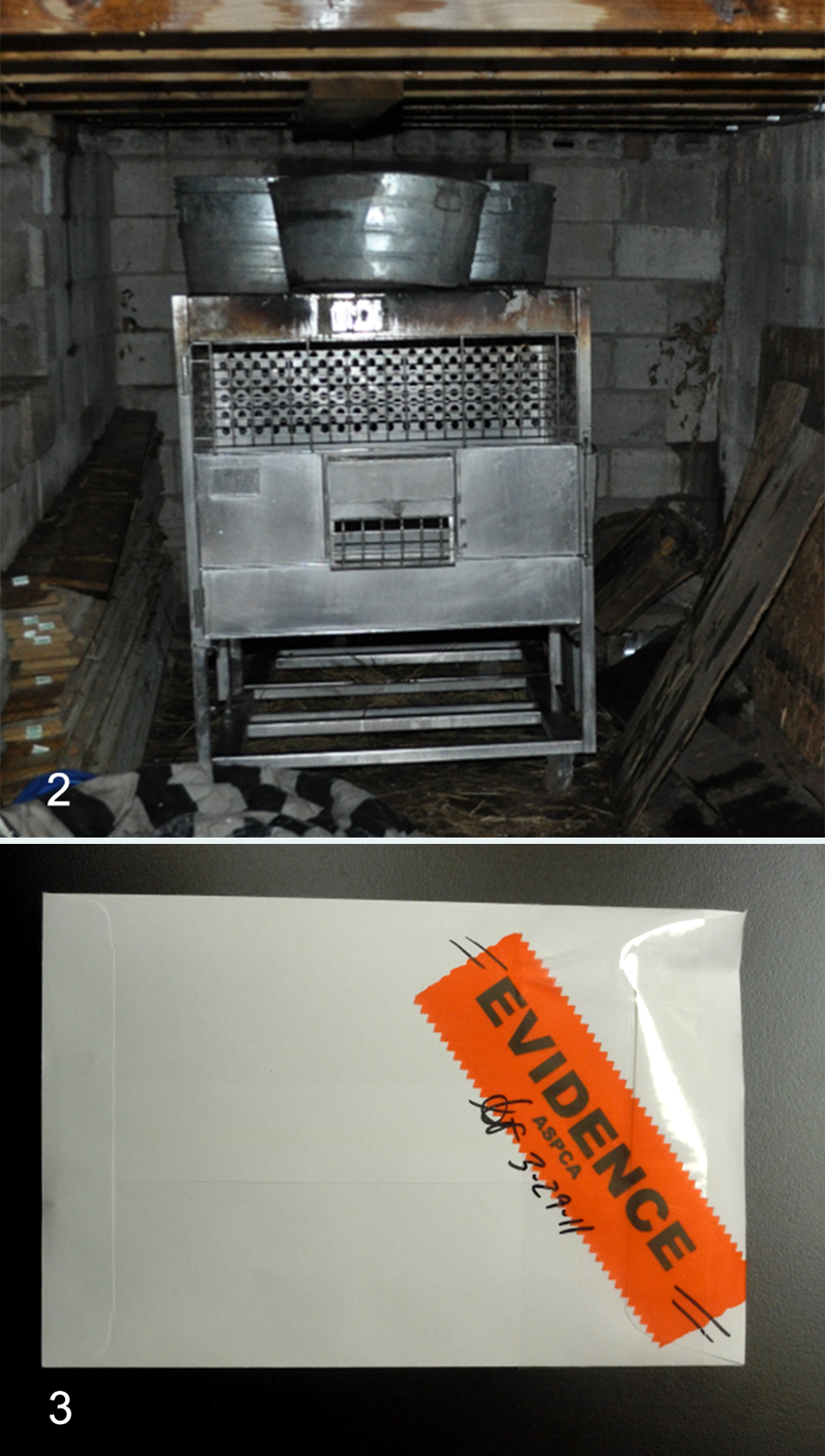
In addition to recognizing and documenting animal evidence, the forensic veterinarian can assist law enforcement with the identification of nonanimal medical and nonmedical evidence. This could include items such as medications, supplements, surgical supplies and fighting paraphernalia. Some items of evidence may be overlooked by law enforcement officers who are not familiar with the particular crime type. For example, the metal tubs pictured in the photo (Fig. 2) were overlooked by law enforcement with respect to a dogfighting investigation. Tubs such as these are utilized to wash the dogs just prior to a fight and were consistent with the opinion that the dogs at the scene were most likely being utilized for the purposes of fighting. However, without knowledge of dogfighting paraphernalia, items such as these are easily overlooked.
Similarly a forensic veterinarian can assist law enforcement with the potential evidentiary value of an item. Although officers may recognize something as evidence, they may not be aware of its full evidentiary value. An example could be anabolic steroids recovered from a dogfighting crime scene. If the investigator is unaware of forensic testing available to detect the presence of anabolic steroids in the body, then the fact that steroids were found on scene will likely not be passed on to the pathologist and possible evidence of the drug in an animal’s system will be lost. However, if present on scene, the forensic veterinarian will be knowledgeable of additional diagnostics and/or forensic testing that could be performed and can therefore, pass along this information about the steroids to ensure the appropriate testing is performed.
Law enforcement may also need the assistance of the forensic veterinarian to ensure the proper packaging and preservation of deceased victims. Deceased animals should not be altered in any way until the veterinarian has had an opportunity to assess the animal and its immediate environment. Once cleared by the veterinarian, the body may be properly packaged and removed. Similar to the clinical forensic exam, forensic necropsies typically do not occur in the field. Performing the procedure in the uncontrolled environment of the crime scene could lead to loss or contamination of evidence. Therefore, it is most likely that a body will have to be packaged prior to leaving the scene and in a manner that will preserve it until the examination can be conducted. The forensic veterinarian can provide guidance as to how to collect, package, and store the body. The veterinarian can also advise of possible zoonotic hazards and of the proper personal protection equipment that should be utilized.
In some cases it may be necessary for the forensic veterinarian to collect trace evidence that is loosely adhered to the body and will likely be lost in transit. The phrase “trace evidence” is used to describe any evidence that is very small, possibly even microscopic, and includes items such as foreign hair, fibers, and paint flecks. If trace evidence is visible on a body with just the naked eye, it is recommended that it be collected prior to the body being packaged. The visible evidence should be gently collected with tweezers or forceps, and sealed in a small container such as a glassine envelope or paper bindle. Items collected from distinctly different regions of the body should be packaged separately. If trace evidence is suspected, but not clearly visible, the body should be packaged in such a way that any evidence that becomes dislodged during transit will be contained in the packaging. To ensure this, the following steps should be taken: Handle the body as little as possible Place paper bags on the feet or head on scene and secure them in place with rubber bands Wrap the body in a clean sheet prior to placing it in a body bag
1
Evidence Present on the Body
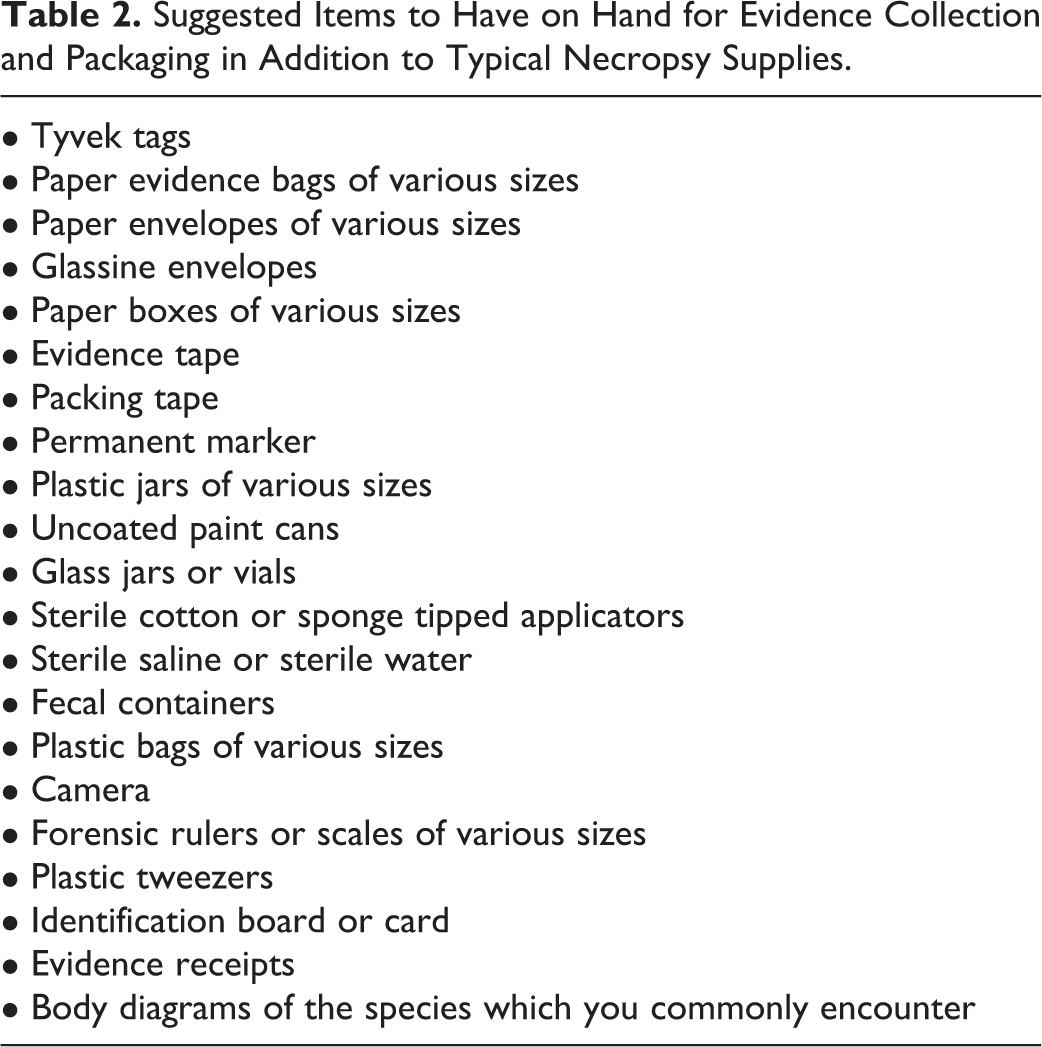
The VFP must be competent in not only the identification of evidence from the body, but also in its collection and preservation. Evidence is commonly lost either because an individual is not aware of its presence and potential value, or they fail to properly collect and preserve the item. 9 The body is an item of evidence and everything collected from the body is evidence. For evidence to be authenticated in court, it must be accounted for at all times. This is done to prove that the item was not tampered with and is in fact the item that was removed from the crime scene or animal. In addition to witness testimony, a chain of custody and evidence packaging are used to prove authentication. A chain of custody is the chronological documentation of every person who has had contact with the item from the time it was seized until it is disposed of. This includes how the item was packaged, the persons involved, dates, times and purposes of all transfers. It is imperative that all bodies be submitted by law enforcement with the original evidence receipt. A body should not be accepted without signing and dating an evidence receipt, which serves as the chain of custody. The original evidence receipt should be maintained with the item of evidence (ie, the body) and copies retained by anyone who has signed the receipt. The second means of authentication is the proper and complete sealing of the container. Evidence should be sealed with friable evidence tape, which is signed with the packager’s initials and the date. These markings should cross over the evidence tape and carry onto the package. This is done as an additional indicator of tampering because it is unlikely that the tape could be replaced in the exact same position should it be moved. If the container is bulky, like a large bag or cooler, it is acceptable to initially seal the container with clear, 2-inch packing tape. Pieces of marked evidence tape can then be used as token seals across the packing tape (Fig. 3). Additional protocols should be in place to ensure that evidence remains secure and unaltered. Items should be signed in and out of storage, and access to the storage areas should be restricted and monitored.
Before opening a sealed container, written and possibly photographic documentation should be made of how the body was packaged upon receipt. Photographing the outer packaging is not mandatory, but is recommended under certain circumstances: for example, if the packaging does not match what is documented on the evidence receipt, if the package has passed through undocumented hands (ie, a courier or delivery service), and/or if there is apparent damage to the packaging. Upon opening and removing the packaging materials, all bags, wrappings, or other items accompanying the body should be maintained as they may prove to contain valuable evidence.
To determine what may be important evidence to collect, the forensic necropsy should be approached within the context of potential criminal prosecution. Questions must be considered and answers sought within this context. These questions will likely be determined by the applicable laws. Therefore, the VFP must have a good understanding of all applicable laws for a given case, to make an informed opinion, as animal abuse is a legal, not a medical determination. In addition, the VFP should question law enforcement as to any specific questions that they are trying to address.
As previously stated, the body is evidence and needs to be documented before being altered in any way. Before any internal or external examination begins, the body should be thoroughly documented—to include photographs, written notes, diagrams, and radiographs if applicable. Notes should be inclusive, beginning with the date and time the evidence is opened and ending with the date and time it is closed. All information that will end up in a final report should be documented in the notes. Photographs are another fundamental component of a forensic necropsy. Forensic photography in this capacity is utilized for several purposes. Identify the victim Demonstrate the condition of the evidence at the time of discovery Record and document evidence that cannot be preserved or left unaltered Allow for later review of the evidence Illustrate and supplement a written report Demonstrate the absence or presence of alleged findings Present in a court of law, the items of evidence as they were found, thereby validating the testimony being presented
9
Because the opinion of the VFP should be based in science and remain unbiased, it is important that the photographs be a clear and accurate representation of what was observed. Photographs should include both expected and unexpected conditions, as wells as those which support and contradict theories. One way to verify accuracy is to utilize an L-shaped forensic scale or ruler. The forensic ruler should be placed flat and on the same plane as the item being photographed—this will prevent size distortion between the scale and the area being photographed. Whether or not the scale is uneven can be determined by looking at the circle with crosshairs. If the ruler is not level, the circle will appear elongated, rather than round. The ruler can also be used to verify proper color and exposure, as it clearly identifies black, white, and 18% gray. Finally, the ruler provides measurement as well as demonstrates that the photo is in focus, as the ruler can be clearly read.
All photographs from the crime scene and necropsy are also considered evidence and must be maintained in a manner that ensures their integrity. Digital media cards should be cleared and formatted prior to beginning a new case and only one case should be captured at one time on a card. If possible, it is recommended that images be taken using a RAW file format. RAW images are uncompressed and unprocessed sensor data. However, because RAW images are data files, they must be processed by a RAW image file converter, which is typically included in the camera software. 8 RAW files are also read only and incapable of being altered without first being saved as a JPG or other image format. While this may seem cumbersome, having RAW formatted images ensures that unchanged originals will be available for presentation in a court room. Photographs should never be deleted. If images are of poor quality or taken by mistake, they should be retained and kept in the sequence in which they were taken. Deleting images can create a gap in the meta-data of the media card which could be called into question. Once the media card is full, or no further photographs are needed, all of the images should be downloaded to a “Master” file located on a secure digital storage device. If a RAW format was used to take the images, they must be retained in this format, as well as be converted to a readable format such as JPEG or TIFF. The converted images should be stored in a “Copy” file and will be the photographs that are not only viewable by standard image programs, but will also be capable of being enhanced. Reproductions of the “Master” and “Copy” files can then be placed on a CD or other external storage device to be placed into case folders or given to law enforcement or attorneys.
The types of evidence most commonly associated with a body include biological, toxicological, entomological, trace, and firearm evidence.
Biological evidence, such as tissue, blood, and urine, is commonly collected during a forensic necropsy. Biological evidence can be utilized to identify the victim or place the victim in a particular location (ie, the trunk of a suspect’s vehicle). In addition to standard sample collection, it may also be requested or necessary that a buccal swab be collected. Buccal swabs can easily be used by DNA analysts to compare the victim’s DNA to unknown biological substances found at the scene, like blood on the walls of a fighting pit. Buccal swabs can be obtained by utilizing a sterile cotton or sponge swab, or cytology brush. With newly gloved hands, the swab or brush is placed, one at a time, against the buccal mucosa of the cheek and swirled for 10 seconds. It is recommended to collect at least 2 samples.
Toxicological evidence, such as stomach contents, liver and kidney, may also be collected during a forensic necropsy. Specimens such as these can be utilized to detect the presence of drugs in the animals system. Unfortunately, there is no fully comprehensive toxicological screen available. However, in cases where there is a suspicion of the specific or type of substance utilized, these can be tested for individually. Such substances may be present on the crime scene or at the suspect’s disposal. There also may be a history or characteristic lesions observed which may assist in determining the type or specific substance to test for. The VFP should work closely with a toxicologist to determine the most appropriate samples to obtain and testing to pursue.
Entomological evidence, such as puparia, insect larvae, and eggs, may be present on a body. Entomological evidence can provide valuable information concerning the postmortem interval and may need to be collected. Because there is a variety of collection and preservation methods used which are dependent on the type of evidence being collected, it is recommended that the VFP work with a forensic entomologist to determine what information the samples may provide, as well as proper collection, sample storage and submission.
Trace evidence, such as foreign hair, fibers, and paint flecks, is minute and commonly overlooked or lost. Visible items should be carefully collected with either tweezers or forceps and placed in an appropriately sized, clean paper or glassine envelope or paper bindle. If trace evidence is not readily visible, but is suspected, tape can be applied to the body, allowing particles to adhere to it when it is removed. The tape should then be placed adhesive side down on a clear backing such as Mylar. Multiple strips of tape can be secured on the same backing as long as they are properly labeled as the area they were collected from. This evidence should be submitted to law enforcement or a private laboratory for further analysis if warranted. It may be necessary to request trace and biological analysis if there are hairs collected which still retain follicular tissue containing DNA.
Firearm evidence, such as projectiles, projectile fragments, jacket, or wadding, may be present in the body. Radiographs should be utilized to assist in locating these items which should be collected if present. Firearm evidence should only be handled with a gloved hand or plastic instruments. Metal instruments should never come into contact with these items as they may damage the microscopic evidence (rifling) which can be used to relate the projectile back to a specific firearm. Firearm evidence should be gently cleaned with water, allowed to air dry, and then placed in an appropriate sized paper box or other rigid container. This evidence should be turned back over to law enforcement for further analysis if warranted.
No matter how decomposed, damaged, or mutilated the body, it is always advantageous to conduct a necropsy. 6 In situations of advanced decomposition and/or in the presence of trauma, it is recommended that the body be macerated and the skeletal remains examined, following examination of the available tissues. It is possible that minor injuries, such as cut marks, may not be visualized on radiographs. It is also possible, due to extensive tissue trauma or injury, that individual defects and sequence cannot be determined with the tissue still on the body. In such cases it is recommended that the VFP work with an osteologist or forensic anthropologist. Although forensic anthropologists are frequently concerned with determining the identity of a human individual, they are also extensively trained and experienced in the identification and analysis of skeletal trauma.
In addition to the typical items and tools associated with a necropsy, there are several others that are recommended to have on hand to assist in the collection and preservation of evidence (Table 2). Use of an alternative light source (ALS) may also help to identify physical evidence present on the body. An ALS consists of a light source (such as a laser or incandescent bulb) and a combination of filters that allow selected wave lengths of light to be emitted. Certain substances, such as biological fluids or fibers, will fluoresce at a given wavelength, allowing these items to be more readily located and collected.
Suggested Items to Have on Hand for Evidence Collection and Packaging in Addition to Typical Necropsy Supplies.
Just as on a crime scene, all items of evidence during a forensic necropsy must be documented in situ via photographs. The location of an item should then be measured and sketched onto a body diagram (Fig. 4). This information can later be utilized to reconstruct the lesions on the body, just as evidence can be reconstructed at the crime scene. In addition to in situ documentation, the item of evidence itself should also be measured and described, and close-up photographs taken following removal from the body. To prevent cross contamination, each item collected from the body should be packaged separately in a new unused container. However, similar items collected from the same body region may be packaged together—for example, 2 buccal swabs collected from the same animal. A plastic bag should not be utilized to package evidence that is wet or of a biological nature, unless the item will be immediately refrigerated or frozen. Plastic traps moisture leading to the formation of mold, mildew, and other processes that can deteriorate the specimen, often times rendering it useless. Moist items, such as a DNA sample in the form of a buccal swab, should be collected and then allowed to air dry before being placed into a paper container, such as a swab box or envelope. Some items, such as those containing accelerants, are unique and will require atypical packaging materials. Accelerants are volatile substances and may dissipate if not properly stored. Therefore, these items need to be stored in a special container designed for arson evidence, a glass jar or uncoated paint can. It is recommended that a reference manual for evidence packaging, such as Crime Scene Investigation: A Guide for Law Enforcement, published by the National Forensic Science Technology Center, be consulted for general and unique packaging guidelines. 7
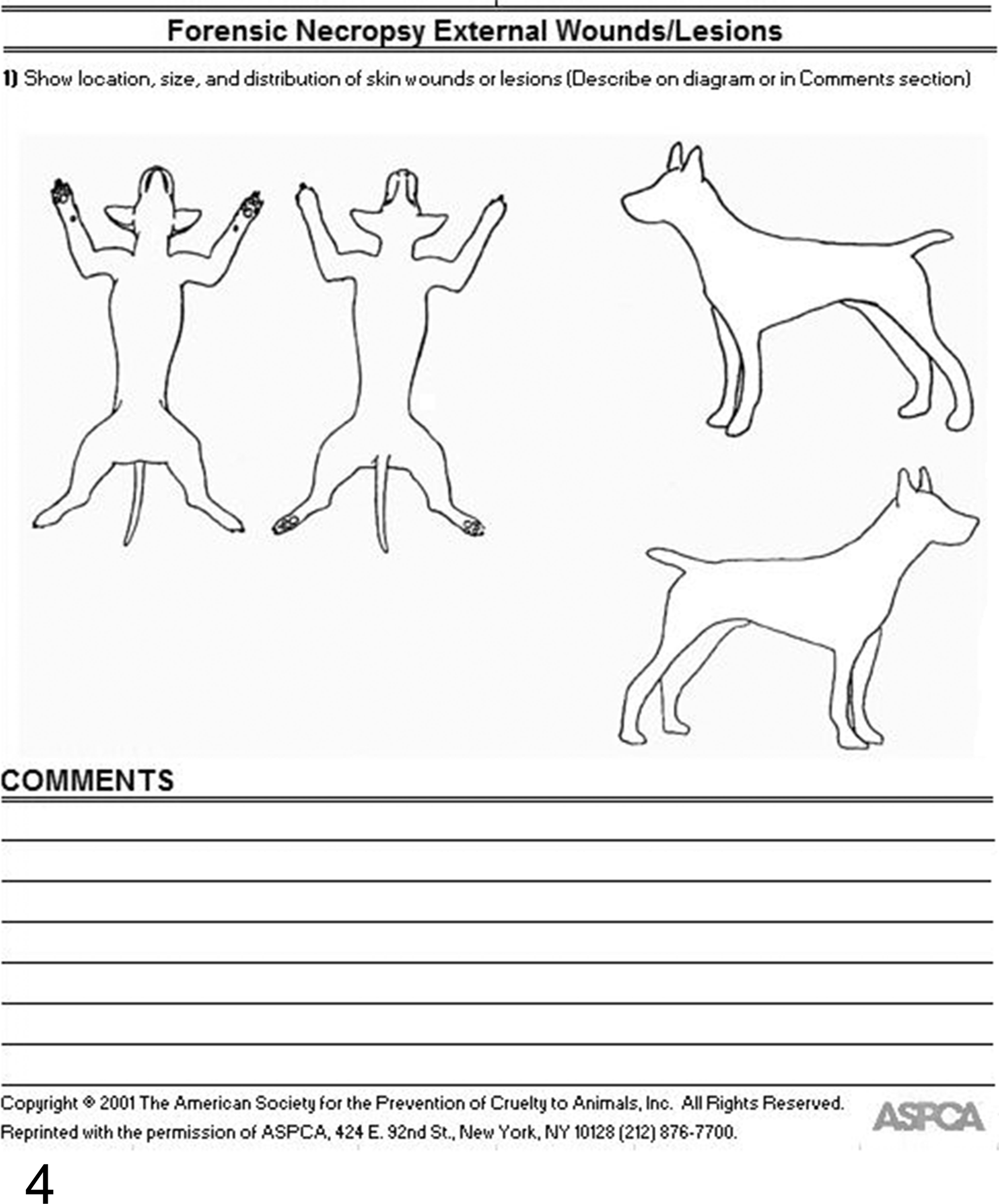
A body diagram can be utilized to facilitate the documentation of items of evidence on the body.
Each item of evidence collected should also be properly identified, labeled, and secured. The container label should include The case number The item number The investigating agency Location of collection Description of the item Name of the individual who collected the item The date and time the item was collected
To prevent loss, contamination, and access by unauthorized individuals, evidence must also be securely and properly sealed with evidence tape as describe above. None of the evidence, including the body, should be disposed of until written consent has been obtained from the submitting agency. Once permission is obtained, disposal of all evidence should be documented on the original evidence receipt and retained in the case file.
Conclusion
A forensic necropsy must withstand scrutiny in the courtroom and, therefore, should be approached within the context of potential criminal prosecution. Any VFP undertaking a forensic necropsy must be familiar with the applicable laws as well as be competent in identifying, collecting and preserving evidence. Since the forensic necropsy begins at the crime scene, it is imperative that the VFP understand the applicability of the crime scene investigation and process, as the body is just one aspect to consider. Doing so will ensure that the VFP receives all of the pertinent information available to interpret findings at necropsy and determine the cause of death.
Footnotes
Declaration of Conflicting Interests
The author(s) declared no potential conflicts of interest with respect to the research, authorship, and/or publication of this article.
Funding
The author(s) received no financial support for the research, authorship, and/or publication of this article.