




Abstract
The role of the veterinary forensic pathologist in the investigation of animal abuse or neglect can go beyond documenting the condition of animals presented as evidence. Although animal cruelty is a moral concern and a crime in itself, law enforcement response to such crimes is often enhanced by the recognition that crimes against animals can be both indicators of other ongoing crimes against people and predictors of the potential for interpersonal violence. An understanding of common motives underlying animal cruelty can aid the pathologist in asking appropriate questions. The authors review the forms of pathology evidence commonly seen in various presentations of animal cruelty. Understanding these forms of evidence can help the pathologist describe findings that can be significant for assessing the potential risks the alleged perpetrator may pose to other animals and humans.
Keywords
The Greek linguistic roots of pathology are pathos, meaning “experience or suffering,” and logia—“an account of.” Thus, from a linguistic as well as a forensic perspective, one role of pathology is to provide an account of suffering. The practice of veterinary forensic pathology is often precisely that, to give a voice to a voiceless animal victim of abuse or neglect and tell a well-documented story about an animal that has suffered or died.
The conditions examined and recorded by the veterinary pathologist do not exist in a vacuum. In forensic cases, they usually have come about as a result of some willful decision by a person who has been responsible for an act or omission that has led to harm. Understanding the underlying motivations for animal cruelty and the resulting effects on the animal victim is analogous to understanding the processes underlying the progression of a disease or the changes resulting from traumatic injury. Awareness of possible motives and method can provide insights into what to look for and how to interpret abnormal findings. In addition, awareness of the connections between animal cruelty and other forms of violence can help the attending veterinarians make the strongest possible case for investing the time and resources needed to be able to tell the victim’s full story in a court of law and can provide valuable insights into the possible risks the offender may pose to other animals or society in general. Such insights can be important in aiding the court and mental health professionals in determining the most appropriate intervention for those found guilty of animal cruelty.
Cruelty to animals is a widespread phenomenon with serious implications for animal welfare, individual and societal well-being, veterinary medicine in general, and veterinary pathology in particular. 65 Extensive research has identified acts of animal cruelty, abuse, and neglect as crimes that may be indicators and/or predictors of crimes of interpersonal violence and public health problems. 6,7,12 –14,16,24,25,44,53,67,71
In many cases, acts of violence against animals are modeled on the same dynamics of power and control that frequently mark the trajectory of intimate partner violence, sexual assault, child abuse, and other violent antisocial behavior. Much like the field of human medicine responded to child abuse and domestic violence, veterinary medicine is poised to take a leadership role in the recognition of and response to violence and neglect directed against animals. 10 Veterinary pathology has a prime responsibility in this arena to provide the clinical, histopathology, and postmortem forensic examinations and reporting systems necessary to ensure effective criminal investigations and prosecutions.
Animal maltreatment is one of the most challenging diagnoses in clinical work, requiring time, experience, emotional energy, sensitivity, tact, and not a small measure of courage. Practitioners may be reluctant to admit that a client would present such animals for treatment. Also, they are accustomed to basing their diagnoses on the assumption that the account they have been given of an animal’s history is generally true, which is often not the case in instances of serious neglect or non-accidental injury (NAI). Nevertheless, most veterinary practitioners will be presented at some time in their careers with animals that have been victims of NAI indicative of neglect, abuse, cruelty, and torture. 2,26,34,35,41,50,51,60,64,73 Many members of the public are more likely to refer to their veterinarian’s expertise on a case of suspected cruelty than to report a case to a local humane society or law enforcement agency. 30 While such cases may not be seen regularly, they are invariably problematic and difficult to resolve. 23
Traditionally, however, the veterinary community has not played an overreaching role in recognition and response to animal abuse. Numerous reasons have been cited for this reluctance, including inadequate training as to what constitutes animal abuse according to each state’s legal framework; insufficient understanding of the typology, nature, and origins of animal cruelty; lack of correlative scientific and clinical literature offering veterinary pathology support; and extensive practice management issues involving client-patient confidentiality, erosion of the client base, personal safety, community reputation, and liability, among others. 10 In response, several toolkits have been developed to assist practitioners in resolving these practical and ethical dilemmas. 8,43,58,70
The Medicolegal Framework of Veterinary Response to Animal Cruelty
Renewed interest in considering animal abuse not only as a crime against animals’ welfare but also as a bellwether and a gateway to possible acts of interpersonal violence has coincided with societal demand for increased prosecution and punishment of cruel acts against animals. All 50 states now have enacted statutes declaring the more aggravated forms of animal cruelty to be felony-level crimes, a process that accelerated rapidly since the early 1990s when only 5 states had such provisions. Now that many animal cruelty cases are no longer simple misdemeanors, increasing public, law enforcement, criminal justice, and veterinary resources are being brought to bear on the investigation and prosecution of cases. Veterinarians in general—and veterinary pathologists in particular—are being called on regularly to offer expert testimony and diagnostic, clinical, and histopathological forensic evidence. 33,49 Practitioners are receiving training in the identification of specific conditions that raise the index of suspicion of animal abuse in the differential diagnosis and in differentiating NAI deriving from deliberate physical abuse from other traumas. 68 The field of veterinary forensics has begun to develop with multiple opportunities for veterinary colleges and continuing veterinary medical education training, and groups such as the International Veterinary Forensic Sciences Association are providing leadership as the discipline matures.
Consequently, veterinary interest in and emphasis on the detection and investigation of animal cruelty is growing rapidly, with professional policies and legislation in at least 4 nations updated in recent years to validate public demand for veterinary engagement and facilitate this response. In most cases, a major reason for this trend has been the increasing recognition of the importance of animal abuse as both an indicator of other ongoing issues of family violence and as a potential predictor of future violence committed by those responsible for animal cruelty.
The American Veterinary Medical Association (AVMA) has helped accelerate this emphasis through recent position statements. AVMA included the protection of animal welfare and the prevention of animal suffering in the 2010 amendment to the Veterinarian’s Oath. 59 The AVMA Policy on Animal Abuse and Neglect issued in 2012 recognizes that veterinarians may observe cases of animal abuse or neglect as defined by laws and that it is their responsibility to report cases promptly to appropriate authorities to protect the health and welfare of animals and people, regardless of whether reporting is mandated by law. 5 As of this writing, 35 states have enacted legislation mandating or permitting veterinarians to report suspected animal maltreatment with immunity from civil and criminal liability. Two states (California, Colorado) require veterinarians to report suspected child abuse, and 1 state (Illinois) mandates veterinary reporting of suspected abuse of elders and vulnerable adults. 56
The Canadian Veterinary Medical Association (CVMA) declares that veterinarians have a “moral obligation” to report suspected cases of animal maltreatment. CVMA encourages veterinary schools to train students in recognizing and reporting animal abuse. It urges veterinary associations to lobby their provincial governments to make the reporting of animal abuse mandatory with immunity from civil and criminal liability when reports are made using professional judgment and in good faith. CVMA recognizes animal abuse as an important social issue affecting families and communities due to the link between animal abuse and human violence. Veterinarians may help break the cycle of family violence and create safe, humane communities by reporting suspected animal abuse. 20 As of this writing, veterinarians in 5 of Canada’s 13 provinces and territories are required to report suspected cruelty. They join other professionals who are granted immunity from civil and criminal liability for reporting animals in distress or for assisting in the enforcement of animal protection laws. 57
The United Kingdom’s Royal College of Veterinary Surgeons’ Guide to Professional Conduct encourages veterinarians to include NAI in the differential diagnosis. If the examination of the animal leads to a suspicion of abuse, the veterinarian should first attempt to discuss these concerns with the client. When this would be inappropriate or the client’s reaction increases rather than allays concerns, the veterinarian should contact relevant authorities. Serious circumstances justify breaching obligations of client confidentiality. The guide extends veterinary response to report suspected child abuse and domestic violence. 63
New Zealand’s Code of Professional Conduct lists animal welfare as the first of 7 fundamental veterinary principles, calling it “a special responsibility” and “an over-riding professional duty.” Veterinarians must act immediately to remedy situations where they have cause to suspect unreasonable or unnecessary pain or distress or possible breaches of animal welfare legislation. If the animal’s caregiver is a client, the veterinarian should discuss the situation and develop an action plan to relieve the concerns. The matter must be reported to an animal welfare inspector if issues cannot be discussed with the caregiver, if the action plan’s improvements are not achieved, or if the case involves severe cruelty or neglect. Valid and justifiable reasons allow disclosure of personal information. Acknowledging research linking animal abuse with human violence, an explanatory note within the code encourages veterinarians to consider whether people within the home might also be at risk; if so, practitioners should use their best judgment to determine whether police or Child, Youth & Family authorities should be informed. 69
Despite a long veterinary history in such human health concerns as disease surveillance, comparative medical research, food safety, and disaster relief services, the prevention of animal abuse as a means of protecting human welfare has only recently come to the forefront of veterinary medical attention. The identification of a battered pets syndrome, 54 which put the veterinary profession on parallel footing with counterparts in human medicine who respond to abused children, women, and elders, expanded the veterinarian’s role as an advocate for animals’ welfare to include the recognition of, response to, and prevention of animal abuse.
Veterinary forensic pathology can play a particularly significant part in the response to animal abuse and neglect that goes beyond the conventional role of thoroughly documenting and reporting on specific injuries, illnesses, or conditions associated with an act of cruelty to help support an investigation or criminal prosecution. Information obtained from veterinary forensic examinations can provide insights that can aid the courts and mental health professionals in assessing the risk to animals, people, and society posed by alleged perpetrators, based on the nature of the offender’s actions toward the animal victims. This information can also aid in developing “offense specific” recommendations for evaluation, treatment, or sentencing. 66
Risk assessment of animal abusers is a growing concern that has given rise to the emerging field of Forensic Animal Maltreatment Evaluation (FAME). 42 Animal abuse occurs for many different reasons and involves a diverse set of individuals across race, gender, age, and levels of functioning. 66 Some individuals engaged in animal abuse are more likely to pose a greater risk for chronic abuse behaviors or crossover into abuse of people or other crimes. Information gathered from forensic examination of animal victims can help illuminate possible motives for the action and aid in assessing the potential risk posed by offenders.
Thinking Like an Abuser: Motivations for Animal, Child, Elder, and Domestic Abuse
The etiology of animal abuse, similar to the origins of interpersonal violence, is a complex and multivariate dynamic. No single psychopathology explains the vast array of abuses committed against animals. Numerous psychological motivations and risk factors for perpetrators of animal cruelty have been presented. Consequently, prosecutors, therapists, veterinarians, and other animal welfare advocates cannot respond identically to an elderly animal hoarder, an adolescent who sets fire to a cat, a rancher facing financial ruin who abandons his herd, an angry resident who poisons his neighbor’s barking dog, a ringleader of a dogfighting syndicate, a person who commits interspecies sexual assault by having sex with animals, a domestic violence batterer who tortures the family pet to intimidate his wife, or a pedophile who enforces the silence of his victims by harming or threatening to harm beloved pets. Each case must be considered within a complex matrix of circumstances, motivations, and underlying psychological conditions, all within the framework of the jurisdiction’s statutory language, societal expectations, and the community’s capacity for enforcement. Much of this response will be dictated by the availability of relevant clinical and pathological evidence in the form of examinations, necropsies, crime scene analyses, and expert witness testimony.
It is helpful for the veterinary pathologist to be aware of the range of motives for acts of animal cruelty to better generate questions to ask or scenarios to evaluate when reviewing the evidence at hand. Awareness of potential motives may not have direct bearing on the information to be collected during a veterinary pathology investigation, but it can help the pathologist develop an investigative mindset—to think like both the perpetrator and the victim. It can be helpful to ask—“What would I have had to do to produce this end result, this wound, or fracture?” “How would the animal subjected to such treatment likely behave?” “Is this consistent with the explanation offered for the animal’s condition?” This process has been central to the work of forensic psychologists involved in criminal profiling, 27,62 but it carries increased risk of personal stress and compassion fatigue for the investigator who temporarily adopts the mindset of the offender or victim and then must pull back to objectively review the evidence in front of him or her. Many veterinarians are understandably unprepared for and uncomfortable with this process, particularly in cases of violent maltreatment or animal sexual assault. Ressler and Shachtman 62 note that FBI profilers need to be aware of this challenge when seeking to understand the actions of serial killers or sexual homicide perpetrators, a process they describe as “looking into the abyss.”
Kellert and Felthous 39 described a preliminary classification of 9 distinct motives for animal cruelty. These motives are presented in Table 1.
Preliminary Classification of Motivations for Cruel and Extremely Aggressive Behavior Toward Animals.
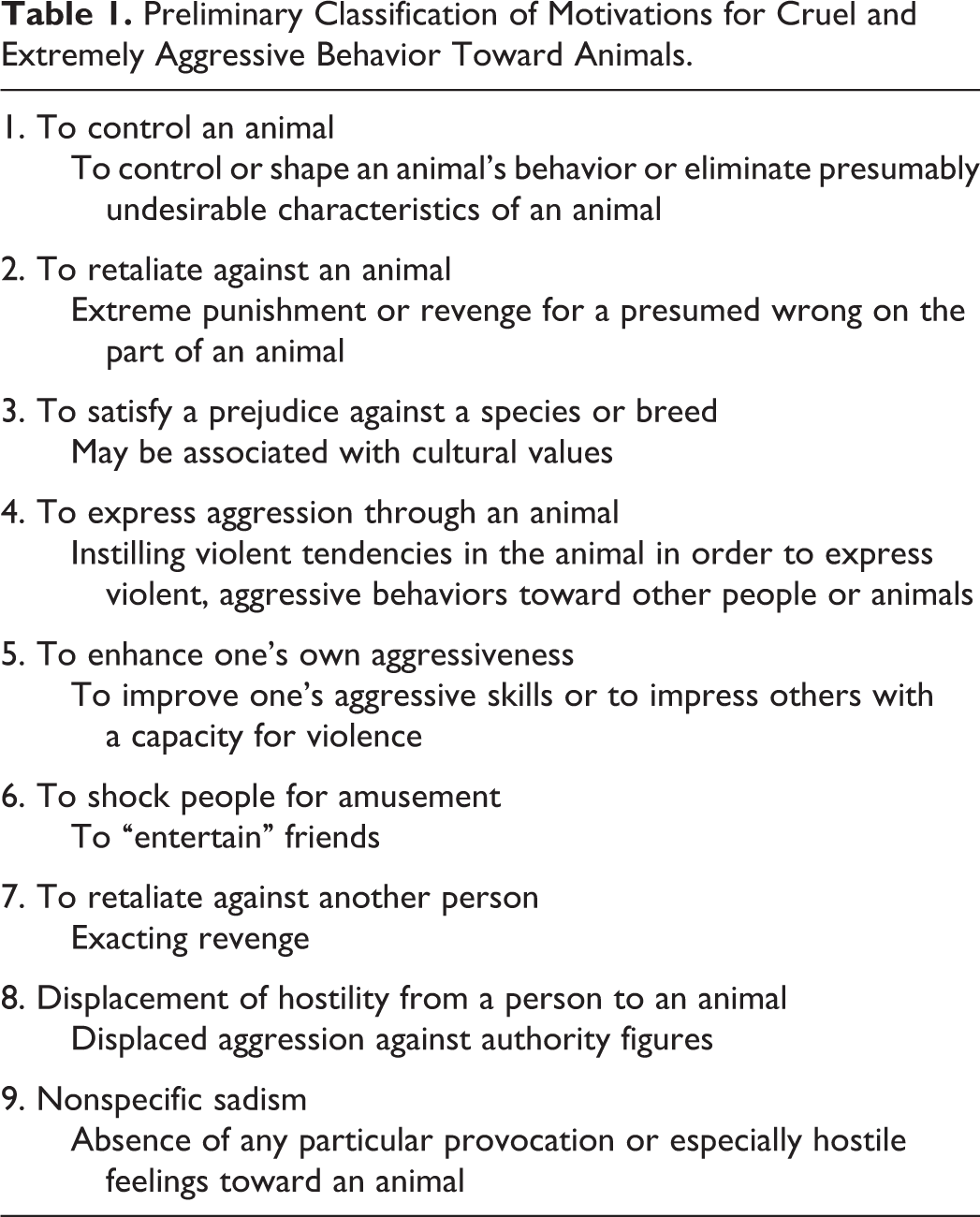
From the perspective of veterinary pathology, the first of the motives described previously—to control an animal—is one most likely to be revealed through evidence of restraint, binding, or other use of force physically affecting the animal. A more useful guide for veterinary pathologists in examining victims of animal abuse is provided by the criteria proposed in several instruments that have been incorporated into forensic animal maltreatment evaluations. 66 The Children and Animal Assessment Instrument 14 looks at the specific acts of animal cruelty committed by juvenile offenders. This assessment includes measures of the severity, frequency, duration, recency, diversity (both animal and injury), animal sentience level, and covertness of the acts. As we will note in the following, many of these factors can be reflected in the findings of a veterinary pathology examination.
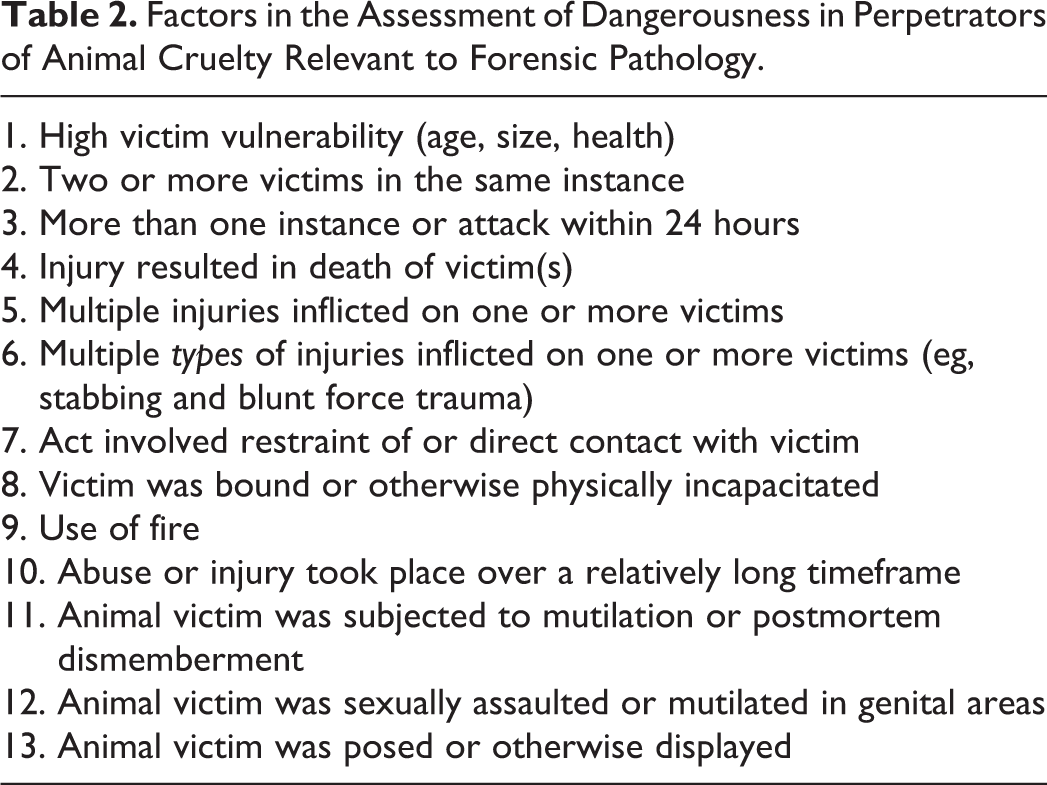
The instrument Factors in the Assessment of Dangerousness in Perpetrators of Animal Cruelty (FADPAC) is intended to evaluate the significance of an individual’s involvement in a particular act of animal cruelty as an indicator of dangerousness or possible risk for involvement of future acts of violence against others. 47,66 The 33 factors in this checklist are based in part on threat assessment criteria used by the National Center for the Analysis of Violent Crime as well as on studies of animal cruelty offenders and habitual violent offenders. Of the 33 factors in the checklist, 13 are deemed relevant to potential forensic pathology findings and are listed in Table 2.
Factors in the Assessment of Dangerousness in Perpetrators of Animal Cruelty Relevant to Forensic Pathology.
Legal Definitions of Animal Cruelty Relevant to Forensic Pathology
The mistreatment of animals takes many forms and is generally codified statutorily under one catch-all term of cruelty to animals that may include acts of physical abuse, abandonment, neglect, or torture. More specialized subsets of animal harm, such as bestiality or animal fighting, are often covered in separate statutes or sections.
American criminal law is predicated on the concept of mens rea, or guilty state of mind. The system of crime and punishment is based on the premise that people have the ability and free will to choose between right and wrong behaviors. In order to be considered criminal, an unlawful act or omission must be accompanied by a criminal state of mind. 19
The majority of states consider malicious harm or torture to be grounds for felony-level charges of animal cruelty. 9 Such a designation usually requires the assertion of a particular mens rea. New York (N.Y. Agric. & Mkts. Law §353), Kentucky (Ky. Rev. Stat. Ann. §525.135), and Tennessee (Tenn. Code Ann. §39-14-202) define such acts as those “done or carried out in an especially depraved or sadistic manner.” Oregon (O.R.S. §167.322) and the US Virgin Islands (14 V.I. Code Ann. §181) define maliciously as “acting with a depravity of mind and wanton disregard of life” while North Carolina (N.C. Gen. Stat. §14.360[b]) defines it as “committed intentionally and with malice or bad motive.”
Several states define torture in terms of its intended and ultimate effect on the victim, thus veterinary forensic pathology can provide information relevant to the determination of the mens rea of the suspect and the charges that might be filed based on the resulting physical condition of the animal victims. Illinois (510 Ill. Comp. Stat. Ann. 70/3.03) defines it as acts “motivated by an intent to increase or prolong the pain, suffering or agony of the animal.” Similarly, Indiana (Ind. Code §35-46-3-12[b],[c]) defines it as acts that “inflict upon the animal severe physical pain with a depraved or sadistic intent to cause prolonged suffering or death.” Florida (Fla. Stat. Ann. §828.12), Ohio (Ohio Rev. Code Ann. §1717.01), and Wyoming (Wyo. Stat. Ann. §181) all describe torture in terms of pain or suffering that is “allowed to continue when there is reasonable remedy or relief.”
In general, definitions that are based more on objective documented medical evaluations of physical harm and suffering are easier to communicate to the triers of fact in a criminal case than attempts to determine the underlying mindset of a suspect. The nature of the injuries that are documented, such as mutilations, burning, multiple types of injuries, and so on, can be used to strengthen the assertion that such harm is the result of excessive, repeated, or prolonged mistreatment.
Specific Forms of Animal Cruelty—What Forensic Pathology Might Reveal About Motive and Risk Assessment
For each common form of animal cruelty, there are potential indicators of motive, intent, and future risk assessment that may be revealed in the course of a thorough forensic veterinary pathology examination.
Neglect
The majority of cases that are reported to humane law enforcement agencies represent instances of neglect, animal maltreatment that may often be unintentional due to lack of education or temporary lapses in care from an otherwise responsible owner. Neglect of animals, whether on an individual level or involving dozens and even hundreds of animals, may be a marker for co-occurring self-neglect and a variety of mental health disorders. 32,45,46 Some neglect may be incidental, short term, and easily resolved through educational or social services interventions; other neglect may be long term, large scale, and chronic. 9
The veterinary forensic examination in cases of neglect can provide useful information about at least 2 measures mentioned as factors in risk assessment—severity and duration of the abuse. For example, the depth of the wound in the case of an embedded collar can offer insight into how long the condition went unrecognized. Similarly, details of matting, overgrown nails or hooves, severity of parasite load, degree of urine scalding, or aging of maggot infestations can all help speak to both the severity and time course of neglect, which can inform decisions about the likelihood that the defendant will reoffend.
Gross Neglect
Gross neglect is usually interpreted as neglect of long duration resulting in death or severe debilitation. The degree of suffering endured by an animal subjected to starvation may be reflected in evidence of pica or attempts to escape from conditions limiting the animal’s access to food or water such as worn or torn nails and tooth wear or fracture. Information about risk assessment of alleged perpetrators can be inferred from the context of the neglect and the likelihood that the suspect knew or should have known the likely end result of his or her actions. For example, abandoning a dog in the woods, although a crime, may be less predictive of other cruel acts than abandoning a residence and leaving an animal locked in a closet without access to food or water. Such action should be interpreted as being indicative of a mens rea indicating an intent to cause harm or at very least callous disregard for the consequences of one’s actions—a strong predictor of future offense.
Animal Hoarding
Understanding of the psychology underlying animal hoarding is still evolving, 32,37,48,61 along with the general recognition of hoarding disorder as a serious mental illness. The forensic examination associated with animal hoarding cases will generally be the same as in other cases of severe neglect, but the characterization of the circumstances as hoarding rather than simple or gross neglect will likely be dependent on assessment of the entire crime scene, case history, and evaluation of the alleged offender. Animal hoarding is associated with a high likelihood of recidivism: there is likely to be greater risk of future instances than in other neglect cases. 32,61 Although most of the efforts of forensic veterinarians will focus on documenting the injuries and illnesses seen in animals removed from a hoarding situation, it is also important to document the presence of healthy and well-groomed animals at the scene. Such evidence indicates that the suspect was knowledgeable of what actions are needed to keep animals healthy and still made the decision to deny that treatment to the animals that suffered. Similar evidence may be provided by the presence of quality food or appropriate medications that may have been found on the scene but not made available to some or all of the animals.
Dogfighting
Dogfighting is a felony in all 50 states and is recognized as a serious and violent crime that is often associated with other criminal behaviors, including drug and weapons violations. 45 Thus, the determination that the injuries seen on dogs removed from a suspected dogfighter are consistent with organized dogfighting is an important factor in building a successful dogfight prosecution. The injuries that are documented in such dogs will generally be inconsistent with explanations offered by the defense, including one-time “yard accident” fights with another dog, injuries due to pig or bear hunting, or accidental injuries caused by barbed wire, broken glass, or other sources. The distribution of wounds on the body and the presence of wounds in various stages of healing can be strongly supportive of other evidence consistent with organized dogfighting. Comparison of the patterns of wounds seen in dogs seized from dogfighting operations with those seen in family dogs that have been in fights with similar-sized dogs show significant differences. 38,45 Forensic examination of suspected fighting dogs and evidence seized with them may also provide evidence of the use of steroids, stimulants, or other drugs commonly used to attempt to enhance fighting performance.
Thermal and Chemical Burn Injuries
Fire setting has long been associated with animal cruelty as a potential predictor of involvement in other violent acts. 36,72 The combination of the 2—setting fire to living animals—is considered particularly predictive of high risk for further offenses. 47,66 Other forms of burn injuries, including scalding, microwaving, or burning with caustic chemicals, are all suggestive potential dangerousness by virtue of the fact that all entail close proximity to the victim, restraint of the victim, insensitivity to victim’s expression of pain, and a degree of premeditation. Examination of burn cases, as in other abuse cases, should include consideration of not only severity, frequency, and duration but also estimation of the degree of restraint of the animal required to produce the injuries and evidence of intentionality. For example, burns that show a pattern of accelerant being poured on an animal at close range or from immersion in hot liquid are likely to appear very different from those produced by accidentally spilling hot liquid on an animal. Similarly, trapping an animal so that it cannot escape burning (eg, in a cage or oven) is also associated with a high level of deviant exercise of power and control.
Blunt Force Trauma
Blunt force trauma (BFT) is a common feature in domestic violence 15 and child abuse 40 as well as animal cruelty. It is often encountered in the context of intimate partner violence where threats or actual abuse of pets is used as a tool for enforcing the abuser’s power and control. 67,71 As with other forms of animal abuse, careful documentation of the severity, frequency, duration, and history can be important in assessing the potential relationship between the animal abuse and past, present, and future harm to other animals or people.
Analysis of animal BFT injuries shows close parallels between injuries to animals and people. Tong 68 looked at fracture patterns in 154 dogs including 19 confirmed NAI and others resulting from falls, road accidents, crushing, and dog attack. She identified 5 features of fractures that should raise the index of suspicion of NAI: (1) presence of multiple fractures; (2) fractures occurring on more than one region of the body; (3) transverse fractures; (4) fractures presenting with radiographic evidence of healing, particularly callus formation; and (5) multiple fractures at different stages of healing.
These are consistent with potential indicators of higher risk for other offenses outlined previously, including multiplicity of injuries in one instance and a history of previous injuries. Other indicators of future risk could be a victim that is small or young, multiple victims, and evidence of binding or restraint associated with the BFT. Tong 68 notes the parallels to child abuse findings regarding both history and multiplicity of injuries, citing findings that showed that 74% (26/35) of abused children had 2 or more fractures compared with only 16% (19/116) of non-abused children 74 and that in 50% to 80% of fatal or near fatal child abuse cases, there was evidence of prior abusive injuries. 22
Sharp Force Injuries
As in BFT cases, postmortem indicators of possible factors for risk include severity (depth of wound, fatality), frequency of wounds, number of separate acts or separate weapons, number of past instances, victim vulnerability, and evidence of restraint. One case reviewed by one of us (R. Lockwood) involved a 13-year-old girl that had repeatedly stabbed more than a dozen cats over a period of several days. Such violence to animals is uncommon in young women. Forensic interviews revealed a long history of her having been sexually assaulted by a family member since an early age. Recommendation was made for intensive therapy and secure psychiatric confinement.
The area of the body targeted for sharp force injuries can also be relevant to risk assessment, particularly if it supports a particular motive or premeditation. One case involved a man who stabbed a pig multiple times, claiming that he was just trying to provide food for his family. However, the more than 70 wounds were focused near the female pig’s genitalia, and the man had complained that his mother-in-law was always nagging him about being a poor provider. The court clearly saw the potential warning signs in this act, and he was sentenced to lengthy confinement with psychiatric assessment.
Gunshot and Projectile Injuries
Gunshot and other projectile injuries (blowgun, arrow) are almost invariably evidence of NAI, and since a weapon must be made ready, such injuries always involve a degree of premeditation that helps establish a mens rea. As in other cases, attending veterinary forensic pathologists should make note of characteristics that relate to the frequency, severity, lethality, and history of the wounds as well as victim vulnerability. Victims should routinely undergo full body radiography to reveal not only the details of the presenting injuries but evidence of past injury as well.
Several other pathology findings are relevant to motive and risk assessment. Self-defense is a common explanation given for gunshot wounds to animals, particularly dogs. Careful documentation of projectile trajectories can call such defenses into question if it is clear that the animal was facing away from the shooter at the time of injury. Assessment of the proximity to the victim, based on wound characteristics and/or residue, may also call elements of the suspect’s account into question.
An overall assessment of the victim’s health for any potential disease states is also an important part of the forensic evaluation. Dog shooters may make claim to the “Old Yeller” defense, claiming that the shooting was an attempt to put a sick or violent animal out of its misery. Although many states do allow the humane killing of one’s own pet, any evidence that the process was slow, painful, or unjustified can call the suspect’s account and motives into question.
Asphyxia and Drowning
All forms of animal abuse involving asphyxia (eg, hanging, strangulation, suffocation, and drowning) involve close contact with the victim. Often this includes binding, taping, or other restraint. Evidence of such actions can indicate a high degree of premeditation and can be strongly associated with a high level of risk for future violence. In addition to thorough documentation of injuries in such cases, it is important to look for signs associated with struggle such as bruising or rib fractures. In addition, there may be indications of attempting to escape from the abuser, such as human tissue under the animal’s claws. Asphyxia can also be one of several forms of abuse committed against the same animal, which can heighten the potential level of risk. School shooter Luke Woodham, who killed his mother and 2 classmates in Pearl, Mississippi, preceded that act by beating his “dear dog Sparkle,” binding her in a bag, and then drowning her in a river 4 months before the homicides. The animal cruelty incident, although witnessed, was not investigated or prosecuted. 21
Poisoning
There is little research examining the links between animal poisoning cases and interpersonal crimes of violence, although some animal poisoning does occur in the context of domestic violence or revenge. Veterinary pathology evidence most appropriate for risk assessment of perpetrators of this form of animal cruelty is more likely to be based on the number of cases attributed to a single offender (ie, serial poisoning cases in a neighborhood) and evidence of premeditation and preparation, such as specially prepared poison baits or use of uncommon or difficult to obtain toxins.
Animal Sexual Abuse
Animal sexual abuse is the preferred statutory term to describe any abusive act with an animal involving the rectum, anus, or genitalia or sexual contact with animals that may or may not result in physical injury to the animal. This term is preferred over the more archaic term bestiality (in which sexual intercourse would have to take place) and zoophilia (a strong, erotic preference for animals), neither of which take into account the potential deleterious effects on the animal. 17,55 Sexual abuse of animals parallels that of sexual abuse of women and children and is also problematic because (1) human-animal sexual contact is almost always coercive, (2) such practice often causes pain or death for the animal, and (3) animals are unable to consent or to communicate about their abuse. 18 Likewise, Ascione 11 notes that bestiality may be considered cruel even in cases when physical harm to an animal does not occur, drawing a parallel to cases of adult sexual activity with a child where consent is presumed to be impossible.
Bestiality or zoophilia is not listed as a formal diagnosis in the current Diagnostic and Statistical Manual of Mental Disorders (DSM-V) 4 but is listed as an example of “other disorders or sexual preference” or “paraphilia not otherwise specified.” Commentary in the previous edition (DSM-IIIR) 3 notes that zoophilia is virtually never a clinically significant problem by itself. This does not mean that the behavior is insignificant; it suggests that when present, there are significant indicators of other mental disorders.
Several studies have shown the significance of animal sexual abuse as an indicator of past exposure to sexual assault or violence or as a predictor of the potential for future violence. In a review of 14 cases of bestiality in a larger sample of 561 adult males evaluated or treated for paraphilia, bestiality was most commonly associated with incestuous and non-incestuous female pedophilia, voyeurism, and exhibitionism. 1 One study found that 20% of children who sexually abused other children had histories of sexually abusing animals; in most cases, the acts were carefully planned, with pets targeted, groomed, and abused in actions that closely paralleled their sexual assaults against children. Bestiality in the sexual history of a juvenile offender can be a warning sign that other sexual paraphilias may be present and as such the individual may be at greater risk for sexually abusing another person in the future. 28 In a study of 381 institutionalized male juvenile offenders (mean age of 16.9), 42% reported sex offenses against people while (6%) admitted to bestiality. Of the 24 boys admitting to bestiality, 23 (96%) reported sex offenses against people. 31 In a review of 180 adults who had committed sex offenses against children, although case records indicated that only 4.4% had engaged in animal sexual assault, when polygraphed, 36.1% admitted such activities. The rate was higher (56.7%) in men whose victims included non-family as well as family members, compared to a rate of 27% in those who only victimized family members. 29
Although sexual contact with animals is a crime by itself in many states, it is rare that such cases are prosecuted in the absence of documented harm to the animal. However, as noted previously, such actions can be associated with a high risk of other offenses even when the animal does not appear to have been harmed. Thus, any suspected sexual contact should be carefully documented with attention to the nature, frequency, and severity of such contact. 52 In addition, veterinarians examining live animals should be alert for signs that the animal has been trained or “groomed” to be sexually receptive to people, such as by showing a lordosis posture on contact.
Conclusion
There is overwhelming evidence that when animals are abused, people are at risk; when people are abused, animals are at risk. Veterinary forensic pathology can play an essential role in providing a detailed account of the effects of abuse and neglect on animal victims. Veterinary forensic pathology can often reveal information beyond the physical condition of the victim. It can also help provide insights into the methods, motives, and state of mind behind such cruelty and thus give the courts and mental health professionals additional tools for the assessment of the significance of these crimes and the potential risks offenders may pose to other animals and society as a whole.
Footnotes
Declaration of Conflicting Interests
The author(s) declared no potential conflicts of interest with respect to the research, authorship, and/or publication of this article.
Funding
The author(s) received no financial support for the research, authorship, and/or publication of this article.