




Abstract
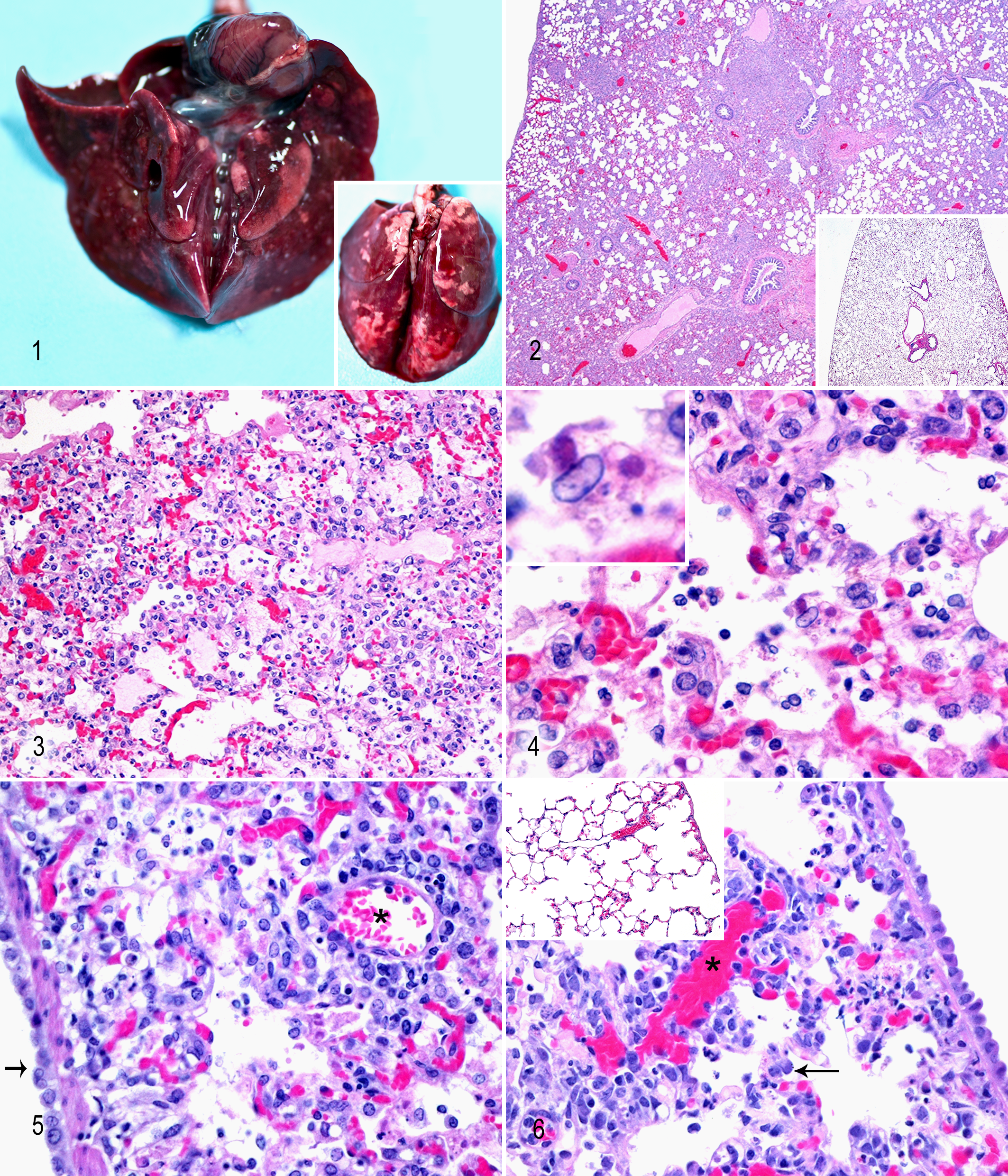
Eight guinea pigs were aerosolized with guinea pig–adapted Zaire ebolavirus (variant: Mayinga) and developed lethal interstitial pneumonia that was distinct from lesions described in guinea pigs challenged subcutaneously, nonhuman primates challenged by the aerosol route, and natural infection in humans. Guinea pigs succumbed with significant pathologic changes primarily restricted to the lungs. Intracytoplasmic inclusion bodies were observed in many alveolar macrophages. Perivasculitis was noted within the lungs. These changes are unlike those of documented subcutaneously challenged guinea pigs and aerosolized filoviral infections in nonhuman primates and human cases. Similar to findings in subcutaneously challenged guinea pigs, there were only mild lesions in the liver and spleen. To our knowledge, this is the first report of aerosol challenge of guinea pigs with guinea pig–adapted Zaire ebolavirus (variant: Mayinga). Before choosing this model for use in aerosolized ebolavirus studies, scientists and pathologists should be aware that aerosolized guinea pig–adapted Zaire ebolavirus (variant: Mayinga) causes lethal pneumonia in guinea pigs.
Zaire ebolavirus (EBOV) is 1 of 5 single-stranded RNA EBOV species belonging to the family Filoviridae and the genus Ebolavirus. EBOV in humans causes viral hemorrhagic fever. It is categorized by the National Institute of Allergy and Infectious Diseases as a category A priority pathogen, and it is listed by Health and Human Services as a tier 1 select agent; consequently, all work must be conducted in high-containment laboratories (biosafety level 4). There has been an intense effort in recent years to develop medical countermeasures that are effective against natural and potentially weaponized (aerosolized) filoviral infections, including EBOV. This type of research requires the use of animal models that closely reflect the disease in humans, which is characterized by fever, bleeding, immune suppression, lymphocyte apoptosis, neutrophilia, increased liver enzymes, azotemia, and skin rash. 12 Nonhuman primates (NHPs), such as the rhesus macaque (Macaca mulatta), cynomolgus macaque (Macaca fascicularis), and African green monkey (Chlorocebus aetheops), are quickly becoming the gold standard for use in these studies; however, work in mice and guinea pigs (GPs; Cavia porcellus) is desirable in certain studies because of space, time, expense, and personnel constraints. Wild-type EBOV does not cause morbidity or mortality in mice and GPs; therefore, adapted strains have been developed. 2 –4,9,11 Sequential passage of EBOV (variant: Mayinga) in GPs (GP-EBOV) yielded novel strains that caused 100% mortality when used to experimentally infect GPs by the subcutaneous route. 4,6 One of these strains was selected for the creation of a seed stock for use in animal model and countermeasure development studies at the US Army Medical Research Institute of Infectious Diseases (USAMRIID). Detailed information on the pathology of this stock in GPs challenged by the subcutaneous route was previously published. 4 This current study characterizes GPs challenged with the same strain of GP-EBOV by the aerosol, not subcutaneous, route.
Materials and Methods
Four male and 4 female 10- to 14-week-old Hartley GPs purchased from Charles River (Raleigh, North Carolina) weighing 506.1 to 670.3 g were used in the virulence confirmation study. Animals were exposed in groups of 4 in a whole-body automated bioaerosol exposure system. 8 The aerosol challenge dose for each animal was calculated with Guyton’s formula, which estimates the minute volume based on mass to determine the inhalation dose. The aerosol challenge was generated with a Collison nebulizer to produce a highly respirable aerosol (flow rate, 7.5 ± 0.2 l/min). The system generated a target aerosol of 1- to 3-μm mass median aerodynamic diameter, determined by TSI Aerodynamic Particle Sizer. Samples of the prespray suspension and aerosol, collected from the exposure chamber with an all-glass impinger during each challenge, was agarose plaque titrated to determine the inhaled plaque-forming units (pfu). Additionally, 100 μl of the prespray suspension and diluent was plated onto blood agar to rule out potential contaminants. Actual aerosol doses ranged from 1901 to 1992 pfu (mean, 1953 ± 31.4 pfu).
The GP-EBOV stock used in this study was created from “parent” stock No. 1394 by passage on VeroE6 cells. The identity of this new stock was confirmed by agent-specific reverse transcription real-time polymerase chain reaction assays, whole genome sequencing, and electron microscopy (data not shown).
Necropsies of each animal were performed, and lung, liver, and spleen were collected for histopathology and immunohistochemistry (IHC). Tissues were routinely processed and stained with hematoxylin and eosin. Indirect IHC was performed on the lung, liver, and spleen with an Envision-PO kit. A mouse monoclonal anti-EBOV antibody was used at a dilution of 1:8000. After deparaffinization and peroxidase blocking, sections were covered with primary antibody and incubated. Secondary antibody was applied, rinsed with substrate-chromogen solution, and then stained with hematoxylin.
Results
At necropsy, every animal had mottled dark red lungs that were firm and noncollapsing (Fig. 1). Of special note, none of the GPs exhibited a cutaneous macular rash, which is characteristically present in human cases and aerosol-challenged NHPs. 5,10,12 Histologically, marked to severe interstitial pneumonia was present in 100% of the GPs (Supplemental Table 1, Figs. 2–6). Pneumonia was characterized by thickened alveolar septa that contained fibrin, cellular and karyorrhectic debris, heterophils, and macrophages that extended into alveolar spaces. Multifocally, there was necrosis and disruption of the septa. There was infrequent necrosis of bronchiolar epithelial cells, and inflammation and necrosis extended into the adjacent interstitium, resulting in a vague bronchointerstitial pattern. The pattern was not apparent in severely affected sections that contained diffuse changes. Intracytoplasmic inclusion bodies were readily identified in alveolar macrophages. Perivasculitis, edema, fibrin, congestion, hemorrhage, mesothelial cell hypertrophy, type II pneumocyte hyperplasia, and rare pleuritis were multifocally present in all animals. BALT was detectable in some animals and usually depleted of lymphocytes.
Mild changes were observed in the liver, including multifocal vacuolar degeneration, few small foci of hepatocellular necrosis, and, in one animal, rare intracytoplasmic inclusion bodies (Fig. 7). Within the splenic white pulp, there was mild to moderate lymphocytolysis (Fig. 8), tingible body macrophages, and mild lymphoid depletion.
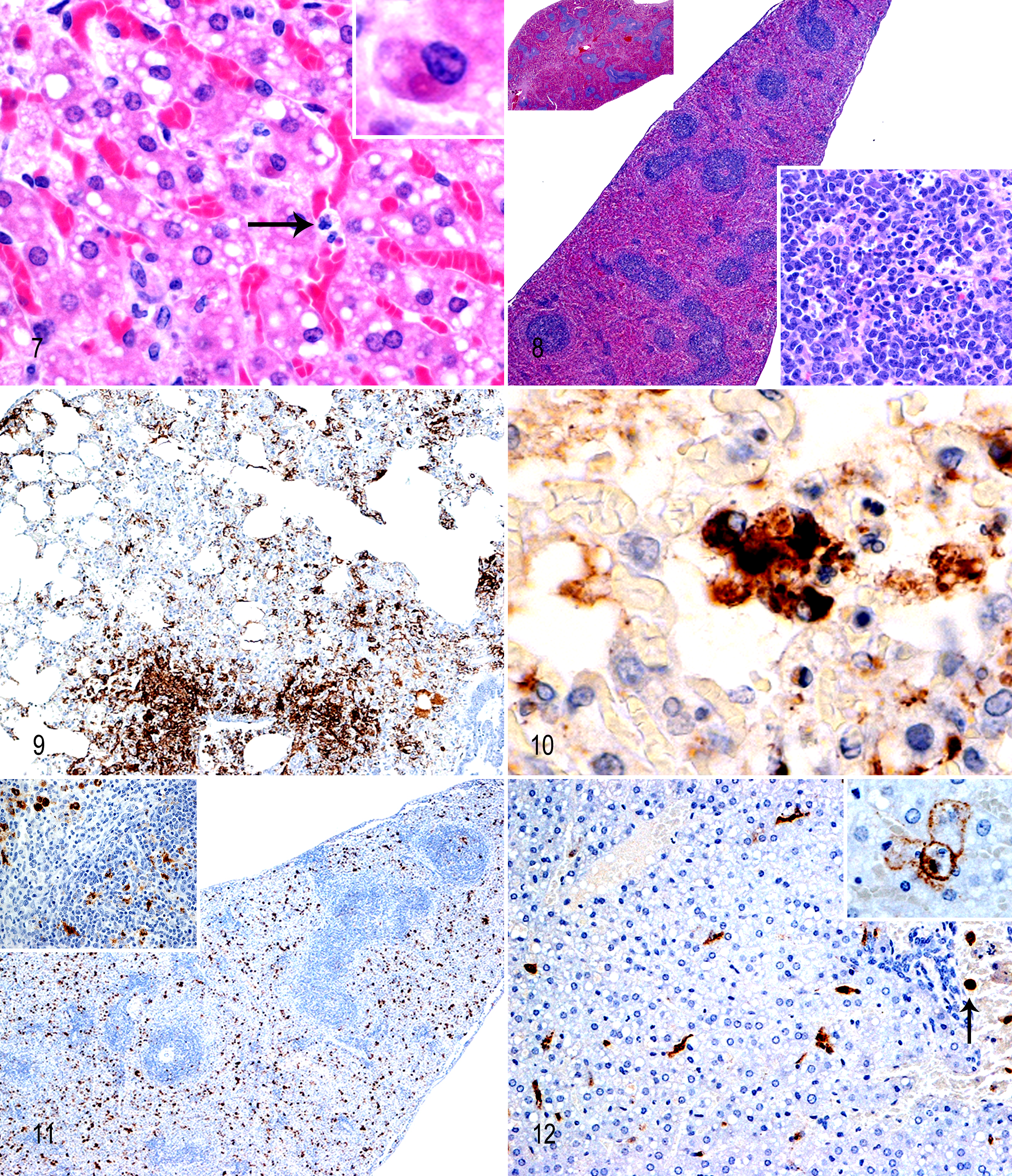
Positive EBOV IHC (Supplemental Table 2, Figs. 9–12) was demonstrated in the lung, alveolar macrophages, intravascular monocytes, perivascular spindle cells, pneumocytes, bronchiolar epithelial cells; cells of spleen (likely fibroblastic reticular cells, dendritic cells, and macrophages); cells of liver (likely stellate and Kupffer cells); and, rarely, hepatocytes.
The current work was compared to a serial sampling study performed at USAMRIID in 2010 that challenged by aerosol and used a virus created from the same parent stock. Hematoxylin and eosin and IHC slides were examined from the USAMRIID pathology archives, and aerosolized GPs of the archived study developed marked to severe interstitial pneumonia that was similar, if not identical, to that noted in our study beginning day 5 postexposure (PE; data not shown).
Discussion
Necrotizing interstitial pneumonia was the primary lesion identified in GPs following aerosol challenge with GP-EBOV (days 6–7 PE). This is distinct from pulmonary changes documented in a serial sampling study of subcutaneous-challenged GPs with GP-EBOV. In that report, diffuse thickening of alveolar interstitium by lymphocytes and macrophages occurred late in the course of disease (days 7–9 PE). 4 Additional dissimilar findings included systemic vasculitis, endothelial cell infection, and many intracytoplasmic inclusion bodies noted within splenic macrophages and hepatocytes. 4 Similarities of subcutaneous- and aerosol-challenged GPs include lack of macular rash, moderate splenic lymphocytolysis with only mild loss of splenic white pulp, and moderate disseminated EBOV immunopositivity; small foci of necrosis with mild EBOV immunopositivity in the liver; and infection of the mononuclear phagocytic system and interstitial cells. 4
Results of this study contrast findings in documented cases of NHPs challenged with aerosolized filoviruses 1,5,10 where the pulmonary changes include infection and destruction of respiratory-associated lymphoid tissues, increased alveolar macrophages with occasional intracytoplasmic inclusion bodies, mild inflammation, vasculitis, fibrin, and hemorrhage. In human cases, there is pulmonary congestion and “absence of significant inflammatory cellular infiltration.” 12 Additional key features of aerosolized EBOV in NHP and human infection include marked depletion of splenic white pulp, severe hepatocellular degeneration and necrosis with many intracytoplasmic inclusion bodies, systemic vasculitis with fibrin deposition in multiple organs and tissues, and a macular rash. 5,7,12
Briefly, the pathogenesis that we propose for aerosol GP-EBOV based on this study is as follows: Inhaled virus infects alveolar macrophages, few bronchiolar epithelial cells, and pneumocytes causing interstitial pneumonia. Infection spreads to blood monocytes, liver, and spleen. Pneumonia progresses rapidly, and animals die due to complications of severe interstitial pneumonia with few changes in the liver and spleen, without widespread lymphoid destruction, without systemic vasculitis, and without a macular rash. Variations between models should be carefully weighed when considering the use of the GPs for EBOV studies involving aerosol exposure.
This study was approved by the Institutional Animal Care and Use Committee, and research was conducted in compliance with the Animal Welfare Act and other federal statutes and regulations relating to animals at the time that these studies were conducted. Experiments involving animals adhered to principles stated in the Guide for the Care and Use of Laboratory Animals of the National Research Council. The USAMRIID is fully accredited by the Association for Assessment and Accreditation of Laboratory Animal Care International.
The views, opinions, and/or findings contained herein are those of the authors and should not be construed as an official Department of Army position, policy, or decision unless so designated by other documentation.
Footnotes

Acknowledgements
We wish to gratefully acknowledge the numerous contributions of Pathology Division laboratory personnel, including Neil Davis, Phil Fogle, Gale Krietz, and Christine Mech; virology personnel William M. Aguilar; Center for Aerobiology personnel; and Bill Discher for photographic assistance.
Declaration of Conflicting Interests
The author(s) declared no potential conflicts of interest with respect to the research, authorship, and/or publication of this article.
Funding
The author(s) received no financial support for the research, authorship, and/or publication of this article.
References
Supplementary Material
Please find the following supplemental material available below.
For Open Access articles published under a Creative Commons License, all supplemental material carries the same license as the article it is associated with.
For non-Open Access articles published, all supplemental material carries a non-exclusive license, and permission requests for re-use of supplemental material or any part of supplemental material shall be sent directly to the copyright owner as specified in the copyright notice associated with the article.
