




Abstract
Obesity is a leading cause of morbidity and mortality worldwide. There is still a wide disparity between the necessity and availability of safe and effective antiobesity pharmacotherapies. Current drugs are associated with adverse effects and are limited in their efficacy. There is thus an urgent need for new antiobesity agents. Animal models are critical to the study of the biological mechanisms underpinning energy homeostasis and obesity and provide useful tools for the development of novel antiobesity agents. Our understanding of the complex neuronal and hormonal systems that regulate appetite and body weight has largely been based on studies in animals. This review describes the physiological basis of appetite, rodent models used in the development of antiobesity drugs, and potential future targets for novel antiobesity agents.
Obesity is a leading cause of morbidity and mortality worldwide. In 2008, the World Health Organization calculated that 500 million people worldwide were clinically obese. 6 By 2030, the number of obese adults is estimated to rise by 76 million within the United States and United Kingdom alone. Obesity is associated with important comorbidities, including type 2 diabetes, ischemic heart disease, and specific cancers. Complication-related costs in the United States alone are set to rise by $65 billion per annum by 2030. 136 These alarming figures highlight the need for concerted efforts directed toward reducing the incidence of obesity and hence the burden of its clinical and financial repercussions.
There is a profound imbalance between the necessity and availability of safe and effective treatments for obesity. To date, no interventional strategy has proven successful. Lack of compliance and regain of weight limit the efficacy of diet and exercise programs in humans. 135 Weight loss on average is only maintained for 1 to 5 years through lifestyle programs. 34,60 However, when used in combination with pharmacotherapy, their additive effects are likely to result in improved short-term and sustained weight loss. 5
Bariatric surgery results in significant weight loss and improves obesity-associated comorbidities. 68 Recent evidence suggests that the combination of surgery and medical therapy may be more effective at achieving glycemic control in diabetics than medical therapy alone. 116 Previously reserved for patients with a body mass index (BMI) >40 kg/m2, eligibility for surgery in the United States and the United Kingdom has been extended to those with BMI >30 kg/m2 and associated comorbidities. However, cost, perioperative risk, and the resources necessary to treat the growing numbers of the obese prevent the use of bariatric surgery as the definitive treatment for obesity. 46
The European Medicines Agency and the Food and Drug Administration (FDA) recommend a new antiobesity drug that results in a statistically significant placebo-adjusted weight loss of greater than 5% at 12 months. Safety remains a significant barrier to the development of novel drugs. Many of the signals that regulate appetite and body weight also influence other physiological systems, and adverse effects are not always identified in preclinical or even clinical trials. Until recently, Orlistat, a gastric and pancreatic lipase inhibitor, was the only drug licensed for long-term treatment of obesity, and it achieved the FDA’s weight loss target in only 30% of patients. 107 In the United States, phentermine, a sympathomimetic antiobesity agent used to suppress appetite, is licensed for short-term use only, 53 and the appetite suppressant sibutramine was recently withdrawn from the European and US markets due to the risk of nonfatal cardiovascular events demonstrated by the Sibutramine Cardiovascular Outcome Trial. 74 Qsymia and Belvig, which have recently been approved for markets in the United States, both faced setbacks in their licensing due to concerns related to adverse effects. 4,8
Qsymia, developed by VIVUS (Mountain View, CA), is a combination agent of topiramate, a weak carbonic anhydrase inhibitor used in migraine prophylaxis, and phentermine, an amphetamine derivative used in the short-term treatment of obesity. Although significant weight loss has been demonstrated in phase III trials, approval was delayed due to FDA concerns regarding cardiovascular risk and teratogenicity. It has now been approved, with the stipulations that it is contraindicated in pregnancy and in patients with high cardiovascular risk. Furthermore, VIVUS will be required to assess 10 postmarking requirements, including long-term cardiovascular trials assessing the effect of Qsymia on cardiac events. 2
Belvig (Lorcaserin) is a serotonin receptor subtype 2c receptor antagonist (5-HT2C) developed by Arena Pharmaceuticals (San Diego, CA). Activation of the 5-HT2C by serotonin inhibits dopamine and noradrenaline release in specific areas of the brain. Lorcaserin has a high affinity for the 5-HT2C receptor 4 and does not bind with high affinity to other serotonin receptors, including the 5-HT2B, a receptor that has been implicated in fenfluramine-induced pulmonary artery hypertension. 24 Preclinical studies raised concerns regarding valvulopathy and carcinogenicity in rats. 129 However, following results from the BLOOM and BLOSSOM phase III trials, the Endocrinologic and Metabolic Drugs Advisory Committee voted in favor of lorcaserin as an adjunct to diet and exercise in patients with a BMI ≥30. 4 The FDA has concluded that the increased risk of developing cancer while on lorcaserin is negligible. 4
Although these recently approved agents offer hope for obese patients, their long-term safety and efficacy outside of clinical trials remain to be demonstrated. The development of safe and efficacious drugs to treat obesity therefore remains a priority. Animal models are critical to the study of the biological mechanisms underpinning energy homeostasis and the epigenetics and environmental factors associated with obesity and its related disorders. Our understanding of the complex neuronal and hormonal systems that regulate appetite and body weight has largely been based on studies in animals. Furthermore, they provide useful tools for the development and testing of novel antiobesity agents.
This review briefly outlines the physiological basis of appetite regulation and focuses on the animal models, particularly rodent models, used in the development of novel antiobesity drugs and the current strategies to develop such agents.
The Physiology of Appetite Regulation
Animal models have greatly enhanced our understanding of the physiological systems involved in human appetite regulation. Energy homeostasis is tightly regulated by a complex network of integrated neuronal and hormonal signaling, which alters appetite and activity to compensate for short-term fluctuations in energy intake and expenditure. However, even very small discrepancies in this system can in time result in the accumulation of body fat and subsequently obesity.
Short-term regulation of appetite largely results from gut-brain axis signaling. The ingestion and subsequent passage of food along the gut is detected by chemoreceptors and mechanoreceptors in the gut epithelium, which alter neuronal signaling to the brainstem or modulate the release of gut hormones from the gastrointestinal tract. Long-term regulation of energy homeostasis is thought to revolve around maintaining adequate stores of adipose tissue. The adipocyte-derived hormone leptin is probably the most significant long-term regulator of appetite. Leptin circulates at levels proportional to fat mass 145 and acts to restore adipose depots following fat accumulation or loss. To this end, low leptin levels stimulate appetite and high leptin levels inhibit appetite, at least in the nonobese; for reasons that are unclear, obesity is associated with resistance to the anorectic effects of leptin.
These peripheral signals are integrated with central signals modulating energy homeostasis in the hypothalamus, the major brain center regulating appetite and energy expenditure. The hypothalamus is an evolutionarily ancient region at the base of the brain, which regulates a number of homeostatic systems. It receives innervations from the brainstem, which communicates signals received from the vagus nerve and directly from peripheral circulating factors. The hypothalamic arcuate nucleus contains 2 neuronal populations that play major roles in the regulation of energy homeostasis. Neurons expressing neuropeptide Y and Agouti-related peptide increase food intake and reduce energy expenditure and are inhibited by leptin. Neurons expressing proopiomelanocortin (POMC) reduce food intake and increase energy expenditure and are activated by leptin. 139 Both neuronal populations have also been reported to respond to gut hormones. A number of other hypothalamic circuits and signals have been implicated in the regulation of energy homeostasis, although few are as discrete or as well characterized as these arcuate neuronal populations. Hypothalamic neuropeptides, including neuromedin U, melanin-concentrating hormone, and the orexins, are all thought to regulate appetite. Monoamines, including serotonin, noradrenaline, and dopamine, have been found to interact with leptin-dependent and leptin-independent systems. 61 Endocannaboid receptors, particularly the cannaboid receptor 1 (CB1), increase food intake when activated by appropriate ligands. 140 The wide range of signaling factors involved in energy homeostasis offers a number of potential targets for antiobesity agents.
Animal Models Used in the Development of Antiobesity Drugs
Many of the major advances in our understanding of the physiological and genetic basis of appetite and body weight regulation have come from animal models. Animals, including monkeys, dogs, pigs, and rodents, are used to investigate energy homeostasis and as models for obesity and its associated disorders.
Rodent models are the most extensively used animal models in researching energy homeostasis and antiobesity drugs. Evidence suggests that, following lineage splits between primate and murid 75 million years ago, as well as between rat and mouse 12 to 24 million years ago, genes implicated in many diseases, such as obesity and its associated disorders, have remained largely conserved between species. 1 The discovery of leptin in 1994, through characterization of the genetic basis of the ob/ob and db/db mice, highlighted the role of adipose tissue as an endocrine organ and resulted in an upsurge in research into the neuroendocrine basis of obesity.144
In general, antiobesity agents have been shown to produce similar effects on feeding and body weight in rodents and humans. Much of the neuroanatomy and circuitry of the regions of the brain that regulate appetite are similar in rodents and humans and, as omnivorous animals, rodents’ taste and digestive systems are also comparable to humans. 134 Rat and mouse models have both proven sensitive to clinically effective compounds, such as d-fenfluramine, sibutramine, and rimonabant, which reduce food intake in rodent models. 71,105,132 This suggests that common biological pathways are involved in energy homeostasis in rodents and humans, supporting their use for development of novel antiobesity agents.
Nevertheless, species- and strain-specific differences do exist and thus illustrate the importance of species and strain selection when conducting antiobesity research in different animals.
Rat Models
Rattus norvegicus was the first mammalian species to be domesticated for scientific research. 65 Many researchers use rats as the preferred model for studying physiology and biochemistry. 73 Such models have greatly enhanced our understanding of many human conditions, including obesity-associated diabetes 76,110 and cardiovascular disease. 51,85,97 The rat genome encodes for a similar number of genes to that of humans and mice, and 40% of its eutherian core, which contains the majority of known exons, aligns with both human and mouse genomes. 59
Metabolic differences between rats and other species do exist. For instance, the cytochrome P450 enzyme family, which is involved in the breakdown of both exogenous and endogenous compounds, plays a vital role in drug metabolism. Comparative genomics has revealed expansion of certain P450 subgroups in rats, whereas those of human genes have remained more static, suggesting that the pharmacokinetics and pharmacodynamics of drugs may differ significantly between these species. 59
Morphological differences exist between rats and mice. Most obviously, rats are larger rodents than mice. The Norway rat weighs between 350 and 650 g and measures 9 to 11 inches in length. The house mouse weighs between 30 and 90 g and has a body length of 3 to 4 inches. Mice also tend to breed faster than rats. 59 Furthermore, rats lack a gallbladder, but mice do not.
Genetic Rat Models
Most rat strains used in obesity research have been selected to express certain physiological traits. More specific models can result from either spontaneously occurring or, more recently, gene knockout (KO) models. These models are useful in determining the pathophysiological relevance of particular genes in energy homeostasis and obesity.
Zucker Fatty Rats (ZFR) rats have a spontaneous mutation in the fatty (fa) leptin receptor gene, which compromises leptin receptor function.145 As described above, leptin is produced by adipose tissue and acts on the hypothalamus to suppress food intake. 82 Within 5 weeks of birth, ZFR are hyperphagic and obese, and they demonstrate insulin resistance, although they do not subsequently develop diabetes.147
Mouse models, largely due to more convenient genomic engineering methods, have traditionally been the rodent KO model of choice. However, the rat is considered to resemble certain human pathology more closely than mice, for instance, in diabetes, cardiovascular disease, and addiction behaviors. 9 Thus, the recent use of transcription activator–like effector nucleases 77 and zinc finger nucleases (ZFNs) to create rat KO models has generated much interest. 38 The first leptin KO rat recently has been created and, as expected, is hyperphagic and obese, with higher circulating cholesterol, triglyceride, and insulin levels than controls. 131
Mouse Models
Mouse models have historically been favored by geneticists for the study of mammalian genetics and physiology. 73 Mapping of the mouse genome predates that of the rat, and their small size and the availability of various coat colors, enabling the identification of chimeras when producing transgenic mice, makes them an appealing model to use for research. 73 Models have arisen from spontaneously occurring single-gene mutations, such as the ob/ob and db/db mice, and through targeted transgenic and KO models. 109
Genetic Mouse Models
Ob/Ob and db/db mice are examples of spontaneously occurring monogenetic mutations used in obesity research. The Ob gene encodes for leptin. The ob/ob mutation prevents the production of leptin and results in an obese phenotype and hyperglycemia. 18 The db/db mouse has a mutated leptin receptor, resulting in obesity with increased leptin levels and hyperglycemia. 18 The altered leptin signaling in these models renders them a limited model for comparison with normal human obesity, in which leptin levels correspond with the level of adiposity and in which leptin resistance is rarely so absolute as that observed in the db/db mouse. 95 Within several weeks of birth, both these models are heavier than their lean counterparts, with fat representing 50% of their body weight. Spontaneously occurring major single-gene mutations are responsible for only a small proportion of human obesity. 49 The main role of these single-gene models is therefore to provide insights into the regulation of energy homeostasis, rather than to mimic human disease.
The development of transgenic and KO models has facilitated the study of gene function. Gene overexpression was the first technique used to alter gene expression in mice; however, this technique did not always result in the expected or desired physiological effect. 121 Global KO ablates target gene expression in all tissues, and “knock-in” models replace endogenous gene expression with a mutation. Examples include the 5-HT2C KO mouse, the phenotype of which suggests that this receptor is involved in body weight control, and melanocortin system KO models. The central melanocortin system regulates body weight through melanocortin 3 and 4 receptors (MC3R, MC4R). 56 The prohormone POMC codes for a number of melanocortin peptides, particularly α melanocyte-stimulating hormone. 108 Mice and humans lacking effective POMC processing and signaling have early onset obesity, among other pathophysiological changes. 86 MC4R-deficient mice are hyperphagic but do not increase their energy expenditure in response to this hyperphagia. Mice lacking MC3R are obese but have normal food intake, suggesting they have altered energy expenditure. 30 The s/s mouse, 21 a “knock-in” model, has contributed to research within the field of diabetes. It consists of a knock-in mutation, which disrupts the STAT3 leptin signaling pathway, thought to be a major pathway mediating the effects of leptin. The resultant phenotype is similar to that of the db/db mouse, but caloric restriction in this model, unlike in db/db mice, normalizes glycemic control. This implies that in addition to leptin-induced adiposity signals, leptin receptor/STAT3 independent pathways also contribute to control leptin-mediated glucose homeostasis. 21
Disadvantages of such models include the potential for embryonic lethality and the fact that embryonic KO may result in compensatory changes during development, thus masking or attenuating the effects of the loss of the gene. The neuropeptide Y (NPY) KO mouse is a useful example of such effects. NPY is a well-established orexigenic neuropeptide, and there is compelling evidence that it plays a role in the regulation of food intake. NPY stimulates food intake following central administration. Hypothalamic NPY expression increases in animals deprived of food. 91 However, the NPY KO mouse does not have altered energy homeostasis, suggesting that it does not play a physiological role in this system or that a compensatory response masks the effect of this deficiency. 48 The effects of knocking down NPY expression in the Arcuate Nucleus (ARC) suggest that the latter explanation is correct. 55 The generation of tissue-specific KO models can allow the investigation of the role of genes in particular organs and may reduce compensatory responses and/or the gross phenotype of the global KO from masking this role. In addition, many KO models show changes in body weight without necessarily demonstrating a physiological role. An estimated one-third of all KO mice have reduced body weight, suggesting that the loss of genes without critical roles in energy homeostasis may still result in an altered body weight phenotype. 111 Although such models can provide useful mechanistic insights into the regulation of food intake and body weight, monogenetic models are not generally used as models of obesity given the polygenic etiology in humans. 128 In view of this, mouse models in particular are increasingly being used for quantitative trait loci mapping, to screen for associations between phenotype and marker information and to identify the genes associated with obesity. 28,43,120 Only rarely is human obesity a consequence of a single-gene mutation, and subsequently, selective breeding of certain strains of rodents prone to weight gain may more accurately reflect human obesity.
Environmental Rodent Models
Models with environmentally driven changes in weight have been used to investigate the propensity for weight gain and loss in rodents. The inherent difficulty in accurately calculating human energy balance makes these models particularly useful. First used by Masek and Fabry in 1959, 96 diet-induced obese (DIO) models can be produced through both commercial “pelleted” high-fat diets (which make it relatively simple to calculate energy and macronutrient intake) and “cafeteria diets,” which offer a choice of various palatable foods, such as chocolate and peanuts, and are considered more representative of human dietary habits, given that a variable human diet is thought to encourage overeating. 121 Although different methodologies are used, models are generated through access to high-fat diets, usually over a 3- to 4-month period. These animals usually have a high body weight gain (predominantly in the form of fat), insulin resistance, glucose intolerance, and elevated cholesterol and triglycerides. Reports of hypertension, although inconsistent, also exist. 93 Of note, rodents are more resistant to the development of non–insulin-dependent diabetes, an important difference to obese humans. 94 In addition, the expression of genes coding for immune response and angiogenic pathways is upregulated to significant levels in DIO as it is in obese patients. 90 Different DIO models tend to result in similar metabolic profiles, although certain fats such as lard and olive oil have been suggested to result in more pronounced obesity in rodents. 29
Rodent strains can vary in their response to a nutritional challenge and their propensity for weight gain. For example, the C57BL/6 mouse is prone to weight gain. 123 Many commonly used Sprague-Dawley rat stocks readily become obese on a standard diet and, indeed, have been proposed as a rodent model of polygenetic obesity, 78 but selective breeding is able to generate DIO-resistant and DIO-prone substrains. 89 Mouse models such as the PWD/Phj or WSB/Eij strain are obesity resistant but display abnormal insulin secretion, with PWD/Phj expressing high basal insulin levels and WSB being extremely resistant to the development of obesity. 88
The strong correlation between weight loss in preclinical DIO animal studies and clinical trials and the similar physiological pathways that appear to be involved support the validity of animal, and particularly rodent, models in the development of antiobesity drugs. However, DIO rodents have important limitations that need to be considered. 64,119,132 Diets exclusively high in fat fail to model individual taste preference and natural variability in food selection, and previous studies examining neuropeptide levels and carbohydrate consumption suggest that food preference and variation in taste receptors can contribute to the propensity for developing obesity. 75,119 One study has demonstrated that when given the choice, dietary fat content ranges from 28% to 83% of total energy intake in mice. 118 Feeding environments in which rodents are free to consume all the time are artificial, and individual housing in small cages may reduce energy expenditure, which can subsequently affect appetite. Such models also, of course, fail to account for the complex psychosocial factors that influence overeating in humans. 61 Thermogenesis has a much more significant role for energy homeostasis in rodents than in humans, 14 and there are differences in the relative lengths and the luminal pH of sections of the gastrointestinal tract between human and rodents, which may have significant implications for the role of the gut-brain axis and for the efficacy of orally ingested drugs. 41,98 Importantly, even chronic studies may fail to detect harmful adverse effects that only become apparent after longer clinical trials. For example, postmarketing concerns regarding cardiovascular safety led to withdrawal of sibutramine after preclinical studies. 74
Additional Rodent Models
Seasonal variations in weight found in mouse models have been confirmed by the use of hamsters. 121 Siberian hamsters have been shown to lose approximately 30% to 40% of their body weight when transferred from a 16-hour light cycle to 8 hours. 45 In contrast, Syrian hamsters and collared lemmings reach peak mass in winter months. 20 Seasonal variation in weight has thus enhanced our understanding of neurohormonal circuits involved in regulated body weight. However, hamsters are not as commonly used in antiobesity research as mice and rats, in part because it is still unknown whether the signals regulating seasonal changes in body weight play similar roles in predominately nonseasonal animals such as humans.
Nonrodent Models
Although rats and mice are the most used animal models in antiobesity research, other species are also used.
Primates
The genetic similarity of nonhuman primates (NHPs) to humans makes them particularly useful in long-term longitudinal studies investigating the environmental and epigenetic etiology of obesity. 121 Although chimpanzees (Pan troglodytes) and bonobos (Pan paniscus) are the closest living mammals to humans, Old World Monkeys, such as rhesus monkeys, macaques, and baboons, are for practical and ethical reasons the most studied NHP. Like rodents, individual primate species have different metabolic and phenotypic responses to high-fat/high-sucrose diets and caloric restriction (CR). For example, squirrel monkeys develop diet-induced obesity in response to the high-fat/high-sucrose diets, whereas cebus monkeys are relatively resistant to their effects. 16 Spontaneous obesity has been demonstrated in certain baboon strains. 11,19 Rhesus monkeys and captive macaques fed ad libitum develop obesity and, in some cases, associated disorders such as diabetes. 26,27,63,79 Unlike rodent models, the development of diabetes in rhesus monkeys is associated with the presence of amyloid in beta cells and diabetic complications similar to those of humans. 23,81,99 Furthermore, their response to pioglitazone by increasing insulin sensitivity, reducing blood glucose, and lowering lipid levels and blood pressure confirms that they represent good models for diabetes in humans. 80 Rhesus monkeys have been shown to lose more total body weight than squirrel monkeys when subjected to CR. 137 In addition, CR in rhesus monkeys reduces glycation of proteins, which under normal conditions increases with aging and may mediate age-related diseases in humans. Squirrel monkeys, in contrast, demonstrate no such response. 117
NHPs are also used extensively in aging research and thus could provide useful models for age-related diseases such as atherosclerosis that are difficult to study using rodent models. Similar to humans, NHP have a long life span, a low reproductive rate, and a relatively high survival rate. Indeed, this slow reproductive rate and long life span of approximately 15 to 30 years can be a considerable disadvantage in studying these animals. Small primates, generally 500 g or less, such as prosimians (lemurs, lorises, and galagos or bush babies), New World callitrichids (marmosets and tamarins), and tarsiers have life spans at the lower end of this range, living for approximately 15 years. A transgenic marmoset capable of passing its transgene to offspring has recently been developed, expanding the possibilities of using NHP genetic models to study energy homeostasis in the future. 115
Porcine Models
The metabolic discrepancies between rodent models and humans can result in difficulty translating findings in preclinical studies into the clinical field. 15 Pigs make an appealing potential model for research since they have several similarities to humans. Their organ size and development of atherosclerosis resemble that of humans. Domestic pigs fed on a high-fat diet do not develop frank metabolic syndrome, 58 but Gottingen, Yucatan, and Ossabaw breeds of swine have been extensively used in obesity and cardiovascular investigation. The Ossabaw breed in particular, when fed a high-fat diet, develops 5 of the 6 criteria for the metabolic syndrome (central obesity, insulin resistance, impaired glucose tolerance, dyslipidemia, and hypertension). 44
Chronic inflammation is thought to be a major contributor to the development of insulin resistance in obesity. 57,113 Porcine adipocytes produce proinflammatory cytokines such as interleukin 6 and tumor necrosis factor–α in response to bacterial lipopolysaccharide. 92 Adipokines, regulatory molecules released from adipose tissue, have been shown to regulate lipid metabolism and body weight in rodents. 52 Newer research in pigs has demonstrated that levels of adioponectin, an anti-inflammatory adipokine, and of leptin are reciprocally regulated in both humans and pigs. 122 Use of rodent models has, in part, been limited by the disparity between adipokine levels in humans and rodents. For example, obese mice have a lower adipsin level, whereas humans have a normal to higher level when compared with nonobese counterparts. 15
Canine Models
Dogs are rarely used as models for human obesity, although they are susceptible to obesity: 25% to 45% of dogs attending veterinary clinics in the mid-1980s were classed as obese. 62 Given that the dog genome has been mapped and much of the research done has been into the etiology of obesity in dogs, there is a theoretical possibility for the use of this information in humans. Bulldogs were the first animal model used for investigating the etiology of obesity-associated obstructive sleep apnea. 66 Recently, canine models of type 2 diabetes mellitus (T2DM) have been created, in which animals received a high-fat diet. Streptozotacin, which decreases pancreatic beta cell function, was administered in a dose-dependent fashion to create models with frank hyperglycemia, mild T2DM with impaired fasting glucose, or prediabetes with normal fasting glucose. These models can be used for therapeutic investigation and the study of compensatory changes that occur in T2DM. 70
The Principles of Feeding Studies
Animal Models Used in Acute Feeding Studies
Acute feeding studies are useful to screen the efficacy and to compare the potency and duration of action of antiobesity drugs. Agents that are demonstrated to effectively reduce acute food intake can subsequently be tested in chronic feeding studies to assess long-term effects on body weight. The decision to use rats or mice for acute studies is important. Although both rats and mice consume most of their daily food intake during the dark phase, there are differences in their diurnal feeding patterns. Central administration can be performed in conscious rats but is usually carried out only on anesthetized mice. 17,39 Anatomical variation between species can also influence model selection. For example, 5-hydroxytryptamine 6 (5-HT6) receptors, which are thought to play a role in appetite regulation, are expressed in the basal ganglia in rats and humans but have a different distribution and pharmacological profile in mice. 67 Of note, mice generally require relatively higher concentrations of compound per unit of body weight than rats, making allometry and transposing of doses difficult when testing novel agents in different species.
Most acute feeding studies investigating putative antiobesity agents use paradigms in which basal feeding is elevated, and it is thus easier to demonstrate any anorectic effect. Most commonly, this is done through an overnight fast. Alternatively, studies can use ad libitum–fed animals exposed to a highly palatable diet 105 or can be conducted during the dark phase, the natural feeding period for rodents, to elevate food intake. 71 The latter 2 methods avoid the potential physiological stress that results from an overnight fast and may modulate effects on feeding and drug efficacy. 10 However, they do not increase basal food intake as dramatically as a fast, and thus such studies may not always detect smaller anorectic effects that would be picked up in fasted animals. Pitfalls in acute feeding studies also include limitations in assessing drugs with a delayed onset of action. For example, 5-HT6 receptor partial agonists require repeated administration to demonstrate their anorectic actions. 64
Animal Models Used in Chronic Feeding Studies
Longer term feeding studies are conducted to determine whether the effects of appetite-regulating agents persist following repeated or long-term administration and whether the changes in food intake they mediate are sufficient to result in changes in body weight over time. Pair-fed controls (in which vehicle-treated groups are given access to only the same amount of food consumed by animals treated with a weight-reducing agent, or when a weight-increasing agent-treated group is given access only to the amount of food eaten by a vehicle-treated group) can help to determine what proportion of changes in weight is due to effects on energy expenditure.
Chronic studies usually last for at least 2 to 3 months, allowing for growth and metabolic rates to reach a steady state. To establish the efficacy of putative antiobesity agents, obese animal models are often used. It is helpful if such models fulfill 3 criteria. First, they should have construct validity (ie, the cause of the obesity should resemble that of human obesity). Second, the characteristics exhibited by the model should resemble human symptoms (face validity). Third, the effect of antiobesity agents should be comparable in the model and in obese humans. 134
Chronic feeding studies are often conducted in male rodents. Male models are generally used to avoid the confounding effects of the estrous cycle in female rodents, which can alter feeding behavior. However, it is important to bear in mind that estrogen can influence energy homeostasis and that males and females may not respond similarly to the same agent. 54 Furthermore, like humans, female rodents have higher levels of subcutaneous fat but lower levels of visceral fat in comparison to their male counterparts. Variation in predominant sites of adipose tissue deposition is associated with a variation in response to adipose hormones. Both leptin and insulin are elevated with higher adiposity levels. However, female rats are more sensitive to leptin, and males show a greater response to insulin. 35 It can therefore be helpful to test agents in both sexes before moving on to clinical studies. It is also useful to establish that the agents being tested are effective in obese models, as the response of energy homeostatic systems can be altered in obesity. For example, obesity notably results in resistance to many of the effects of leptin in animals and humans, and leptin administration is thus ineffective in treating human obesity. 47,145 In addition, as mentioned previously, certain strains or stocks may be resistant to the effects of high-fat or high-sucrose diets, either remaining lean or developing obesity only later in life. Growth rates between strains may also influence the development of obesity. Metabolic differences between substrains also exist. For example, C57 is the commonest DIO mouse strain used in antiobesity research, yet even substrains have differing metabolic characteristics. C57BL/6 J mice become obese and insulin resistant on a high-fat diet, similar to humans. In contrast, C57BL/KsJ mice are more resistant to obesity. 37
Weight Loss, Behavioral Changes, and Adverse Effects
It is important to assess whether weight loss is specifically related to the effects of novel antiobesity compounds on energy homeostasis. Other factors, such as disruption of normal feeding patterns, stress, toxicity, or drug-induced malaise, can reduce food intake.
Gross behavioral changes that may affect feeding and weight through both hyperactivity and sedation are assessed at each food weighing and can be quantified through automated activity boxes. Distinguishing true enhancement of satiety from behavioral disturbance is vital. The satiety sequence in rodents is characterized by a routine of feeding followed by activity, grooming, and resting. 13 Behavioral observation can thus demonstrate whether an agent results in a “natural” satiety sequence, as has been observed, for example, following the administration of d-fenfluramine and sibutramine. 61,72,125,133 Excessive grooming and scratching when rats were given the CB1 antagonist rimonabant suggested that food intake was reduced through altered behavioral sequences, rather than through natural satiety. 125
The likelihood of drug-induced gastrointestinal malaise, nausea, and vomiting as adverse effects in humans can be difficult to assess in rodent models. Behavior in models with malaise may not differ hugely from those with satiety. In addition, rats and mice lack an emetic response. Persistent ingestion of inert substances such as kaolin or china clay, a behavior known as pica, can be used to demonstrate gastrointestinal malaise in several strains of rat, including Wistar, hooded Long-Evans, and Sprague-Dawley. 100,124 Distress is relieved by kaolin, which has also been demonstrated to reduce nausea in humans and is thought to reduce absorption of emetic substances. 124 In addition, it has been demonstrated in male Sprague-Dawley rats that conditioned taste aversion or avoidance protocols can be used to investigate whether rodents associate a particular treatment with feeling unwell. 25 Conditioned gaping is a newer technique based on the fact that intraoral administration of emetic solutions causes gaping in rats. 106
Current Strategies in the Development of Antiobesity Drugs
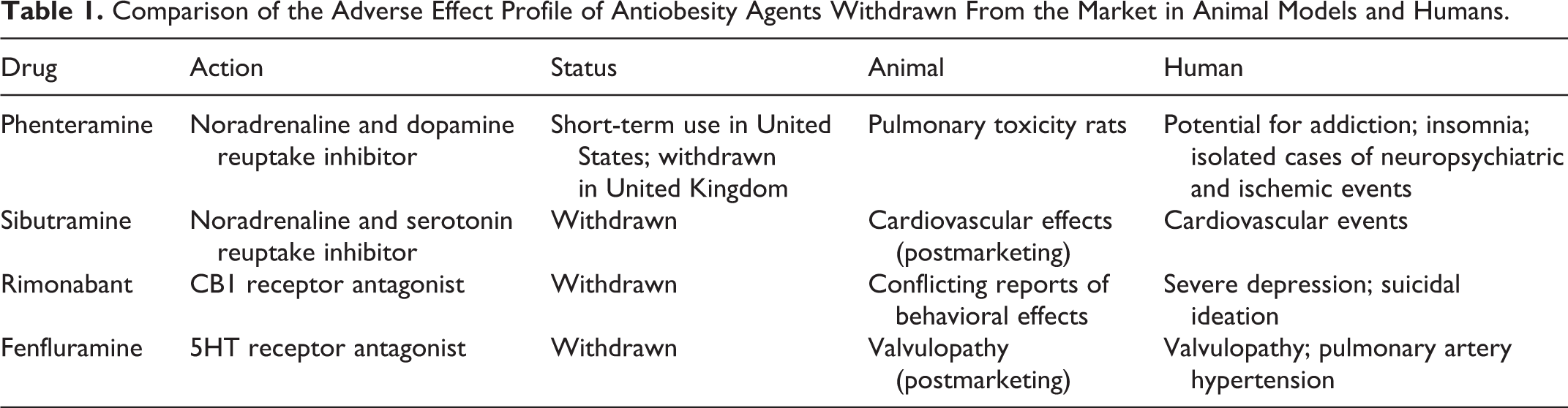
Safety concerns led to the withdrawal of previously licensed drugs from international markets. For example, aminorex was withdrawn in 1968 because of its association with pulmonary artery hypertension in male Sprague-Dawley rats, 138 and the valvulopathy associated with fenfluramine and dexfenfluramine resulted in their withdrawal in 1997. 114 Rimonabant, a CB1 receptor antagonist that significantly reduced body weight in clinical trials, 42 failed to reach US markets due to safety concerns and was withdrawn from the United Kingdom in 2009 due to adverse psychiatric events in humans (see Table 1). 101 Similarly, recent promising drugs such as Qsymia and Belviq have suffered setbacks in licensing because of cardiovascular risk. 2,4
Comparison of the Adverse Effect Profile of Antiobesity Agents Withdrawn From the Market in Animal Models and Humans.
Gut Hormones as Antiobesity Drugs
Specific gut hormones are released in response to food intake to regulate appetite in animals and humans. Unlike many central drug targets, which are rarely exclusive to the regulation of appetite and thus often have unacceptable adverse effect profiles, gut hormones are physiological signals designed to be released in the periphery to influence specific appetite-regulating circuits in the brain. They thus represent promising targets for antiobesity agents.
To date, ghrelin is the only identified orexigenic gut hormone, released from the stomach in the fasted state in animals and man. Peripheral ghrelin administration stimulates acute food intake in rats and humans, and chronic administration promotes weight gain in rats. 130,141,142 However, ghrelin antagonists have to date proven of limited efficacy in the clinical management of obesity.
The anorectic gut hormones, glucagon-like peptide 1 (GLP-1), peptide tyrosine tyrosine (PYY), and oxyntomodulin (OXM), are released from intestinal L-cells in response to nutrients in the gut. Obese individuals remain sensitive to their effects. 22,102,103,144 With successful preclinical outcomes in animal models, many agents based on gut hormone signaling are now undergoing clinical trials. Given that the success of novel antiobesity agents in preclinical testing is not always paralleled in the clinical phases, it will be interesting to see if gut hormones and their analogues are clinically effective at reducing body weight in humans.
Oxyntomodulin
OXM is a 37–amino acid peptide produced through posttranslational enzymatic cleavage of the pre-proglucagon gene product. Peripheral administration of OXM reduces food intake 36 and increases energy expenditure in both humans and rodents. 144 Although no specific receptor has been identified, OXM has a weak affinity for the glucagon receptor (GCGR) and also binds to the GLP-1 receptor (GLP-1R). KO mouse models have demonstrated that the anorectic effects of this hormone are mediated through GLP-1R. 17 Interestingly, despite having a lower affinity for GLP-1R than GLP-1, oxyntomodulin has more potent anorectic effects than GLP-1, thus making it an appealing antiobesity therapy. 39 In addition, OXM is thought to increase energy expenditure via the GCGR. 143 However, the short half-life due to breakdown by DPP-IV and neutral endopeptidases has limited the clinical use of OXM.
In April 2012, PROLOR Biotech (Nes Ziona, Israel) announced that MOD-6030, a GLP-1R and GCGR dual agonist, caused significant weight loss in preclinical studies. MOD-6030 is oxyntomodulin with a polyethelene glycol group attached to increase its half-life, as the short half-life of the naturally occurring hormone means it has to be injected several times a day. The study demonstrated significant weight loss, reduction in blood glucose, improved insulin sensitivity, and lower cholesterol over a 30-day period in DIO mice when compared with placebo. Phase I human trials are scheduled to commence in 2013. 7 In addition, TKS1225, a long-acting synthetic analogue of oxyntomodulin developed by Thiakis Ltd (London, UK) and now owned by Pfizer (New York, NY), has been demonstrated to reduce body weight and improve glucose tolerance in preclinical models and is currently in phase I development. 3
Glucagon-Like Peptide 1
GLP-1 is a 30–amino acid peptide, which is also a pre-proglucagon product. Its physiological roles include stimulating glucose-dependent insulin secretion, inhibiting glucagon secretion, delaying gastric emptying, and reducing food intake. 69 GLP-17-36 is the major bioactive form of GLP-1. Although GLP-1 treatment reduces acute food intake in animals and humans, 31,40,112 its short half-life has necessitated the use of long-acting analogues in the clinic. The antidiabetic drugs, exenatide and liraglutide, are based on the GLP-1 system. Postmarketing concerns for GLP-1 analogues include acute pancreatitis, 12 a adverse effect that was not demonstrated in animal models. 127 There is also an increased incidence of thyroid cell hyperplasia and tumors in rodents treated with liraglutide, 83 but as yet there are no data as to whether there are similar effects in humans. 33
Pancreatic Polypeptide
Pancreatic peptide (PP), a member of the PP-fold of peptides, is secreted from pancreatic islet PP cells following food intake. Peripheral administration reduces food intake in mice and humans, an effect thought to be mediated by the Y4 receptor. 22 As with other gut hormones, the short half-life of PP makes the endogenous hormone unsuitable as a drug candidate. PP 1420, an analogue of human pancreatic peptide (hPP), is well tolerated and has a longer half-life than PP in humans. 126
There are difficulties implicit in designing antiobesity drugs based on gut hormones. Their short half-lives need to be addressed by developing longer lasting modified hormones or analogues and/or agents that inhibit their breakdown. Designing small molecule agonists is possible but problematic for many gut hormone receptors, 32,84,102 necessitating the use of peptide-based therapies that are unsuitable for oral administration. In addition, some gut hormones appear to have relatively narrow therapeutic windows, with higher doses causing nausea. 87 It may be necessary to use combinations of low doses of gut hormones to reduce the risk of nausea but to drive the necessary weight loss. For example, combination therapy with GLP-17-36 and PYY3-36 has additive anorectic effects in obese mice and humans. 50,104 It is interesting that a number of the therapies recently approved or currently under review (such as Contrave and Onexa), although not gut hormone based, also use a combination therapy approach. It seems likely that in the future such combination therapies will be commonplace, but the current practical and legal framework of drug discovery makes developing such combinations difficult, particularly with novel agents.
Conclusion
Poor safety and efficacy track records have limited the development of novel antiobesity drugs. Existing drugs are ineffective and newer centrally acting agents are fraught with cardiovascular and psychiatric complications, which are often difficult to predict using animal models. However, animal models have an important role to play in understanding the pathophysiology and genetic basis for obesity, as well as the preclinical development of novel pharmacotherapies. As our understanding of the complex pathways regulating energy homeostasis has grown, potential peripheral and central targets for novel treatment agents have been identified. The gut-brain axis, hypothalamic orexigenic and anorexic signals, and effectors of leptin and insulin signaling pathways offer numerous potential drug targets. A combination of therapies targeting several of these different pathways may prove an effective approach to the future treatment of obesity.
Footnotes
Declaration of Conflicting Interests
The author(s) declared no potential conflicts of interest with respect to the research, authorship, and/or publication of this article.
Funding
The author(s) received no financial support for the research, authorship, and/or publication of this article.