




Abstract
The development and regulatory approval of medical countermeasures (MCMs) for the treatment and prevention of bacterial threat agent infections will require the evaluation of products in animal models. To obtain regulatory approval, these models must accurately recapitulate aspects of human disease, including, but not necessarily limited to, route of exposure, time to disease onset, pathology, immune response, and mortality. This article focuses on the state of animal model development for 3 agents for which models are largely immature: Francisella tularensis, Burkholderia mallei, and Burkholderia pseudomallei. An overview of available models and a description of scientific and regulatory gaps are provided.
The development of medical countermeasures (MCMs: diagnostics, vaccines, and therapeutics) for the detection, prevention, or treatment of bacterial threat agent exposure or infection is an area of great interest to the US Department of Health and Human Services (HHS). Due to the highly pathogenic nature of the organisms that cause these infections and their low clinical prevalence, it is generally unethical and impractical to evaluate the efficacy of these potential medical products in humans. As a consequence, the US Food and Drug Administration (FDA) developed a draft regulation commonly known as the “Animal Rule” (21 CFR 314.610 and 21 CFR 601.91) that allows animal efficacy data to support product licensure or approval when direct evaluation of the product’s efficacy in a clinical setting is not feasible. 75,106 Although this guidance is meant to facilitate MCM research and regulatory approval, the development of animal models presents several unique challenges. Many of these issues were highlighted and discussed during the recent 2012 Animal Model Development Workshop held at the National Institutes of Health (NIH). Paramount among these is the availability of data describing disease pathophysiology in animals and how these symptoms relate to the human clinical disease manifestation. Also discussed during the workshop was the identification and characterization of correlates of disease progression, triggers for MCM intervention during animal efficacy studies, and the relevance of mortality in an animal model where clinical disease is not always lethal in humans. Although published (and unpublished) data exist for many animal models, it was generally agreed that additional research efforts are needed to bring them to the stage of qualification that will support the development of antibiotics, antivirals, or other MCMs.
In an effort to address these gaps and challenges, the Biomedical Advanced Research and Development Authority (BARDA), a component of the Office of the Assistant Secretary for Preparedness and Response within the HHS, has established a Nonclinical Development Program. The goal of this program is to accelerate the approval of antibiotics, antivirals, and other MCMs through the generation of reagents and well-characterized animal models that recapitulate human disease. The tools and information developed under this program will be made available to all potential MCM product developers. Currently, BARDA is initiating projects aimed at developing reagents and animal models of tularemia, glanders, and melioidosis.
To date, the labels of 2 licensed antibacterial drugs have been expanded to include indications for the prevention or treatment of biothreat agents under the FDA Animal Rule.* Ciprofloxacin and levofloxacin were granted approval for postexposure prophylaxis (PEP) of inhalational anthrax under 21 CFR 314 Subpart H, which allows for accelerated approval through the use of a clinical efficacy surrogate (ie, serum plasma levels). Products that are not currently licensed or approved must comply with 21 CFR 314 Subpart I to gain approval for a biothreat disease indication (eg, anthrax, tularemia, plague), which relies on animal models that adequately recapitulate human clinical disease.
Levofloxacin was also approved under 21 CFR 314 Subpart I for the treatment of pneumonic plague. In April 2012, the FDA convened a meeting of the Anti-Infective Drugs Advisory Committee to evaluate the suitability of the African green monkey (AGM) model of pneumonic plague. 41 The committee reviewed all facets of the model (ie, time course of disease; temperature elevation; heart rate elevation; respiratory rate elevation; presence of Yersinia pestis in sputum, blood, or lungs; presence of pulmonary infiltrates in chest radiographs; lung pathology; etc) and generally concluded that the model recapitulated key aspects of human clinical illness. The committee also evaluated levofloxacin efficacy data collected using the AGM model and unanimously recommended that levofloxacin be approved for the treatment of pneumonic plague. The approval recommendation was based on data demonstrating a survival benefit as well as a consideration of the risk-to-benefit ratio of treating pneumonic plague with levofloxacin. In May 2012, the FDA responded to the committee’s recommendation by approving label expansion of levofloxacin to include the treatment of pneumonic plague. The committee also evaluated ciprofloxacin efficacy data in the AGM model during the same advisory committee meeting and similarly recommended that the body of data supported its use for the treatment of pneumonic plague. However, in the absence of a drug sponsor for ciprofloxacin, no approval has been granted by the FDA, to date. In December 2012, the FDA approved raxibacumab to treat inhalational anthrax or prevent inhalational anthrax when alternative therapies are not available or not appropriate. 42 Raxibacumab, a monoclonal antibody that neutralizes toxins produced by Bacillus anthracis, is the first monoclonal antibody approved under the Animal Rule. Its effectiveness for inhalational anthrax was demonstrated in 1 nonhuman primate (NHP) study and 3 studies using rabbits that were supported by BARDA.
The National Institute of Allergy and Infectious Diseases (NIAID) sponsored the AGM, levofloxacin, and ciprofloxacin work just described. The approach that NIAID took to develop the AGM model for plague will likely serve as the paradigm for future biothreat model development activities and will help guide the activities of BARDA’s Nonclinical Development Program. The characterization of the AGM pneumonic plague model and its comparison to human pneumonic plague allowed for the identification of clear, reproducible pathological parameters that could be used in the evaluation of both existing and future MCM products. Whether the FDA will require a safety and efficacy database as robust as that for levofloxacin (or ciprofloxacin) for future products seeking approval under the Animal Rule to justify the risk-to-benefit analysis is uncertain. If this becomes a standard requirement, many products that are concurrently in development for commercial and biothreat indications would not meet this threshold until many years after approval for their commercial indication(s) since it would take many years in the commercial marketplace to generate safety data in sufficient numbers of patients to fulfill this requirement.
This report focuses on the status of animal models of infection caused by Francisella tularensis, Burkholderia mallei, and Burkholderia pseudomallei. BARDA has chosen to focus some of its earliest animal model development efforts on these 3 pathogens because significant data gaps for each must be addressed before an animal model is able to withstand regulatory scrutiny against the criteria set forth in the Draft Animal Rule Guidance. This report will highlight data gaps that we have identified and discuss the challenges or limitations of specific animal models.
BARDA’s Nonclinical Development Program
To facilitate its MCM development mission, BARDA established the Nonclinical Development Program in May 2011 for the development of animal models for chemical, biological, radiological, and nuclear (CBRN) agents. An objective of this program is to develop well-characterized tools, reagents, and systems that reliably recapitulate human pathophysiology in relevant animal models of disease. This review will focus on BARDA’s current effort to develop animal models of infection caused by F. tularensis, B. mallei, or B. pseudomallei. For melioidosis and glanders, BARDA began by assembling a panel of subject matter experts to develop a clinical definition of inhaled human disease. Such a definition provides valuable clinical criteria to inform the selection of end points (or other parameters) in candidate animal models. BARDA is also supporting the development of reference strain panels for B. mallei and B. pseudomallei that can serve as a resource for the biodefense community. The reference strain panels will be provided to requesting laboratories along with a technology transition package that outlines strain passage history and provides instructions for proper passage conditions. BARDA also intends to develop small animal and NHP models of glanders, melioidosis, and tularemia. Natural history studies that include examination of disease course, bacterial dissemination, pathology, reproducible end points, and triggers for treatment are planned. BARDA’s work will take into account animal model data that currently exist for tularemia, glanders, and melioidosis. We will briefly summarize that data in the following sections, focusing specifically on the pros and cons of particular models and data gaps that currently exist.
Existing Data for F. tularensis
Human clinical presentation of tularemia has been relatively well described because of endemic illness as well as both accidental and intentional exposure of humans to F. tularensis. 37,68,95 Hundreds of human subjects (volunteers, prisoners, contentious objectors, or military personnel) have been exposed to F. tularensis in studies investigating natural disease course or the efficacy of vaccines or antibiotics (reviewed by Lyons and Wu 56 ). In the United States, many of these studies occurred during the 1950s and 1960s. Several different forms of tularemia have been described depending on the route of exposure. These include ulceroglandular, oculoglandular, pneumonic, oropharyngeal, gastrointestinal, and typhoidal. 26,29,37 Pneumonic tularemia, the result of inhalational exposure to F. tularensis, will be the focus of our discussion because aerosolization is considered the most likely route of exposure during a bioterrorism event. Pneumonic tularemia is considered the most acute form of the disease and can result in a mortality rate as high as 30% to 60% if left untreated. 26,29,91 Inhalation of 10 to 50 colony-forming units (CFU) of F. tularensis Schu S4 can reproducibly cause human disease; 1 human study demonstrated that inhalation of 15 F. tularensis Schu S4 bacteria was sufficient to cause infection. 56,84 In that study, subjects first displayed symptoms 4 to 5 days postinfection; no blood cultures were positive for F. tularensis during that time. 84 Common signs and symptoms of pneumonic tularemia include fever, chills, headache, myalgia, anorexia, dry cough, dyspnea, chest pain, patchy infiltrates, lobar pneumonia, or bloody pleural effusion. 26,29,59,91,113 Patients also typically complain of sore throat and prostration. Ulcers typically observed with other forms of tularemia may not be present in those with the pneumonic form. Once pulmonary infection is noted (which typically occurs 2–4 days after the onset of fever and headache), differential diagnoses will include various forms of pneumonia. 59
The importance of strain selection when designing an experiment that will support approval via the Animal Rule cannot be understated. The Animal Rule states that the etiological agent should be identical to the one that causes human disease. Moreover, the FDA prefers a strain that has been isolated from a fatal human case of disease. F. tularensis Schu S4 and F. tularensis LVS are the 2 most common F. tularensis strains tested in animal models. F. tularensis LVS is often used in studies to evaluate vaccine efficacy, the intracellular pathogenesis of F. tularensis, or in studies that aim to further characterize the human immune response to infection. F. tularensis LVS is also used as a surrogate by researchers since it is avirulent in humans but lethal in mice and can therefore be studied at BSL-2 containment. Because this report focuses on animal models that could be used to support the development and approval of candidate antibiotics under the Animal Rule, and because Schu S4 produces significant disease in humans (while LVS does not), this article will focus specifically on data generated from animal exposure to F. tularensis Schu S4. The F. tularensis Schu S4 culture that is maintained and distributed by culture repositories was originally isolated in Ohio in 1941 from a human ulcer. 38 This strain is widely used, yet there has been no attempt to standardize the number of passages, storage conditions, or propagation conditions used within each lab that maintains and employs this stock, nor have the conditions for aerosol preparation been standardized.
Table 1 summarizes published data collected from animals exposed to Schu S4 and compares the signs and symptoms with those reported for humans with disease caused by Schu S4. Not only do gaps exist regarding standardized strain preparation, but by reviewing Table 1, it also becomes immediately apparent that most studies either did not include collection or reporting of data that will be required to support licensure or approval via the Animal Rule, including telemetric data (temperature, heart rate, etc), a likely requirement for pivotal studies supporting animal model qualification under the Animal Rule.
Summary of Published Animal Model Data Following Aerosol or Intranasal Francisella tularensis Schu S4 Exposure.
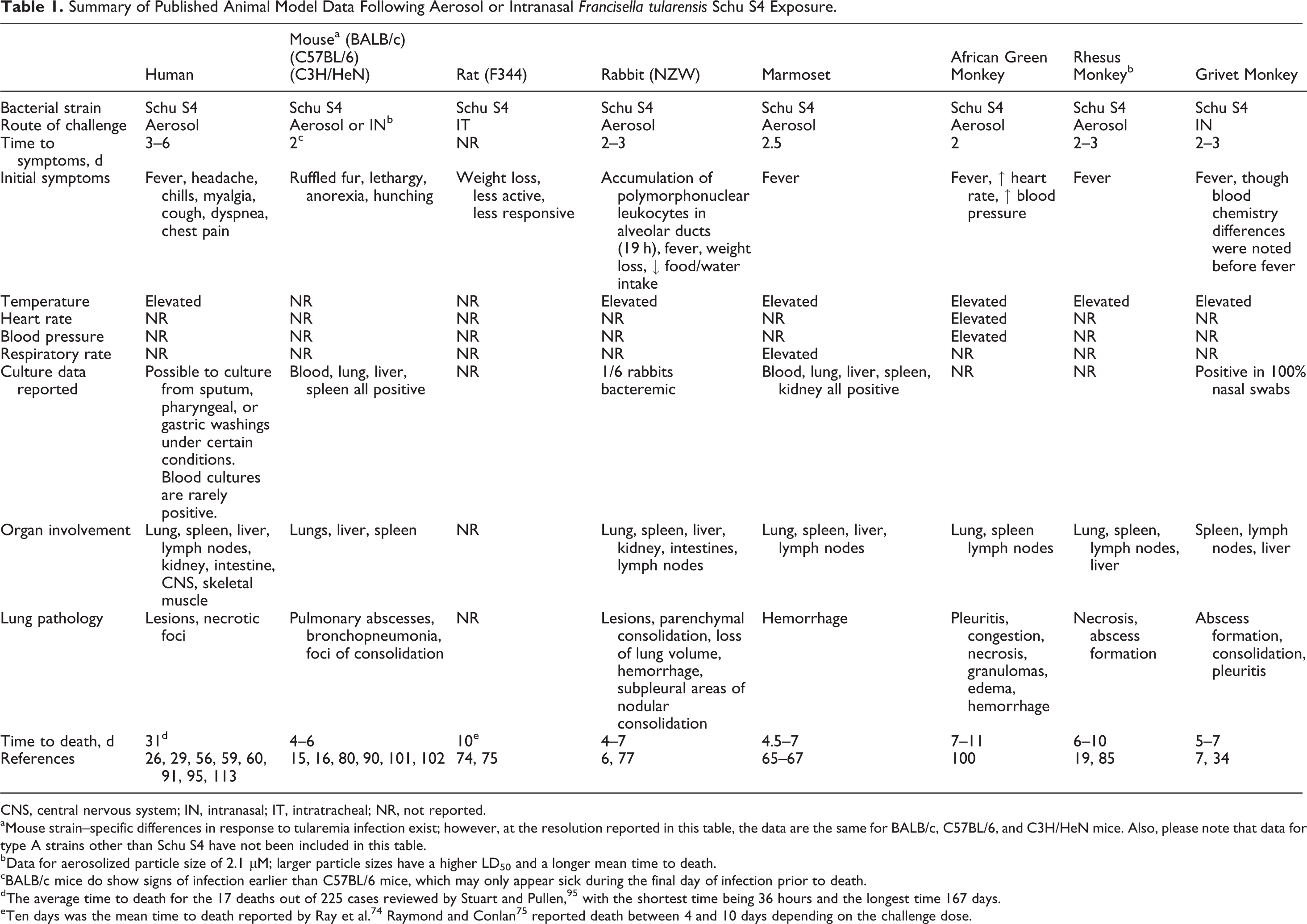
CNS, central nervous system; IN, intranasal; IT, intratracheal; NR, not reported.
aMouse strain–specific differences in response to tularemia infection exist; however, at the resolution reported in this table, the data are the same for BALB/c, C57BL/6, and C3H/HeN mice. Also, please note that data for type A strains other than Schu S4 have not been included in this table.
bData for aerosolized particle size of 2.1 μM; larger particle sizes have a higher LD50 and a longer mean time to death.
cBALB/c mice do show signs of infection earlier than C57BL/6 mice, which may only appear sick during the final day of infection prior to death.
dThe average time to death for the 17 deaths out of 225 cases reviewed by Stuart and Pullen, 95 with the shortest time being 36 hours and the longest time 167 days.
Small animals are natural reservoirs of tularemia and are susceptible to infection by several F. tularensis strains, including Schu S4; however, several challenges and inherent limitations have confounded small animal model development. Mice have been used extensively in tularemia studies; unlike humans, mice are highly susceptible to infection with LVS or novicida strains of F. tularensis, suggesting that the mechanisms of pathogenesis may differ between mice and humans. 56 Rabbits and Fisher 344 (F344) rats may be more suitable models than mice for mirroring the human response to infection because rats, like humans, are more susceptible than mice to infection by Schu S4 but not by LVS or subspecies novicida. 74,77 Interestingly, the rat response to F. tularensis challenge is rat strain specific, with some strains more closely mimicking the human response than others. Early studies with “white rats” suggested that rats were less susceptible to infection than mice and that susceptibility varied greatly depending on route of exposure; the rats were more susceptible to infection by the intraperitoneal (IP) route than by subcutaneous (SC) or intradermal (ID) routes. 24 Moreover, Raymond and Conlan 75 showed that F344 rats were much more susceptible to infection with either type A or type B F. tularensis than Sprague-Dawley rats when challenged IP. Ray et al 74 then further suggested that F344 rats may be the most suitable rat strain to use for animal model studies of tularemia because they are susceptible to Schu S4 infection but are resistant to LVS and novicida as mentioned above. Although this may be true, the F. tularensis Schu S4 LD50 in F344 rats is 5 × 10² CFU, whereas in humans, it is approximately 10 to 15 CFU, demonstrating that humans are much more sensitive to Schu S4 than F344 rats. Therefore, although some may argue that F344 rats are the best small animal model of tularemia, this certainly does not mean they are the best overall animal model of human tularemia.
Another limitation of small animal models is that there are significant differences between the immune response of humans and small animals following infection. F344 rat macrophages do take up F. tularensis, yet the rate of uptake and subsequent response by these macrophages is different from what is observed with human macrophages. 74 In addition, a massive expansion of the V9γV2δ T-cell population has been reported in human clinical tularemia, yet this T-cell population is absent from common small animal models, including mice. 68 Only primates possess V9γV2δ T cells. 68 Primates also develop skin ulcers and lymphadenopathy characteristic of human disease, whereas small animal models do not. 66 For these and other reasons, small animals are more suitable for proof-of-concept studies or to generate supportive data. Pivotal studies for approval of MCMs against tularemia under the Animal Rule will likely involve the use of NHPs.
Unfortunately, published data on the natural history of disease caused by Schu S4 in NHPs are lacking. A description of the lesions during inhalation tularemia in AGMs was published in 2009, but the telemetry and clinical chemistry data generated during this study have not been published and are needed before the suitability of the AGM model can be fully evaluated. 99 Cynomolgus monkeys (cynos) are susceptible to tularemia, as evidenced by a 2007 outbreak at a German primate center as well as data from the 1960s, when cynos were used to evaluate the efficacy of F. tularensis LVS vaccination. Several studies have involved exposure of cynos to Schu S4, yet public disclosure of data from these studies has been limited to conference proceedings.
In the late 1960s and early 1970s, rhesus monkey studies were published that evaluated the effects of aerosol age and particle size on infectivity. One study involved simultaneously exposing men and rhesus monkeys to aerosols that had been aged by 60, 120, or 180 minutes. 85 The infectivity of Schu S4 decreased after 120 minutes of aerosol aging and was reduced 10-fold after 180 minutes, yet the disease course was similar regardless of the age of the aerosol. The effects of aerosol aging were the same across man and rhesus monkey; however, once data were normalized for respective respiratory volumes, data indicated that rhesus monkeys were 3 times more susceptible than man to Schu S4 infection. 85 A second study in which rhesus monkeys were exposed to particles ranging from 2.1 to 24 μM in size demonstrated that as particle size decreased, LD50, ID50, time to disease onset, and time to death also decreased. 19 The signs and symptoms of disease, clinical chemistry, and pathology were all documented during this study. These studies represent the best published characterizations of the rhesus monkey model of tularemia, to date, and also highlight the importance of controlling particle size and aerosol age when considering appropriate challenge doses for future studies. When comparing the data collected to what would likely be required for qualification of the rhesus monkey model, numerous gaps still exist (Table 1).
The response of grivet monkeys to F. tularensis challenge has also been assessed. Grivet monkeys challenged intranasally (IN) all demonstrated signs of infection by 72 hours postinoculation, including fever, anorexia, dyspnea, and mucopurulent nasal discharge; all monkeys died between days 5 and 7. 7 Necropsies revealed lesions in the spleen, liver, lungs, and lymph nodes. Hambleton et al 34 also carefully documented the earliest possible serum chemistry markers of infection in grivet monkeys and identified numerous serum chemistry changes prior to the onset of fever on days 2 to 3. Because the challenge produced acute tularemia, which was consistently fatal, the authors suggested that disease in grivet monkeys was more severe than in humans. Therefore, the grivet may not be the NHP that most closely mimics human disease.
The marmoset, a New World NHP species, is increasingly gaining attention as an alternative NHP model. Marmosets are susceptible to inhalational tularemia. Data suggest that they develop symptoms of infection 2 to 3 days postexposure and typically die between 4 and 7 days postexposure. 67 Thus, the disease course in marmosets appears to be more compressed than that observed in humans. A precise marmoset LD50 has not been determined, but challenge doses of 102 CFU and above have reproducibly resulted in 100% lethality. During 1 study, 2 animals received doses of 4 and 9 CFU, respectively. 67 Both animals died, suggesting that the infectious dose is within the range reported for humans, yet this cannot be stated conclusively. One study establishing a lethal inhalational tularemia in marmosets reported elevated body temperature after 2.5 days as the first indicator of disease. 67 Overt clinical signs (altered activity level, respiration rate, etc) were not observed until 12 to 18 hours after the temperature increase. All animals died between 4 and 7 days postexposure. During this study, blood and tissue bacterial loads were only assessed postmortem. A second follow-up study detailed disease progression in the marmoset model through 96 hours postexposure. 66 The authors indicated that fever was the first overt indication of infection observed around 72 hours postexposure. Elevated body temperature coincided with increased organ bacterial load, increased immunological response, and more pronounced gross pathology. Histological assessments revealed lesions consistent with what is reported for humans.
In summary, although NHPs will likely serve as the pivotal animal models for approval of new therapeutics under the Animal Rule, additional studies are needed to fully elucidate which NHP model most accurately recapitulates human tularemia. Based on the data summarized above, the AGM and cyno certainly deserve further consideration, and BARDA’s Nonclinical Development Program recently initiated work in this area.
Finally, it is important to discuss signs or symptoms that could be used as triggers for tularemia treatment during animal model development studies. Fever was used as the trigger to begin treatment in the AGM studies presented to the FDA in support of the use of levofloxacin or ciprofloxacin to treat plague. 41 The rationale for this decision was that, for plague, fever correlates with the onset of bacteremia, and bacteremia correlates with mortality. For tularemia, the trigger for treatment is unlikely to be bacteremia given the intracellular nature of the organism. Typically, human cultures are only positive for F. tularensis when the individual presents with severe disease. 4 Humans usually begin to exhibit signs and symptoms of infection 3 to 6 days after exposure with the initial overt indicators being fever and/or ulcer formation. This is followed by positive C-reactive protein tests reported on days 10 to 11, elevated erythrocyte sedimentation rates on day 12, and increased bacterial agglutination titers on days 14 to 15. C-reactive protein has been reported as a sensitive indicator of inflammation due to microbial activity since it disappears as the illness remits and reappears with febrile relapse. 56,60 In studies investigating metabolic changes after human aerosol exposure to 25 000 CFU, it was reported that disease was associated with decreased unbound thyroxine, increased insulin and 17-hydroxycorticosteriod levels, and decreased serum amino acid levels.8,9,10,28,89 In rabbits, elevated body temperature is reported approximately 30 hours after inoculation; however, by this time, bacteria have disseminated from the site of inoculation and are typically systemic. 88 Abnormal clinical chemistry values were not observed until 72 hours after inoculation. In marmoset studies, changes beyond elevated temperature were observed within the first 48 hours, including elevated alanine aminotransferase (ALT); elevated bilirubin; increased neutrophils, natural killer (NK) cells, and macrophages in the lung; and increased T and B cells in the spleen. Overall, additional physiological parameters such as bacterial organ dissemination, pathology, and immunological findings will also need to be rigorously evaluated for potential use as secondary end points in candidate animal models. It is important to note that identification of suitable markers is only the first step. It is also critical for researchers to develop reproducible, validated assays to detect these disease markers in tandem with animal model development.
Existing Data for B. mallei
Glanders is a disease resulting from exposure to B. mallei, a Gram-negative, nonmotile bacillus and obligate animal pathogen. 3,11,20,27,32,115 Six forms of human glanders exist: nasal, localized, pulmonary, septicemic, disseminated, and chronic. The course of the infection depends on the route of exposure. Direct skin contact leads to a cutaneous, local infection that manifests as ulcerating nodules at the site of infection, leading to lymphangitis and lymphadenopathy. This is followed by bacterial dissemination to target tissues and organs such as the skin, skeletal muscle, bone, and joints. Inhalational exposure often leads to septicemic, pulmonary, or chronic infections of the muscle, liver, and spleen. Bacterial lung colonization is a cardinal feature of inhalation glanders. Regardless of the route of exposure, initial symptoms following infection often include fever, rigors, and malaise with progression to pneumonia, bacteremia, pustules, and abscesses. 20 Other symptoms may include severe headache, myalgia, fatigue, diarrhea, weight loss, chills, dizziness, vomiting, tachypnea, diaphoresis, and altered mental state. In the absence of early diagnosis and aggressive therapeutic intervention, septicemia can develop and produce an acute disease that may lead to death in 7 to 10 days with a 95% case fatality rate. 2,13,20,115
Strain selection is a critical component of developing an animal model of glanders. B. mallei was first isolated by Schütz and Löffler in 1882 from the liver and spleen of an infected horse. 86 Since then, 10 different B. mallei strains have been isolated and made publicly available for experimental use. One strain, ATCC22334 or China 7, which was isolated in China in 1944 from postmortem human cultures of blood and secretions, is commonly used to study experimental glanders, screen for virulence genes, and identify vaccine candidates. 115,116 However, comparative data are lacking regarding the impact of genomic/proteomic variation between strains, route of administration, host genetic background, and immune competence on infection, virulence, pathogenesis, and mortality. Furthermore, variations in the methods for preparing and storing master and working cell stocks can have a marked impact on B. mallei virulence and pathogenicity. The BARDA Nonclinical Development Program is establishing a panel of B. mallei isolates that can serve as the basis for selecting an index strain to be used in the development and validation of a qualified animal model system for MCM product evaluation. Once candidate strains are identified, master and working cell banks will be produced and validated for purity and identity. Certificates of analysis (CoAs) will be produced for each strain. The intent is that all interested investigators will have access to the reference strain panel at minimal cost.
Several animals have been investigated as possible models of human glanders. Glanders has, perhaps, been most thoroughly studied in equines, its natural host. Equine disease does share with humans many features of glanders; however, working with equines is cost and space prohibitive. The US Army Medical Research Institute of Infectious Diseases (USAMRIID) conducted a comprehensive study in the late 1940s evaluating the susceptibility of several common laboratory animals to B. mallei infection, including mice, rats, hamsters, guinea pigs, ferrets, and NHPs. 61 This study and others have shown that, in general, goats, dogs, ferrets, cats, and hamsters are highly susceptible to infection; monkeys, sheep, camels, and mice are moderately susceptible; guinea pigs are variably susceptible; and cattle, hogs, birds, rats, and rabbits are resistant to B. mallei infection. 11,20,110 Although the infectious dose of B. mallei in humans has not been established, the low historical incidence of human glanders suggests that humans are moderately resistant to B. mallei infection.
Table 2 summarizes published data comparing the clinical signs, symptoms, and pathophysiologies of glanders following infection in humans and a number of animal models of glanders. The Syrian golden hamster is one of the most common and well-characterized animals used to experimentally model acute disease and assess B. mallei strain virulence. 11,12,23,31,81,105 The course of glanders progression and the pathological characteristics of disease in hamsters are comparable to what is observed in humans. However, hamsters, unlike that predicted for humans, are extremely sensitive to B. mallei infection, with an approximate LD50 of 10 CFU via aerosol or IP routes of infection. Although hamsters are often chosen to model the acute phase of glanders, the laboratory BALB/c mouse is commonly used to model chronic B. mallei infection and disease progression. 11,30,51 Mice, like humans, are moderately susceptible to B. mallei infection with an LD50 of 102 to 104 CFU depending on the route of infection, and both mice and humans are more susceptible to B. mallei infection via the aerosol route compared with the IP route.
Summary of Published Animal Model Data Following Burkholderia mallei Infection.
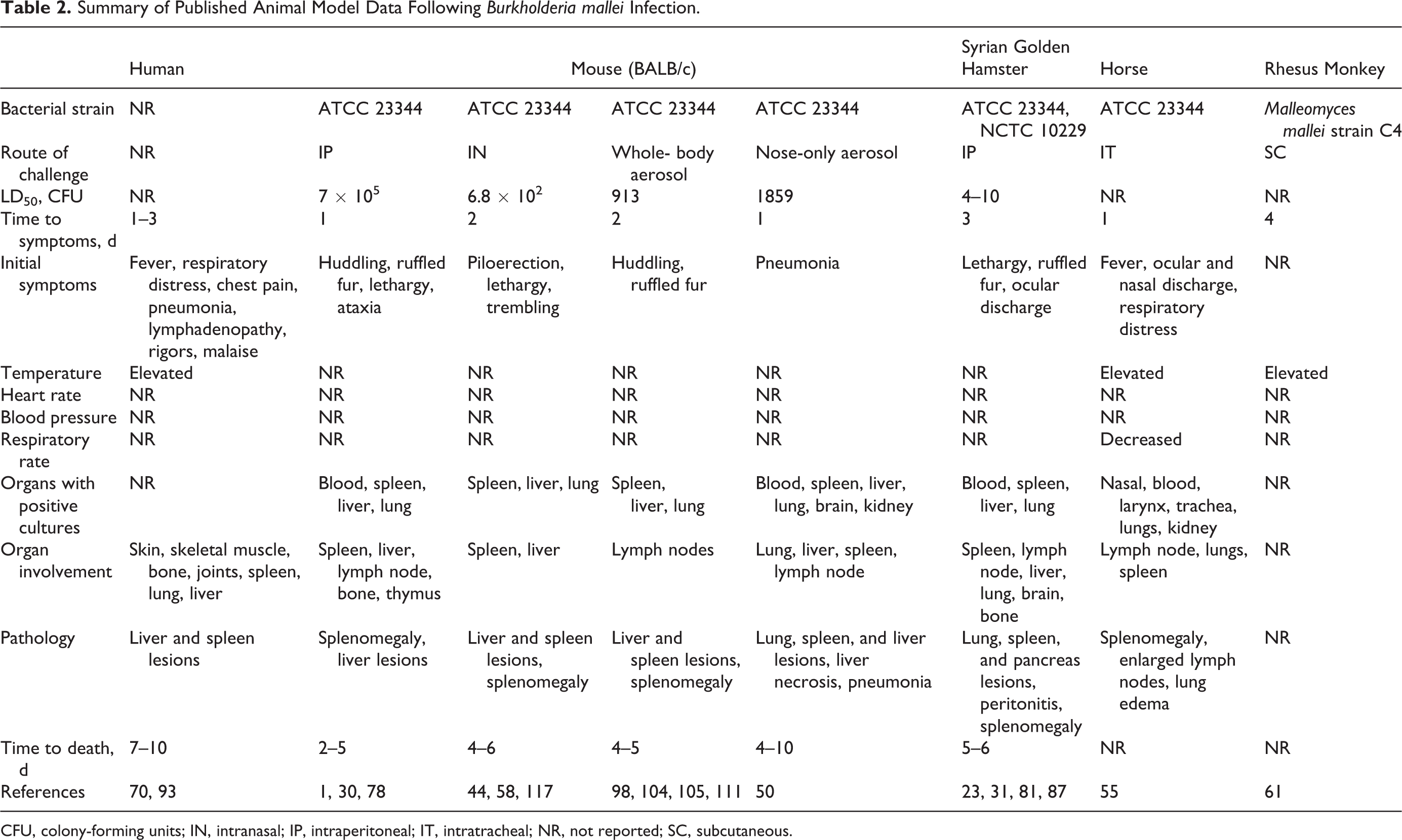
CFU, colony-forming units; IN, intranasal; IP, intraperitoneal; IT, intratracheal; NR, not reported; SC, subcutaneous.
Table 2 highlights histopathological comparisons of disease across humans, mice, and hamsters and reveals several interesting features. In both mice and hamsters, reticuloendothelial (RE)–rich tissue (liver, spleen, lymph nodes, and bone marrow) is especially susceptible to bacterial colonization and lesion development. 11,30,79 In mice, organs without significant RE tissue are not normally affected during the course of infection, unlike the hamster, in which such organs are infected but only in later disease stages. In addition, far fewer bacteria are detected in infected tissue in mice than in hamsters, and phagocytic cells in infected mice are not necrotic but are in infected hamsters. Finally, lung lesions, which are also commonly observed in humans and hamsters, are rarely seen in mice.
Although very few studies of NHP exposure to B. mallei have been published, USAMRIID did explore the rhesus monkey model of glanders in the 1940s. 61 Rhesus monkeys challenged with 1.5 million CFU developed subcutaneous draining abscesses at the site of inoculation 4 days after injection that healed completely within 3 weeks. Other clinical signs beginning at the time of abscess formation included daily core body temperature increases of 1°C to 3°C, increased erythrocyte sedimentation rates, and marked increases in the white blood cell count that returned to baseline levels following healing of the abscesses. On average, infected animals lost approximately 15% of their starting body weight during the course of infection. Immunologically, specific agglutination and complement fixation tests were positive 8 to 14 days postinoculation, with agglutinin titers reaching 1:2560, whereas complement fixing titers reached 1:640. Intradermal skin tests for mallein, a sensitive and specific antigen test for glanders, were negative throughout the course of the study. By approximately 2 months, infected monkeys regained health and normal vigor. Animals challenged with lower doses showed no evidence of infection at any time, and pathological and cultural examinations at autopsy were negative. However, the amount of inocula used at this lower challenge dose was not reported. The authors concluded that the rhesus monkey, like humans, is moderately susceptible to subcutaneous infection with B. mallei. Given that the course of disease in NHPs and humans is similar and that NHPs are likely to be required for pivotal animal studies during MCM product development, development of such models warrants further investigation.
To qualify animal models for use in the development and licensure of MCMs, definitive and physiologically relevant triggers for initiating treatment of glanders with candidate antimicrobials must be identified. It will be critical that these treatment triggers correlate with clear and well-defined primary end points (eg, mortality) and provide a sufficient therapeutic window for evaluating the efficacy of candidate MCMs. The earliest signs and symptoms reported in humans following a B. mallei infection include headache, fever, chills, rigors, night sweats, fatigue, and cough. In animal models, initial symptoms often include lethargy, ataxia, fur ruffling, huddling, and bacteremia with death occurring within 3 to 6 days of a lethal challenge.30,31 Given the intracellular nature of B. mallei, blood bacteremia is unlikely to be an appropriate treatment trigger for glanders. Alternative triggers should be explored and developed, including fever, antigen detection, diagnostic polymerase chain reaction (PCR) of bacterial DNA, and host-based responses. Although telemetry data (eg, temperature, heart rate, respiratory rate) following B. mallei infection have not been collected and/or reported in published glanders studies, a recent study demonstrated that interferon-γ (IFN-γ), interleukin-6 (IL-6), and monocyte chemoattractant protein 1 (MCP-1) levels were elevated in sera by 5 hours after infection in mice. 78 Although these immunological markers provide an early indication of infection, they are not definitive of a glanders diagnosis. It is critical that diagnostic assays for detecting bacterial antigen or nucleic acid or other secondary physiological end points (eg, bacterial dissemination, pathology, immunological responses) that will be used as treatment triggers be qualified and validated along with the animal model.
Existing Data for B. pseudomallei
Although phylogenetically related to B. mallei, B. pseudomallei, the etiological agent of melioidosis, is an environmental saprophyte with a distinct epidemiology. In highly endemic regions such as Southeast Asia, roughly 80% of the population is seropositive by the age of 4 years. 48 Despite this high rate of exposure, only a small portion of these seropositive individuals (0.0045% annually) develops melioidosis. It is surprising that such a large population tests positive for B. pseudomallei yet does not become inoculated with enough bacteria to contract melioidosis. This finding has prompted many to believe that the route and level of exposure (dose and frequency) can influence the infectivity and severity of the symptoms independently of the infecting strain. Indeed, increased rates of melioidosis, characterized by severe pneumonia and higher mortality, follow the monsoon and typhoon seasons in Southeast Asia and Australia. 18,46 This seasonal increase has been linked to prolonged inhalation of storm-generated aerosols of contaminated particles. 118
Clinical manifestations of melioidosis range from acute sepsis to chronic disease or a latent infection that can reactivate years after initial exposure. Unfortunately, rapid diagnosis is hindered by the absence of pathognomonic signs of infection. Furthermore, traditional diagnostic approaches are hampered by difficulties in isolating B. pseudomallei from a specimen for culture identification as well as the limited sensitivity and poor specificity of serological assays. 69 Acute melioidosis has a nonspecific prodrome phase characterized by fever, malaise, and abscess formation either locally or in the lung, liver, and spleen. If left untreated or poorly managed, the infection advances to a progressive phase characterized by pneumonia, sepsis, and, in severe cases, neurological infections. 11,17 Chronic melioidosis has a similar pattern of presentation in patients; however, the symptoms are more mild and can last up to a year. 114
A variety of treatment options have been evaluated; however, aggressive antibiotic therapy composed of ceftazidime followed by trimethoprim-sulfamethoxazole (TMP-SMX) with or without doxycycline has proven the most effective against melioidosis. 114 Recent HHS consensus recommendations are ceftazidime or meropenem for initial intensive therapy and TMP-SMX or amoxicillin-clavulanic acid for eradication and PEP. 53 Despite this, melioidosis has a high mortality rate and is the third most common cause of death from an infectious disease in endemic areas. 52 Probable reasons for this include late diagnosis due to nonspecific symptomatology and a high relapse rate when antibiotics are discontinued early. It is not surprising that there is a renewed interest in the development of MCMs and vaccines as treatment or prevention against melioidosis. One would need to overcome significant ethical, time, and cost challenges to evaluate a melioidosis MCM in a human clinical trial. Thus, the FDA’s Animal Rule presents an alternative option for melioidosis MCM development and regulatory approval.
Critical to the validity of an animal model study is the ability of the challenge agent to cause disease. In addition, as stated above, the FDA prefers the use of strains isolated from lethal human cases of melioidosis. 47,51,54 However, only a few published studies have included information on the location, circumstances, and clinical (fatal/nonfatal) or environmental disposition of the strain(s) used in vivo (Table 3). There is a general failure to report the genetic purity of the challenge material, the number of passages, and the culturing conditions of the B. pseudomallei strain during strain generation. In the absence of such information, it is impossible to track a strain’s clonal lineage or be assured the strain has been standardized for identity, purity, and quantity. This is a critical issue given that B. pseudomallei has a highly mutable genome. 25,99,114 As a testament to this plasticity, several reports have documented clonal variations within a clinical strain during the acute phase of infection and over the course of a chronic infection. 36,71,72,82 In some cases, these subtle mutations have resulted in “accidental virulence” and development of antibiotic resistance. 14,63,83 Conversely, repeated laboratory passage may adversely affect a strain’s fitness by introducing mutations that degrade virulence and pathogenicity. This new clone may not fully recapitulate the expected melioidosis symptoms, possibly exaggerating or diminishing the observed efficacy of a candidate therapeutic. These seemingly subtle variations may be responsible for the numerous clinical manifestations of B. pseudomallei infection and virulence levels, both in the clinic and in the variety of animal models proposed. 112 To address these issues, BARDA has developed a panel of 11 fully characterized B. pseudomallei strains that will be further evaluated in the in vivo models of disease. Included in this reference strain panel are 2 frequently used strains, K96243 and 1026b (Table 3), and several clinical isolates from Australia and Thailand. 109 Each strain was included in the panel based on a comprehensive literature search and scoring matrix with 5 categories: preexisting animal model data, virulence, source (clinical/environmental), passage history, and availability. 108,109 The latter category took into consideration potential intellectual property issues that could hinder the transfer of the strain(s) between labs. The intent is that all interested investigators will have unfettered access to the reference strain panel at minimal cost, as described above for B. mallei.
Summary of Burkholderia pseudomallei Strains, Provenance, Sources, and Symptoms in Various Animal Models.
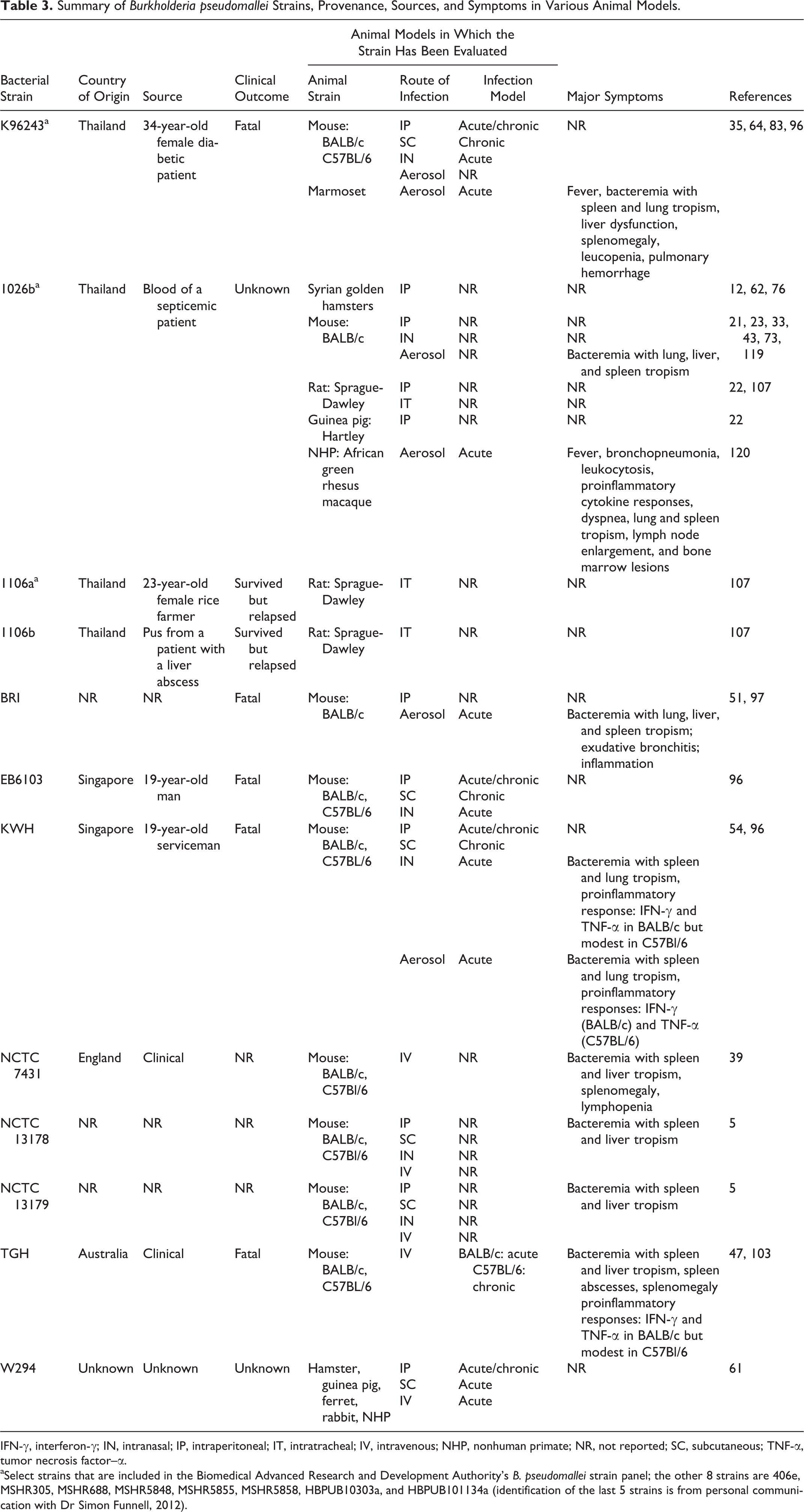
IFN-γ, interferon-γ; IN, intranasal; IP, intraperitoneal; IT, intratracheal; IV, intravenous; NHP, nonhuman primate; NR, not reported; SC, subcutaneous; TNF-α, tumor necrosis factor–α.
aSelect strains that are included in the Biomedical Advanced Research and Development Authority’s B. pseudomallei strain panel; the other 8 strains are 406e, MSHR305, MSHR688, MSHR5848, MSHR5855, MSHR5858, HBPUB10303a, and HBPUB101134a (identification of the last 5 strains is from personal communi-cation with Dr Simon Funnell, 2012).
Despite the use of incompletely characterized strains, several animal models of melioidosis have been evaluated, the majority of which are rodents (Table 3). The use of rodents has been extensively reviewed 112 but deserves mention in the context of model development. Murine studies have revealed that the severity of melioidosis and proinflammatory cytokine involvement are mouse strain dependent. This led researchers to classify mouse strains as either models of acute infection (BALB/c) or chronic infection (C57BL/6) based on their sensitivity to infection and proinflammatory response. 47,112 However, this is an oversimplification as the choice of B. pseudomallei strain and the route of infection may, in part, influence the acute or chronic nature of melioidosis (Table 3). 54 Furthermore, B. pseudomallei has the same lung, liver, and spleen tropism in BALB/c and C57BL/6 mice observed in humans regardless of its acute or chronic manifestation. Despite these parallels between the murine models and human melioidosis, the results in mice have, for the most part, been based on intravenous (IV) and IP exposure, which do not represent the natural route of human infection, 112 a requirement of the Animal Rule. In contrast, SC and aerosol mouse infection models both result in a systemic infection with similar clinical presentation as pericutaneous inoculation and inhalational melioidosis in humans. 96,112 Both routes of infection also present with chronic (SC/pericutaneous) and acute (inhalation) manifestations, regardless of species (Table 3). Like mice, rats have been used to model pulmonary and chronic disease with great success. Rats have been instrumental in understanding how diabetes increases the risk of B. pseudomallei infection. 112 Unfortunately, the full capacity of the rat model is limited as there are few reagents available for evaluating the rat’s immune response to infection. Syrian golden hamsters have also been evaluated as a small animal model of melioidosis but do not closely mimic human infection due to their extreme sensitivity to B. pseudomallei infection. 11 This extreme sensitivity highlights a major limitation of many small animal models of melioidosis and their utility in therapeutic and PEP development. For these reasons, large animal models that mimic human clinical melioidosis with a moderate level of sensitivity will likely be needed for MCM development.
There are limited published data characterizing B. pseudomallei infections in large animal models, particularly NHPs. An early report documented oral susceptibility in cynomolgus macaques but provided no details on clinical signs. 94 Later, Miller et al 61 evaluated the susceptibility and natural history of B. pseudomallei infection in different animal models, particularly rhesus macaques, following SC infection with graded doses of B. pseudomallei. Only the primate receiving the highest dose, 1.5 × 10⁶ CFU of strain W294, had clinical and immunological signs of infection, including abscess formation at the site of infection, fever, and elevated white blood cell counts with positive agglutination and complement fixation results 1 to 2 weeks after infection. By the end of the study, the clinical signs had resolved and organ cultures were negative for B. pseudomallei, suggesting that rhesus macaques are resistant to SC melioidosis. Reports of naturally occurring melioidosis in NHPs have identified additional clinical features that are also prominent in human cases, including wasting, cough, nasal discharge, and a mild respiratory disease that can develop to an acute fulminant bronchopneumonia. 45,92 Similarly, an evaluation of IP and SC B. pseudomallei infection in Hamadryas baboons resulted in the same lung, liver, spleen, and lymph node tropisms observed in humans. 57 More recent efforts have been undertaken to evaluate the pathology of inhaled B. pseudomallei in the marmoset, rhesus macaque, and AGM. 64,120 The marmoset is exquisitely sensitive to aerosols of B. pseudomallei strain K96243, preventing the identification of an exact LD50, but 102 CFU yielded consistent results and was uniformly lethal in both males and females. 64 Disease onset with this challenge dose was typically observed within 24 hours and was characterized by fever, decreased activity, and rapidly progressive bacteremia consistent with sepsis and the acute form of melioidosis. The natural history of strain K96243 in marmosets is characterized by progressive pulmonary distress and lymphadenopathy 22 to 46 hours after inhalation followed by severe hepatosplenomegaly and hepatic necrosis 46 hours postinfection, consistent with acute human melioidosis. 49,114 The natural history of melioidosis in rhesus macaques and AGMs following inhalation is fairly similar to the marmoset (Table 3). 120 The initial symptom in both monkeys is a nonspecific fever 24 to 40 hours after infection followed by dyspnea and bacteremia/septicemia approximately 56 to 96 hours after infection. A transient increase in leukocytes was typically observed by day 2 that gradually decreased the longer the rhesus macaques and AGMs survived. Gross pathology was also similar as both rhesus macaques and AGMs presented with lung lesions, lymph node enlargement, splenomegaly, and bone marrow lesions. However, proinflammatory cytokine responses between the 2 species were different. IL-1β and IL-6 were significantly increased in rhesus macaques on day 4, whereas AGMs had significant increases in IL-1β, IL-6, IL-8, and IFN-γ. These reports highlight the comparable pathology of B. pseudomallei infection in NHPs and humans. However, qualification of any one of these models will require additional studies confirming disease progression and natural history in NHPs, particularly following aerosol exposure. BARDA and its research partners are addressing this by pursuing the development of common marmosets and rhesus macaques as potential animal models for inhalation-acquired B. pseudomallei. These recently initiated efforts will include comparative virulence studies to select 2 strains from the BARDA index panel that will be used in full natural history studies. The goal of this work is to demonstrate that melioidosis progression and clinical signs in these animals mimic what is clinically observed in humans.
The BARDA-sponsored melioidosis animal model studies will also seek to identify and characterize a suitable trigger for therapeutic intervention that can be used during advanced drug research and development. It is critical that these triggers/markers appear during a window when a candidate treatment has an opportunity for successful intervention. Unfortunately, the previously discussed rodent models may be poorly suited for the identification of a clinical trigger such as fever due to the difficulty in setting up telemetry systems in small animals and the rapid onset of mortality in these animals. Using the common marmoset, Nelson et al 64 determined that the appearance of a fever in these animals positively correlated with the onset of bacteremia, disease progression, and ultimately death. This finding is particularly relevant to the development of therapeutics since blood culture is still regarded as the gold standard for diagnosis despite the fact that it is difficult to isolate B. pseudomallei from clinical samples even when melioidosis is suspected. 40,69 Other quantifiable markers of infection, including a bacterial marker (antigen or DNA) or immune marker, may provide added value during the go/no-go treatment decision process by increasing the specificity of the treatment time point. This is particularly true in small animals in which fever may be difficult to assess. Furthermore, the tools to detect and quantify these alternative markers in small animals and NHPs have been developed and are well characterized. Additional studies that track the progression of B. pseudomallei infection, its interaction with host organs, and the resulting imbalance in the host’s homeostasis will be necessary to identify appropriate and consistent triggers for treatment that correlate with mortality. Ultimately, the assays to detect these potential triggers will have to undergo extensive quality control and validation testing.
A number of candidate products have progressed through the development pipeline for the treatment or prevention of infection from biothreat pathogens. Many of these products were advanced through the evaluation of their efficacy in animal models that have been rigorously characterized. These efforts have identified several lead models for MCM development. Critical to this process has been the comparative evaluation of host pathogen responses in humans and candidate animal models, specifically the identification of similar immune responses and pathologies. Despite this immense body of work, there remain several unanswered questions, as highlighted above, that BARDA hopes to address through its animal model development programs. These efforts will be integral to assisting product developers as they aim to satisfy the Animal Rule. For pathogens with incompletely characterized animal models such as Francisella and Burkholderia, the biodefense community has the rare opportunity to learn from the successes and setbacks of other development programs and apply best practices for effective model development. Ultimately, animal model development could be accelerated by initiating formal, government-wide mechanisms for data sharing and integration.
Conclusion
This report highlights many of the gaps that currently exist in animal model development for diseases caused by F. tularensis, B. pseudomallei, and B. mallei. A number of studies have been completed in an attempt to develop or characterize animal models; however, the design of most studies reported did not take into account the requirements of the Animal Rule. Thus, much work must be undertaken to adequately develop and characterize models that will be reproducible and withstand regulatory scrutiny. Generating master and working cell banks of well-characterized challenge material will be critical for ensuring the reproducibility and validity of study results across multiple research organizations. As stated in the Animal Rule draft guidance, consideration must be given to the clinical origin of the bacterial strains and their passage history. This is of particular concern for B. mallei model development, due to the low number of lethal human cases from which strains have been isolated. Future research must also focus on identifying reproducible and physiologically relevant triggers to initiate treatment. Such treatment triggers will have to correlate with the onset of a clear primary end point, such as mortality. For Francisella and Burkholderia animal models, the use of bacteremia as a treatment trigger will likely be of little utility, given the intracellular nature of these pathogens. Alternative treatment triggers such as fever, detection of an antigen, detection of bacteremia by PCR, or a host-generated marker (eg, cytokines) could be evaluated as potential candidates. Treatment triggers that rely on assays that detect antigen or nucleic acids will need to be qualified and validated along with the animal model. Additional physiological parameters such as bacterial organ dissemination, pathology, and immunological findings will also need to be rigorously evaluated for potential use as secondary end points in candidate animal models. B. pseudomallei animal models present additional specific challenges. Defining the clinical manifestations of inhalational melioidosis, given the limited number of identified inhalational cases, limits the amount of patient data in existence that can be used to define and evaluate disease parameters in candidate animal models. Although mice, marmosets, rhesus macaques, and African green monkeys are all being evaluated as candidate animal models for acute inhalational melioidosis, there are currently insufficient data to pursue their qualification under the FDA Animal Rule. At present, modeling the acute phase of infection and evaluating antimicrobial therapies that would be effective during the intensive phase of treatment appear an attainable goal. It is unclear, however, how models of chronic B. pseudomallei infection will interface with acute phase models and if or how their collective results will affect product approval. Overall, for Francisella and Burkholderia, a significant body of data needs to be generated to develop animal models that are suitable for the evaluation of antimicrobial therapies in a regulatory acceptable fashion.
Footnotes
M. V. Stundick, M. T. Albrecht, and C. R. Houchens contributed equally to this project. The contents of this article are the sole responsibility of the authors and do not necessarily represent the official views of the Biomedical Advanced Research and Development Authority, the Office of the Assistant Secretary for Preparedness and Response, or the US Department of Health and Human Services.
Declaration of Conflicting Interests
The author(s) declared no potential conflicts of interest with respect to the research, authorship, and/or publication of this article.
Funding
The author(s) received no financial support for the research, authorship, and/or publication of this article.