



Abstract
Objective
To investigate the relationship between FKBP prolyl isomerase 5 (FKBP5) gene expression and CD8 T cells in tumour progression and immunology of the luminal B subtype of breast cancer (LBBC) using bioinformatics analyses.
Methods
The Gene Expression Profiling Interactive Analysis 2, Human Protein Atlas and breast cancer gene-expression miner v4.5 databases were used for data mining and analysing FKBP5, its co-expressed genes and CD8 T cell-related markers. The Tumor IMmune Estimation Resource 2.0 database was used for analysing the correlation and prognosis of FKBP5 and CD8 T cell infiltration level in LBBC.
Results
Upregulated FKBP5 expression was correlated with improved survival in LBBC. Upregulated FKBP5-related CD8 T cell markers were also demonstrated to be significantly correlated with better survival in LBBC and might play a role in the biological activity of FKBP5.
Conclusion
These findings suggest that FKBP5 and its associated CD8 T cell infiltration are potential benign prognostic indicators for LBBC.
Introduction
Breast cancer (BC) is the most common cancer in women worldwide. 1 Early diagnosis and comprehensive treatments have dramatically improved the prognosis of BC patients. In recent years, molecularly targeted therapy and immunotherapy have become new and promising options in BC.2,3 However, it is still necessary to develop more reliable biomarkers to enhance therapeutic strategies for individual patients.
The FK506-binding protein 5 (FKBP5, also known as FKBP51) belongs to a family of immunophilins; and it has been reported to possess multiple functions with regard to the regulation of various signalling pathways and in tumorigenesis and chemoresistance.4–7 For example, FKBP5 has been recently found to play a pivotal role in androgen receptor (AR) signalling in metastatic castration-resistant prostate cancer.8,9 However, there still exists a lack of relevant research on FKBP5 and clinical characteristics in the luminal B subtype of breast cancer (LBBC). For the first time, this current study explored FKBP prolyl isomerase 5 (FKBP5) gene expression in LBBC and its relationship with clinical outcomes and co-expressed genes using bioinformatics analysis.
CD8 T cells are the major immune cells infiltrating solid tumours and detecting antigens from tumour cells in the tumour microenvironment, thus presenting an effective immunotherapy treatment response. 10 Previous studies have shown that tumour-infiltrating lymphocytes (TILs) are crucial cells involved in immunotherapeutic strategies for BC. 11 For instance, CD8 TILs have been reported to contribute to spontaneously prominent periductal fibrosis in ductal carcinoma in situ. 12 However, the underlying relationship between FKBP5 and CD8 T cells in tumour progression and immunology of LBBC remains unclear.
In this current study, the Gene Expression Profiling Interactive Analysis 2 (GEPIA2) database, Human Protein Atlas (HPA) database and breast cancer gene-expression miner v4.5 (bc-GenExMiner v4.5) database were used to assess the potential variation of FKBP5 gene expression between a BC group and an adjacent control group, as well as the relationship between FKBP5 gene expression and clinical outcomes. Furthermore, preliminary analysis of the molecular mechanisms by which FKBP5 could be involved in LBBC was conducted by screening co-expressed genes with GEPIA2, Database for Annotation, Visualization and Integrated Discovery (DAVID) and other databases. Then, Tumor IMmune Estimation Resource 2.0 (TIMER2.0) was used to analyse the correlation and prognosis of FKBP5 gene expression and the level of CD8 T cell infiltration in LBBC. Lastly, the association between FKBP5-related CD8 T cell markers and prognosis in LBBC patients was determined using bc-GenExMiner v4.5 and GEPIA2.
Materials and methods
Data mining and analysis
The GEPIA2 database (gepia.cancerpku.cn) 13 was used to evaluate the mRNA level of FKBP5 and its co-expressed genes in cancer specimens compared with those in normal controls using Student’s t-test. The GEPIA2 database was also used to analyse overall survival (OS) of targeted genes in BC patients. The HPA database (www.proteinatlas.org) 14 was used to assess the immunohistochemistry outcomes of FKBP5 and 3-hydroxyanthranilate 3,4-dioxygenase (HAAO) in both BC and normal tissues. The expression and correlation modules of bc-GenExMiner v4.5 (bcgenex.centregauducheau.fr) 15 were used to show the clinicopathological traits and linear dependence of the studied genes in BC patients.
Immune infiltration analysis
The relationship between FKBP5 and the immune infiltration was explored using TIMER2.0 (timer.comp-genomics.org/). 16 The outcome module of TIMER2.0 was used to show the association between immune infiltrates and the clinical outcome of FKBP5 in BC patients. The sCNA module of TIMER2.0 was used to explore the association between immune infiltrates and somatic copy number variation of FKBP5 in BC patients.
COSMIC and cBioPortal analysis for mutations
The COSMIC database (www.sanger.ac.uk/cosmic/) 17 and cBioPortal database (www.cbioportal.org) 18 were used to explore FKBP5 gene mutations.
Screening for FKBP5 co-expressed genes
Genes co-expressed with FKBP5 in BC were screened from the similar genes detection module of the GEPIA2 database, which identified a list of genes with similar expression patterns compared with an input gene and selected datasets. Pearson’s correlation coefficient was used to determine 200 co-expressed genes.
Enrichment analysis and protein–protein interaction network
Gene Ontology (GO) analysis of FKBP5 co-expressed genes was analysed using the DAVID database (david.ncifcrf.gov). 19 The Search Tool for the Retrieval of Interacting Genes (STRING) database (www.string-db.org) 20 was used to construct the protein–protein interaction (PPI) network of FKBP5 co-expressed genes or CD8 T cell markers.
Statistical analyses
The prognoses of targeted genes were estimated using Kaplan–Meier curve analysis. Correlations between FKBP5 and different immune infiltrations or CD8 T cell markers were estimated using Spearman’s correlation. Other data analyses were performed and illustrations were generated using statistical algorithms within various databases. A P-value < 0.05 was considered statistically significant.
Results
Association between FKBP5 and prognosis in breast cancer patients
Previous findings from this current research team showed FKBP4 was a malignant indicator in luminal A subtype of BC, 21 and a potential FKBP4/5-related ncRNA-mRNA regulatory axis contributing to BC was also identified, 22 so this current study aimed to further explore the regulatory mechanism of FKBP5 on BC.
Based on the GEPIA2 database, FKBP5 mRNA expression was found to be significantly down-regulated in tumour samples compared with normal samples in 16 types of cancer, including bladder urothelial cancer, BC, cervical squamous cell cancer and endocervical adenocarcinoma (see supplementary materials, Fig. S1). Meanwhile, FKBP5 protein level in BC was assessed using the HPA database. The HPA database indicated that FKBP5 protein level was significantly reduced in cancerous tissues compared with corresponding normal tissues when using either antibody CAB009315 (see supplementary materials, Figs S2A–S2D) or antibody HPA031095 (see supplementary materials, Figs S2E–S2F).
Using the bc-GenExMiner v4.5 database, decreased FKBP5 was found significantly related to the luminal A and luminal B subtype than the normal group rather than human epidermal growth factor receptor 2 (HER2) positive and basal-like subtype (Figure 1A). Only oestrogen receptor (ER) status was negatively correlated with FKBP5 expression (Figure 1B), while FKBP5 expression had no significant change when comparing progesterone receptor (PR) or HER2 positive groups with the normal group (Figures 1C and 1D). The impact of FKBP5 expression on OS was further explored in four molecular subtypes of BC patients using GEPIA2. Upregulated FKBP5 expression was significantly related to better survival in luminal B subtype of BC patients (hazard ratio [HR] = 0.54, P = 0.021), but not in luminal A (HR = 0.92, P = 0.84), HER2 positive (HR = 1.1, P = 0.87) or basal-like subtype (HR = 0.82, P = 0.69) (Figures 1E–1H). Taken together, down-regulated FKBP5 expression was only correlated with worse survival in LBBC patients.
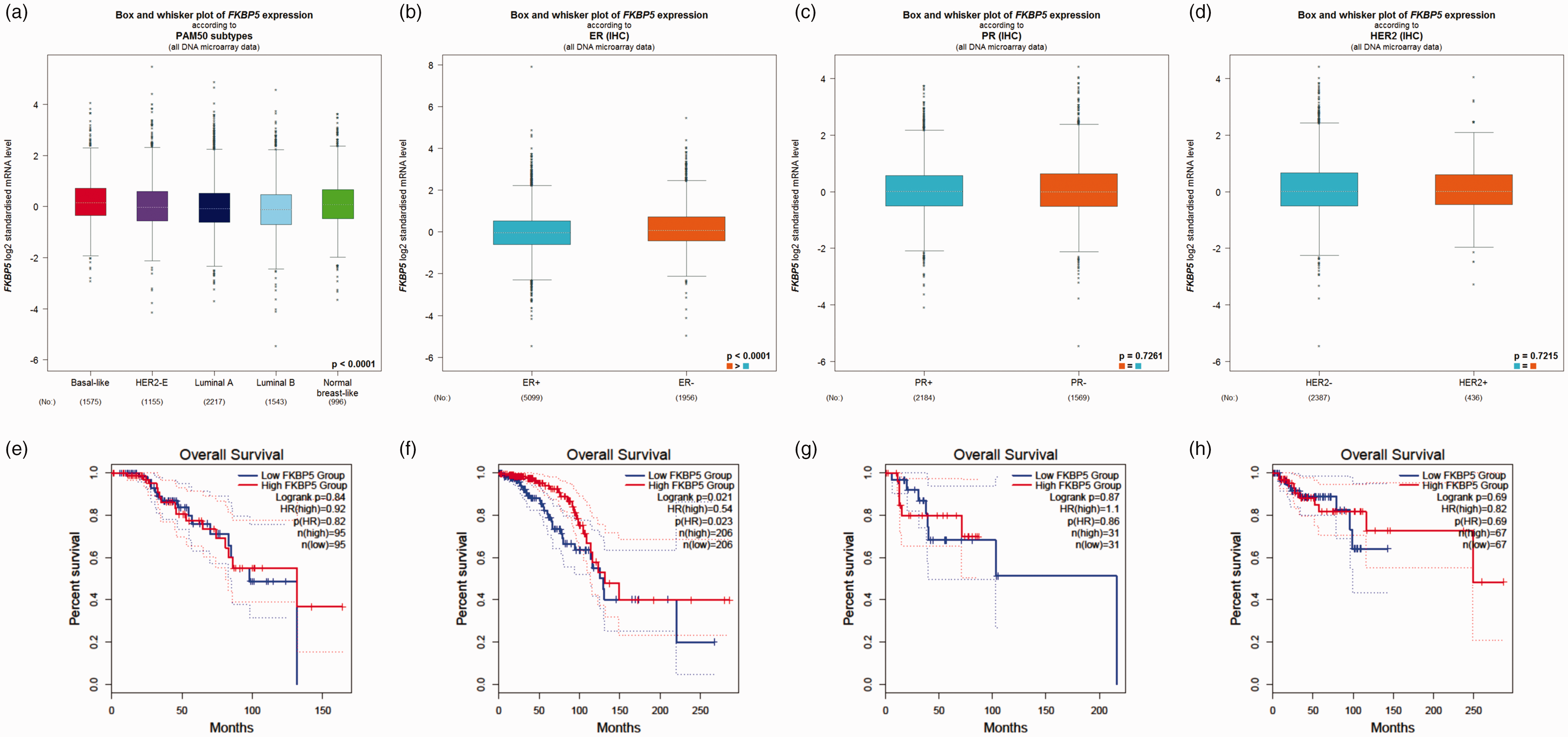
Relationship between FKBP prolyl isomerase 5 (FKBP5) gene expression with the clinicopathological characteristics and the prognostic merit in breast cancer patients. Box and whisker plots showing relationship between mRNA expression of FKBP5 and (A) different molecular subtypes, (B) oestrogen receptor (ER), (C) progesterone receptor (PR), and (D) human epidermal growth factor receptor 2 (HER2). The central horizontal lines for each group are the medians; the extremities of the box are the 25th and 75th percentiles; the error bars represent the minimum and maximum outliers; and the asterisk(s) above and below the error bars represent extreme outlier(s).Survival curves are plotted for patients of (E) luminal A, (F) luminal B, (G) HER2 positive and (H) basal-like. The P-value cutoff was 0.05. A Welch's test was also performed (along with Dunnett-Tukey-Kramer's tests for pairwise comparison when appropriate).
The impact of alterations in FKBP5 gene on clinical survival
In the COSMIC database, the pie chart described various mutation information including nonsense substitution, missense substitution and synonymous substitution. The proportion of missense substitution was the highest (14.43%) (see supplementary materials, Fig. S3A). BC mainly had 33.80% G>A, 24.65% C>T and 9.86% A>G mutations in the FKBP5 coding strand (Fig. S3B). Alteration frequency of FKBP5 mutations in BC was analysed by using cBioPortal. From 0.5% to 3% mutations in the patients with BC were observed (see supplementary materials, Fig. S3C). Kaplan–Meier plot and log-rank test analysis demonstrated that the alterations in FKBP5 had no correlations to OS (P = 0.547) or disease-free survival (P = 0.714) in BC patients with/without FKBP5 alterations (see supplementary materials, Figs S3D and S3E).
Bioinformatics analysis of FKBP5 co-expressed genes
A total of 200 FKBP5 co-expressed genes collected from GEPIA2 were analysed using the DAVID database. The GO enrichment analysis comprised three categories: a biological process, a molecular function and a cellular component. The most valuable 10 pathways of each category are presented (see supplementary materials, Figs S4A–S4C), suggesting that FKBP5 co-expressed genes might participate in multiple basic functions including the oxidation–reduction process and catalytic activity. The PPI network was displayed using the STRING database (see supplementary materials, Fig. S5); and three pairs of co-expressed genes with the highest combined scores (HAAO, KYNU, AADAT, CCBL1, FDFT1 and IDI1) were collected from the PPI network (Table 1).
Top 20 pairs of FKBP prolyl isomerase 5 (FKBP5) co-expressed genes from the protein–protein interaction network.

Based on the GEPIA2 database, HAAO but not KYNU, AADAT, CCBL1, FDFT1 or IDI1 mRNA expression was significantly downregulated in tumour samples compared with normal samples in various types of cancer, including BC (see supplementary materials, Figs S6–S11). The HPA database indicated that FKBP5 co-expressed gene HAAO expression was significantly reduced in cancerous tissues compared with corresponding normal tissues when using antibody HPA036394 (see supplementary materials, Figs S12A–S12F).
Using the bc-GenExMiner v4.5 database, decreased HAAO gene expression was significantly related to all molecular subtypes compared with than the normal group (Figure 2A). Both ER and PR status were negatively correlated with HAAO expression (Figures 2B and 2C), while HAAO expression had no significant change when comparing HER2 positive group with the normal group (Figure 2D). The correlation of HAAO expression and survival was further explored in all molecular subtypes of BC patients. Upregulated HAAO expression was only significantly related to better survival in LBBC patients (HR = 0.42, P = 0.019), but not correlated to those in luminal A, HER2 positive and basal-like subtypes of breast cancer patients (HR = 0.89, P = 0.68; HR = 0.39, P = 0.13; HR = 1.6, P = 0.53) (Figures 2E–2H). Taken together, these findings suggest that downregulated FKBP5 co-expressed gene HAAO was also only correlated with worse survival in LBBC patients.

Relationship of HAAO gene expression with the clinicopathological characteristics and the prognostic merit in breast cancer patients. Box and whisker plots showing the relationship between mRNA expression of HAAO and (A) different molecular subtypes, (B) oestrogen receptor (ER); (C) progesterone receptor (PR); (D) human epidermal growth factor receptor 2 (HER2). The central horizontal lines for each group are the medians; the extremities of the box are the 25th and 75th percentiles; the error bars represent the minimum and maximum outliers; and the asterisk(s) above and below the error bars represent extreme outlier(s). Survival curves are plotted for patients of (E) luminal A, (F) luminal B, (G) HER2 positive and (H) basal-like. The p value cutoff is 0.05. A Welch's test is also performed (along with Dunnett-Tukey-Kramer's tests for pairwise comparison when appropriate).
Correlation of FKBP5 expression and immune infiltration level in breast cancer
Tumour-infiltrating cells are independent predictors of survival in BC patients.23,24 Therefore, this current study investigated whether FKBP5 functioned as a tumour suppressor by interacting with immune infiltration in BC through the TIMER2 database. After the correlation adjustment by purity, results showed that FKBP5 expression had significantly positive correlations with infiltrating levels of CD8 T cells (r = 0.155, P<0.001), neutrophils (r = 0.316, P < 0.001), macrophages (r = 0.072, P = 0.023) and dendritic cells (r = 0.139, P < 0.001), but there was no correlation with CD4 T cells (r = 0.025, P = 0.436) or B cells (r = –0.009, P = 0.766) in BC (Figures 3A–3F).

Correlation between FKBP prolyl isomerase 5 (FKBP5) gene expression and immune infiltration level in breast cancer. Correlation of FKBP5 expression with infiltrating levels of (A) CD4 T cells, (B) CD8 T cells, (C) B cells, (D) neutrophils, (E) macrophages and (F) dendritic cells. The P-value cutoff was 0.05.
The association between survival and BC defined by immune infiltration level and FKBP5 expression was examined. Patients with the better survival over 150 months had increased CD8 T cell infiltration with high expression of FKBP5 (P = 0.042), whereas patients with increased CD8 T cell infiltration with low expression of FKBP5 had no significant improvement in survival (P = 0.364) (Figure 4B). As for the influence of infiltration level of CD4 T cells, B cells, neutrophils, macrophages and dendritic cells on survival, results revealed no statistically significant correlations (Figures 4A, 4C–4F).

Overall survival stratified by a combined analysis of immune infiltration level and FKBP prolyl isomerase 5 (FKBP5) gene expression in Tumor IMmune Estimation Resource 2.0. Survival based on high/low FKBP5 expression and (A) high/low CD4 T cells infiltration level, (B) high/low CD8 T cells infiltration level, (C) high/low B cells infiltration level, (D) high/low neutrophils infiltration level, (E) high/low macrophages infiltration level and (F) high/low dendritic cells infiltration level. The P-value cutoff was 0.05.
The association between immune infiltrates and somatic copy number variation of FKBP5 was also explored in BC patients. Arm-level gain of FKBP5 gene level was significantly detected among CD8 T cell, neutrophil and macrophage infiltration, but no somatic copy number variation of FKBP5 gene was found in CD4 T cells, B cells or dendritic cells (see supplementary materials, Figs S13A–S13F). These findings strongly suggested that FKBP5 played a specific role in CD8 T cell infiltration in BC.
Interaction between CD8 T cell related markers and FKBP5 gene expression in luminal B subtype of breast cancer
The CD8 T cells in the tumour microenvironment can produce various markers on their surface and secrete many immune-related markers, including PRF1, CD8A, CD69, BTLA, GZMB, ICOS, CCL5 and PTPRC(see supplementary materials, Fig. S14), finally leading to upregulated adaptive immune pathways.25–29
As upregulated FKBP5 expression was only correlated with better survival in LBBC patients, the study then examined whether FKBP5 acted as a tumour suppressor by association with the expression of CD8A or other CD8 T cell-related markers among the tumour microenvironment in LBBC patients. Consistent with this hypothesis, a positive relationship between CD8A and FKBP5 was observed (r = 0.13, P < 0.001) (Figure 5B). Similar results were obtained between FKBP5 and other CD8 T cell-related markers (Figures 5A, 5C–5H).

Pairwise Pearson’s correlation analysis between CD8 T cell-related markers and FKBP prolyl isomerase 5 (FKBP5) gene expression in bc-GenExMiner v4.5. Scatter plots of pairwise expression between FKBP5 and (A) PRF1, (B) CD8A, (C) CD69, (D) BTLA, (E) GZMB, (F) ICOS, (G) CCL5 and (H) PTPRC. The P-value cutoff was 0.05.
Association between CD8 T cell related markers and prognosis in luminal B subtype of breast cancer patients
To further confirm FKBP5-associated CD8 T cell-related markers that might induce tumour immunosuppression in LBBC and provide prognostic insight, the expression of PRF1, CD8A, CD69, BTLA, GZMB, ICOS, CCL5 or PTPRC was correlated with 150-month survival curves using data from GEPIA2.
Using the bc-GenExMiner v4.5 database, decreased CD8A or other CD8 T cell-related markers was found significantly related to the luminal A and luminal B subtype than the normal group rather than HER2 positive and basal-like subtype (see supplementary materials, Figs S15A–S15H). The impact of CD8A and other CD8 T cell-related marker expression on OS was further explored in four molecular subtypes of BC patients using GEPIA2. Upregulated PRF1, CD8A, CD69, BTLA, GZMB, ICOS, CCL5 or PTPRC was solely significantly related to better survival in luminal B subtype of BC patients (HR = 0.38, P = 0.009; HR = 0.33, P = 0.003; HR = 0.22, P < 0.001; HR = 0.29, P < 0.001; HR = 0.43, P = 0.021; HR = 0.37, P = 0.006; HR = 0.3, P = 0.001; HR = 0.33, P = 0.003; respectively) (Figures 6A–6H), but not in luminal A (see supplementary materials, Fig. S16), HER2 positive (see supplementary materials, Fig. S17) or basal-like subtype (see supplementary materials, Fig. S18). Taken together, these findings show that upregulated FKBP5-associated CD8 T cell-related marker expression was only correlated with better survival in LBBC patients.
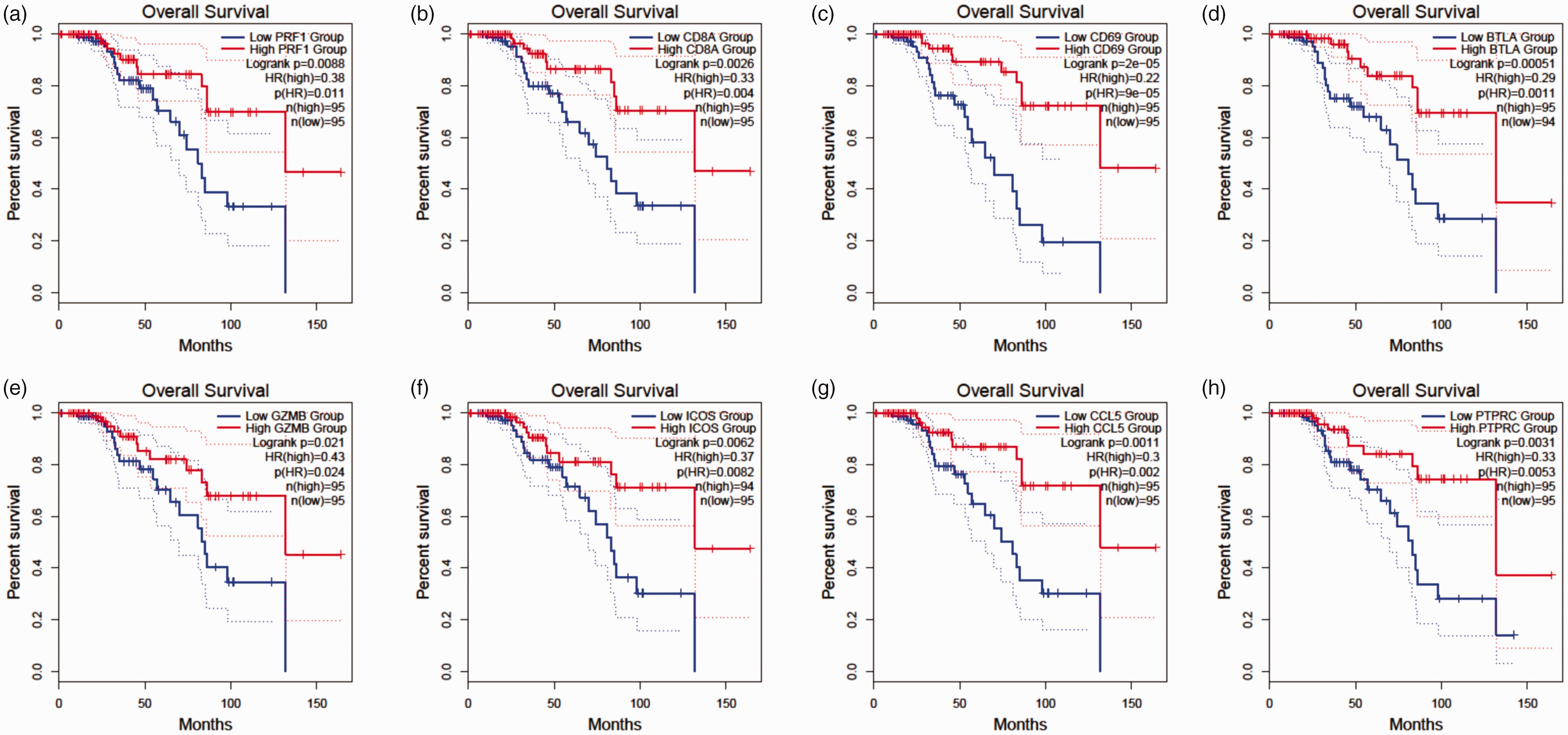
Relationship between CD8 T cell-related markers with the prognostic merit. Kaplan–Meier plots of overall survival based on (A) PRF1, (B) CD8A, (C) CD69, (D) BTLA, (E) GZMB, (F) ICOS, (G) CCL5 and (H) PTPRC in luminal B subtype of breast cancer patients. The P-value cutoff was 0.05.
Discussion
Breast cancer is a heterogeneous tumour, showing variable morphological and biological features. 30 Although early detection and personalized treatments have decreased the mortality rate based on traditional molecular classification of BC, identifying novel drivers and biomarkers are still necessary for improving the prognosis of BC patients. This current study found that FKBP5 might play a significantly benign role through modulating its co-expressed HAAO gene expression in LBBC.
The FKBP family members in human and other mammals have been reported to exert important roles in multiple biochemical pathways including cardiac function, neurodegenerative disorders and cancer development. 31 For instance, lack of FKBP12.6 leads to sever cardiac dysfunction via a calcium signalling pathway, resulting in early death of the gene deletion mice shortly after birth. 32 In Alzheimer’s disease, FKBP4 is the most extensively studied protein binding to hyperphosphorylated Tau (a microtubule associated protein) and it blocks its ability to induce microtubule assembly. 33 In melanoma, upregulated FKBP8 has been found to reduce cancer cell growth by involvement in mTOR signalling activity. 34
Recent research suggests that FKBP5 expression is also strongly associated with various types of cancers, for example, oesophageal adenocarcinoma, 35 prostate cancer, 36 acute lymphoblastic leukaemia, 37 melanoma 5 and neuroglioma. 38 Particularly in prostate cancer, where FKBP5 has been well studied in relation to AR; with the overexpression of FKBP5 stimulating AR transcriptional level and promoting cell proliferation. 39 Because of the lack of a more systematic study between FKBP5 and breast cancer, this current study was conducted to assess the clinical role and molecular regulatory importance of FKBP5 in LBBC.
In the GEPIA2 and HPA databases, both the mRNA and protein levels of FKBP5 were observed to be significantly downregulated in the BC group compared with the adjacent normal group in the current study. In addition, the lower FKBP5 expression was found in both luminal A and luminal B subtypes, but was irrelevant to the HER2 positive or basal-like subtype in BC; and downregulated expression of FKBP5 was only significantly correlated with ER status. Furthermore, the bc-GenExMiner v4.5 database was used to demonstrate that downregulated mRNA expression of FKBP5 was associated with unfavourable survival for LBBC patients. More research is warranted to find out whether FKBP5 plays a crucial part in ER-related signalling pathways in LBBC.
A total of six co-expressed genes of FKBP5, namely HAAO, KYNU, AADAT, CCBL1, FDFT1and IDI1, were screened in the current study. With the exception of AADAT and IDI1, the other co-expressed genes are all involved in many biological processes of tumorigenesis. HAAO has been shown to be a significant methylated gene in prostate cancer; 40 KYNU can suppress BC cell proliferation; 41 and CCBL1 and FDFT1 are both good prognostic markers for survival prediction in patients with colorectal cancer.42,43 In the current study, only lower FKBP5 co-expressed gene HAAO was found in the BC group compared with the adjacent normal group at the mRNA and protein levels. Moreover, downregulated HAAO significantly correlated with ER and PR status and predicted a shorter survival time in LBBC patients. Therefore, these current findings suggest that HAAO might interact with FKBP5 in LBBC, though specific molecular mechanisms remain to be further explored and clarified.
Another important aspect of this current study was that FKBP5 expression was found to be positively correlated with various immune infiltration levels in LBBC, especially the infiltration level of CD8 T cells. In addition, these current results indicated that the increase in FKBP5 expression positively correlated with the expression of CD8 T cell-related markers. For example, CD69, a strongly increased marker of CD8 T cell activation, 44 was highly correlated with FKBP5 expression in LBBC. These above-mentioned correlations could indicate the potential mechanism by which FKBP5 regulates CD8 T cells within the tumour microenvironment of LBBC. This current study has for the first time demonstrated longer survival for FKBP5high/CD8 T cellshigh patients with LBBC. These findings suggest future opportunities for the improvement of novel immunotherapies for LBBC patients depending upon screened credible biomarkers.
Supplemental Material
sj-pdf-1-imr-10.1177_03000605231211771 - Supplemental material for FKBP5 associated CD8 T cell infiltration is a novel prognostic biomarker in luminal B breast cancer
Supplemental material, sj-pdf-1-imr-10.1177_03000605231211771 for FKBP5 associated CD8 T cell infiltration is a novel prognostic biomarker in luminal B breast cancer by Fei Tong, Genlin Lu, Jie Zang, Dingji Hao, Wangjue Xu, Jida Chen, Qiong Ding and Hanchu Xiong in Journal of International Medical Research
Footnotes
Author contributions
Writing – Original Draft Preparation: F.T., H.C.X., J.Z. and G.L.L.; Writing – Review & Editing: W.J.X., J.Z., F.T., D.J.H., J.D.C. and Q.D.; Supervision: Q.D. and H.C.X. All authors have reviewed the manuscript. All authors read and approved the final manuscript.
Declaration of conflicting interest
The authors declare that there are no conflicts of interest.
Funding
The work was supported by grants from the National Natural Science Foundation of China (no. 82102814) and the Zhejiang Provincial Natural Science Foundation of China (no. LY20H160026, LQ22H160053). The work was also supported by Zhejiang Provincial People’s Hospital Scientific Research Foundation for The Excellent Youth (no. ZRY2020B007).
References
Supplementary Material
Please find the following supplemental material available below.
For Open Access articles published under a Creative Commons License, all supplemental material carries the same license as the article it is associated with.
For non-Open Access articles published, all supplemental material carries a non-exclusive license, and permission requests for re-use of supplemental material or any part of supplemental material shall be sent directly to the copyright owner as specified in the copyright notice associated with the article.
