



Abstract
Objective
To explore self-consciousness and depression in children with precocious puberty (PP) and analyse its effect on children of both sexes.
Methods
Sixty children with PP and 60 non-PP children matched for sex and age participated in the study. Children were assessed using the Birleson Depression Self-Rating Scale for Children and the Piers–Harris Children’s Self-Concept Scale.
Results
There were significant differences in physical appearance and attributes, anxiety, happiness and satisfaction between PP children and non-PP children. PP children had significantly higher depression than non-PP children. In the PP group, girls were significantly more prone to anxiety and unhappiness than boys. Conclusion: There were sex differences in the effect of PP on children’s self-consciousness, and girls were more prone to anxiety and unhappiness. More attention should be paid to improving the physical and mental health of children with PP.
Introduction
Children who experience early puberty have a greater potential risk of developing psychosocial problems than children with normal puberty because their emotional and cognitive development does not match the physical changes that occur in early maturation. 1 In recent years, the number and incidence of children with precocious puberty (PP) has increased in both developing and developed countries. 2 However, population-based epidemiological data are lacking for several countries. 3 A study in China showed that the prevalence of PP in Shanghai is approximately 100/10,000. 4 The China Association of Health Promotion and Education has attempted to raise public awareness about the adverse effects of PP. 5 In China, numerous studies have focused on the characteristics and effects of treatment regimens for children with PP. 6 However, more research is needed on the mental health status of children with PP.
Self-consciousness refers to an individual’s understanding and evaluation of himself or herself in relation to others and to society. 7 Self-consciousness is a major aspect of human psychology and its formation and development are strongly related to mental health. 3 During the developmental process, children are affected by internal and external factors that influence self-consciousness, 8 thereby affecting behavioural habits, learning and social ability and personality development. 9 Depression is a common mental health problem in children. A previous study showed that the incidence of depression in adolescents is increasing annually and the age of onset is declining. 10 There is some evidence that children with PP have lower self-consciousness 4 and obvious symptoms of depression.2,4 However, one study found no substantial differences in depression and psychosocial problems between children with normal puberty and those with PP. 11 There has been little research on the effects of PP on self-consciousness and depression in children of different sexes. The present study aimed to explore levels of self-consciousness and depression in children with PP, and analyse the effect of PP on boys and girls. The data could be used to promote understanding of children with PP and to developing nursing interventions to promote psychosocial health.
Methods
Participants
The inclusion criteria were children who developed secondary sexual characteristics before the age of 8 years in girls or 9 years in boys, along with biochemical confirmation of hypothalamic–pituitary–gonadal axis activation (gonadotropin-releasing hormone stimulation test with peak luteinizing hormone ≥5 mIU/mL and luteinizing hormone/follicle-stimulating hormone ≥0.6 12 ) at paediatric endocrinology clinics. The control group consisted of non-PP children matched for age and sex living in the same region. The exclusion criteria for the two groups were children with severe physical diseases, mental disability or language communication disorders. Data were collected from November 2020 to March 2021. Participation for all children and their guardians was voluntary and participants were informed about the investigation before providing their written consent. The study protocol was approved by the medical ethics committee of West China Hospital of Sichuan University (approval number: 2021 medical scientific research for ethical approval No. (85)).
Measures
Piers–Harris Children’s Self-Concept Scale (PHCSS)
The PHCSS was developed by the American psychologist Piers 13 and revised in 1974. In 2002, Su et al. revised the scale for Chinese children and obtained a split-half reliability of 0.8176 and a Cronbach’s α of 0.858. The scale contains 80 items divided into six subscales: behaviour, intelligence and school conditions, physical appearance and attributes, anxiety, gregariousness, and happiness and satisfaction. 14 Scores on the scale are interpreted with reference to national norms. Scores <51 indicate low levels of self-consciousness and scores >63 indicate high levels of self-consciousness. 15
Depression Self-Rating Scale for Children (DSRS-C)
The DSRS-C, developed by Birleson, 16 consists of 18 items rated according to three levels: none (0), sometimes (1), and often (2). A high negative score on the scale indicates depression. Items 1, 2, 4, 7, 8, 9, 11, 12, 13 and 16 are reverse scored: no (2), sometimes (1), and often (0). The total scale score is the sum of the scores on each item. In 2003, Su et al. developed urban norms 15 to evaluate the self-awareness of children in China, with a reliability of 0.72 and Cronbach’s α coefficient of 0.73. Total DSRS-C scores ≥15 indicate possible depression.
Participants also completed a general information questionnaire that recorded age, school grade, sex, nationality and other baseline data.
Procedures
This cross-sectional study used convenience sampling. The timing of the survey was as follows: when children with PP visited the endocrine clinics, the nurses explained the purpose of the survey to the children and their parents and obtained informed consent. The children filled in the questionnaire on the spot and the questionnaire was then collected. Participants were assured that the data would remain confidential. Non-PP children of the same age and sex were also invited to complete questionnaires, and these questionnaires were identified by a two-dimensional code.
Statistical analysis
A double-blind method was used for data entry in Microsoft Excel. IBM SPSS Statistics for Windows, Version 25.0 (IBM Corp., Armonk, NY, USA) was used for statistical analysis, and total and item scores on each scale were represented as means (± standard deviations). The DSRS-C and PHCSS scores of the children with PP were compared with those of non-PP children. The independent t-test was performed to compare self-consciousness and depression status in boys and girls. Values of P < 0.05 indicated statistical significance.
Results
Baseline comparability between the observation and control groups
The study participants comprised 60 children with PP and 60 children without PP. The average age of children in the observation group was 8.22 (± 1.01) years, and the average age of children in the control group was 8.18 (± 0.948) years. Most participants (95%) were girls. The baseline characteristics of children in the two groups are shown in Table 1. Comparison between the two groups showed baseline comparability.
Baseline comparability between the observation and control group.

PP, precocious puberty; SD, standard deviation.
Between-group comparison of self-consciousness
There was no significant between-group difference in PHCSS total score. The PP group scored lower than the control group on the PHCSS subscales physical appearance and attributes, and on happiness and satisfaction, but scored higher on anxiety (P < 0.05) (Table 2).
Between-group comparison of total and subscale PHCSS scores.
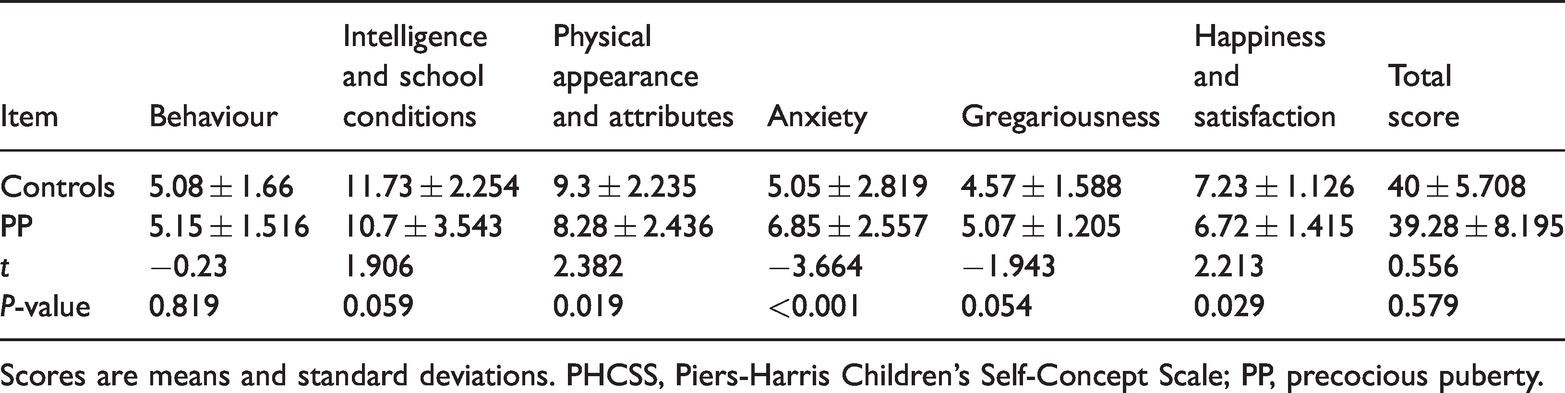
Scores are means and standard deviations. PHCSS, Piers-Harris Children’s Self-Concept Scale; PP, precocious puberty.
Between-group comparison of depression
Total DSRS-C scores and those for item 1 (Look forward to things), item 3 (Always want to cry), item 9 (Have self-confidence) and item 15 (Feel lonely) were significantly higher in the PP group than in the control group (P < 0.05). Items 1 and 9 were reverse scored (Table 3).
Between-group comparison of DSRS-C scores.

Scores are means and standard deviations. DSRS-C, Depression Self-Rating Scale for Children; PP, precocious puberty.
Characteristics of self-consciousness and depression in PP children of both sexes
No significant differences between boys and girls were observed in the total PHCSS scores and DSRS-C scores. However, girls scored higher than boys on the subscale anxiety, whereas boys scored higher than girls on the subscale happiness and satisfaction (P < 0.05) (Table 4).
Characteristics of self-consciousness and depression in PP children of both sexes.

DSRS-C, Depression Self-Rating Scale for Children; PHCSS, Piers-Harris Children’s Self-Concept Scale.
Discussion
More than half of the children in the PP group were of early school age. Children with PP had a mean age of 8.22 (±1.01) years. Most participants (95%) were girls. The age and incidence of PP are consistent with data from previous studies. Of 80 children with PP in a study in Baghdad, 85% were girls and 56.25% were aged 7 to 8 years at presentation. 2 Studies on the psychology of children with PP in South Korea and Washington found a mean age of 8.12 (±0.64) years, and most children (88%) were diagnosed at age 7 to 8 years.5,17,18
PHCSS scores on the subscales physical appearance and attributes, anxiety, and happiness and satisfaction were lower than the control group. These results are in accordance with previous studies on PP.2,4 PP is characterized by fear and shame caused by ‘early penis enlargement and breast enlargement and increased vaginal secretions, and even menstruation.’ 4 Children with PP feel different from their peers, experience dissatisfaction with their body shape 19 and experience unhappiness and anxiety because of these differences.
We found that children with PP had higher total DSRS-C scores than children with normal puberty. This is in line with previous findings that children with PP show growth spurts and advanced bone age,2,17 which may cause psychological disorders. 17
Early puberty is associated with mainly negative perceptions of physical appearance and often with negative emotions toward the self. 19 Pubertal changes in physical appearance may cause feelings of shame, frustration or insecurity; these feelings may increase isolation and interfere with peer and family relationships.2,17 We found that children with PP scored significantly higher on the DSRS-C items of Look forward to things, Always want to cry, Have self-confidence, and Feel lonely.
We found no significant difference in total scores of self-consciousness and depression between boys and girls with PP. Girls scored higher on anxiety than boys, whereas boys scored higher on happiness and satisfaction. There are two possible reasons for this: (1) girls normally mature faster than boys, mainly because of idiopathic developmental factors, 2 and (2) the incidence of PP in girls is considerably higher than that in boys; a study by Lin showed that 90.11% of children with PP are girls (only 9.89% are boys). 20 However, the small sample size and the disparity between the number of boys and girls in Lin’s study and in the present study may have led to errors in interpreting the results.
The present study has some limitations. The sample size was small. In addition, children were accompanied by their parents during the whole process of filling in the questionnaire. This may have resulted in bias if, for example, children did not express their true feelings on the questionnaire. Early and targeted attention to the psychological status of PP children is vital for promoting healthy psychological development. 21 In addition, it is important to examine sex differences in self-consciousness in children with PP. Strategies are needed to help children with PP to develop a better understanding of their appearance, body shape and physiological changes; cultivate their self-confidence and self-esteem; and enhance their resistance to setbacks. This would help to raise levels of self-consciousness and the ability to self-evaluate in this population.
Study limitations
Although the sample size in the present study was small, there are many children with PP in China, so future follow-up studies are possible with more participants. In this study, most children with PP received gonadotropin-releasing hormone treatment, but we did not measure whether the treatment had an effect on self-consciousness and depression, nor did we examine the effect of different treatment periods.
Supplemental Material
sj-pdf-1-imr-10.1177_03000605211020227 - Supplemental material for Self-consciousness and depression in precocious pubertal children
Supplemental material, sj-pdf-1-imr-10.1177_03000605211020227 for Self-consciousness and depression in precocious pubertal children by Hongyu Huang, Lili Liu, Shaoyu Su and Dandan Xie in Journal of International Medical Research
Footnotes
Acknowledgement
The authors would like to thank and acknowledge the contributions of Wu Jin.
Declaration of conflicting interest
The authors declare that there is no conflict of interest.
Funding
The author(s) disclosed receipt of the following financial support for the research, authorship, and/or publication of this article: This study was supported by funding from the “Scientific Research Fund for Young and Middle-aged Endocrinologists” (09H1240).

References
Supplementary Material
Please find the following supplemental material available below.
For Open Access articles published under a Creative Commons License, all supplemental material carries the same license as the article it is associated with.
For non-Open Access articles published, all supplemental material carries a non-exclusive license, and permission requests for re-use of supplemental material or any part of supplemental material shall be sent directly to the copyright owner as specified in the copyright notice associated with the article.
