



Abstract
Objective
This study investigated micro (mi)RNAs associated with the survival of patients with gallbladder carcinoma (GBC).
Methods
miRNA expression profiling was carried out of 40 cancerous tissues from GBC patients with long-term (n = 20) and short-term (n = 20) survival and eight healthy gallbladder tissues from the Gene Expression Omnibus database. miRNAs dysregulated in GBC patients with long-term or short-term survival were identified using GEO2R and VennDiagram packages, and analyzed by miRNA target prediction tools and the clusterProfiler package.
Results
Compared with healthy gallbladder tissues, 104 and 124 miRNAs were dysregulated in cancerous tissues of GBC patients with long-term survival and short-term survival, respectively. Two miRNAs (hsa-miR-142-5p and hsa-miR-146b-5p) and 22 miRNAs (such as hsa-miR-30a-3p, hsa-miR-660-5p, and hsa-miR-338-3p) were exclusively dysregulated in GBC patients with long-term and short-term survival, respectively. Enrichment analysis revealed that miRNAs exclusively dysregulated in GBC patients with short-term survival were involved in 46 biological processes, 10 cellular components, 11 molecular functions, and 44 pathways such as morphogenesis of an epithelium, response to transforming growth factor beta, heterochromatin, and phosphatase binding.
Conclusion
This study not only identified some promising biomarkers for predicting survival in GBC patients, but also contributed to our understanding of the pathogenesis and prognosis of GBC.
Introduction
Gallbladder carcinoma (GBC) is a relatively rare but highly lethal malignancy. Because of the absence of specific symptoms in the early stages of GBC, more than 90% of patients are diagnosed at an advanced stage. 1 These patients cannot be effectively treated so have an extremely poor prognosis, which has compelled researchers to explore new therapeutic interventions and early prognostic markers.
Micro (mi)RNAs are endogenous, short non-coding RNAs with a length of ∼22 nucleotides (nt) that negatively regulate gene expression either by mRNA degradation or translational repression at the post-transcriptional level. 2 The dysregulation of a single miRNA may affect the expression of hundreds of genes, resulting in the disruption of normal biological processes and the occurrence and development of a variety of diseases, including cancer.3–6 For instance, the expression of miRNA-222 and miRNA-221 was shown to be closely related to the prognosis of glioma patients, with their high expression correlating with shorter survival times. 3 Furthermore, upregulated miR-654-5p in late-stage oral squamous cell carcinoma (OSCC) was correlated with poor prognosis of OSCC patients. miR-654-5p was found to target Grb-2-related adaptor protein to promote proliferation, metastasis, and chemoresistance of OSCC via Ras/mitogen-activated protein kinase (MAPK) signaling. 4 Additionally, miR-378 was reported to be significantly elevated in cholangiocarcinoma (CCA) tissues compared with adjacent healthy tissues, and CCA patients with high miR-378 expression had a poor survival. 6 These findings indicate that alterations of miRNA expression are also involved in the prognosis of cancer patients.
Although miRNAs influencing the survival of GBC patients, such as miR-146b-5p, miR-335, and miR-101, have also been reported, the related studies did not identify all miRNAs associated with GBC patient survival because of research limitations.7–9 In the present study, we identified miRNAs exclusively dysregulated in GBC patients with both long-term and short-term survival by expression microarray, then analyzed these miRNAs based on bioinformatics methods. Our findings not only reveal promising prognostic markers, but also lay the foundation for further understanding of the pathogenesis and prognosis of GBC.
Materials and methods
Microarray data
The miRNA expression profiling dataset (GSE104165) was obtained from the Gene Expression Omnibus database (https://www.ncbi.nlm.nih.gov/geo/). Forty cancerous tissues from GBC patients with long-term (n = 20) and short-term (n = 20) survival and eight healthy gallbladder tissues were detected using the Agilent-046064 unrestricted Human miRNA V19.0 microarray (Platform: GPL18402) (Agilent Technologies Inc., Santa Clara, CA, USA).
Data processing and analysis
To recognize dysregulated miRNAs in the cancerous tissues of GBC patients with long-term or short-term survival, GEO2R online software (https://www.ncbi.nlm.nih.gov/geo/geo2r/) was used to analyze microarray data that had been processed by quantile normalization and log2 transformation. The adjusted P-value <0.05 and |logFC|>2 were used as cut-off criteria. Subsequently, the VennDiagram package in R software was used to identify miRNAs that were exclusively dysregulated in GBC patients with long-term or short-term survival.
Identification of biological targets of dysregulated miRNAs
TargetScan can predict potential targets of miRNAs by searching for the presence of conserved 8mer and 7mer sites that match the seed region of each miRNA. 10 miRDB is an online resource for miRNA target prediction and functional annotations, containing target prediction data, a web server interface for custom target prediction, as well as a set of functional miRNAs annotated by integrating computational analyses with literature mining. 11 miRTarBase contains many experimentally validated miRNA-target interactions (MTIs) and can provide a large number of positive samples to develop computational methods capable of identifying MTIs. 12 Here, the three tools were used together to predict potential targets of miRNAs exclusively dysregulated in GBC patients with long-term or short-term survival. Consistent prediction results from the three tools were considered biological targets of miRNA. Subsequently, Cytoscape 3.3 software was used to construct MTI networks. 13
Comprehensive analysis of the function of dysregulated miRNAs
To comprehensively analyze the function of miRNAs exclusively dysregulated in GBC patients with long-term or short-term survival, we performed Gene Ontology (GO) and Kyoto Encyclopedia of Genes and Genomes (KEGG) pathway enrichment analyses for targets of the corresponding miRNAs using the clusterProfiler package in R software. 14 An adjusted P-value <0.001 was considered to be statistically significant.
Results
Identification of dysregulated miRNAs
A total of 104 dysregulated miRNAs including 85 that were downregulated and 19 that were upregulated were identified in cancerous tissues of GBC patients with long-term survival when compared with healthy gallbladder tissues (Figure 1a). There were 124 dysregulated miRNAs (94 that were downregulated and 30 that were upregulated) in cancerous tissues of GBC patients with short-term survival compared with healthy gallbladder tissues (Figure 1b). A Venn diagram showed that two miRNAs (hsa-miR-142-5p and hsa-miR-146b-5) were exclusively downregulated in GBC patients with long-term survival (Figure 2a and Table 1), while 11 downregulated miRNAs (hsa-miR-30a-3p, hsa-miR-660-5p, hsa-miR-338-3p, hsa-miR-98-5p, hsa-miR-20b-5p, hsa-miR-103a-3p, hsa-miR-200a-3p, hsa-miR-17-5p, hsa-miR-148a-3p, hsa-miR-200c-3p, and hsa-miR-200b-3p) and 11 upregulated miRNAs (hsa-miR-4462, hsa-miR-1181, hsa-miR-762, hsa-miR-4530, hsa-miR-4507, hsa-miR-3610, hsa-miR-4417, hsa-miR-4463, hsa-miR-1471, hsa-miR-188-5p, and hsa-miR-520b) were exclusively observed in GBC patients with short-term survival (Figure 2 and Table 1).

Volcano plots showing dysregulated miRNAs in GBC patients. a: GBC patients with long-term survival. b: GBC patients with short-term survival.

Venn diagrams showing miRNAs exclusively dysregulated in two groups of GBC patients. a: miRNAs exclusively downregulated in two groups of GBC patients. b: miRNAs exclusively upregulated in two groups of GBC patients.
miRNAs exclusively dysregulated in GBC patients with long-term or short-term survival.
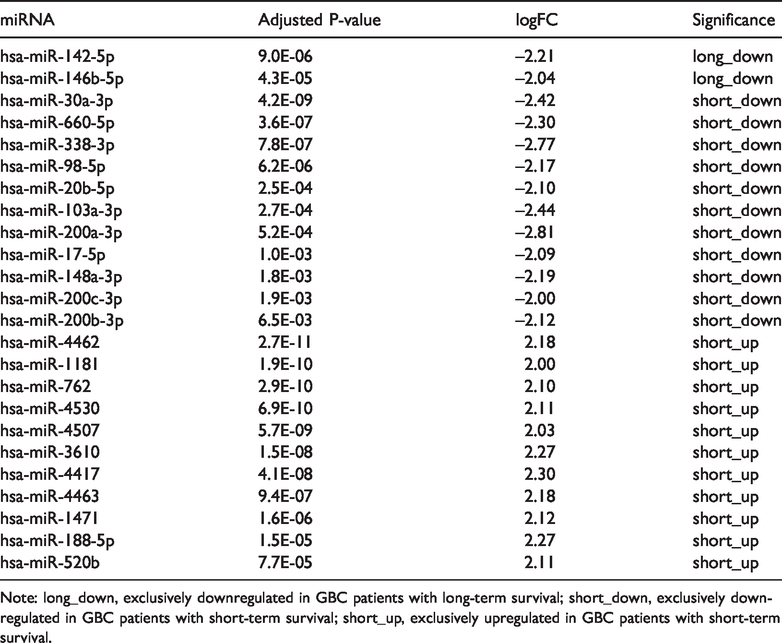
Note: long_down, exclusively downregulated in GBC patients with long-term survival; short_down, exclusively downregulated in GBC patients with short-term survival; short_up, exclusively upregulated in GBC patients with short-term survival.
Identification of dysregulated miRNA targets
Biological targets of miRNAs exclusively dysregulated in GBC patients with long-term or short-term survival were predicted by TargetScan, miRDB, and miRTarBase. Except for hsa-miR-1181, hsa-miR-3610, and hsa-mir-1471, all miRNAs had biological targets (Figure 3a and Figure 3b). hsa-miR-17-5p was found to have the largest number of biological targets (n = 358).

Networks of interactions between dysregulated miRNAs and their targets. a: miRNAs exclusively dysregulated in GBC patients with short-term survival. b: miRNAs exclusively dysregulated in GBC patients with long-term survival. Red and green indicate upregulation and downregulation, respectively.
Functional analysis of dysregulated miRNAs
Because miRNAs exert their functions via downstream targets, biological targets of miRNAs exclusively dysregulated in GBC patients with long-term or short-term survival were further analyzed by GO and KEGG pathway enrichment. Targets of miRNAs exclusively dysregulated in GBC patients with long-term survival were not significantly enriched in any GO terms or KEGG pathways. However, targets of miRNAs exclusively dysregulated in GBC patients with short-term survival were significantly enriched in 46 biological processes (BPs), 10 cellular components (CCs), 11 molecular functions (MFs), and 44 pathways. The top five enriched BPs were positive regulation of cell morphogenesis involved in differentiation, morphogenesis of an epithelium, anoikis, response to transforming growth factor beta, and regulation of cell morphogenesis (Figure 4a), while the top five enriched CCs included heterochromatin, endosome membrane, early endosome, endosomal part, and histone methyltransferase complex (Figure 4b). The top five enriched MFs were chromatin binding, receptor signaling protein serine/threonine kinase activity, core promoter binding, phosphatase binding, and protein phosphatase binding (Figure 4c). Finally, the top five enriched pathways included miRNAs in cancer, proteoglycans in cancer, the MAPK signaling pathway, signaling pathways regulating the pluripotency of stem cells, and hepatitis B (Figure 4d).
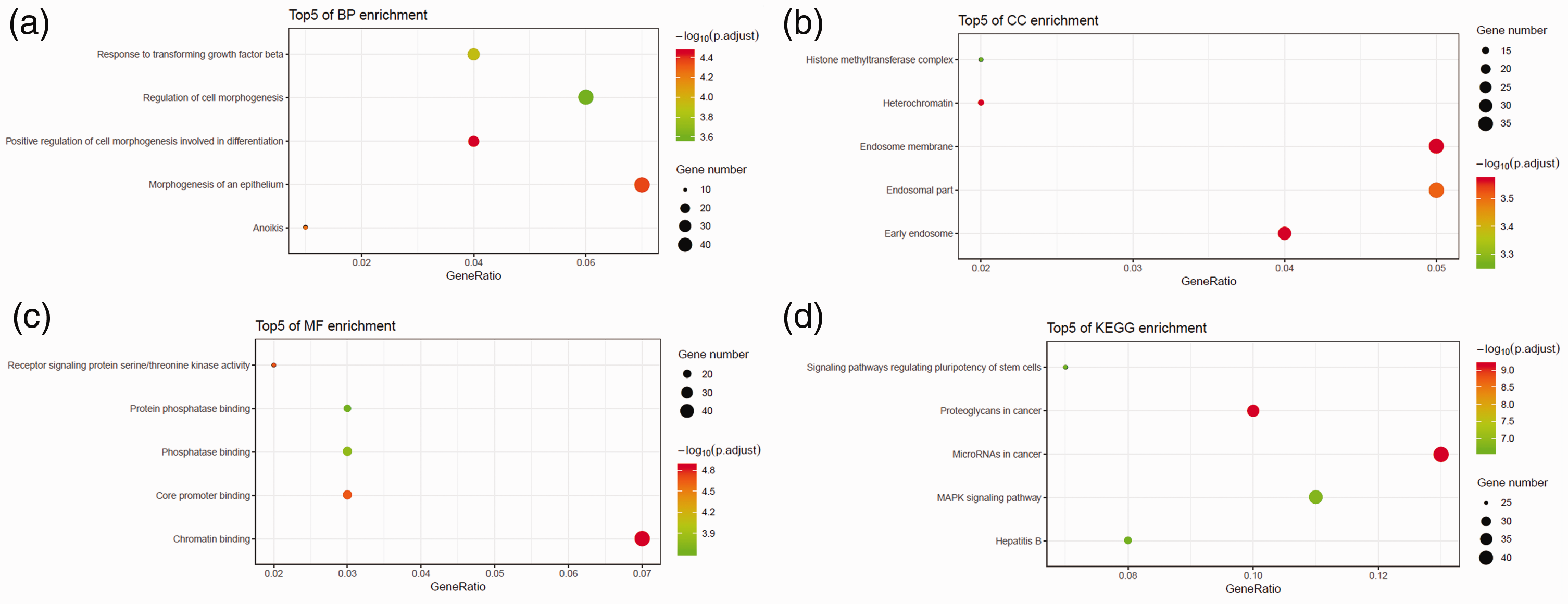
Bubble plots showing top five GO terms and KEGG pathways enriched by targets of miRNAs exclusively dysregulated in GBC patients with short-term survival. a: biological process enrichment. b: cellular component enrichment. c: molecular function. d: KEGG pathway enrichment.
Discussion
In recent years, increasing numbers of molecular prognostic markers and therapeutic targets have been identified for different types of cancer, providing an opportunity for the prognostic evaluation of cancer patients and the development of innovative cancer drugs.15–17 In the present study, we first used microarray technology to identify dysregulated miRNAs in GBC patients with long-term or short-term survival. Compared with healthy gallbladder tissues, 104 dysregulated miRNAs were observed in cancerous tissues of GBC patients with long-term survival, and 124 dysregulated miRNAs were detected in cancerous tissues of GBC patients with short-term survival. Subsequently, the dysregulated miRNAs were analyzed by a Venn diagram to reveal that only hsa-miR-142-5p and hsa-miR-146b-5 were downregulated in GBC patients with long-term survival, while 22 miRNAs were exclusively dysregulated in GBC patients with short-term survival, suggesting that these might be involved in the survival of GBC patients.
Previous studies showed that hsa-miR-146b-5p was downregulated in GBC tissues, while miR-146b-5p expression was correlated with the tumor–node–metastasis stage, liver metastasis, and differentiated degree of GBC. 7 However, the role of other miRNAs in GBC remained unknown, suggesting that they might be novel prognostic markers for GBC. To comprehensively analyze BPs, CCs, MFs, and pathways affected by these dysregulated miRNAs, we performed GO and KEGG pathway enrichment analyses for miRNA targets, and found that miRNAs exclusively dysregulated in GBC patients with short-term survival significantly affected 46 BPs, 10 CCs, 11 MFs, and 44 pathways, such as anoikis, response to transforming growth factor beta, regulation of cell morphogenesis, endosome membrane, receptor signaling protein serine/threonine kinase activity, miRNAs and proteoglycans in cancer, the MAPK signaling pathway, and signaling pathways regulating the pluripotency of stem cells.
In summary, the present study identified a set of miRNAs associated with the survival of GBC patients, which not only could be used as promising prognostic biomarkers for GBC, but also as a bioinformatics basis for further understanding the pathogenesis and prognosis of GBC.
