




Abstract
Positive mental imagery (PMI) is believed to counteract the negative effects of anxiety and depression. However, research on PMI remains nascent. Participants often report difficulties in generating positive mental imagery, including prospective mental imagery, which involves creating hypothetical future events based on episodic memory. The present qualitative study investigated the prospective mental imagery content and the influence of soothing videos on prospective mental imagery production. Twenty semi-structured interviews were conducted with participants aged 18–65 years of various nationalities. The data were analyzed using, an interpretative phenomenological analysis (IPA). The study found that prospective mental imagery content, included, regardless of nationality and age, was related to A) goals, including life a life and career milestones, B) time with family and friends, and C) travel. Participants also reported that it was easier to produce vivid PMI after soothing videos were presented. These findings suggest that regardless of the similar content across demographics, interpretation is subjective and linked to individual factors. These insights should be considered in the clinical setting when addressing mental imagery.
Introduction
Mental imagery (MI) is an internal representation of perceptual experiences without external sensory input (Pearson et al., 2015). It has been described as the phenomenon of “seeing with the mind's eye,” “hearing with the mind's ear,” and so forth by accessing sensory information from memory (namely, episodic memory) rather than from the direct perception of stimuli (Kosslyn et al., 2001)
Mental imagery has also been directly linked to episodic memory (Schacter et al. 2019). Episodic memories are the bases that allow individuals to “pre-feel” how a potential future scenario might play out. The ability to “pre-feel” is usually accompanied by strong emotions. Lang's bio-informational theory of emotional mental imagery (Lang, 1979) illustrates that experiencing mental imagery can bring on emotional reactions. For instance, Wilson et al. (2010), asked participants to generate mental imagery based on the scripts produced by both the experimenters, or by the participants. The results showed that self-reported imagery ratings were higher, and EMG activity (muscle response) in the right arm was greater, when the participants generated their own imagery scripts, compared to scripts provided by the experimenter. Similar findings can be found, when comparing aphantasia (individuals with very limited ability to produce mental imagery) participants to controls with findings suggesting higher amounts of physiological responses in controls compared to the aphantasic participants (Wicken et al., 2021). Taken together these findings suggest that the ability to generate a mental picture, and by extent its content, will have an emotional impact on individuals.
In recent years, there has been a particular focus on the connection between prospective mental imagery, and those with anxiety and mood disorders (including Major Depressive Disorder). Particularly, due to the established notion that prospective mental imagery (and other forms of mental imagery) have a higher degree of emotional and psychological impact than their verbal counterparts, namely verbal thoughts (Holmes & Matthews, 2010). Thoughts (both verbal and visual), strongly influence the intensity and worsening of the symptomology present in affective, and anxiety disorders (Brewin et al., 2010). In both disorder groups, negative rumination plays a key role on the worsening of symptoms (McEvoy et al., 2013); due to the presumed “visual”, and at times “immersive” properties of MI (i.e Holmes et al., 2007, Ehlers et al., 2002). Moreover, prospective mental imagery is believed to be key, in those who suffer from suicidal ideation or Nonsuicidal Self-Injury (NSSI)- as outlined by the integrated motivational-volitional model of suicidal behavior (O’Connor, 2011; O’Connor & Kirtley, 2018) which is consistent with Holmes et al. (2007) conclusions that those who experience “flash-forwards” (negative, traditionally suicide-related mental images, of events taking place in the future) are more likely to carry out their MI depictions.
Nonetheless, the impact of MI (and its different forms), can be traced to the content being displayed through the mind's eye. Alongside, the consensus of what is considered positive and negative content. Some studies, highlighted that content of mental imagery will protray interpersonal interactions such as conversations or events with people in their lives such as family and friends (i.e Ivins et al., 2014 and Di Simplicio et al.,, 2016). But the interaction may also extend to their co-workers (i.e Yamada et al., 2018), or assailants (Hackmann et al., 2004). However, in non-clinical populations, similar findings have also been suggested by the Imagined Interaction (II) theory, by Honeycutt (2003). This theory states that individuals visualise future interactions with significant relational partners, including family members, friends, or co-workers. This theory encompasses that individuals experience both visual (scenes) and verbal (lines of dialogue between the self and others) imagery. The theory suggests several reasons why individuals visualise future interactions, including (I) maintaining relationships, (II) rehearsing messages, and (III) self-understanding and introspection (i.e Yamada et al., 2018), or assailants (Hackmann et al., 2004).
Arguably the interpretation of the mind eye's content, will be directly linked to one's emotional status. Predominantly, one's content matches with the understanding of what is considered to be either positive or negative emotions, and emotional its associated effect. However, Weßlau et al. (2015) introduced the term 'ID-images', ID-Images are described as negative mental images with a positive appraisal/interpretation. In other words, participant visualize an act of self-harm (i.e negative content), and yet interpret these mental images as comforting. This type of mismatch between content and appraisal must be highlighted to ultimately improve therapeutic interventions dealing with mental images.
Those with depression and anxiety, are speculated to have a reduced ability to construct positive prospective mental imagery (Pile & Lau, 2020; Pile & Lau, 2020). But these individuals can still produce prospective mental imagery with external help. For instance, with interventions such as guide imagery or imagery rescription i.e., altering, (Arntz, 2012) where clinicians assist with either the production of positive prospective mental imagery or the rescription of negative mental imagery (Yamada et al., 2018), that can lead to lower levels of depression, compared to before the intervention. In addition this intervention was shown to cause lower levels of depression symptoms long-term (Blackwell & Holmes, 2017).
Another aspect that has helped with the symptoms of anxiety and depression is seeing/ experiencing soothing environments (Wilson et al., 2018). Stress Restoration Theory (Ulrich et al.,1991), outlines that nature scenes can release stress, and decrease anxiety (Huang & Lei, 2021). Particularly those who live in urbanised areas, (Lee et al., 2015, Kaplan, 1995), as it allows individuals to disconnect from their everyday lives, allowing them to relax, and thus decreasing their levels of anxiety. The impact of nature in individuals can be explained by the evolutionary Biophilia Hypothesis (Kellert & Wilson,1993) which states that humans have an inherited connection to nature. Currently it is suggested that the five major nature categories (identified by Project Soothe-www.projectsoothe.com), that individuals find most soothing; these are: water features, sky, landscapes, trees and flowers, animals, and landscapes (Mok et al., 2020). From the project Wilson et al. (2018), found that those participants with higher levels of depressive and anxiety symptoms at baseline experienced a greater reduction in negative affect and depressive mood state, as well as a larger increase in serenity affect following exposure to soothing images. Moreover, authors, highlight the connection between their findings and Lang's bio-information theory, as they argue when participants were shown soothing images (i.e., nature scenes), it accessed positive episodic memories, allowing the participant to retrieve positive information when presented with soothing images, thereby having positive affective response.
Current research, investigating prospective mental imagery, has primarily, focused on the vividness and frequency of either positive or negative content presented via prospective mental imagery, which can be measured quantitatively. These methods predominantly use cue-words to assist participants to generate mental imagery, and although some research does report appraisals, they do not go into great-depth into the appraisal of the experience. To the author's knowledge only apart from Dargan et al., (2016), no other qualitative research paper has explored the individual lived experiences of visualizing future events in-depth by employing an Interpretative Phenomenological Study. Thus, the current study asks the following questions for each of the study's sections: Yet to our knowledge apart from Dargan et al, (2016), there is no other interpretative phenomenological analysis study has explored the individual lived experiences of visualizing future events. Thus, the current study asks the following questions for each of the study's sections:
For part 1
How do individuals experience and appraise the content of prospective mental imagery? What are the individuals’ experiences in using external soothing stimuli (video) in the production of prospective mental imagery?
For part 2:
Method
Sample
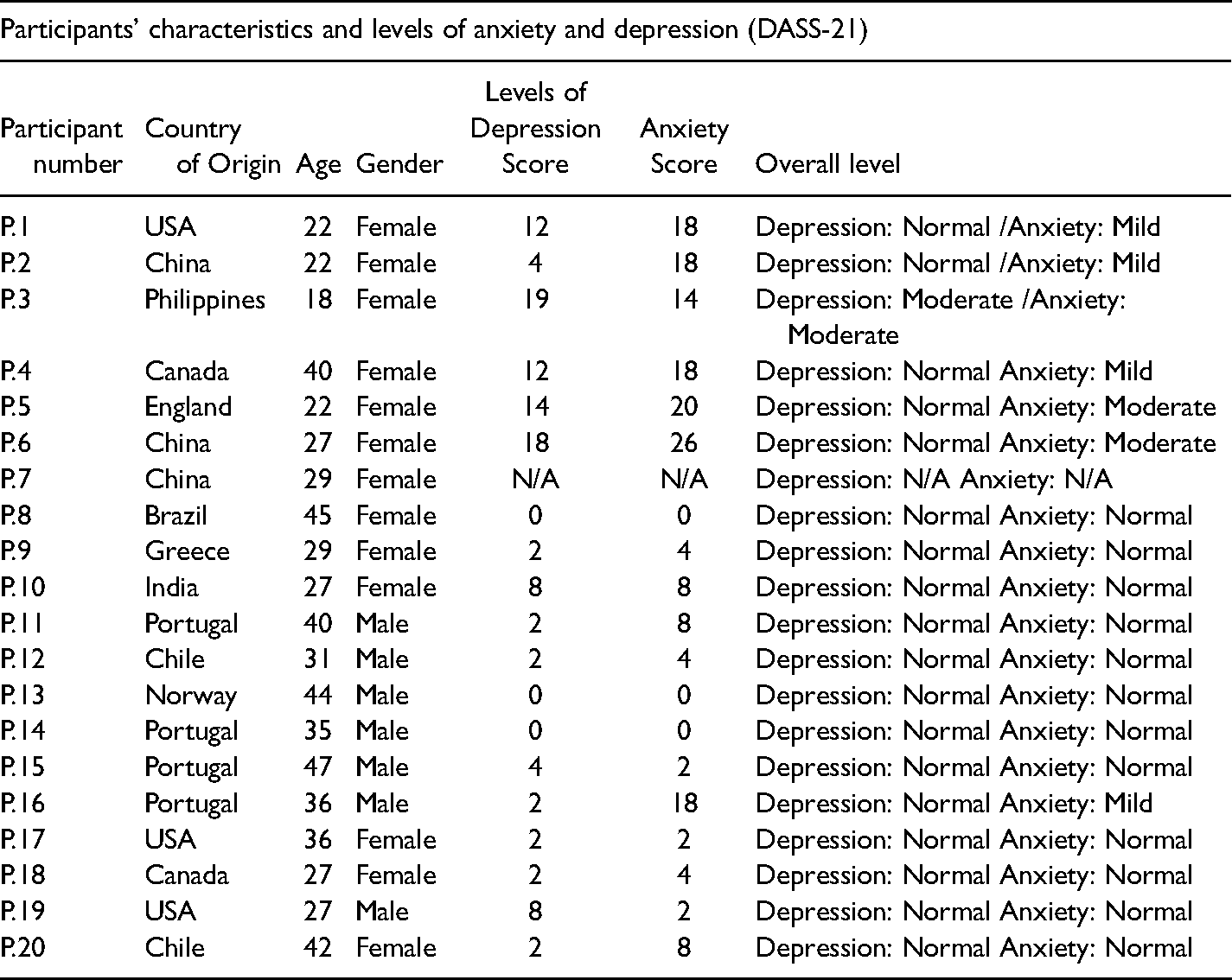
Appendix 1 provides the sampling characteristics. The participants were individuals whose ages ranged from 18–65 years old N = 20 (Males N = 7; Females = N = 13, Mage = 36.8). N = 5 were Masters students, N = 1 undergraduate student, N = 5 were PhD candidates or recently PhD graduates, N = 9, were non-students (participant demographics and anxiety and depression levels can be found in appendix 1). The participants were from the community (non-clinical) and had proficient English-language skills. The current study included individuals who felt comfortable with the soothing categories of Water features, Landscapes, Flowers and trees, Animals, and Sky. The exclusion criteria for the current study were individuals who did not feel comfortable with the soothing categories, who were currently receiving NHS treatment for psychological problems, who were visually impaired, and who had aphantasia.
Recruitment
Convenience sampling was used for the recruitment. The current study was advertised on several online platforms, such as Facebook, Twitter (now X), and Reddit. Participants who wished to participate in the study emailed the primary investigator. The primary investigator then explained the study and sent the participant information sheet (PIS) and consent form. By reading these forms, the participants were informed of the study objectives and procedures, and informed consent was obtained. Recruitment was conducted between March 2022 and September 2022. The study was given full Ethical Approval (CLS052) by the School of Health and Social Sciences at the University of Edinburgh.
Due to the potentially sensitive nature of the interviews, participants were asked to provide an emergency contact for the researcher, if they wished. Moreover, participants were allowed to stop the interview at any time. Furthermore, participants were given a week after the interview to change their minds, meaning that participants were given a chance for their interview data to not be used as part of the study. Moreover, to ensure participant confidentiality, the interviews were uploaded to the university's servers and promptly deleted once the data analysis was completed.
Materials
Procedure
Before the interview started, the participants completed a Depression, Anxiety, and Stress Scale-21 (DASS-21, by Lovibond & Lovibond, 1995), which was sent to them to complete before participating in the interview. At the start of the study, participants were briefly informed of what prospective mental imagery is. The participants were also informed that the interview they would partake had two parts (please refer to Appendix 2). The first part of the interview, the researcher invited participants for a semi-structured interview about their prospective mental imagery, which included their experiences, content, appraisal, and emotional impact that imagery had on them,personally (see Appendix 1 for the interview schedule).
In the second part of the interview (photo-elicitation), participants were instructed that they will be shown a compilation of soothing video clips [from the Virtual Nature-scape website:: https://www.virtualnaturescapes.com/], resulting in a 10-min-long video. Each clip had a duration of 30 s to 1 min. After seeing the 10-min soothing video, the participants were asked whether the video evoked any memories and the emotional impact of the memories. In addition participants were asked to visualize a hypothetical future based on or inspired by one or multiple clips. Following that, participants were asked about the content of their newly generated, prospective mental imagery and what emotions were associated with the image. After this they were asked questions regarding the link between their prospective mental imagery, existing memories and any emotions attributed to the generated mental image(s).
In the presented video, the categories (Water features, Flowers and Trees, Landscapes, Sky and Animals) were compiled randomly, and two of the most soothing clips of each category were used in the compilation, resulting in ten clips in the 10-min video. The same 10-video compilation was shown to every participant. Both these sections were conducted online via MS Teams; the interviews were audio-visually recorded. The recordings were either recorded via MS Teams or audio recorded. Moreover, the interview had a duration of about one hour.
Data Analysis
Interpretative Phenomenological Analysis (IPA)
Interpretative phenomenological analysis (IPA) is an analysis method based on phenomenology, hermeneutics, and Idiography (Pietkiewicz & Smith, 2014; Smith & Osborn, 2015). Semi-structured interviews were developed by the lead researcher. Questions for part one of the interview focused specifically on the content of prospective mental imagery, as well as appraisal. For the part two of the interview, questions focused on questions regarding the emotional impact of the video compilation, as well as, anyincluding emotional impact, any associated memories, and the content of future scenarios that participants produced based on the video compilation (please see Appendix 2 for interview schedule). Interview schedules guided by pre-determined questions, allowing participants flexibility to discuss their experiences, is a key component of IPA (DeJonckheere & Vaugh, 2019). The analyses were performed using NVIVO. Two IPA analyses were conducted for each section of the interview separately.
Researchers have opted for this approach because it acknowledges individuals’ subjective experiences and allows an in-depth analysis of the perceptions and experiences of individuals of the phenomena being studied (Smith et al. 2009). This approach is rooted in phenomenological (focus on lived experience) and hermeneutic (interpretation provided by the researcher serves as a means of gaining insight into the experiences of participants) theoretical underpinnings seeking to understand and interpret the meaning of lived inductive experiences (Neubauer et al. 2019; Frechette et al. 2020). This analysis was performed in accordance with the guidelines of Smith et al. (2009). The primary investigator read and re-read the transcripts, followed by initial experimental notes and statements. The primary investigator aligned the personal experimental themes (PET) per participant, followed by the group experimental themes (GET) across participants. Data reliability involved three reviewers (the primary researcher and two more) looking over both PET and GET and agreeing to the presenting themes as well as quotes attached to them. The Kappa Alpha was calculated in NVIVO, by CGG and LZ. The Kappa Alpha was 0.70
Researcher Reflexivity
It is important to include researchers’ reflexivity statements to reflect on how expertise and experience may have affected the interpretation of the data. The primary analysis was conducted by the primary investigator - CGG, a neurodivergent white Portuguese/Brazilian (Luso-Brazilian) female PhD candidate with vivid mental imagery, who developed an interest in mental imagery and its therapeutic potential during her postgraduate studies. CGG understood that the content of mental imagery could have an impact on mood and well-being, not only through their own personal experience but also through reading clinical literature surrounding those with mental health conditions. LZ (and the third reviewer- mentioned in the acknowledgement section) are Chinese neurotypical Nursing PhD students whose research was independent is not about mental imagery, are not only able to provide a neurotypical perspective to the data analysis but also an independent, and potentially unbiased, perspective, (not influenced by prior research) on the current findings and themes.
Results
Part 1-Subjective Experiences of Prospective Mental Imagery
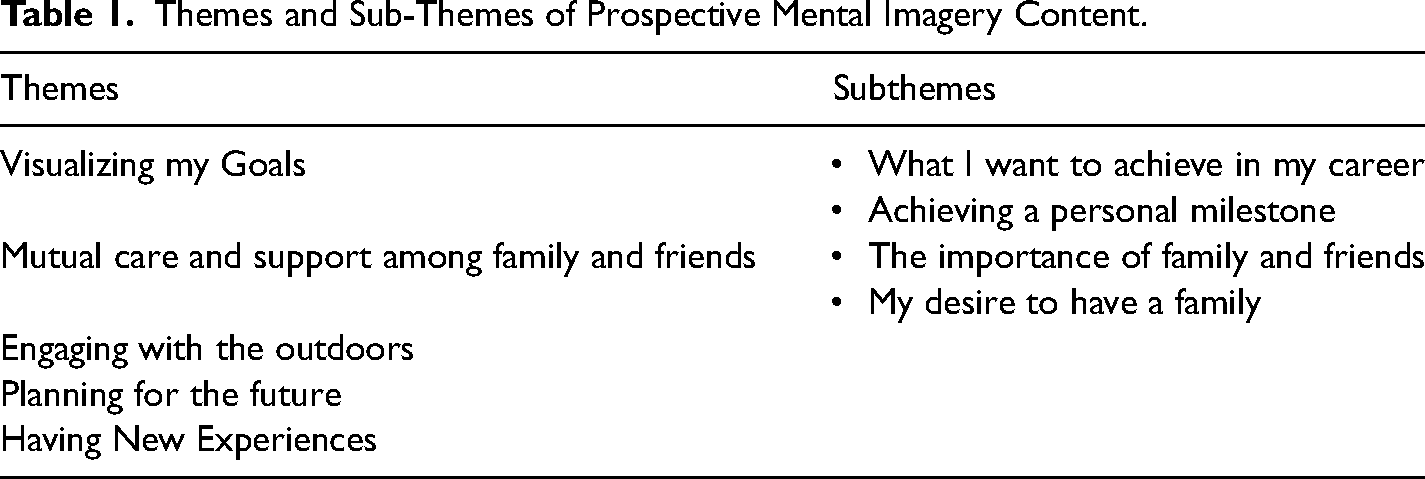
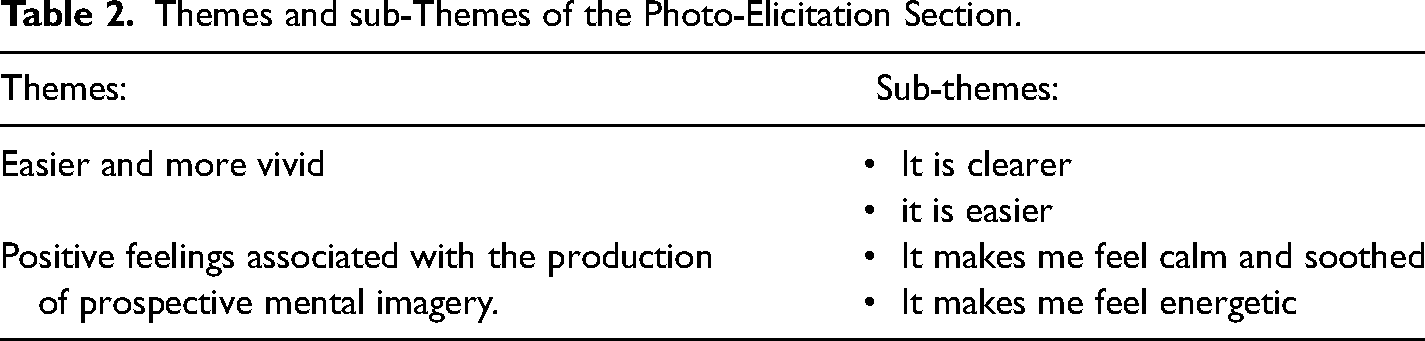
The current study is divided into two sections. The first section corresponds to the prospective mental imagery content section of the interview, and the second section corresponds to the photo-elicitation section of the interview. In the prospective mental imagery section, five themes emerged: Visualizing one's milestones, Mutual care and support among family and friends, Planning for the future and Having New Experiences (see Table 1). Two themes emerged in the second section (photo-elicitation): Easier and more vivid, and Postive feelings associated with the production of prospective mental imagery.
Themes and Sub-Themes of Prospective Mental Imagery Content.
Theme 1: Visualizing my Goals
The theme of visualizing one's milestones has two sub-themes: 1) What I want to achieve with Career- relevant to achievement in participants’ careers and professions, and 2) Achieving a Personal Milestone, the experience in visualizing relevant to achievement in their personal lives.
What I Want to Achieve with Career
The sub-theme of a career outlines the participants experiences in visualizing and reaching a professional goal, academic goal, or dream job. Moreover, participants said that visualizing the result or the end goal (work-oriented) gives them the motivation to maintain consistency to achieve their goal. However, it can also be a source of anxiety; for example, P.1 stated: I had anxiety … maybe career-wise, or just my lifestyle, or, you know, like having a family or have I written a book yet …. I had not done this yet. So, there was this disconnect of, well, in my head, I know, I could do it. But I don’t have that. At the same time, whatever I’m doing in my real life is not conducive to that.
P.1 highlights that despite being able to visualize their goals and knowing that they are able to achieve these goals, the fact that they have not done so yet, and their life is not moving towards those goals, led to anxiety. Another instance in which anxiety is attached to a professional goal is outlined by P.17, who explained: So, I give a lot of importance to work, my professional life, and my career, it's not like I want to be CEO, but I want to be successful and do my job. …, it was stress. Because [the job] certainty brings you anxiety and some stress, and then competition, the feeling of competition, …
Career goals for P.17 were driven by the desire to be successful. However, P.17 acknowledges that work can be stressful and anxiety-provoking and that the sense of competition contributes to stress. Meanwhile, P.11 has a different take on what they characterize as a career goal; their idea of a goal is to complete their PhD studies: … I’m looking forward the most to writing my Acknowledgement Page. …. It makes me emotional, even thinking about it, … So sometimes, … even thinking that if I can finish my PhD, I can dedicate this piece to her [their mother] …. ‘So I think I’m like, what I’m imagining is that, you know, closing this chapter,... ‘I feel I’m ready to have a more positive life and having something new, I’m excited about the new.’
P.11 visualizes the acknowledgment page, which is bittersweet. On the one hand, it symbolizes the conclusion of a Ph.D. and a difficult part of her life. On the other hand, the participant aims to dedicate the acknowledgment page to her mother and move on.
Achieving a Personal Milestone
Throughout the first part of the interview, participants mentioned that they wished to achieve personal milestones. These milestones included wanting to be financially independent and having certain possessions (i.e., dream houses). These mental images bring several emotions, such as happiness and satisfaction, and they are appraised as bringing a sense of satisfaction. For instance, P6 stated that they have achieved what they have strived for. I’ve become successful, and … I’ve got, like, a good income; I guess … I’ve not really had a nice income growing up. And so, it's kind of what I’ve always strove for. It’d be nice to have stability.
The participant recalls the lack of monetary funds growing up, and they now visualize financial stability. This narrative suggests an important link between stability, success, and good income. The participant appraised the images surrounding money as success and stability and reported having a positive emotion toward the visualization. Meanwhile, a personal goal for P.17 means having a house: … It is for some years now, I have this thing of getting myself a house, in the countryside, my house with terrain, where I can grow my own vegetables and my chilli peppers that I love so much. …. I always visualise myself in that environment. And, of course, very happy taking care of that space and nature.
Both P.6 and P.17 visualized having a house in the country for similar reasons. Nevertheless, while P.16 emphasizes natural noise, P.17 values serenity (appraisal) and mentions the wish to engage in gardening activities. The narrative also provides readers with a happy mental picture. P.17 places emphasis on having a place of their own and states that they have been imagining it for years and want to accomplish this personal goal.
Theme 2: Mutual Care and Support among Family and Friends
The theme “Mutual care and support among family and friends” is highlighted by participants when emphasizing the significance of the people around them, with a particular focus on those who are closest, namely, their family and friends. The current theme can be divided into two sub-themes: “The importance of family and friends”, which highlights the occasions in which participants will be there for their friends and “Having a family” which highlights the participants’ desire to start a family.
The Importance of Family and Friends
Participants demonstrate this theme by visualizing the times they hope to spend with their family and friends (in the future). For instance, P.19 – hoped to be present and support their friends at their upcoming wedding. … two decades, and we’ve had this joke that I would be her man of honor . .. my friend I know how much she loves the beach. So, I imagined like a beach site wedding a sample arch, my friend's there and her friends … of course me and everyone in green …. So … [the with] like a green dress me with a green tie. … I imagined him [the fiancé] and his army buddies …
Meanwhile, P.13 discussed how they want to support their child's future endeavors. My son is 15. He's going to kindergarten School, which is …, let's say, it is atypical, for a guy who is 15 years old to become a kindergarten person. As for me, I don’t care what kind of school he goes to. He doesn’t need to become a lawyer or follow my footsteps going to the Army or Air Force or whatever. I want him to do what is making him happy. And I will support that.
Both P13 and P.19 discuss supporting those who are close to them (P19–a close friend and P.13 their child) on their choices. The narratives suggest a sense of happiness in their designated role as supportive figures.
My Desire to Have a Family
This sub-theme was shared as participants recounted their desire to start a family and have a life with their family. P.6 explains as follows: “that's kinda like a positive thought I want, like, I’ve always wanted a family. And it's just something that plays a lot of importance so, like, I visualize a nice husband, a nice house, a nice, happy, positive life”.
P.6, the idea of a “positive life” is to have a family. The image of having a family was of high importance to the participant. This narrative suggests that stability refers to a positive and happy future that involves having a family. In addition, P.6 mentions “a nice house,” which suggests that financial stability is important. P.19 describes the daily activities of a new family and how they might look in the future: So there's some images like … walk the dog and having the baby strapped to me, in a baby carrier, and like, Yeah, going out walking in [local park] … going to the baby sing along or like story reading at the library and meeting other parents would be quite fun. Sort of, yeah, getting out and meeting people ….
Both P.6 and P.19 imagine having a family; nevertheless, P.6 tends to focus on the overall picture and the happiness that a family will bring to their life., P.19 has more specificity in its content; P.19 appraises the image as a fun and wholesome experience. They had clear images of what this new family would bring about. While P.20 imagines specific conversations that their children could have: “You know, it was pretty cute that was a pretty nice atmosphere. Pretty warm atmosphere. And then, yeah, I could see like the kids saying stuff like oh, yeah, my mums like a nurse. My dad's a physiotherapist.”
For P.20, they could see their children, but most importantly, they could see what sort of conversations they would have and what their children would say about them (in terms of their career). This narrative suggests that the participants are proud of the professions they chose, and their children will reflect on this in the future, demonstrating the profession's importance to this person and how this will play a role within the family. Nevertheless, P.1 clearly shows that they wanted to have a family, but the sentiment was rather bittersweet:. “I’m on the bus, and I see a kid, that I’m like, oh, man, and then I start thinking about what I want and how I haven’t done that yet.”
This shows a disconnect between what they want and what they have not done—between the present and the future self.
Theme 3: Enagaging with the Outdoors
In this theme, participants reflected on future events that were primarily relevant to activities engaged in outdoor settings.
Participants reflect on future events that are related to activities engaged in outdoor settings, ranging from exercise outdoors to having dinner outside. For instance, P.17 mentioned the following: … going on a little adventure, you know, whether it was biking to a beach and going swimming, or . .. you know, driving to do a wine tasting, or something like that would be really nice, but sort of getting out and doing something during the day. And then having some nice dinner plans, sitting outside and having some lovely food and nice wine
P.17 reflects on planning activities outside, which include going for a swim and later that day have dinner outside, while P.16, visualizing sports and physical activity, “Surfing back in [coastal country]”, which is similar to P.12 in which they state: “I imagine myself running, you know, here, I live very close to [local hill]. So, I imagined myself just doing some sport and running, or something like that.” Both participants visualized physical activity outdoors, while P.17 visualized physical activity as well as non-physical activity carried out in an outdoor setting.
Theme 4: Planning for the Future
Participants demonstrated that they used their mental images as motivational tools. Essentially, it helps them achieve their ambitions and goals, but above all, it helps keep them motivated. The sub-theme underneath the motivation is “planning”. Planning, outlines the participants experiences, using their prospective mental imagery, to plan out activities or daily schedules.
Participants reported that they visualized their days or processes with which they would engage. For instance, P.10 states that:
“… A lot of motivation comes from insight or intrinsic motivation, … I am about to wake up, I, I kind of pass my daily schedule in my mind … So I have to do this, this, this, this is going to be my day. Or . .. what is going to be my week of work and of course, … my life is aligned, everything is kind of under control. …”
This narrative suggests that having an image of what will happen that week makes them feel controlled (appraisal). This suggests that having the ability to pre-feel prospective mental imagery (i.e., the emotions that this imagery evokes) is important for individuals to develop motivation (appraisal) to achieve their needs. Similarly, P.19 stated: … Like, yeah, I think it’d be quite nice to go on campus and see people, but I think the planning has the recency effect of the planning. … So, it's sort of future imagination of what it's going to be like.
Both P.19 and P.10 have images of their day's activities; although both have high specificity, P.19 is more focused on work and what they must do for their current work project. This narrative suggests that mental images are used to list what to do and when.
Theme 5: Having new Experiences
The prospective mental imagery generated by participants also included future travel. Individuals mentally pictured their next trips and new experiences. This sub-theme is depicted by the mental picture of the potential experiences they will experience on that trip. For instance, P.21: And I imagined Tokyo because that's been a place I’ve wanted to go since I was literally a child. I imagine … that a crazy eight-person walkway square in Tokyo, all the busyness around me, I just have this image of me standing there. In addition, the stereotypical scene of someone seeing Times Square in New York for the first time, where they’re looking up at everything, and they’re kind of awestruck. Everybody's just going around, like it's no big deal. …. But for me, it is like this huge grand thing.
P.21 does not appear to base their future-based mental image on previous experience, but rather on a stereotypical scene. Therefore, they are projecting/basing a stereotype on their future, reflecting that they would feel “awestruck” and travel to a place they wanted to since they were a child., Meanwhile, P.12 is driven by a desire to experience other cultures. “I’ve always been a person who really likes to travel because it's not like a hobby. …is … an important part of my life … I really want to like, explore, and experience different cultures. And I want to understand the experiences of people who are not like me … something that I really want to do. … It is also an important goal for me to experience different things. …”
P.12 sees travel as an essential part of their lives; for the participant, it is important to experience different cultures and see and understand how different people live their lives. This is connected to their past experiences, sense of self, and core beliefs since they view this as part of their personality.
Part 2
Findings- Photo Elicitation
In the photo-elicitation section, participants were asked about their experiences in using the soothing video as base of their prospective mental imagery. The following themes and sub-themes of the photo-elicitation section can be found in Table 2
Themes and sub-Themes of the Photo-Elicitation Section.
Theme 1: Easier and More Vivid
The theme “Easier and more vivid” has two sub-themes “it is clearer” and “It is easier”. This theme outlines the participants experiences of using external stimuli (in this case the soothing video mashup/compilation). In particular, it relates to the generation and vividness of a prospective mental image. This sub-theme illustrates that participants found their future scenario using their mind’s eye, more vivid (or clearer), when the scenario was based on a soothing video clip(s). This can be exemplified by P.9:
It is clearer
“[the soothing] videos really helped me to imagine… the scenarios more vivid” Similarly, P.6: “… when you're seeing an image, … it's [more] clear so it's not as like blurry as if there wasn't help from like the visual photo or video.”
P.6 and P.9 outlined similar experiences when using soothing videos as bases for prospective mental imagery. Nonetheless, P.6, provides further insights on the vividness of the prospective mental imagery(in the absence of external stimuli)- P.6 describes it as “blurry”, and the presence of the soothing videos helped with the vividness of their mental picture. P.14 builds on P.6’s experience by stating: “I think it was really vivid for me, … I cannot really imagine myself ‘. But with the [soothing] images … it was really concrete. I mean, I [do not] create [too] much. It was just insane; I inserted myself there. Straightforward. … it was really simple and concrete. I mean, you put that [soothing] image, and I imagined myself, feeling that kind of landscape with my wife and with my daughter…
P.14 provided insight into, not only the vividness of the mental picture, but also into, their lack of engagement with prospective mental imagery as mentioned in the following passages: “I can’t imagine myself “or “I [do not] create too much” illustrating that they traditionally do not engage in prospective mental imagery. Nonetheless, when engaging with prospective mental imagery alongside the soothing videos, they describe the experience as insane when referring to the vividness, but also, to an extent, the immersion of the experience, particularly when referring to feeling the landscapes with their family (wife and daughter).
On the contrary to P.14, immersion, and by extent the vividness, of the produced mental image is not a shared by all participants, P.2 states I think …it's just [the video was shown in]my laptop screen so it's not so immersive. … but I try my best to put myself into this scenario. … I can't really imagine and fit myself into that [because] it's not so immersive.
This narrative provides an opposite view to previous accounts, particularly surrounding the element of immersion that P.14 lightly alludes to in “feeling the landscape”. Due to the videos being presented via MS teams, it did not allow P.2 to visualize a future scenario and experience it in their mind's eye.
It is Easier
This sub-theme outlines the experiences relating to the act of generating a future-scenario based on the soothing videos. P.19 refer to the videos to allow for a concrete and easy to produce mental image: the videos, I think, …[it] did have something physical to look at. And it was more concrete, … I guess, gave a grounding, a focus that was easier to think about a future scenario related to that.
Here the participant outlines that the act of physically looking at the stimuli made it easier to produce the mental picture. Similar, experiences are uttered by P.17: “I would say that maybe … the support of the multimedia, maybe it can … direct you, … you are more contained in the imagination…”
These narratives seem to suggest that having the stimuli may help “direct” and “contain” prospective mental imagery, thus making easier to produce. Nonetheless, P.11 takes a different stance exemplified by: I think it was with looking at the videos. It was easier for me to dig in my own memories. So, I feel like the ones that stood out for me the most, are the ones that I already have an image [of] my past. But looking at them, it was much easier to recall them and imagine again, because it made, you know, the set out the things or the context … sometimes for me, they're quite blurry. It made it specific. So, I was able to actually contextualise my feelings.
The narrative above seems to suggest that the videos have three roles. Firstly, it helps to bring specific “memories” to the surface. Secondly, it realigns memories to visualize a new scenario- highlighted by the reference “recall them and imagine again”. Thirdly, the videos provide “context” to the mental image as well as the feelings of the participant.
Theme 2: Positive Feelings Associated with the Production of Prospective Mental Imagery
The theme “Positive feelings associated producing the prospective mental imagery” represents the overall positive experiences outlined by participants, when asked about the emotional/psychological impact of a prospective mental imagery following the presentation of the video compilation. The present theme has two sub-themes. “It makes me feel calm and soothe”- which outlines the experiences after producing the mental image; and “It makes me feel energetic”- this subtheme, describes the experiences relating to feeling excited, and energetic after generating a mental picture about a future event.
It Makes me Feel Calm and Soothed
This subtheme, encompasses, the participants feelings experienced after generating a future-based mental picture. The participants reflected on their feelings of being soothed, and the calmness that image generation evoked. This can be exemplified by P.12: Good, it makes me feel very calm … make me feel that I do have something to look forward to- away from all the hustle and all the busyness of the things, makes me feel very assured.
This narrative suggests that after generating future-oriented mental picture, the participant felt calm. However the narrative also suggests, that the generation of the mental images assisted the participant to look forward to what one can assume a specific future event. In opposition to P12 who highlighted the calm feeling helped them to ‘look forward’ P.8 reflected on how the mental images helped them to focus on their present self. They said,: Yeah, one thing about those mental images, I think it's like, a way to soothe your mood, like, like emotional regulation … can improve my perception of myself, how to perform, but I guess. … I'll probably will perform well, better, rather than [focus] in this ... stress.
Unlike P.12, P.8 explicitly mentions that the generation of the prospective mental imagery as “a way to soothe your mood”- potentially classifying it as method to self-soothe. This, further highlighted by the P.8 reference to “like emotional regulation”. Participants go further, describe how they utilize their prospective mental imagery as seeing the action “how to perform”. Nonetheless, Both P.8, and P.12, both refer, to stress and “busyness”, associated to their current circumstances, and how prospective mental imagery, can calm or soothe their minds. P.16 describes the similar soothing feelings after the generation of prospective mental imagery. Think it made me feel happy and relaxed and lacking the word now… privileged, yep. Because, of course, … I would have either[sic] enough savings to do that without caring or found a job that allows being such location [near the beach]. Of course, to decide to live in such location and being able to do those physical activities[surf] means at least we're healthy.
This narrative seems to suggest a degree of uncertainty- unlike P.12. On one hand, the participant felt relaxed as a result of generating prospective mental imagery. On the other, they explicitly mention the external factors, that they would meet to achieve the mental image depicted in their mind's eye, such as finding a job or having enough savings. The narrative further highlights the uncertain tone, when the participant mentions “means at least we’re healthy”- when referring to the relationship between the physical activity and being healthy as if that relationship is the only certainty they have.
It Makes me Feel Energetic
This subtheme, highlights, the feelings of excitement, motivation, and overall positive feelings. This can be exemplified by P.2: Yeah. … Very happy. Excited. … They [the mental images] can push you to work harder just like “Oh, next week. Or next year after graduation. I can go travelling with my boyfriend”. Oh, you need to work hard now. Then you can travel happily.
This narrative suggests that after generating the mental image the participant felt excitement. Here P.2 highlights a sense of being motivated; particularly, when they referred to “push you to work harder”. Similar notion of motivation has been exemplified by P.14. Yeah. … I would say … excitement with this kind of filling your belly ... something really you want to do. I mean, you really want to do it. … I have been really, really stressed during the academic year, but then you have the chance to go there in Summer. Like that's worth it's like that. Something that really motivates [you]. Yeah. So, excitement, and this kind of looking forward. So, I'm really looking forward to it [moving back to their home country].
Unlike P.2, P.14 explicitly mentions excitement and looking forward to a specific event (in this case moving back to their home country). P.14 also mentions the physical feeling of being excited over the mental picture, that was just generated. Nonetheless, when the mental images were generated by the participants, some participants also report other feelings other than just excitement, but, also a mixture of feelings. This can be exemplified by P.21: Excitement … not really nervousness, but there was like a sense of like, anticipation and excitement to it. There was obviously the idea of joy of being with one of my best friends. And obviously that's always a fun time so laughing, enjoying that. … But there's an emotion I always feel when I'm out travelling. That immediately puts me in my happy place but it also I don't know it kind of makes everything quiet and peaceful in my head for a minute. …kind of that feeling of quiet.
This narrative suggests a mixture of feelings, such as excitement, quiet and peaceful. The narrative implies explicitly that there is a sense of anticipation. Nonetheless, P.21 infers that the generation of their prospective mental imagery based on the video mirrored the same feelings when they travel “quit and peaceful in my head” proposing the visualization, potentially, quietened the verbal thoughts. Surprisingly, another perspective was uttered by P.11, when they referred to the experience as “Adventure adventurous, hopeful, relaxed. Yeah. Nice.” Outlining, that they felt a few feelings occurring at once but they didn’t go into detail. However, P.17 did go into more detail when describing the feeling of “adventurous”: Well, the first one, maybe it's more that adventure, that thrill of going somewhere for some time and just going [sic]adventure and then having fun with friends and just enjoying the time. Second one, of course, it brings you some level of happiness and comfort.
The narrative describes the feeling of adventure, the thrill of going to a different location. Yet, the narrative does not explicitly read as if it was a new place, but rather a location that they can be with their friends and enjoy their time. The narrative suggests that out of that time spent with people, the participant feels happiness and comfort.
Discussion
The current study had two aims, one for each section of the study. The first was to explore the content and appraisal of the prospective mental imagery (PMI). The second aim was to explore the individuals’ experiences in using external soothing stimuli (videos) in the production of prospective mental imagery. Firstly, the current study found that individuals can appraise their prospective mental imagery content as both positive (meaning individuals felt good when visualizing prospective mental imagery content), and negative experiences such as a source of stress, anxiety, and disappointment (discontent between their present and future selves). Secondly, for the current study, individuals found it easier to use an external stimulus as the base of their generated prospective mental imagery (compare to the times in which they had to produce this spontaneously). Additionally participants report being left (after the production of PMI using soothing videos) with positive feelings such as happiness, calmess and excitement.
Regarding the first section of the current study there was a diverse representation of nationalities and ages. Yet similar content was observed across participants which primarily focused on their interpersonal relationships. The connection between, the people who surround the individual, and their influence over the content of MI has been a source of debate among philosophers, who divide into two camps. On the one hand, some believe that the content of one's imagination (or MI) is entirely an intrapersonal experience without the influence of the outside world. Meanwhile, the second camp places emphasis on the role of the outside world (including social and cultural norms) and how this influences the content of one's MI; the second camp also believes that external stimuli including books or artwork can also influence one's MI/imagination content (Zittoun et al., 2020). However, to the authors’ knowledge, no study has compared the content of MI or prospective mental imagery across cultures or its psychological impact on the individual.
The current findings is consistent with the latter view (the outside world, including social and cultural norms, influencing the content of one's MI), and somewhat in line with the wider literature. Particularly the content involving interpersonal interactions. The imagined interaction theory (at its extension: the conflict link theory) by Honeycutt, (2003) states that individuals visualise interpersonal interactions between themselves and other important or relevant individuals such as familial members, friends or partners. Which in par allows to rehearse a hypothetical future interaction, based on previous experience. Honeycutt (2008) outlines that there are several reasons as to why individuals visualise interpersonal interactions, these can include, self-introspection, lack of actual interaction or rehearsal for future interactions. The current finding supports this theory by showing that the majority of prospective mental imagery content involved family members or friends.
The present study is in line with Honeycutt (2003; 2008) conclusions, as spending time with family and having a good and stable family life is often noted as a ‘dream’ by several participants, and was appraised as good, and heartwarming. In addition, The participants reported feeling happy, energetic, and excited about their goals (both personal and professional) when visualizing them. These conclusions have also found to be consistent in the wider literature for example Blackwell et al. (2013) who reported that the ability to generate vivid mental imagery of positive future events can improve both mental health and even physical well-being. Visualising future scenarios affects the “carry it through action,” allowing the individual to pre-feel their end goal (Ji et al., 2016). The conclusions drawn from Ji et al. (2016) and Renner et al. (2019)- have somewhat supported our qualitative findings depicted in the second part of the study. As participants in the second part also reported feelings of excitement and motivation after generating a specific prospective mental image of a future event.
In addition, the current findings (both sections results) also suggests that prospective mental imagery can be used as motivation for individuals to achieve their goals. These findings are consistent with Stawarczyk et al. (2013), and Liefgreen et al. (2020), who reported that individuals, when they mind wander, visualise their personal goals. Furthermore, the present findings are somewhat consistent with the notion proposed by Motivational Amplifier Hypotheses (Renner et al., 2019), which claims that mental imagery promotes motivation and engagement of planning pleasant and rewarding activities. Another way the current findings somewhat support the literature is when participants reported feeling happy, energetic, and excited about their goals (both personal and professional) when visualizing them. The positive emotions and appraisal has been associated with improved well-being and decreased long-term anxiety and depression symptomology (Carver et al., 2011).
Nonetheless, the current study showed that individuals can also experience negative appraisals with connection to their goals. These experiences have not been explored in depth within the literature. In the clinical literature, prospective mental imagery content surrounding goals are traditionally associated with positive appraisals and emotional impact (i.e Renner et al., 2019). Meanwhile, participants in the current study reported feeling anxious and stressed when visualizing future goals. Particularly, having a disconnect between their present circumstances and what they want to achieve in the future. One could argue or prospective mental imagery being used as a reminder of where they should be, or should already have achieved. Even though, negative emotions are not traditionally associated with personal goals, (as depicted in the clinical literature), the experimental literature has acknowledged the presence of negative emotions associated with personal goals (Bossuyt et a., 2014).
The current study found that content portraying goals, included, finishing a degree, having a certain grade, getting a promotion, and having the dream job. These findings somewhat reflect other research, for example., Ivins et al. (2014) and Yamada et al. (2018) who concluded that positive mental imagery made individuals visualize being praised for a good job. The current findings also show that participants imagine achieving personal life goals like starting a family, which is a novel finding. This might be because, the current study had a large number of participants were young women under the age of 30 (appendix 1) Like the current study, the family has been depicted in previous research as a positive image, particularly in the light of birthdays, celebrations, and holidays (Ivins et al., 2014).
Imagining traveling is a finding that is not common in the literature, apart from Ivins et al. (2014), and M’Bailara et al.(2024) where participants imagined skiing in the Alps, travelling to Barcelona, travelling to the Maldives, and climbing Kilimanjaro The current study (the results of both sections) conclude that travel is associated with longing for different scenery, having new experiences, freedom, or simply having a good time. Ivins et al. (2014) findings differ (form the current study) in the perspective that an individual wanted to travel to achieve something. The current study, however, does not see travelling as an accomplishment but rather as a desire for freedom, exploration of a new culture, or new experiences. One potential explanation for the discrepancy between our findings and the wider literature could be the difference in samples. Ivins et al. (2014) and M’Bailara et al. (2024) recruited participants with a bipolar diagnosis, while the current study solely recruited a sample from the non-clinical community.
The second part of the study primarily focuses on the experience of producing prospective mental imagery, after being exposed to soothing stimulus. To the author's knowledge there has been limited studies that investigate the generation of prospective mental imagery -without focusing on the mental imagery vividness. In fact, a large portion of clinical studies focus primarily on the generation of vivid mental imagery rather than generation ability alone (for example: Blackwell et al., 2013; Holmes et al., 2016). To the authors knowledge this is the first study that connects both film clip (of neutral/positive nature) with the generation of prospective mental imagery. The closest, the literature, has come is on the effects of the trauma film paradigm. The paradigm outlines that a trauma based- film (stress/trauma-induced imagery) will induce film related intrusive mental imagery, and negative emotions or feelings. (i.e., Holmes & Bourne, 2008). Using the same logic, a positive film clip would propagate positive emotions or feelings. Thus, to an extent, the current findings support the trauma film paradigm on the grounds that a film clip, can induce mental imagery, and have an emotional impact.
As mentioned above, the content of prospective mental imagery can cause positive and negative emotional impact; however, it can also be derived from specific emotions. The findings suggest a bidirectional relationship between the content of prospective imagery and the emotions that the individual is experiencing. This finding fits with Lang's (1979) bio-informational theory of emotional and mental imagery, which suggests that mental imagery can evoke emotional responses. This can enhance or limit emotional experience. For instance, the current findings demonstrate the presence of escapism content, imagining a better situation than the participant's current situation—particularly a positive scenario (freedom of circumstance or obtaining financial freedom). The wider literature has noted escapism in connection with suicidal visualization rather than, traditionally viewed positive future thinking. Nevertheless, escapism has also been associated with comfort as “a way out” from the current situation (Hales et al., 2011).
Limitations
The current study has some limitations. First, some participants did not understand mental imagery (or required extensive clarification), refused to engage with questions, or completely missed the point of the question (by providing an unrelated answer to the question). Second, the interview questions were open. The researcher had to provide examples to guide the interviews and offer continuous clarifications. Third, some participants’ feedback highlighted that they engaged in mind-wandering instead of relaxing and observing the video. Finally, the current study did not measure for aphantasia, we relied on the participants self-awareness. All of these factors could potentially influence the present findings by providing a less-than-optimal account of personal experiences. Furthermore, based on the connection between autobiographical memories and prospective mental imagery, one could argue that primary effects could have influenced participants’ replies, particularly within the second section of the interview. Therefore, the definitions and conclusions derived from the present study must be carefully interpreted.
Future Recommendations and Conclusion
Future studies should continue to explore the impact of mental imagery content on individuals and how clinical and non-clinical individuals appraise it. Future studies should explore how soothing environments impact the construction of mental imagery and how best to implement them in clinical practice. To further assist with clinical practice, future research should explore how different cultural backgrounds and norms influence the content of mental imagery and how they differ. In addition, taking into consideration not only the content but also how the content is integrated into certain cultural backgrounds/norms may help clinicians not only to have a better understanding of the issue their client is facing but also better rapport and therapeutic outcomes.
Potential Clinical Implications
The current study has shown that participants feel that it is easier to produce a mental picture based on an external stimulus. These findings, along with the conclusion of Wilson et al. (2017), suggest that external stimuli may help with the production of positive prospective mental imagery. Interventions, such as imagery rescription or guided imagery, may benefit from the use of external tools such as images and videos to help those with higher levels of difficulty in mental imagery production. For example, traditional therapeutic methods, such as CBT involves engaging with homework assignments; soothing stimuli can easily be used as a homework assignment because of its availability and low demand on resources.
In conclusion, this study investigates the content of mental imagery of non-clinical individuals and is also one of the first studies to connect mental imagery with soothing environments (MacLennan et al., 2023). Our findings suggest that the most frequent content is milestones (personal and professional), travelling, and family; similar content is also observed when individuals use soothing environments to produce their prospective mental imagery and recall past episodic memories.
Footnotes
Acknowledgements
We would like to thank Miss Xiaoyang Li for discussing and reviewing the themes and subthemes presented in this study.
Declaration of Conflicting Interests
The authors declared no potential conflicts of interest with respect to the research, authorship, and/or publication of this article.
Funding
The authors received no financial support for the research, authorship, and/or publication of this article.

Appendix 1
| Participants’ characteristics and levels of anxiety and depression (DASS-21) | ||||||
|---|---|---|---|---|---|---|
| Participant number | Country of Origin | Age | Gender | Levels of Depression Score | Anxiety Score | Overall level |
| P.1 | USA | 22 | Female | 12 | 18 | Depression: Normal /Anxiety: Mild |
| P.2 | China | 22 | Female | 4 | 18 | Depression: Normal /Anxiety: Mild |
| P.3 | Philippines | 18 | Female | 19 | 14 | Depression: Moderate /Anxiety: Moderate |
| P.4 | Canada | 40 | Female | 12 | 18 | Depression: Normal Anxiety: Mild |
| P.5 | England | 22 | Female | 14 | 20 | Depression: Normal Anxiety: Moderate |
| P.6 | China | 27 | Female | 18 | 26 | Depression: Normal Anxiety: Moderate |
| P.7 | China | 29 | Female | N/A | N/A | Depression: N/A Anxiety: N/A |
| P.8 | Brazil | 45 | Female | 0 | 0 | Depression: Normal Anxiety: Normal |
| P.9 | Greece | 29 | Female | 2 | 4 | Depression: Normal Anxiety: Normal |
| P.10 | India | 27 | Female | 8 | 8 | Depression: Normal Anxiety: Normal |
| P.11 | Portugal | 40 | Male | 2 | 8 | Depression: Normal Anxiety: Normal |
| P.12 | Chile | 31 | Male | 2 | 4 | Depression: Normal Anxiety: Normal |
| P.13 | Norway | 44 | Male | 0 | 0 | Depression: Normal Anxiety: Normal |
| P.14 | Portugal | 35 | Male | 0 | 0 | Depression: Normal Anxiety: Normal |
| P.15 | Portugal | 47 | Male | 4 | 2 | Depression: Normal Anxiety: Normal |
| P.16 | Portugal | 36 | Male | 2 | 18 | Depression: Normal Anxiety: Mild |
| P.17 | USA | 36 | Female | 2 | 2 | Depression: Normal Anxiety: Normal |
| P.18 | Canada | 27 | Female | 2 | 4 | Depression: Normal Anxiety: Normal |
| P.19 | USA | 27 | Male | 8 | 2 | Depression: Normal Anxiety: Normal |
| P.20 | Chile | 42 | Female | 2 | 8 | Depression: Normal Anxiety: Normal |