



Abstract
In April 2017, scientists and science sympathizers held marches in the United Kingdom as part of a coordinated international March for Science movement that was held in over 600 cities worldwide. This article reports from participant-observation studies of the marches that took place in London and Cardiff. Supplemented with data from 37 interviews from marchers at the London event, the article reports on an analysis of the placards, focusing on marchers’ concerns and the language and images through which they expressed those concerns. How did the protesters articulate their concerns and objectives, and how were these articulations used to build a community? The placards did not represent a clear, focused, and unifying message; they instead illustrated disparate concerns ranging from human-induced climate change, Trump and “alternative facts,” and local UK specific political issues concerning the country’s exit from the European Union. Our analysis shows that placards gave a playful and whimsical character to the march, with slogans displaying significant amounts (and moments) of humor, often formulated through insider jokes, scientific puns, or self-deprecating appropriation of negative stereotypes about scientists. We analyze the march through the social movement literature and as a collective identity-building exercise for an (emergent) community of scientists and sympathizers with long-term aims of establishing a louder voice for scientists, and experts, in public discourse.
Introduction
The March for Science, held in Washington, DC on the April 22nd, 2017, as well as more than 600 other cities worldwide (Sasse & Tran, 2018), was organized as a grass-root protest by scientists and science sympathizers ostensibly as a reaction to the election of Donald Trump to U.S. president. Inspired by the “Women’s march” 3 months earlier—also a response to Trump’s political ideologies—the March for Science took up themes, which collectively signified concerns by scientists and scientific sympathizers that they and their professions were not taken as seriously as they felt they should. It thus represented a collective outcry of a diverse range of scientific concerns: not only over Trump and “alternative facts” but also about climate change, alternative medicine, antivaccination movements, general public ignorance of science, lack of funding, lack of respect and, in the United Kingdom at least, Brexit (the referendum on exiting from the European Union) and conservative politician Michael Gove’s now infamous populist remark that the public “has had enough of experts” (Clarke & Newman, 2017).
As a site for scientists marching against all that they felt was wrong with science and science governance, the March for Science provided a rare opportunity for science studies academics to get a snapshot of the ways in which those marching conceptualized the relationship between science and society, what they were concerned about, and how those concerns were being enacted, performed and brought to life. For this study, we conducted dual-sited participant observation at both the March for Science London and the significantly smaller equivalent in the Welsh capital Cardiff. With permission from the march organizers, we photographed, filmed, and made field notes of the march and our experience of it, and approached marchers in London for vox-pop style interviews (37 with 45 interviewees). With a particular interest in the representations of science and scientific concerns, we recorded as much of the content as was possible of the many march signs, banners, costumes, chants, and songs.
This article reports an analysis of those signs supplemented, where relevant, with field notes of our own observations and interviews with marchers about their signs and their motivations for producing them. In particular, a feature that stood out to us, was the use of humor in the placards and visual performances. These intentionally humorous signs succeeded in bringing wider social media attention to the march, as the signs were picked up by the wider mainstream media of the marches, both in the United Kingdom and internationally. 1 As such, the core questions this article answers are as follows: What issues concerning science did the marchers emphasize? How were these issues collectively articulated and represented? How was humor used in the march? And what are the potential consequences of how this nascent community presented itself and its relations to the outside?
As a result of the political upheaval in the country, the marches in London and Cardiff were very much textured by local political contexts, with the referendum to leave the European Union having occurred in June the previous year and the then impending U.K. general election called by the then Prime Minister Theresa May in the wake of the result. This appeared clearly in the opinions expressed in the placards and our interviews. In the following sections, we expand on the local political context and then the local organization of the London march, before considering the issues of science activism, political protests and protest humor in turn. First, we discuss key literatures on social movements and science.
Social Movements, Collective Identity, and Humor in March for Science
Studying social movements has been an object of academic interest for decades. During the 1960s, sociologists examined the ways in which political parties and trade unions organized (Booth & Babchuk, 1969); while later, others discussed how social movements recruited their members through networks of common friends and family (Klandermans & Oegema, 1987; Snow et al., 1986). In the decades that followed, however, scholars focused more on collective identity to unpack the ways in which the sense of cohesion that existed in communities made people act against something or brought up feelings of support (Polletta & Jasper, 2001). Discursive signifiers of collective identity have also been considered to be central to the cohesiveness of a collective identity. Here, the “March for Science” headline was a crucial signifier for the collectiveness of the demonstration.
The headline’s ambiguity—which did not define what the demands of the march were—facilitated a range of discourses to be present and enabled individuals to identify with the march through their own experiences as scientists or as supporters of science. According to Stone (2003), this “ambiguity can work as the glue of politics" since it allows people to agree on specific issues “because they can read different meanings into the words” (p.38). Melucci (1995) has further promoted this idea of a collective identity that was more methodological and inclusive pointing out that “the empirical unity of a social movement should be considered as a result rather than a starting point” (p. 43). Consequently, dynamic mechanisms of contemporary social movements such as common language, rituals, practices and cultural artifacts, such as the placards we discuss in this article, create a collective identity that is constantly in situ and exists in a context that does not have to be consistent, but can be instead constructed in interaction and held together through multiple and sometimes incompatible definitions.
The ambiguity of the March for Science as a contemporary movement with its own fluid collective identity is important as marchers did not entirely identify with specific ideas, beliefs, or aims as a means of becoming part of the community; they rather formed different humorous narratives through a range of slogans, placards, and opinions that did not necessarily align with one another. Following Melucci (1995), we look into this contemporary movement as a producer of new ideas as well as constructing a fluid collective identity that relied on feelings of solidarity toward science and was visible in the placards carried through the streets of Cardiff and London.
The study of social movements and their relationship when it comes to society and science has long focused upon environmental movements (Davies & Mah, 2020; Hess, 2016; Welsh, 2003) and issues of medical patienthood (Epstein, 1996; Welsh et al., 2007). One key theme of this literature is the general ambivalence toward science and its societal impacts, often with audiences both within and beyond science (Yearley, 1992). Environmental activism, for example, is aimed both at making sure environmental science is taken seriously by society and policy actors, as well as criticizing the technological advances that have given rise to the environmental problems in the first place. Superficially at least, there seems to be only a little of that criticism of science and its impacts in the March for Science movement, despite its affinity to the environmental social movement. Instead, the main message came as an unashamed, unreflexive celebration and defense of science, with references to the political and societal realm made mainly as actors interfering with and endangering the scientific quest for truth and objectivity for the public good.
MacKendrick (2017), and responses from Whooley (2018) and Ruane (2018) have debated whether social scientists should support the march and its unreflexively celebrative approach to science, with all three opting for a qualified but positive commitment to the marches’ aims. In science and technology studies (STS) circles, the March for Science has fed reflection upon the role of STS itself in generating, analyzing, and challenging, the notion of the posttrust era (Fuller, 2018; Jasanoff & Simmet, 2017; Lynch, 2017; Sismondo, 2017). In all these cases, the social science discussion has largely focused on what roles the social sciences should play, whether the movement is justified and if so whether it is effective. Our approach, in contrast, is to take the necessary sociological step back and analyze the march as a contemporary social movement. In line with Penders (2017) and Motta (2018), we take the march and its narratives as an empirical site for exploration, with a particular focus upon humor studies.
To date, the intersection of STS and humor studies remains an underresearched area of study. Famously, Mulkay and Gilbert (1982) examined the uses of humor in scientific life as part of the interpretative work that scientists use to “create social meaning” (p. 606). More recently, Riesch (2015) theorized uses of humor in relation to scientific identity and stereotype constructions, and Pinto and Riesch (2017) analyzed how audiences respond to humor in popular science articles. Here, we seek to further research at this intersection. Doing so is productive, as humor studies has emphasized the discursive social uses of humor in terms of group cohesion within organizations (Romero & Pescosolido, 2008) and identity constructions in general (Martin, 2007, p. 122) as well as within social movements (Fominaya, 2007; t’Hart & Bos, 2007). We will show the significance of this in terms of science protest, introducing relevant concepts from humor studies as the article unfolds.
Science, Marching, and the U.K. Context
The March for Science in London was organized by a local committee, as part of the wider March movement, with details and discussions posted on a Facebook group, 2 a Facebook event, 3 a (now defunct) website and a Twitter account. 4 The march consisted of a procession starting at Exhibition Road in the South Kensington area of London; a location chosen due to its proximity to several prominent scientific institutions, namely The Natural History Museum, The Science Museum, and Imperial College London. The march itself started at 12 pm, with the route passing through central London before arriving at Parliament Square nearly 2 hours later. At around 2 pm a series of speeches were held from a truck stage featuring publicly prominent scientists and science communicators such as John Butterworth (a UCL physicist who writes the “a life in physics” column for the national newspaper The Guardian), Brenna Hassett (an archaeologist and member of TrowelBlazers, a women’s archeology advocacy group), and Andrew Steele (the chair of the campaign group “Science is Vital”). There was a generally jovial and celebratory tone to the speeches and two speakers introduced themselves as comedians (Heydon Prowse and science comedian Robin Ince). In keeping with the light-hearted atmosphere the organizers aimed to achieve, the event finished with a collective singing of Monty Python’s “the Galaxy Song,” lyric sheets for which were circulated among the crowd. In the ensuing mainstream reporting of the London march, the Financial Times newspaper reported the crowd size to be ca. 10,000. 5
The Cardiff March was also locally organized, again with its own independent Twitter and Facebook pages. However, this event was much smaller, in our own estimation around 300 people, although its own Twitter site estimated the crowd to be closer to 200. Like London, it took political and scientific landmarks as its start and end, beginning outside the Senedd—the home of the Welsh government—and processing to Techniquest Science Discovery, one of the U.K. first science communication centers, a destination only several hundred meters away. In Cardiff, the speeches occurred before the procession, and featured Wendy Sadler MBE, founder of the science communication organization Science Made Simple, Richard Catlow, Foreign Secretary of the Royal Society, Rhys Jones, academic and television presenter, and Sarah Jaffa event organizer among others. The Cardiff and London Marches were two of several in the United Kingdom, including Bristol, Edinburgh, and Manchester.
Participants in the march were not all scientists and included a range of citizens from various hinterlands, though they were of course all united by an appreciation of science. Our impression was that of a relatively well educated, well to do, and predominantly middle-class crowd, but we have not performed any deeper analysis of the demographic makeup of the march (though see Ross et al., 2018, about the Washington, DC march).
The date for the march—22nd April—had been set by the U.S. organizers of the global event to fall on Earth day, signifying a clear connection between the general worries about science the marches aimed to address, and the issues of climate change and environmental protection that are said to be under threat from the Trump administration. The marches in the United Kingdom took on an extra political dimension, not just because of the on-going issue of Brexit, but because Prime Minister Theresa May had announced a general election less than a week previously (18th April).
This occurred in the context of the ongoing financial crisis, which begun in 2008, that contributed to the U.K. slashing public funding to universities widely affecting scientific research. At the same time, the rise of far-right and populist rhetoric deployed by all political parties had generated new kinds of hostile environments for migrants and immigrants; a large percentage of whom are employed in scientific sectors in the United Kingdom such as the NHS and universities. More significantly, the campaigns for and against the U.K. EU membership in 2016 aggravated even more public anxieties over the money spent in academic, scientific, and research environments.
Perhaps the most visible statement of U.K. populism on science at the time had famously come from Michael Gove, the current Chancellor of the Duchy of Lancaster, and minister of the Cabinet Office and then a prominent campaigner for Britain to leave the Europe Union. In an interview with Faisal Islam of Sky News on June 3, 2016, Gove proclaimed that the British people “have had enough of experts.” His comments, according to Clarke and Newman (2017), were refracted questions of both class (antipathy to ruling elites who were deemed to be the architects of austerity) and nation (expertise symbolized as everywhere and “elsewhere” other than here; international institutions, EU bureaucrats and those seeking to protect global free trade). (p. 110)
With the Leave campaign positioning the people against experts, those on the side of the scientific community struggled to make their voices heard. In this context, the March for Science was both an expression of public and collective disdain toward the Leave campaign rhetoric, and also a statement against the impact of neoliberal and austerity policies placed onto scientific institutions in the United Kingdom.
Aside from the specifically local political context mainly around Brexit, the U.K. science community—as in most other countries—followed the developments of U.S. politics very closely. Trump and Brexit, as well as a rising tide of popularist politics in other countries such as Poland or Hungary were, as our interviewees would often note (see next), linked together. These related directly to concerns around science, as it was felt that these political developments endorsed direct disdain for expertise—social and economic expertise most prominently in the case of Brexit, environmental expertise in the case of Trump, and medical expertise generally. The populist critique of science is at least partly built around the (perception) of the experts’ elite social status, where the preservation of a status quo and thus their social standing is very much in their interests—scientists’ objections to Brexit, energy policies or alternative medicine are thus framed as motivated by the experts’ own self-interest, rather than the public good. This is also then entwined in discussions about the wider beneficiaries of science being the social elites rather than the population at large. In this context, Gove’s remarks about experts, contrasted with the ordinary population for whom he claimed to be speaking, should be interpreted as an attack on experts and the wider elites that rely on them, rather than on expertise as such. How much of this critique is valid is a larger question, and though we do not agree with it, it should not be dismissed out of hand. This however would break the bounds of our article (though see Clarke & Newman, 2017, for further discussion).
In any case, the political context of spring 2017 for the science community was one of anxiety over jobs, funding and international collaboration, as well as maybe worries over loss of status, and of a growing and international populist disdain for scientific expertise. However, these worries were not just linked to personal concerns about jobs or public stature, but to the huge environmental and public health damages they felt this disdain for expertise would bring to everyone. Thus, while the protest could possibly be conceptualized as relatively well-off people worried about a lack of social standing, the protest framed and understood science as a general public good under threat.
Method
Having sought and received permission from the march organizers, the authors attended the marches, making notes, observing, and recording the events and their impression of the events, as well as undertaking 37 vox-pop style interviews with marchers in London. These interviews were recorded, with permission of the interviewees, and fully transcribed. An analysis of the broader ethnographic work is presented in a separate paper (Stephens et al., 2021). This article centers on our observations specifically on the visual and written representations of the science community and the problems facing science by the demonstrators.
The modes of visual protest we recorded included costumes, such as demonstrators wearing dinosaur, “Dolly the Sheep” and “Statue of taking liberty” outfits, while a fair amount of marchers also came to the march wearing their lab coats or bringing other conspicuous science paraphernalia (including a model of a molecule). However, signs and placards were the most pervasive means for marchers to provide meaning—or their own interpretation of the meaning—to the march. In the analysis below, we use the word “sign” to denote all visual representations and placards we noted, although the vast majority of these were simply placards. We follow Ferdinard de Saussure’s (1974) approach to sign-signifier to analyze the placards and visual representations of the march. We follow the sense that the relationship between signifier and signified is completely arbitrary and relies on cultural agreement, that is, scientific humor is not always humorous to nonscientific crowds. Based on this, we suggest that the meaning of each placard/sign/artefact is the result of the relationship between what it says with what it represents.
Signs, slogans, and designs were written down by the authors in notebooks, while photos and videos were also taken both by the authors and other attendees who later posted on social media (including the @SciMarchSigns twitter account and a YouTube upload of the London march walking by 6 ). Overall, 495 placards and other representations were observed (468 from London, 27 from Cardiff). For the purposes of this analysis, identical placards were counted only once, these included a few placards featuring exactly the same slogans, as well as the preprinted placards handed out by organizations such as World Wildlife Federation or the Socialist Worker’s Party. That said, duplication was rare and the majority were do-it-yourself placards with the preprinted signs featuring less frequently. There was, however, a distinct feature that we did not come across often: the imagery used and visual aids of the placards relied extensively on popular culture, such as memes (an image, text, etc., typically humorous in nature, that is copied and spread rapidly by internet users, often with small changes), and made references to visual representations of science, such as figures and graphs.
The signs were coded by the lead author with a focus given on their intention being humorous as well as coding the rhetorical and visual ways in which the message was being represented. The coding was double-checked by Author 3 for consistency. Alongside the visual representations, we also asked the majority of the interviewees about the meaning behind their signs or their views of other signs present at the march.
The following sections report our analysis of the march signs, divided into two parts—first on the topics present in the signs and second on how these were articulated. The subsequent section analyses these two in more detail, supplemented with relevant observations and comments made by our interview participants.
Scientists Are Revolting! But What Are They Revolting About? Key Themes From the March for Science
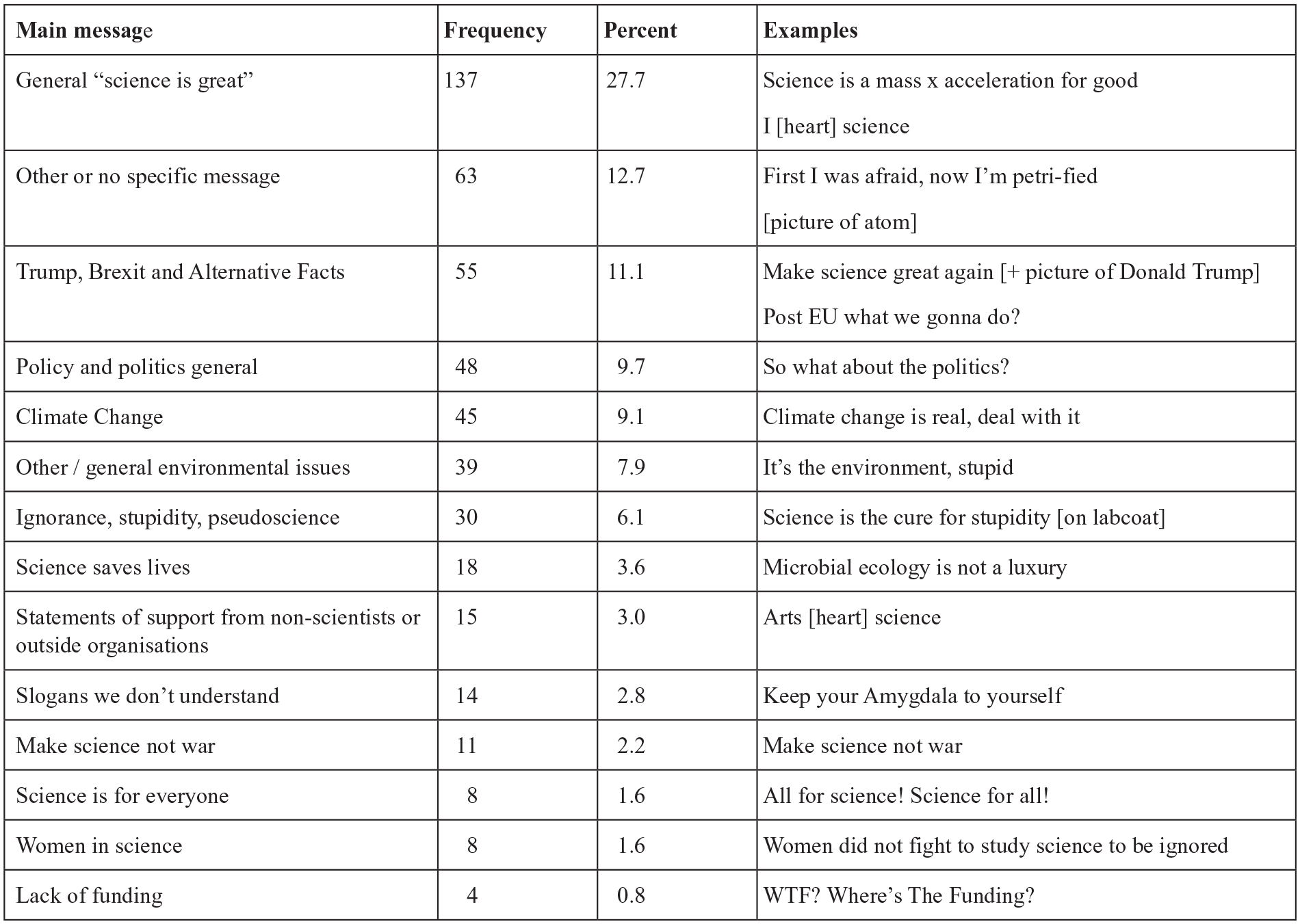
The precise focus of the march was left vague by the organizers, quite likely deliberately so, and with the focus of the march being fluid and ambiguous, the march became a site for representing a wide range of topics and concerns. This was evidenced in our interviews and, the core focus of this article, the analysis of placards displayed by marchers. In both, we saw strong emphasis on issues related to Brexit, as well as Trump and climate change denialism. In some cases, this spread to broader environmental issues. But Trump related anxiety also fed into concern over the deployment of alternative facts and the general lowering of emphasis on scientific data in policy making and public discourse. Also across both interviews and placards, there were, preempting the COVID-19 pandemics, examples of concern with antivaccination movements. While our interviews showed how an individual could carry multiple concerns, the analysis of placards and signs brings us closer to an understanding of which specific issues marchers chose to prioritize on their signs as the core messages that represented their terms. Our analysis of signs also allows us to provide a sense of where the balance lied on the various issues raised. We now analyze this data further, as summarized in Figure 1, by exploring key themes presented on the signs in turn.
Themes by proportion at the March for Science.
The largest category of signs was those coded as “generic messages highlighting that science is ‘a good thing’” (27.7%) or as otherwise not having any overall clear message at all (12.7%). An example of the latter included puns made on scientific concepts (see next section), or other types of joke that did not specify any particular issue the marcher was concerned about. Another group of signs in this category (2.6%) featured inspirational quotes from a variety of scientific greats and celebrities (including Newton, Sagan, Popper, and deGrasse Tyson). A final group of signs (3%) that did not reference any particular issue included general statements of organizational support from both scientific groups (“archaeologists marching for science”) and organizations outside of science, (e.g., banners of political parties that participated in the march such as the Liberal Democrats). In all of these categories, the message was not unified, demonstrating that the collective identity of the march was multifaceted and allowed for individual difference.
Of the signs that did carry a specific message, the largest group referenced current political events—in particular, Donald Trump’s election and Brexit alongside worries about “alternative facts” and the disregard of experts that have been accompanying public discussions of both (11.1%, where 5.3% referenced to Trump and 4.2% to Brexit). Examples included the slogan “No to Trump” or the symbolic carrying of an EU flag around a marcher’s shoulders. Other than these specific current events, many placards (9.7%) referenced politics or science policy more broadly, sometimes singling out a particular political party (“Tories R illogical”), or general anger at science policy (“Evidence-based policy making, not policy-based evidence making”).
The next largest categories referenced climate change (9.1%, e.g., “Climate change deniers = truth deniers”) and other environmental topics or environmentalism in general (7.9%, e.g., “No science, no planet”). This was followed by signs expressing a general concern about “pseudoscience,” “antiscience,” or simply “stupidity” (6.1%). These perspectives were articulated, for example, through disdain for specific so-called “pseudosciences” (see Kaufman & Kaufman, 2019) like homeopathy, or a general distaste for opinions in public life trumping “the facts” that science provides, and were effectively doing the boundary-work of separating science from nonscience (Gieryn, 1999). This was usually formulated as a general concern (“Science is the cure to stupidity,” “stop making shit up”). A more positive message was formulated by a group of signs that highlighted medical science and the role it plays in saving lives (3.6%), for example, a placard stating that “I’m here because of mum, dad & modern medicine” or the pithier “vaccines work.” Finally, other concerns that were discernible but not particularly present in large numbers included worries about the representation of women in science (“We want #scidiversity and #womeninSTEM”), the fact that defense spending could be redirected to science (“invest in science not war”) or that science funding generally is not quite as abundant as the marcher felt it should be (“WTF? Where’s The Funding?”), and that science should be for everyone (e.g., echoing and leaning on the open science movement, “If it’s not open it’s not science”). 7
Overall, the diversity of concerns that the demonstrators had about science can be divided into the broader themes of (a) Trump and Brexit’s risk to science, (b) the environment, (c) medical science, and (d) “general ignorance.” These themes were also reflected in our interviews, in which we asked respondents what they felt was the biggest challenge currently facing science, and whether there were any particular issues that motivated them to join the march. Most interviewees remarked that there was a general malaise about where the world was heading, and in this regard Trump and Brexit was mentioned by many of them. The particular danger that these two events posed to science was articulated through criticism of Trump’s attitude toward climate change, as well as concerns about the impact that Brexit will have on international collaborations (and access to EU funding) and a commentary on the general disregard of (scientific) expertise respondents felt were embodied by both events. To this end, it was difficult to separate these two themes as respondents tended to argue that they were more likely symptoms of a general drift toward a creeping antiscience and antiexpert sentiment that presented the danger of gripping Western society.
The issue of climate change was prominent, raised by many interviewees as a primary motivation for attending the march. Other problems articulated included the austerity-induced cuts to science funding and the benefits that medical science brings which they felt was under threat from an antiscience agenda described above, sometimes articulated through specific examples like vaccine scares. Concerns about religion and education policy were also presented (an interviewee complained that “public money is being funneled into faith schools [ . . . ] I think it debases science”). An attending humanities academic thought that “scientism” and “science worship” presented a clear threat to science (noting that he was aware he was at odds with the majority of codemonstrators).
If one can discern a generalized message that crystallized from our analysis of the signs and interviews at the march, it would be that science is under threat. Though specific instances and challenges were mentioned, the overarching feeling was one of nonlocalized and nonspecific fear that science is not taken as seriously as it should be, and that current political events bring this into sharp relief.
However, we should not see the failure to articulate a clear message and a correspondingly clear set of demands as a failure of the march as a whole. It was overall potentially effective as a demonstration that scientists (and science supporters) are generally troubled. But this brought with it a sense of futility that articulated itself both directly by some of the demonstrators we interviewed, and through the frequently inward-looking rhetoric displayed on the placards, which often seemed to be aimed at other scientists more than the public or policy influencers. In this context, the march articulated a collective identity, but not a specific set of demands. We now turn to analyzing how the messages in the signs were formulated and what we consider it means for the march as a whole.
Vive la R = V / I! Humor at the March for Science
The way in which the marchers formulated their points took various forms. Sometimes science was just visually represented without further comment, by the display of stereotypic scientific equipment or paraphernalia (models of molecules, pictures of Erlenmeyer flasks or a life-size cardboard cut-out of Charles Darwin) for instance. Also, frequently present were references to “nerd” culture, such as comic book and superhero characters or self-deprecating allusions to scientists’ popularly assumed lack of social skills. The way science therefore was generally depicted symbolically by the demonstrators included many of the wider science stereotypes that are often critiqued in the Public Understanding of Science literature and by some scientists themselves (Haynes, 2003; Losh, 2010), but appropriated here as a positive signifier of collective identity.
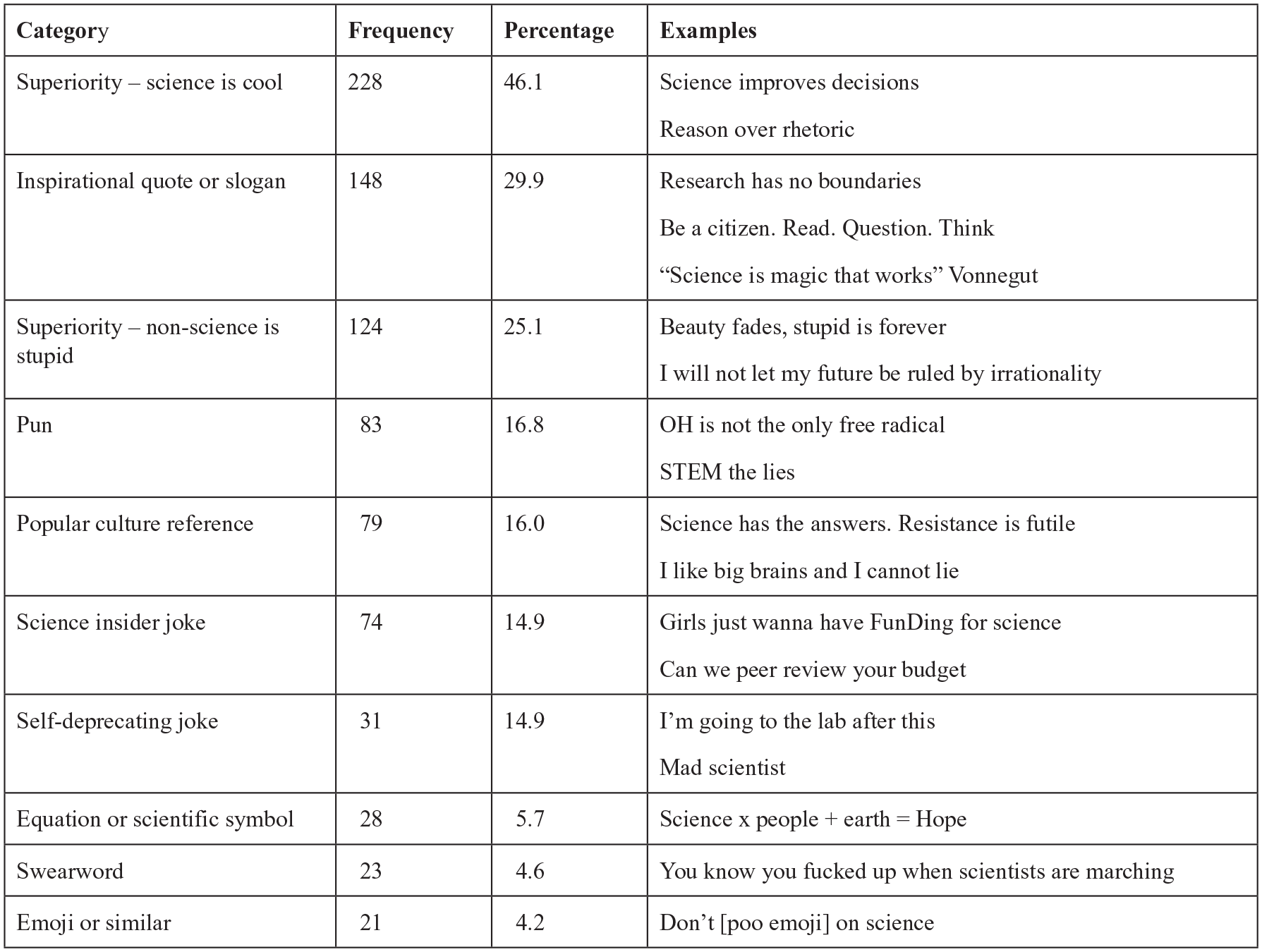
Figure 2 shows the main categories through which the messages were expressed, these were overlapping, that is, a sign could be both a pun and an equation, or both an inspirational quote from a famous scientist as well as an insider joke.
How the messages were expressed.
Many of these stereotypical portrayals of science are meant to be humorous. Indeed, 46.5% of the signs were coded as being humorous in some form. This needs to be interpreted with caution as we could only count what we thought was meant to be humorous. Some jokes, particularly insider jokes (see next) might have gone unnoticed by us, while other jokes may have simply fallen flat. Conversely, some signs may have not been intended as humorous, but interpreted by us as such. We coded a further 3% of signs as “unsure.”
The particular form in which the humor was expressed can be divided into several (again overlapping) categories. 16.8% were puns–these could be puns on the names of political figures (“Science trumps alternative facts”), a pun on science generally (“A moment of science please”) or a pun involving a specific scientific concept. (One sign simply displayed the “Ω” symbol—this took us a while to understand, demonstrating the danger that some science insider jokes may have gone unnoticed. In this case, Ω we believe is meant to be the SI unit for electrical resistance; the same pun was made a bit more obviously by the sign “Vive la R = I / V”). Some signs were made purely for the pun itself and did not carry any particular message other than that it was to do with science in some way: One sign, for example, headed with “Pier review” displayed pictures of three seaside piers in various states of disrepair and rated them on a scale of 1 to 10.
Referencing popular culture (16%) was also used to generate humorous messages. These would mostly be allusions to “nerd” culture, comic books, and science fiction (a sign displaying a picture of The Hulk with the message “you’re making us angry”; various signs alluded to science fiction or science in popular culture; one young girl held a sign saying, “My mommy thinks Brian Cox is lovely” 8 ), but also featured a variety of other pop cultural references such as Masterchef, Game of Thrones, and a variation of the “keep calm and carry on” meme (“keep calm and study science”).
Humor could also be derived through the simple insertion of swearwords (4.6%)—this may have demonstrated genuine anger, but also frequently clearly meant to be humorous (“Science, cool as fuck”). Swearing was sometimes self-censored, for example, using the “poo” emoji to spell “don’t [poo] on science,” using asterisks (“b**ches”), or through using milder swearwords such as “bloody” or “ruddy.”
Here, humor theory becomes vital to our analysis. It posits that one of the most frequent ways in which humor is produced is “incongruity” (Billig, 2005; Morreall, 1983). In the case of puns, incongruity is produced rather obviously by the juxtaposition of two unrelated concepts that share spelling or similarly superficial similarities. Swearing and popculture references work the incongruity on a slightly subtler level in that it juxtaposes the (usually very) serious scientific concepts with the frivolous: swearing in a context where swearing is expected is not as funny as in contexts that are supposed to be serious, as the stereotypical image of science propagates (and which as outlined above, the demonstrators themselves often poked fun at). In both cases, humor works against the stereotypes of science, and could be seen as a deliberate choice of marchers to combat this characterization.
Alternatively, some jokes were deliberately self-deprecating; they portrayed a stereotype of science or scientists and played on it for humorous purposes, as well as trying to make wider points. A sign proclaiming its holder to be a “mad scientist” produced humor by referring to both the pop-culture stereotype of scientists as well as the fact that the person is angry enough to be marching. We also learnt from another marcher interviewed that the sign she carried (“I’m a nasty woman scientist”) was a specific reference to the anti-science and antiwoman attitude of president Trump.
As the Ω pun demonstrates, many jokes might be constituted as insider jokes, that is, jokes that are directed at other scientists, or at least people with an advanced understanding of science. We coded 14.9% of signs as insider jokes, and almost certainly there were a few more that were too specialized for us to realize they were gags. Insider jokes might refer to specific science concepts, including the variations of the “resistance” pun discussed above, or plays on other science concepts (“do I have a large p-value? Because I feel insignificant”). There were also puns about scientists (“alternative facts are Bohr-ing”). All these require at least some scientific competence to be understood, and possibly at least some investment in a “science” identity to be perceived as funny. Placards also referenced general aspects of scientific life, such as peer review, the long hours scientists work (“I’m going to the lab after this” and “I should be writing”), or funding applications (“Girls just wanna have FunDing for science”), all of these were likely appreciated more by other scientists than a general public unfamiliar with scientific life and scientific culture.
One rather interesting aspect of the insider jokes and comments on the placards was that they were not always necessarily displayed by people who felt themselves to be insiders. Two of our interviewees, both of them holding placards that made fairly obscure puns on scientific concepts, told us that they were not actually scientists themselves and had asked for outside scientific help with their placards: [sign: “Science is my pectonised, sucrosed angiosperm ovaries”] I did have to consult an actual chemist to get it right, to make sure that all the scientists here wouldn’t laugh at me. So, this sign says “resistance is not futile it is [R(Ω) = V / I]” and it has . . . scientific things . . . that my son understands [laugh] but I don’t completely.
Of the not-so-obvious humorous signs, reference to science was also made in various other ways. These included inspirational slogans and quotes from famous scientists or science popularizers. While these were often funny or intended to be funny, in other cases these featured their hero referencing the sublime and the sense of wonder many marchers associate with scientific discovery (e.g., Newton’s famous remark about standing on the shoulders of giants) or the anger they share with their heroes at how scientific expertise is being ignored or treated. These were not always necessarily attributed as some quotes have seeped into popular scientific culture: for example, science fiction author Arthur C. Clarke’s famous observation that advanced technology is indistinguishable from magic appeared in various forms on the placards, both attributed and unattributed. Other inspirational slogans included generalized calls for action but without the use of direct quotes—these included signs like “Science for the people” or “Science without borders,” or simply “Reason.” They also included adaptations of general popular protest slogans (“Make science not war”).
Finally, two other categories we coded were also very revealing about the general message that the march portrayed about science and scientists. We labelled them as “science is superior” because they express the belief that science or scientists are better in some form than “nonscience” and thus potentially generating humor through superiority. They could be framed positively (i.e., science is great) or negatively (i.e., nonscience is bad or stupid). The positively framed ones referred to how great science is in general, how great scientists are, or how great facts and evidence are (“the [picture of earth] needs thinkers not deniers”; “A scientist made that”; “science reveals reality”). These of course also included most of the inspirational quotes referred to above and very often, featured puns, pop culture references, and other types of humor.
In its negative formulation, many signs were referencing aspects of life that were not seen as scientific and therefore inferior. Science was contrasted favorably to stupidity, ignorance, pseudoscience and antiscience and politics. Some merely mentioned stupidity leaving the connection to science as an exercise for the reader (“Beauty fades, stupid is forever”; “Don’t be bloody stupid”), others were more explicit (“Experts in this country have had enough of people like Michael Gove”). Or they displayed both at the same time (“Science > Opinion”).
Across the marches, humor featured as a method to attack targets of the march, and secure connections and bonds within it. In closing this article, we discuss more fully the work on community building in humor theory and how that relates to STS and New Social Movement theory to better understand how “science” was positioned by marchers, and why this is significant.
Discussion: The March for Science, Humor and Community Building
The core focus of this article has been to answer these key questions: what issues concerning science did the marchers emphasize, how were these issues collectively articulated and represented, how was humor used in the march, and what are the potential consequences of how this nascent community presented itself and its relations to the outside. In this discussion, we draw together our previous observations to show the connectivity between these points.
The collective articulation of issues concerning science involved a diverse but connected set of concerns. While many March for Science supporters had a specific issue that they felt they were marching for/against—most clearly the current trends in U.K. and U.S. politics, climate change and denial thereof, defending medicine and its value for saving lives—the overall message of the march was dispersed and fluid. Importantly, our analysis of the signs reveals another goal of the march, specifically that of solidarity and internal community building. This was also a frequent theme in the interviews, where interviewees’ reasons for participating ranged from jovial “It’s a fun day out” to the more frequently expressed hope that it will mobilize scientists (and the science supporting public), bringing them together to strengthen the community. These goals were also often repeated when we asked them about what the march will accomplish. All interviewees were sceptical about achieving any clear policy goals by marching, but instead hoped that the march might be the catalyst for scientists and publics to come together as a community signaling the beginning of a stronger representation of science in public life. The value of the march in terms of strengthening a community feel within science can be analyzed in science studies terms through the boundary-work that is going on in demarcating this emergent activist science (and science supporting) community from the imagined antiscience out-groups (Gieryn, 1999). The in-group scientific norms and values and both in-group and out-group stereotype projections performed through the signs strengthen both the metaphorical boundary with the out-group as well as the group cohesion experienced within the in-group (Riesch, 2010). As social movement theorists note, such work is key to march identities (McCarthy & Zald, 1977).
The role of humor and its effects at the march feeds into this identity and group cohesion work. To fully answer this question requires some contextualization within previous studies of humor in protest, and the long history of humor in political activism. Bakhtin (1984), for example, has analyzed the performative function of late medieval and renaissance carnival. Modern political protest also contains much humor, which can be a powerful communication strategy that has the power to mock, subvert, and undermine the structures that are the focus of the march. Due to its inherent polysemic nature, humor can be used to make political statements that cannot necessarily be shown to mock the authorities, even if it is clear to the intended audience what is meant. As a result, it has long been seen as the recourse for political protest, especially in repressive regimes (Obrdlik, 1942).
Yet humor and social protest is a complicated marriage. When genuine anger and passion motivate protest, it is difficult to maintain, emotionally and strategically. As t’Hart (2007) argues, in such settings, humour is one of the first victims. Seriousness and a strong emphasis on the righteousness of the claims inhibit laughter and joy. It is not without reason that revolutionaries (along with scientists) have been labelled humourless. (p. 2)
While t’Hart notes scientists and revolutionaries can be deemed unfunny, we have shown the key role of humor in the March for Science. This might be an indication that there was not a significant amount of palpable anger and passion motivating the marchers. Indeed compared with other protests such as the marches through London for the victims of the Grenfell Tower fire a few months later, this might be the case. Certainly, the anger was more abstracted and reasoned at the March for Science than the raw emotion, shock, grief, and sense of injustice that accompanied the Grenfell protests. This given, the science marchers were communicating heavily held concerns, and in many instances using humor to do so. This likely had a solidarity-building function. As several contributed chapters in t’Hart and Bos’s (2007) collection highlight, humor can work as a means of building a collective identity for the emergent community of protestors. And as Diani (1992) notes, this recognition of sharedness is central to social movements.
Humor studies has shown that the structure of humor itself can be used as a way to indicate identities. Jokes that rely on insider knowledge delineate those who get the joke from those who do not (see Riesch, 2015, for the case of science humor), and to an extent most jokes rely on a certain amount of background knowledge or understanding in order to function as humorous. In explanations of humor using incongruity theory (Morreall, 1983), the unexpected juxtaposition of two usually unrelated concepts only works if the usual contexts of the two concepts is understood by the listener. Telling a joke thus becomes a way of identifying who belongs to the in-group, and humor can be used to “discipline” in-group boundaries, just as it can also be used for “embarrassing” people into conforming to group norms (Billig, 2005).
These two dimensions of humor in identity formation and maintenance were clearly on display in the messages displayed at the March for Science. The self-stereotyping of scientists as “nerdy,” comic book obsessed and socially awkward went along with jokes and puns expressed in the form of equations or chemical symbols that clearly were aimed at people with fairly high levels of scientific knowledge. This was in-group solidarity and identity formation.
The community-building manifested itself in the textual and visual representations in the march; this was most visible in the attempted insider jokes aimed at other members of the community, through comedic self-stereotyping either through the appropriation of widely shared negative stereotypes about scientists, or positive constructions of science being a force for good, which is favorably contrasted to other activities, notably politics, “pseudoscience,” and religion. While many of those were not necessarily or particularly humorous (allusions, e.g., to the sublime in science also featured), this created, at least to us, an impression of a whimsical and playful side to the march, one that was clearly valued and enjoyed by many of those we interviewed. This strengthened the community feel and imparted a sense of purpose that felt much clearer than the fairly dispersed variety of topics the marchers worried about would suggest. It also provided material for mainstream and social media outlets (such as @SciMarchSigns), which demonstrates that the use of humor provided more visibility to the march, and possibly even that it made it more attractive to an outside audience.
However, there is also jeopardy in the whimsical approach to protesting. On one level, a humorous tone in which to address the substantive issues risks trivializing them, while if a message is too overtly aimed at an in-group it may not be appreciated, or even understood, by others. More subtly perhaps, the insider, self-deprecating and self-stereotyped expression of the humor directed inwards at scientists rather than outside at a wider audience risks different messages being received by those outside the in-group. Within the U.S. context, Motta (2018) found that the march had a polarizing effect on attitudes toward scientists. How this exactly translates into the U.K. national context of the London and Cardiff marches is of course difficult to say in the absence of a parallel study, but Penders’ (2017) article and at least a superficial glance at the international protest signs collected by Sasse and Tran (2018) suggest that a similar playful and humorous approach to the march was present internationally.
So, how the marchers presented themselves and science in the United Kingdom, and possibly internationally, may have had an influence on that polarization: what may be an identity-affirming play on in-group self-perceptions, might end up confirming or exaggerating already held negative stereotypes held by outsiders (Weaver, 2010). In sum then, the humor at the march may have both aided in bridging the gap between scientists and lay publics by making scientists appear more humorous and thus sympathetic, but at the same time also aided in creating division through the strengthening of in-group/out-group boundaries that the disciplining side of humor entails. The use of humor in a public setting is very much a double-edged sword.
The success of this community building, and with it the question of whether they have succeeded in building something that can be termed a “proper” social movement is worthy of attention. While it is certainly possible that new political circumstances—such as maybe the rise of antivaccination movements in the wake of the Covid-19 pandemic—may provide the impetus for this diverse international group of scientists and science sympathizers to take to the streets again, it appears that the initial enthusiasm for the science march has fizzled out relatively quickly. This was even before political circumstances have changed with Trump’s election loss or Brexit having crossed the point of no return: A follow up march organized for 2018—envisaged as the second of an annually occurring march for science—was considerably less well attended, and there have to our knowledge been no further marches since. As such, despite the wider aspiration of the organizers, we consider the march for science to be a one-off event rather than a social movement by itself, it does potentially however feed into a broader ongoing movement that links concerns over science, Trumpism, Brexit, and environmental degradation.
The march for science produced a moment of hitherto unseen science activism in which a heterogeneous set of actors with heterogeneous concerns rallied around a notion of science and the threats and undervaluations that challenged it. It became a distinct event in the public response to life in the posttruth era that configured protest, objectivity, and humor as resources for solidarity. We have argued it is key site best analyzed through the intersection of science studies, humor studies, and new social movement studies. Through this perspective, we recognize the multiplicity of messages and meanings presented at the march, and the role of laughter in solidarity activities, in this case, around the proper role of science in contemporary society.
Footnotes
Author’s Note
Neil Stephens is now affiliated with University of Birmingham, UK.
Declaration of Conflicting Interests
The author(s) declared no potential conflicts of interest with respect to the research, authorship, and/or publication of this article.
Funding
The author(s) received no financial support for the research, authorship, and/or publication of this article.
