



Abstract
In this paper, we delve into the opportunities and challenges of implementing municipal renewal as a national policy, especially in the context of local authorities’ relationships with anchor institutions, civil society and the social economy. Drawing on the initiation of a national Community Wealth Building policy, as adopted by the Scottish Government in 2021, we review the extant literature to discuss the emerging challenges and opportunities for CWB as a form of ‘New’ Municipalism.
Introduction
Questions of how to create a more inclusive economy cut across the interests and concerns of academics and policymakers. From a policy perspective, strategies to foster a more inclusive economy have emerged transnationally drawing on theoretical approaches rooted in heterodox economic thinking and advocating for place-sensitive approaches. Community Wealth Building (CWB) has emerged as a policy tool for local economic development through a ‘new municipalism’ based on the notion that, at the local level, there is a propensity for enduring place-based economic relationships that the nation state cannot offer (McInroy, 2018: 681). New municipalism movements have most often emerged as local reactions against national, or indeed global, economic pressures. Departing from local applications of new municipalism, the Scottish Government has announced plans to implement CWB as a national policy. This article, firstly, reviews the extant literature on the emergence of alternative economic models and their appeals to ‘localism’, with a focus on ‘new’ municipalism and CWB as a means to operationalise these concepts. Secondly, it discusses the opportunities and challenges of implementing a placed-based approach to economic development as a national policy and outlines the implications transnationally.
Inspired by the work of The Democracy Collaborative (Cleveland, Ohio) and championed in the UK by the progressive think tank the Centre for Local Economic Strategies (Guinan and O’Neill, 2020: 10–11), CWB was notably adopted by the city of Preston, Lancashire, in 2012. More recently, a CWB strategy has also been initiated in Plymouth, Devon (Thompson, 2023), and importantly for this paper in 2020 by North Ayrshire council, Scotland. Over a relatively short period, CWB has become a central tenet of the Scottish Government’s National Strategy for Economic Transformation, supporting the vision for a wellbeing economy. 1 As currently conceived in the UK, central to CWB is the concept of ‘new municipalism’, drawing from municipal socialism in the UK, and the ‘libertarian municipalism’ of Murray Bookchin (1999) in the US, emphasising the power of cities and municipalities to drive social and political change (Angel, 2021). To date, CWB in the UK has centred on municipal stewardship, whereby local authorities, at least in theory, should work with ‘anchor institutions’ (such as universities and the NHS) across five ‘pillars’ 2 to increase community participation and ownership of local economies (Guinan and O’Neil, 2020).
The initiation of a national CWB policy, as adopted by the Scottish Government in 2021, the first of its kind, poses a distinct set of opportunities and challenges for how to adapt this policy tool, which is thoroughly rooted in the locality. Being mindful that each place has evolving histories, legacies, institutions and other distinctive characteristics that impart path dependencies and shape – inter alia – its economic assets and trajectories, social outlooks, environmental concerns, politics and culture (Pike et al., 2017:1258), this paper seeks to contribute to current debates around what is required for CWB to be implemented in ways that contribute to the development of an inclusive economy that works for local communities. The aim of this article, therefore, is, firstly, to review extant literature on inclusive economies, combined with literature on ‘new’ municipalism and CWB in the UK and internationally. The scoping review informs the second part of the article, a critical analysis of the Scottish Government’s plans to implement CWB as a national policy. The paper is structured as follows. Firstly, we contextualise the resurgence of alternative local economic development frameworks, such as CWB. The following section introduces the methodology followed to carry out the scoping review and thematic synthesis. The results of the review and analysis are then discussed in the following sections. The paper concludes with a discussion on the emerging challenges and opportunities for CWB as a form of ‘new’ municipalism and how place-based economics can be held in tension with national policy.
Background
As successive crises expose the vulnerability of countries around the world to changes in the financial markets and (at least in the UK) the gap between poor and rich widens, 3 questions about the credibility and viability of the neoliberal economic model are increasingly articulated by a wide range of actors, from a variety of different perspectives. The impact of globalisation on public sector spending has been contested (Castles, 2001), nevertheless, the plea is for an economy that is more balanced and democratic. This is so that economic growth also reflects social, cultural, political and environmental advancements, and cooperation is stimulated among different stakeholders, including markets, governments and civic institutions, in order to cultivate a plural economic system. Whether these debates represent a genuine break is uncertain, however their presence reveals a growing desire for ways to organise the economy around different principles and interests beyond the imperatives of profit maximisation (Mazzei, 2013). There is certainly a resonance with longer term discussion on the efficacy of social exclusion policy and the need for a continuing change in behaviour to tackle exclusion (Mayes, 2002).
A number of theoretical approaches begin to articulate the foundations, principles and characteristics of an alternative economic model (Pike et al., 2007, 2017). These are rooted in heterodox economic thinking and include perspectives such as the moral economy, diverse economy (Gibson-Graham, 2006), sharing economy (Cheetham and Lever, 2021), transitional economy (MacKinnon et al., 2022) and more recently the wellbeing economy (Fioramonti et al., 2022). What these have in common is the advancement of social inclusion by offering a sense of socio-economic belonging and sense of attachment to the place, be it cities/localities or regions and community participation and rootedness in unifying frameworks for mobilising collective efforts (Crisp et al., 2023). CWB provides an opportunity to revisit these underpinnings and work through challenges. Reviewing the growing literature on inclusive economies, new municipalism and CWB clarifies emerging typologies, challenges in implementation and its prospects as a national policy.
Methods
A scoping review approach is particularly useful when examining emerging areas of research and policy, to help identify gaps and clarify concepts (Tricco et al., 2016). A scoping review approach was chosen to provide a preliminary assessment of the extent and scope of research and policy in this area and to address the broad research questions (Arksey and O’Malley, 2005). Further, a scoping review provided a structured approach to reviewing literature from a wide range of sources, both academic and policy related, irrespective of study design or quality (Levac et al., 2010; Tricco et al., 2016).
Between November 2022 and April 2023, academic and grey literature was sourced through the electronic databases Scopus and Google Scholar. The search strategy used the keywords ‘inclusive economies’ and/or ‘community wealth building’ and/or ‘municipalism’ and included all possible combinations featured in the title, abstract and main text. In addition to the specific topical focus of the literature on inclusive economies, CWB and municipalism, the inclusion criteria were that literature (a) was in English language, (b) had a publication date post-2000 to ensure relevance and (c) was not a newspaper or other media sources that are not government reports or not reputable sources (e.g. not affiliated to a reputable organisation, institution or agency).
The initial literature search identified 74 articles (34 Scopus and 40 Google Scholar). From this, 6 duplications were removed, and 28 articles were excluded because they were deemed to be on the periphery of the topic and/or did not offer an empirically derived discussion (see Figure 1). A total of 40 articles were included in the final review, compiled of 38 peer-reviewed articles, 1 book chapter and 1 grey literature report (see Appendix 1). While a data extraction template was produced in Microsoft Excel and was tested and agreed by all authors at each stage of extraction, a formal quality assessment of each article and source was not undertaken due to the scoping nature of the review (Arksey and O’Malley, 2005). PRISMA 2020 flow diagram for new systematic reviews which included searches of databases and registers only.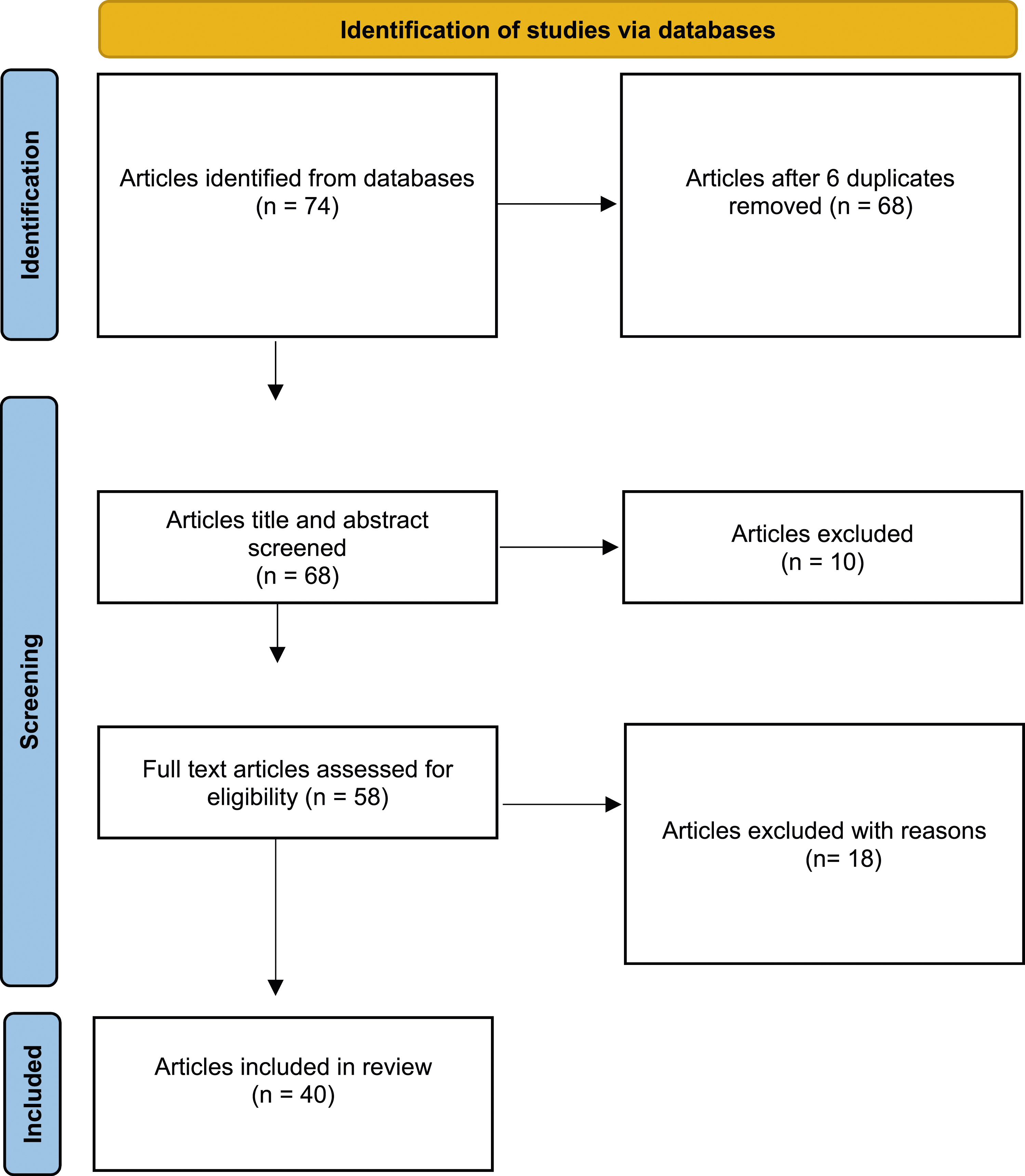
The characteristics of all articles included in the review are reported in Appendix 1. The majority of studies (87%) were from Europe, with 26 articles from the UK and 6 articles from Spain. Four articles focused on North and South America and four on global or multi-continent contexts. The majority of articles (33 papers) were published or released between 2019 and 2023, which demonstrates the topic’s current policy interest and relevance.
Data synthesis
While a more systematic approach was used to identify articles, given the qualitative and descriptive nature of the selected studies a narrative thematic approach (Lucas et al., 2007) was used to synthesise findings from the scoping review. Each of the researchers independently conducted a thematic analysis of the articles identified using NVivo software. This included descriptive coding of data into themes and sub-themes and then refining and comparing codes between researchers until consensus on key themes was found (Thomas and Harden, 2008). Emerging themes and sub-themes were considered for relevance in relation to the research questions (Lucas et al., 2007). Findings were then written up to allow for a narrative overview of the existing body of literature within this broad field.
While the findings section provides an overview of themes identified through the synthesis process, this paper will also reflect on a wider range of literature (outside of the review) that did not directly answer the research question. This is to provide wider historical and cultural context to the themes that are being described and to further inform the flow of the argument.
Review of results
Inclusive economies: Democratisation of the economy
The literature clustered around this theme of our scoping review highlighted how alternative approaches to regional and local development have been framed as potential routes to democratise the economy. Pike et al. (2007) argue that alternative approaches of local development began to surface during the 1960s and 1970s, questioning the dominant economic focus of local and regional development on firms in a national and international economic context (Geddes and Newman, 1999). The ‘post-development’ critique (Gibson-Graham, 2003) and recent research on alternative concepts that work with broader, more social versions of the economy (Leyshon et al., 2003) have further increased the range and diversity of approaches to local and regional development. Pike et al. (2017) have suggested that progressive local and regional development is based upon a set of foundational, even universal, principles and values such as justice, fairness, equality, equity, democracy, unity, cohesion, solidarity and internationalism (Harvey, 1996). Principles and values of local and regional development reflect the relationships and balances of power between state, market and civil society and are socially and politically determined within localities and regions (Pike et al., 2007).
Emerging from our scoping review, the first aspect of democratising the economy – and therefore developing inclusive economies – is rooted around the potential for the social economy. Debates around the contribution of the social economy to local development have emerged in conjunction with heterodox economic thinking. The social economy encompasses different forms of market engagements that privilege meeting social/environmental needs over profit maximisation, usually mobilising disadvantaged communities in producing socially useful goods/services (Amin, 2009). Historically, these forms of economic engagement were relegated to the margins of economic discourses. However, recently they have increasingly been recognised as having an important and all-encompassing economic role (i.e. to boost local economies, a model of economic growth based on social wellbeing, innovative and qualitative better services and so on). Changes in policy and theoretical emphasis have brought ‘entrepreneurship’ to the fore and within that, the notion of social enterprise as a coherent economic category.
Leyshon and Lee (2003) adopt the concept of alternative economic geographies to challenge traditional economic models and emphasise the importance of diverse, localised economic practices. Indeed, understanding ‘economic democracy as a socio-economic arrangement where local economic institutions are influenced by democratic principles as exemplified by cooperation, place, and community’ (Prinos and Manley, 2023: 630). This resonates with the intention of both Community Economies and Local/Social Innovation, which suggest that social inclusion through innovative community initiatives can be understood as an ethical practice of locality (Gibson-Graham, 2003).
Nevertheless, the difficulties in developing a thriving social economy are evident in much of the literature looking at the implementation of specific support strategies (see e.g. Amin et al., 2002; Choi et al., 2020; Mazzei and Steiner, 2021). Atherton and Smallbone (2013) suggest that entrepreneurial policy ‘effectiveness’ depends on the context in which policies are developed. Lyons and Wyckoff (2014) noted that while most of this literature has focused on the supply or value chains themselves – their management, the transmission of information and market intermediation – less is known and acknowledged on the coordinators and what capabilities and capacity they require in order to be successful (Lyons and Wyckoff, 2014: 443). The authors argued that it is necessary to articulate and elaborate an ecosystem of support that fosters skill development, empowering collaboration, and facilitates connections (Lyons and Wyckoff, 2014: 455). It is important therefore to ensure that different approaches fit the needs of the locality but also that local authorities and key stakeholders are ‘allowed’ to experiment with different practices of multi-scalar emancipatory politics and policies (Angel, 2021; Peck and Teodore, 2007). In this way, ‘the local state, then, is not a passive arena within which national state processes or global circuits of capital “touch down” but, rather, a set of practices and relations that co-evolve with processes stretching across space and time’ (Angel, 2021: 530).
However, caution against the dangers of localism in participatory development is also noted (Mohan and Stokke, 2000), as excessive focus on the local level may lead to the neglect of broader structural issues and perpetuate existing power imbalances. This resonates with Geddes and Newman’s (1999) discussion on the evolution and conflict in local economic development, emphasising the need to address underlying power dynamics and conflicts within local contexts, emphasising their complexity. Therefore, effective policy must reflect the institutional make-up of localities and their capacity. Ultimately, policy is what professionals and practitioners ‘do’ in the field (Dunleavy, 1981). It is likely therefore that a disjuncture between social enterprise policy and the realities faced by those involved in implementation on the ground reflects the complexities of specific contexts.
Definitions and kinds of local and regional development are closely related to the question of local and regional development for whom? Answers to this question concern the objects and subjects of local and regional development and the social welfare dimensions of the uneven and geographically differentiated distribution of who and where benefits and losses from particular varieties of local and regional development are derived (Pike et al., 2017). Such ideals are often forged in place and can connect particular local struggles – ‘militant particularisms’ – in a more general, geographically encompassing, common and shared interest (Harvey, 2000; Williams, 2005). Relatedly, within our review of the relevant literature, community empowerment and resilience were recurrent themes. An increasing number of studies have shown that responses to engagement in shaping the future of communities are varied. Community development programmes that support community participation and empowerment are frequently posed as crucial in providing local people with the capacity to respond to change, achieve positive outcomes and develop resilience (Mohan and Stokke, 2000; Spicer, 2020).
However, a growing body of work emphasises the importance of tailoring strategies to the unique characteristics of each community. For example, Zautra et al. (2008) advocate for an integrative approach to community development and resilience, emphasising the interconnectedness of social, economic and environmental factors. This approach recognises that resilience extends beyond a singular dimension and requires a nuanced understanding of community dynamics. This resonates with Matarrita-Cascante and Trejos’s (2013) call for context-specific approaches to understanding of the factors influencing resilience, offering insights into the variations in community resilience in resource-dependent settings.
By and large, the review of the literature around the theme of inclusive (democratising) economies shows how local and regional interests have been framed as ‘alternative’ areas of economic activity that can be developed around an ‘alternative’ set of values and principles. Within this discussion, the place and role of the social economy in local economies, and relatedly how ‘community’ features within these local, social economies were framed simultaneously as central to the success of democratising the economy, and, at times, seemingly so highly specific and complex as to pose an intractable implementation challenge. Elsewhere, however, the assumption that a turn to ‘localism’ is a move towards democratic and inclusive economies has also been questioned. The balancing of community, regional and national interests and how power is shared between respective institutions are central to operationalising ideas of the inclusive economy through ‘new’ municipalism and CWB, as discussed below. These themes likewise inform our critical analysis of the Scottish case of CWB in the second half of the paper.
‘New’ municipalism
Our scoping review identified a growing body of research that has sought to trace how different typologies are evolving within new municipalism. Drawing on Bookchin’s work (1986) on different types of municipalism, and observing the variegated implementations of the municipalist ideal, a variety of typologies have been developed (see e.g. Roth et al., 2023). Among these, Thompson proposes three variegated subcategories of new municipalism (Thompson, 2021: 3) (see Figure 2). (1) ‘Platform municipalism’ working in, against and beyond the state and platform capitalism via civil society mobilisation to establish new citizen platforms, often utilising digital platform technologies. (2) ‘autonomist municipalism’ aiming for a stateless polis of confederated cooperatives, communes and assemblies through collective self-organising, motivated by anti-statist struggles for bio-regional and cultural self-determination; and (3) ‘managed municipalism’ aiming to retool the local state for the democratisation of urban economies through technocratic engineering. Indeed, depending on the orientation towards the capitalist state, new municipalism has been found to be rooted in civil society mobilisation (platform municipalism), collective self-organising through cooperative collaborations (autonomist municipalism) or technocratic engineering lead by local authority (managed municipalism) (Thompson, 2021: 326). Three models of municipalism (Thompson, 2021:327).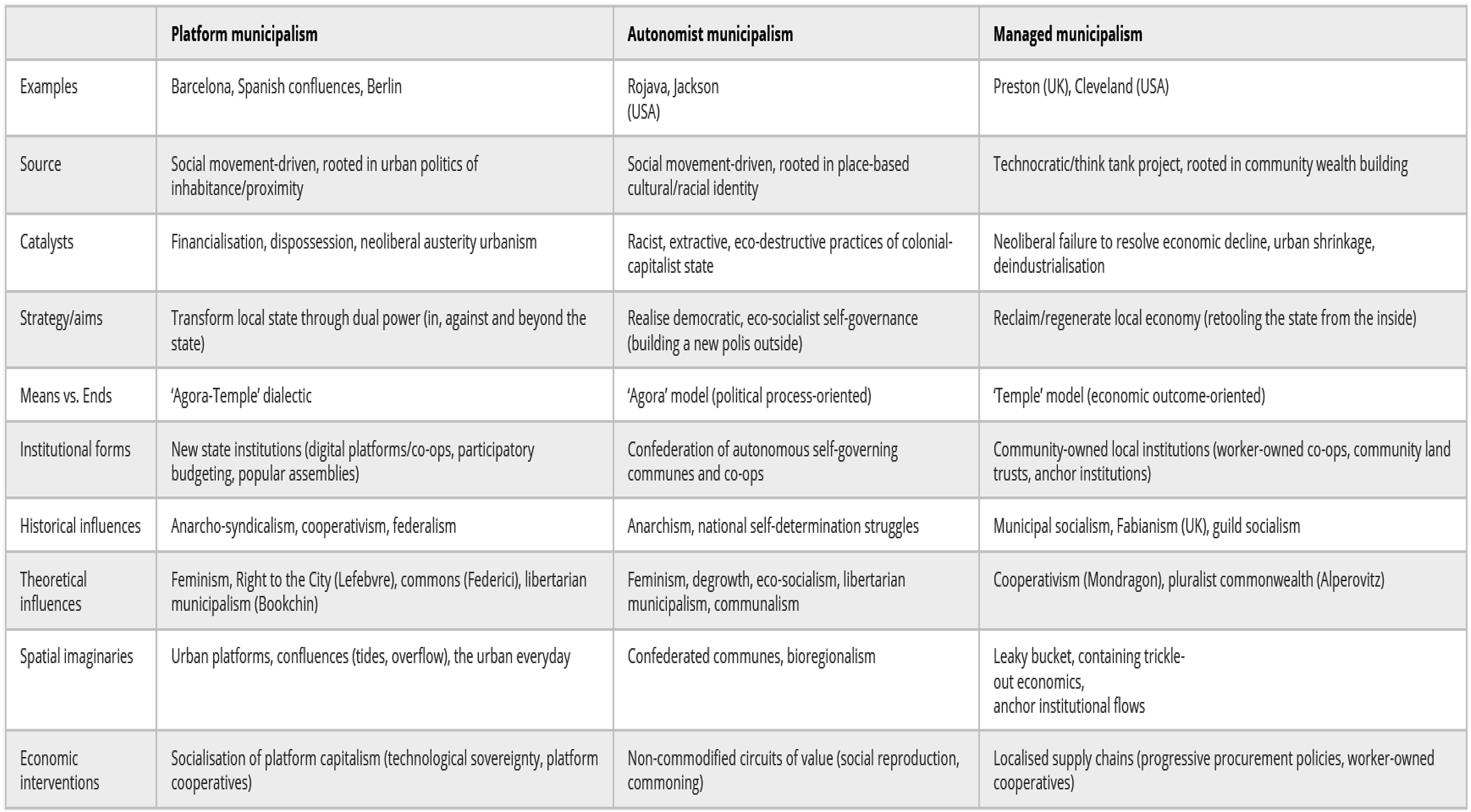
CWB, especially in the UK, is aligned with what has been defined as managed municipalism, with its praxis firmly rooted in economic development and its centring the agency of ‘local councils and communities to “take back” ownership of the agenda of public entrepreneurship’ (Baines et al., 2018: 9). However, considering the assemblage of interventions (Thompson et al., 2020) constituting the renascent movement of municipalism (Thompson et al., 2020), it can be argued that these localised strategies can vary between statist and communitarian approaches.
Studying the emergence of new municipalism across diverse geographies and cultural contexts is especially pertinent in understanding the ‘statecraft’ of local authorities (Thompson et al., 2020). By ‘statecraft’ we mean the different approaches to leadership, ambitions, ambivalence and ability to operationalise ‘new’ economic development strategies and to work effectively with anchor institutions and the social economy to achieve these goals. For example, while being considered as a type of managed municipalism, there are considerable variations in its Preston and Cleveland implementations indicating centrality of agency of local councils and communities (Baines et al., 2018). Thompson (2021: 330) describes the Cleveland model origins as ‘technocratic and philanthropic’ which ‘place it outside local democratic control’ (international municipalism model), while the Preston model appears to be driven by elected local government (a municipal socialism model).
While rooted in the understanding of the relative power of municipalities over political and economic governance (Thompson et al., 2020), the varying applications of new municipalist principles and practices suggest there is potential for a local development re-structuring beyond statism, to achieve a communitarian, social movements driven democratic transformation of the local economy and state (Sareen and Waagsather, 2022). The Fearless Cities movement born in Barcelona in 2017 4 is exemplar of a new municipalism movement that encapsulates grassroots actors challenging local elite managerialism and evoking alternative radical democratic politics by aiming to democratise governance and invoking an alternative politics of solidarity, feminism, community and social justice (Cumbers and Paul, 2022: 202). Researching and reflecting on the experiences of the Catalan capital, Russell (2019) argues that the Fearless City municipality managed to ‘mobilise a range of social forces—from both within and without the municipal authorities— to instead “democratise” institutions such that decision-making and power are distributed outwards’ (Russell, 2019: 991). Indeed, he further noted that what is common to many new municipal initiatives is indeed the focus on transforming all institutions (including social movements) into more collective and collaborative forms of self-government (Russell, 2019: 1002). Since the wider agenda of new municipalism is to build a new landscape of power relations (Russell et al., 2022: 4), it is envisaged that the process of transformation of institutions and processes ‘contribute to the development of new assemblages of social power across the fabric of society and embody a politics of the common’. In this sense, by ‘reimagining the role of municipal institutions and foregrounding a politics of the common, a new municipalist strategy [can be envisaged where] councils and public bodies become contributors to place-specific reorganisations of power, ownership and governance’ (Russell et al., 2022: 3 and 20).
Within regional studies literature, it is demonstrated that local, regional and national interests determine local and regional development in specific and particular contexts, albeit in relation to broader economic and political processes (Pike et al., 2007). According to Shelley (2022: 2), a ‘transition to a more socially just order seems to depend heavily on identifying the agents well-placed under present political circumstances to carry out the actions necessary to establish these changes’. In times of increasing competition within the markets, the most dynamic localities have responded by using citizens’ capabilities, starting-up innovative firms and making use of new technologies. The best outcomes have been obtained as a consequence of strengthening institutions, the interaction of development forces and combining different objectives (Vazquez-Barquero and Rodriguez-Cohard, 2015: 1143).
Vazquez-Barquero and Rodriguez-Cohard (2015) argued that institutions facilitate the introduction of innovations leading to diversification of activities; therefore, the efficiency of local initiatives depends on the agreement between local actors on strategies and goals, as well as local communities’ participation in the management and control of development initiatives. It is necessary here to ask how institutions should be treated and considered within local development policy, especially during the strategic planning process (Rodrıguez-Pose and Garcilazo, 2015). In fact, local and regional institutions are different; therefore, territories require different policies, since a one-size-fits-all policy could lead to implement wrong actions (Quesada-Vazquez and Rodriguez-Cohard, 2015; Rodrik, 2010). As Waite and Roy (2022: 1997) state: ‘despite the progressive intentions, are there sufficient local capacities to work across a range of policy domains?’. Indeed, within the Scottish context, much of the efforts of various high-profile regeneration efforts have been found to reproduce much of the class inequalities that these efforts were trying to tackle (Gray, 2022; Paton et al., 2017).
It is noticeable however, that in recent years, new municipalism is coming under critical analysis from some of its most prominent academic proponents. For example, Russell (2019) argued that increasingly the municipal is framed as a ‘smaller and thus inherently better or more democratic level of governance’ (Russell, 2019: 991). The variety of new municipalist approaches also reflect the fundamental distinction between Bookchin’s-inspired radical municipalism, focused on transformational social change, and ‘progressive policies’ centred around municipality as a locus or municipalised local economies (Roth et al., 2023). As Russell (2019: 995) noted, democratisation is dependent on who is involved in the process of democratisation and the place through which it happens. Since place plays a role in transformative politics (Russell, 2019), it can be expected that different variations of its implementation will occur within the Scottish context. However, as municipalities are increasingly pressed to taking a central stage in responding to the challenges posed by austerity, questions as to which municipal mutation (Thompson et al., 2020) might prevail, and how place-based economics can be held in tension with national policy is central to understanding the expanding repertoire of approaches to implementing CWB. This is the focus of the final part of our scoping review.
Community Wealth Building
Surveying the emerging literature, CWB is conceptualised as being rooted in place-based economics, democratic participation and control and mobilising untapped power of the local public sector (Guinan and O’Neill, 2019: 383). When considering the implications that broader political and economic processes may have on the implementation of CWB as a national policy, our review of the relevant literature suggests that we have to be mindful of various dynamics, such as the changes in administration and longevity of the new municipal ideal (Bua and Davies, 2022), broader economic and political processes (Pike et al., 2007) which contribute to determine resilience (Sutton et al., 2023) and the need for institutions to evolve (Vazquez-Barquero and Rodriguez-Cohard, 2015), in order to fulfil the democratic aspirations underpinning CWB. Thus, depending upon how CWB is interpreted and approached, power, leadership and decision making can be held in a variety of ways, privileging certain groups of stakeholders. The assumed novelty of CWB is that by advocating a new municipalist responsibility, it counteracts the neoliberal program in which responsibilities are shifting downwards, favouring multi-level governance over state intervention and accountability (Argüellesa et al., 2017). The aspiration of CWB is not just that communities take democratic control of their local economies but also that they can use that control to shape those economies in a more equalitarian direction (Guinan and O’Neill, 2019: 388).
While for some advocates, leadership of CWB very much comes from the municipality (see e.g. Guinan and O’Neill, 2019; Thompson et al., 2020), the CWB literature refers to the need of leveraging the local state institutions to provide developmental support for the social economy (cooperatives in particular), by engaging ‘anchor institutions’ in favourable procurement strategies’ (Guinan and O’Neill, 2019). However, embedding support structures (i.e. legal, technical and financial assistance) for social economy development via anchor institutions and other local agencies (McMahon, 2021) comes with increased scepticism. In reviewing the emerging literature, engagement with the social economy is shown to be operationalised in a number of different ways in UK CWB strategies. Evaluating evidence from the UK’s most established CWB case study, Thompson (2023: 7) identifies Preston’s approach as an anchor institution model, distinguished by a ‘unified approach to cooperative ecosystem development through anchor institution procurement’. Initially, benefitting from investment from US non-profit partners, which raises questions over its replicability in other contexts, sustainability, in this aspect of CWB, now hinges on the Preston Cooperative Development Network’s success in incubating and coordinating activities of new worker-owned co-ops. Thompson argues that community anchor organisations, with their ‘capacity and capability to channel resources more locally’ (Thompson 2023: 9), have been overlooked in the Preston context. Elsewhere, however, Lockey and Glover (2019) argue that Preston’s performance in recent years on a number of important metrics (i.e. deprivation, employment, wages and productivity) indicates the adoption of the CWB model may have positive outcomes. The authors further posit that the long history of anchor institutions being utilised successfully for economic development and nurturing new worker cooperatives to meet gaps in anchor institutions’ supply chains have assisted in strengthening both the financial resilience and innovation diversity of a local economy (Lockey and Glover, 2019: 6).
In contrast to Preston, Thompson explains that Plymouth has developed two routes to CWB partnership with the social economy, firstly, a municipal-cooperative enterprise model: ‘a council-led attempt to revive the city’s co-operative movement through public-common partnerships’ (2023: 9). Secondly, a philanthropic community anchor model ‘funded by a state-endowed charitable trust supporting community enterprises in partnership with Plymouth’s vibrant social enterprise sector’. These two different trajectories point towards two different visions – a cooperative city, on the one hand, and a social enterprise city on the other. Thompson argues that though this is not wholly incompatible there are points of difference with one more rooted in co-operative ownership and the other in social innovation (Thompson, 2023). Once again, this indicates variegations within and between places, underlying the differing relationships with state, social economy and other actors. In line with moving away from ‘one size fits all’ approaches, and based on the highly variable composition of local social economies, it is both unsurprising and perhaps to be welcomed that different approaches to this issue are being considered. Comparing the engagement of the social economy in Preston and Plymouth, it is worth highlighting how the social economy is at times framed as a proxy for small-scale, hyper-local activity, but in some contexts the very social economy actors being encouraged are national organisations. The implications for the Scottish context are considered below, in doing so we pay particular attention to how organisations in the social economy are associated with representing ‘community’ perspectives in CWB.
The ‘Scottish approach’ to policy-making and delivery: Prospects for a national CWB policy in Scotland
The scoping review highlighted several points of contention that have informed academic debates around inclusive economies and routes to operationalising inclusive economies through ‘new’ municipalism and CWB. Namely, using ‘inclusive’ strategies to democratise economies and identifying effective strategies to transform institutions through ‘new’ municipalism, and relatedly the role of the social economy and ‘community’ in CWB. These issues will be discussed in turn to inform our analysis of the prospects for a national CWB policy in Scotland.
Scotland has often been described as having a ‘different’ approach to policymaking and governance (Cairney et al., 2016; Matthews, 2014; Pugh and Connolly, 2020; Sinclair, 2022). The notion of a ‘Scottish approach’ to policy making and delivery underpins, and provides insightful context to, the aspiration of the Scottish Government to develop CWB as a national policy. The ‘Scottish approach’ refers to the Scottish Government’s reputation for pursuing a participative and collaborative style when it makes and implements policy in devolved areas (including health, education, local government and justice). This approach extends to policy delivery, with the Scottish Government willing to produce a broad national strategy and series of priorities – underpinned by the ‘National Performance Framework’ – and trust bodies such as local authorities to meet its aims. In turn, local authorities work with a wide range of bodies in the public, voluntary and private sector (Cairney et al., 2016: 333). Through a relational governance system (Sinclair, 2022: 5), the Scottish Government encourages local authorities to exercise leadership and work in partnership with a range of other bodies in the public sector, alongside a commitment to ‘community engagement’ and participatory policy making and delivery (Sinclair, 2022: 5). What has become recognised as, the ‘Scottish approach’ aligns with calls in the ‘inclusive economies’ literature reviewed above to move away from ‘one size fits all’ policy making and an acknowledgement that strong regional institutions will be required to address local priorities.
However, it is increasingly argued that the complexities of balancing devolved powers with the broader UK context and navigating the intricate relationships between various levels of government generate problems of ambiguity or fragmentation deriving from the mismatch between policy ambition and implementation (see e.g. Cairney et al., 2016) at local level. Indeed, despite prioritising community engagement and coproduction, there is still room for improvement in outcomes (McKendrick et al., 2016; Sinclair, 2022) as ‘bottom up’ policy development and delivery, while promoted, may lead to variations in policy outcomes within and between localities. A growing body of evidence suggests (see Cairney et al., 2016; Matthews, 2014; Pugh and Connolly, 2020; Sinclair, 2022) there is a need for a nuanced and adaptive policymaking framework. This involves reconciling national and local interests, navigating historical legacies and strategically interpreting local knowledge to achieve policy outcomes that are both effective and contextually relevant across the diverse landscape of Scotland.
The reasons as to why these variations occur however need also to be questioned. Regional disparities in income and productivity, labour market exclusion and unequal access to ‘good jobs’ (Hill O’Connor et al., 2023: 2) and power asymmetries play an important role in shaping local outcomes. Pugh and Connolly’s (2020) examination of contemporary challenges for Scottish local government provides a valuable lens through which to understand the complexities inherent in managing national and local priorities. Devolved powers to the Scottish Parliament allow for localised decision making, but this also creates challenges in coordinating policies at the national level. Striking a balance between national objectives and the diverse needs of local communities presents persistent challenges in resource allocation, policy coherence and the tensions arising from varying regional demands.
Concerning the development of CWB in Scotland specifically, it is important to foreground more recent developments with the adoption of the Christie Commission (2011), where the Scottish Government accepted recommendations, including, to improve public sector partnership working (Sinclair, 2022). Subsequently, in 2015, the Scottish Government launched its Economic Strategy, centred on the concept of ‘inclusive growth’, and introduced the Community Empowerment Act. At times described as ‘a buzz word looking for an agenda’ (Waite and Roy, 2022: 5), the concept of inclusive growth has been criticised for acquiescing to ‘old market liberalism, with its inbuilt social and economic injustices’ (Burch and McInroy, 2018: 2), incompatible with inclusive economy agendas. However, recent research by Hill O’Connor et al. (2022: 7) has argued that malleability may ‘invite interest in alternative ideas’. As also noted by Waite and Roy (2022), O’Connor et al. noticed growing interest in ideas of ‘wellbeing economies’ during the course of their respective studies. However, rather than representing a ‘whole-sale shift away from inclusive growth’, Hill O’Connor et al. (2023: 7) argued that this resulted in ‘a layering of ideas’ that resulted in ‘an uneasy coexistence and even greater malleability’.
In light of these findings, an optimistic interpretation of the prospects of CWB as a national policy would be that CWB provides evidence of the ‘layering’ of ideas of inclusive growth and the wellbeing economy within Scottish Government policy, with the direction of travel indicating an eschewing of inclusive growth in favour of an inclusive economy, and CWB providing a route to refine the implementation of a wellbeing economy. A less optimistic interpretation, however, would suggest that the ‘uneasy coexistence’ of the contradictory elements of aligning ‘inclusive growth’ with inclusive and/or wellbeing economies facilitates the persistence of Scotland’s policy implantation gap, where, as highlighted in other studies, change is impeded by ‘retrospective labelling’ of existing practice as evidence of ‘new’ policy implementation (Waite and Roy, 2022: 5). The studies by Hill O’Connor et al. and Waite and Roy suggest that the effectiveness of CWB will depend on how successfully tensions can be resolved as metric and evaluation policies for the implementation of CWB are developed (Hill O’Connor et al., 2023; Waite and Roy, 2022).
At the time of writing, the Scottish Government is preparing CWB legislation having ran a consultation on the development of a CWB Bill in 2023. Considering the role of ‘new’ municipalism in informing approaches to CWB, Arpini et al. (2022:8) suggested that ‘A key dimension of new municipalist movements relates to their aspirations to democratise state institutions and have them “opened outwards” to allow for increasing levels of social involvement in deciding and implementing local policies’. From this perspective, a first implication for Scotland, where CWB is a national policy commitment (rather than city-led as in earlier examples), is the recognition of the diverse geography of municipalities (city, town, remote and rural). This will result in the need to support a variegated combination of models in each locality, to facilitate a different array of relationships with the state, anchor institutions and the social economy are expected to emerge, as well as determine the challenges in implementation in the local contexts, in terms of framings (i.e. interpretations), practices and politics (Waite and Roy, 2022: 5). Economic policymaking is a reserved issue, rather than one devolved to the Scottish Government, which means that Scottish local authorities work within comparable budget parameters to English local authorities, while attempting to reconcile this with Scottish Government policy. The outcomes of the Scottish case are therefore highly pertinent to the global project of using CWB to realise inclusive economies.
Considering the relationship between regional development and broader economic and political processes, on the one hand, decentralisation creates a situation in which municipal decisions must to be attuned to those of the regional and central governments; if local initiatives are to be efficient, the coordination between the various levels of state administration is necessary. On the other hand, relations between the local elites and actors are often difficult when conflicts of interest arise between them. Cooperation between public administrations, firms and private organisations facilitates the local response to the challenges of development and drives productive activity and social progress (Vazquez-Barquero and Rodriguez-Cohard, 2015: 1143). Yet, as McAreavey (2022: 223) suggests, ‘when communities are “stuck” in specific pathways because of structural problems including geographical constraints and economic lock-ins connected to economic capital they cannot overcome major structural challenges, including long term lack of investment and economic decline’. As well as differing power dynamics, some contributors (see e.g. Dennis and Stanley, 2023; Reynolds, 2020) have argued that the uneven distribution of anchor institutions and their resources might jeopardise the process of CWB implementation. In this respect, the implication for a national CWB policy for Scotland is to stimulate the coordination of different administrations, which would make the combination of vertical, horizontal and bottom-up policies possible (Vazquez-Barquero and Rodriguez-Cohard, 2015).
It can be argued, therefore, that CWB needs to be ingrained in the practices of local administrations and various institutions – in the case of Scotland, this includes anchor institutions such as the NHS, Universities and state development agencies, and anchor organisations, such as co-operatives, social enterprises and other community organisations – to promote partnerships and collaborative working practices. Indeed, as noted by Eckersley et al. (2022), partisan politics affect decision making, in terms of outsourcing and supplier selection decisions in a local government context (Bel and Fageda, 2017) as well as decisions over the spatial distribution of local authority contracts (Eckersley et al., 2023). Eckersley et al. (2022) further suggest that the Scottish Parliament’s Procurement Reform (Scotland) Act 2014 imposes a sustainability duty on contracting authorities by making them consider how their procurement processes can ‘improve the economic, social, and environmental wellbeing of the authority’s area’. 5 The Community Benefit Clause has certainly paved the way for a localised approach to procurement (Preuss, 2007). Yet, even devolved administrations are not immune to global financial flows and direct investments (Pike et al., 2017).
Reflecting further on these discussions, by considering emerging approaches to ‘new’ municipalism engaged with the social economy, the variegated ways Scottish local authorities could approach CWB could well hinge on how partnerships are formed with co-operatives and third sector organisations. As highlighted in the scoping review, this depends on the strength of the social economy locally, as well as the potential of national third sector organisations, how they relate to local organisations and the expertise they could provide at a strategic level.
Lastly, the role of ‘community’ in Scottish Government policy, and, as mentioned above, the Community Empowerment Act (2015) in particular, provides a further point of analysis for the prospects of CWB as a national policy. Indeed, in Scotland, and the UK more generally, from the 2000s onwards, there has been growing policy focus on ‘community’, community development, community ownership and enterprise (Henderson and McWilliams, 2017). One of the driving initiatives in Scotland of the Community Empowerment (Scotland) Act 2015, while emphasising tackling inequality (Henderson and McWilliams, 2017), prioritised the decentralisation of state and public sector structure and services, rather than a ‘community empowerment’ as citizen activity that includes independent community action that may conflict with the state (Henderson and McWilliams, 2017: 3837). The Act supported a move away from top-down public services, unresponsive to local needs, to an approach that strengthened local democracy, encouraged co-operative working and focused on place-based community action. Despite this, many Scottish communities of place remain disconnected from decisions that affect them and from local land and resources, limiting their ability to self-organise and develop the fully rounded resilience (Revell and Dinnie, 2020). Furthermore, recent evaluations of this show that moves towards greater community participation in local democracy, including attempts to address iniquitous power relations between local authorities and communities, have been challenging to implement (Redwood et al., 2023; Steiner et al., 2022).
Markantoni et al. (2018) argue that policy documents often neglect to consider the reality that the level of readiness of citizens to engage varies between communities. Steiner and Farmer (2017) also noted that the successful implementation of community empowerment policies requires appropriate support structures and processes to transfer power from state to people in communities (Markantoni et al., 2018: 144). An increasing number of studies have shown that responses to engagement in shaping the future of communities are varied. Community development programmes that support community participation and empowerment, therefore, might be crucial in providing local people with the capacity to respond to change, achieve positive outcomes and develop resilience (Mohan and Stokke, 2000; Spicer, 2020). Against this background, for CWB to work effectively, it requires an enabling role of the state. In line with Elvidge (2014), such an enabling state would provide the right sort of ‘helping’ hand at different stages of community development, which might mean different things in different places and for different stages in the development of civic participation (Markantoni et al., 2018).
It is important to question, to what extent does CWB cease to be ‘community’ wealth building when pursued at a national level? Or, in contrast, given the complexities of local implementation across diverse regional economies – highlighted throughout this paper – is strategic insight and overview through a nationally coordinated programme welcome, and perhaps necessary? In Scotland, CWB was first adopted by North Ayrshire Council, who published a Community Wealth Building Strategy (2020–2025) which stated: The answer is no longer traditional economic growth, we need a new approach to our economy, centred on wellbeing and inclusion. A fair local economy must be central to our aims of tacking poverty and inequality.
6
In comparison to the Preston model, where CWB was adopted by Preston City Council and six other public sector organisations in 2011, following the collapse of a regeneration initiative which had been expected to secure inward investmentfor the town centre, investment from the Scottish Government is very apparent in North Ayrshire’s journey towards CWB. As acknowledged in the North Ayrshire Strategy, the Council was the first place to work with economists in the Scottish Government to develop an inclusive growth diagnostic. Furthermore, a £3 million Ayrshire Community Wealth Building Fund was secured as part of the Ayrshire Growth Deal in March 2019. 7 While further research would be required to establish to what extent it was local decision making that began to move North Ayrshire away from ‘inclusive growth’ and towards ‘inclusive economy’ policy development, and the role of the development of diagnostic tools in doing so, it does appear that the Scottish Government has supported this trajectory. Likewise, the secondment of Neil McInroy (formerly of CLES) to the Scottish Government to support the development of CWB in Scotland is notable, as is the completion of CWB reports by CLES for Scottish CWB pilot areas, such as North Ayrshire and Western Isles.8, 9 While the support from the Scottish Government in North Ayrshire is in many ways encouraging, there is perhaps learning to be derived from communitarian models of CWB and how the social economy and ‘communities’ can be engaged in the implementation process. How the Scottish Government makes use of evidence from pilot studies combined with the CWB consultation responses in forthcoming legislation will provide an indication as to what extent CWB decision making will be devolved to local authorities and regional anchor institutions and organisations. A failure to do so would suggest the implementation gap is likely to remain.
Conclusion
This paper set out to review extant literature on the emergence of inclusive economies and new municipalism, with a focus on CWB, and discuss the opportunities and challenges of national implementation, using the example of the current Scottish context. What we have found is that, like many of its predecessors, CWB’s success can be dependent on the local dynamics of place. That is, the historical legacies and institutional structures that shape the nature of local relationships. While CWB has yet to be fully implemented in Scotland, the 2021 Scottish Programme for Government confirmed that legislation on CWB is to be introduced during the current Parliamentary session. 10 The legislation is thought to accelerate the delivery of CWB across Scotland and address blockages identified by the areas and organisations leading the implementation of CWB. However, solely passing a Bill into law is not going to have the transformative impact desired without the Scottish Government and local authorities placing CWB at the heart of all decision making, working in close partnership with and being led by the expertise of local anchor institutions and community organisations. As previous research has highlighted, the pluralistic approach required to implement CWB would require a significant strategic and cultural change within Scottish local authorities that have been slow to embrace collaborative, socially innovative approaches to social policy and service delivery (Mazzei and Roy, 2017). In practice, if CWB is also going to achieve ‘broadly held ownership’ and ‘democratically controlled economies’, then local authorities not only need to work differently internally (in terms of how departments relate to each other) but also in how they share power and work with anchor institutions and anchor organisations locally. If we look at the track record of local authorities in Scotland on achieving either of these things, as recommended in the Christie Commission (2011) or through the Community Empowerment Act (2015), then the evidence is that progress on these issues remains slow (Revell and Dinnie, 2020; Steiner et al., 2022).
Questions therefore arise as to the prospects for localising decision making and for partnership working with anchor institutions and organisations, that is, the social economy. Firstly, implementing ‘cultural change’ in partnership working at a time of budget cuts risks negatively impacting upon the already depleted capacity of local government. Therefore, in terms of the prospects for localising decision making, producing high-quality CWB strategies requires significant investment in both financial and human resources, at a time when capacity is stretched to its limit and council budgets are under increasing pressure. The prospects for partnership working across the variety of stakeholders involved in the delivery of a national strategy for CWB are embedded in the recognition of CWB as a means of anchoring benefits for local people and businesses with a strong connection to the National Strategy for Economic Transformation and other Scottish Government policy goals. A national CWB strategy should envisage further devolution of power and economic decision making to the lowest level possible, building community capacity and capability. Indeed, a radical approach would use CWB to accelerate and enhance Scottish policy on local governance reform, land reform and community empowerment.
Scotland’s plans are novel and ambitious. However, central to an informed and effective implementation of CWB is a nuanced understanding of its potential alignment with supportive policy levers such as the Community Empowerment (Scotland) Act 2015. In this paper, we seek to draw out lessons from the implementation of previous Scottish Government legislation that has sought to use the discourse of community to move away from top-down public service delivery. Thinking beyond Scotland to the transnational implications of implementing CWB as a national policy, our review has identified that policy implementation is context-dependent. Expectations as to what CWB can achieve need to be balanced with an understanding of the context and the institutional make-up of place, which reflect the personal/professional capabilities of those involved at all stages and should be supported by appropriate support structures and processes. Where new municipalism has emerged as a social movement, this has been valuable to generating knowledge of alternative practice and energising change, but a national policy requires deep engagement with local contexts while not fetishising the ‘local’ as a goal in itself. Further, research should look at other transnational contexts to seek clarity around how partnerships are to be formed and governed in CWB, with acknowledgement that how these are formed and funded impacts on the extent to which CWB can support meaningful change.
Footnotes
Acknowledgement
We would like to thank Dr. Tom Montgomery, University of Stirling, for his comments and feedback on this paper.
Declaration of conflicting interests
The author(s) declared no potential conflicts of interest with respect to the research, authorship, and/or publication of this article.
Funding
The author(s) disclosed receipt of the following financial support for the research, authorship, and/or publication of this article: This work was supported by the Royal Society of Edinburgh (grant number 2404).

Notes
Summary of characteristics of articles included in the scoping review.
Author and study
Country context
Thematic focus
Study type
Source
Dennis J and Stanley L (2023) The de-globalisation of capital? The political economy of community wealth building. New Political Economy: 1–16.
UK
CWB
Peer-reviewed journal article Discussion piece
Scopus
McAreavey R (2022) Finding rural community resilience: Understanding the role of anchor institutions. Journal of Rural Studies 96: 227–236.
UK
CWB
Peer-reviewed journal article Empirical research study
Scopus
Thompson M, Southern A and Heap H (2022) Anchoring the social economy at the metropolitan scale: Findings from the Liverpool City Region. Urban Studies 59(4): 675–697.
UK
CWB
Peer-reviewed journal article Empirical research study
Scopus
Eckersley P, Flynn A, Lakoma K et al. (2022) Public procurement as a policy tool: the territorial dimension. Regional Studies: 1–15.
UK
CWB
Peer-reviewed journal article Empirical research study
Scopus
Thompson M (2021) What’s so new about New Municipalism? Progress in Human Geography 45(2): 317–342.
UK
CWB
Peer-reviewed journal article Discussion piece
Scopus
Lyons T S and Wyckoff B (2014) Facilitating community wealth building: Understanding the roles played and capacities needed by coordinating institutions. Community Development 45(5): 443–457.
US
CWB
Peer-reviewed journal article Empirical research study
Scopus
Arpini E, Panez A, Cumbers A et al. (2022) New municipalism in South America? Developing theory from experiences in Argentina and Chile. Urban Studies 0(0).
South America
NM
Peer-reviewed journal article Empirical research study
Scopus
Bua A and Davies JS (2022) Understanding the crisis of New Municipalism in Spain: The struggle for urban regime power in A Coruña and Santiago de Compostela. Urban Studies 0(0).
Spain
NM
Peer-reviewed journal article Empirical research study
Scopus
Sareen S and Waagsaether SL (2022) New municipalism and the governance of urban transitions to sustainability. Urban Studies: 1–19.
Spain
NM
Peer-reviewed journal article Empirical research study
Scopus
Thompson M, Nowak V, Southern A et al. (2020) Re-grounding the city with Polanyi: From urban entrepreneurialism to entrepreneurial municipalism. Environment and Planning A: Economy and Space 52(6): 1171–1194.
UK
NM
Peer-reviewed journal article Empirical research study
Scopus
McInroy N (2018) Wealth for all: Building new local economies. Local Economy 33(6): 678–687.
UK
CWB
Peer-reviewed journal article Discussion piece
Scopus
Markantoni M, Steiner A, Meador J E et al. (2018) Do community empowerment and enabling state policies work in practice? Insights from a community development intervention in rural Scotland. Geoforum 97: 142–154.
UK
Community Empowerment
Peer-reviewed journal article Empirical research study
Google scholar
Pike A, Rodríguez-Pose A and Tomaney J (2007) What kind of local and regional development and for whom? Regional studies 41(9): 1253–1269.
UK
Local economic development
Peer-reviewed journal article Discussion piece
Google Scholar
Pike A, Rodríguez-Pose A and Tomaney J (2017) Shifting horizons in local and regional development. Regional Studies 51 (1):46–57.
UK
Local economic development
Peer-reviewed journal article Discussion piece
Google Scholar
Vázquez-Barquero A and Rodríguez-Cohard J C (2015) Endogenous development and institutions: Challenges for local development initiatives. Environment and Planning C: Government and Policy 34(6): 1135–1153.
Spain/Global
Local economic development
Peer-reviewed journal article Discussion piece
Google Scholar
Cumbers A and Paul F (2022) Remunicipalisation, mutating neoliberalism, and the conjuncture. Antipode 54(1): 197–217.
UK/Global
Municipalism
Peer-reviewed journal article Discussion piece
Google Scholar
Angel J (2021) New Municipalism and the State: Remunicipalising Energy in Barcelona, from Prosaics to Process. Antipode 53: 524–545.
Spain
NM
Peer-reviewed journal article Empirical research study
Google Scholar
Thompson M (2023) Whatever happened to municipal radicalism? Transactions of the Institute of British Geographers 00: 1–16.
UK
NM
Peer-reviewed journal article Empirical research study
Google Scholar
Waite D and Roy G (2022) The promises and pitfalls of operationalizing inclusive growth. Regional Studies 56(11): 1989–2000.
UK
Local Economic Development
Peer-reviewed journal article Empirical research study
Google Scholar
Steiner A, McMillan C and Hill O’Connor C (2022) Investigating the contribution of community empowerment policies to successful co-production-evidence from Scotland. Public Management Review: 1–23.
UK
Community Empowerment
Peer-reviewed journal article Empirical research study
Google Scholar
Lockey A and Glover B (2019) The wealth within. Source: www.demos.co.uk
UK
CWB
Grey literature report
Google Scholar
Guinan J and O’Neil M (2019) From community wealth-building to system change. IPPR Progressive Review 25(4):382–392.
UK
CWB
Grey literature report
Google Scholar
Russell B (2019) Beyond the local trap: New municipalism and the rise of the fearless cities. Antipode 51(3): 989–1010.
Spain, Italy, US and Lebanon
NM
Peer-reviewed journal article Empirical research study
Scopus
Crisp R, Waite D, Green A, et al. (2023) ‘Beyond GDP’ in cities: assessing alternative approaches to urban economic development. Forthcoming in Urban Studies
UK
Local Economic Development
Peer-reviewed journal article Discussion piece
Google Scholar
Spicer JS (2020) Worker and community ownership as an economic development strategy: Innovative rebirth or tired retread of a failed idea? Economic Development Quarterly 34(4): 325–342.
US/Canada
CWB
Peer-reviewed journal article Empirical research study
Scopus
Lacey-Barnacle M, Smith A and Foxon TJ (2023) Community wealth building in an age of just transitions: Exploring civil society approaches to net zero and future research synergies. Energy Policy 172: 113277.
UK
CWB
Peer-reviewed journal article Discussion piece
Scopus
Tod E, Shipton D, McCartney G et al. (2022) What is the potential for plural ownership to support a more inclusive economy? A systematic review protocol. Systematic Reviews 11(1): 1–9.
UK
CWB
Peer-reviewed journal article Systematic review protocol
Scopus
McInroy N and Longlands S (2010) Productive Local Economies: Creating Resilient Places. Manchester: Centre for Local Economic Strategies.
UK
CWB
Grey literature Discussion piece
Scopus
Russell B, Beel D, Rees Jones I et al. (2022) Placing the Foundational Economy: An emerging discourse for post-neoliberal economic development. Environment and Planning A: Economy and Space, 54(6): 1069–1085.
UK
CWB
Peer-reviewed journal article Discussion piece
Scopus
Prinos I and Manley J (2023) The Preston Model: Economic Democracy, Cooperation, and Paradoxes in Organisational and Social Identification. Sociological Research Online, 0(0).
UK
CWB
Peer-reviewed journal article Empirical research study
Scopus
Nicholson D and Mckeown M (2021) Bringing Community Wealth Building to Justice: Back to a mutual future for probation? British Journal of Community Justice 17(2): 150–168.
UK
CWB
Peer-reviewed journal article Discussion piece
Scopus
Sparks L (2021) Towns, High Streets and Resilience in Scotland: a question for policy? Sustainability, 13(10): 5631.
UK
CWB
Peer-reviewed journal article Discussion piece
Scopus
Barnett N (2020) English local government and the local trap. Local Government Studies, 46(4): 604–621.
UK
CWB
Peer-reviewed journal article Discussion piece
Scopus
Kaswan MJ (2014) Developing democracy: Cooperatives and democratic theory. International Journal of Urban Sustainable Development, 6(2): 190–205.
US
CWB
Peer-reviewed journal article Discussion piece
Scopus
Martínez MA and Wissink B (2023) The outcomes of residential squatting activism in the context of municipalism and capitalism in Madrid and Barcelona (2015–2019). Journal of Urban Affairs, 45(1): 65–83.
Spain
NM
Peer-reviewed journal article Empirical research study
Scopus
Purcell TF and Ward C (2022) The political economy of land value capture in the UK: Rent and viability in Salford’s new municipalist turn. Environment and Planning A: Economy and Space, 0(0).
UK
NM
Peer-reviewed journal article Empirical research study
Scopus
Fernández-Martínez JL, García-Espín P and Alarcón P (2022) Assessing the New Municipalism Reform of Advisory Councils: The Cases of Madrid and Barcelona (2015–2019). Urban Affairs Review, 10780874221109444.
Spain
NM
Peer-reviewed journal article Empirical research study
Scopus
Russell B, Milburn K and Heron K (2022) Strategies for a new municipalism: Public–common partnerships against the new enclosures. Urban Studies, 00420980221094700.
UK
NM
Peer-reviewed journal article Empirical research study
Scopus
Webster A, Kuznetsova O, Ross C et al. (2021) Local regeneration and community wealth building–place making: co-operatives as agents of change. Journal of Place Management and Development, 14(4): 446–461.
UK, Italy and US
NM
Peer-reviewed journal article Empirical research study
Scopus
MacKinnon D, Kempton L, O’Brien P et al. (2022) Reframing urban and regional ‘development’ for ‘left behind’ places. Cambridge Journal of Regions, Economy and Society, 15(1): 39–56.
UK
Local Economic Development
Peer-reviewed journal article Discussion piece
Google Scholar