




Abstract
This article discusses the danger of a growing digital divide between rural and other areas. It presents broadband as increasingly necessary for the delivery of information, health, education, business, social security, public and leisure services. Access to broadband has become vital for rural communities to participate in a progressively digital economy and to overcome problems of physical and social isolation. Yet rural areas are among those most excluded from fast broadband developments. Although this is partly due to technological/economic barriers in reaching more remote locations, even where technology is available, adoption can still be low in rural areas. This article explores the problems of providing broadband in rural Britain, considers various technological approaches and concludes with key development areas for policy and government.
Keywords
Information technology has become the connective tissue of modern society (Royal Society of Edinburgh, 2010: 6).
Introduction
Rural areas potentially suffer economic and social disadvantages due to problems of distance and remoteness. Information communication technologies (ICT) and in particular broadband can benefit such areas by connecting people and places, businesses and services. Yet paradoxically rural isolation is amplified by the technological landscape, with rural communities facing problems both in terms of broadband access technologies and willingness or ability of residents to adopt these.
Access to broadband is fast becoming a part of daily life. Increasingly, a large number of day-to-day activities are performed online including banking, shopping, working and social networking. Online access is necessary to claim social welfare support as well as stewardship grants and agricultural subsidies, particularly important for rural areas (Boston Consulting Group, 2010). New applications are emerging as web technologies are used in novel ways for a wide range of social and political purposes (Royal Society of Edinburgh, 2010). Demand for continuous connectivity is resulting in a proliferation of Internet-enabled platforms from smart phones, gaming devices, mobile tablets, to Internet-ready televisions (Ofcom, 2011, 2012). A growing dependence upon the Internet suggests that broadband should be universally available as a utility: an essential tool for participation in modern society. Unfortunately around a third of the UK population does not have broadband access – a problem more likely to affect those living rurally (Ofcom, 2011, 2012). This problem is also widely recognized beyond the UK, with many lacking access across Europe (European Commission, 2009).
This article considers the role of broadband access in socially and economically empowering rural communities. First we consider some of the social and economic problems faced by rural communities and businesses by using the concept of the ‘rural digital divide’. Second, we discuss the value of broadband to enterprise and culture in rural communities in the UK. Third, we consider appropriate technologies for connecting rural areas and discuss problems associated with adoption of broadband services. Finally, we critically assess whether current UK policy is likely to bridge the rural digital divide.
The rural context
This section introduces key problems associated with rural living. Although rurality is difficult to define (Hart et al., 2005), academic discourse on rurality fits broadly into two categories: rural as a geographical locality, and rural as a social representation. As a locality, rurality is often discussed in terms of population, distance to urban centres and density. Socio-cultural approaches to rurality rely on assumptions about rural attitudes, beliefs and lifestyles (Keating and Philips, 2008). Definitions often differ across regional and national bodies – it was estimated in 2007 that over 30 definitions of urban-rural were in use across the UK (Office for National Statistics, 2011) and the devolved governments also differ in their definitions. For example in England and Wales, rural settlements are defined as those with fewer than 10,000 inhabitants with variations within rural areas between sparsely and less sparsely populated areas in terms of access to infrastructure such as healthcare centres, post offices, schools and shops (Defra, 2011). These rural areas (small town and fringe) make up 10.3% of the population and rural areas (village and dispersed) 9.2%. In contrast, the Scottish Government uses a rural definition of population below 3000, and distinguishes levels of remoteness based on distance to urban settlements. Of the Scottish population 18.1% is estimated to live in rural areas with 11.6% in accessible rural areas, 3.4% in remote rural areas and 3.1% in very remote rural areas. Most of the landmass of Scotland is counted as rural (Scottish Government, 2012).
Many rural areas in Europe are characterized by ageing populations with low education and skills as younger people move to urban areas for education and jobs. However, in the UK and other more urbanized societies, rural areas are also characterized by counter-urbanization as wealthier people move there in pursuit of a higher quality of life – increasing house prices and raising the general levels of income and educational attainment. In some regions of Europe this is a phenomenon confined to city peripheries, but in Scotland and the rest of the UK it is widespread (Jedrej and Nuttall 1996). This means that there are rather mixed populations in rural areas which can be both relatively rich and relatively poor (Office for National Statistics, 2011).
Economic survival can be difficult for rural businesses struggling to compete relative to businesses in urban areas. Often people must re-skill or diversify to remain viable in employment or business terms. One example is farming, where declining incomes often lead to diversification (Phelan and Sharpley, 2012) and service industries have replaced agriculture in importance (OECD, 2008). As globalization accelerates, remote businesses must work harder to reach their client base necessary for sustainability (Winters and Martins, 2004). In-migrants also bring new businesses and the need to work from home, and can be disadvantaged by slow broadband. Evidence suggests that, in rural areas, high levels of aspiration and entrepreneurship do not result in commensurate levels of growth and wealth and that rural businesses often fail to effectively work together on the obstacles they face (Burgess, 2008).
Rural communities are demographically distinct, being composed of older populations (Hart et al., 2005) – the predominant age group in rural England is 45–64 years, with over 50% of the overall rural population older than 45, and only 14% of the population in the 16–29 age group, compared with 20% in urban areas (Defra, 2013a). These findings are more marked in sparsely populated areas (Defra, 2013a). This has implications for healthcare delivery (Henderson and Taylor, 2003; Kalache, 2008). For example, only 52% of inhabitants in rural areas live within walking distance of a doctor’s surgery, compared with 62% in urban areas, with even poorer accessibility in sparse rural areas (Defra, 2013a). Rural patients with dementia may lack opportunities to interact with healthcare and community networks (Forbes et al., 2011) and social exclusion can be problematic for elderly rural dwellers, particularly if their relatives live elsewhere (Abas et al., 2009; Dugan and Kivett, 1994; Scharf and Bartlam, 2008).
Accessibility and mobility can be problematic in rural areas. Inhabitants often face extended travel times to services and places of work, education and leisure – rural dwellers are both physically and socially isolated. Travel infrastructure itself is more limited given geographical distance from urban centres (Velaga et al., 2012). This further impacts on remoteness, meaning it is not always easy to access a place of work, education, health or leisure. Physical distance to urban centres means that many rural dwellers work from home or run small home-based or local businesses.
It is problematic to assume that rural communities are by definition socially isolated, or that social and physical isolation go hand in hand. A sense of community may be strong in such areas. Yet challenges faced by rural communities (often relating to physical isolation) can result in more socially isolated individuals and communities, so for these people online social networking may be particularly important for staying in touch with friends and relatives.
Rural communities need good broadband infrastructure if they are to remain viable. Broadband connectivity has the potential to reduce the barrier of distance for those living rurally by connecting people and providing access to a range of essential and desirable resources (Premkumar and Roberts, 1999). Yet unfortunately a paradox exists in that rural areas typically suffer from weaker broadband infrastructure compared to other areas (Blanks Hindman, 2000; Eastin and La Rose, 2000; Skerratt, 2005, 2006). The problem of unequal access has been recognized for some time – in 2003, Skerratt and Warren (2003: 484) described poor broadband in rural areas as ‘the new digital divide’. The next section explores the nature of this digital divide within the UK.
The rural digital divide
Many rural communities across the UK have no or inadequate broadband service. In this article, we consider adequate broadband as defined by speeds of at least 2 megabits per second (Mbps). This was the minimum speed recommended in the Digital Britain Interim Report (Digital Britain, 2009) because despite previous definitions referring to speeds of under 1Mbps as broadband, this is no longer adequate for frequently used applications. Some uses, for example relating to creative media, may demand higher speeds (the topic of a minimum speed is discussed later). A recent Ofcom report notes that 5% of the UK population cannot currently access broadband of at least 2 Mbps. Of these premises 60% are rural – comprising 20% of all rural premises (Ofcom, 2013).
Where broadband access is available in a remote or sparsely populated location there are technological reasons why users may be offered lower speed and/or there may be higher cost. Broadband Delivery UK (BDUK) estimate that upgrades/access to the last 10% of UK households may cost up to three times that for the first two-thirds of potential users (BDUK, 2011). This makes it much less commercially viable for Internet service providers (ISPs) to offer broadband to rural communities. This forms part of a wider phenomenon – the ‘digital divide’ – where different groups in society experience different levels of access to (and adoption of) digital technologies.
Ofcom provided a map broadly outlining the available speed of broadband for administrative authorities across the UK – see http://maps.ofcom.org.uk/broadband/. The lowest speeds are in Wales and Scotland – particularly the Highlands and Islands and Clackmannanshire, and the North of England, particularly the North West. The South West also experiences low speeds, although BT is currently rolling out broadband across the whole of Cornwall in an EU-funded pilot exercise (www.superfastcornwall.org). In contrast, London and other major cities have the highest speeds, together with the Midlands.
‘Notspot’ areas, with little or no broadband availability account for 1.3% of the population across the UK, with 1.7% in Scotland, and 1.8% in Wales (Ofcom, 2012). In rural Hampshire, 25% of the population is offered less than 1Mbps – despite this county being adjacent to areas where much higher speeds are available. The more remote parts of the UK are particularly vulnerable (Royal Society of Edinburgh, 2010) with mountainous regions such as the Lake District, Highlands of Scotland and Wales characterized by the lowest speeds – areas that are both geographically remote and sparsely populated, increasing the cost and technology challenges in connecting to broadband infrastructure.
Percentages of households with no/slow broadband (2010) and average broadband speeds (2012) for England, by type of area.
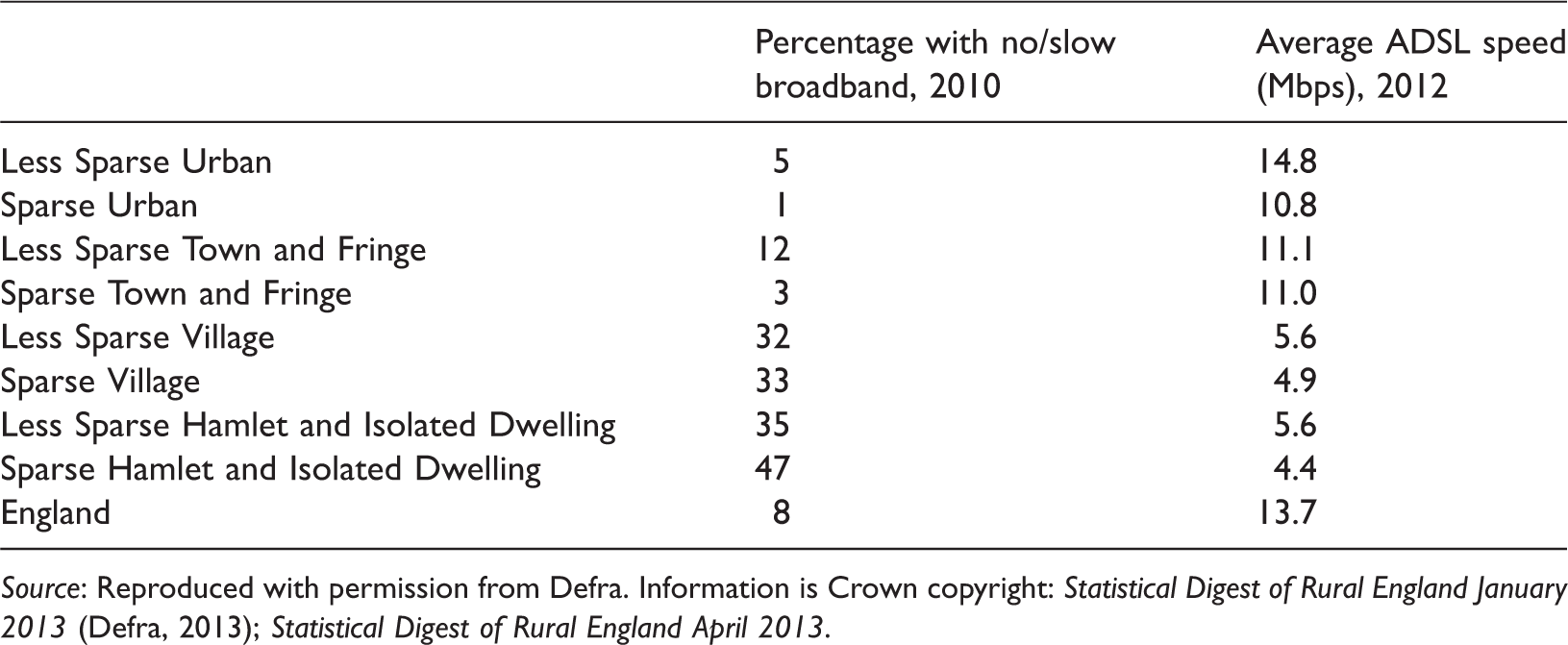
Source: Reproduced with permission from Defra. Information is Crown copyright: Statistical Digest of Rural England January 2013 (Defra, 2013); Statistical Digest of Rural England April 2013 .
Inequalities also exist due to socio-economic factors that affect adoption of broadband and associated technologies. Barriers to adoption include demographic factors such as income level, age, level of education (Dwivedi and Lal, 2007; Eastin and La Rose, 2000; Horrigan, 2009) and digital literacy (Hauge and Prieger, 2010) all associated with rural living (Horrigan, 2009; Skerratt and Warren, 2003). Ofcom (2012) reported the most cited reasons for failure to adopt a broadband service are lack of interest and cost. The high cost of connection in remote/sparsely populated locations demands using wireless technologies such as satellite, where the monthly costs can be higher and/or the broadband speeds slower. Although income affects broadband adoption, this is probably more so in certain types of rural areas, and might be a stronger influence in urban areas, for example in Glasgow where adoption is particularly low at only 60% of the population (Ofcom, 2012).
The rural digital divide is therefore a matter of the interplay between challenges of technology for connecting remote areas impacting the cost of provision and the characteristics of rural populations that may inhibit take up (Horrigan, 2009). It has been argued that the digital divide (particularly in relation to broadband access) serves to strengthen existing power inequalities within society (Blanks Hindman, 2000). According to the Royal Society of Edinburgh (2010: 31) ‘Those already most disadvantaged are least likely to be connected’. It highlights inequity across different groups in society, putting those affected at a disadvantage in social and economic terms.
The digital divide is widening because as urban areas benefit from improved technologies, rural areas are left further behind. In arguing that the divide is a particular problem for rural areas, we must also provide a strong case for broadband as a crucial tool for rural living. The next section considers the role of broadband in rural Britain both in terms of advantages and also disadvantages that arise when not available.
The importance of digital communications in rural Britain
We live in a digital age in which broadband access has become vital and increasingly favoured as a means of delivering information and services. Broadband is increasingly necessary for business development and efficiency, social support, delivery of health and government services, leisure, consumption, employment and educational services (Qiang and Rossotto, 2009; Royal Society of Edinburgh, 2010; Skerratt and Warren, 2003). It enables access to a seemingly infinite scope of information, services and resources as well as providing opportunities for social interaction.
Information channels and public service provision increasingly utilize online forms of media (Skerratt, 2006). Access to these resources enables people to become more skilled, search for jobs and earn a higher wage. This has clear implications for those living rurally who suffer decreased resources in terms of training and employment (Royal Society of Edinburgh, 2010). The shift to online provision of public services and benefits could potentially mitigate the problems associated with remote living but ironically will present further problems for those who are unable to access them. Increasingly welfare payments are accessed online, disadvantaging those without broadband access. Farm and land stewardship subsidies now take place wholly or partially online requiring access to these resources for those dependent on agricultural incomes.
E-commerce continues to grow, whilst sales on the high street fall steadily, leading to the closure of many well-known high street stores (see www.internetretailing.net for information relating to online market trends). This trend is driven by reduced online costs when buying goods and services (e.g. holidays, car insurance). Those with access to broadband can search for the fairest price, putting people without at a financial disadvantage. Those living at a greater distance from supermarkets and shops may also benefit from delivery of online shopping. Yet those without broadband are unable to take advantage of such services.
Broadband connectivity is becoming crucial for economic healthcare delivery. Over the next 20 years, the National Health Service will come under mounting pressure to deliver virtual healthcare services and remote monitoring of patients. This will be crucial for those living rurally as access to health centres becomes more difficult, especially since the median age in rural areas is six years older than their urban counterparts (Royal Society of Edinburgh, 2010).
Education is another area that increasingly relies on broadband access, with online learning resources becoming common in schools, colleges and universities, for example Glow which is used widely by schools in Scotland (https://portal.glowscotland.org.uk/). Such resources become invaluable during times of bad weather and school closures – a marked phenomenon in rural areas. Increased broadband penetration could reduce differences with those in urban areas who are able to attend school for more days during the winter period. Students without broadband are increasingly at a disadvantage compared with better-connected classmates (Malone, 2011). Connectivity is beneficial also for lifelong learning, education and career development for adults, especially relevant in a rapidly changing economy where people need to quickly re-skill to remain employable.
Leisure and entertainment are increasingly delivered online, particularly games, music and video/television content (Royal Society of Edinburgh, 2010). The majority of TV channels have an option of online viewing – allowing viewers to ‘catch up’ on missed TV or experience additional content beyond ‘linear’ broadcast television. Rural dwellers are more likely to watch online TV and movies due to a lack of access to entertainment venues such as theatres and cinemas (Commission for Rural Communities, 2009). To meet this growing trend, television manufacturers are producing Internet ready (‘smart’) televisions, which Ofcom suggests could drive demand for higher access speeds (Ofcom, 2010). This increased demand will be difficult to satisfy for the more remote locations. Access to rural broadband could play a vital role in ensuring that rural areas remain attractive places to live – particularly to the younger generations.
Online networking is fast becoming important for maintaining relationships, building social capital and expanding social networks (Ofcom, 2011). For those without broadband, this development is a major area of social exclusion. The demand increases as people move away from traditional forms of contact such as letters and landline telephone conversations in favour of interactions using email and instant messaging via social networking sites or voice over IP (including Skype). Online social interactions have considerable potential for those living in rural areas who are often socially as well as physically isolated.
Broadband is not just important for residential use, it is crucial for rural businesses too since it enables innovation and wealth creation and enhances productivity and growth. Without broadband, rural businesses are unable to compete in the global economy (Royal Society of Edinburgh, 2010). The Scottish Executive (2001: 5) argued that: ‘If we are not connected we shall not compete. Embracing the Digital Age is not an option but a necessity for success’.
Businesses in rural areas possess distinctive characteristics. Small businesses predominate, typically with no/few employees, with less focus on business growth (Chell and Baines, 2000; Moyes et al., 2012). Physical isolation is a particular issue, making it harder to reach customers and access the resources necessary to manufacture and deliver services or products. Access to broadband can potentially reduce some barriers (Skerratt and Warren, 2003) by providing opportunities for teleworking and video conferencing that can compensate for difficulties associated with distance. It can allow businesses to create an online identity, advertising products and services beyond the local area, presenting new business contacts and opportunities for engaging with the customer – ‘Communication is the lifeblood of commerce and society’ (Royal Society of Edinburgh, 2010: 4). This is invaluable for rural businesses that find it difficult to network (Burgess, 2008), allowing them to work together to achieve economies of scale and access support and information (Moyes et al., 2012). Research at the dot.rural Digital Economy hub at the University of Aberdeen is revealing the high value of social networking for rural businesses, particularly in terms of engaging with a wider market and growing their professional networks (http://www.dotrural.ac.uk/). Rural businesses without broadband therefore suffer, with evidence of higher growth amongst those with broadband compared with those without (Stenberg et al., 2009).
Broadband is therefore essential in accessing an increasing proportion of resources relating to business, health, government, leisure and educational services. These are compelling examples of how the digital divide puts those lacking access at a disadvantage. Ensuring that all members of society can access these everyday services and activities is vital if we are to protect vulnerable rural communities from the threat of depopulation. The argument that we have developed so far is two-fold: first, that broadband can benefit rural communities in social and economic terms; second, that not being able to access broadband is itself one of the major social and economic problems faced by rural communities. This is something of a paradox, yet it seems that the situation could be greatly improved with UK-wide access to broadband. Yet delivering broadband to the whole of the UK is problematic, in terms of both access and adoption. The next section addresses these concerns in more detail.
Technological barriers
We have argued that a lack of adequate broadband access is a particular problem for rural communities and that good broadband connectivity would help make rural communities more sustainable. Yet the technological landscape means that the more widely used technologies are not always commercially viable in rural areas. Even when broadband can be made available, rural adoption may be low, suggesting the solution is not straightforward. This section explores these considerations.
What is technologically possible?
There are a number of technical barriers to delivery of broadband services in rural areas that result in large variation in access speeds across the UK. The cost of wired broadband deployment depends on three parameters: distance, remoteness and sparseness of the population.
The upper speed of the broadband service is partly determined by the cable forming the ‘last mile’, or ‘local loop’. Rural dwellings and businesses are normally further from their local exchange building or radio access base station than their urban counterparts. In the UK wired connections are typically either copper or fibre. An installed copper cable will limit the access speed depending on the age of the cable and the cable length. The cost of upgrading or replacing a cable will be higher for remote users, because the distances are larger. In some areas cable-TV broadband is available (usually based on DOCSIS 3), but coverage is localized, mainly in or near urban areas, and this is not usually a technology available in rural locations.
The speed of a wired service depends not only on the cable from the local exchange to the user, but also on the exchange technology (e.g. Digital Subscriber Line Access Multiplexer, or DSLAM) and the backhaul capacity connecting the exchange to the ISP Point of Presence (PoP), where connectivity is provided to the Internet backbone (and possibly other services, such as Internet TV).
Backhaul networks can provide high capacity, but are most economical when their capacity is fully utilized and are therefore normally shared between groups of customers, in a method known as ‘contention’. The level of contention varies significantly between ISP products, and can dominate performance at peak times of the day. To operate economically, the backhaul in sparsely populated areas needs to operate at lower speeds and can result in more variation in the service due to contention.
The exchange and backhaul equipment has high basic costs, but a capability to serve many (a few hundred or more) connections, with overall costs per user lowest for densely populated areas. Rural users may be presented with less choice of price/performance of a broadband service if fewer ISPs offer service at an exchange.
One way to increase the broadband speed is to replace copper cabling in the local loop with optical fibre. This has associated cost when new cables need to be laid. Once deployed, Fibre To The Home/Premises (FTTH/FTTP) can support ‘superfast’ broadband speeds, e.g. 10–100 Mbps, enabling services such as Internet TV, high bandwidth gaming and advanced applications.
The cost of fibre installation may be reduced using Fibre To The Cabinet (FTTC). This retains the copper cable to the customer, but moves the DSLAM from the exchange to a street cabinet connected via fibre, and is often seen as a key enabling technology for urban broadband roll-out. However, to be cost-effective this requires a high density of users within the reach of the cabinet, often not the case for rural deployment.
Cellular technologies have a role in providing broadband up to 100 Mbps using next generation cellular technologies such as 4G Long Term Evolution (LTE). LTE is expected to be rolled out to a number of cities by 2015 (BBC News Scotland, 2011). As in wired technologies, the pool of connectivity is shared with all devices active in a cell. A high rate demands smaller cell sizes, which makes it unattractive for sparsely populated areas or long-range access to remote locations, therefore most users receive a much lower speed of service. While expected advances are likely to further increase capacity, these upgrades do not themselves extend broadband coverage to more rural or remote locations.
A small proportion (approximately 10%) of remote locations cannot be cost-effectively reached using wired or cellular infrastructure. In these areas, the service requirements are the same, but the delivery mechanism needs to be different, and the minimum service may have to be less than that in urban areas to ensure cost effective deployment. Wireless methods may be used to deliver broadband, and various technologies exist.
Satellite access can provide country-wide coverage to reach locations that cannot be economically reached by other access technologies (Satellite Broadband Steering Group, 2011) and is not constrained by the need to provide backhaul capacity for each location, although it has a higher cost for the same speeds than fibre and has higher delay (impacting some interactive applications). Typical monthly costs range between £17 and £75 with speeds of 2–20 Mbps. Some users have the flexibility to choose a higher service at a higher monthly cost or to pay on an occasional basis (www.dotrural.ac.uk/dart/index.php?page=dart-technology-enablers). As in other technologies, the costs may be reduced with a longer-term contract (Satellite Broadband Steering Group, 2011). Recent advances in satellite technology continue to reduce costs and improve performance (Ewald et al., 2011). Research at the dot.rural Digital Economy hub at the University of Aberdeen is contributing to the development of these services (www.dotrural.ac.uk/sira/).
In summary, a range of technologies are needed to deploy ubiquitous broadband access including FTTH/FTTP for business and new sites, FTTC to upgrade existing access, cellular wireless in places where this is cost effective, supplemented by wireless and satellite for remote locations. No single technology can achieve cost-effective superfast access throughout the whole of the country.
Realising broadband access for all
The imperative to offer broadband access is acknowledged by the European Commission, which aims to realize basic broadband for all by 2013, and states that by 2020, all European citizens should be able to access 30 Mbps, with 50% able to access speeds of 100 Mbps and above. The Fibre to the Home Council Europe shares this vision (http://www.ftthcouncil.eu/).
The European Commission acknowledges the need for a comprehensive policy utilizing a mix of technologies to meet these targets (European Commission, 2010). As part of their strategy, they initially allocated €9.2 bn towards broadband roll-out from rural development funds to ensure that broadband roll-out becomes a central concern of rural development planning across European states. Recently these funds have been cut to just €1 bn, with critics arguing that it is now unlikely that rural regions across Europe will achieve the target of 30 Mbps by 2020 ( The Guardian, 2013).
The UK Government recognizes that superfast broadband is vital for growth as one vehicle by which the UK will recover from the current economic recession. It has therefore set up BDUK to widen broadband access across the UK and progress mobile roll-out. They state that broadband access is particularly important for rural communities and businesses, to enable access to the same benefits as their urban counterparts (BDUK, 2011). It has endeavored to deliver the best ‘Superfast Broadband network in Europe’ allocating £530 m within the lifetime of the current parliament. An additional £300 m may be made available up to 2017 (BDUK, 2011) intended for areas that are least likely to be reached by ISPs, particularly communities with sparse population densities (typically rural and/or remote areas) where it is not commercially competitive to upgrade infrastructure. This has motivated a range of initiatives, such as the Royal Society of Edinburgh recommendations for universal access for Scotland by 2015, and the creation of a Digital Scotland Trust to oversee the digital health of the Scottish economy (Royal Society of Edinburgh, 2010).
BDUK aims to extend broadband to harder to reach areas, and hopes to deliver community hubs from which networks may be extended by the communities themselves. An important, but challenging question concerns the minimum speed for broadband service across the entire country. BDUK aims to provide 90% of UK residences with superfast broadband (above 25 Mbps), and universal access of at least 2 Mbps to the remainder, by 2015. One criticism is that the target minimum speeds have been too low with a 2 Mbps uncontended service for people living at the edge of deployed networks. Royal Society of Edinburgh (2010) argues that this is significantly lower than speeds available in well-served urban areas. It instead proposed that by 2015, all of Scotland should have a speed of at least 16 Mbps, with a median speed across the country of 64 Mbps and aiming for a minimum speed of 128 Mbps by 2020 (Royal Society of Edinburgh, 2010). This would require a significant investment in fibre infrastructure, and would doubtless be challenging to provide this as a universal service.
Others have argued that BDUK’s target speeds are too high – that by focusing on superfast speeds for 90% of the population, BDUK are failing those rural communities at the edge of current provision (precisely the communities that were proposed to be prioritized in their strategic vision). While superfast broadband is often thought desirable and can directly benefit medium-large businesses, the requirement for superfast broadband for residential and small businesses is presently unclear. We therefore argue that research with rural businesses and communities is required to gain a better understanding of the current and future access requirements across rural Britain. Most notably the drive for high speed has been criticized by a House of Lords Committee report, which argues that a focus on speed for the masses is detracting from work towards universal access across all of the UK, as well as failing to stimulate sufficient competition among ISP providers (House of Lords, 2012).
We would agree with this latter stance – a strategy that prioritizes superfast broadband will favour development and investment in specific technologies such as fibre roll-out and high-speed cellular services. This is supported by the EC Integral Satcom Initiative (ISI) who noted that setting an expectation of superfast broadband will divert resources away from investment in other technologies that are essential for implementing universal access (ISI, 2011). This would exacerbate the rural digital divide by essentially making the speed gap wider between the ‘haves’ and ‘have-nots’.
Other EU countries have set exemplary precedents for roll-out. Sweden, the first European country to implement a broadband strategy (in 2000) focused on universal access, utilizing two-thirds of the €4m allocated to connect hard to reach areas (Eskelinen et al., 2008). The Netherlands currently has the highest broadband coverage (Point Topic, 2012), with universal access to basic broadband and all inhabitants able to subscribe to superfast services (in part this has been made possible by the accessible physical geography of the country with a smaller proportion of people living in rural locations). Finland has declared access to the Internet to be a citizen’s subjective right, and has set a legal requirement for 1 Mbps, arguing that not unlike water or electricity, broadband access is something that one cannot reasonably be expected to live without (Skerratt et al., 2012).
To achieve the benefits of digital inclusion we suggest it is essential that the long-term strategy focuses on universal access, establishing broadband access as a right for all in a digital society (Skerratt et al., 2012). We argue this is important in the interest of social equity in the UK – both to ensure access to everyday services and benefits that are already being enjoyed by the majority, and to ensure that all members of our society are able to participate equally in the digital economy. The sustainability of rural communities in terms of developing business and accessing public and commercial services may depend upon it. So how might this universal access be better achieved? Although broadband satellite and wireless technology is now readily available, public awareness is still low. There is a need to improve awareness of alternative broadband technologies as well as financial support to introduce the necessary equipment for rural communities who might be best served by satellite and other non-wired technologies.
This needs to be accompanied by a drive to raise awareness of the need for universal access. BDUK broadband coverage maps are intended to help guide the fibre roll-out. The maps may misrepresent the need because they failed to include wireless connectivity (e.g. wifi and WiMAX) and may be misguiding local partnerships to prioritize investment in communities who already have access to reasonable broadband connectivity. Accurate information is essential to ensure a fair roll-out of broadband services.
We propose that a strategy that begins at the edges and prioritizes those who currently have no (or very poor) broadband connectivity is necessary to close the digital divide in the UK. We argue that this is more important than striving for the best superfast broadband network in Europe.
Will rural dwellers adopt the Internet?
Even when broadband is improved, adoption rates do not always increase. The literature explains this in terms of factors such as age and income levels (La Rose et al., 2007), past experience with the Internet, an appreciation of the potential benefits, and the overall cost of the service (Howick and Whalley, 2007). These factors correspond with characteristics seen in some rural communities, which might explain low adoption rates.
Booz and Company (2012) argue that a crucial driver of broadband infrastructure is usage and that a key role of government is to stimulate usage by bringing as many public services online as possible (effectively giving users little choice but to adopt the Internet). UK Government is already working towards this with the Digital by Default policy. Other examples of adoption stimulation include South Korea, which exhibits amongst the fastest growth in adoption of superfast broadband worldwide. The South Korean Government aggressively and systematically rolled out e-services online from the 1980s, more recently trialling digital home voting. Large-scale programmes have promoted e-learning, e-working and digital literacy, for example by providing training for remote working for all public workers and subsidizing the purchase of computers for low-income citizens. Japan has made streaming of on-demand high definition video content a priority, and all governmental services have been digitized, resulting in 95% of all transactions with government being completed online. Sweden has focused on digital literacy, implementing digital strategies in education delivery, and subsidizing personal computing equipment via corporate tax deductions. Additional incentives may be offered to fibre broadband users, such as dedicated Internet protocol television channels (Booz and Company, 2012).
Booz and Company (2012) noted that despite a policy for all governmental services to move online by 2010, only half of the services are currently online and more needs to be done to digitize the remaining 50%. Estimates suggest that moving these services and transactions online could provide significant annual savings: central government could save £1.8bn, local government could save £421 m (as well as cutting Co2 emissions by 28%), and the NHS could save £2.9bn.
We argue that although moving essential services online may stimulate adoption amongst those that may otherwise hold little interest in using the Web, there is also a potential for those without the skills or confidence to be disadvantaged if they are unable to adequately participate. Support in the use of Internet technologies is crucial. The Royal Society of Edinburgh has recommended investment in a broadband delivery plan, together with local community hubs to provide training and support for those with low levels of confidence or motivation.
Local and national government are being encouraged to promote tele-working, tele-medicine and e-learning (Royal Society of Edinburgh, 2010). This is expected to go hand in hand with the Communications Consumer Panel – a body that acts independently and can influence Ofcom, government and industry to benefit the interests of users, with a focus on the elderly and those with low incomes or disabilities. Additional initiatives are being put in place by governmental and non-governmental bodies. Various public-centred initiatives seek to increase digital engagement with online technologies. In 2010 the ‘Get Online Week’ initiative saw almost 30,000 people registering for online services. Martha Lane Fox’s ‘Race Online’ initiative sought to get at least 1.75 million people online by 2012 and has now transferred its activities to Go On UK – a charity aiming to make the UK the ‘most digitally skilled nation in the world’ (http://www.go-on.co.uk/about-us/our-mission). These partners are enabling a range of solutions including recycled personal computers (PCs) and affordable hardware. Such support is crucial in engaging people with broadband, especially those in newly upgraded (often rural) areas where previous broadband connectivity has been poor or non-existent. This roll-out of broadband access technologies should go hand in hand with support and training to help people engage with and adopt the technologies.
Conclusion
Broadband is becoming central to everyday life and connectivity is vital for access to a range of services – be they financial, lifestyle, healthcare, educational or business/career based. Entertainment is increasingly skewed towards online forms of media delivery, and a large proportion of social communications now take place online. Other services will continue to move online, leaving those who cannot (or choose not to) connect to broadband at a large social, economic and educational disadvantage. We therefore argue that broadband should be available to all in UK society.
To support this, this article has presented a number of compelling arguments that suggest that broadband can go far in addressing the problems of social and physical isolation in rural communities. For those who suffer a penalty in terms of distance to services and others, connectivity could be crucial. Rural communities need broadband as much, if not more than their urban counterparts. Yet the available evidence suggests that the majority of those without broadband infrastructure live in rural (and often remote) locations. This is problematic not only in terms of access to services, but also for those wishing to run businesses or work from home. Public services are increasingly delivered online, thus disenfranchising those without broadband access. Online commercial services provide a far wider range of consumer and leisure options. Rural communities that are well connected may be more attractive places to live and work than those that are not – this has clear implications for social and environmental sustainability. For the majority of businesses, broadband is now crucial to enable competition in a wider economy (Royal Society of Edinburgh, 2010; Scottish Executive, 2001). Lack of adequate connectivity is not the only problem – rural communities sometimes suffer from low adoption (Skerratt, 2008). Thankfully, a number of initiatives are emerging to support people and increase adoption.
Connecting rural areas will bring the UK one step closer to universal access. Yet a high cost for remote connection, together with slow rates of adoption, means that universal access to broadband is unlikely to be achieved for some time. For the foreseeable future, at least 5% of UK premises (largely rural ones) will rely upon technologies such as satellite for broadband access. These technologies will not offer the same speed per unit cost as fibre in better-connected areas. There is still much work to be done before the divide truly narrows.
BDUK is focusing on speed in its allocation of the £530 m funds to roll out broadband across the UK, rather than prioritizing rural broadband notspots and ensuring universal access. As urban areas enjoy increasing broadband speeds in the drive for the best superfast broadband in Europe, the divide is likely to widen as rural areas will suffer from an even greater discrepancy in terms of broadband provision, putting them at a larger competitive disadvantage. Many rural communities not currently connected could benefit from wireless technologies which would provide them with speeds fast enough to enable applications such as Internet TV, video conferencing and upload of large files. This will allow rural communities and businesses to profit from many of the same benefits enjoyed by their urban counterparts. It is crucial that we continue to place rural users at the centre of broadband roll-out and support. Otherwise, whilst urban areas race ahead with superfast broadband, our vulnerable rural communities may be left further and further behind.
Footnotes
Acknowledgements
The authors would like to thank Professor Alistair Anderson, Robert Gordon University, Aberdeen for his helpful suggestions relating to this article.
Funding
The research reported here is supported by the award made by the RCUK Digital Economy programme to the dot.rural Digital Economy Hub (award reference: EP/G066051/1).