




Abstract
We examine the principles, purpose and practice of Community Wealth Building (CWB). Our case study, located in the UK, involves a Local Authority (LA), local community groups and local people, and the implementation of a CWB initiative by the LA. Action research enabled us to scrutinise the LA approach to the CWB initiative in terms of community engagement and consultation. We identified power and control tensions in relationships between the LA and different community groups (including local development trusts) that undermine the theoretical principles of CWB. Examination of these issues through a Bourdieuvian lens reveals the role played by power relations and highlights the need for ‘practical reflexivity’ in any community engagement process especially where institutions are at risk of misinterpreting how CWB might be accomplished in practice. Our study contributes a reflexivity model of CWB for purpose and practice, grounded in ethics, fairness and inclusion, and is of significance to LA initiatives claiming a CWB mission, vision and strategy.
Introduction
With the economy gradually emerging from the global pandemic, new initiatives are being explored to enable society to ‘build back better’ (HM Treasury, 2021). Given the unprecedented, at least in peacetime, (Macfarlane, 29 April 2021) state intervention during the covid era, the call to ‘build back better’ has been accompanied by further demands to end austerity. In this paper, we argue that political and economic actors must regain ground as supporters of local people with local solutions and forgo any narcissistic rhetoric if communities are indeed going to ‘build back better’ (Saad-Filho, 2020).
To build back better at a local level will require increased support for LAs who are still recovering from austerity policies which have resulted in cuts to LA spending of 50 per cent (Centre for Cities, 2019); in some LA areas causing a reduction in employment, within English LAs of over 24% of full-time equivalents since 2012 (ONS, 2020). Unfortunately, UK and national government monetary deficiencies are systemic, resulting in reduced public spending at the LA level. Reductions of this nature had led to the exploration of new potential solutions of how LAs could not only at least maintain acceptable levels of service delivery (Thompson et al., 2020) but also build back better. One potential solution, known as ‘community wealth building’ (CWB), is the subject of this paper. By examining local interactions, consultations and power tensions, we highlight critical failure and success points that can exist in CWB initiatives, and which inform the development of a reflexivity model of CWB purpose and practice.
Community in its broadest sense, and as a conceptual solution to poverty, exclusion and inequality, has attracted academic interest for many years. Notably, over 20 years ago, North et al. (2002) acknowledged that types of assets owned by communities are highly relevant to any community development and resilience. Equally, it is widely accepted that the degree to which community assets are fit to provide income streams and solutions to inequality is highly questionable, often they are a liability that depletes local resources (Skerratt and Hall, 2011). Acknowledging that dynamics of community power and resilience were well understood in 2002 (North et al., 2002), is ‘community’ as a central mechanism for wealth creation 20 years on from then a success, or at best an institutional rhetoric? We argue in this paper that, with increasingly irrefutable evidence, more needs to be done to centre the community as the wealth builder and reposition the power and influence of the institution in the context of democracy. More recently, McInroy (2018: 679) claimed ‘local economic policy assumes that once investment capital had been enticed (often to our large metropolitan cores) wealth creation will flourish…’; indeed, this appears to be the broad approach adopted by LAs yet this is not CWB as it was conceptualised.
CWB is an initiative which seeks to utilise assets within the local community to enhance community development which will remain within the locality creating a virtuous circle. The idea originated in Cleveland, USA, though some commentators identify the genesis of the ideals within the Mondragon cooperative system of the Basque country and equivalent structures of Emilia-Romagna (Italy) with historical routes dating back to the Paris Commune (Brown and Jones, 2021). A key aspect of CWB is the community aspect, that is, democratic accountability and decision-making at a local level. This differentiates the initiative from other UK community development projects which dominated the political landscape of the 1970’s and 1980’s which were LA-led but lacked community engagement.
The principles within the CWB model would seem to offer a hopeful way forward to balance accountability for delivering the local economy (already devolved to regional and community levels in the UK) with the increased agency to deliver this in locally shaped ways that sustainably address the challenge to revitalise communities faced with a legacy of long-term underinvestment caused by centralist austerity policies and long-term de-industrialisation (Rowthorn and Wells, 1987). However, a major challenge to CWB’s success lies in the execution of the model, particularly in its aim to re-empower local communities by engaging them as active participants in the project.
The focus on CWB in this paper was prompted by seeking to identify how recent UK national policy initiatives, such as those relating to improving community engagement and community asset transfer, have been implemented in local areas. In particular, successive bids by the UK and Scottish Governments to empower communities (Elliot et al., 2018; Revell and Dinnie, 2020; Rolfe, 2016; Steiner et al., 2022) should have set the groundwork for this basic principle of CWB. However, the lack of successful policy in transferring power to the ‘community’, such as in Prime Minister David Cameron’s ‘Big Society’ (Civil Society Media, 2015) has highlighted the complexity of such policy. It has been viewed as elected bodies offloading their responsibilities onto unelected agencies (Rose, 1996; Raco and Imrie, 2000; Hancock et al., 2012), especially when they are accompanied by budgetary cuts (Rolfe, 2016) and drastic funding cuts to the Third Sector. Failures in community empowerment initiatives (e.g. Bennett et al., 2022) also highlight the subjectively complex meaning within the singular term ‘community’ and change the understanding of community action by categorising as ‘community self-help [everything] from the informal assistance of neighbours to formal service provision by community organisations’ (Rolfe, 2016: 101). The nature of ‘community’ has also become contested as it is treated by policies as both objects requiring support and subjects expected to take on previously public sector responsibilities including (in Scotland) addressing issues of equality (Rolfe, 2016). The subjective interpretation of ‘empowerment’ is also evident in the contradictory wording of the Community Empowerment (Scotland) Act 2015 and the National Standards for Community Engagement that clearly state that community engagement should deliver ‘shared decision-making, shared action, and support for community-led action’ (Scottish Government, 2005; revised 2016: 6) but that their aim is to ‘make [the community’s] voices
We utilise a particular project in a Scottish Local Authority, an area which, having struggled to overcome problems associated with de-industrialisation, has turned to CWB as a way of resolving issues of multi-deprivation within the community. Our research provides a model of how to substantiate aspirations of encouraging local initiatives that demonstrate a…. ‘democratic approach to address poverty and inequality’ (Thompson et al., 2020: 1173).
Whilst we agree with the principles of CWB, particularly as a counter to austerity-driven and neo-liberalism policy, we show evidence suggesting that CWB might struggle to be operative without an effective community engagement tool; the LA institution itself situated in the power role rather than the body of people it serves. To fully justify this claim, we utilise a Bourdieuvian lens to analyse the implications of not fully understanding the power relations and ‘symbolic violence’ at play within the ‘fields’ of local communities.
We fostered connections within the local community and, through action research, we adopted an engaged scholarship approach (Van de Ven, 2007), enabling us to observe and engage in discussions with a local community development group as well as analyse the documentary evidence of the interactions and plans for the place making project. Our involvement was reciprocal, we were invited to observe and comment on a meaningful attempt at CWB then, post analysis, provide a report to support the community in their ongoing efforts to place a grassroots voice at the centre of decision-making. Our findings and subsequent report for the community development group argued that CWB in this instance fell short due to a disconnect between the LA’s promised community engagement and the community engagement experienced by the community.
In short, our findings relating to the place-making project at the heart of our case study evidence that CWB remains stubbornly flawed in its execution, and our longer-term observation is that this is a complex and recurring issue that requires understanding and addressing if CWB initiatives are to succeed. Therefore, in this paper, we present a model of practical reflexivity as a tool to define the purpose and more effective practice for CWB projects. The paper is organised as follows: after a brief description of the governance structures in Scotland, we then outline what is understood by CWB, ‘community’, ‘community participation’ and ‘social relations of power’. We then provide a case study narrative, followed by a table of themes generated from field notes and a content analysis of documents made available by the community and the Local Authority website. Our discussion includes consideration of the concepts of space and place, industrial heritage and industry decline as social and cultural capital which combine with economic capital that create ‘wealth’ in CWB. All this is viewed through a Bourdieuvian lens to explore unseen power dynamics at play in shaping who or what is ‘community’.
Governance structures in Scotland
As our understanding of CWB has been shaped by our learning from a community-level project in Scotland, UK, it is important to explain the governance structures that provide the political context in which our case study, a place-making project in Scotland, is positioned. The UK Government devolves power on specific issues (for more information see Elliott et al., 2022) including economic development to the Scottish Government which further devolves power to local level LAs, also known as Councils. Each of these government agencies is democratically accountable to their electorate. The Scottish Government has, since soon after its re-establishment in 1999, placed strategic emphasis on becoming a fairer, wealthier, healthier and greener nation and in 2003, LA’s were tasked with forming Community Planning Partnerships, working together with other public bodies and Third Sector Interfaces within their local communities ‘to design and deliver better services that make a real difference to people’s lives’ (Scottish Government, 2021). Indeed, it is suggested that the ‘Scottish approach’ to policymaking relates to consultative and cooperative principles, operating across ‘silos’ and drawing on strengths of the third, public and private sectors (Cairney et al., 2016). Some noted that this ‘partnership working has become an increasingly popular way of delivering public services’ (Lamie and Ball, 2010: 109) with ‘the drive towards greater localisation in the design and delivery of public services […] gaining momentum across the UK’ (Elliott et al., 2018: 314). In spite of this, and although the language of ‘partnership working, institutional capacity building, leadership, active stakeholder engagement and consensus-building’ has been promoted in Scotland for many years, concerns related to ‘the need to develop
Community wealth building, ‘community’ and ‘community empowerment’
CWB is a dynamically emerging economic governance model, devised originally by a Washington DC-based think tank, the Democracy Collaborative, to offer a ‘[…] left alternative to both extractive neoliberalism and xenophobic nationalism […]’ (Guinan and O’Neill, 2019: 383), ideologies which Guinan and O’Neill suggest are proponents of ‘dangerous inequalities of wealth and power’ (Guinan and O’Neill, 2019: 383). Growing acknowledgement of CWB as a new way forward internationally is establishing an irrefutable impetus for change. Since the not-for-profit collaborative, Evergreen Cooperatives developed the initial concept into what became known as the ‘Cleveland model’ in 2005, a collaborative UK research ‘think and do’ tank, the Centre for Local Economic Strategies (CLES), further developed this to establish the ‘Preston Model’ in 2013; and this has since been introduced in several regions across the UK. ‘Community Wealth Building is about creating a resilient and inclusive economy for local people’ (Preston City Council, 2021: 7) by shifting the balance of economic power from central to local level (Kelly and Howard, 2019; Lee, 2019) through the development of place-based (community) networks that are fully invested in delivering goods, services and projects shaped by the local electorate to favour the generation and retention of wealth and wellbeing locally rather than patronage of companies outside the area. More than that, however, the aim is ‘[…] to shift the position of individual citizens from being bystanders – who can merely watch economic forces play out in their local communities – to active participants, who can collectively give some form and direction to the economic future of their local area’ (Guinan and O’Neill, 2019: 387). By delivering locally rooted initiatives that meet the needs of those they aim to serve, the CWB model aims to deliver better sustainability and equity than is possible with traditional competitive market economics (Lee, 2019).
The Preston Model introduced five structural pillars of CWB: 1. Plural ownership of the economy; 2. Making financial power work for local places; 3. Fair employment and just labour markets; 4. Progressive procurement of goods and services; and 5. Socially productive use of land and property. However, because of its principle of uniquely shaping the model to individual communities, CWB is not a ‘blueprint’ (Power and Goodwin, 2021), a ‘one size fits all’ model (Democracy Collaborative, nd) and those undertaking a CWB approach should be critical of adopting a model which was shaped to meet the needs of one particular city (such as Preston), and carefully consider where and how relevant aspirational principles of CWB can effect positive change in their local community. The case study within this paper takes a more holistic approach than, for example, Dundee City Council which is intent on creating ‘a living wage city’ (pillar 3) and others including Preston which have focussed initially on pillar 4, creating CWB through the development of anchor institutions (Jackson and McInroy, 2017). Anchor institutions are a key element of the progressive nature of CWB (Power and Goodwin, 2021) in which ‘public, non-profit organisations anchored to place with important civic functions’ (Thompson, 2021: 330) are identified and engaged with, the aim being to localise procurement of supplies and services thereby enhancing local employment opportunities for social enterprises, small businesses and local entrepreneurs and reducing travel distance and costs in the supply chain. This last aspect is becoming more important as nations and non-government grassroots pressure groups are aligning in support of an increasingly international Green New Deal movement to influence policy in ways that combat the impending challenges of climate change. If large anchor institutions such as universities and housing associations adopt positions of responsibility to local residents and work together with other local agencies to ensure benefits ‘ripple’ outwards (Jackson and McInroy, 2017), economic capital can be better shared in peripheral as well as central locations (Thompson et al., 2022).
In exploring a CWB initiative, we need to consider the meaning and application of the word ‘community’. This somewhat contested socially constructed term (Cohen, 1982) is viewed as being ‘in transition as a result of major social transformations which have brought with them new cultural and political experiences and forms of living’ (Delanty, 2009: 150). Whilst its literal meaning of ‘bringing together’ (com) ‘into one single unit’ (unity) evokes a sense of commonalities and solidarity, it is often used to define groups on the basis of what separates them from others rather than the commonalities they share (Fitzpatrick, 1966; Barth, 1969). ‘Different uses and interpretations of the term are unavoidable’ (Delanty, 2009: xii) but there is a common understanding that ‘community’ is more about people than just a geographical area; and that it represents a nostalgic longing for solidarity and collective identity (Delanty, 2009). It is not surprising therefore that government agencies use language that positions them as part of their community, shoulder to shoulder with their electorate and champions of creating what Delanty (2009) calls ‘[…] the cosy world of community, belonging and solidarity, where the individual [can feel] at home in an otherwise homeless and increasingly insecure world’ (Delanty, 2009: 150).
That said, the Scottish Executive’s (2004) Statutory Guidance on Community Planning Partnerships refers to public bodies working together with local communities, creating a not uncommon inference that these are two distinctly separate entities with differentials of social power between and amongst them. Because the community which an LA serves is comprised of multiple, complexly overlapping communities (a phenomenon which we explain later in terms of Bourdieuvian ‘cultural fields’) where individuals may belong to more than one grouping at any given time, we should exercise caution regarding the inferred sense of unity implied in phrases such as ‘the community says’ or ‘the community was consulted’, or even community wealth building’s aim ‘to bring power back to the community’. Whilst LAs may seek to engage with their communities by actively reaching out to groups and individuals within the electorate, there are undoubtedly some voices ‘missing’ or ‘lost’ from the engagement process; those whose views are not heard, whose skills and ideas have not been harnessed for the good of all (Redwood, 2017); this is an issue we will return to later. Nonetheless, the Scottish Government narrative aligns with the notion of anchor organisations but evidence of CWB is restricted to regional projects and pilots (Scottish Government, n. d).
Community participation
It is not clear in CWB discourse which ‘community’ is to be involved in decision-making processes or what shape that involvement might take regarding local economic development. The interchangeable use or conflation of a diversity of terms commonly used to describe the interactive process between an LA and their electorate, for example, ‘community consultation’, ‘engagement’, ‘participation’, ‘empowerment’, leaves CWB’s aim to deliver ‘bottom-up economic development based on greater democratic ownership, participation, and control’ (Democracy Collaborative, nd) open to subjective interpretation. Differing expectations between LAs and community groups can result in misunderstanding of, and tensions around ‘community involvement and the local authority’s community leadership role’ (Sinclair, 2008: 377).
Community consultation seeks out the views of others on specific issues but there is no guarantee that these views will carry any influence on decision-making processes (Cho and De Moya, 2016). Following widespread recognition of ‘consultation fatigue’ (Beveridge et al., 2016: 36) where people no longer want to offer opinions as their experience is that these never seem to influence key decisions, the Scottish Government states that consultation alone is no longer acceptable: community planning partnerships, for instance, must ‘secure the participation of [their] communities’ (Scottish Government, 2021), working towards joint strategies in more meaningful partnerships than is the case with Community Planning in the rest of the UK (Sinclair, 2008, 2011).
Whereas ‘community
Community participation which
Social relations of power
The growing global appetite for radical economic reform ‘in a once-in-a-generation change’ (Guinan and O’Neill, 2019: 383) from long-standing Marxist and Keynesian economic models to a new focus on participative and co-productive working, requires new insight into the human dynamic in local communities. The social class divides of Marxist production-led economics do not fit with co-production projects, for instance and yet, whilst a hierarchical class system may be rejected as outdated and unhelpful, social grouping is very much a present reality even if it is an unacknowledged ‘elephant in the room’ (McLeod et al., 2009). To create the ‘shift in the balance of power’ (Kelly and Howard, 2019: 387) that CWB aims to deliver, there is a need to overtly acknowledge what Butler and Watt call ‘social relations of power’ (Butler and Watt, 2007: 173) between and amongst groups and individuals and, where relevant, to ensure that barriers to effective community development are revealed and addressed.
As Bourdieu’s theories of social class offer a helpful model to aid understanding of social power dynamics, this paper examines the community engagement aspect of CWB through a Bourdieuvian lens. Bourdieu views human interaction in any ‘cultural field’ (arena of shared interests) at any given time as being comprised of multiple and overlapping groups of people who have subconsciously classed themselves together because of their shared social, economic and cultural capital. These groups compete with each other to ensure their way of doing things prevails (Bourdieu, 1990a, 2010).
In Bourdieuvian terms, each of us develops ‘habitus’, a subconscious, ‘bodily’ sense of what passes for the norm in our world (Bourdieu, 1990a, 2010). This is uniquely socially constructed according to each individual’s experiences, and it shapes their interaction with others. Different mixes of capital can be collected, saved and exchanged in ‘fungible transactions’ (Portes, 2000: 2) and can be elevated to the status of ‘symbolic capital’ within a group conferring esteem and power to its owner (Bourdieu, 1986). Economic capital is that which can be exchanged into money, used to buy possessions and accumulate wealth; cultural capital is the value we ascribe to cultural tastes, education and skills; and social capital is about how socially connected we are (Bourdieu, 1986).
In a form of ‘class unconsciousness’ (Crossley, 2006: 93) people ‘naturally’ gravitate to those with a similar habitus, whose views and values seem like the norm in contrast to others who live life differently. In Bourdieuvian theory, dominant groups containing symbolic capital compete with other groups within a given field using ‘symbolic violence’ to establish their sense of norm as the prevailing way of doing things, what Bourdieu calls the ‘doxa’ (Bourdieu, 1999). ‘Symbolic violence’ is not recognised or acknowledged; it is instead a misrecognised use of social power directed towards an individual or group which is actioned ‘with his or her complicity’ (Bourdieu and Wacquant, 1992: 167) thinking that they are making their own choices.
Although Bourdieu uses terminology which might be unfamiliar to some, the principle of his model is clear: Like-minded people group together and strive to promulgate what feels like the normal way to do things. We can belong to many different groupings at any given time. Because all of this happens at a subconscious level, it is difficult to question or change our personal habitus without Bourdieuvian ‘reflexivity’ to help reveal the social relations of power in action (Bourdieu, 1990a, 1990b). Sometimes this can happen inadvertently (Bourdieu, 1990b); for instance, a councillor sharing habitus with a specific community group whilst also sharing a different habitus with an LA executive group may not be aware of how these both shape his or her sense of ‘normal’ in everyday life until a conflict of interests between the groups prompts reconsideration of where he or she is positioned in relation to a dichotomy of standpoints. However, it is also possible to deliberately choose to view one’s paradigms of habitus from the outside-in as it were and uncover what social relations of power are in action. Through new understanding achieved by this methodology of ‘reflexivity’, previously unseen power disparities which may be impeding productive outcomes can be identified and mitigated.
The use of a Bourdieuvian lens also provides the opportunity to explore where spaces in between groupings (Arber, 2000) can emerge to offer individuals better opportunities for empowered control over their life choices and the potential for social mobility (Redwood, 2017). This is critical to delivering the radical change, redistribution of power and equity that CWB as an ‘emerging new local socialism’ (Guinan and O’Neill, 2019: 384) seeks to facilitate. A Bourdieuvian lens enables examination of habitus and highlights evidence of shortcomings in reflexivity while in pursuit of a CWB project. The following section examines the case where questions were raised by a community group over Local authority reflexivity during a CWB project.
Community project: our case study
Our case study comprises three small towns as well as several smaller villages and hamlets and is part of an LA in Scotland. The wealth of the area today is found in physical, historical and cultural spaces. However, the narrative of the identity is incomplete without an understanding of its industrial past, embedded in the minds of the people. It has a notable rich industrial heritage extending back to the mid-nineteenth century when local mines, ironworks, thread mills and factories helped grow the local population. The nearby engineering works employed around 3000 people at its height of production in 1920, which gradually declined to 200 at the time of its closure in 1985 (Grace’s Guide, 2020). The decline of primary industry typified the process of de-industrialisation (Rowthorn and Wells, 1987) and presented severe challenges and change for the local communities, resulting in a loss of cultural heritage caused in turn by the loss of economic importance.
This economic decline manifests itself in the lack of job opportunities, with only 0.57 jobs per working-age person, the sixth lowest in Scotland (Millard et al., 2016). The level of unemployment for the local area is 7% higher than for the Local Authority region overall and 80% higher than the national average. Youth unemployment shows a similar picture, underlining the pressing need for local job creation. Two-thirds of people in the local area earn less than £30k and educational attainment rates are below the local authority average. Furthermore, 25.8% of the local population lives in areas considered deprived (Millard et al., 2016), with 40% of the population living in the most deprived SIMD quintile, and life expectancy for men being 4 years below the average life expectancy for similar accessible rural areas (Millard et al., 2016). As evidenced by the fact that a wide diversity of community organisations has used the local physical recreation areas for more than 100 years, it can be argued that the area has a strong community spirit. A Local Community Group, state: “We believe that the meaningful involvement of people, combined with enabling initiatives which equip people with the capacity to engage at a level and pace defined by them, is fundamental to the success and sustainability of regeneration initiatives.”
The CWB project includes development plans for approximately 248 ha consisting of a ‘place-making project’ on both green space and the brownfield sites.
We built a case study and created a single analytical unit (Eisenhardt and Graebner, 2007). The process of case building involved participatory research which occurred over a 5 year time period, engaged scholarship and back-and-forth communications with a community organisation examining complex social issues (Reason and Bradbury, 2008; Van de Ven, 2007, 2018). We searched and collated papers and reports, retrieved published charettes, and examined consultations from community organisations as well as the LA and government websites; all information exists in the public domain. We undertook a content analysis of the documents, searching for concepts and repeating patterns thus enabling the construction of themes which were then discussed with community members as a way of triangulating evidence, clarifying issues and correcting expression (Charmaz, 2006).
Thematic analysis of tension between habitus and power ideology.
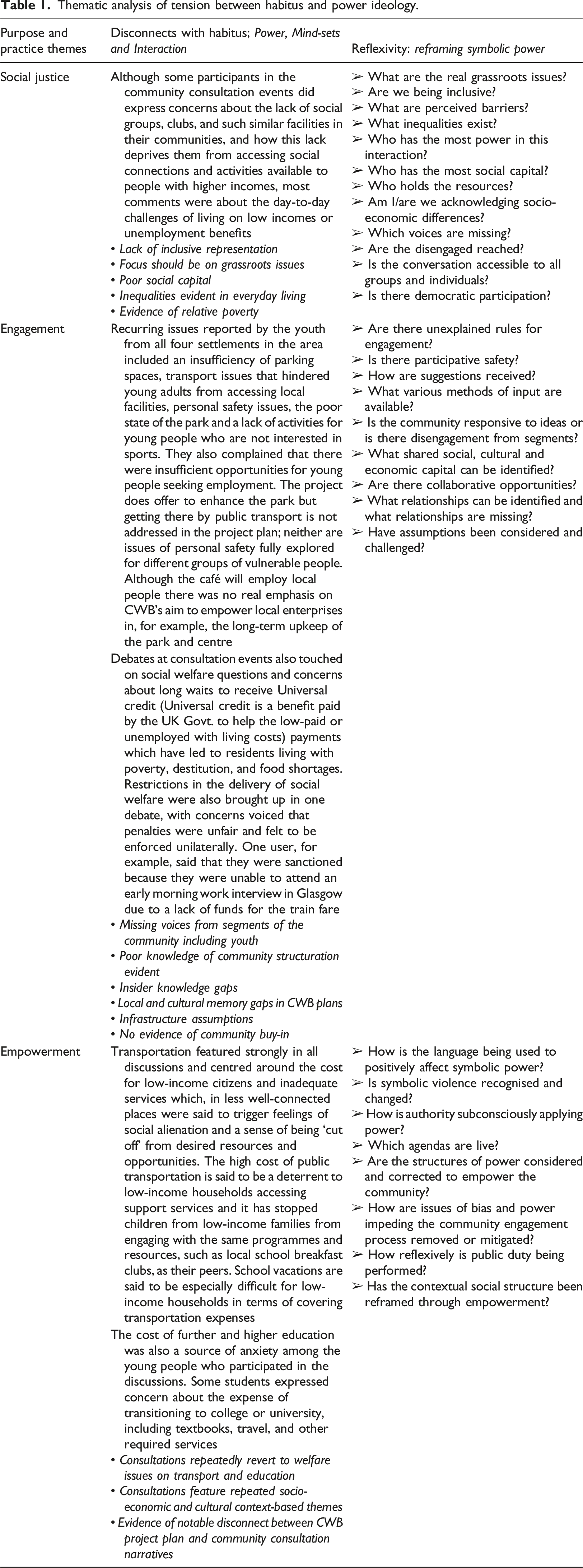
It is evident from our data analysis that the community is very much focused on domestic issues, and it would be a reasonable expectation that a project tasked with building wealth and equity would engage with the public to not only explore these issues further but, as the first step in building trust and an empowered community, work together with them to find innovative solutions. That this has not happened might explain why local people believe their voices are not heard and their concerns are not raised or acted upon; a fundamental flaw grounded in poor reflexivity and faulty power ideology.
As a key learning point to all public authorities striving to connect with their communities, we present these findings to illustrate how an LA’s formulaic, short-term and sporadic contact with groups and individuals falls short of effective community engagement. Concerns about community voices not being heard have also been brought to our attention by a community development organisation involved with the LA’s wider CWB development plans. Although these plans are deemed to offer an ideology of sustainability and social inclusivity, grassroots complaints continue to persist with claims that community voices are lost; that the spatial, memory and historical identity is unfulfilled by the plans; and that community acceptance of these proposals is at risk. Recent LA proposals for a multimillion pound spend for further local development have unsurprisingly received a cool response from the community.
Wealth in community wealth building
It is worth reflecting, therefore, that the wealth to be developed in CWB projects should include social and cultural as well as economic capital; flawed and faulty assumptions about a local context have no place in CWB. A notable feature of the community in our case study area is memory identity; culture and history remain in people’s memories, and it is those memories that shape local identity based on both social and sensory aspects (Deffner and Mexatas, 2007). Most notable in the case study area is the industrial memory of the brownfield site, now popular with dog walkers and used by local sports clubs. Selman and Swanwick (2010) have suggested the importance of realising landscape uniqueness in modern landscape development processes to increase ties between residents and the environment.
In keeping with many rural communities across the world, our case study area has become less isolated, and more attractive to newcomers who, together with some long-standing ‘born-and-bred locals’, can commute outside of the area for work and services. This impacts on identity shaped by placed-based memory and, as memory is a key component of habitus and can fuel strong emotions including bitterness, defence and pride, it will create new social ordering in a community in which not everyone will share or value the area’s industrial memory. Over time, fewer people will have a living memory of those who shaped this past identity, and they may have different aspirations for the community going forward. Those tasked with managing change in the development of CWB projects should therefore consider the potential tensions of power and place between different identity groupings in the community, and those who do not live in the community in which their project is sited should also be mindful of their outsider status in relation to its shared memory habitus.
Bourdieuvian insight
Our examination of the community engagement process through a Bourdieuvian lens highlights the as-yet-unseen barriers of power that are impeding successful community engagement and the re-democratisation process. In Bourdieuvian terms, different groupings of people with shared habitus within the cultural field of a community each try to gain dominance over other groups so that their own doxa will prevail. Subaltern groups misrecognise the dominant group’s symbolic violence being exerted against them as values and views which align with their own, and they therefore accept and validate the actions of the dominant group. Life goes on unchangingly.
In plain English, Local Authorities’ sense of what is normal (habitus) is so normal to them that it is never thought of as being a particular paradigm within a world of multiple paradigms. Habitus influences their interaction with the people in the shared cultural field of their community. They follow the rules for community engagement not realising the control (symbolic violence) they exert over this process and without understanding the inherent power in the rules themselves, shaped as they were by other like-minded public servants. They decide who will be invited to participate, to what degree, and at what time(s). Any LA, however, is not a singular grouping: it comprises elected councillors of different political views, as well as differing levels of management and agency within the bureaucratic office that exists to carry out public services. To further complicate matters, habitus is shaped by power exerted on this complex institution by regional and national governments as well as from local electors and community groups. Overall, however, there remains an innate sense of an ‘essence of local government’ which will be felt as normal to those who work and live within this shared set of values and practices, and as a sense of ‘other’ to those who do not live in this way in their daily lives. The unseen, unacknowledged sense that it is simply the natural order in life for an LA to maintain its ultimate position of power, will subconsciously influence any behaviour and activity within its business practice. For example, the unacknowledged normality of seeking funding first and deciding later how to use it may explain why the LA in our case study completed some of its decision-making before engaging with the community. We are not privy to the LA’s reasons for their decisions and acknowledge that procurement laws may restrict licence in this regard, but we do question if habitus is why a CWB project would commission its business plan ‘using out of town’ consultants, consultants from a different country in fact, instead of investing in local businesses. Such actions illustrate how limits placed on community input might compromise a project’s innovation and creativity.
It is important to stress here that we are not criticising the sincerity of LAs in general in this process; rather, we aim to highlight why a subconsciously internalised blindness to the underlying drivers of delivering normative practice is threatening the sustainability that CWB in action promises. An overriding, again unarticulated, sense that the LA knows best what its electors need may cause projects to fail because costly interventions are not what the community want. It is also important to stress that the complex and ever-changing interplay of power between and amongst multiple groups which exists within the geographical limits of a community can impact the degree to which community ‘activity’ or ‘participation’ is welcomed or impeded by the LA and can also shape the public’s willingness or reluctance to participate.
Empowered citizens and social justice
In light of our findings and our reading of Bourdieu, we return once again to the vexed question of ‘community’. A major stumbling block to the execution of CWB is the vagueness around who or what in terms of ‘the community’ is to be re-democratised or empowered. Whilst this may be, and probably has been interpreted as the democratically elected LA acting as the community’s representative in local governance, others within the electorate might reasonably interpret ‘community’ to refer to Guinan and O’Neill’s (2019) vision of empowered citizens actively involved in shaping the local economic agenda. The meaning of ‘active participants’ (Guinan and O’Neill, 2019: 387) here is also unclear as it too is variously interpreted within a diversity of subjective interpretations of the terms ‘community’ and compound terms of community ‘involvement’ or ‘participation’ or engagement’ or ‘empowerment’. This lack of objective clarity risks obfuscating the CWB’s aim of re-democratisation of the ‘community’.
As ‘community exists at different levels [… and can be] experienced as a collection of socially networked people’ (Redwood, 2017), Bourdieuvian reflexivity can be used to explore what forms of social, cultural and economic capital are supporting or undermining the development of such networks. New insight into the shaping of ‘community’ expressed in the sense of solidarity of values and purpose could identify opportunities to form new groups of shared values that bring together a wide diversity of the public, including LA personnel as part of this identity and as equals in terms of social relations of power. This would be a major step forward to achieving the CWB’s aim of partnership and community empowerment at a level deeper than local authority representation of the community.
In a salutary lesson to agencies which use their power to promulgate a doxa of rules-driven practice, HIEF (2010) states that communities work best when ‘driven by a need to make life better for their residents, not to fulfil some legal policy’ (HIEF, 2010: 14), and that in order to build dynamic communities that reflect the social diversity of needs within them, all sectors should work together as equals (HIEF, 2010). Arguably, making life better is a subjective logic shaped by contexts. Each community has historical memory, spatial dynamics and a socio-economic canvas; the combination of all these features creates individual communities and their identities and, as such, an ideology around making life better is heavily situated.
Whilst LA personnel following regional and national guidelines for community engagement will have identified and made contact with community groups which provide support to those who can be more challenging to connect with directly; the vulnerable, ethnic minorities, the elderly, young people etc., there can be a poor response rate and certain ‘voices’ are regularly ‘missing’ such that those participating cannot be seen to be an inclusive and representative cross-section of the general public, especially when many citizens are not part of any formal community group (Lee, 2019). Of course, we acknowledge that it is human nature that some people will always opt out of any engagement in civic issues; some later insisting that they were never asked for their opinion despite public notices about consultation events, but it is important that this is never taken as an excuse not to strive to involve the public, especially as this is a key aim of CWB.
A successful sampling strategy in Redwood (2017) used ‘insider contacts’, individuals known by name from across the public, private and third sector with whom the researcher had built a good relationship over a prolonged period and who she could contact directly. Investment in growing familiarity over time was not only rewarded by the development of trust but also in a closer sense of shared habitus of values and power than exists when LA personnel only reach out to designated local group contacts sporadically. Redwood’s (2017) strategy of requesting that a meeting invitation should be cascaded on to group members was also an effective way of including and empowering individuals at the grassroots level rather than relying on the LA strategy of connecting with group representatives. There was the additional bonus that support groups understood how to communicate effectively with their members, many of whom would need communications transcribed using different media and formats or would require advocacy support to ensure they could engage with the topic at hand.
Community empowerment through engagement
Whilst acknowledging that community engagement is challenged by a lack of time, resources and adequately trained staff within local authorities (Garven et al., 2014: 66), it should also be noted that many small community groups and individuals who report ‘consultation fatigue’ and feel aggrieved at being called upon regularly as ‘unpaid consultants’, also have very limited resources to dedicate to LA projects (Beveridge et al., 2016: 36). Aside from resource issues, a prevailing attitude within the public sector that discourages innovation and public engagement persists (Garven et al., 2014: 66), what we would explain as the LA’s protection of doxa.
Our critique of the place-making project plan, in comparison to content analysis of data from consultation events, centred on it being too sport-orientated and failing to focus on several important issues such as community identity, mental health, women’s safety and well-being on proposed dog-walking routes, creating employment and the use of volunteers. The LA’s inability to resolve the major, ongoing issue of local transport also contributed to an overall sense that public policy was continuing along a well-trodden route unaffected by community involvement. If the LA were to embrace community participation more intently, new opportunities for grassroots solutions could be identified; for example, a community bus service run by local social enterprises or charities could address the non-viability of public transport costs. There are many examples of creative community transport schemes such as the one created by Interloch transport as part of DeServe, 1 a Northern Periphery Programme currently still operating in the Cowal area of Scotland. Such an initiative would be a good example of CWB’s plural ownership of the economy (Pillar 1) or progressive procurement of goods and services (Pillar 4).
We maintain that CWB in action in this case study is not delivering the anticipated dynamic of more imaginative projects permeating upwards from the interactive involvement of an engaged and empowered community; bureaucracy in LAs itself can hinder the speed and response to CWB. The place-making project seems an almost predictable solution to how a vacant green space should be developed given that parks and sports venues have been a regular feature since the 1960s in the repurposing of coal mines and industrial plants.
When there are concerns that a recurrent pattern of LAs asking for opinions only to disregard them exist in any community the result is disempowerment, rendering the public impotent and disillusioned with local democratic processes; it also fails to improve social equality and sets up CWB to fail on its key aims because it creates significant risks to the sustainability of costly initiatives and concerns about the viability of economic growth in a project which is driven by the LA rather than being meaningfully shaped by local people.
Model of reflexivity; CWB purpose and practice
Reflexivity in practice follows the same ongoing, iterative, cyclical process that is already familiar to researchers checking for the influence of personal bias in their work. As an alternative to the traditional focus on individual self-examination, we posit a new model of collective or group reflexivity as an adaptation of Bourdieu’s three elements of epistemic reflexivity (Bourdieu and Wacquant, 1992). Reflexivity can inform practical action by revealing how subjectively formed moves are being played out, considering what barriers and challenges these present, and identifying practical solutions that promote beneficial outcomes. This approach is a response to the issues raised in this paper, specifically enacted power between the narrative of Government CWB and behaviours of LA in CWB projects with community, context and their own vision of community wealth. (Figure 1) Model of CWB reflexivity.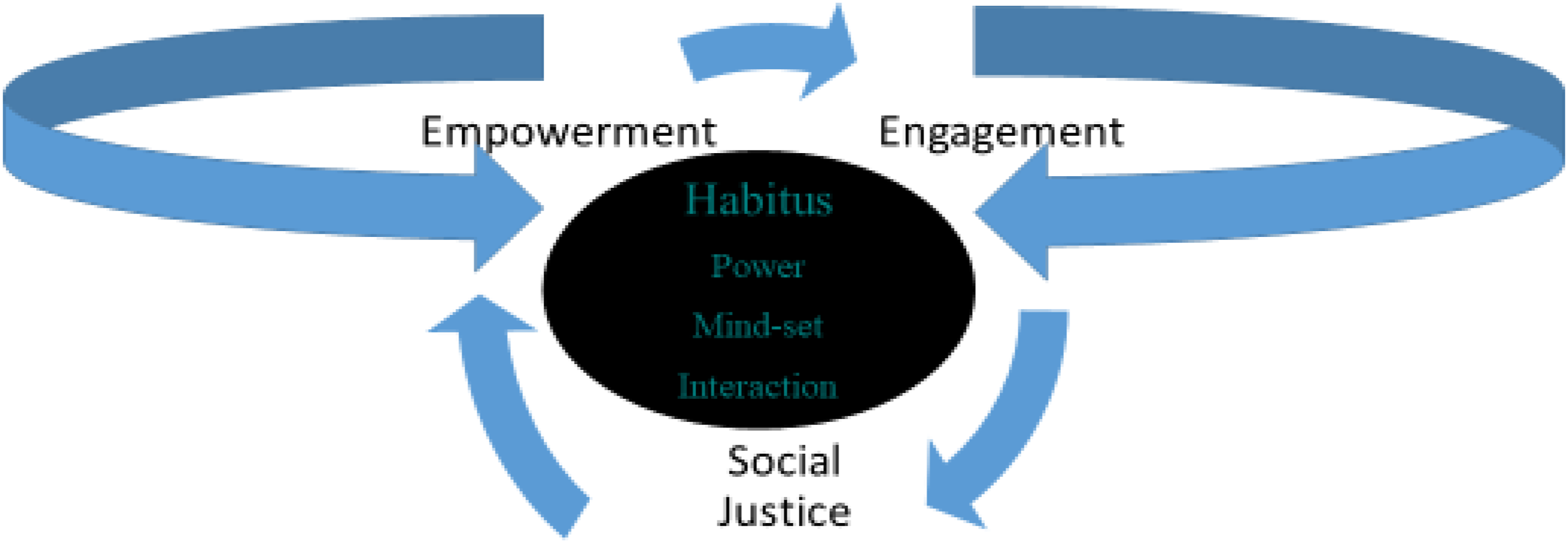
We therefore advise that any public authority (or any group within that authority) undertaking community engagement should regularly and collectively: 1) look at itself objectively and critically question what shared social, cultural and economic capital is creating mindset biases and assumptions, especially those that shape the values and views that provide the construct of their doxa; 2) truthfully acknowledge how they esteem themselves within the community power dynamic; and 3) identify how they have been subconsciously applying that power in different ways and directions within the community to push forward their own agenda (doxa). As a practical extension of this three-part exercise, it is vital that consideration be given throughout and after the reflexive process as to where and how issues of bias and power that are impeding the community engagement process might be removed or mitigated. Despite an acknowledgement that some elements of control must be retained by LAs, especially where they concern fiscal and electoral accountability, it is important that the wider community is empowered wherever possible for the principles of CWB to be upheld. Using reflexivity to identify and remove barriers to effective community engagement offers new opportunities for the inception of new groups of shared habitus that might include LA personnel as equal partners (in terms of social relations of power) with other members of the community. Our case highlighted the disconnect between LA decision-making and community visions of what makes life better, and our model calls for reflexive thinking with the community at the centre of a cyclical process of engagement, creating space to include the most vulnerable in our society, diluting overbearing power of any one voice, and promoting healthy relationship in CWB projects.
Regular and long-term investment in the relationship and trust building is necessary to develop such new groupings and effect a move from the historical, bipolar council/community power divide to a more holistic shaping of the community. Charrettes (analysed in our case study) which have been criticised as a form of ‘parachuted in’, time-limited consultation (Beveridge et al., 2016), may need to be used with caution as they are likely to impede rather than advance cultural change. Reflexivity will not only reveal if control is being exerted regarding when in the project’s planning process and at what times of day or night community engagement events are held; it will also highlight how this might impact on attendance. It can greatly enhance relationship building, for instance, if LA personnel engage in regular long-term contact at community group meetings rather than inviting groups to the council chambers.
Reflexivity is not a major mind shift for UK LAs, it is already implicit in their public duty to seek advice from representative voices in order to assess how policy change may potentially impact them. The cost of resourcing relationship building should therefore be viewed as a sound investment of CWB which will reap a more sustainable return on limited funding for projects; and there is ample opportunity for local entrepreneurs to offer facilitation services to aid LAs’ application of the reflexivity model.
Concluding thoughts
Within this paper, we have expressed our support for the principles of CWB particularly as they offer an alternative to the failed policies of austerity and its cousin neo-liberalism. The results of twenty-plus years of pursuing such policies are witnessed in communities such as those in the case study example highlighted in this paper. However, whilst we are sympathetic to CWB, we believe that the implementation in the case study area will struggle to create community benefit due to flaws in the Community Engagement process which lies at the heart of CWB. Our paper reveals a disconnect between what local communities want and what is being offered by the good intentions of the LA. We argue that the LA is engaged in Bourdieuvian ‘symbolic violence’; they set the agenda and, in many cases, consult the ‘community’ after the key decisions have been made. Additionally, there are ‘missing voices’ from this community engagement process.
We would argue that this failure to engage in meaningful community engagement has implications beyond the specific example highlighted by our case study. As councils of different political standpoints all fail to improve the effectiveness of community engagement, frustration and disillusionment within the electorate can lead to low turnout in elections, thereby disenfranchising electors from the democratic process and weakening the legitimacy of elected bodies. We offer a solution to this deficit by arguing that a reshaping of community power dynamics due to a community engagement process made more effective by the use of our reflexivity model opens the door to increased community participation including co-production. The change in social relations of power within the community will impact positively on the democratic process as an empowered electorate will feel less distant from an LA who is working in partnership with them.
Although we have described our model of reflexivity as an aid to effective purpose and practice within a public sector agency, it can also be used beneficially by other sectoral groups involved with community engagement. Furthermore, we would argue that the issues surrounding community engagement are not unique to our case study and hence our proposed solution of reflexivity is transferable to other LAs engaging with CWB.
Footnotes
Declaration of conflicting interests
The author(s) declared no potential conflicts of interest with respect to the research, authorship, and/or publication of this article.
Funding
The author(s) received no financial support for the research, authorship, and/or publication of this article.
