




Abstract
In the UK, the proliferation of voluntary and community organisations (VCOs) providing emergency food aid has been the subject of critical scrutiny. Analysis has called for further work to understand and act upon the diverse practices taking place within and across food banks. We consider how co-ordinators of food banks in the county of Northumberland have responded to interlocking crises and rising demand, and how they reflect upon their practices. We embed their views and experiences within a critical, contextualised analysis of a core tension: how to provide food in a minimally stigmatising manner, while simultaneously arguing and acting for the end of such activities. We consider the implications of such tensions for approaches to local development, focusing on two key elements of a ‘transformative social innovation’ approach: system innovation and narratives of change. We argue that without significant change in, and challenges to, these ‘shades of change’, enacting (empowering) transformative social innovation in relation to food insecurity will be difficult. In doing so, we consider the potential of community wealth building (CWB) and universal basic services (UBS) to enable innovative change in social and system practices and enhance social infrastructure.
Keywords
Introduction
In the UK, the proliferation of voluntary and community organisations (VCOs) providing emergency food aid and food assistance (in response to increasing demand) has been the subject of critical scrutiny (Cloke et al., 2017; Willams and May, 2022), (Lawson and Dowler and Lambie-Mumford, 2015; Loopstra et al., 2015; Caplan, 2016; Williams et al., 2016; Garthwaite, 2016, 2017; Cloke et al., 2017; Loopstra, 2018; Iafrati, 2018; Lambie-Mumford, 2019; MacLeod et al., 2019; May et al., 2019; 2020; Strong, 2021; Lee et al., 2021). Areas of concern (well-articulated by Williams et al., 2016) include: the depoliticisation of food insecurity (see Dowler and Lambie-Mumford, 2015); retreatment of the state (see Garthwaite, 2017; Lambie-Mumford, 2019); subjectification of ‘the poor’ (see Carson, 2014); concerns that the charitable ethos placates political activism and change (see Poppendieck, 1998 from a US perspective). In addition, Strong (2021) has discussed the mobilisation of ‘shame’ under austerity.
Despite the possibilities for ‘spaces of encounter’ that food banks might offer (Williams et al., 2016), the serious problems identified above are growing more acute and there is an urgent need to implement alternative forms of development. The long run of neo-liberal political economy and the implementation of austerity politics have underpinned the unequal legacy of COVID-19 (Bambra et al., 2020; Horton, 2020) and accelerated a cost-of-living (income/profit) crisis, with potentially catastrophic implications for food insecurity and poverty (Power et al., 2020). The ‘Right to Food Campaign’ and similar social justice campaigns have called for an end to food insecurity and the ‘sticking plaster’ of food banks, through: the provision of universal free school meals; community kitchens; making public the notional amount calculated for food in minimum and living wages and benefits; Ministerial duty for food security; independent enforcement (Byrne et al., 2021; see also Bakers Food and Allied Workers Union, 2021). As Janet Poppendieck has rightly restated (in the context of COVID-19), ‘Hunger, food insecurity, is fundamentally an income problem, not a food problem’ (Poppendieck, 2020).
Food bank managers and co-ordinators can have a role in setting the scope and form of such debate, including the critical discussion of the causes of poverty, the growth in food bank use, the potential power of campaigns such as the Right to Food and the possibilities of diversifying provision (see Adams et al., 2022, for an example of the latter). In this article, we consider how co-ordinators in the county of Northumberland have responded, and how they reflect upon the purpose, form and future of their activities. Our aim is to embed their views and experiences within a critical, contextualised analysis of the primary tension faced by food banks and similar organisations: how to provide food in a minimally stigmatising and convivial manner, while simultaneously arguing and acting for the end of transactional (or in other words ‘impersonal’) approaches to food aid and food poverty (if, indeed, that is an aim for the organisation, see Huffington Post (2022)).
Rather than provide an analysis restricted to the internal practices of food banks, we situate such tensions within a discussion of the potential of more socialistic (and currently marginalised) approaches to local development. These approaches – specifically community wealth building (CWB) and universal basic services (UBS) – are focused on addressing underlying inequalities and inequities, which are features of current dominant modes of political economy. CWB and UBS are sometimes referred to as remunicipalisation approaches, in that they seek to reverse or avoid the privatisation of foundational and community services and social infrastructure (Gough, 2019; Brown and Jones, 2021; Guinan and O’ Neill, 2020; Coote, 2021; Webster et al., 2021). Significantly, CWB and UBS are both concerned with economic democracy and the collective ownership of fundamental services as the means by which to address inequalities and inequities, with a strong emphasis on supporting and working with forms of collective organisation such as trade unions and co-operatives (and therefore have a radically different focus to income-oriented interventions such as universal basic income (Coote, 2021)). Emerging evidence suggests that approaches such as CWB and UBS can have a positive impact on impact on mental health (Barr et al., 2022), particularly if they can help to address household income pressures (see Thomson et al., 2022).
Our aim is to consider the potential of CWB and UBS to address the disempowering social and system innovations which have produced (and have been produced by) the growth of food banks. Our article is a critical analysis of the past, present and future of food banks which challenges the premises of claims for a ‘community power’ approach to development (in the form articulated by Baillie et al., 2021, see below). Conceptually, we draw upon a transformative social innovation (TSI) perspective to structure our critical analysis (Avelino et al., 2019; Pel et al., 2020). A TSI approach tries to understand connections between local changes in practices (comprising social innovation), system innovations (meso-level socio-technical change), significant game-changers (including social movements and socio-economic challenges) and narratives of change (the story lines of societal changes). Transformative social innovation approaches are concerned with understanding (dis)empowerment as produced by these overlapping ‘shades of change’ (as distinct from clearly defined of levels and in keeping with a co-evolutionary approach). Avelino et al. (2019) suggest that: any research on TSI empowerment should give explicit attention to power relations and processes of disempowerment (whether intentional or unintentional). Hence our consistent reference to (dis)empowerment; they are two sides of the same coin. This also reasserts our earlier argument that SI does not necessarily lead to desirable social goals.
We focus on all four shades of change as applied to food banks in Northumberland. However, we argue that without significant change in, and challenges to, system innovations and narratives of change, enacting transformative social innovation which is empowering will be difficult. We consider the potential of CWB and UBS to enable socialistic, innovative change in social and system practices (and address the harmful impacts of privatisation and outsourcing, see McDonald 2018; Bach-Mortensen et al., 2022). UBS is focused on ensuring collective ownership of, and responsibility for, the key needs people have, including for food, clothing, housing, transport, education, healthcare, childcare and adult social care. Coote (2021: 34) suggests that UBS ‘…involves pooling resources, sharing risks, and investing collectively – through government institutions – in social and material infrastructure to serve the public interest.” UBS is concerned with three forms of need for which services must provide (though, of course, variations to this typology exist): those needs frequently met through market transactions (e.g. food or clothing); those needs frequently met through direct payment (e.g. housing or transport); those needs frequently met through reliance on others and where individual market access is prohibitively costly (e.g. education or healthcare). CWB is defined in more detail below but shares with UBS a concern with the democratic ownership of infrastructure and support for the scaling-up of grassroots innovation (Lacey-Barnacle et al., 2023). Such approaches remain relatively marginal to ‘narratives of change’ in the UK, but real-world examples exist (including in Rochdale, Salford, North Ayrshire and Preston, see Brown and Jones (2021); North Ayrshire Council (2022); Webster et al. (2021); Lacey-Barnacle et al., 2023). Outside of the UK, there are other examples of similar approaches to local development, including Mondragón in the Basque Country and Bologna in Emilia-Romagna, Italy (Guinan and O’ Neill, 2020).
The political challenge facing CWB and UBS in the UK is set out in the following quotes: Conservatives in the 19th century empowered people through political reform. In the 20th century we empowered people through economic reform. In the 21st century our mission should be to empower people through reform of the way communities are governed and local decisions are made. The next stage of the Conservative story is community power. Community Wealth Building (CWB) is a local economic development strategy focused on building collaborative, inclusive, sustainable, and democratically controlled local economies……CWB supports democratic collective ownership of the local economy through a range of institutions and policies”
The first quote is taken from the policy paper ‘Trusting the people: the case for community-powered conservatism’ published in October 2021 by the think tanks New Social Covenant and New Local and authored by Conservative MPs. The second quote, on CWB, is taken from Guinan and O’ Neill (2020). A decade on from the implementation of austerity and the discourse of the ‘Big Society’ (and the longer run of neoliberal political economy), and via the on-going fallout of Brexit, COVID-19 and the cost-of-living (income/profit) crisis, the Conservative government is seeking to continue the shifting of responsibility (and liability) onto already disadvantaged communities and regions; places already feeling the significant strain of low incomes, insecure work and underfunded public services. At the same time, significant commitments to addressing health inequalities and inequities have not materialised (Iacobucci, 2022). As McCann (2020) has shown in the case of regional inequalities and Gray and Barford (2018) have demonstrated in the case of local authority funding cuts, the ongoing reality is of uneven development (and stressful lived experiences, see for example Garthwaite and Bambra, 2017), a situation compounded by steep price rises in food (The Food Foundation, 2022), household energy (Bolton & Stewart, 2022) and overall household costs (Office for National Statistics, 2022). The result is that locally and historically embedded traditions of mutual support and voluntary aid are being pushed to their limits (which Strong (2020) refers to as the double-bind of austerity: increasing need and shifting responsibility).
Voluntary and community organisations, food banks and transformative social innovation
We now turn to consider the organisational features of food banks and their relationship to transformative social innovation. There is a growing literature on VCOs and emergency food aid from an organisational perspective (Santini & Cavicchi, 2014; Coque and González-Torre, 2017; Iafrati, 2018). Iafrati (2018) analyses the impact of increased demand on food banks in the UK and explores the (disempowering) social innovations some food banks are considering adopting (including limiting demand and increasing transactional interactions). In an interesting examination of food assistance practices in three schemes in Italy, the Netherlands and Ireland, Hebinck et al. (2018) utilise a TSI approach to identify and understand ‘shades of change’. They recognise that food assistance and emergency food aid schemes are not always considered to be engaged in (empowering) transformative change, echoing the critiques set out by Williams et al. (2016) from a UK perspective, and which we discussed in the introduction. However, Hebinck et al. (2018) suggest that the relevancy of a TSI approach is in the focus upon ‘small wins’, which are changes in social practices that may culminate in system level change. As defined by Avelino et al. (2019), TSI involves four shades of change and innovations: social innovation (new ways of doing, organising, knowing and framing); system innovation (changing institutions, social structures and infrastructures); game-changers (events, trends and developments that change the conditions for interactions); narratives of change (sets of ideas, concepts, metaphors). For the organisations in their study, Hebinck et al. (2018) identified several changed practices in social innovation, including: reducing stigmatisation, tailoring food aid, professionalising volunteers, offering guidance on managing expenditures, establishing alliances, using social media to match food surplus, harnessing logistical expertise to redirect food. This list is not exhaustive but gives an indication of the range of practices that might comprise such change.
What remains to be developed in TSI is a clear sense of the relationship between these ‘shades of change’, and between social innovations and political economy (for example, modes of political economy, following Guinan and Hannah (2017) from a CWB perspective, based on public ownership, community-based industrial strategy and localised procurement). Avenlino et al. (2019) discuss how social innovation involves changing social relations or practices, terms used relatively interchangeably. When discussing system innovation, they suggest that system innovation unsettles institutional stability. They draw – in part – on theories of social practice to capture the interactions between social innovation and significant changes in socio-technical systems, along with the Multi-Level Perspective which introduces the notion of transitions involving changes in macro-trends, dominant institutions and places of innovation practices. Other important contributions to debates about social practices and scale have been made by Feldman and Orlikowski (2011) on strategy, knowledge and institutionalism in organisational processes, Schatzki (2005) on ‘practice-arrangement bundles’ (see also, Reckwitz, 2002)) and by Nicolini (2012; 2017) on ‘large-scale phenomena’. Correctly, in our view, Pel et al. (2020: 9) have asserted that, ‘The transformative ambitions of SI initiatives consist in their attempts to challenge, alter or replace dominant institutions’. The adaptation and maintenance of food bank organisations in relation to ‘dominant institutions’ are social and system innovations we consider in the following sections.
Transformative social innovation, ‘system innovations, ‘game-changers’ and ‘narratives of change’ in context
Understanding the relationship between social innovation, system innovation, game-changers and narrative of change as applied to food insecurity is crucial if the proliferation of organisations providing emergency food aid – and the demands they face – are to be challenged and transformed. In the UK, punitive welfare policies (see Clifford, 2020), low-income levels (maintained by insufficient welfare support and by low wages) and precarious employment, are all game-changers (macro-developments that change the game of social interactions) contributing to the significant increase in demand for emergency food aid and it is understandable that charitable ‘sticking plasters’ have been deployed. Given the state of crisis, what use is an analysis of how food bank managers, co-ordinators, locality workers and elected representatives talk about food aid and food insecurity within a Northern county of England such as Northumberland (particularly given critiques about the proliferation of locality or region specific case-studies (Pel et al., 2020))? Well, the on-going work discussed in this article is part of a dialogue with local government officials and VCOs to ‘challenge’ dominant institutions and narratives (more on this later). It provides a means to think through the multi-scalar development implications of the functioning of food banks within a particular territory, during what Cumbers and Paul (2022) – drawing on the Gramscian notion of ‘the conjuncture’ 1 – recognise as an uncertain conjunctural moment in neo-liberalism. As Guinan et al. (2020) state in their ‘bad’ (and most likely) scenario of recovery post-Covid, the continuation of austerity policies and politics (or ‘community-powered conservatism’) will lead to further reliance on VCOs (to the detriment of well-funded public services and infrastructure). The normalisation of food bank use in the ‘Household Support Fund (1st April–30 September 2022): final guidance for County Councils and Unitary Authorities in England’ is suggestive of this (Department for Work and Pensions, 2022). It is within this context that we now consider the specifics of our case-study site.
Northumberland
Northumberland is a socio-economically and politically (though not a racially and ethnically) diverse county, comprising former mining towns and villages, new towns, coastal fishing towns and villages, tourist areas and rural and agricultural settlements. It contains wide variations in income and wealth. At the (Euclidian) extreme of this, there are 8 miles between 5th Viscount (Matt) Ridley’s Blagdon Hall Estate and Wansbeck Valley Food Bank. There are 6 miles between Chillingham Castle (owned by Sir Edward Humphry Tyrrell Wakefield, 2nd Baronet, father-in-law to Dominic Cummings) and Wooler Food Bank. It is less than 1 mile from Alnwick Castle (seat of Ralph George Algernon Percy, the 12th Duke of Northumberland) to Alnwick Food Bank. Galtung (1969) would recognise this as the outcome of structural violence, with the riches of a few nestled alongside the low incomes of the many.
Rural poverty has been much researched and theorised from a UK sociological and geographical perspective (e.g. Cloke et al., 1995; Shortall and Warner, 2010; Heley and Jones, 2012; Shucksmith, 2012) including recent work on rural food banks (May et al., 2020). Northumberland could be crudely characterised as rural (in particular the North and West of the county), peri-rural, urban (in particular the Southeast of the county) and coastal, bound to the East by the North Sea. Southeast Northumberland – comprising many former coal mining towns and villages – shares socio-economic, cultural and political similarities with the Valleys of South Wales, where Strong (2020, 2021) undertook ethnographic research on food banking and the lived experience of austerity, and through which Hincks and Powell (2022) have asserted the importance of landscape, memory and detachment to the ‘territorial stigmatisation’ of former (and non-metropolitan) industrial areas (drawing on and critiquing the work of Wacquant, see, for example, Wacquant et al., 2014).
A report on Child Poverty in Wansbeck (a Parliamentary Constituency in Southeast Northumberland) commissioned by Ian Lavery (Labour Member of Parliament for Wansbeck) found that: Over the past 5 years it [Wansbeck Constituency] has seen an increase in child poverty from 25.7% up to 35.2% meaning there are now 5079 children growing up in poverty in my constituency – over a third of all children. This figure undoubtedly hides the worst of child poverty in some areas of the constituency. Wansbeck is made up of more prosperous towns and rural areas alongside more populated and deprived clusters who suffer poverty worse. [Lavery I and the National Education Union, 2021]
Data at ward level bears out this diversity, with most wards in the market town of Morpeth showing lower levels of child poverty than wards in the former mining towns of Ashington, Blyth and Bedlington (including in-work poverty). The report makes recommendations, but also critiques the Conservative Government’s ‘Levelling Up’ Agenda. ‘Levelling Up’ explicitly recognises regional inequalities but suggests that they can be addressed by ‘…improving economic dynamism and innovation to drive growth across the whole country, unleashing the power of the private sector to unlock jobs and opportunity for all’ (HM Government, 2022). Commenting on the evolution of ‘Levelling Up’, Jennings et al. (2021) suggest that Levelling Up ‘is not primarily concerned with redistribution between social classes, or even between regions, but rather picks the places that are to be levelled up’ (their emphasis) and note the pork barrel politics of the Towns Fund. Likewise, Tomaney and Pike (2020) argue that any meaningful development approaches require a radical devolution of power and resources. The Britishvolt saga is illustrative of the weaknesses in current development approaches (ITV, 2021; Hexham Courant, 2023).
In a speech given in September 2019 in Newcastle-upon-Tyne (see also Tomaney and Pike, 2020 on this), Andrew Haldane then Chief of the Industrial Strategy Council and former Chief Economist at the Bank of England (now Chief Executive of the Royal Society of the Arts, at the time of writing) riffed on ecology, economies and towns like Ashington (where he had spent some time ‘fact finding’): In towns such as Ashington, industrial-scale clearance of the dominant crop has led to permanent damage to the supporting eco-system – infrastructure, skills, jobs, social spaces. What is left is barren economic tundra, permanently leeched of nutrients. That means a less fertile economy in which many have less to spend, nothing to save and too little to do.
In his speech, Haldane considered the role of schools, education, housing, transport, social infrastructure and ‘good work’ on local economies. While his speech drew on multiple sources of statistical data demonstrating the distribution and impact of low incomes – and on occasions recognised the serious harmful impacts of low incomes and job insecurity – nowhere was a serious proposal made to guarantee people’s incomes and access to services, or, further, that improving incomes, job security, working conditions and access to universal services often involves contestation. The deliberate avoidance of these core issues of conflict and antagonism 2 (and the importance of worker organisation and income support in preventing poverty) comes as no surprise. In contrast, Sharon Graham (General Secretary of Unite the Union in the UK) has expounded a notion of ‘industrial strategy’ premised upon the centrality of jobs, pay and conditions being protected and enhanced through union organisation (Graham, 2021).
Having introduced some of the key themes from the literature on food banking, considered the tensions between different approaches to local development, discussed the relevancy of a TSI conceptual approach, and detailed the situation of Northumberland, we now turn to the specifics of increased food bank use in the UK (including the proposal for a politics ‘in common’) and the findings of our interviews with food bank co-ordinators (and others) in Northumberland. As stated previously, our aim is to explore the connections between increased demands on food banks (and associated social innovations), with broader system innovations, game-changers and narratives of change (in keeping with a TSI approach). In particular, we focus on reflections by food bank co-ordinators concerning the role of food banks (and VCOs) and approaches to development and inequalities and inequities.
Poverty, food banks and a politics ‘in common’
Food insecurity is principally the result of low income. A report by the Bakers, Food and Allied Workers Union (2021) on The Right to Food concludes: ‘No one should go without food in the 6th richest country in the world yet shamefully, too many food workers are struggling to earn enough to purchase the very food they produce…’ In such situations, are ‘small wins’ (to use the language of TSI approaches) enough? Perhaps, that is the wrong question; are they all that is possible? The possibilities offered by CWB and UBS lie in their focus upon economic democracy and collective ownership of fundamental services, including those pertaining to the food system. Rather than rely upon low universal payments (as per UBI), CWB and UBS aim for a more equitable and universal settlement of infrastructure ownership, freeing up income for other costs (CWB and UBS approaches also offer strong support for fair pay settlements and encourage organised representation for workers through trade unions, in contrast to the individualised payments approach of UBI).
CWB and UBS approaches provide an implicit critique of neo-liberal political economy and existing forms of local development. However, in a significant article on the geographies of UK food banks ‘in the meantime’, Cloke et al. (2017) challenge some critical accounts of food banking which they suggest ‘…can too often lead to self-fulfilling, overly-formulaic and potentially uncritical analysis; food banks, and other such spaces of care, become accepted as inextricably mired in the neoliberal politics of their context, and no possible good can be seen in them’ (Cloke et al. (2017: 706). Their calls for close attention to the performances of care and the ‘politics of encounter’ in food banking are stimulating (see also Williams et al., 2016; May et al., 2019; May et al., 2020) and must be engaged. Our argument in this paper is to recognise the potential of some existing organisational forms seeking to address food insecurity, while making the case for the possibilities that CWB and UBS offer for addressing the conditions that have given rise to highly transactional food bank practices focused on meeting spiralling demand.
In the UK, system innovations and narratives of change relating to food insecurity have included, in recent years, including the ‘Right to Food Campaign’ described in the Introduction (as Mechlem (2004) has discussed, the right to food has a long history (pre-dating the concept of food security) and the ‘Food and Work Network’, involving trade unions, VCOs, MPs and academics (including co-ordinator Alex Colas and Andrew Williams). The ability of such campaigns to find traction and integration within food banks is subject to organisational and political practices. Indeed, Cloke et al. (2017: 720), when considering resonances with different political agendas, suggest that, ‘…different organizations present specific opportunities for developing politics ‘in common.”’ And so, perhaps some food banks are the wrong sites for a (transformative) politics ‘in common’?
Given the features of many food banks (to be crude ((and recognising the diversity of organisational forms)), reliance on middle-class (often retired) volunteers, diversity of views about the causes of poverty, often links to Christian churches or fellowships, sometimes co-opted by councillors and local MPs who do not have close involvement most of the year, many run by the Trussell Trust), such questions cannot be avoided. If they are understood as therapeutic places of care, this would make the politics of encounter one in which ‘the political’ is invoked in specific and restricted ways (see Lee et al., 2021 on food bank volunteer work). Williams et al. (2016) devote considerable time to considering the specific ‘political’ encounters and discourse which arise in food bank spaces, drawing primarily on the case of ‘Levington Food Bank’, and provide a rich source of discussion (though since then, the significant increase in demand has – for many food banks – led to a focus on ‘transactional’ approaches). However, these questions about intent, direction and possibilities remain live. From a TSI perspective, what social practices are at work in specific food banks (in specific places) that might inform our (place-specific) approach to system innovation, game-changers and narrative of change?
Food banking and social transformation: the views of food bank co-ordinators in Northumberland
In this section we present findings from serial semi-structured interviews with food bank co-ordinators, elected officials and locality partnership leads, focusing on three co-ordinators in particular. This focus reveals key aspects of food bank practices in a specific territory (Northumberland) and contributes to a discussion about the wider possibilities and limitations of transformative social innovation. We draw on these insights to inform a discussion about the role of (following Avelino et al., 2019) ‘system innovations’ (change at the level of societal sub-systems, including institutions, social structures and physical infrastructures) and ‘narratives of change’ (discourses on change and innovation, that is, sets of ideas, concepts, metaphors and/or story lines about change and innovation). In particular, we consider the potential of CWB and UBS to produce (empowering) transformative social innovation in these shades of change, and thus transform social practices and innovation.
Participants, main role and date of interview(s).
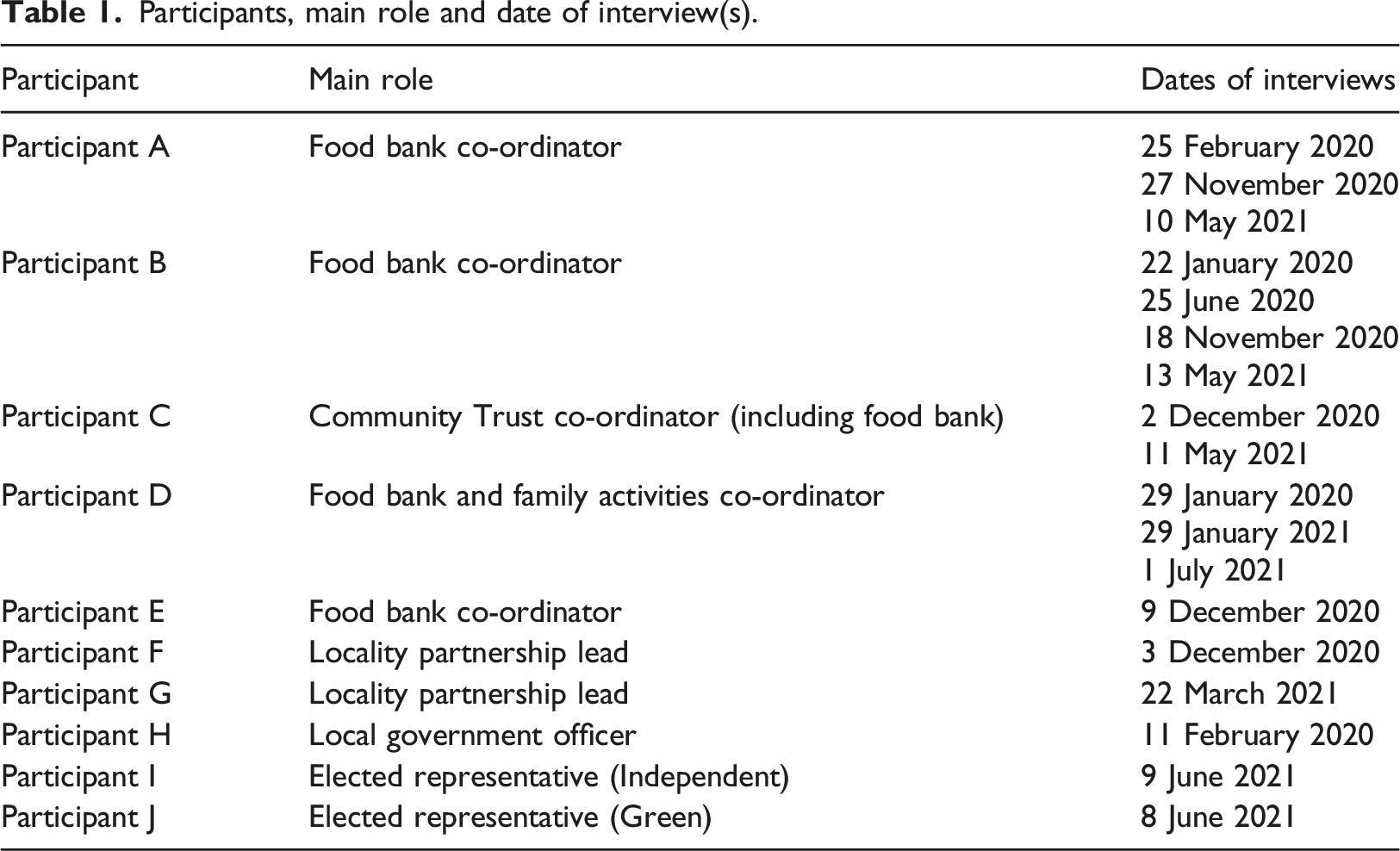
All food banks involved had experienced a sharp increase in demand. The food bank co-ordinated by Participant A had experienced a rapid increase to 240 parcels a month in 2021 (from 30 in early 2020) and all participants spoke about the social innovations they had implemented to cope with increased demand (often involving a shift towards more transactional forms of interaction).
In the remainder of this section, we draw heavily on interview data. We focus on how three co-ordinators relate to the issue of food poverty and insecurity, in order to interrogate some of these issues detailed in previous sections. In doing so we present individual accounts (spanning multiple interviews) and explore the relationship of the participants to elements of the transformative social innovation framework (including system innovations, game-changers and narrative of change). Biographical detail has been limited to support anonymity.
Participant A: ‘guerrilla welfare’ and ‘food on the table’
Participant A had previously worked on emergency food aid and food assistance in diverse settings. In his own words, I’m a great believer; I call it ‘guerrilla welfare’. We should be allowed to do more on our own. If you start to have too much centralised control things start to fall apart. I am a great believer of let different charities get on with it, because we respond to local need. Let us talk to each other, but don’t try and then put a straitjacket on us with rules, regulations and all this stuff, because that is when it all starts to fall apart, to be perfectly honest. On that I don’t think we should always turn to government and ask for help and what do we do? I’m quite astonished when I see councillors and stuff on television going, “Well, we are just waiting for the government to tell us what to do.” No. At the end of the day, local solutions need local initiatives, and some of that has to be through the volunteer base…
There are many things of interest in this passage of talk. One is the conceptualisation of ‘guerrilla welfare’ in terms of the organisation, rather than in terms of people who need to access the food bank and their experience of welfare and income support. Participant A draws attention to ‘restrictions’, ‘rules’ and ‘straitjackets’ on VCOs which hamper their ability to provide ‘local solutions’ to ‘local problems’. But what if ‘local problems’ are mainly the result of extra-local decisions and actions? In the third interview conducted with Participant A, the conversation turns to uneven development: Why can’t we have the government spread around the country rather than all squashed into London, the investment going into London? Of course, if you then redistribute all these people and these power-making industries, what follows on from that is then you’re going to have to have effective communication lines, you’re going to have to have effective transport lines…There’s too much talk about the redistribution of wealth, the redistribution of wealth just gets people’s backs up. Also, the redistribution of wealth has not happened because that’s normally done by tax and people avoid tax and pay themselves dividends…We spend too much time, in this country, looking backwards about our great old history. A lot of it wasn’t particularly great……You’ve got that monolith of Victorianism, the Houses of Parliament. The first thing I would do, if I had the power and the money, would be to bulldoze it and build something like Holyrood, a 21st century forward-looking parliament rather than this edifice that harks back to ages that are long gone.
Again, this passage of talk raises a number of interesting (related) themes, including a model of development comprising a mixture of trickle-down economics (‘the wealth follows that’, as opposed to redistribution) and the decentralisation of government and investment in infrastructure. Such proposals are set out along with a modernising (and somewhat critical) impulse to challenge historically embedded institutional and infrastructural arrangements. Of course, the rise of food banks in the UK over the last 10 years has been critiqued as a return to ‘Victorianism’ (Garratt, 2017).
These passages of talk are important because such conversations allow us to build an understanding of how food bank co-ordinators situate and rationalise their activities. Rather than focus only on the day-to-day challenges faced by the food bank (as part of organisational social practices and innovations), there is a need to consider system innovations, game-changers and narratives of change. The critique of Participant A encompasses changing the organisation and distribution of political power and decision-making, though they are sceptical of wealth redistribution. This tension is a significant one and, rhetorically at least, bears some resemblance to the ‘community-powered conservatism’ (Baillie et al., 2021) mentioned in the opening section, if the intent is to preserve the current form of (neo-liberal) political economy. In contrast, approaches such as CWB and UBS confront the need to reinvigorate localised democracy and political economy, drawing on the concepts of economic democracy and collective ownership and responsibility. Further, from a CWB perspective, the meaning of employment is rightly deemed important: ‘The pre-occupation of policy-makers with job creation must be informed by thinking about what employment can offer people beyond simply “a job” – from a good and secure standard of living to a sense of ownership, control and purpose’. (Brown and Jones, 2021: 94). We will return to these issues in the Discussion.
Participant B: ‘It’s a justifying of existence, really…’
For Participant B, co-ordination of the food bank was one element of a broader role. During a second interview – when discussing causes of food poverty and the role of food banks – Participant B reflected that, I just feel that it’s too easy, sometimes, for organisations to justify their existence by the volume of support that's going out…My idea of success around access to food and the right to food is that food banks are no longer needed… It’s scandalous that a country like this has food banks…It’s a justifying of existence, really, and it’s not helpful to the recipients. It’s just breeding a reliance that’s inappropriate, really. It is a debate that’s quite frequently had…I get quite annoyed with lots of people who’ll say when I get asked to go and talk about the food bank at various things, and they’ll say, “People just need to learn to budget better.” I say, “Actually, if you’re on Universal Credit, chances are you're bloody good at budgeting, because you’ve got no choice”…because if you can budget and only very occasionally need an extra bit of support on Universal Credit, you're doing a pretty good job, really. It’s just there's no slack, so if something does go wrong – your washing machine breaks down or whatever it might be – there is no slack in your budget, and there is no opportunity to save…What in some people's world is a nothing thing is a massive crisis.
In this passage of talk, Participant B offers a strong defence of people who engage with the service (emphasising people’s skills, but also drawing attention to the incessant challenges they face). Significantly, Participant B recognises a ‘justification of existence’. In these justifications – which in some ways are well intentioned – a strong rationale can emerge of dealing with what is possible: in other words, addressing the ‘realities’ of ‘local problems’, on the terms from which they emerge (with echoes of what Mark Fisher (2009) described as the ‘pervasive atmosphere’ of ‘capitalist realism’). Given the impact of Covid (causing a reduction in elderly volunteers and an increase in demand for food due to job insecurity and income reduction), food bank co-ordinators can be forgiven for being primarily focused on maintaining the availability of food parcels. It is this pressurised (transactional) situation which also leads to a pre-occupation with meeting demand, a consequence of which is the normalisation of high demand in the planning of the organisation and limited scope to address the impacts of stigma and highlight the injustices of low incomes and reductions in support.
The consolidation of food banking is highly problematic. Participant B talks openly about organisations seeking to justify their existence, an issue common to many VCOs and not restricted to those who provide food aid and food assistance. Williams and May (2022) have argued there is a complex history behind the existence of food aid in the UK and that food has often been part of political solidarities. It is precisely the forms and function of the contemporary food banking landscape (which they recognise as an increasingly corporate institutionalisation) – set against this history and a wider contemporary political-economy – which needs to be the focus of scrutiny, challenge and action.
Participant C: ‘the opportunity for the conversation’
A third co-ordinator – Participant C – spoke (over a series of three interviews) of the significant challenges wrought by COVID-19 (on top of the consequences of austerity). In our conversations, we considered the role and forms of interactions which were taking place between people engaging with the food bank and those working there [interviewer] What effect has that had on being able to have conversations with people? [participant C] Very brief, really. They’re collecting. We try and make them as welcome as possible, but in terms of listening to and hearing…it becomes impossible to have either a confidential conversation or even much of a conversation. We were lucky in that we still work predominantly by referrals, so we can guess the situation or we know the situation some people are in. So, you can say, “Hello, X. It’s nice to meet you. You’ve got 5 weeks, have you, before Universal Credit comes on?” and she can confirm that. Then we can fit her in 1 day a week for those 5 weeks so that she’s not having to take out a loan.
Participant C went on to describe situations where further conversations might have been helpful to deal with the stress people coming to the food bank were facing. Interactions tended to be functional and in her words ‘…in all honesty, no in-depth conversations’.
The pressure to meet ever increasing demands for food (during a period in which the volunteer base was, at times, severely depleted) was common theme for all co-ordinators. Many of the issues associated with such spiralling demands (the depoliticisation of food insecurity by focusing on simply meeting need; retreatment of the state and VCOs expanding their role; the subjectification of ‘the poor’; dominance of a charitable ethos placating political activism and change; the mobilisation of ‘shame’ under austerity) were set out in the introduction of this paper, drawing on previous academic work and studies. Ruminating on these interactions and experiences, the authors asked the writer, poet and community facilitator Paul Summers
3
(who was born in Blyth, Northumberland and lives in nearby North Shields) to write a brief piece on the topic (an excerpt is included below, echoing the concerns of Cloke et al. (2017)): Food banks are a reaction to a crisis precipitated by deep seated societal and systemic injustices, injustices that we should all be actively seeking to alleviate or eradicate. This lies at the crux of the discussion of what food banks currently are, and what they could be, in terms of being active instruments or theatres of change, or alternatively, mechanisms of conservatism.
Discussion
Our interviews with food bank co-ordinators in Northumberland revealed clear connections between the internal (changing) social practices and innovations within food banks, and responses to, and reflections upon, wider change. These wider considerations included the causes of food bank use, the location of responsibility and the scope of the societal changes needed (or not). Existing and ‘ideal’ system innovations, game-changers and narratives of change were not necessarily agreed upon (and diversity existed within food banks, as well as across co-ordinators of different food banks, reflecting the complex interactions of space, class and poverty identified by Lawson and Elwood (2014)).
For Hebinck et al. (2018: 410), one aspect of social innovation which took hold in Tuscan food assistance organisations – increasing advocacy for people in poverty – was supported by a narrative of change around the ‘right to food’. They suggest that: Possible avenues for inquiry would be the role of narratives such as ‘the right to food’ from ‘inside’ the food bank and the new relations that are a result of the increasing intertwining of social movements with forms of food assistance practices.
In our case, contestation was even evident over the desirability of food banks in the long term. As Williams and May (2022: 630) recognise in their genealogy of food charity in the UK, the growth, consolidation and corporatisation of food banking means that ‘…renewed attention should be focused on voluntary-sector policy mobilities, their troublesome origins, and their entanglements with state and corporate power, as well as on the divergent practices of acquiescence, incorporation, and resistance enacted by voluntary-sector organisations themselves’. From a TSI perspective, it is necessary to stretch analysis beyond social innovation practices (such as those taking place within a food bank, for example changes to the interactions between volunteers and those people using the food bank), in order to understand those social innovations (which, as Avelino et al. (2019) note, are not necessarily empowering).
The system innovations, game-changers and narratives of change relevant to the food banks in our Northumberland-based study ranged from: the development of ‘Nourish Northumberland’, a county wide food partnership (system innovation); the impact of COVID-19 and the cost-of-living crisis on demand (game-changers); and critiques of uneven development and dominant approaches (narratives of change). The social innovations evidenced within the food banks were mainly a response to game-changers which produced increased demand. There was little evidence of the kind of empowering social innovations discussed by Hebinck et al. (2018). Despite this, the possibilities of system innovations and narratives of change were discussed by co-ordinators. We argue that one important ‘narrative of change’ which can be engaged to understand such entanglements and divergent practices, is that of contestation over approaches to local development. Such engagement is necessary to challenge a dominant discourse of ‘community power’ (Baillie et al., 2021), which deliberately ignores issues related to economic democracy and which underpin inequalities and inequities. Without such challenge, social innovations within food banks risk being constrained and disempowering (as discussed in relation to the reflections of Participant B).
In July 2022, one of the authors took part in one of a series of events organised by Northumberland County Council intended to contribute to the formulation of a strategy to address health inequalities. While a social determinants of health approach was presented (and crucial issues such as social isolation were discussed), there was noticeably little focus on ‘economic democracy’. Further conversations with public health and poverty officers on this (including Participant H, see Table 1) led to the inclusion of the following ‘hyper-local’ action in a report to the Health and Wellbeing board presenting draft Northumberland Inequalities Plan 2022 – 2032: ‘3.6 Pilot and evaluate a community wealth and equity building programme: Hyper local pilot in self-selecting neighbourhood and test and learn redistribution of resources and difference made’. Including actions on CWB was (given the Conservative led administration) an interesting (and welcome) move by officers. It might enable practical activity and the opening of dialogue about economic democracy and local development at the community and officer level.
From a CWB perspective, economic democracy – the move towards ‘democratic collective ownership of the local economy’ (Guinan and O’ Neill, 2020: 2) – is crucial if significant and persistent societal problems are to be addressed. In discussing current examples of CWB in practice in the England, Brown and Jones (2021) point to Jamie Driscoll, Mayor of the North of Tyne Combined Authority who stood on a platform which included a commitment to CWB and positive engagement with trade unions. One outcome of this programme is the development of supply teacher’s co-operative to address insecure work, falling incomes and extractive business models (CLES, 2022). In Preston, where the City Council is one of the pioneers of CWB in England, a food subscription co-operative has been initiated to ground the issue of food poverty within a broader institution and set of practices, comprising democratic membership, affordable food and fostering experience in co-operative organisation (Rawlinson and Khan, 2021, see also Adams et al., 2022).
From a UBS perspective, Morley and Morgan (2021) have examined how the remunicipalisation of features of the food system (which they term ‘municipal foodscapes’) – in their case school meals – can embed and elevate foundational needs within civic social infrastructures and institutions. Importantly, they draw attention to the multi-scalar process at work (reflecting the multi-level focus of a TSI approach). Such system innovations and narratives of change represent ways to enable the transformation of social innovations taking place within food banks. By changing the institutions, strategies, and narratives of local development, the transformation of a transactional food bank organisation/provision to a food co-operative may become possible. Indeed, co-ordinators from the food co-operative studied by Adams et al. (2022) provided external guidance to the study presented here, allowing for lesson learning. Other examples of alternative forms of provision exist in Northumberland, for example, Northern Soul Kitchen in Berwick has a ‘pay-as-you feel’ approach and makes use of unsold food (however, tellingly, this social enterprise faces funding pressures (Northumberland Gazette, 2023)). In order for empowering, transformative social innovations to become possible and new practices produced and maintained, system innovations and narrative of change also have to undergo transformations.
Community wealth building has been described as ‘guerrilla localism’ by some of its leading practitioners (Brown and Jones, 2021), and can be contrasted with the ‘guerrilla welfare’ described by one of our interview participants. Central to the CWB approach are the principals and practices of economy democracy for place-based development, and a rejection of extractive and placeless economic strategies (Kelly et al., 2016; Guinan and Hannah, 2017; Guinan and O’ Neill, 2020; Brown and Jones, 2021). It requires active, local institutions (in particular local government) which will support citizens to exert meaningful democratic control over community-based economic development. Guinan and O’ Neill (2020), drawing on Williamson et al. (2003), argue that communities have embedded infrastructures (social, built, ecological) that should be considered as integral to development, rather disposable. In considering the role of social infrastructure (including libraries, swimming pools, community halls, markets, playgrounds, footpaths, high streets and many other places) in public life, Latham and Layton (2019) state that, ‘In short, social infrastructure refers to the networks of spaces, facilities, institutions, and groups that create affordances for social connection’ (Latham and Layton, 2019: 3). Drawing on a range of work (including Klinenberg, 2018), they suggest that thinking of such places and spaces as infrastructure is important in a number of ways, not least that it draws attention to the locally embedded features that are essential for social life to function.
Connecting notions of social infrastructure to the principles of CWB, McInroy (2018) discusses the importance of continued investment in social infrastructure, while Guinan & O’Neill (2020) emphasise the investments already embedded in existing social infrastructure. Social infrastructure – in all its forms – is therefore something to be protected and enhanced, not treat as a ‘lesser’ or more disposable mode of infrastructure. Further, Power et al. (2022) elaborate the concept of ‘shadow care infrastructures’, which they define as concerning: ‘…how survival is made possible via sociotechnical networks of infrastructures that organise and shape possibilities for care’. Diverse and interconnected infrastructures of everyday life are also a core focus of UBS, which makes the case for a ‘collective framework to address shared needs, with a focus on services rather than money and goods’. (Coote, 2021: 34). Gough (2019) draws attention to the role of provisioning systems to the ‘foundational economy’ (Floud et al., 2018) and the interconnectedness of human needs, provisioning systems and locally democratised local economies, echoing the ‘municipal foodscapes’ discussed by Morley and Morgan (2021).
The relevancy of UBS and CWB for our Northumberland-based study, and more broadly, lies in the possibilities such approaches offer for transformative system innovation through system innovations and narratives of change. Rather than limit the scope of change to practices internal to food bank organisations, actual existing examples of high-quality social infrastructure can be seen and learned from, and the issue of increased food bank use can be broadened beyond transactional supply to consider the causes of poverty and alternative forms of local development.
Conclusion
In this article we have sought to move beyond an analysis of the internal workings of specific food banks, to consider the relationship between food bank practices, uneven development and the potential of marginalised approaches to local development: CWB and UBS. The continuing diversification of approaches to addressing food poverty – including food co-operatives and ‘pop-up’ pantries – provides an opportunity to sustain dialogue and action inspired by existing examples of CWB and UBS approaches, and by the essential critiques of (and challenges) to dominant approaches to development which have contribute to the proliferation of transactional solutions to food poverty. CWB and UBS are attempts to harness democratic and public good principles to enable local economies (broadly defined) to thrive and address the underlying causes of place-specific poverty and low incomes through high-quality, social and physical infrastructure. However, adopting such strategies do not guarantee progressive outcomes, nor citizen ownership, and processes must be developed to avoid technocratic control (Manley and Whyman, 2021; Lacey-Barnacle et al., 2023). Although CWB and UBS offer exciting potential for local development trajectories, as Cumbers and Paul (2022: 212) warn, remunicipalisation remains a ‘terrain of contestation’.
Footnotes
Acknowledgements
The authors acknowledge the research participants; without their involvement the research would not have been possible.
Declaration of conflicting interests
The author(s) declared no potential conflicts of interest with respect to the research, authorship, and/or publication of this article.
Funding
The author(s) disclosed receipt of the following financial support for the research, authorship, and/or publication of this article: British Academy / Leverhulme Small Research Grant: SRG20\200138.
Ethical approval
Northumbria University Faculty of Health and Life Sciences Ethical Approval.
Data availability statement
In order to respect the confidentiality of research participants, consent was not sought to make available original transcripts. Therefore, the data cannot be made open.
