



Abstract
Entrepreneurial ecosystem theory can be described as a continuation of traditional cluster theory and regional innovation system theory, the difference being that entrepreneurial ecosystem theory takes the entrepreneur as its focal point. This study explores the extent to which current frameworks can explain the dynamics of a rural ecosystem. We apply a single-case-study research design to a rare, rural and vibrant business ecosystem in western Norway in order to discuss the various elements of entrepreneurial ecosystem theory. Furthermore, we look at the assumption of the bottom-up approach that growth is generated principally by the main entrepreneurial actors. This study makes a clear distinction between formal and informal resources in the ecosystem and shows the key importance of access to informal resources. The study shows how the rural ecosystem is driven from the bottom up and thus offers valuable lessons to practitioners seeking to understand and facilitate the dynamics of rural entrepreneurial business.
Introduction
Ever since Alfred Marshall (1920) argued that there are forces outside of an organisation but within a region that contribute to a company’s competitive advantages, this way of thinking has been theorised in various ways. The theory with the most practical significance in policy terms is cluster theory, which builds on the idea that closer cooperation with a business community can give a company the kinds of advantages it would have were it bigger or merged with others, but without losing the flexibility that comes with being smaller and independent (Porter, 1998). Cluster theory has underpinned and been used to justify a number of recent regional entrepreneurship policies (Delgado et al., 2010), but it has serious limitations when it comes to explaining how the actors in entrepreneurial clusters access and utilise critical resources. Currently, entrepreneurial ecosystem (EE) theory is an emerging branch of research rooted in entrepreneurship research; EE theory represents a continuation of systemic innovation theory and entrepreneurship theory wherein entrepreneurs are the focal point (Stam and Spigel, 2016; Acs et al., 2017). The literature focuses predominantly on how various elements in the regions (market access, human capital, financial environments, cultural and political support and infrastructure) facilitate entrepreneurial and regional development and growth (Isenberg, 2010).
Other literature on strategic management focuses on the company and the mechanisms that allow business clusters to become self-sustaining and strong. Most relevant to our enquiry here is Spigel and Harrison’s process theory (2018), according to which vital entrepreneurial ecosystems result from internal and self-reinforcing dynamics that systematise the resources necessary for establishment, growth and commercialisation. Improved knowledge of this dynamic will help to improve policy formulation and thus reduce friction in the development and growth of ecosystems, especially in rural areas, where the regional conditions identified by Isenberg (2010) are not necessarily present.
Knowledge of rural ecosystem dynamics should be of interest to anyone undertaking to vitalise rural regions. Rural regions suffer from a range of disadvantages (Salemink et al., 2017) in terms of market potential, organisational thinness (Asheim & Coenen, 2005) and distance to financial milieus (Avdeitchikova & Landström, 2005). Rural entrepreneurship is said to be a mostly European concern (Pato and Teixeira, 2016), but it can be challenging to determine what exactly ‘rural’ means. The context of our study is rural according to the OECD (2016). Although the sparsely populated Førde region, which has approximately 10,000 inhabitants, cannot be considered urban in a European sense, its functional central area does have some urban qualities.
A problem when exploring this issue is that – in contrast with top-down initiated clusters and public offices for entrepreneurs – self-sustaining and vibrant EEs in rural areas are hard to come by. Therefore, we have chosen to conduct a single case study to test the extent to which process theory can explain the Norwegian case. To do this, we have chosen PEAK Sunnfjord in Førde as a representative entrepreneurial and rural ecosystem as compared to other top-down initiated and rural entrepreneurial start-up cluster initiatives or even its urban counterparts. We believe there is considerable potential for insight from this study to be transferred to similar communities.
This study firstly elaborates upon its theoretical background and the relevant literature. Then, in the methods section, the single-case-study research design is justified and the data collection, processing and analysis are discussed. After we present our findings and analysis, we conclude by discussing our main insights and the implications for policy.
Literature review
Marshall (1920) discussed industrial atmosphere, which, among other things, relates to how trust reduces transaction costs between firms (Asheim, 1996), a way of thinking that also dominates in modern ecosystem thought. EE theory can be viewed as an accumulation of knowledge from other traditional systems theories, primarily those relating to regional innovation systems (RIS) and industrial clusters (Cooke et al., 1997; Porter, 1998). Although the various systems theories have different perspectives, they share a common goal of increased value creation. Another shared characteristic is that, to varying degrees, most systems theories overlook the key role of the entrepreneur, which is curious in view of the important role originally played by the entrepreneur in Schumpeter’s important work on innovation (Schumpeter, 1934).
Cluster theory posits that, through cluster participation, the company gains access to advantages in the same way as if it were bigger or were merged with others, but without losing the flexibility that comes with being smaller and independent (Porter, 1998). For instance, access to labour and suppliers is improved in that the whole is greater than the sum of its parts. The existence of many firms in the same industry in an area will result in a greater number of skilled specialists, and if a small, resource-poor company has access to this competence, this will help reduce costs and increase its ability to innovate (Porter, 1998; Capello, 2002; Spigel and Harrison, 2018).
While cluster theory takes a broader view of business activity, generally, as a goal than does the entrepreneurship perspective, RIS theory views innovation activity as a separate goal for business activity and as a basic component of economic growth. RIS are considered to be a form of regional infrastructure that supports innovation (Njøs and Sjøtun, 2016). Within a top-down approach, public institutions, whether municipalities, educational institutions or grant schemes, play an important role as facilitators and partners (Asheim and Gertler, 2005; Sire et al., 2014).
There are many definitions of an EE (Spigel, 2020). The definition here has been borrowed from Stam and Spigel (2016), according to whom it is a set of interdependent actors and factors coordinated in such a way that they enable productive entrepreneurship within a particular territory. The main components of the theories as they relate to EEs are the role of the network, the importance of the anchor organisation as a knowledge producer and the strategy to establish an environment for innovative entrepreneurship (Spigel and Harrison, 2018). Furthermore, EE theory distinguishes itself from cluster and RIS theory in three fundamental ways. Firstly, it is not necessarily the case that cluster theory and RIS theory offer what new entrepreneurs require first and foremost. For instance, new firms may have a low capacity to absorb much of that knowledge, and new entrepreneurs may have insufficient social capital to properly benefit from existing networks. Therefore, EE theory looks beyond the existence of resources so as to also consider the availability of resources to entrepreneurs. Another difference is that ecosystems should be led by the entrepreneur through a bottom-up approach (Spigel, 2019). Lerner (2009) argues that decision-makers’ lack of entrepreneurial competence is a major problem in the development of effective government support for entrepreneurs. Since it is the entrepreneurs themselves who know best where the shoe pinches, it is they who can find the best solutions. This is clearly distinct from top-down strategies and policies, which include variations such as publicly initiated science parks, incubators or office hubs as means to foster regional entrepreneurship. Thus, rather than play a short-term and initiating role with regard to entrepreneurs, the government should assume a long-term and catalysing role (Colombo et al., 2019). The final difference is the focus on industry. Unlike the actors in RIS and cluster theory, in EE theory the actors are not necessarily in the same industries. This eliminates the advantages one would otherwise gain from a shared market and supplier chains, which can often be found in industrial clusters. Thus, within an EE, there is less emphasis on industry-specific knowledge but a greater need for entrepreneurial knowledge. We often find actors from many different industries whose common denominator is often that they are undergoing a challenging growth phase. Cooperation and shared learning are possible to a considerable extent within EEs, as the differences between the industries eliminate the competitive aspect and enable a trust-based environment for interactive entrepreneurial learning (Spigel and Harrison, 2018).
Formal and informal resources in ecosystems
The process-based perspective on EEs posits that an analysis of the dynamics in the ecosystem will distinguish strong and self-sustaining ecosystems from those that are weak and in need of economic stimulus. The analysis seeks to locate available resources in the ecosystem and the process whereby these resources flow between entrepreneurs. Therefore, recycling is an essential part of the resource flow in an ecosystem and can be defined as a self-enhancing recycling of resources under certain conditions that allows the enhancement of the ecosystem and its members (Frimanslund, 2022). Resources such as economic capital, mentors, competent labour and entrepreneurial knowledge are acquired in the ecosystem over time through investment and entrepreneurial activity. These resources are recycled when their use ceases, for example, in the event of an exit or a failed company. When companies fail, labour becomes available to others, and a significant experience resource remains, which is transferred to new jobs in the ecosystem. According to Isenberg and Global (2011), spill overs strengthen all domains in an ecosystem. In the event of an exit or buy-out, successful entrepreneurs, former employees, investors and others can often remain in the ecosystem as angel investors, serial entrepreneurs or advisors, thus other resources will also be recycled in the ecosystem. Even though the media may often present entrepreneurs as digital nomads who can live and work anywhere in the world, entrepreneurs often have a connection to the place where their family and social circle are located. Entrepreneurs who have lived in the same place for a certain period of time have often accrued greater social capital in the area, which, as we have previously seen, means they are more likely to succeed (Isenberg and Global, 2011; Spigel and Harrison, 2018).
In their paper, Spigel and Harrison (2018) illustrate how the various actors in the ecosystem interact. This includes resource flow, resource recycling/creation and resource flow in and out of the ecosystem. They also show how an EE can develop over time to become stronger or weaker. Their conceptualisation offers the starting point for our exploration and understanding of PEAK Sunnfjord. As this is not a longitudinal study, we will not consider PEAK Sunnfjord’s development over time; we will instead focus on the ecosystem’s dynamics independently of time.
Terms that can describe a group of network of entrepreneurs.
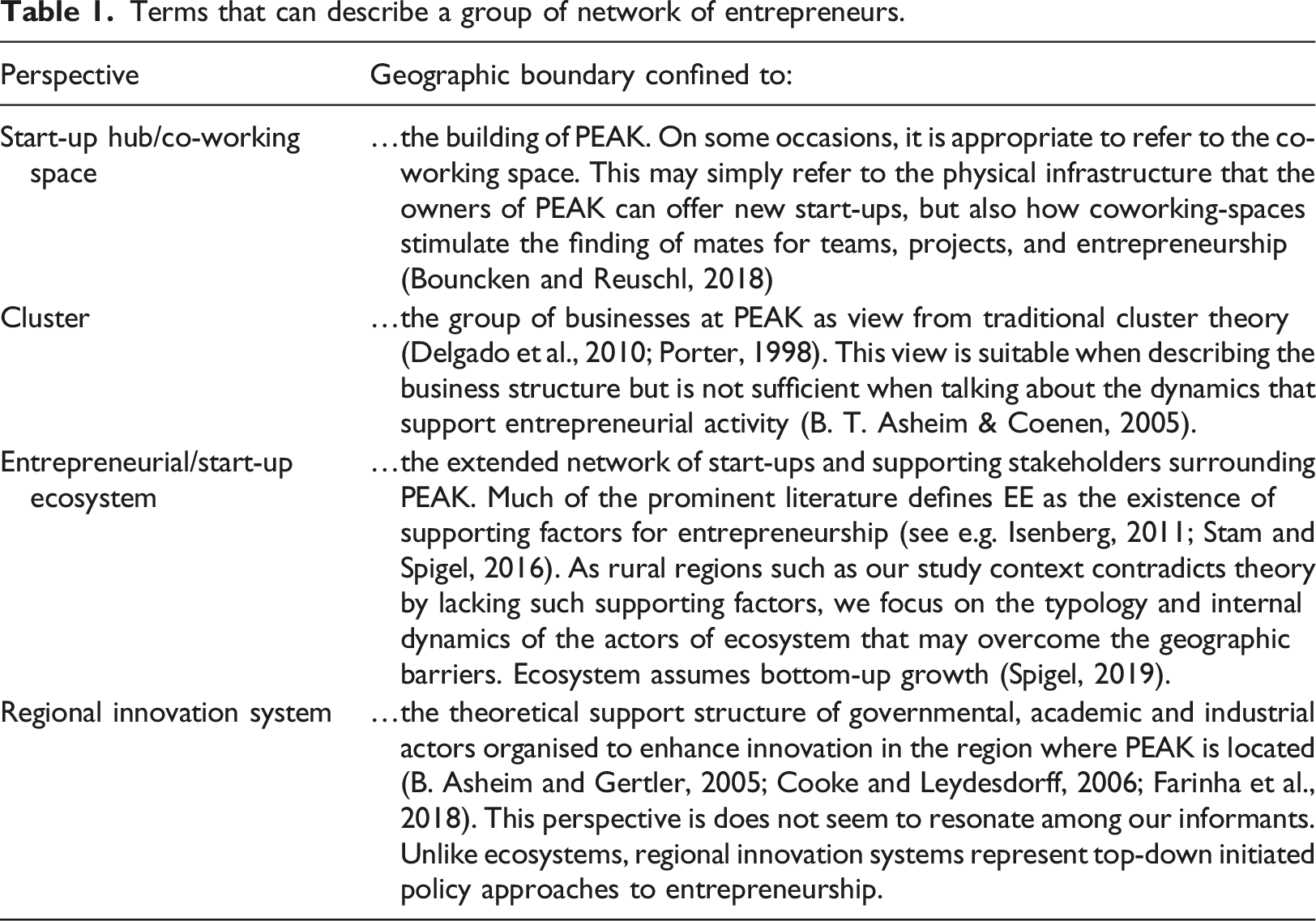
As the purpose of this paper is to examine the dynamics of a group of entrepreneurs and stakeholders, we must employ a perspective that adheres to applicable EE literature. Although clusters, RIS and co-working space can address important facets of an entrepreneurial system, we believe they are not used to describe the interactions within a system. Our case study is thus confined to the ecosystem perspective. The rural context implies that the supporting factors (e.g. Isenberg, 2011) are not necessarily present. This means that parts of the prominent theory do not explain rural ecosystems. For example, entrepreneurs in rural areas will not benefit from the same access to markets, human capital, culture or distance to financial milieus as urban counterparts. Therefore, understanding the dynamics of vital rural ecosystems is of particular interest.
Materials and methods
As discussed above, attempts have been made to describe resource acquisition and distribution in ecosystems in theoretical terms. Despite such theoretical advances, to our knowledge there have been few if any empirical studies examining these perspectives in rural cases. In our view, there are two main approaches to examining internal dynamics within entrepreneurial ecosystems. According to the first, a number of bottom-up clusters of entrepreneurs are identified and compared. Given our interest in the rural aspect of EEs, their scarcity impedes such an approach, thus leading us to conduct a theory-testing case study. The approach we have taken does, however, enable us to dig more deeply into the constructions and dynamics of the actors endogenous to the ecosystem and better explore how the ecosystem relates to exogenous actors and factors. The study employs a single-case-study design, which is a useful tool for examining the usefulness of a theory with regard to underdeveloped constructs or processes (Ozcan and Eisenhardt, 2009; Yin, 2013: 187) such as our understanding of ecosystems (Spigel, 2017). This case study considers the entrepreneurial ecosystem of PEAK, as described in Table 1.
In an increasingly digital and globalised world, we have assumed that the design and configurations of entrepreneurial ecosystems follow major trends. Therefore, insights into single systems should be transferrable to other contexts as a quality requirement (Guba, 1981). This suggests that the examiner should be able to draw attention to a set of interrelations determined and predicted by the theory and filter out contextual variances. We are aware that some researchers do not recommend the application of quantitative logics such as replication to qualitative studies (Pratt et al., 2019), but our insights should be transferrable and replicable according to the logic that underlies the case study research tradition of Eisenhardt (1989).
An entrepreneurial ecosystem has been chosen for this case study. To enhance its robustness, we have gathered accounts from as wide a selection of available informants as possible. Figure 1 illustrates the embedded research design based on Yin (2013, p. 50) and the actors interacting within the ecosystem. An embedded case design is a case study containing more than one sub-unit of analysis. In our case, we want to examine the functions of the theoretical ‘sub’ actors within an ecosystem. A purposive and theory-determined sampling (Eisenhardt, 1989) was conducted to select the necessary variety of such actors. The objective was to examine all facets of the business network, which allowed us to avoid the pitfall of drawing inferences from non-representative events, activities and processes (Miles and Huberman, 1994: 264). Table 2 provides information on the 11 informants located in the ecosystem. Embedded case study research design (Yin, 2013: 50). Informants at PEAK.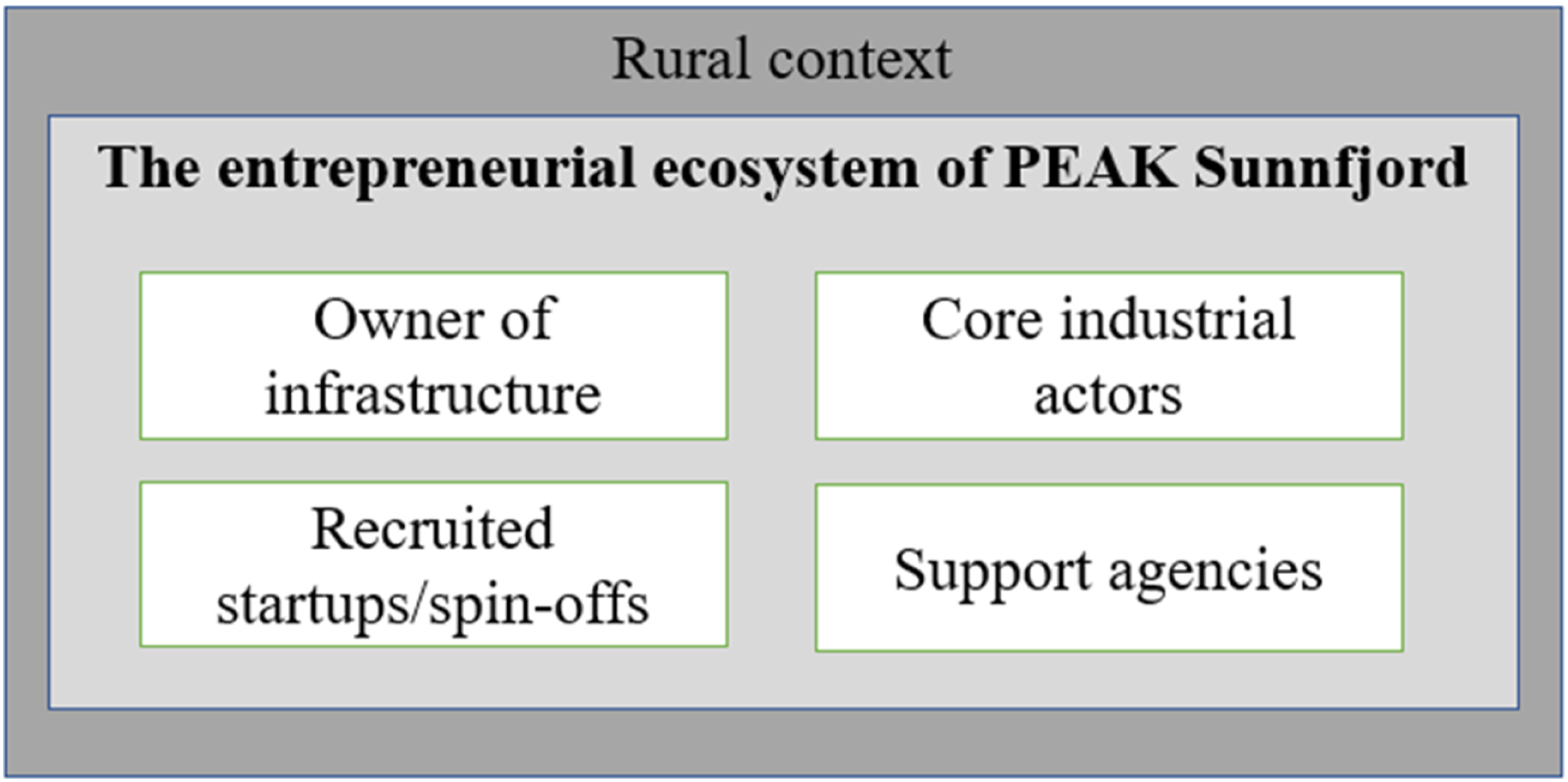
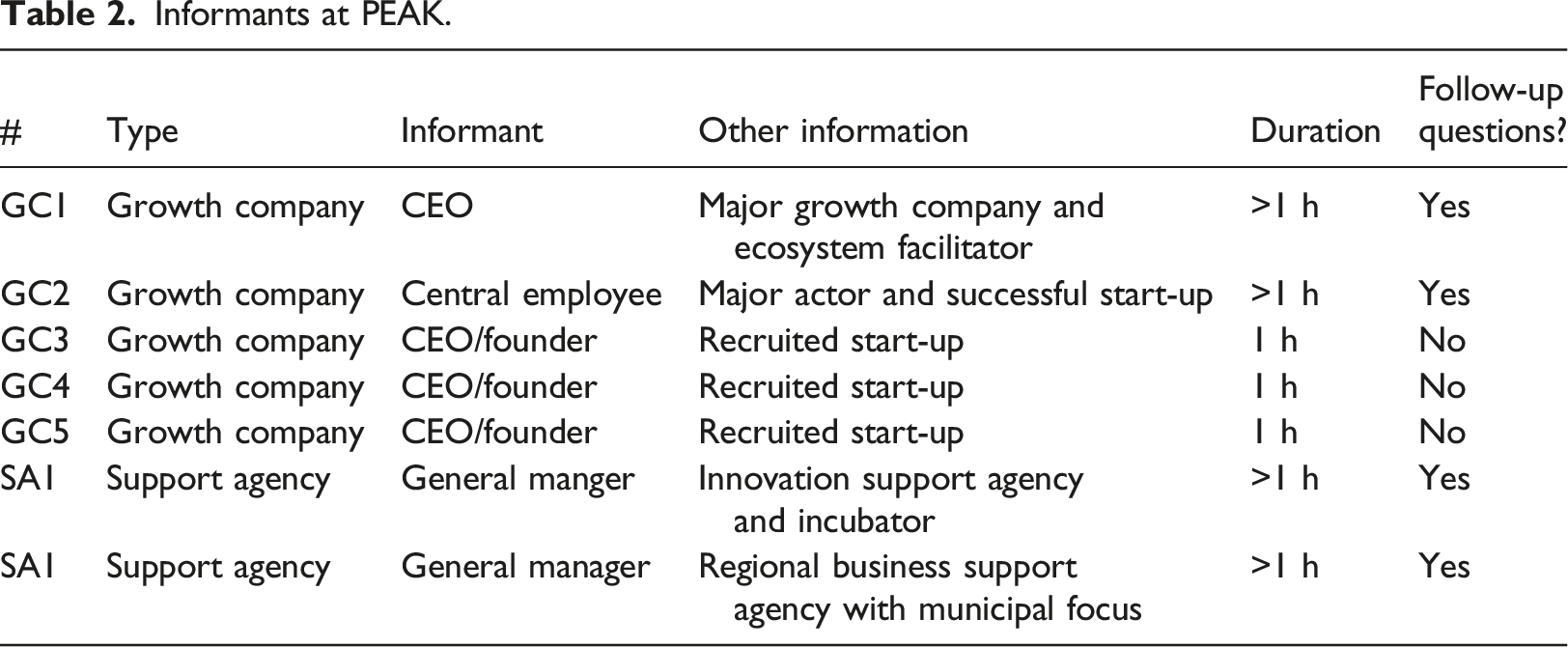
The informants of this study are categorised by growth company (GC) and support agencies that have a presence in PEAK (SA). Table 2 gives an overview of the informants and positions. All of the informants had founding or leading roles in their respective companies.
Study context, background and selection
The context of the study is the small town of Førde, in Norway’s westernmost county, Vestland. This is a typical rural region where, for decades, de-centralisation policies have sought to counteract migration to the larger cities. The purpose of these policies has typically been to enhance rural growth-oriented entrepreneurship by way of beneficial support schemes and focussing on issues such as improved work-life balance, among others. The case study in this paper examines PEAK Sunnfjord, an entrepreneurial ecosystem and a policy role model for rural revival and attractiveness. Our starting point in this study is our belief that this ecosystem’s accomplishments are a direct result of its ‘organic’ bottom-up emergence from an initial entrepreneurial success.
The physical atmosphere of PEAK is intended to be experienced as positive, facilitating inspiration and resource sharing in a manner comparable with similar start-up environments and modern environments. The walls dividing its office spaces from common areas consist largely of transparent glass, which facilitates a considerable degree of interaction and enhances the impression of high activity in all spaces by opening up a larger area and making it visible. An open hot-desk space is intended to lower the threshold for small actors to become part of the environment. However, according to the theory, the environment cannot be designated as a vital business ecosystem until it attains a certain degree of interaction and resource sharing between actors. According to the overview in Table 1, the PEAK entrepreneurial ecosystem is believed to contain within itself a set of self-sustaining as well as a flow of resources that circulates and branches out from the physical location. Overall, the environment is adapted to meet entrepreneurs’ professional and social needs.
The selection of informants is representative in the sense that it is intended to represent self-initiated entrepreneur systems, especially in the districts (Yin, 2013), and therefore to satisfy the requirements for transferability to other contexts and ecosystems (Lincoln and Guba, 1986). As regards selection criteria, it is in principle desirable to speak with as many participants associated with the environment as possible. The selected theory indicates various types of actors who play different roles in the ecosystem. Together with a representative from the public sector with good knowledge of the actors and who has a key role at PEAK Sunnfjord, we identified the various actors by way of a suitable typology. It must be noted that, despite the limited number of informants when compared to other large-scale urban or regional case studies, this selection covers a relatively large part of the system. It is therefore considered sufficient for the study’s objective of better understanding how an entrepreneurial ecosystem can thrive in a rural region.
Thus, our selection includes actors in the position of primus motors and therefore capable of accounting for the history, strategy and development of the cluster. We furthermore interviewed more recent start-ups and the support agencies located in the building. The selection provided perspectives of all facets of the ecosystem.
In accordance with the selected theory, two of the informants selected were categorised as anchor organisations, three of the informants were selected from the category of growth companies and two of the informants were selected from the category of other ecosystem actors. It must be noted that the selections categorised as anchor organisations according to the theory actually belong to the category growth companies and will, in the findings and discussion section, be referred to as growth companies. However, they were selected as anchor organisations given their key positions at PEAK Sunnfjord; as the purpose of the study is to examine PEAK Sunnfjord as an ecosystem, this was considered the most appropriate approach. There were no informants representing another region or ecosystem, as these types of actors are not contained in the ecosystem and are relevant only in terms of resource flow to or from actors in the ecosystem, actors that are already represented in the selection.
Data collection, processing and analysis
Data collection occurred in two stages. At an initiating and observing visit, the environment was superficially mapped and a theory-based typology of informants was noted. During this stage, we identified a small group of informants critical to the ecosystem’s existence and bottom-up emergence and conducted four open pilot interviews. In the next stage, we developed an interview guide based on theory and the pilot interviews. At this time, meetings were arranged and semi-structured interviews were conducted with actors identified during first stage. In addition, we carried out further interviews of as many actors as were available over the course of two full days in the environment. A total of 11 interviews were conducted, although ultimately we based this study on seven semi-structured interviews of about an hour’s duration each. In addition, follow-up questions were emailed to four informants after the interviews to align and match various views and accounts that did not arise in the main interview. These questions also allowed us to ask other questions that arose after the interviews.
The data analysis included an initial transcription and a thematic identification (coding) of quotes (Miles and Huberman, 1994). The coding and identification of themes were based on the theoretical selection of the ecosystem actors set out in the literature review above. In accordance with Guba (1981), credibility for the process of analysis was sought through peer debriefing among the authors. Dependability was sought through a transparent audit of the data selection process. As previously mentioned, transferability of findings is a weakness of single case studies. However, by exploring a rare rural best-case ecosystem, the study seeks to provide valuable insights and lessons for scholars, practitioners and policy-makers.
Findings and discussion
This section includes two sub-sections reflecting the various dimensions and specific processes in Spigel and Harrison (2018), these being: 1) access, flow and recycling of resources and 2) environment, facilitation and motivation. When quoting the seven informants, we use typological designation and numbering (growth company = GC 1–5 and support agency = SA 1 and 2). The illustration in 4.4 sums up our insights on the basis of our findings.
Access, flow and recycling of resources
We have chosen to categorise resources as formal or informal. Formal resources are specific resources that the local support structure (i.e. the government’s means of economic support and advice etc.) and that Innovation Norway (national and regional support agency for entrepreneurship and innovation) and actors in the capital environment or elsewhere deliberately make available to the entrepreneur. Informal resources arise as the result of experience and social interactions and are therefore harder to acquire (Pocek, 2022). They include resources such as the experience and competence of other entrepreneurs and employees, surplus resources following exits and failed projects and other resources that the entrepreneur must identify, locate and seek out. In most circumstances, the informants name exclusively formal resources when the topic of resources is discussed, and the interviewer must direct the informant in order to obtain commentary on informal resources. Once prompted with regard to the topic, the informants have considerable input to offer on informal resources.
The formal resources at PEAK Sunnfjord are well represented by national, regional and local support agencies. Framtidsfylket (Future County), Kunnskapsparken Sogn og Fjordane (Sogn og Fjordane Science Park), Sunnfjord Utvikling (Sunnfjord municipality development) and a regional office of Innovation Norway all have offices on the premises, although informant GC2 is of the opinion that had the financial-theoretical and practical competence been even broader, larger sums could have been obtained. The lack of access to external venture capital accords with Lerner (2009) and is a common rural problem where distances to urban financial milieus is higher in general (Avdeitchikova & Landström, 2005). The public support agencies have been designed to play a role in bridging this gap, although in practice their most significant contribution occurs at the start-up phase (or ‘grant phase’). The role of these agencies receives special attention in the RIS literature, which stresses the important role that public actors play as facilitators and partners (Asheim and Gertler, 2005; Sire et al., 2014). This is also the case with PEAK Sunnfjord. Nearly all of the companies at PEAK Sunnfjord have received support via the support structure and via Sunnfjord Utvikling, a municipal support enterprise in Sunnfjord. It must be noted that the only venture capital firm in the region, Fjord Invest, is located within the premises of the same building. The informants have indicated that Fjord Invest is an important actor. And then there’s the fact that you have ripple effects caused by others visiting other companies here, and then you are marketed. (GC3) […] and nearly all the companies here have received public support […]. (SA1) We need capital to grow. We have a capital environment in-house, and this is important. (GC5)
The informal resources at PEAK Sunnfjord are also well represented by the wide variety of companies, which translates into a broader selection of competence and experience. It is interesting to observe that the access to these informal resources is not as good as the access to formal resources, as the entrepreneur must satisfy greater demands in order to obtain such access. It is the access to these resources that is most reminiscent of the resource access discussed by Spigel and Harrison (2018), where availability depends on entrepreneurs. Their theory posits that within social networks, entrepreneurs’ opportunities to gain access to resources is affected by internal capacity, perception of the individuals’ legitimacy as entrepreneurs, and personality characteristics. While findings of this study may partly support some of these ideas, it also appears that a willingness and ability to promote oneself, together with the efforts that are made, are decisive when it comes to whether an entrepreneur will gain access to these resources. The [informal competence] is easily available to those who promote themselves a bit and actually say “Hey, we actually need this.” If you’re sitting quietly in a corner and think that things will be handed to you, they won’t. By definition, it’s easily available to those who actively seek it out, and there have been new additions here who have more or less trawled through the lunch table in search of the right type of people to speak with, or the right type of hints. And for them, it’s really easy. (GC4) We know the ecosystem pretty well in the rest of the county, too. And you won’t find such good access to anything elsewhere as you do here. For example, mentors and investors. (GC1) We’re expanding our network here, and we, as entrepreneurs, have learned a lot about other industries and how they work. And we’re listening to how they solve some problems, and then we copy them. Aha, so that’s what they did; can’t we do that? And then we have a ridiculously large network. (GC5) But the informal is all the rest of us who have experience in building companies. You can speak with us, you know. You can ask for a meeting. We haven’t formalised this, but we have said it. And those who are in the incubator and [the support structure] know that we’re available to share our experience. (GC5)
The interviews show some early signs of recycling of resources; these are few in number, but according to the process theory, this is to be expected in such a relatively young ecosystem. One finding that stands out is an attractiveness effect that influences recruitment. So, it’s an example of how an environment will function. He chose to move home to Førde and bring his whole family with him, to bring his company and to work remotely, and has ended up being recruited by a local company here. (GC5)
In the situation described above, several of the companies at PEAK were interested in recruiting the same employee. Competition for employees is mentioned by nearly all of the informants in connection with the topic of competition. As there are several technology companies at PEAK Sunnfjord, there is naturally considerable demand for technology competence. Several of the informants refer to the competition for labour as something positive. Developers, that is, labour. Obtaining the right people. That’s probably where there is the most competition in that regard. But we want to view this as a super positive thing. That is, if you have good job mobility in such a small place as this, it only indicates that you have an attractive labour market. […] So, it’s definitely a strength, but that’s where the competitive advantage lies. (GC2) We thought he’s a good guy, so we thought perhaps we should hire him [in my company]. Then he comes to me here, last week, and tells me that he has got a new job [in a different company in PEAK]. (GC5)
This generates an additional effect in connection with marketing, which will also influence the interest in, the attractiveness of and the aforementioned recruitment to PEAK Sunnfjord and Førde. Even though the companies at PEAK represent many different industries, their common denominator is that most of them are technology companies, and there is a considerable need for technical competence and developers. Therefore, we can say that this corresponds with cluster theory’s claim that a gathering of many firms in the same industry will contribute to the recruitment and gathering of more competent labour as well as to training new labour, which in turn will contribute to a greater ability to innovate and/or lower costs. Furthermore, a small company will also be better able to achieve economies of scale (Porter, 1998; Capello, 2002; Glaeser and Kerr, 2009). So, they [the politicians] have used PEAK Sunnfjord as a sort of thing to show off, that they’re proud of. So, from [when] we started until today, we’ve had visits from seven government ministers, in addition to Prime Minister Erna Solberg. Last Friday, Jan Tore Sanner visited, who’s the new Minister of Finance. So, that’s generated enormous, like, marketing locally. But also nationally. (GC5) Now, when we hear them talk about recruitment, we hear “Oh, you have an office in PEAK? Okay. That’s pretty neat, isn’t it?” Indeed, we think that for the companies that are recruiting, it’s an added value because people want to belong here. It makes it a bit more interesting. And perhaps that’s something that’s a bit underestimated. (SA2)
Environment, facilitation and inspiration
Thus, it appears that the various entrepreneurs may take a different view of the availability of informal resources. It also appears that actively seeking out resources is necessary in order to access them, and that social gatherings may be a way of enabling entrepreneurs to speak with those in possession of the resources. In this context, the environment also contributes to lowering the threshold for the entrepreneur to access the resources; the informal aspects are emphasised. This corresponds with Spigel and Harrison’s (2018) argument that those who participate in events in the entrepreneurial community in the area and thereby build relationships with other entrepreneurs will to a greater extent appear as full-fledged members of the community and, therefore, be granted easier access to the resources in the ecosystem. But, in my view, the social and professional very much overlap. It’s a matter of how comfortable you are with communicating with the others who are here. And then you need the type of social events that allow you to have proper conversations with people. A bit more than what you do during lunch or similar. (GC1) In other words, it’s the unplanned that is the unique thing about such a concept. And that’s when it happens. You can’t sit down and say, now we’ll find something, now we’ll begin collaborating, let’s have a meeting, what can we collaborate on. It becomes a bit forced, you know. It doesn’t really happen. (GC5)
Both EE and RIS theory emphasise the important role of state actors and educational institutions in enabling entrepreneurs to meet and build networks (Asheim and Gertler, 2005; Sire et al., 2014; Spigel and Harrison, 2018). This can be accomplished by organising forums, events and workshops and by arranging lectures by experienced business people. In this study, we have found that state actors perform this role well. At the same time, we see that this role is not performed exclusively by state actors. From the outside, PEAK Sunnfjord comes across as a progressive environment intended to inspire individuals. The proximity this environment provides to the other actors described in cluster theory suggests that it also makes it easier for companies to compare themselves to others (Pocek, 2022) while it also creates motivation for development, something Porter which described as follows: ‘[P]eer pressure, pride, and the desire to look good in the community spur executives to outdo one another’ (1998, p. 83). [PEAK is] a very progressive environment and it’s very much like everyone wishes you well and for the person next to you to do at least as well yourself […]. So that you’re also able to compare yourself, you know, to bigger companies. You get to sit in the same premises. There are quite a few benefits to being able to compare yourself to the other companies sitting here. (GC1) With this general mentality, we experience that there’s quite a lot of openness and generosity among those who’ve come here. And that’s perhaps why they’ve come here, because they’ve been searching for it. (GC4) We think it does something to your mind. So, perhaps when you’re here, you feel like you have to deliver something. Suddenly, you’re involved in something that’s perceived as cool. And then you don’t want to be the uncool one, in a way. So, perhaps you take it up a notch. We’ve thought about this on a few occasions. We believe it has an effect. But it’s not measurable. (SA1)
Typology of ecosystem actors
Overall, the data in this study indicates that the vast majority of the actors view PEAK as something more than a co-working community or just a cluster of businesses (as seen in Table 1). Nonetheless, we see that in some areas, there is less conformity between theory and our observation of PEAK Sunnfjord as an ecosystem, especially in terms of typology. Figure 2 shows Spigel and Harrison as referring to growth firms, anchor organisations, other ecosystem actors and other regions or ecosystems, but this typology is based on the much larger industrial areas in North America. As a small, rural entrepreneurial ecosystem, however, PEAK Sunnfjord does not appear to correspond fully with these actor types and contexts, so we are left with a gap in the literature as to how to describe such ecosystem dynamics in smaller business clusters. According to process theory, anchor organisations are equivalent to what is seen in RIS (i.e. actors such as universities, research communities and others that often produce knowledge and labour, represented here by Western Norway University of Applied Sciences (HVL) and Førde Hospital Trust). The informants indicate little resource flow between PEAK actors and the anchor organisations in Førde. Although the anchor organisations are not considered to be part of the ecosystem, this does not mean that they cannot belong to a shared network. SA1 says that this as unproblematic, but that it is a collaboration that needs to be tended to. [What significance have HVL, Førde Hospital Trust and others had for the establishment and operation of PEAK Sunnfjord?] No significance. They weren’t involved in its establishment, but they have joined as tenants. Either directly (HVL) or through companies such as Norse Feedback and Kunnskapsparken. PEAK Sunnfjord was not established as a result of bigger actors, but as an initiative on the part of small actors and business owners [in cooperation with] Sunnfjord Utvikling. (SA1) We have not seen any links between PEAK and HVL or Førde Hospital Trust. (GC1) The actors and the flow of resources in entrepreneurial ecosystems and the proximity.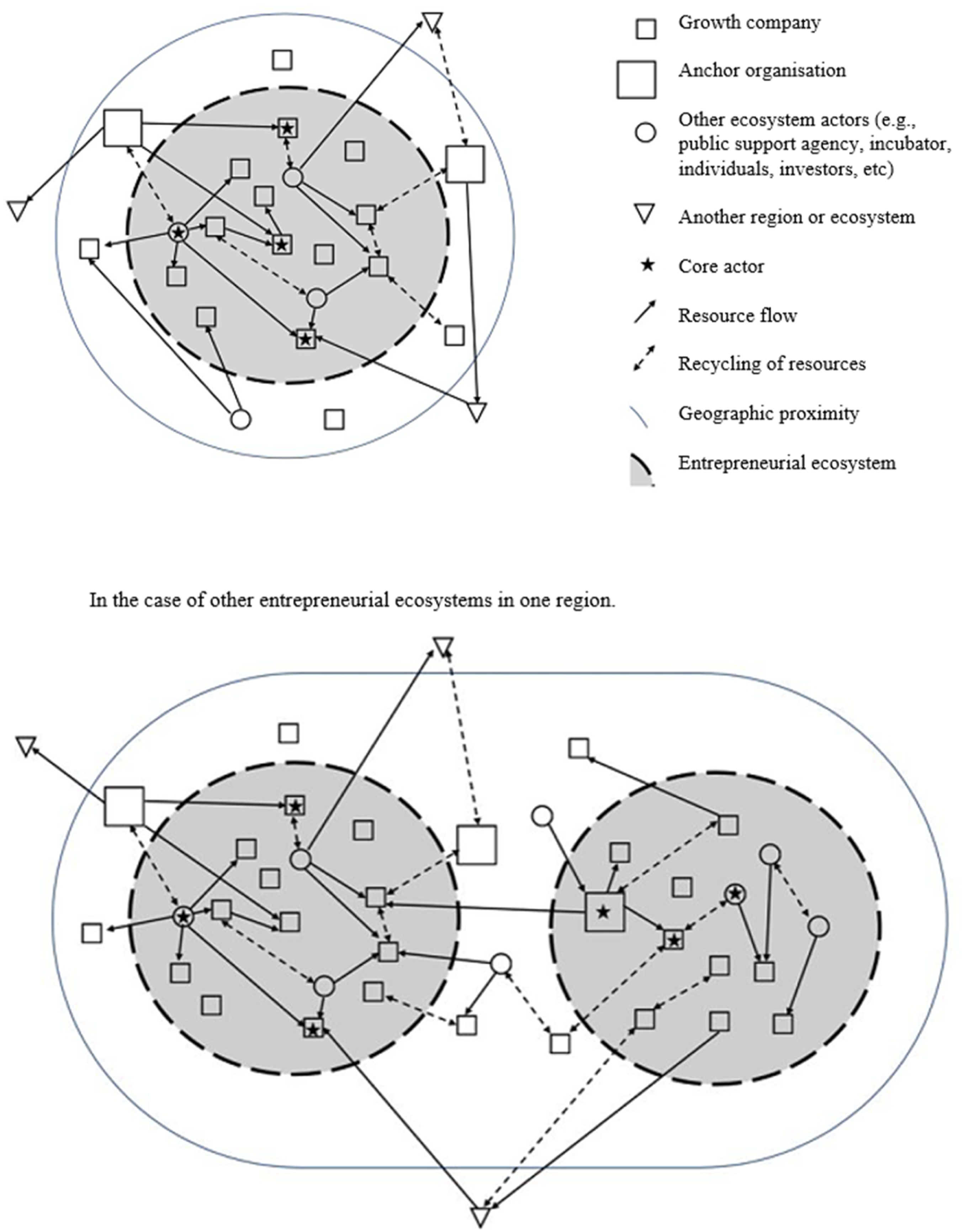
Conceptualisation of the PEAK Sunnfjord ecosystem
This conceptualisation may entail adjusting and outlining our ecosystem model so that the model corresponds with our data. We do not necessarily view the anchor organisations as central elements of the ecosystem, but it is nevertheless important to view these actors as part of a shared network, as, among other things, they are RIS accommodations. However, we want a model that supports the rest of process theory in terms of resource flow, resource access, recycling of resources, geographic proximity, facilitation and competition. Therefore, we have chosen to illustrate PEAK Sunnfjord in Figure 2. This figure is inspired by, and also adapts, the process model of Spigel and Harrison (2018) for the purpose of this rural context.
The resources in the figure include both formal types (e.g. those provided by support agencies or other resources and made available to the entrepreneur by design) and informal types (experience, knowledge, labour, seats on the board, investors and other resources that are made available as a result of ecosystem vitality). An outer perimeter has been added in the figure to represent the geographical area around the ecosystem, which corresponds to the region. In this case, the outer perimeter is where the anchor organisations are located, which are not considered to be part of the PEAK Sunnfjord ecosystem.
Additionally, we have added a new actor type that we have chosen to refer to as a core actor. Like the leader firm in cluster theory, a core actor is essential to the establishment of the ecosystem, along with growth, strength and vitality. The flow of resources from this type of actor corresponds with that shown in Figure 2. In this study, it has also emerged that the individuals representing the various actors may be just as important as the companies themselves, and it is therefore proposed that a core actor may be an individual. Individuals who have entrepreneurial competence, initiative or a position as a role model are essential to the ecosystem. On the basis of this study, it is suggested that this aspect should be taken into greater consideration, even though there is a need for more specific research in order to analyse the actual significance of individuals. For all practical purposes, it is impossible to present this in a simple and easily understandable manner in a figure intended to describe a model for EEs, nor is there a sufficient basis to make statements regarding how significant this is or what role it plays.
Conclusion
The purpose of this study has been to examine and reveal the dynamics of a rural entrepreneurial ecosystem on the basis of recent theoretical advances. The literature on entrepreneurial ecosystems combines insights from RIS theory (geographically spread) and cluster theory (geographically concentrated) but promotes the examination of a system’s internal dynamics. We therefore find it most natural to talk about the subject of our case study – a rural start-up milieu – as an entrepreneurial ecosystem. The main reason for making this distinction is that, while clusters focus on economies of scale, the ecosystem concept focuses on complementarity through the shared challenges of growth and commercialisation of innovation.
The main lesson of our study relates to the importance of informal resources. The study largely supports the premises regarding resource access and resource flow, but we find that there are grounds for distinguishing more clearly between formal and informal resources. Formal resources are equally available to all entrepreneurs, whereas access to informal resources depends to a greater extent on the factors described by Spigel and Harrison. Furthermore, it is argued that the entrepreneur’s own willingness and ability to self-promote is crucial with regard to whether the entrepreneur will obtain access to these resources. Spigel and Harrison indicate that social capital and entrepreneurial legitimacy are important factors in this respect, although this falls beyond the scope of this study. There are, however, grounds to support the claim that participating in social activities and building social relations makes it easier for the entrepreneur to obtain access to informal resources. In addition, it appears that the important role played by public actors in facilitating network building and event implementation can also be played by the entrepreneurs themselves. This strengthens the claim regarding the importance of viewing the entrepreneur as being at the centre of a bottom-up perspective, which is one of the premises of the ecosystem literature.
Another contribution that this study makes relates to theory structure and the generalisability of typology. Through data collection in a smaller ecosystem, it appears that what the literature refers to as anchor organisations do not necessarily play the same role here as outlined elsewhere. This case study of PEAK Sunnfjord establishes a basis for reducing the importance attached to anchor organisations and moving them out of the ecosystem and into the geographical area surrounding the ecosystem. Nevertheless, it is not inconceivable that an anchor organisation may have greater importance and may occupy a different position in other ecosystems. In addition, the study finds grounds for adding the actor type of core actor to the figure. This is a role that is somehow essential to the ecosystem and which may be performed by growth companies, anchor organisations, support agencies or other ecosystem actors. Furthermore, the data in this study indicates that the significance of individuals may have been underestimated in previous research and that individuals may also perform the role of core actor. The study therefore seeks to add nuance to current theory so as to better fit small and rural contexts.
Implications for policy
As national and regional business policies have been guided by innovation systems theory and cluster theory for decades, we emphasise the importance of attaining a better understanding of the internal dynamics of ecosystems. This study provides policymakers and practitioners interested in rural entrepreneurship with a lesson in how to revive rural or deprived regions. We consider it important for political decision-makers, as well as decision-makers involved in support structures and (county) municipalities, to be aware of the flow of informal resources as a criterion for success. There is a considerable need beyond the support structures that needs to be met in order for entrepreneurial business development to succeed. This is especially true of placing the entrepreneur at the centre and utilising individuals and entrepreneurs who possess informal resources, such as valuable experience of successful or failed start-ups and growth companies, and other resource persons.
Limitations and future research
Contextuality is a known challenge in the entrepreneurial ecosystem literature. A limitation here is that, without further studies, there are no grounds for stating that the findings of this study in its entirety can be generalised and said to apply to all entrepreneurial ecosystems, and especially not to those in urban areas. Furthermore, we can see that longitudinal network analyses of resource flows between various actors in both rural and urban entrepreneurial ecosystems will have a lot to say about actual resource flows.
Footnotes
Declaration of conflicting interests
The author(s) declared no potential conflicts of interest with respect to the research, authorship, and/or publication of this article.
Funding
The author(s) received no financial support for the research, authorship, and/or publication of this article.
