




Abstract
The entrepreneurial ecosystem (EE) concept has been getting attention as a comprehensive approach to studying the evolution of a local economy, and it is increasingly adopted by policymakers to promote entrepreneurship and innovation and foster local socio-economic development. This study represents an original attempt to understand the EE governance evolution and to contribute to the research on underdeveloped places, such as low-density territories. Evidence is taken from the EE of Fundão, a low-density municipality in the Centro region of Portugal, between 2012 and 2022. The primary and secondary data collected was analysed in the light of evolutionary governance theory and recent literature on evolutionary EEs. The findings highlight the significant role local government plays in the creation and development of the EE, by addressing the gaps in governance and resources within low-density territories, and performing multiple roles during the EE evolution. Moreover, several EE governance strategies were identified to tackle local obstacles including community acceptance, lack of entrepreneurial culture, or resource limitations. This work provides important contributions to EE and regional development literature, as well as implications for local and regional policymakers aiming to promote entrepreneurship and innovation in their territories.
Introduction
The entrepreneurial ecosystem (EE) concept has been getting attention as a comprehensive approach to studying the evolution of local economies and their underlying mechanisms (Spigel et al., 2020). Nevertheless, despite the growing interest, there are still several theoretical and empirical gaps (Wurth et al., 2021), such as a bias towards urban territories and more developed regions (Roundy, 2017; Tsvetkova et al., 2019) and lack of the ‘time’ dimension (Theodoraki et al., 2021). Moreover, the literature has almost overlooked and largely ignored the governance of EEs (Colombo et al., 2019) and the role of public policy in shaping EEs (Cunningham et al., 2019). However, EEs are by nature dynamic and in constant evolution (Spigel and Harrison, 2018); thus, analysing how its networks and institutional settings co-evolve is crucial to a better understanding of their evolution, performance, and impact over time. On the other hand, governance can also be seen as an evolutionary process, co-evolving with a dynamic network of actors, discourses, and institutions (van Assche et al., 2014). Looking at EE governance through an evolutionary perspective is, thus, necessary to understand the dynamics of the local economy evolution and the key dimensions for its sustainable development.
This study focuses on ‘low-density territories’ (LDTs), territories with low demographic density and lagging economies, often geographically remote, institutionally remote, and/or thin (Credit et al., 2018). This concept is not unanimous, and there are several concepts used synonymously, such as ‘rural’, ‘marginal’, ‘remote’, or ‘peripheral’ territories. We do not aim to discuss the terminology of the concept but rather understand how EE contributes to the development of left-behind territories, since they face a number of social, technological, economic, environmental, and political challenges that affect their development potential and resilience (Almeida and Daniel, 2022). LDTs are highly dependent on the capacity of local communities and institutions to entrepreneur and innovate (OECD, 2018). Thus, the creation of a supportive environment for entrepreneurs and innovators is crucial to break the so-called vicious cycle of decline that these territories are suffering.
Linking the evolutionary governance theory (EGT) with the recent research on evolutionary EEs, this study will push forward two emerging research topics which are closely related, both with roots in biology. Moreover, this study will contribute to the literature on regional development by focussing on an understudied spatial context. Thus, using this innovative approach, our purpose is to enrich discussions on EE governance (Cho et al., 2022) by offering insights that complement existing research, and specifically answering the following research questions: (1) How does local EE governance evolve over time in an LDT? (2) What are the governance strategies and barriers for developing an EE in an LDT?
Firstly, we provide an overview of the theoretical background, highlighting the importance of understanding EE governance through an evolutionary perspective and introducing EGT and its application to the context of our study. Additionally, we examine the unique challenges faced by LDTs and the role of EEs in their development. In next section, we present our research methodology, including data collection and analysis techniques, and present our case study. Following that, we present our empirical findings, discussing our case study’s evolution, including the main events and the governance aspect in each phase. In the following section, we discuss the findings within the lens of EGT building blocks and draw several implications for local policymakers. Finally, we conclude with our contribution to theory, the limitations of the study, and directions for future research.
Entrepreneurial ecosystems
There is a general agreement in the literature on entrepreneurship that entrepreneurs do not emerge in isolation but need a conducive environment in which they can innovate and develop their businesses successfully (Cowell et al., 2018). The need to understand entrepreneurship ‘in broader geographical, temporal, and social contexts’ (Alvedalen and Boschma, 2017: 890) has fostered, in the last decades, the emergence of the EE concept as a supportive environment for the members of the ecosystem to engage in entrepreneurial and innovative activities.
The seminal work of Isenberg (2010) in the Harvard Business Review ‘launched’ EE as a new paradigm for economic policies. From then on, the concept quickly attracted a lot of attention among researchers and policymakers, with an exponential growth of research publications and policy papers (see: (Alvedalen and Boschma, 2017; Wurth et al., 2021) reviews). Despite its popularity, there are several challenges and gaps in EE research. For instance, most EE studies tend to provide a static framework capturing a snapshot of EEs without considering their systemic evolution (Alvedalen and Boschma, 2017; Spigel and Harrison, 2018) and thus not reflecting the changing network dynamics (Fernandes and Ferreira, 2021). On the other hand, research on EEs mostly focuses on technology-based industries, developed economies, at the national level or in large urban areas due to their dynamism, size, and impact (Muñoz and Kimmitt, 2019; Roundy, 2017). This leads to ‘a bias towards large cities in the EE literature’ (Spigel et al., 2020: 487), with several authors calling for more studies analysing EEs outside of their ‘comfort zones’ (Tsvetkova et al., 2019), and specifically outside major urban centres (Cowell et al., 2018; Roundy, 2017).
Entrepreneurial ecosystems governance
EEs involve a complex and diverse network of individuals and organizations and environmental factors that interact with each other. These formal and informal networks of interactions prompt challenges related to resource distribution and allocation of costs and benefits. This raises the importance of comprehensive governance models for EEs (Cunningham et al., 2019) to guide these relationships, motivate EE actors, and achieve competitive advantages (Colombo et al., 2019). Despite its importance, research on EE governance is still in an early stage (Panetti et al., 2021), given the complexity of developing a comprehensive framework, as classical governance models may not apply to EEs (Stam, 2015).
Most EE research focuses on the macro-level, ignoring the specific role of a given EE actor. Moreover, the common analogy to natural ecosystems in EE research may underestimate the relevance of governance. However, recent studies have been pushing forward the knowledge about EE governance and identifying several actors that support (formally and informally) the EE. Cunningham et al. (2019) introduced a micro-level framework centred around the role of principal investigators and highlighted the role of both venture capitalists and technology parks in EE governance. Nordling (2019) highlights the role of public policy and a dedicated actor leading the ecosystem during its evolution. Panetti et al. (2021) analysed the role of a regional government institution, stressing the importance of a blend of top-down and bottom-up governance approaches. Along the same line, Colombo et al. (2019) discuss these two approaches to understand if EEs evolve like a natural ecosystem (bottom-up), benefiting from path dependencies and previous entrepreneurial culture, or artificially (top-down), where the EE could be created and governed by a visible hand of an EE actor.
An evolutionary perspective of entrepreneurial ecosystems governance
EEs are in a constant process of development, with their culture, history, institutional settings, needs, and resources changing over time (Nordling, 2019; Spigel and Harrison, 2018). Despite being on the mind of EE theorists since the beginning (Cohen, 2006), the inclusion of an evolutionary perspective in EE theory is still at an early stage of research. In 2016, (Mack and Mayer, 2016) made an initial attempt by proposing an EE evolutionary framework based on four lifecycle stages (birth, growth, sustainment, and decline). Building on this perspective, Cantner et al. (2021) add a fifth phase (re-emergence), proposing a dynamic lifecycle model. From a different perspective, other authors claim that EE evolution is not linear, analysing EEs through the lens of adaptive systems (Auerswald and Dani, 2017; Roundy et al., 2018).
Nonetheless, few studies analyse EE governance from an evolutionary perspective. Ryan et al. (2021) and Colombelli et al. (2019) studied the changing role of anchor tenants over time, and Panetti et al. (2021) analysed the evolution of EE policies and the changing role of institutions. However, adopting an evolutionary perspective in governance is crucial to understand the diverse and dynamic networks of actors, discourses, and institutions that co-evolve over time.
This work draws on the literature on evolutionary governance theory (EGT) to frame the investigation of how EEs are developed and governed in LDTs. EGT is a relatively recent theoretical framework with an evolutionary perspective of governance, drawn from complex adaptive systems theory, actor-network theory, and institutional economics, among others, considering everything as a product of evolution (van Assche et al., 2014). As a developing area of research, EGT may lack robustness and empirical support. However, it has been used as a lens to understand governance processes in rural areas (Ubels et al., 2019), regions where the population is declining (Beunen et al., 2020) or economically vulnerable regions (Marais et al., 2021), thus presenting an opportunity to deliver a new perspective into understanding the dynamics of governance and its implications for these complex systems.
EGT builds upon several key concepts. Firstly, the concept of functional and organizational differentiation presupposes that distinct systems of function co-evolve and continuously generate new subsystems, shaped by different organizations (Beunen et al., 2015; van Assche et al., 2014). Secondly, formal, informal, and dead institutions play a complex coordination role that evolves with different combinations of actors and roles over time. Thirdly, the existence of several governance paths that can run in parallel, entangle, or even block each other. Related to this are the notions of path dependencies, interdependencies, and goal dependencies, which consider a governance path as dependent from prior legacies, affected (positively and negatively) by other existing paths and institutions, and influenced by the changes in the plans for the future and the actors’ shared vision (Beunen et al., 2015). Finally, EGT key concepts of sites, mechanisms, and boundaries are defined. Sites are places and occasions of higher communicative density, when and where decisions are taken or prepared. Mechanisms include institutions (as coordination mechanisms), object formation mechanisms, plans, and actors’ tactics. Boundaries include spatial, social, and chronological boundaries that distinguish the different actors and relations and can harden or ease governance paths and evolution (van Assche et al., 2014).
Entrepreneurial ecosystems in low-density territories
Low-density territories are a ‘patchwork of poorly connected local economies and societies, physically, institutionally, or functionally’ (ESPON, 2019: 79), suffering from several local bottlenecks that affect their social and economic development. These include demographic challenges (e.g. ageing and brain drain), locational disadvantages, lack of physical and technological infrastructures, limited access to information, limited markets, and insufficient educational, cultural, and economic opportunities (Perpiña Castillo et al., 2024). This formula exacerbates territorial disparities, social fragmentation, and political polarization, increasing their vulnerability to social, political, and financial fluctuations (Rodríguez-Pose, 2018).
Nonetheless, it has been increasingly acknowledged that LDTs also play an important role in several social, economic or environmental issues, such as green and circular economies or new working trends, for example, Almeida and Daniel (2022). LDTs’ potential is highly dependent on the capacity of local people and institutions to identify new business opportunities and innovate. Entrepreneurship plays a crucial role in the ‘overall health’ of LDTs economies, and entrepreneurs are seen as the ‘best hope’ to revitalize LDTs (OECD, 2018). Thus, it is crucial to understand how to create a supportive environment where entrepreneurs can create and develop their businesses in these territories, tackling existing challenges (Roundy, 2017).
Given the characteristics of LDTs and the challenges entrepreneurs face in these territories, it is expected that well-known processes, elements, and frameworks for urban territories or cities will not necessarily suit LDTs (Hammer and Frimanslund, 2022; Roundy, 2019). The differences between EE in urban areas and in LDTs go far beyond the population and business density, resources available, or the number of stakeholders. LDTs have different cultural, social, and economic dynamics that influence the emergence and development of an EE, such as the place attachment, the role of natural capital, stronger network ties, and the role of a local leader, or the different outputs and outcomes expected from entrepreneurs and other EE actors (Almeida and Daniel, n.d.). Thus, the generalization of urban models in the case of LDTs can be risky and lead to unexpected harmful effects in these territories rather than contribute to their development.
Recent case studies shed light on the nuances of EE dynamics in rural and peripheral contexts. For instance, Hammer and Frimanslund (2022) examine a rural EE in Western Norway, highlighting the importance of access to informal resources and the need for bottom-up processes to complement the roles of public actors and anchor organizations. In a rural UK town with a digital gaming EE, Xu and Dobson (2019) discuss the lack of resources and actors, emphasizing the significance of access to external resources and the role of government policy in shaping EE development. Additionally, Porras-Paez and Schmutzler (2019) longitudinal analysis of an EE in Northern Colombia points out the importance of having a locally embedded lead actor with resource endowments and legitimacy to foster EE emergence in developing regions.
Thus, understanding the governance processes of EEs is even more important in the case of LDTs, since the emergence, development, and success of EEs greatly rely on the abilities of a local leader, along with their governance strategies and procedures.
Methodology
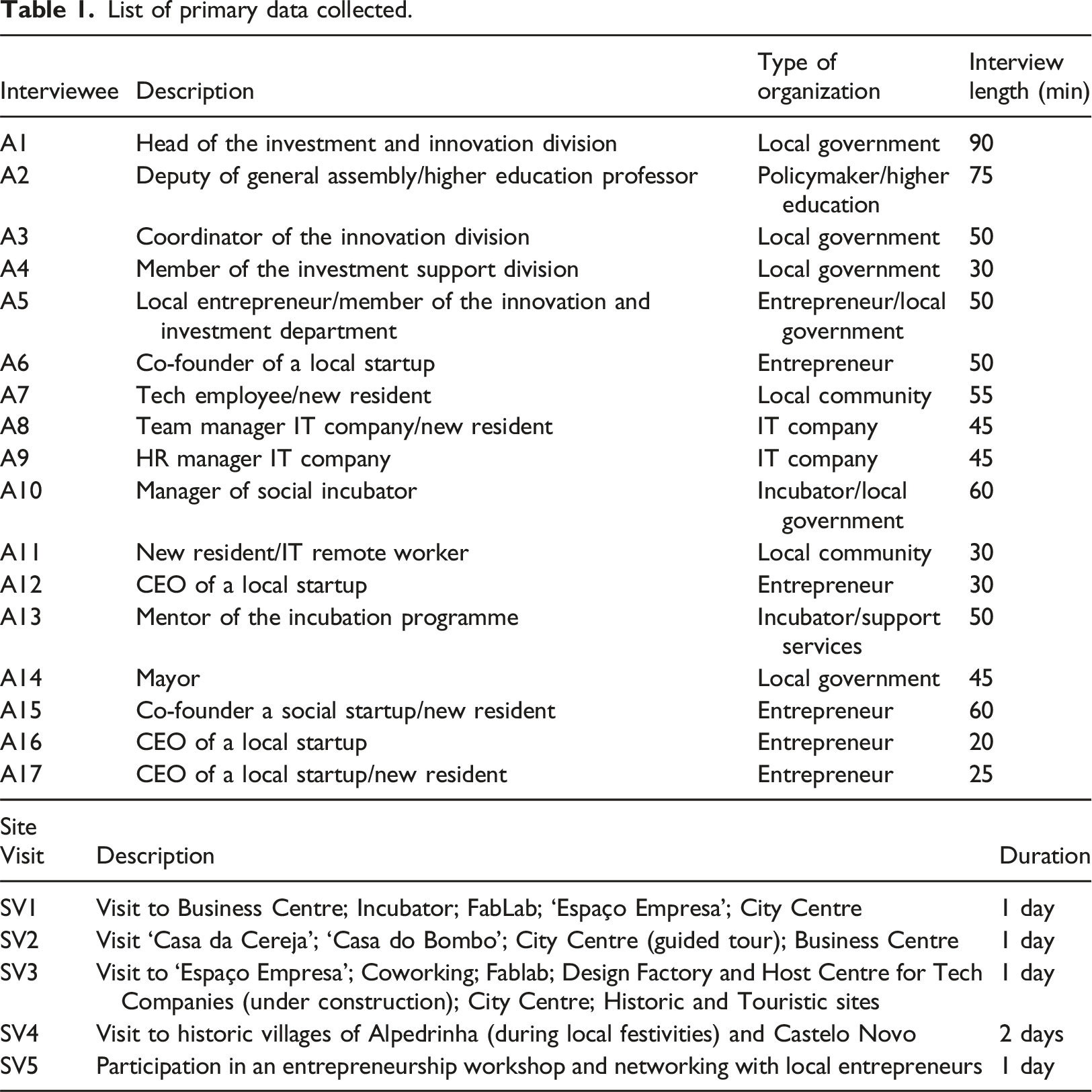
List of primary data collected.
Case study – Fundão (Portugal)
The case study selected is the ecosystem of Fundão, 1 a Portuguese rural, cross-border, peripheral, low-density municipality with slightly over 26.000 inhabitants and less than 50 people per km2, located in the Centro region of Portugal. There are several reasons for selecting Fundão as our case study. Firstly, Fundão represents a unique context characterized by low population density and limited resources. Secondly, Fundão is one of the few Portuguese low-density municipalities with a clearly defined (and written) strategy to promote a local EE. Thirdly, Fundão has undergone considerable transformations in its EE over the last decade, presenting an ideal scenario for a longitudinal analysis. Finally, Fundão has received attention from academics and policymakers due to its efforts to promote entrepreneurship and innovation in a challenging environment (Almeida et al., 2023; Lopes and Mota, 2021; Vaz and Nofre, 2019).
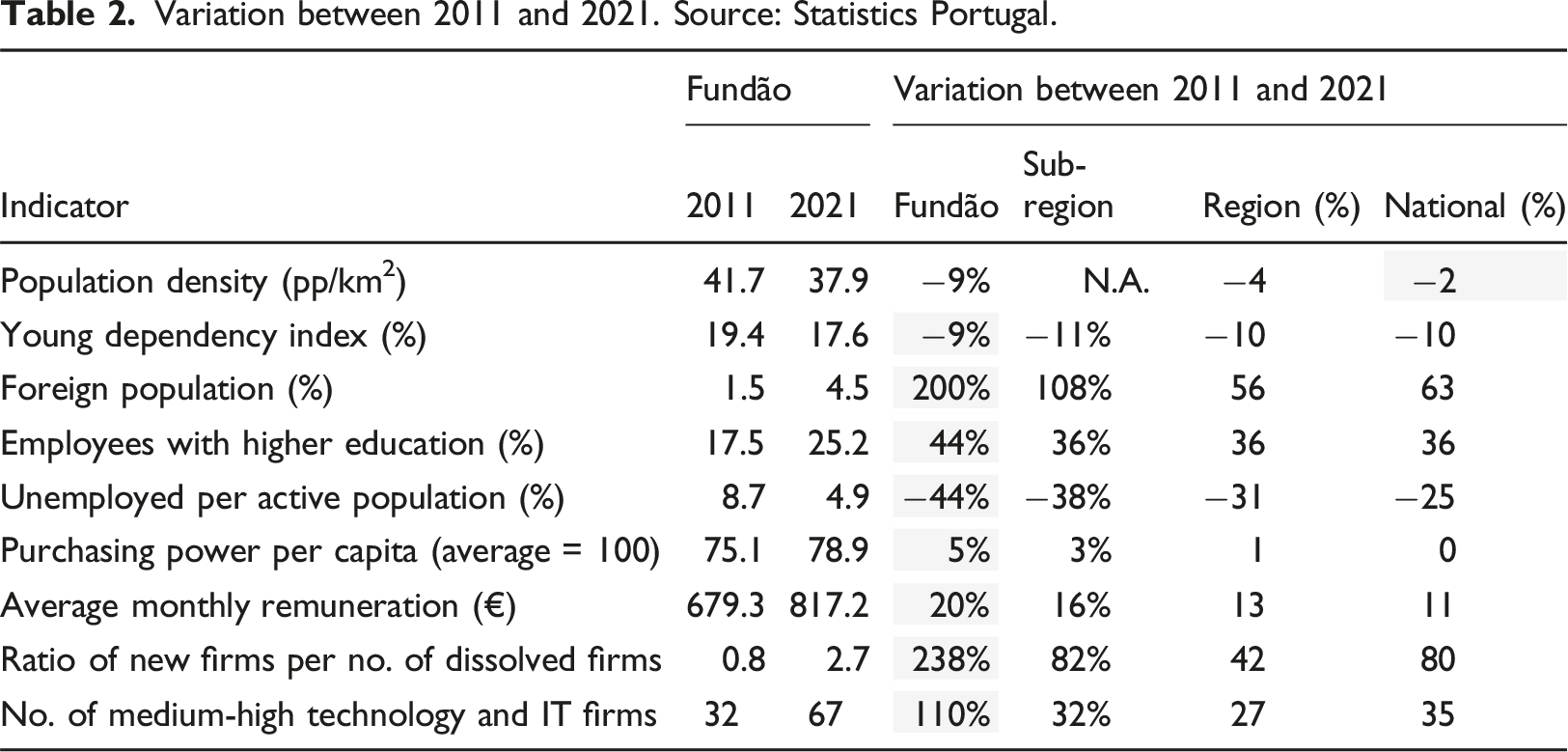
Variation between 2011 and 2021. Source: Statistics Portugal.
Fundão’s entrepreneurial ecosystem evolution
The evolution is presented in three phases (birth, transition, and consolidation) based on Colombelli et al. (2019). The authors defined the birth phase as ‘the emergence of an entrepreneurial setting in which different actors start to bind together in a close geographical, institutional, and relational context’ (Colombelli et al., 2019: 509). In this case, the birth phase occurs between 2012 and 2014, when the main events to create the EE took place. The transition phase is characterized by ‘the emergence of a complex variety of social, cultural, political, and economic feedback mechanisms, which may support or discourage path dependence processes within the network of actors’ (Colombelli et al., 2019: 509). In the case of Fundão, the transition phase goes between 2014 and 2022, where the EE grows in terms of activities and actors. Finally, the consolidation phase is when the actors of the EE have ‘survived the adaptive life cycle and are well embedded in the context’ (Colombo et al., 2019: 509). In this case, the consolidation phase is at its beginning since the EE actors are at the make-or-break point to adapt and become embedded in the EE strategy and culture. Figure 1 summarizes the key milestones of Fundão’s EE between 2012 and 2022. The following sections describe each phase in detail and present the EE governance characteristics in each one. Evolution and main events of Fundão’s entrepreneurial ecosystem.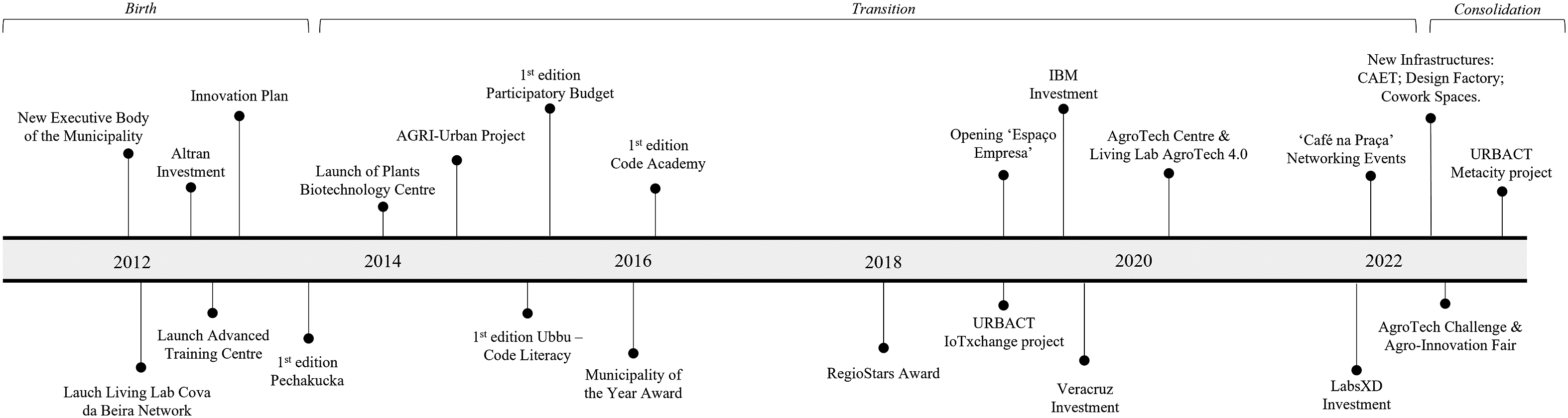
Birth phase
Main events during the birth phase
Most interviewees, as well as published studies regarding Fundão’s EE, highlight two main events that set the ‘first steps’ towards the local EE development. The first key moment was the election of the new local government in 2012, which defined ‘the creation of conditions for the success of our entrepreneurs, the development of attractive factors for investment and the emergence of an entrepreneurial and innovative spirit, are our main objectives and premises that will capture much of our attention in the coming times’ (Mayor of Fundão – Opening Speech in his first General Assembly as Mayor, 2012). This new political leadership soon proposed a Strategic Innovation Plan and started the project ‘Living Lab Cova da Beira’ which aimed ‘(…) to bring together a set of entities, banks, universities, companies, business associations, technology associations, and municipalities, so that altogether we create an ecosystem that supports companies, supports ideas, and supports entrepreneurship development’ (Mayor of Fundão during a TV interview, 2012). A remarkable statement from a local politician from a peripheral territory, who had this long-term vision long before ‘entrepreneurial ecosystems’, had become a buzzword. This initial strategy was also supported by the rehabilitation of the old sports centre into a new business centre, funded by the European Regional Development Fund with over two million euros.
The second main event was the settlement of a big technological company – Altran (nowadays Capgemini), initially creating over 100 qualified jobs. Several interviewees highlight the anchor role of this international company to attract not only highly qualified human capital but also other companies in the shared services sector. Besides, the initial investment by this firm was key to validating the strategy, getting media coverage, and strengthening the arguments for application to EU funds and other projects. Nowadays, this company still plays a prominent role in the local EE, being the major IT company with over 500 employees.
EE governance during the birth phase
In 2012, the entrepreneurship community was almost non-existent. Thus, the local government had to play a proactive role in filling this gap, providing guidance, resources, infrastructure, and above all a vision for the EE. All interviewees agree on the key element for EE governance – the strong political leadership and vision of the Mayor. A3 highlights that the Mayor ‘has a great knowledge of the territory, its pains, and how it can grow (…), and he clearly understands that his current acts or decisions have implications for the future. He has a vision of the territory and a vision of what he wants’. A13 states that the mayor’s ‘vision of the future is fundamental. For me, it's the philosopher’s stone of the new Fundão’.
This long-term strategic vision is also very clear in the documents and reports analysed. The shift in the political leadership is also noticeable in the minutes of the General Assembly meetings, where the words ‘entrepreneurship’, ‘innovation’, ‘ecosystem’, and ‘investment’ constantly appear. In his opening speech, the Mayor highlighted that they would ‘update and review the major strategic documents that have guided our action over the last 10 years to determine what will be the major guidelines for the next decade’ (Mayor of Fundão, General Assembly Minutes, 2012). Also, at the beginning of his first full mandate, he states that ‘for the 2013–2017 mandate, our bet is clear, attracting investment and creating conditions for the development of an innovative and entrepreneurial community’ (Mayor of Fundão during a General Assembly, 2014).
The ‘open’ approach of Fundão’s strategy towards entrepreneurship and innovation during the birth phase is also highlighted by several interviewees (A1, A3, and A14). Fundão’s Strategic Innovation Plan established the ‘open governance approach’ as a key assumption of the strategy, with the concepts of open culture, open government, open data, open arms (to receive and involve all), open minds (to foster a positive and innovative spirit), and open for business, being widely used in the document (Município do Fundão, 2012). A2 stresses the importance of open governance and open data to foster entrepreneurial opportunities in the Municipality. An example was the co-creation sessions of the Innovation Plan, which ‘started in a very open and shared way, with the involvement of the community’ (A1). According to A1, one of the key elements of EE development was the constant involvement of the citizens during the process, where ‘people understood what was happening (…) and felt part of it’.
On the other hand, one of the barriers, during the birth phase, pointed out by most interviewees was the community reaction and initial acceptance of the municipality’s strategy towards entrepreneurship and innovation (A1 and A2). A5 highlight the risk and innovation aversion culture of the local community ‘that was not prepared for these dynamics’. Besides, there was also resistance towards the new residents and new companies, with many people saying, ‘they give everything to the others, and nothing to the local people’ (A3 and A5). This struggle was also seen in the General Assembly meetings, where the opposition political parties criticized many aspects of this strategy, and according to A2, in the beginning, the community was not able to understand the time needed to recognize the compounding effects of the EE.
Transition
Main events during the transition phase
After the initial phase, the municipality implemented several strategies and projects to support the EE consolidation, including urban rehabilitation, incubator and business services, cultural spaces, education and training with programming classes for all children (Ubbu – Code Literacy), IT training courses for unemployed or career conversion (Code Academy) and networking events (e.g. Pechakucha; ‘Café na Praça’). Besides, the involvement of the local government in several national and international projects in agrotech, smart cities and circular economy fields was important to fund and allocate human resources to many of these initiatives, contribute to the expansion of the EE network, and attraction of international partners, private investment, and opportunities.
Over these 10 years, there has been a transformation from a relatively specialized local economy (based on tourism and agriculture) to a more diversified set of economic landscape. This shift has been driven by the involvement of companies like IBM, LabsXD, and Veracruz, leading to a wider range of economic activities including the digital economy, agriculture, tourism, services, and industry, which in the long term can improve territorial resilience (A2).
The agricultural sector, a traditional sector in Fundão, has also benefited from the EE strategy, with the establishment of the Agrotech Centre, the implementation of the Living Lab Agrotech 4.0 strategy, and initiatives like the ‘Agrotech Challenge’ and the ‘Agro-Innovation Fair’. This focus on combining digital technologies and innovation with the agricultural sector has been acknowledged by several interviewees and in previous academic works, which highlight Fundão’s multisectoral experience and the promotion of various typologies of entrepreneurship (Lopes and Mota, 2021; Rodrigues and Franco, 2021).
During the transition phase, the initial resistance from the community decreased as the long-term effects of the strategies became apparent. A2 and A3 pointed out the inter-temporal (and not immediate) effect of the strategies, highlighting that when local people started to feel the effects (‘feeling the money in their pockets’ (A2)) of these new companies and workers who came from outside, the attitude started to change. Also, in the political debate, the appearance of the ‘first results’, which impacted local economic and social statistical indicators, has softened the criticism. Most interviewees agree that ‘everything is much more aligned now’ (A3) and ‘the number of people who understand this strategy is increasing’ (A5). However, ‘the communication (with the local community) is one of the points that still need to be improved’ (A5).
One of the barriers during the transition phase was the lack of an entrepreneurial culture and role models. Interviewees point out that the entrepreneurial spirit is not rooted in people and companies, arguing that this is not a specific problem of Fundão but of all LDTs in Portugal and even in Europe (A3 and A6). A6 states that the Fundão’s ecosystem ‘is not yet entrepreneurial, it is an ecosystem of tech companies’. Besides, the interviewees pointed out the lack of history, a tradition of entrepreneurial activity and role models, which do not contribute to existence of a stronger entrepreneurial culture (A2 and A6). Fundão ‘lacks history (…) and people relate more with cities that have some history (A6). Fundão needs a ‘sexy project that will make Fundão’s history and make Fundão known’ (A6) and an example of other entrepreneurs that share their journey and set a role model (A11). According to A2, the ecosystem will evolve according to the activities located there historically, so it is in the process of change. For A6 and A11, the municipality needs to put more energy and investment into developing entrepreneurial spirit.
EE governance during the transition phase
One key EE governance aspect was the multiple roles that the local government played during the transition phase. The interviewees use different terminology to characterize its role, such as lever (A3), driver (A2), or engine (A1), but the common denominator is its vital and multiple roles in the EE. A7 pointed out that their major role is ‘to provide a strategy which shows companies and entrepreneurs the benefits to moving to Fundão’. However, the municipality was not only the strategic leader of the EE but also played several ‘practical’ roles, many of them not usually played by this type of public institution, such as of a network broker, creating partnerships between the actors of the ecosystem. A3 highlights that ‘almost everything that has to do with external actors is done through the municipality’.
Furthermore, as far as taxes are concerned, the Municipality played a key role by designing a ‘set of tax incentives to attract business investments to the urban centre, as well as to create conditions for people to carry out rehabilitation of the built heritage’ (A2). Besides, it also played the role of economic diplomacy by preparing investment plans to present to national and international investors, namely, in South America (A2).
Another important aspect during this phase was the entrepreneurial approach taken by the Local Government. A7 highlighted that ‘(…) compared to other cities where I lived, I noticed more accessibility from the Municipality, more commitment and openness to listen to ideas and criticism (…) The reduction of bureaucracy also helps a lot’. This is also stated by A6, who argue ‘the great advantage that made us go there was the proximity to the Municipality teams, and the ease and speed of processes (…) Fundão is a Municipality that is similar to a startup’. On the other hand, the constant involvement and concern for improvement by the Municipality are also illustrated by A7: ‘(…) some international friends of mine from the company had a meeting with Municipality representatives half a year after moving into Fundão to find out if anything was missing and if they needed something’.
From the municipality’s team perspective, A1, A13, and A14 highlighted the ability to ‘learn and adapt quickly to what (companies and entrepreneurs) needed’ (A3), and nowadays still ‘have very agile and effective processes’ (A1). This entrepreneurial attitude is also noticeable in several declarations by the Mayor, for example, ‘(…) nowadays, developing territories like ours also incorporates the notion of some risk because there is no innovation without risk’ (Mayor of Fundão, General Assembly Meeting, 2015).
An open governance approach is also present during this phase. For example, through the municipality’s website section called ‘A minha ideia’ (my idea), where citizens can write their ideas and opinions to improve something in their community, and which the Municipality believe ‘will contribute to a robust and entrepreneurial discussion (…)’. They have been also organizing, since 2015, annual Participatory Budgets where local citizens can propose their ideas to answer local problems, needs, or new opportunities. Besides, local action groups created by the municipality to discuss several themes are also pointed out by the mayor as a crucial methodology in this phase: ‘We create a first focus group, and then this focus group becomes more of an action group, to create the action plans and validate them. We open them up to citizens in open models, where they are sometimes formally incorporated into the action plans’ (A14).
In Rodrigues and Franco (2021) work, the open governance model is highlighted by the mayor as part of the local public policies to meet the population’s wishes and real needs, to promote the culture of learning and growth through new experiences, to stimulate transparency and the population’s trust, and to promote a constructive, positive and innovative spirit. Lopes and Mota (2021) also highlighted the multilevel open governance model of Fundão, led by the municipality and involving a wide set of different actors.
Consolidation phase
The results achieved by Fundão’s EE were recognized nationally and internationally, for example, through the RegioStars award in 2018, by the European Commission, as well as the Municipality of Year Award in 2016. Nowadays, over 1300 IT engineers from over 30 nationalities are working in Fundão. Moreover, more than 100 new ventures were created, and over 200 private investment projects were supported in these 10 years, with significant economic and social impact in the region. Fundão, leveraged by its EE, was able to reduce the unemployed population and renew its population by retaining the active population and increasing the foreign population. Besides, the average salaries and the local purchasing power were boosted by the great number of new firms, especially in the medium-high technology and information technologies fields. Even though population loss is still a reality, in 2015 and 2016, Fundão had, for the first time since 2001, a positive migratory balance, which holds a good prospect for fighting the demographic challenge in the future.
Table 2 presents a comprehensive overview of the evolution, between 2011 and 2021, in various indicators concerning the social and economic context of Fundão. These indicators are compared to the corresponding variations in the sub-regional (NUTS III – Beiras e Serra da Estrela), regional (NUTS II – Centro), and national levels. Upon analysing the data, Fundão reveals a consistent pattern of over-performance when comparing to sub-regional, regional and national indicators, with notable differences in the presence of foreign population, the proportion of employees with higher education, the establishment of new firms, and the number of technology companies. The number of new firms per number of dissolved firms increased by an impressive 238%, surpassing the sub-regional (82%), regional (42%), and national (80%) averages. Similarly, Fundão experienced an extraordinary growth in the number of new medium-high technology and IT firms, outperforming the sub-regional (32%), regional (27%), and national (35%) rates.
EE governance during the consolidation phase
Nowadays, there are also some governance barriers in this phase. While acknowledging the need for a strong leadership figure, interviewees raised the importance of having a more distributed leadership approach that involves various stakeholders, including the entrepreneurship community itself. Engaging entrepreneurs in decision-making processes and empowering them to take leadership roles can enhance the ecosystem's resilience and adaptability. Most interviewees highlight the high dependence of the EE on the municipality, given the multiple roles it plays, as discussed previously. Besides the strong political leadership and vision described as a critical success factor for the EE emergence and transition, the high dependence on the local government may lead, at some point, potential disadvantages given the nature of limited political cycles (A2). A2 thinks that ‘in terms of general orientation, the long-term vision will be pursued (…); however, it will depend a lot on who will be the protagonists in the upcoming years’. A5 stated that ‘the whole municipality’s teams played an important role in the ecosystem (…) but, clearly, many things come from the Mayor’s vision and beliefs’. The Mayor, considered by everyone as the visionary and engine of this strategy, cannot continue to lead the Municipality after 2025, and this is an important matter of concern to the EE evolution (A3 and A5).
Another barrier pointed out by the interviewees is the lack of engagement and cooperation between EE actors (A10). A3 highlights that ‘most of the work really comes from the Municipality, and there is not a lot of own initiative (from the other local actors)’. The municipality’s teams are almost always involved in the investment projects, submission proposals, and events organized, bridging the gap between the local stakeholders who traditionally do not communicate and ‘sitting them at the same table’. Regarding business cooperation, A2 believes that there is some institutional solidarity between companies (…), but the business cooperation is very low compared to what happens in other areas of the country.
A1 and A3 highlight that there is a need and opportunity to innovate in the governance model and to discuss an independent structure that can be more flexible because the public administration has several legal contingencies. Fundão’s EE ‘need to evolve to the next stage because if it does, the people and companies that are here will feel more and more comfortable and reassured’ (A1). In the same line, the Mayor points out the need ‘for a reflection on the governance model (…) how can it be more adjusted to what is an even faster, more operational world where we have to have a balance between informality and formality’, stating that he ‘wakes up every morning thinking on how this could all be less dependent on me’ (A14).
Discussion
Fundão’s EE governance evolution.
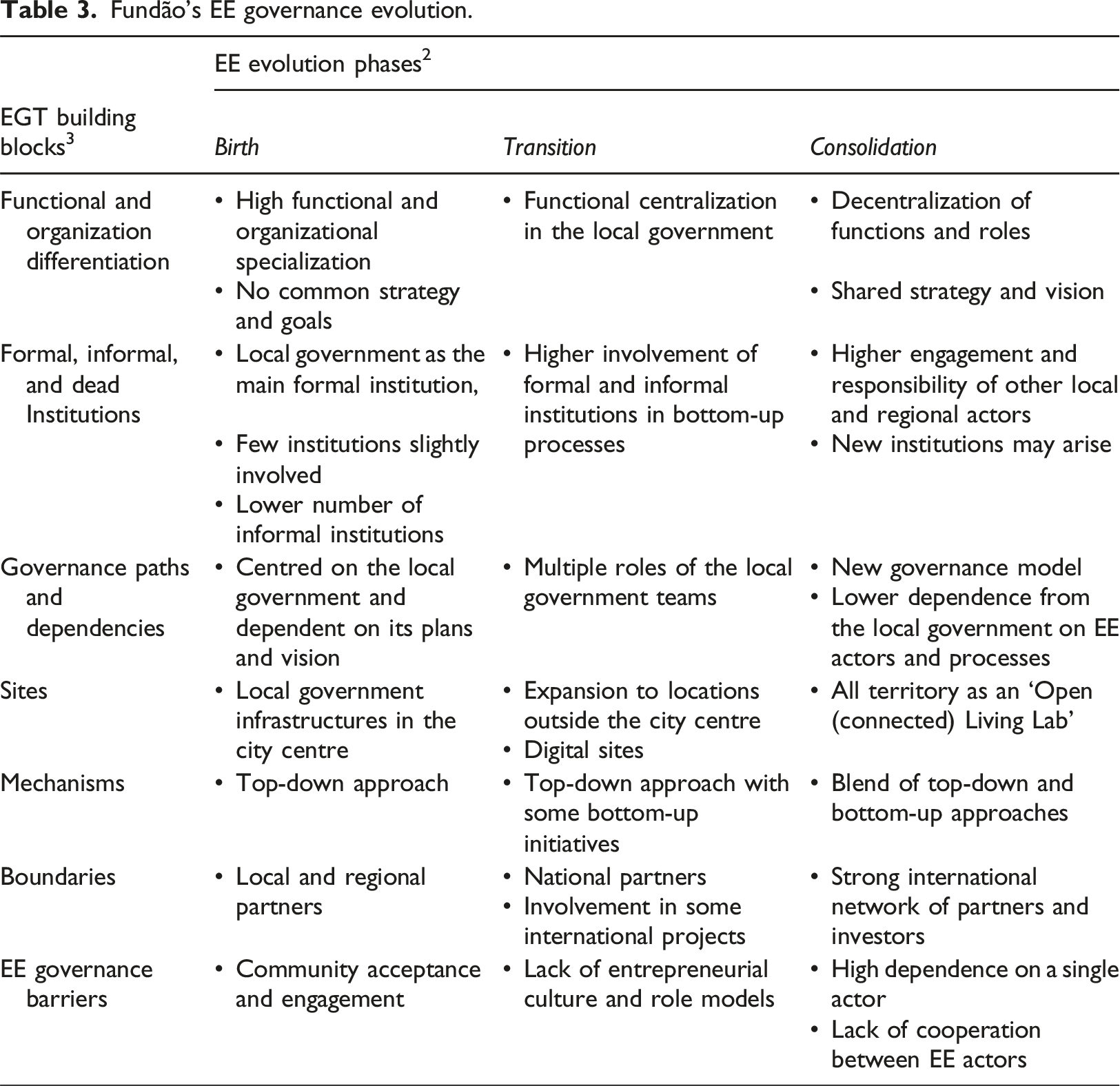
During the birth phase of the EE, we observed high functional and organizational specialization without a common strategy and goals. The primary focus was on individual actors and their specific roles, resulting in a lack of coordination and collaboration and, thus a fragmented and loosely interconnected EE. The local government played a solitary role as the main formal institution, and dictated the plans and vision, with minimal involvement from other existing institutions. Informal institutions were also relatively scarce during this phase. However, in the transition phase, we noted a shift towards functional centralization within the local government. The local government took on multiple roles and became more involved in bottom-up processes, actively engaging formal and informal institutions. This phase marked a significant increase in the involvement of different actors in the EE, indicating a more collaborative approach where different actors had a say in decision-making processes. Moving towards the consolidation phase, we anticipate a trend towards decentralization of functions and roles, accompanied by the development of a shared strategy and vision. This implies a lower dependence on the local government as various EE actors take on more responsibilities and actively participate in shaping the EE future governance paths.
Regarding the geographical boundaries, the initial focus of the EE was centred around local and regional partners. In the transition phase, the scope expanded to include national partners and involvement in some international projects. In the consolidation phase, we envision a strong international network of partners and investors, with the entire territory becoming an open and connected living lab.
Lastly, the mechanisms of governance have evolved over the different phases. The birth phase was characterized by a top-down approach, where decisions were primarily imposed from higher levels of authority. In the transition phase, there was a combination of top-down and bottom-up approaches, reflecting a more participatory and inclusive governance style. As the ecosystem moves towards consolidation, we anticipate a blend of top-down and bottom-up approaches, creating a more balanced and collaborative governance framework.
EE governance principles in LDTs
This section presents a discussion of five fundamental principles concerning the governance of EEs in LDTs, drawing upon our research findings.
Governance stability
Governance stability has emerged as a key attribute within the context of our case study, aligning with the EE conceptualization as a dynamic organism that strives for homoeostasis, which needs to sustain equilibrium amidst evolving conditions. EGT highlights the importance of governance systems being able to adapt and become resilient while recognizing the existence of stability and homoeostatic tendencies in specific contexts. Thus, EEs should pursue a state of dynamic equilibrium rather than immutable stability. This dynamic equilibrium encompasses an ongoing process of adaptation and adjustment aimed at preserving the functionality and efficacy of the governance system. While stability provides predictability and consistency, an excessive emphasis on stability can lead to rigidity and less ability to respond to changing circumstances. Conversely, excessive adaptability without foundational stability can precipitate instability and erode legitimacy.
The role of stability in EE governance studies has received limited attention (Cunningham et al., 2019), mainly due to the shortage of longitudinal research on the field, with most studies predominantly focussing on the ecosystem’s adaptive capacity. Future research should explore the delicate equilibrium between adaptability and stability within EEs, with the overarching goal of attaining a dynamic balance conducive to the sustainable evolution of the ecosystem.
Time and timing
Related to governance stability, we also argue that time and timing in EE development matters (Audretsch et al., 2021). Most interviewees argue the importance of having a long-term vision to develop a resilient EE, following most literature on this topic (Colombelli et al., 2019; Xu and Dobson, 2019). We found a much longer time perspective for the construction of the EE than initially expected. Besides, there is a challenge between the time needed to develop the EE and the expectations of the different stakeholders regarding the outputs and outcomes of this strategy. EEs in LDTs evolve very slowly and needs a long-term commitment from EE actors. In this case, timing is crucial to gain public acceptance of the different initiatives aimed at building the ecosystem and local entrepreneurial culture.
An entrepreneurial approach
Although in the studied case study the EE leader is a public institution, a flexible and customer-focused EE support structure was developed internally with a highly motivated and technically competent team. The mayor argues that one of ‘the great secrets are the decentralized autonomy that is then given to the organizational structures, to the people, to the leaders of the different areas, and to the action groups’ (A14). This structure was, over time, capable of optimizing processes and seeking new ways of supporting ecosystem players. Besides, the open governance mindset and the inclusion of several bottom-up strategies and policies were distinguishing features of the EE evolution. Nonetheless, it is crucial for the development and resilience of EEs to promote this entrepreneurial approach within the EE network, and not only within the local government, improving the interactions between the actors who are still highly dependent on the Municipality and need to be developed autonomously. Thus, any EE governance model must include an entrepreneurial approach by both the leader and the main ecosystem actors.
The importance of community culture
We argue that given the importance of community culture in the LDTs, the EE can only enter the consolidation phase when the local actors and the local community are truly inserted in the entrepreneurial spirit and capable of stimulating the ecosystem in a spontaneous and organic way. The involvement of the community and other stakeholders at different parts of the EE strategy was a success factor in the case of Fundão, going in line with previous authors (Grujić, 2019; Markley et al., 2015).
However, barriers remain, especially related to the entrepreneurial culture, lack of cooperation between the actors and community acceptance, and involvement. As van Assche et al. (2014) described, the emergence of new governance models and governance evolution may create anxiety and fear within the community. This happened at the birth of Fundão’s EE but can also happen when there is a change in the leading institution or when a new governance model emerges. Thus, innovative open governance strategies need to be put in place to include citizens and institutions in these processes. On the other hand, the lack of cooperation between the actors is also reflected in the weak relationship between the EE and the existing business ecosystem. Cantner et al. (2021) highlight that, in a consolidation phase, there is a need for mechanisms to promote the intersection between these two ecosystems.
Strong role of the local government
The case of Fundão follows the literature on EEs, which argues that in territories with a lack of resources and weak institutions, such as LDTs, it is very unlikely for an EE to emerge as a natural or organic process (Porras-Paez and Schmutzler, 2019), given the lack of other strong local institutions in these type of territories (Dal Bello et al., 2021; Miles and Morrison, 2020). On the other hand, the local government shape the culture and strategies of the community and other institutions but also co-evolve with the constant interactions with other local, regional, national, and international actors, changing many of its internal rules, culture, and position towards the EE.
Nonetheless, a high dependence on the local government hinders the sustainability, maturity, and resilience of the EE (Harima and Harima, 2021). It is now necessary to discuss this governance paradox from a theoretical and practical point of view. According to the mayor ‘his strength is proportional to the way he shares that same leadership’ (A14). Thus, there is a need to understand how the EE can evolve towards a phase of non-dependence, where other actors take on responsibility for some EE governance functions. The findings of our case study align with existing literature, which highlights the need for the creation of visible success stories and successful/failed narratives of entrepreneurs to improve the entrepreneurial resources flow and acquisition in a consolidation phase (Brown and Mason, 2017; Harima et al., 2021).
Concluding remarks
In today’s complex and uncertain global society, developing a supportive environment to promote entrepreneurship and innovation has become crucial, especially for territories with a long history of structural challenges related to their location, population structure, and (lack) of infrastructures and investment. EEs have been widely discussed and applied as a framework to promote entrepreneurship and innovation at local level. However, the are still gaps in the understanding of how these complex systems evolve and are governed persist. The analysis of the Fundão’s EE governance evolution across the birth, transition, and consolidation phases reveals a progression towards greater coordination, collaboration, and shared vision among ecosystem actors. The findings suggest a shift from a fragmented and centralized governance structure to a more decentralized and inclusive model.
In conclusion, the evolution of the entrepreneurial ecosystem (EE) in Fundão is a multifaceted process characterized by both significant achievements and ongoing challenges. Our analysis has demonstrated that while the proactive initiatives of local policy actors have played a crucial role in fostering entrepreneurship and innovation, the journey has not been without obstacles. Initial community resistance, the struggle to cultivate an entrepreneurial culture, and the dependence on local government leadership are among the critical issues that continue to shape the ecosystem’s trajectory. These insights contribute to the evolving body of knowledge on EE governance and provide a basis for further research and practical implications.
Implications for local policymakers
Our findings and principles discussed can provide several policy implications to guide local and regional policymakers who aim to develop an EE-based local development strategy. Firstly, governance stability through a long-term vision, strategic planning, and a sense of time and timing emerges as key factors that policymakers should consider. By balancing stable governance structures with an increasing adaptive capacity, policymakers can navigate the evolving socio-economic challenges of LDTs, ensuring the resilience of EE initiatives over time.
Secondly, strategic validation and external recognition play a pivotal role in supporting EE initiatives. Policymakers should recognize the significance of strategic partnerships with anchor firms and expand EE networks through participation in national and international projects, networks, and awards to enhance the credibility of EEs, and attract investment and knowledge, thus overcoming resource constraints related to funding and expertise in LDTs.
Moreover, promoting an entrepreneurial culture within EE stakeholders is crucial. Policymakers should aim to foster innovation and collaboration among ecosystem actors and promote community engagement initiatives to ensure the active involvement of local stakeholders, fostering a sense of ownership and commitment to the EE’s development.
Finally, while local governments play a central and diverse role in initiating and supporting EEs, policymakers should strive to reduce dependency on centralized governance structures over time. We highlight the importance of having an entrepreneurial perspective in policymaking, with innovative place-sensitive policies that answer local needs and explore opportunities and future trends. Empowering other ecosystem actors and fostering autonomy within the community are critical strategies to avoid the so typical one-size-fits-all top-bottom strategies and investments that, in the end, lack legitimacy and become severely underused by the local actors.
Limitations and further research
This study has several limitations that should be acknowledged. Firstly, employing a single case study qualitative approach restricts the generalizability of findings beyond this specific context. To enhance the validity and generalizability of future research, comparative and multi-scalar approaches should be adopted. Furthermore, the definition of LDTs is not static and may vary across countries and institutions. Adopting a ‘European perspective’, our study may differ from the definitions in other countries and thus require contextual consideration in different regions. Additionally, the retrospective nature of the study and the absence of digital records before 2012 pose challenges to a complete understanding of the entire evolutionary process and may overlook the messy and complex nature of how EE develop and evolve in real-time. Future research could employ more dynamic and real-time data collection methods to capture the intricacies and complexities of EE evolution. Moreover, the snowballing strategy employed for data collection may introduce selection bias. While efforts were made to mitigate this bias (use of secondary data), alternative data collection procedures and mixed-methods approaches should be explored to provide a more representative understanding of EE dynamics and evolution (Cho et al., 2022; Panetti et al., 2021).
Despite these limitations, this study contributes to the theoretical advancement of EE literature by clarifying the role and governance mechanisms in EEs, a key dimension to building resilient and sustainable ecosystems (Colombo et al., 2019). Future research should continue examining EE governance models, including the paradox between the strong role of the local government and the high dependence of the ecosystem on this institution, as highlighted in this study. Moreover, this study contributes to the emerging research on EE in non-urban areas, avoiding the generalization of one-size-fits-all EE models (Tsvetkova et al., 2019), which may lead to disastrous results in resource-constraint environments, such as LDTs, confirming the distinctive features of EEs in these types of places (Almeida and Daniel, n.d.) and emphasizing the significance of context-sensitive frameworks and the importance of adapting strategies to suit the unique characteristics of different ecosystems.
Footnotes
Declaration of Conflicting Interests
The author(s) declared no potential conflicts of interest with respect to the research, authorship, and/or publication of this article.
Funding
The author(s) disclosed receipt of the following financial support for the research, authorship, and/or publication of this article: This work was supported by the Research Unit on Governance, Competitiveness and Public Policies (UIBD/04058/2020) + (UIDP/04058/2020) and funded by FCT - Fundação para a Ciência e a Tecnologia Fundação para a Ciência e a Tecnologia; through the scholarship 2021.05286.BD.
