




Abstract
Entrepreneurial ecosystems are the focus of government economic policies around the world for their potential to generate entrepreneur-led economic development. The paper identifies key research questions and challenges to building effective public policy: (i) the limitations of existing data sources, (ii) the need to balance findings from quantitative and qualitative studies, (iii) the danger that entrepreneurial ecosystems will be just a policy fad, (iv) the narrow focus of policy and research on high tech firms and scale-ups, and (v) the need to balance research approaches between simplified models and a complex systems approach. There is a need for a better understanding of the diversity of policy contexts (level of government, country context) and model of ecosystem governance. A more granulated understanding of ecosystem thinking is required, with greater consideration of the diversity of actors and the institutional context, with more attention given to the heterogeneous nature of places and complex interactions between actors and networks. Looking to the future, the potential of new data sources and methodologies is identified. Future research should give greater consideration to the institutional context to understand how policy can better support entrepreneurial activity and the extent to which specific policies can be replicated elsewhere.
The landscape
Entrepreneurial ecosystems have emerged as one of the most popular new economic development policies of the decade. Governments in developed and developing economies have turned to the development of ecosystems as a way in which to create jobs, boost innovation, and, in turn, generate economic prosperity. There has been a substantial growth in interest in topics such as entrepreneurial and start-up ecosystems over the past 15 years (Figure 1). Major international NGOs such as the Kauffman Foundation (Motoyama and Watkins, 2014), the World Economic Forum (2013, 2014), and the OECD (Mason and Brown, 2014) have all advanced ideas on the development of entrepreneurial ecosystems. They have been joined by a growing collection of economic development policy advisors, gurus, practitioners, and researchers who are implementing ecosystem ideas on the ground.
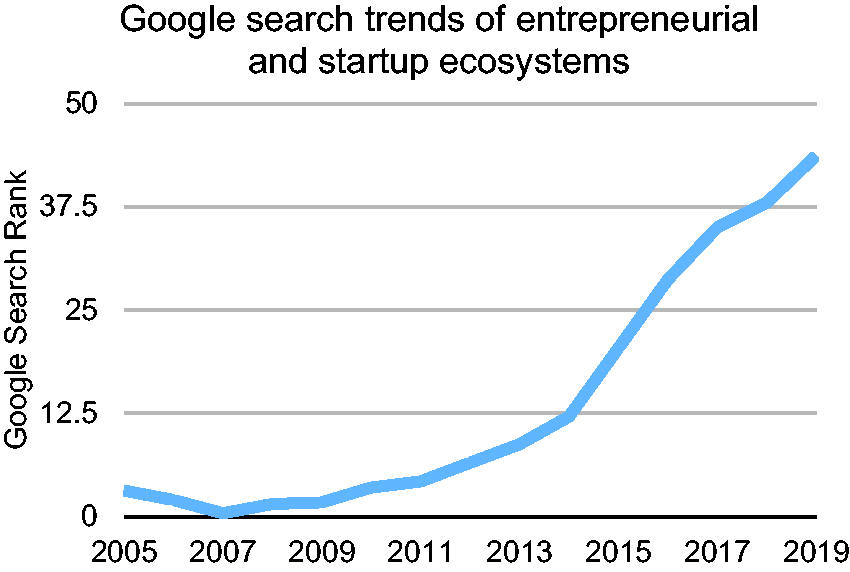
Google search trends of entrepreneurial and start-up ecosystems.
The popularity of the entrepreneurial ecosystem concept emerged at a time of profound austerity, economic stagnation, and a widening of geographical disparities in economic development in many economies. Harnessing the potential of local entrepreneurs is seen as a way in which to transform the economic trajectory of economically lagging regions, potentially helping to reverse the declines caused by de-industrialization, and automation. In the most successful cases, small nudges from public servants and local business communities create a self-sustaining cycle of entrepreneurial innovation, growth, and re-investment. These shifts make entrepreneurial ecosystems an attractive idea for policymakers and researchers (Mason and Brown, 2014; Spigel, 2017, 2020). Unlike clusters and innovation systems, it is argued, ecosystem approaches do not call for major investments in new physical infrastructure. Rather, they seek to build an engaged community of entrepreneurial actors who can co-create the support required to help innovative new firms start and scale (Feld, 2012). Ecosystem approaches seek to harness local skills and specialties to create new value rather than depending on tax incentives or grants to attract in footloose global players who may leave as quickly as they come. Nevertheless, much like older ideas of cluster and innovation systems, ecosystem concepts are easy to promote but hard to implement.
Acs et al. (2014) defined the system of entrepreneurship as ‘dynamic, institutionally embedded interaction between entrepreneurial attitudes, ability, and aspirations, by individuals, which drives the allocation of resources through the creation and operation of new ventures’ (479). According to Stam (2015), the entrepreneurial ecosystem is ‘a set of interdependent actors and factors coordinated in such a way that they enable productive entrepreneurship’ (1765). Building on these definitions (Acs et al., 2014; Autio and Levie, 2017; Stam, 2015), we define entrepreneurial ecosystems here as the regional collection of actors (such as entrepreneurs, advisors, workers, mentors, and workers) and factors (cultural outlooks, policies, R&D systems, and networks) that all contribute to the creation and survival of high-growth ventures. We focus on high-growth entrepreneurship because it is seen as a major driver of job creation and economic growth in both advanced and emerging economies (Brown et al., 2014; OECD, 2010). Governments have a keen interest in identifying barriers to this kind of innovative entrepreneurship and are looking for new avenues to support it. Whereas in the past many regions have looked to attract new investment from multi-national companies, local entrepreneurship is now seen as a leading engine for economic development (Auerswald, 2015). At the same time, throughout the world, economic development powers are being devolved to city-regions so they can build new policies that reflect their unique resources, capabilities, and strengths, creating a new urgency for localized, contextually sensitive policies (Katz and Bradley, 2013).
Given this, there is a need to bring together stakeholders to investigate what we know about entrepreneurial ecosystems, what we don’t know, and what is needed to create the best environment for innovative entrepreneurship. This public policy interest demands critical inquiry by scholars. More research is necessary to understand not only what entrepreneurial ecosystems are – the types of actors and factors most associated with high-growth entrepreneurship – but also if, how, and why ecosystems can increase the performance and survival of innovative firms. More research is needed on how entrepreneurial ecosystems develop and what types of events or conditions can constrain their growth. Critical perspectives are needed to identify what best practices can be transferred from place to place, and to question the validity of the connections between high-growth entrepreneurship and overall social prosperity. Such insights will not only help policymakers and entrepreneurial communities understand how to overcome common challenges in the quest to build stronger ecosystems but will also provide insights into fundamental questions about how entrepreneurship works and how it is affected by its environment.
To address these research and policy needs, supported through the UK-Japan Social Sciences, Arts and Humanities Connections grants under the Economic and Social Research Council and the Arts and Humanities Research Council, we organized two international workshops in the UK and Japan in 2019 to help create a community of interested researchers and practitioners with the objective of identifying the most salient research questions and identify the challenges to building effective public policy and entrepreneurial support. This Manifesto is designed to synthesize the major themes and discussions from these workshops and sketch out a research agenda that will produce both engaged scholarship to move forward debates in entrepreneurship and innovation research and identify actionable insights and ideas that can be applied to help strengthen entrepreneurial ecosystems around the world.
At the first workshop in Glasgow (7 May 2019) – ‘Measuring entrepreneurial and innovation ecosystems’ – we identified several issues facing research on entrepreneurship ecosystems. At the second workshop in Tokyo (24 June 2019) – ‘Place-Based Ecosystems: Making Connections between Entrepreneurship and Innovation’, we came to realize the very different contexts and challenges facing the two different nations and regions within them, requiring different approaches to ecosystem policy. Identifying the problems is a first step to addressing them. Below, we summarize the problems that limit the policy-relevance of ecosystem research as well as its ability to grow as a self-sustaining field. We then discuss the diverse and evolving nature of policy needs, with different initiatives taken by governments at both national and local levels. We conclude with some suggestions for future research agendas.
The problems
Problems with existing data
One of the major topics of discussion in the first workshop was the limitations of existing data sources such as government censuses, business surveys, and economic data and existing research data such as the Global Entrepreneurship Monitor (GEM). The first issue is one of scale: much of the most important data are only available at national levels, 1 while ecosystems function predominantly at the sub-national (e.g. city, city-region, regional) scale. National-level data hide a great deal of variation between and within city-regions, which makes it difficult to understand the reality of the situation on the ground.
The more pernicious problem is the difficulty of gathering quantitative data on how entrepreneurial ecosystems work. This begins with the challenges of identifying ‘high-growth’ firms – the firms that ecosystems are, in principle, designed to support. For instance, the Eurostat-OECD’s (2007) definition of ‘high-growth firms’ is ‘All enterprises with average annualised growth greater than 20% per annum, over a three year period’ measured by the number of employees or by turnover (OECD, 2007, p. 61), is overly restrictive and excludes many job-creating innovative firms (Daunfeldt et al., 2015). Corporate registries provide very few details on the growth patterns of early stage or small firms, making it hard to identify firms beginning their scaling phase. Although some business intelligence companies are developing methods to identify these firms, such data are restricted, expensive, and rarely is available across multiple countries.
But as hard as it is to define high-growth firms, it is even harder to measure many of the actors and factors that make up strong entrepreneurial ecosystems. While a few measures such as highly educated talent (if we define this people with university degrees) and innovation (if we define this as patents or R&D investment) can be easily counted, other aspects of ecosystems such as the presence of entrepreneurial cultures, the density of social networks, and the size of communities of angel investors are much harder to measure. Existing proxy measures and expert surveys are limited in what they can tell us. We are also missing dynamic data that show the underlying processes of how ecosystems develop and deliver benefits to entrepreneurs within them.
At the Glasgow meeting, we discussed different measurement approaches, both qualitative and quantitative. There are already different forms of ‘ecosystem rankings’ and a set of comparative measures has been developed and adopted internationally (e.g. MIT REAP Framework). 2 Here the risk is that the easy and convenient things get measured rather than the things that matter. The challenge is understanding what to measure: Feld and Hathaway (2020) argue that the focus should be on the interactions rather than the parts of the ecosystem. There is a need for new and innovative metrics that can measure aspects of ecosystems that have so far been obscured. We discussed new techniques for using data from digital platforms (e.g. Meetup.com and LinkedIn) to quantify ecosystem attributes such as entrepreneurial culture and the movement of people and ideas between firms, and new ways to use data from firm websites to systematically identify innovative, high-growth firms (discussed further in the ‘New directions of travel’ section).
The challenge of combining qualitative and quantitative insights
One of the most common themes discussed by policymakers at our workshops was the importance of bringing together findings from quantitative case studies of ecosystems with qualitative insights from discussions with key stakeholders within ecosystems. These stakeholders range from those in the public sector who are charged with supporting entrepreneurial activity to members of the business and investment community to the entrepreneurs themselves. This reflects the core arguments of practitioners like Dan Isenberg (2010) and Brad Feld (2012) that the ecosystem must be focused on the needs of the entrepreneurs themselves.
One particular issue that was discussed at both the Glasgow and Tokyo meetings was the tendency amongst both researchers and policymakers to focus on formal support rather than the informal support networks between entrepreneurs. This is often a consequence of visibility: support programmes funded by the government are easy to identify and have known directors and missions, making them easier to study. WhatsApp groups of local founders, small informal meetups for Chief Technology Officers, and conversations between investors are invisible to those outside. Although studying formal support programmes is important, this misses out on the complexity of what entrepreneurial ecosystems are and how they work.
But whereas an idealized view of ecosystems may have entrepreneurs as the main leaders and organizers, the reality is that they often lack the time, resources, and ability to take on this role. Possible leaders of entrepreneurial ecosystems may not be necessarily currently engaged in entrepreneurship. They may be, for example, cashed out and exited entrepreneurs, or ‘hands-off’ entrepreneurs who have brought in senior management people to enable them to step aside from day-to-day involvement. Other actors must take the lead by creating buy-in about the needs of entrepreneurs and the wider community and to develop short-term interventions and long-term plans. This requires more than just surveys to measure existing actors, factors, and resources in an ecosystem; it also necessitates a deep engagement with the needs of many different groups to identify and plan the best path forward. New research and engagement approaches are required to bring these groups together to build consensus and a shared vision of how the ecosystem should progress.
Ecosystems as a policy buzzword
There is a long tradition of ‘policy fads’ that are positioned as cure-alls for ailing economies. Examples include clusters, regional innovation systems, creative cities, and the attraction of mobile investment though grants and tax subsidies. Entire consulting industries have developed to sell such solutions. However well-meaning the research and practice community is, entrepreneurial ecosystems risk falling into this category. If this were to happen, we would lose the focus on building entrepreneur-focused communities that aid the scaling and innovation processes in favour of quick checklists of standard approaches.
At this point in time, research interest in ecosystems is driven by its intense popularity in policy circles rather than more fundamental research questions. This interest can be seen at large events such as the Global Entrepreneurship Congress which feature multiple sessions on ecosystem building, the creation of ecosystem rankings (e.g. Start Up Genome; Startup Blink), and investments by organizations such as the Kauffman Foundation in creating ‘Ecosystem Playbooks’. These activities have contributed to a deep cynicism within research communities whether ecosystems is a useful term or if it is just a new buzzword with a limited lifespan before the community moves on to the next economic development fad (Martin and Sunley, 2003).
Moving ecosystems from a buzzword to a reliable, robust policy idea requires more systematic research. Critical, independent research is needed to both aid regions in building effective entrepreneurial ecosystems, but also to identify when such developments might not be feasible. Ideas about how ecosystems work cannot simply be transferred from one place, such as Silicon Valley, and applied to a different context such as Tokyo or Glasgow. There is a need for nuanced understanding of how the nature of a place, its people, and its politics affects how strong ecosystems can develop and become embedded in a society.
Inclusion and exclusion in ecosystems
Both policy and research on entrepreneurial ecosystems have focused on a small segment of firms: digital start-ups and scale-ups. This reflects both the interest of the major practitioners who helped establish its popularity 3 as well as a broader bias in the research literature towards high-tech firms (Aldrich and Ruef, 2018). To be sure, technology firms have the potential to scale by developing new digital products that can be sold globally for comparatively little upfront investment. However, this focus ignores the evidence that HGFs are not predominantly high tech (Brown et al., 2017) and excludes the large number of potential entrepreneurs who are not in technology sectors.
Entrepreneurship, including high-growth entrepreneurship, occurs in multiple sectors, ranging from food and drink to tourism to fashion to creative industries. This is particularly true in emerging economies in general where technology entrepreneurship is limited by a number of intractable macro-economic factors that cannot be overcome by ecosystem policies alone. A hotel that draws upon its home region’s cultural heritage to attract tourists is likely to have a greater economic impact than an app development start-up. There is also a bias towards large cities in the ecosystem literature. In smaller cities and towns and rural areas, there are a different range of entrepreneurial practices, challenges, and opportunities (Roundy, 2017). Instead of building a technology entrepreneurial ecosystem in a rural area, it may be possible to build an ecosystem of food, travel, or leisure entrepreneurs. If we focus too much on creating and building ecosystems aimed at large city technology entrepreneurship, we are implicitly excluding entrepreneurial activities in these other geographies.
Different demographic groups of entrepreneurs (e.g. women, minority, migrant, indigenous groups, the Third age, and other types of entrepreneurs) may find different approaches to ecosystem support appropriate with a diverse range of their entrepreneurial activities. They may be implicitly or explicitly excluded from discussions of high-growth entrepreneurship. Consequently, these groups may fall outside a stereotypical view of who is a ‘legitimate’ or ‘mainstream’ entrepreneur.
Research must move beyond the limited scope of technology entrepreneurship to embrace a broader view of what (high-growth) entrepreneurship is and who it is for.
Parsimony or complexity
Research on ecosystems is caught between two research traditions. The first, dominant in economics and management theory, is based around building parsimonious, generalizable models of real-world phenomenon. The goal is to create a simplified model of the world that can explain phenomena across a wide array of different contexts. The second research tradition, which is most often found in economic geography but is also well represented in entrepreneurship research, explores the complexity of different situation and contexts, seeking to identify how these complex systems operate. While these differences can be portrayed as the divide between quantitative and qualitative methods, they represent a more fundamental difference in how researchers see the world. But this is not an ‘either/or’ situation: ecosystem research is enriched by both approaches. We must ensure that a variety of different perspectives are embraced in order to build a vibrant research domain that contributes to both economic development policy and our broader understanding of the entrepreneurship process.
Policy diversity
Diversity of policy contexts and actors
One question that immediately arises when analysing ecosystem is what the proper unit of analysis is. This may be the country, the city, the region, or something smaller, like a university, an incubator, or accelerator (Miller and Acs, 2017). At both the Glasgow and Tokyo workshops, we saw evidence of strong buy-in from the highest levels of government. Representatives from national and local governments attended both meetings and shared details of their latest policy initiatives. This made the diversity of policy and local governance mechanisms readily apparent. The very diverse contexts and challenges facing the two different nations have led to distinctive approaches to ecosystem policy.
There are different roles for local governments: the importance of designing multi-scalar support mechanisms for start-ups and small and medium enterprise innovation was pointed out. In the Japanese context, growing roles are recognized for municipalities (i.e. cities and towns) rather than at the prefectural level (Okamuro et al., 2019). Large metropolitan cities and smaller towns and places need to collaborate more to create and build larger ecosystems and enhance cross/inter-sectoral collaboration. However, challenges for such horizontal collaboration are recognized in terms of the complexity of ‘identities’ of places. 4 The UK has had asymmetrical processes of devolution and decentralization over the last three decades. Since the 1990s, the central government has devolved policy-making responsibilities to elected sub-national governments, and devolution processes to Scotland, Wales, and to Northern Ireland. 5 Across the UK, decentralization of governance has occurred at a rapid and unprecedented pace since the 2010s, where city-regions are increasingly seen as arenas and actors for enterprise and innovation policies.
In Scotland, recent entrepreneurial ecosystem policy challenges are found in terms of scaling-up due to limited sources of venture capital and a small local market. In Japan, ecosystem policies are forced to engage with much larger societal issues: how to deal with the implications of a shrinking population and stagnant national economy, and the need to promote an entrepreneurial culture. The Scottish policies have been based on a diffuse network of support organizations and stakeholders brought together by both government effort (such as the Scotland CanDo framework) and entrepreneur-led organizations such as Entrepreneurial Scotland. The Japanese approach has been more top-down, led from the central government – Cabinet Office, and the Ministry of Economy, Trade and Industry. Local governments, including large ones such as Tokyo Metropolitan Government and Osaka Prefectural Government also play active roles. There are exemplars of strong place-based leadership and significant local efforts by cities of different size, such as the ‘Startup City Fukuoka’ 6 initiative, and technology-based local entrepreneurial initiatives as in the case of Tsuruoka City (Nishizawa and Gibson, 2018).
The important roles played by the universities in the entrepreneurial ecosystem are highlighted in both countries. These include the creation of university spin-off firms, attracting ‘star scientists’, investment in infrastructures such as pre-accelerators, accelerators, and incubators, and the development of skills human capital including exposure to entrepreneurial education and alumni networking activities (Marzocchi et al., 2019; Mason et al., 2020; Nagane et al., 2018; Prokop et al., 2019).
New models of ecosystem policies and governance
It is appropriate to recall the ecological and biological perspective of the ecosystem concept (Isenberg, 2016). Here the ecosystem is defined as ‘a biological community of interacting organisms and their physical environment’. Ecosystems cannot be created top-down, but emerge through collective and individual action. Questions remain about the roles of government and policies: What is the feasible and appropriate role of government – is it as ‘curators’ rather than ‘builders’? Picking and choosing ‘good practices’ in the ecosystem at a particular point in time may not work – in the long term, different elements of the ecosystem influence each other, and particular policy measures will have unintended consequences.
Existing studies on governance point out that large-scale social change comes from better cross-sector coordination rather than from the isolated intervention of individual organizations (Kania and Kramer, 2011). The ecosystem approach needs to include experimental governance from a systemic point of view – with goals, metrics, and decision making that involve a widening circle of actors (Brooks et al., 2019). Balancing policy measures for both short-term growth (i.e. gazelles) and more locally embedded, long-term growth is needed. This raises the question: what might be effective policies and who is the appropriate actor for implementing them? The importance of longitudinal data and collaboration between academic, private, and government sectors for the setup of data collection and management is imperative. More explicit start-up and entrepreneurial ecosystem models for non-metropolitan towns, older industrial towns (Beatty and Fothergill, 2018), and rural areas are required across different national contexts.
What this suggests is that there is a need to build a typology of ecosystems and ecosystem policies and governance. This typology should be built from the ground-up by studying ecosystems in places throughout Asia, Eastern and Western Europe, North and South America, and Africa, in both developed and emerging economies, and advanced and lagging regions (Potter and Lawton Smith, 2019). Asia offers the potential to ask new questions of entrepreneurial ecosystems. For example, does a mega-city like Tokyo have a single ecosystem or multiple, distinctive district-based ecosystems? In reality, ecosystems operate as a nested system, with innovation districts operating within city ecosystems which, in turn, operate within national ecosystems – what Feld and Hathaway (2020) have described as a ‘Russian dolls’ perspective. Further research is required also to investigate entrepreneurial ecosystems in non-metropolitan areas.
New directions of travel
There have been several recent developments in entrepreneurship research both in terms of new data sources through the use of social media and also in terms of innovative research methodologies, where entrepreneurial ecosystem approaches are influencing the state of the art in entrepreneurship research and policy. When combined with novel data sources, these new methodological approaches represent a way to overcome some of the empirical and policy challenges discussed earlier, and have the potential not only to direct policy efforts but also to understand the complex interrelationship between elements of an ecosystem and thereby help develop the research domain of entrepreneurial ecosystems.
New data sources
As discussed earlier, there are significant limitations in what existing data can tell us about how entrepreneurial ecosystems work and their impact on the broader economy and society. But new data sources are being developed by researchers to better understand these processes. These include work to create alternative data sources from internet sources such as social media and company webpages. This has been demonstrated in the TechNation reports (2016) on the UK’s digital economy, which uses data from sources such as Meetup.com, GitHub, and Glassdoor to show trends in jobs, skills, and networks. Other researchers have built machine learning tools to create new classifications of firms to better identify scale-up firms and technological innovation (Nathan and Rosso, 2015). These new data will provide valuable insights into how entrepreneurs engage with, and are impacted by, their ecosystems in ways not previously possible, where the challenge still remains in measuring what is important – the ‘interactions’ rather than the ‘parts’ of the ecosystem.
One of the most promising new directions for data is the use of social media and other non-governmental data (Feldman and Lowe, 2015). New business directories like Crunchbase and AngelList provide immediate, up-to-date information on new entrepreneurial firms, investment trends, and product introductions. Nevertheless, Crunchbase and AngelList only capture what is visible, and there is a considerable amount of invisible activity that is not captured by these data sources. 7 Social media sites like Twitter, LinkedIn, and Instagram have the potential to shine new light on not just who entrepreneurs are, but also what they are doing and how they interact both with each other and other ecosystem actors. Platforms such as Meetup.com and Slack allow new perspective on the networks within and between ecosystems, with the potential to understand the flow of knowledge and insight in ways that were previously not possible. There is a need to build new innovative research methodologies by using these new data and newly available analytical tools and data infrastructures, but at the same time recognizing the limitations of such new approaches.
The meetings also highlighted a new direction of open data source development based on collaborative links between the government initiative, commercial business database, and academic research in Japan. A large firm-level open database has been constructed between Teikoku Databank Ltd and the Graduate School of Economics, Hitotsubashi University that enables micro-level analysis of firm behaviours and local ecosystems. 8 The central government launched the Regional Economy Society Analysing System in 2018 as an open digital data platform aggregating and charting public and private data on industrial structure and population dynamics. This is known as ‘the world’s largest visualization system for a nation’s economic big data’ 9 and would appear to have a potential for ecosystem policy analyses especially for those working at local government and open new opportunities for collaboration between the government and academia as well as citizens.
New methodologies
Along with new data sources, researchers have been applying novel research methodologies to better understand entrepreneurial ecosystems. The bottleneck methodology, a statistical way to understand the relationship between different ecosystem elements and identify which attributes need the most development in order to improve overall scaling efforts, has been used by the EU to better understand the strengths and weaknesses of regional ecosystems (Szerb et al., 2014, 2018). New qualitative methods such as Qualitative Comparative Analysis (QCA) show great promise in helping to reveal the diversity of different types of ecosystems (Coduras et al., 2016). QCA methods allow researchers to explore how different configurations of elements can lead to the same outcomes, allowing for more explanatory space that encompasses the variety of different ecosystem types. This approach is useful for establishing what types of regional attributes are required to achieve higher rates of scale-up entrepreneurship and what types of individual and firm attributes are required to successfully engage in local entrepreneurial communities. In order to better capture regional ecosystem attributes than the existing national-focused approach (e.g. the GEM national survey), new data collection and subnational indices have been implemented in a limited number of cities and regions around the world (Sternberg et al., 2019).
More methodological innovation is required to better capture the subtle ways in which ecosystems work. Ecosystems inherently involve a complex interplay between a variety of different localized economic, social, policy, and cultural factors along with the individual attributes of entrepreneurs and firms. Revealing this interplay is crucial to understand how ecosystems work. There is also a need for more nuance in how we understand the connections between a region’s resources, culture, and structure with outputs such as entrepreneurial action and firm growth. There may not be clear lines of causality in ecosystems, particularly when thinking about the impacts of individual policies or support programmes. It is this focus on the interplay between local and individual factors that makes ecosystems a unique research domain and a fertile area for methodological innovation.
But above all, new approaches should give voice to communities that have so far been excluded from ecosystems research. This should include a renewed focus on women (McAdam et al., 2019), minority, indigenous, disabled, and older entrepreneurs who are often implicitly or explicitly excluded from discussions of high-growth entrepreneurship. Their experiences may be missed by existing methods that focus on a narrowly defined band of so-called ‘high-tech firms’ or that use samples derived from organizations that have inherently exclusionary selection processes like venture capital firm or accelerators.
New questions and next steps
The purpose of these workshops was not simply to define a new research agenda but rather to bring together interested researchers and policymakers to identify the most pressing questions that policymakers need answers to. Throughout the two workshops, it became apparent that more granulated understanding of ecosystem thinking is required, with greater consideration of the institutional context given the heterogeneous nature of places and complex interactions between actors and networks (Huggins et al., 2015). These questions help shed light on difficult policy problems around how best to identify and support productive, high-growth entrepreneurship and if and how successful policies from one place can be replicated elsewhere. This depends on specific contexts that define the ‘success’ for a place-based ecosystem. These questions also help provide a deeper understanding of the entrepreneurship process as a socially embedded phenomenon that is affected by where it takes place.
Beyond Japan and the UK, we recognize the multiplicity of entrepreneurial ecosystem models across countries in East Asia, North America, and Europe. There is a dearth of evidence as to:
What are key drivers of the diversity of entrepreneurial ecosystems? How do different entrepreneurial ecosystems vary in their performance?
We need to investigate the institutional factors further that could help us explain the differences between the different ecosystems. Another interesting point of reflection from cross-national perspectives is the time dimension. For example, one of the speakers at the Tokyo workshop made the following observation: ‘for both innovation and entrepreneurship, it takes 10 years for a firm to change their culture of the organization’. Can regional cultures, in which firms are embedded, change within a similar time span? Recent studies in Germany show that regional entrepreneurship culture remained almost unchanged over the last century (Fritsch and Wyrwich, 2014). This opens up a set of interesting policy questions: how does a regional culture of entrepreneurship emerge and what can policy do to stimulate the development of such a culture? Can governments sustain long-term entrepreneurship cultures through changes in economic conditions so that substantial changes can be identified at both micro (e.g. firm, individual) and macro levels (Fritsch and Wyrwich, 2014)? How does learning take place as part of the entrepreneurial ecosystems (Pugh et al., 2019)? This may suggest the need for research on those rare places that have shifted from low level of entrepreneurship to high levels of entrepreneurship 10 and on ecosystems that have exhibited resilience following the decline or demise of the business(es) that drove their growth. 11 It is also important to understand how different resources and capabilities (e.g. human, financial, technological) are recycled in the ecosystem (Mason and Brown, 2014; Mason and Harrison, 2006), and move between ecosystems (e.g. mobility of talents, graduate start-ups). Local capability changes over time, and support mechanisms need to evolve accordingly.
Footnotes
Acknowledgements
We acknowledge the contributors to the two workshops, and particularly thank Professor Jonathan Levie and Dr Hiro Izushi for constructive comments on earlier version of this document. The views expressed here and any omissions and errors are those of the authors.
Declaration of Conflicting Interests
The author(s) declared no potential conflicts of interest with respect to the research, authorship, and/or publication of this article.
Funding
The author(s) disclosed receipt of the following financial support for the research, authorship, and/or publication of this article: This paper draws on the outcomes of the international collaborative project supported under the ESRC-AHRC UK-Japan Social Sciences, Arts and Humanities (SSH) Connections grants: “Entrepreneurial and Innovation Ecosystems in the UK and Japan – Place-based policy scenarios and options” (ES/S013587/1)
