




Abstract
The present study compared the comprehension of morphological case in transitive and ditransitive German sentences in two multilingual speaker groups whose first languages (L1s) differ typologically and structurally from the target language: Polish and Norwegian. Like German and unlike Norwegian and English (Germanic languages), Polish (Slavic) has morphological case and a relatively free word order. For all participants, German was the third or even later acquired language, and all had knowledge of English. In a picture selection task, the participants were presented with two event scenes: one that matched the event as described in an auditorily presented sentence and one that mismatched. Critically, successful comprehension required the exploitation of case on full noun phrases (NPs). The results showed that the comprehension of object-initial vs. subject-initial transitive sentences differed between Norwegian and Polish L1 speakers, supporting cross-linguistic influence as a function of structural similarity to the target language. The difference in performance between the object-initial and the prototypical subject-initial order was larger for the Norwegian than for the Polish L1 group, indicating a higher reliance on word order in the former group. The results for the comprehension of different object orders following a ditransitive verb were less conclusive but point in a similar direction. The findings of this study provide new answers to the question under which circumstances there is cross-linguistic influence from other grammar(s) in the comprehension of a later acquired language beyond early stages of acquisition.
I Introduction
We focus on a long-standing question in second language (L2) research, that is, under which circumstances there is cross-linguistic influence (CLI) from the first language (L1) during the processing of a language that was learned later in life. The answer to this question is particularly difficult for multilingual speakers, who may not, or not only, be influenced by their L1, but from one or even more additional language(s); for review, see Lago et al. (2021). One of these languages could be English, a language which is almost omnipresent in many parts of the world today.
In recent years, there has been a growing body of research on the acquisition of a third (L3) or further language (henceforth Ln), which has led to the proposal of different models aiming to account for the observed acquisition patterns. However, as will be shown in the following literature review, much less is known about L3/Ln development. Is there CLI from the L1, the L2, or even both in more proficient L3/Ln comprehenders? The aim of the present study is to specifically address the role of the L1 in multilinguals’ comprehension beyond the initial stages of acquisition and test the assumptions of some existing models, mainly the Linguistic Proximity Model (Westergaard, 2021a, 2021b; Westergaard et al., 2017;) and the Scalpel Model (Slabakova, 2017).
1 Cross-linguistic influence in multilinguals’ comprehension
Thus far, only a handful of studies have investigated CLI in multilingual speakers’ comprehension beyond the initial stages of acquisition. For instance, Lago et al. (2019) used a speeded acceptability judgment and a self-paced reading task to examine the comprehension of German possessive pronouns by L1-Spanish–L2-English and L1-English–L2-Spanish speakers. The authors found that, in both tasks, performance was influenced by the L1, and, for accuracy in the judgment task, also the L2. Abbas et al. (2021) tested L1-Arabic–L2-Hebrew speakers in English, using an eye-tracking during reading and a grammaticality judgment task, and compared the results to an L1 English group. Critical sentences in the study were ungrammatical in English, but when translated were either grammatical in the multilinguals’ L1, L2 or both. As in Lago et al. (2019), results indicated an influence from both L1 and L2 for offline judgments, and online measures revealed an earlier influence from the L1 than the L2. While Lago et al. (2019) investigated CLI in multilinguals by comparing mirror-image groups (i.e. L1-
2 Third and further language acquisition and development
While in L2 acquisition transfer can only come from the L1, there are far more options for the acquisition of an L3 or Ln. Different hypotheses have been proposed with respect to transfer from other grammars in L3/Ln acquisition. Some have attributed an important role to the order of acquisition and argued that the L1 has a privileged role (for review, see, for example, Puig-Mayenco et al., 2020). Others have claimed that the L2 will have a privileged status, mainly at early stages but also to some extent throughout L3/Ln development, due to similarity with the L3/Ln in terms of the (instructed) learning situation, age of onset etc. (e.g. Bardel and Falk, 2007). As shown, for example, by Lago et al. (2019) and Abbas et al. (2021), who found cross-linguistic influence from both the L1 and L2, neither of these hypotheses can hold for L3/Ln development (and they also mutually exclude each other). According to the Typological Primacy Model (e.g. Rothman, 2011, 2013, 2015), at the so-called ‘initial stages’ of L3/Ln acquisition, there is wholesale transfer from the grammar with the highest degree of typological proximity, 1 which is determined by a four-way hierarchy starting with the lexicon, 2 followed by phonology, morphology and syntax (for evidence against wholesale transfer, see, for example, Jensen and Westergaard, 2023). Since the model focuses on the early acquisition process, it is unclear how far typological similarity between languages plays a role throughout L3/Ln development. Throughout this article, we refer to ‘typological similarity’ in the sense of Rothman’s (2015) hierarchy, and since one of the L1s in our study (Norwegian) is lexically very similar to the target language (German), the similarity between the L3 and one of the L1s (Norwegian) will be decided at the topmost level of the hierarchy (the lexicon). That is, in this language combination, lexical similarity will be the most salient similarity for the parser, and the term typological similarity thus refers to lexical similarity in this case. As Norwegian and German are also genetically closer than Polish and German, this similarity also corresponds to the original meaning of the term typological similarity in Rothman (2011), that is, as belonging to the same language family.
We now zoom in on the results of Lago et al. (2019). The authors tested Spanish-L1(–English-L2) and English-L1(–Spanish-L2) speakers on sentences as in (1), where (1b) is an example of an infelicitous condition. In (1b), the pronoun and possessor disagree in gender, so that the pronoun must refer to someone else, here a male person. While German possessive pronouns encode both possessor (indicated in bold) and possessee agreement (indicated by underlining), English only encodes possessor agreement, see (2), and Spanish only possessee agreement, see (3).
(1) a. Ms. Schmidt kissed her mother at the last family reunion b. # Frau Schmidt küsste sein Ms. Schmidt kissed his mother at the last family reunion (2) a. b. (3) a. Nosotras queremos a We
b. Nosotros queremos a We
Results from an acceptability judgment task indicated a selective influence from the L2, while response times were found to be influenced by the L1 3 : Spanish L1 speakers needed more time to reject sentences with a possessor violation (1b) than English L1 speakers. Moreover, with higher proficiency in English, Spanish L1 speakers became more likely to reject sentences with possessor violations, yet English L1 speakers were not (negatively) affected by a higher proficiency in Spanish. In a second experiment, only the English L1 but not the Spanish L1 groups had longer reading times following infelicitous pronouns in a self-paced reading task, which the authors explain in terms of familiarity with possessor agreement from the L1. Here, proficiency in Spanish or English did not modulate participants’ performance in German. If comprehension of German possessive pronouns were influenced by the grammar typologically closest to German (i.e. English), then the two multilingual groups should not have differed, as both were familiar with English agreement constraints (for the second experiment, knowledge of English agreement constraints was assessed by an additional untimed choice task). The authors thus reasoned that, for comprehension in more advanced L3/Ln speakers, linguistic procedures that are more automatized might be deployed, hence the L1 influence.
According to more recent models that also make predictions beyond initial stages of acquisition, such as the Scalpel Model (Slabakova, 2017) and the Linguistic Proximity Model (Westergaard, 2021a, 2021b; Westergaard et al., 2017), all previously acquired languages can influence an L3/Ln, and transfer occurs on a property-by-property basis. Both in L3/Ln comprehension and production, representations of relevant properties in all other languages are activated and compete. The winner will typically be the representation that has the most overlap with the target language. Other factors may affect the strength of the activation (e.g. frequency, complexity, recency). That is, structural similarity to the target language for the respective construction under investigation is the most decisive factor. For the example by Lago et al. (2019), the overlap in possessor agreement between English and German is such an example, which led to higher sensitivity towards a morphosyntactic violation in L3/Ln German for English L1 as compared to Spanish L1 speakers, potentially bolstered by stronger cross-linguistic influence from the L1 under time constraints.
While both terms, transfer and cross-linguistic influence, are often used interchangeably in the literature, researchers like Rothman et al. (2019) and Schwartz and Sprouse (2021) distinguish between representational transfer as the onset of a cognitive state and cross-linguistic influence as a broader category that includes performance strategies deployed under time pressure or limited cognitive resources. While they argue for wholesale transfer from only one grammar to the L3/Ln at the ‘initial stages’, they also propose that all grammars may influence further L3/Ln development. Thus, any predictions for L3/Ln comprehension in more advanced speakers and thus CLI, as they define it, are somewhat vague.
In our study, we compare two multilingual groups with typologically distinct L1s:
L1–L2–L3 4 Germanic, no morphosyntactic overlap between L1 and L3 as well as between L2 and L3, lexical similarity between L1 and L3
L1-Slavic–L2–L3-Germanic, morphosyntactic overlap between L1 and L3 but not between L2 and L3
This comparison enables us to test whether structural similarity (for a property) between grammars has a larger impact on L3/Ln comprehension than typological similarity, as predicted by the Scalpel and Linguistic Proximity Models. For our study, we chose morphological case as a property.
3 The exploitation of case marking for argument interpretation in non-native sentence comprehension
Especially in sentences that do not follow the prototypical word order, comprehenders must use morphosyntactic information such as agreement and case, to correctly assign grammatical functions and semantic roles to the arguments of the verb. In this section, we focus on morphological case as a property of full noun phrases (NPs). Several eye-tracking during listening studies have shown that non-native speakers rely less on case than L1 speakers when processing sentences in real-time (e.g. Hopp, 2015; Mitsugi, 2017; Mitsugi and MacWhinney, 2016). Moreover, non-native speakers may rely more on word order than case if their L1 lacks morphological case. For example, Hopp (2015) found that, irrespective of case on NP1, L1 English speakers used the lexical-semantics of the verb and word order in German transitive sentences to anticipate a plausible object/patient. Given the lack of a comparison group, it is unclear whether this was the result of CLI or a general learner effect. This is different for the next study.
In a picture-selection task with concurrent eye-movement recording, Frenck-Mestre et al. (2019) contrasted the comprehension of Korean sentences in two non-native groups, one with Kazakh and one with French as L1. 5 Like Korean, Kazakh has morphological case marking and a flexible word order with SOV as the basic word order. French, on the other hand, does not mark case on full NPs, and the basic word order is subject–verb–object (SVO), although subject–object–verb (SOV) surface order occurs for clitic left dislocated NPs. In the experiment, participants were presented with two scenes, one showing the target event (e.g. chef chasing girl) and one showing the same event with role reversal (e.g. girl chasing chef). Following a one-second preview, participants listened to Korean sentences that were presented with either SOV or OSV order. Although none of the non-native groups showed an anticipatory use of case (i.e. a preference for the target over competitor scene prior to the verb), unlike an additional L1 control group, the Kazakh L1 group displayed a more native-like pattern than the French L1 group. Irrespective of word order or case (dative or accusative structure), the Kazakh L1 group looked more often at the target than the competitor scene at the sentence-final verb, while the eye movement and accuracy data indicated that the French L1 group primarily relied on word order.
In a study using the same sentence stimuli, Frenck-Mestre et al. (2022) found that French L1 speakers’ processing of Korean case more closely resembled the native pattern in reading than in listening comprehension. A difference between modalities may explain why self-paced reading studies that examined the use of case marking in German in different groups of L1 speakers failed to find evidence for CLI (Gerth et al., 2017; Hopp, 2010). Nevertheless, there is indication that CLI shows up even in the written modality and in offline measures. In a speeded grammaticality judgment task in German, Hopp (2010) showed that differences between groups depended on the L1. While even participants at near-native proficiency levels performed at chance when their L1 was English or Dutch, highly proficient non-native speakers with Russian as L1 reliably detected case violations in German. That is, non-native speakers whose L1 has case on NPs outperformed those whose L1 does not.
To conclude this section, since the successful comprehension of sentences following a non-prototypical word order requires the use of morphosyntactic information and has been shown to be subject to CLI from the L1, these sentences provide an ideal testing ground for the present investigation. In our study, we extend previous research on CLI from an L1 grammar in L2 comprehension (see note 5) to multilingual comprehension.
4 Case and word order in German, Polish, Norwegian, and English
We chose German as the target language, in order to investigate multilinguals’ comprehension of transitive and ditransitive sentences with varying word orders. For all of our multilingual speakers, German was the L3 or Ln, and all had knowledge of English, another Germanic language. The multilinguals’ L1 was either Norwegian, a Germanic language, or Polish, a Slavic language. In Table 1, we provide an overview of the languages and indicate how they overlap or differ for the constructions under investigation. For transitive sentences in German, we manipulate the order of subject/agent and object/patient, so sentences follow either the order SVO or OVS. For ditransitive sentences in German, we manipulate the order of indirect object (IO)/recipient and direct object (DO)/theme in a double-object construction. All four critical languages have in common that the predominant surface word order in main clauses is SVO.
Overview of overlap between languages for the constructions under investigation.
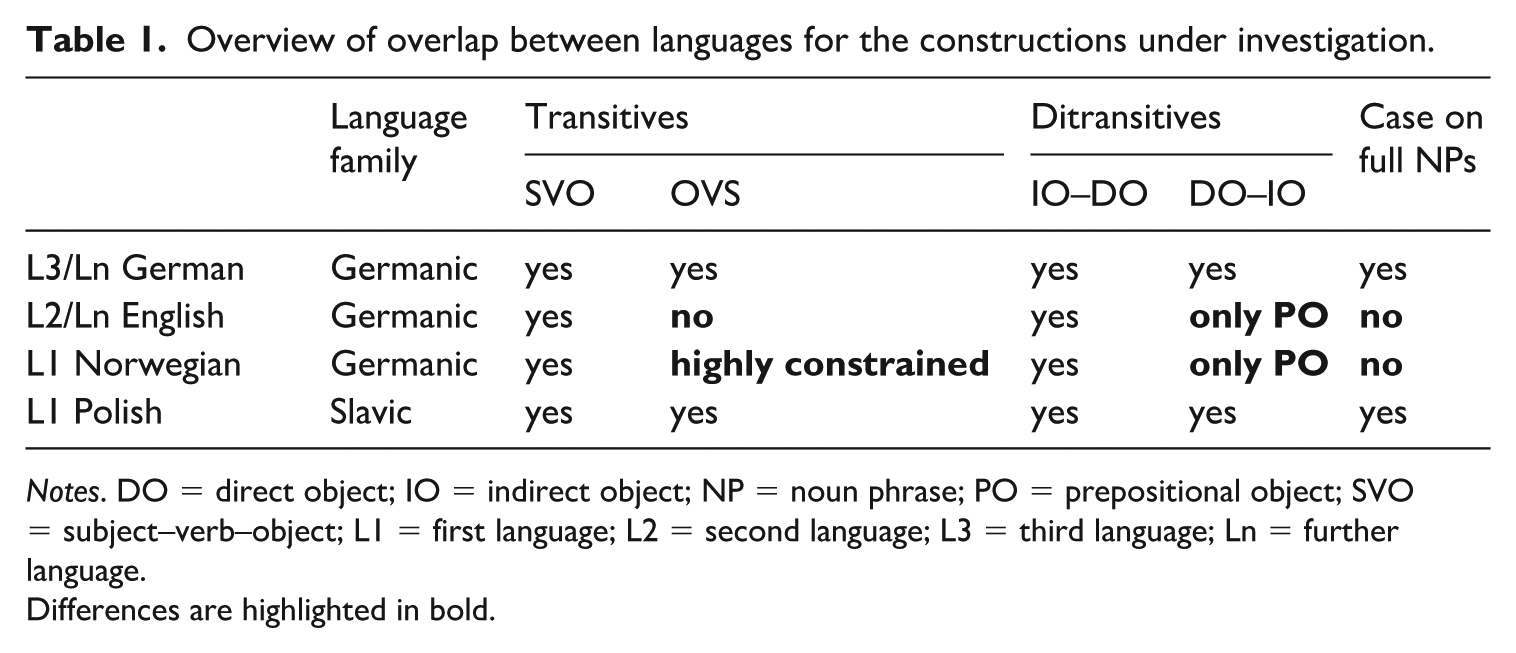
Notes. DO = direct object; IO = indirect object; NP = noun phrase; PO = prepositional object; SVO = subject–verb–object; L1 = first language; L2 = second language; L3 = third language; Ln = further language.
Differences are highlighted in bold.
a German
German discriminates between the three genders feminine, masculine, and neuter, and has four cases: nominative (
(4) Den Prinz-en besiegt schließlich der Drache The- ‘Finally, it is the prince the dragon defeats.’
In sentences with more than one object, such as in examples (5a–b), German allows two orders of DO and IO in a double-object construction. In addition, German speakers can use a prepositional object (PO) construction, see (5c), that follows the order theme > recipient.
(5) Der Krankenpfleger bringt . . . The- a. der Ärztin den Patienten. the- b. den Patienten der Ärztin. the- ‘The nurse brings the doctor the patient.’ c. den Patienten zu der Ärztin. the- ‘The nurse brings the patient to the doctor.’
The double-object construction is more prevalent in German (e.g. Melinger and Dobel, 2005). In this construction, the most frequent and preferred order is the order IO/recipient > DO/theme. For sentences with full NP objects following the finite verb, Häussler and Bader (2012) report an occurrence of 89% IO–DO and 11% DO–IO in the TIGER Treebank, a corpus consisting of sentences from a German newspaper. However, the preference for IO–DO seems to depend on the animacy of the objects.
7
Given their corpus and judgment task findings, the authors concluded that the preference for
b Polish
Polish discriminates between the three genders feminine, masculine, and neuter, and has six cases: nominative (
(6) a. Pielęgniarz przyprowadza lekarc-e pacjent-a Nurse- b. Pielęgniarz przyprowadza pacjent-a lekarc-e Nurse- ‘The nurse brings the doctor the patient.’
c Norwegian
There are two written standards of Norwegian, Bokmål and Nynorsk, that both discriminate between three genders (feminine, masculine, neuter). However, in some dialects, the feminine gender is in the process of disappearing (e.g. Busterud et al., 2019). Unlike German and Polish and like English, Norwegian has no case marking on full NPs, but only marks subject and object forms on pronouns. Unlike in German, English and Polish, there is no subject–verb agreement. Constituents other than the subject can be placed in sentence-initial position preceding the finite verb, including (in certain cases) the object. That is, OVS is a grammatical, although clearly marked, option in Norwegian. Without further cues such as a special context and prosody, the sentences in (7) should be interpreted as SVO. Following a corpus analysis by Øvrelid (2004), object topicalization in transitive sentences is highly constrained by animacy and definiteness. Objects tend to be topicalized more often when the subject is higher in animacy or differs in definiteness from the object. Both factors contribute to the ease of disambiguation, as exemplified in (7a) in comparison to (7b), which has two equally animate arguments that are also both definite. As evident in example (7), [+definite] is realized post-nominally as a suffix. Hence, at least for definite NPs (without an adjective), Norwegian is like Polish in that there is no pre-nominal article.
(7) a. Speil-et spør heks-a. Mirror. ‘The mirror asks the witch’ or ‘The witch asks the mirror’ b. Trollmann-en spør heks-a. Wizard. ‘The wizard asks the witch’ or ‘The witch asks the wizard’
Unlike German and Polish and like English, Norwegian allows only one order in double-object constructions, which is the order recipient > theme, as in (8a), but the theme can precede the recipient in a PO construction, as in (8b). The PO construction has been said to be the default (Anderssen et al., 2014).
(8) a. Sykepleier-en bringer lege-n pasient-en Nurse. b. Sykepleier-en bringer pasient-en til lege-n Nurse. ‘The nurse brings the patient to the doctor.’
d English
Unlike in the other languages described thus far, OVS is no option in English. When the object is fronted, the subject still precedes the finite verb, as shown in (9). Whether English uses a double-object (10a) or a PO construction (10b) is strongly verb-dependent (e.g. Şafak and Hopp, 2023), though not entirely (e.g. Bresnan et al., 2007). Overall, the double-object structure (and thus recipient > theme) has been said to be preferred in American English (e.g. Kaan and Chun, 2018).
(9) [It is] the dragon, the prince defeats. (10) a. The nurse brings the doctor the patient. b. The nurse brings the patient to the doctor.
5 Intermediate summary
Like German, Polish marks case morphologically on NPs (not on articles though) and allows the order OVS (or patient > agent) as an alternative to SVO and both orderings of indirect and direct object in a double-object construction. Norwegian marginally allows the order OVS in a transitive sentence and both orderings of recipient and theme in a ditransitive sentence, but not in a double-object construction. Like in English, the order theme > recipient can only appear in a PO construction, that is, together with the preposition til (‘to’) that functions as a dative marker. Despite its limited word order flexibility in comparison to German and Polish, all semantic role orders under investigation can appear in Norwegian. However, unlike in German and Polish, there is no morphological case in Norwegian.
II Present study
In the present study, we capitalized on sentences with varying word orders in German, for which successful comprehension hinges on the exploitation of morphological case. We employed a picture-selection task similar to the one used by Frenck-Mestre et al. (2019), in order to investigate the nature of CLI in multilinguals’ sentence comprehension. Like Frenck-Mestre and colleagues, we investigated oral speech at a natural speech rate that was presented without written stimuli or an opportunity to listen to it again. This was done since CLI may be more likely detected under time constraints (see Section I.3).
In our materials, we carefully controlled for other factors that could influence the comprehension of transitive and ditransitive sentences, in order to single out the use of case marking as a cue to argument interpretation. For example, all entities in our test sentences were animate, so animacy did not help identify semantic roles. Our materials included fully reversible actions, and participants were presented with two event scenes, as illustrated in Figure 1 for the sentences in (11) and (12). One scene corresponded to the target and the other to the competitor scene.
(11) a. Der Prinz besiegt schließlich den Drache-n The- ‘Finally, the prince defeats the dragon.’ b. Den Prinz-en besiegt schließlich der Drache The- ‘Finally, it is the prince the dragon defeats.’ (12) a. Der Krankenpfleger bringt der Ärztin morgens den Patienten. The- ‘In the morning, the nurse brings the doctor the patient.’ b. Der Krankenpfleger bringt die Ärztin morgens dem Patienten. The ‘In the morning, the nurse brings the patient the doctor.’
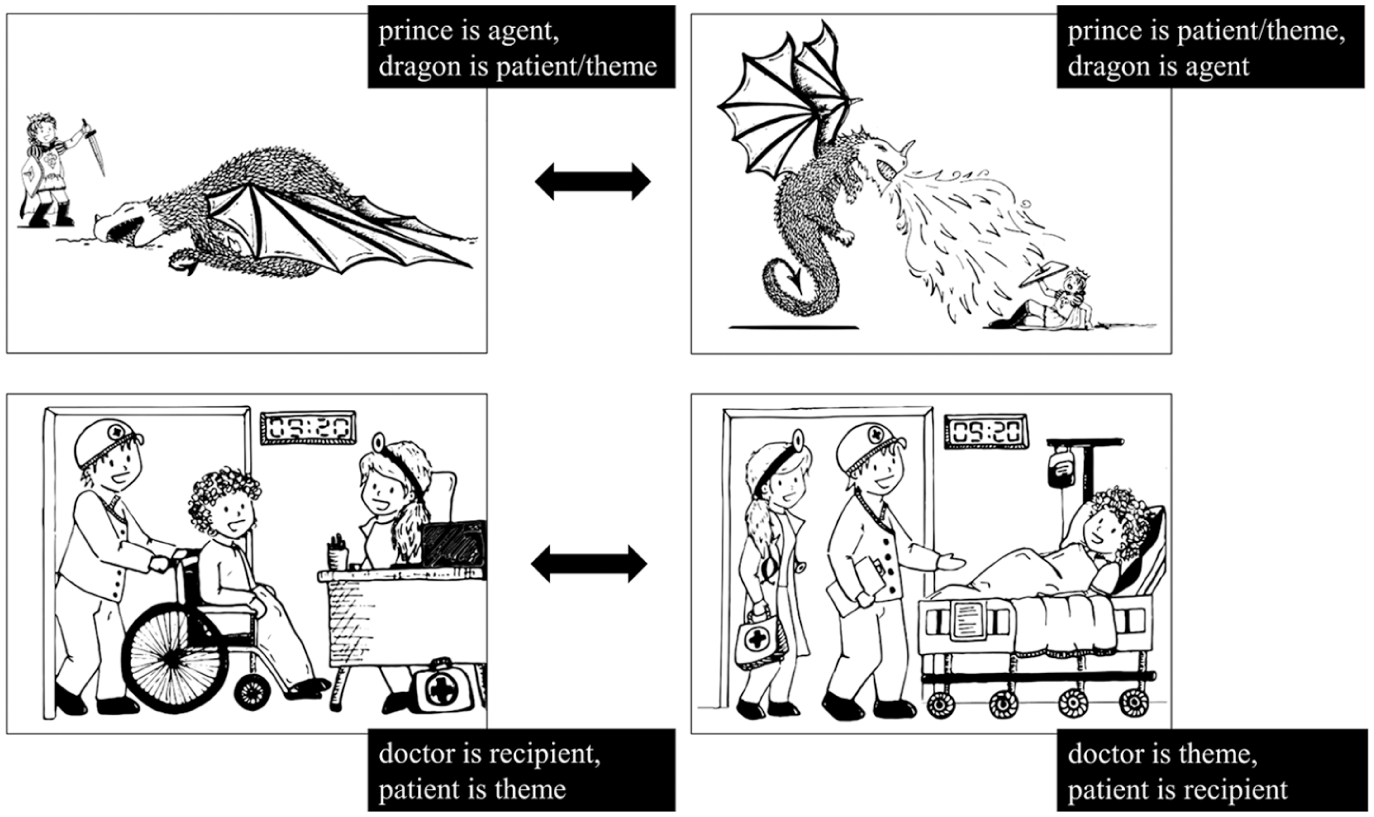
Examples for reversible event scenes in the present study.
1 Inclusion criteria
Our search criteria for multilingual speakers were the following: Participants should have (a) grown up in Norway/Poland and Norwegian/Polish should be the L1, (b) have knowledge of English and German as a foreign language, and (c) be older than 18 years. In a background questionnaire, we asked participants to provide information about all languages they speak, the order of acquisition and current exposure to/usage of these languages. Moreover, participants had to rate their reading and listening proficiency in English and German on a scale from 1 (very bad) to 7 (very good) and additionally complete the LexTALE vocabulary test in these languages (Lemhöfer and Broersma, 2012). The LexTALE has been shown to correlate with measures of general language proficiency and has been widely used in the field. Early and/or regular exposure to/usage of other languages with or without case marking (see Section III.1), diagnosis with a language disorder, as well as LexTALE scores below 60% were exclusion criteria. 8 Prior to data collection, we pre-registered this study on OSF at https://osf.io/fg5e8/. As several Polish L1 speakers but none of the Norwegian L1 speakers reported German as their L2, we later included only those learners for whom German was the L3/Ln. Thus, for none of our speakers German has the status of an L2.
2 Predictions
Based on recent L3/Ln models such as the Scalpel and Linguistic Proximity Models, we expected CLI to be based on structural similarity between grammars and not solely on typological (lexical) similarity. Thus, the presence/absence of morphological case (and corresponding flexibility in word order) in other actively used languages of our multilingual speakers should influence L3/Ln German comprehension, meaning that the performance for the Norwegian L1 and Polish L1 groups should differ. More precisely, we expected the Polish L1 speakers, who are familiar with morphological case, to outperform the Norwegian L1 group, even though Norwegian is lexically more similar to the L3. That is, we expected to obtain more correct responses (i.e. target selections) for the Polish L1 relative to the Norwegian L1 group. Moreover, if Norwegian L1 speakers relied more on word order and less on case marking in L3/Ln German than Polish L1 speakers, then there should be an interaction between order and group. We hypothesized that we would find an interaction between order and group also for the ditransitive sentences, as the Norwegian L1 group might score lower than the Polish L1 group when the order was theme > recipient (i.e. DO–IO), because this order can only appear in a PO construction in Norwegian (and English).
In contrast, if cross-linguistic influence were based on typological similarity, along the lines of the Typological Primacy Model (note though that this model does not make claims beyond the initial stage of L3/Ln acquisition), Polish L1 speakers should rely on their L2/Ln English when comprehending sentences in German, as English and German are typologically closer, and Norwegian L1 speakers should rely on their L1 and/or their L2/Ln English. If true, then there should be no difference between groups, as both groups should prioritize word order over case. However, it is difficult to discriminate between the role of typological similarity and a general learner effect in the present study. More generally, we predicted an effect of order across groups for the transitive sentences with fewer correct responses for OVS relative to SVO order, due to a general subject/agent-first preference (e.g. Bader and Meng, 2023).
III Method
1 Participants
In the study, a total of 29 Norwegian and 40 Polish L1 speakers participated. Three people had to be excluded from the Norwegian L1 group, one because of incomplete data, one because of a score of less than 60% for the German version of the LexTALE, and one who had acquired Finnish (i.e. a case-marking language) from birth. Sixteen people had to be excluded from the Polish L1 group because German was their L2 (9), because of a score of less than 60% for the German LexTALE (6), or because English had been acquired from birth (1). This left us with 26 participants for the Norwegian L1 group and 24 participants for the Polish L1 group. Details for both groups are provided in Table 2. Other currently used languages were Spanish, French, Italian, Dutch, and Danish (maximum 30% exposure) as well as the case-marking languages Russian, Lithuanian, Latvian, Czech, and Japanese (maximum 20% exposure; only Polish L1 speakers).
Participant information.
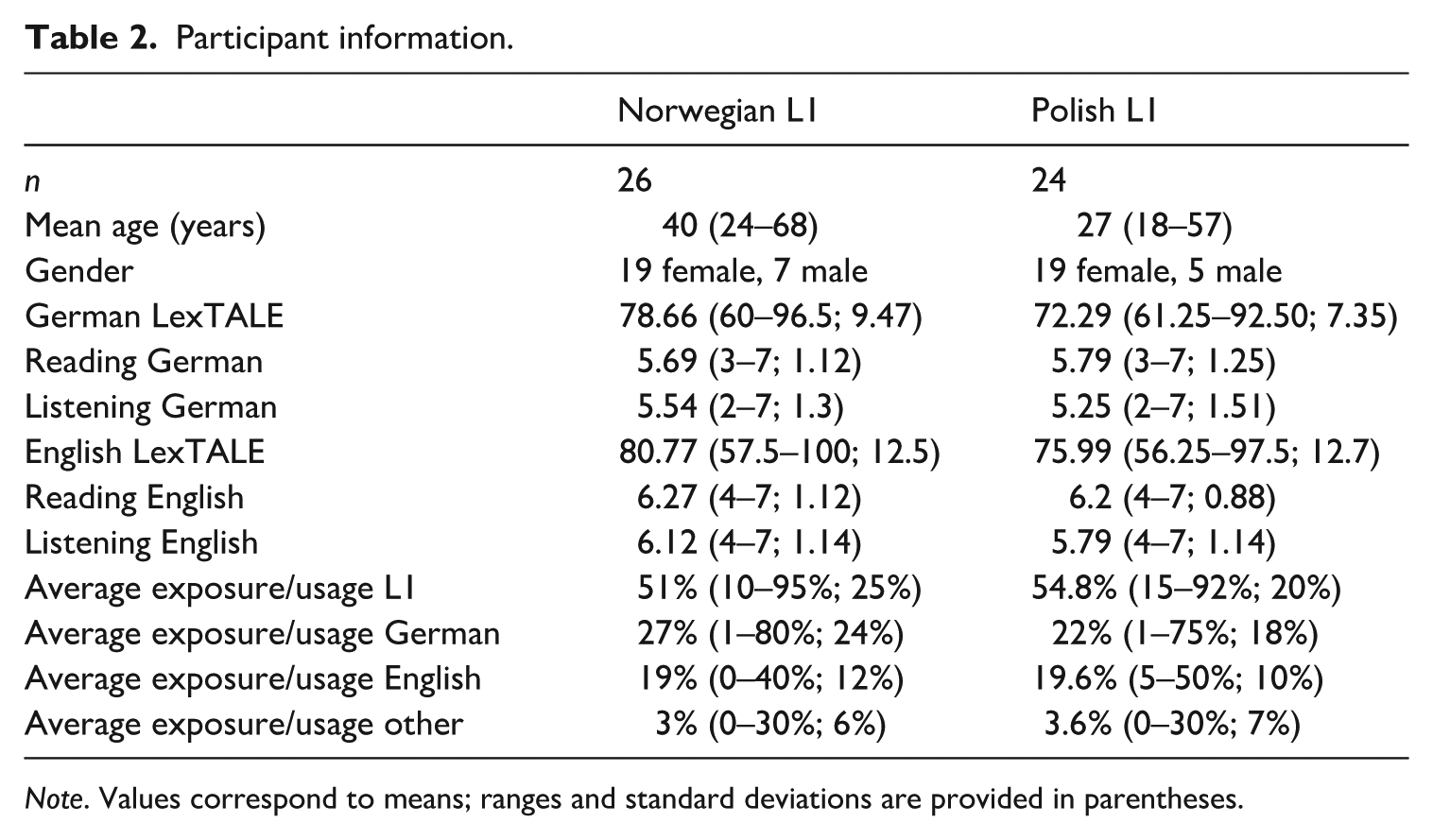
Note. Values correspond to means; ranges and standard deviations are provided in parentheses.
In the Norwegian L1 group, one participant was a Norwegian–Danish simultaneous bilingual. In this group, 24 participants had English as L2 and two participants had Swedish as L2. The mean age of acquisition (AoA) for the L2 was 7.7 years (range: 2–11). All Norwegian L1 speakers had acquired English prior to German. For 20 of them German was the L3 and for six the Ln. Of the latter, two reported that they had learned other case-marking languages (Sami, Russian, Ukrainian) prior to German but reported no active usage/exposure. Except for one participant, all reported at least some exposure to English in daily life. Twenty participants had been at least once in a German-speaking country for more than three months, and eight reported that they were residing in Germany at the time of testing.
For 22 participants in the Polish group, English was the L2 and German the L3 (17) or Ln (5). The remaining two participants had French or Russian as L2, German as L3 and English as Ln. 9 The mean AoA for the L2 was 6.4 years (range: 2.5–11). All participants reported at least some exposure to English in daily life. Eleven participants had been at least once in a German-speaking country for more than three months, and two reported that they were residing in Germany at the time of testing. Overall, the Polish L1 group appeared to have less immersion experience than the Norwegian L1 group.
2 Materials and design
We included two sets with 24 items each: a transitive and a ditransitive set. The sentences appeared in two conditions. That is, each participant listened to 48 sentences in total, 12 per experimental condition.
In the transitive set, sentences followed the order SVO or OVS. Twelve different transitive verbs were used that could be easily depicted and that clearly identified one event character as agent and another as patient/theme, such as besiegen (‘defeat’). Each verb appeared twice, each time with different characters. Event characters were either human beings, fictional characters, or animals and should be easy to identify because of their stereotypical features (e.g. a crown for the prince). Nouns in the transitive set were always masculine, so that there was a clear distinction between
Ditransitive sentences always started with the subject/agent followed by the verb and two animate objects. The order of objects was either IO–DO or DO–IO. Except for two, all ditransitive sentences were double-object constructions.
10
The following ditransitive verbs were used: bringen ‘bring’, holen ‘take/fetch’, überlassen ‘leave (to)’, übergeben ‘give/surrender’, zeigen ‘show’, and empfehlen ‘recommend’. Since there is a limited number of ditransitive verbs that sound natural with two animate objects, each verb was used four times. As in the transitive set, every time a verb was repeated, it appeared together with a new character combination. The first postverbal object was always a feminine NP, so the difference between
The sentences were spoken by a female native speaker of German with a natural speech rate of ~4 syllables per second. As the sentences were previously included in a study analysing the time window between case offset and NP2 (transitive set) or case offset and object2 (ditransitive set), the region that overlaps between conditions was cross-spliced in Praat (Boersma, 2001), in order to be identical in length and prosody. For web-based data collection, it was necessary to convert the original wav files into the container format mp3. 11
The sentences appeared together with two pictures, one showing the target event and another the same event with role reversal. For the transitive set, the roles of agent and patient were reversed. For the ditransitive set, the roles of recipient and theme were reversed, while the agent remained the same. Each scene functioned once as the target and once as the competitor picture. The position of target and competitor picture, left or right, was counterbalanced. The two item sets functioned as fillers for each other. Items were distributed across two lists with a Latin Square design. The order of items was randomized on a by-participant basis by the experimental software.
3 Procedure
Information about the study was sent out to colleagues in Norway and Poland, who shared it with their students, as well as to German teachers and tourist offices in Norway. Information was also posted in Facebook groups. Participation included a background questionnaire and experiment, which were both implemented in the online platform Gorilla (Anwyl-Irvine et al., 2020), as well as the German and English version of the LexTALE test (Lemhöfer and Broersma, 2012). Prior to all tasks, participants gave their informed consent. The processing of personal data in this study was assessed by the Norwegian Agency for Shared Services in Education and Research (reference number 130064). Completion of all tasks took approximately 25 minutes and participants received a 150 NOK or 50 PLN gift card.
In the experiment, participants were instructed to select the picture that matches the sentence as fast as possible. The experiment started with four practice trials, in which participants were given feedback as to whether their response was correct or not. Practice and experimental trials were preceded by an audio check. Figure 2 shows an example trial. Participants were presented with both pictures and could decide for themselves when to listen to the audio by clicking/pressing the start button. The pictures turned into response areas when the participant hovered over them. Participants could respond before the audio ended. In that case, they would still hear the rest of the sentence before they proceeded to the next trial.
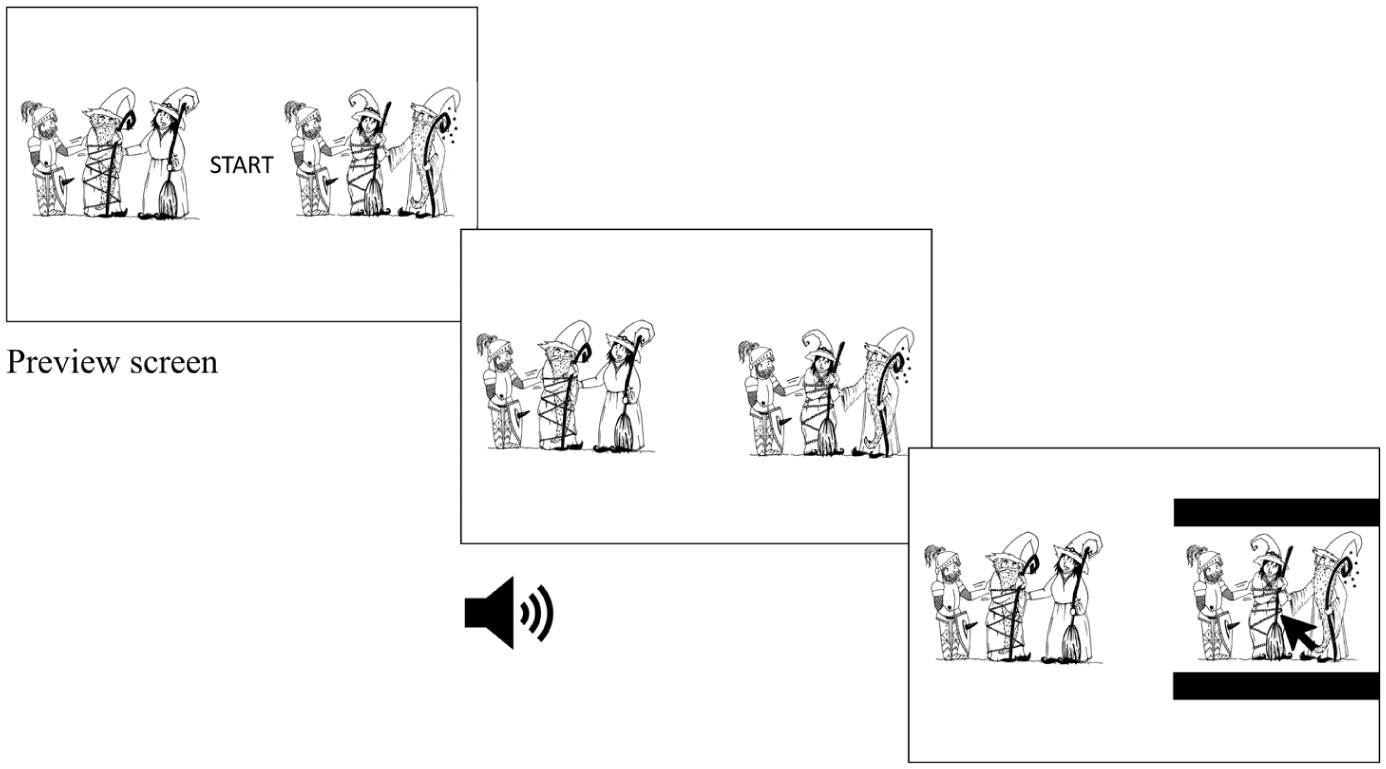
Procedure in the picture selection task.
In the LexTALE tests, participants had to decide whether a word exists in the respective language by clicking/pressing ‘yes’ or ‘no’. Both the German and English versions consisted of 60 items.
IV Results
1 LexTALE tests
A two-sample t-test showed a difference in the average German LexTALE score between the Norwegian L1 and Polish L1 group, with the Norwegian L1 speakers scoring higher than the Polish L1 group, t(48) = 2.64, p = .006. A two-sample t-test for the English LexTALE scores showed no significant difference between groups, t(48) = 1.34, p = .19.
2 Picture selection task
Two trials were excluded from the analyses of the ditransitive set: one due to technical issues with the audio, as was visible in the output file, and one trial where a participant responded before the first critical case cue could be heard. In Table 3, we show the accuracy per argument order and group for each set. For comparison, we added the results from a German L1 group from another study of the authors (Schlenter and Westergaard, 2025).
Number and percentages of correct responses.
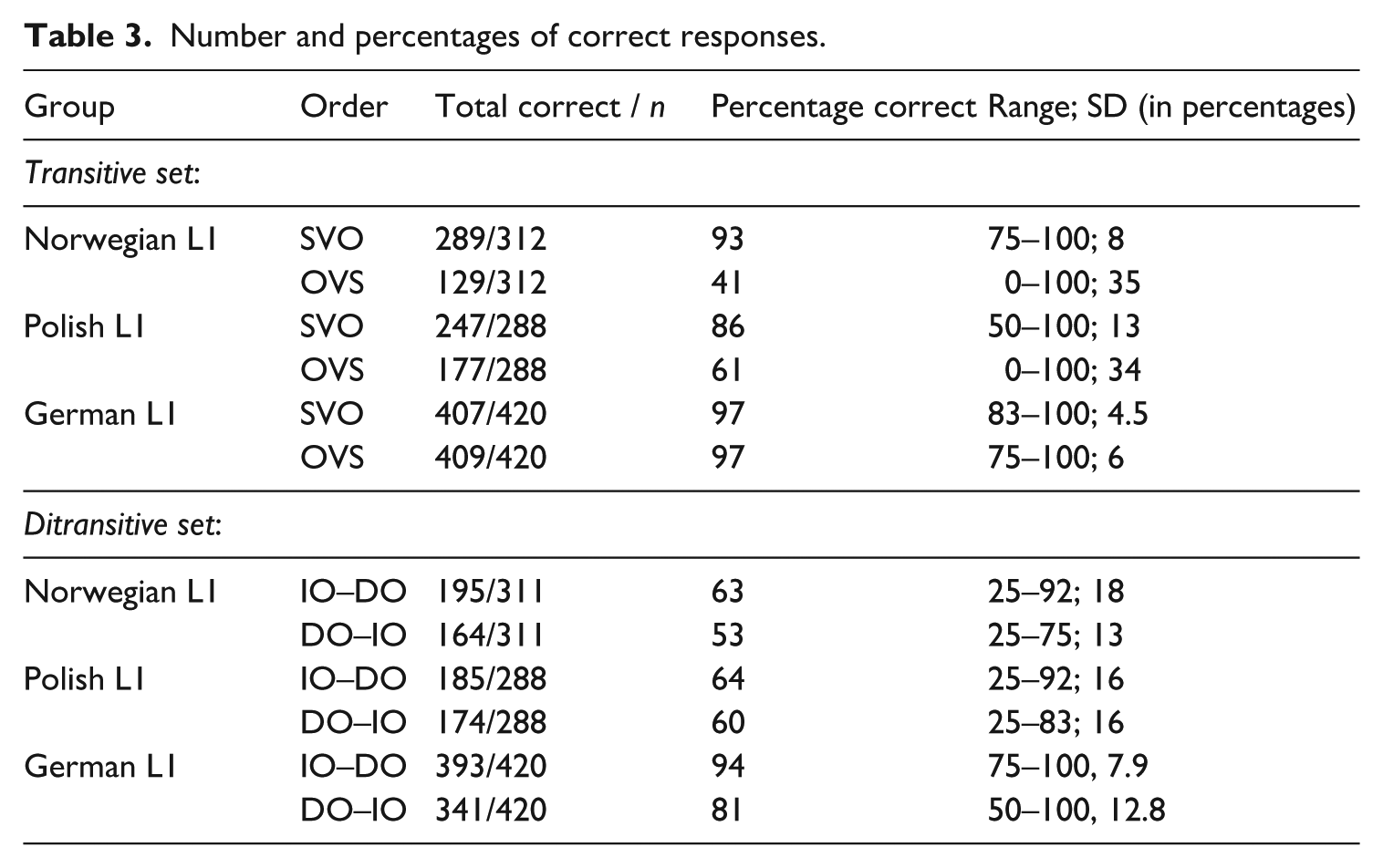
There were seven participants who did not have a single correct response for OVS, five from the Norwegian L1 and two from the Polish L1 group. Conversely, three participants from the Polish L1 and two from the Norwegian L1 group had an accuracy of 100% for OVS. One participant in the Polish L1 group had an accuracy of 50% for SVO and 17% for OVS, another an accuracy of 67% for SVO and 75% for OVS. 12 All other participants scored 75% (i.e. 9/12) or higher for SVO. In the two examples of PO constructions in the ditransitive set, the Norwegian L1 group scored 100% for both, while the Polish L1 group scored 50% and 79% respectively. We return to this finding in the discussion.
For statistical analyses, we fitted generalized linear mixed-effects regression models to predict accuracy with order and group for each set. This was done in R (R Core Team, 2024, version 4.4.2), with the packages lme4 (Bates et al., 2015), lmerTest (Kuznetsova et al., 2017) and report (Makowski et al., 2023). Order and group were categorical variables with two levels each, which were coded as 0.5 and −0.5. Follow-up comparisons were conducted with the help of the package emmeans (Lenth, 2024). We started with the maximal random-effects structure (Barr et al., 2013) and simplified the model in case of convergence issues. In these cases, we report the output of the model with the lowest AIC value (Matuschek et al., 2017). In addition to the pre-registered omnibus analyses, we report the results from separate models per group that were additionally computed to assess whether performance for the different orders was above chance.
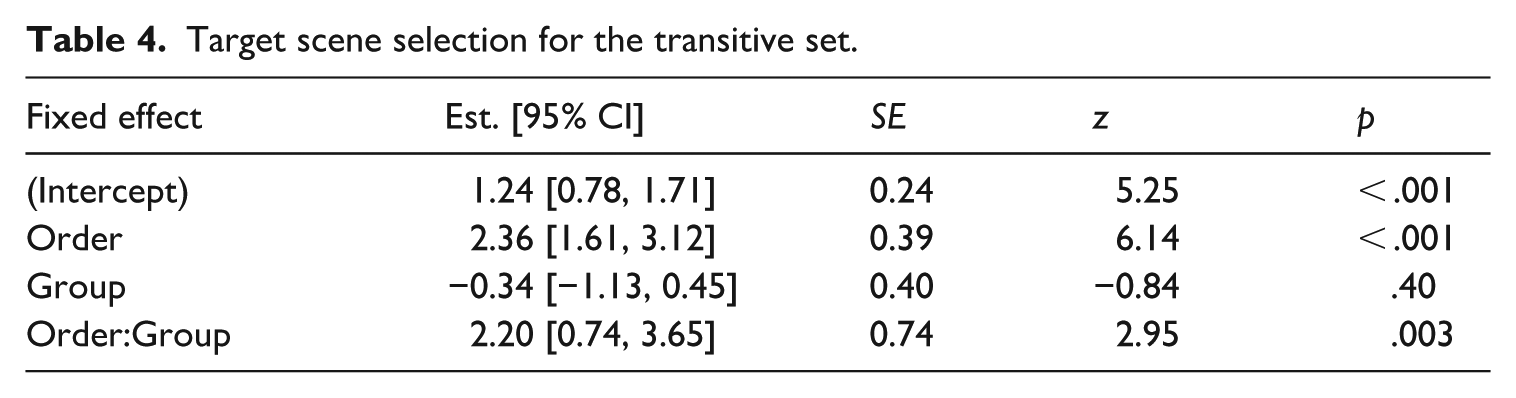
In Table 4, we show the output of the best-fitting model for the transitive set and in Figure 3, the predicted probabilities of this model. The model included subject and item as random intercepts and order as by-subject slope. Across groups, participants were less likely to select the target scene for the order OVS relative to SVO. As indicated by the significant interaction between order and group, the effect of order depended on the level of group. Even though the performance for SVO and OVS did not differ significantly between groups, as shown by pairwise comparisons (Table 5), Norwegian L1 speakers showed a greater difference between SVO and OVS than Polish L1 speakers. Separate models per group (see Tables S1 and S2 in supplemental material) showed that neither group scored above chance for OVS.
Target scene selection for the transitive set.
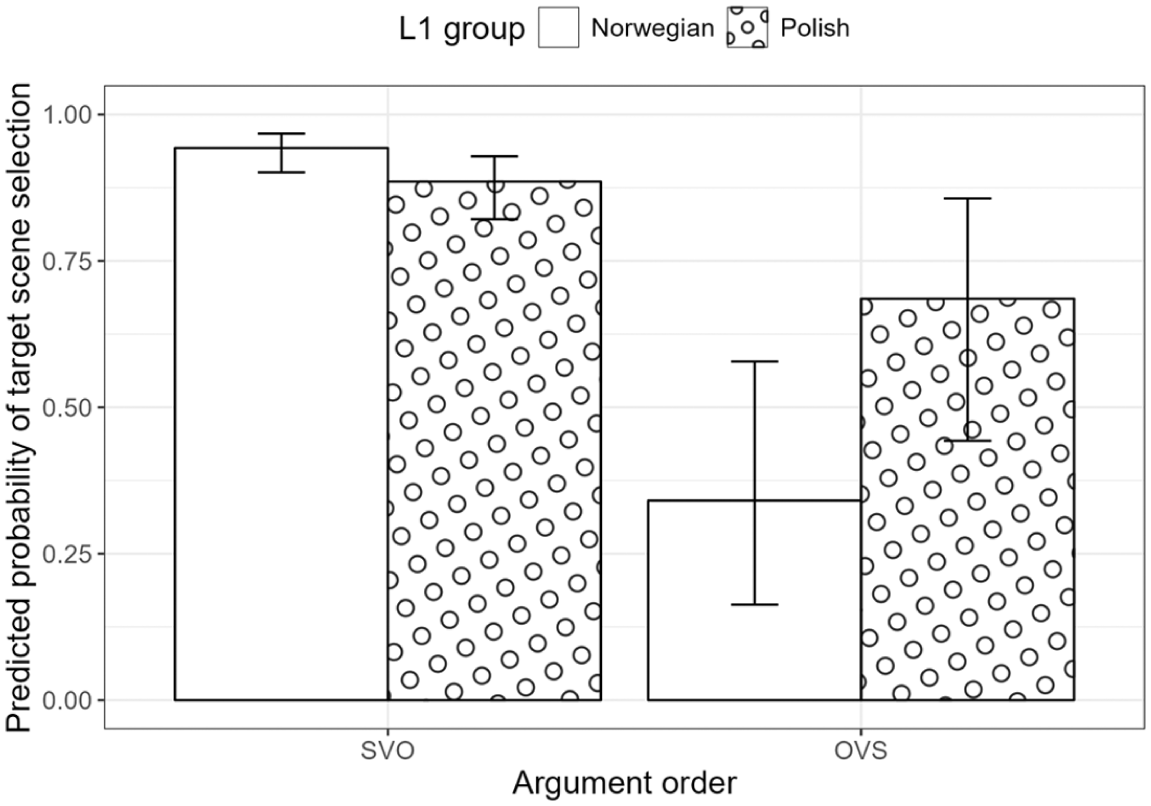
Predicted probabilities of target scene selection and 95% confidence intervals for the orders SVO and OVS per L1 group.
Results of pairwise comparisons for the transitive set.
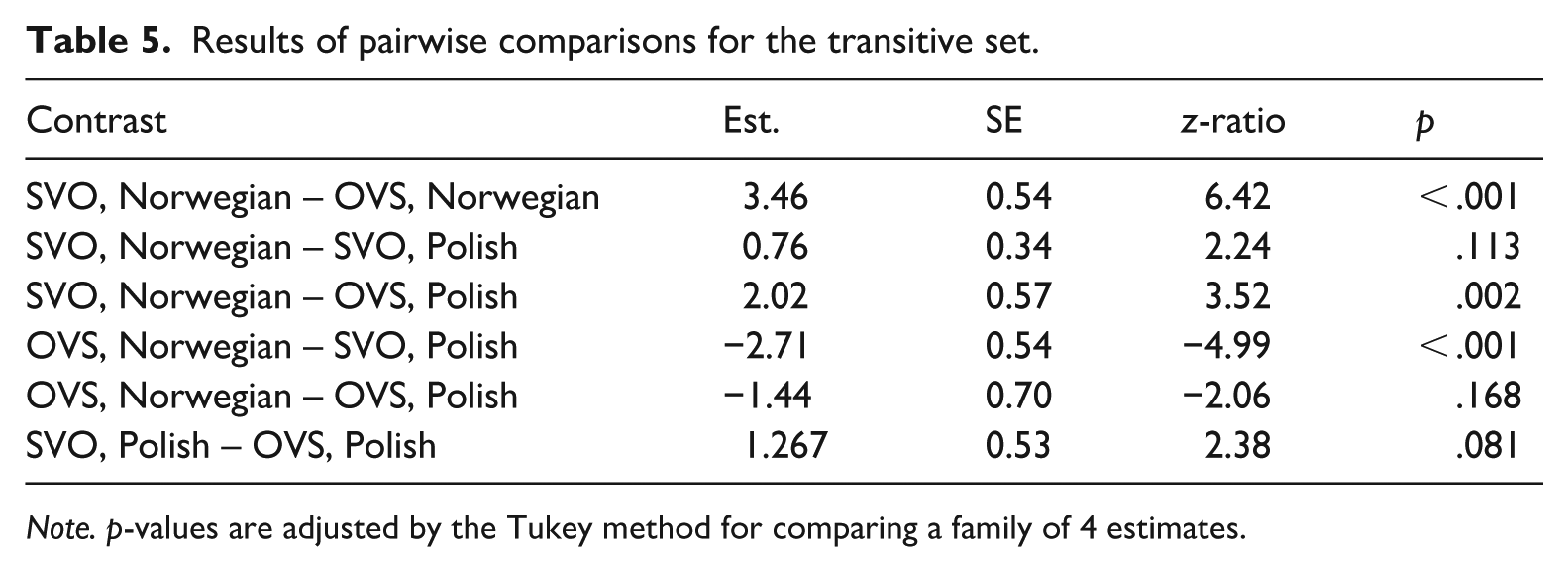
Note. p-values are adjusted by the Tukey method for comparing a family of 4 estimates.
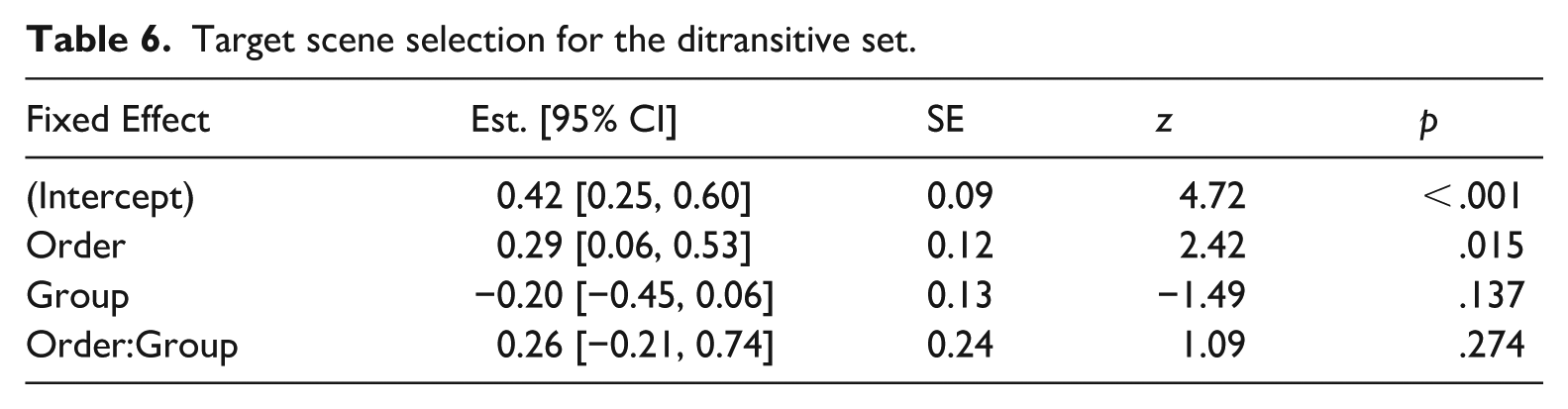
In Table 6, we show the output of the omnibus model for the ditransitive set and in Figure 4, the predicted probabilities of this model. Due to convergence issues, the model only included subject and item random intercepts. Across groups, participants were less likely to select the target scene when the order of objects was DO–IO compared to IO–DO, resulting in a (very small) effect of order. Within groups, the difference between orders did not become significant. Moreover, the separate models revealed that the Polish L1 group scored above chance for both object orders, while the Norwegian L1 group only did so for IO–DO; see Tables S3 and S4 in supplemental material.
Target scene selection for the ditransitive set.
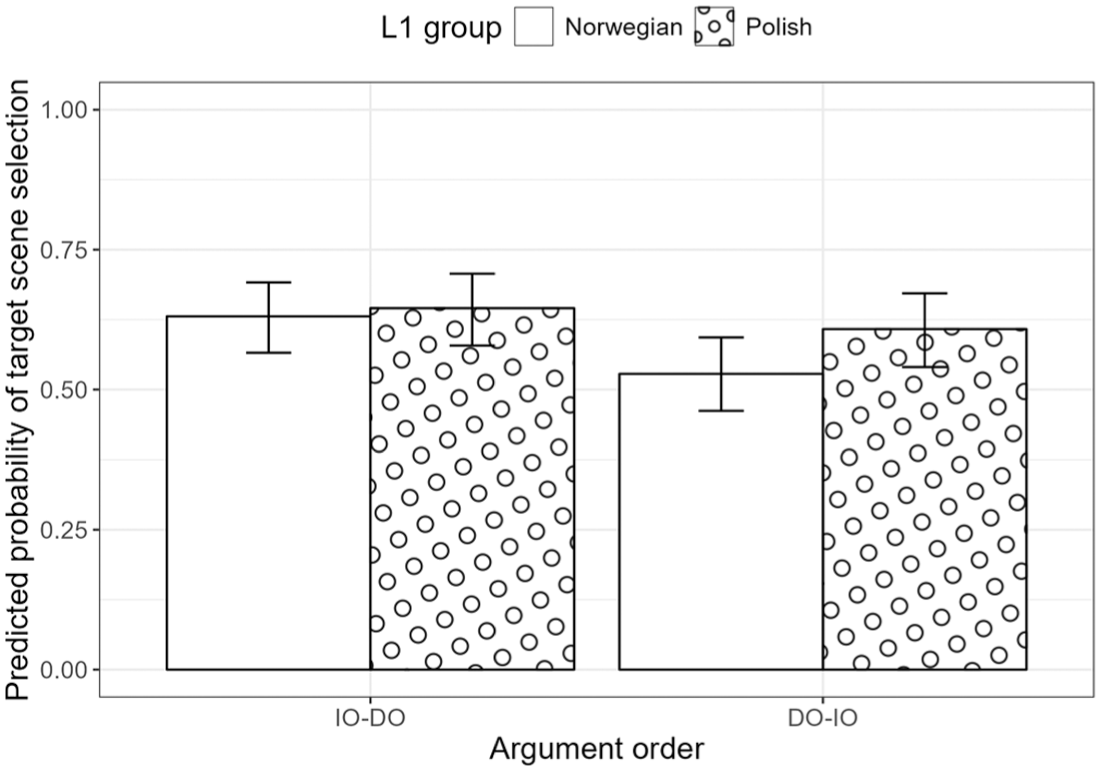
Predicted probabilities of target scene selection and 95% confidence intervals for the orders IO–DO and DO–IO per L1 group.
V Discussion
We employed a picture selection task to assess multilingual speakers’ comprehension of German sentences. Unless the sentences included a transitive verb and followed the prototypical SVO order, successful comprehension hinged on the exploitation of case marking to enable the mapping to semantic roles, e.g.
We found that, for the transitive sentences, comprehension of OVS was difficult across groups, which is in line with previous studies testing object-initial structures in non-native processing (e.g. Gerth et al., 2017). In both groups, listeners were more likely to select the target scene for the prototypical order SVO, and performance for OVS was only at chance. We did not find an effect of group. Nevertheless, we found an interaction between order and group as predicted by CLI based on structural similarity: The difference in performance between SVO and OVS was larger for the Norwegian than for the Polish L1 speakers. This was the case despite the Norwegian L1 speakers having had more immersion experience than the Polish L1 speakers. Against this background, it is all the more remarkable that the Polish L1 speakers as a group still differed from the Norwegian L1 speakers in their performance for object-initial vs. subject-initial transitive sentences. We thus attribute this finding to CLI, more precisely, facilitative CLI from Polish in the Polish L1 group and non-facilitative CLI in the Norwegian L1 group.
For the ditransitive sentences, we only found a very small effect of order across groups, indicating slightly better performance for IO–DO than DO–IO in German, but no effect of or interaction with group. Recall that Polish is like German in that it allows both orders in a double-object construction. In Norwegian (and English), in contrast, only the order recipient > theme is allowed in a double-object construction, while the theme can precede the recipient in a PO construction. In principle, speakers could rely on the most frequent and prototypical order in German ditransitive sentences (i.e. IO–DO), which corresponds to the preferred order in double-object constructions in Polish and the only possible option in Norwegian (see Section I.3). Based on the prediction that the Norwegian L1 group would rely more on word order and less on morphological case than the Polish L1 group, we thus suspected that the Norwegian L1 group would score lower for the DO–IO order than the Polish L1 group. If so, we should have found an interaction between order and group, which we did not. Instead, only separate models per group indicated that the performance for IO–DO was above and for DO–IO at chance in the Norwegian L1 group, but above chance for both orders in the Polish L1 group. For the two uses of PO in our materials (which were included as the order theme > recipient would have sounded strange in a double-object construction), Norwegian L1 speakers (but not Polish L1 speakers) scored 100%, which speaks to the reliance on a preposition as a dative/indirect object marker. Altogether, our evidence for CLI based on structural similarity for this set of sentences is thus limited.
Given the ceiling performance for the two occurrences of PO in the Norwegian L1 group, a follow-up study that includes a condition with a preposition as a case cue seems a promising avenue for future research. This way, one can investigate even more systematically whether comprehension of the order theme > recipient in German is influenced by the L1. Norwegian L1 speakers’ performance may be better for familiar means of indirect object marking (preposition) than for unfamiliar means (morphological case).
Finally, we should point out the following limitations: Despite our selection criteria, our participant groups were still heterogeneous. While some multilinguals reported exposure to Polish/Norwegian, English and German, others were exposed to other languages as well, including Romance languages. Given the small sample size, we refrained from further analyses that would take into account (often interrelated) variables such as the country of residence, length of immersion, age of acquisition, number of additional languages and frequency of exposure to the individual languages. However, we acknowledge that these are variables that may play a role in multilingual comprehension and potentially did so in our study.
VI Conclusions
The present study shows that multilingual speakers with Polish as L1 differed in their comprehension of object-initial vs. subject-initial transitive sentences in German from speakers with Norwegian as L1. We argue that this provides evidence for CLI based on structural similarity to German, in that Polish shares the property of morphological case marking with the target language, while Norwegian does not. The evidence was less clear for the comprehension of ditransitive sentences with an alternating order of theme and recipient. As regards the circumstances under which L1 influence is observed throughout L3/Ln development, the results of the present study point to a more important role of structural than typological (lexical) similarity between grammars, in line with the Scalpel and Linguistic Proximity Models.
Supplemental Material
sj-docx-1-slr-10.1177_02676583251408780 – Supplemental material for Sentence comprehension in German by multilinguals with Norwegian or Polish as L1: Is there cross-linguistic influence from the L1?
Supplemental material, sj-docx-1-slr-10.1177_02676583251408780 for Sentence comprehension in German by multilinguals with Norwegian or Polish as L1: Is there cross-linguistic influence from the L1? by Judith Schlenter and Marit Westergaard in Second Language Research
Footnotes
Acknowledgements
We thank Helene Jensberg and Jagoda Dyga for their help with the translations into Norwegian and Polish. We thank all people who helped us with participant recruitment, especially Anna Skałba. Moreover, we thank Nadine Kolb for lending us her voice for the study and Cecilia Puebla Antunes for drawing the event scenes.
Author Note
JS moved to the University of Cologne after the research had been completed.
Consent to participate
All participants provided written informed consent prior to participating.

Ethical considerations
The processing of personal data in this study was approved by the Norwegian Agency for Shared Services in Education and Research (reference number 130064). For research in the humanities and social sciences in Norway there is no requirement for an additional ethics approval.
Declaration of conflicting interests
The authors declared no potential conflicts of interest with respect to the research, authorship, and/or publication of this article.
Funding
The authors disclosed receipt of the following financial support for the research, authorship, and/or publication of this article: This project has received funding from the European Union’s Horizon 2020 research and innovation program under the Marie Skłodowska-Curie grant agreement number 101024414.
Supplemental material
Supplemental material for this article is available online.