




Abstract
Aims and Objectives:
The study investigates the extent to which offline and online comprehension of reflexive possessive pronouns in L3 and L4 is modulated by previously acquired native and non-native grammars.
Design/Methodology/Approach:
Thirty-one intermediate to advanced L1 Polish learners of Swedish, who have also acquired German and English (L4 Swedish learners) or only English (L3 Swedish learners), completed a self-paced reading task and a grammaticality judgement task. The tasks targeted learners’ sensitivity to possessor and possessee agreement violations.
Data and Analysis:
Reading times and judgement accuracy were collected and analysed using generalised linear models.
Findings/Conclusions:
In online comprehension, L3/L4 Swedish learners showed sensitivity to possessor and possessee agreement, which was affected neither by their proficiency, nor by their prior native and non-native grammars. In offline comprehension, however, they had difficulty deploying possessor and possessee agreement. Performance on possessee but not possessor agreement increased with advancing proficiency, indicating the persistent influence of L1 Polish grammar. Furthermore, L4 Swedish learners achieved an overall higher judgement accuracy than L3 Swedish learners. At the same time, L4 Swedish learners read the relevant regions longer than L3 Swedish learners, suggesting a speed–accuracy trade-off for L4 Swedish learners.
Originality:
The study investigates cross-linguistic influence in the comprehension of reflexive possessive pronouns in multilingual learners, which has not been explored before. It is also the first to provide evidence for a multilingual advantage in the accuracy of reflexive possessive agreement, albeit at the cost of reading speed.
Significance/Implications:
The study demonstrates that native and non-native grammars differently affect the offline comprehension of reflexive possessive pronouns in L3 and L4. The native language seems to have a more direct effect that consists in the employment of agreement mechanisms, while the non-native language has a more indirect effect, as it can increase learners’ sensitivity to morphosyntactic violations.
Introduction
The recent remarkable growth of research on third language acquisition has provided many valuable insights into the interplay between languages in the multilingual mind. The topic of cross-linguistic influence at the initial state and further development of L3/Ln grammar has been crucial in the L3 field (see Rothman et al., 2019, for an extensive overview of the relevant literature). It has been shown that both L1 and L2 exert an influence on L3/Ln grammar beyond the initial state of acquisition, which is due to the constant interaction between languages in the mind of multilinguals (Westergaard, 2021). By contrast, cross-language interactions with respect to L3/Ln processing in the grammatical domain have not been studied so extensively, thus leaving many questions open. How does previous language experience shape L3/Ln processing? What factors affect L3/Ln processing? Is L3/Ln processing fundamentally different from L2 processing?
The present study intends to bridge this research gap by investigating both offline and online comprehension of reflexive possessive pronouns in Swedish among native speakers of Polish who have also acquired English and German or only English before Swedish. Morphosyntactic constraints on reflexive possessive pronouns vary across these languages, thereby providing fertile ground to study cross-linguistic influence in L3/Ln comprehension. In addition, comparing learners with knowledge of German, a language that encodes reflexive possessive agreement similarly to Swedish, to learners with no knowledge of German, may provide insights into the direct effects of multilingualism on L3/Ln comprehension. The specific aim of this study is thus to examine how the native and non-native grammars modulate the ability to establish reflexive possessive agreement in sentence comprehension in L3/Ln.
Current accounts of multilingual acquisition and processing
Although the field of L3/Ln processing is only in its infancy, some attempts to gain insight into the processes of real-time comprehension in L3/Ln have been made, particularly with respect to word recognition (e.g., Lago et al., 2021, for a discussion). Here, research has demonstrated that multiple languages are always active to varying degrees and interfere with one another during L3/Ln lexical processing (e.g., Szubko-Sitarek, 2011). Morphosyntactic processing in L3/Ln has also been addressed although to a much lesser degree. Rah (2010), for example, observed that L1 German learners of French and English transferred the relative clause attachment preference from English to French, but only if they were English-dominant. More recently, Abbas et al. (2021) provided proof of activation of the entire language repertoire during processing of several morphosyntactic properties in L3 English among learners with L1 Arabic and L2 Hebrew. Eye movements during reading revealed L1 interference earlier than L2 interference, but both were found in offline judgements.
Evidence of possible cross-linguistic influence in sentence processing primarily comes from L2 studies. When processing language, L2 learners can in principle use the fully developed grammar and processing strategies of their L1. However, while some studies have indeed provided proof of transfer of L1 processing routines (e.g., Kilborn, 1989; Uludağ, 2020), others have found evidence against it (e.g., Jackson & Dussias, 2009; Papadopoulou & Clahsen, 2003). The present study focuses on reflexive possessive agreement in local agreement contexts. In contrast to long-distance dependencies that span clauses, local agreement dependencies relate to ‘morphosyntactic feature matching between adjacent or locally related words’ (Clahsen & Felser, 2006, p. 565). Previous research has revealed cross-linguistic influence during processing in non-local grammatical domains. For example, Sabourin and Haverkort (2003) examined how L2 speakers deal with local grammatical gender agreement within the noun phrase. Their online event-related potential (ERP) data indicated that L2 learners can use their L1 processing strategies to process their L2 if the grammars are very similar.
Morphosyntax has much more extensively been examined in untimed experiments to inform L3 acquisition research (see Rothman et al., 2019). One logical scenario is that cross-linguistic influence comes predominantly from the native language, which has been acquired early in life and is thus more internalised compared to L2 (e.g., Hermas, 2010; Na Ranong & Leung, 2009). It has also been proposed that non-nativeness can be a driving force of influence (e.g., Bardel & Falk, 2007; Falk & Bardel, 2011). According to this line of research, L2 grammars are acquired in instructed settings, whereby they rely more heavily on metalinguistic knowledge and are stored differently than the native language grammar. Since acquiring an L3/Ln grammar shares more characteristics with L2 than with L1, learners should be more likely to be affected by the L2 grammar.
Other accounts of L3/Ln acquisition have been concerned with the typological similarity between L3/Ln and previous languages. For example, it has been argued that the whole grammar of either L1 or L2 will be transferred at the initial state of L3/Ln acquisition, depending on the global similarity between languages (Rothman, 2010). Other researchers have highlighted the role of structural proximity rather than global similarity. Such proposals posit that both L1 and L2 are always active and can thus affect an L3/Ln grammar in a property-by-property manner (Slabakova, 2017; Westergaard et al., 2017). Although the current accounts of L3/Ln acquisition are mainly concerned with the initial L3/Ln grammars and do not make predictions about processing, the role of the factors that are at the heart of these accounts can potentially be probed in L3/Ln comprehension. For example, one can ask whether the typological similarity between languages, which has recently been shown to play a decisive role in the initial state (see the meta-analysis by Rothman et al., 2019), can also constrain cross-linguistic influence during processing. A similar question can be asked with respect to the (non-)nativeness of grammars, which has also been proved to play an important role in transfer selection (e.g., Bardel & Falk, 2007; Falk & Bardel, 2011). However, the scarce evidence so far shows that both native and non-native languages shape L3/Ln processing, regardless of typological similarity (Abbas et al., 2021; Lago et al., 2019).
Processing possessive pronouns in language learners
Differences between languages with respect to agreement constraints have been found to be challenging for L2 learners. For example, the correct use of the English possessive pronouns ‘his’ and ‘her’ has been shown to be a difficult acquisition task for French and Spanish learners, even after prolonged language exposure (e.g., Antón-Méndez, 2011; White et al., 2007).
Antón-Méndez (2011) studied the production of his or her pronouns in English as L2 among speakers of different L1s: Italian, Spanish, and Dutch. While English and Dutch require possessor agreement, Spanish and Italian require possessee agreement. Interestingly, differences in agreement constraints between these languages were found to influence the learners’ production of possessive pronouns in English. Italian and Spanish learners made more errors for animate possessee nouns than Dutch learners, in that they produced possessive pronouns that agreed in gender with the possessee. Antón-Méndez (2011) therefore concluded that L2 learners are subject to the influence of automatic processing mechanisms present in their L1.
Evidence for the automatic recruitment of L1 processing mechanisms has also been provided by Lago et al. (2019), who studied the processing of German possessive pronouns during comprehension. They tested two groups of German L3 learners: L1 English–L2 Spanish and L1 Spanish–L2 English bilinguals. While German and English encode possessor agreement, Spanish only encodes possessee agreement. Lago et al. (2019) have demonstrated that comprehension of possessive pronouns was affected by both the L1 and L2 grammars. Importantly, cross-linguistic influence manifested itself differently depending on the task. The influence of L1 was more pronounced in online measures, such as reading times in a self-paced reading task and judgement latencies in a grammaticality judgement task. In contrast, L2 only affected the participant’s judgement accuracy. This study thus shows that the L1 processing routines are, by default, more accessible in real-time comprehension in L3 because they are acquired early in life and are consequently more internalised than L2 processing routines. The influence of L2, in turn, is limited to the explicit use of metalinguistic knowledge.
Stachowiak-Szymczak and Behrens (2021) report on an experiment in which the use of possessive pronouns was studied in simultaneous interpreting from English to Polish. The authors found incorrect renditions of non-reflexive possessive pronouns in the contexts in which they should be rendered as reflexive possessive pronouns. This can be due to transfer because English does not distinguish morphologically between reflexive and non-reflexive possessive pronouns.
So far, only one study has focused on processing possessive pronouns in multilingual speakers (i.e., Lago et al., 2019). Therefore, it remains to be clarified to what extent previously acquired languages affect the processing of possessive gender agreement in L3/Ln.
Reflexive possessive agreement in Polish, English, German, and Swedish
The focus of this study is on reflexive possessive pronouns in singular in local agreement contexts, which in many languages need to agree in gender with the possessor antecedent and the possession noun (henceforth, possessee).
Whereas the grammatical gender systems of Polish and German classify nouns into three categories, that is, masculine, feminine, and neuter, the grammatical gender system of Swedish only includes two categories, that is, neuter and uter. In turn, modern English does not have grammatical gender at all, whereby gender agreement can only refer to natural gender.
Reflexive possessive pronouns in Swedish concurrently agree in gender both with an antecedent possessor (backward agreement) and a following possessee (forward agreement). Possessor agreement is expressed by the stem of the pronoun, whereas possessee agreement is expressed by the suffix (see Example 1).
1. Jag tvättar mi-n bil. ‘I wash my car’.
The form of reflexive and non-reflexive possessive pronouns is the same for the first and second person. The difference arises in the third person, where the possessive pronouns ‘hans’ and ‘hennes’ cannot be used reflexively. Here, the reflexive possessive pronoun ‘sin/sitt’ is the only licenced option (e.g., Teleman et al., 1999, p. 333ff). The pronouns ‘sin/sitt’ cannot point to a possessor different from the subject (see Example 2).
2. Hon borstar sin hår. She brushes ‘She brushes her hair’.
In Polish, the reflexive possessive pronoun ‘swój’ is used in all persons. It takes endings according to the gender of the possessee but is neutral when it comes to the gender and person of the possessor. However, there is a strong tendency to use non-reflexive possessive pronouns in the first- and second-person singular in lieu of the reflexive possessive pronouns (‘mój’, ‘twój’, respectively), which is considered to be prescriptively inappropriate (Bańko, 2009). Like in Swedish, the non-reflexive possessive pronouns ‘jego’ and ‘jej’ in the third-person singular cannot be interpreted as being coreferential with the subject. Since Polish allows for referential null subjects, which are conditioned by subject–verb agreement, the pronominal possessor can be null, depending on discourse (see Example 3).
3a. Zgubiłem swój klucz. lost. lost. ‘I have lost my key’.
In German, all non-reflexive possessive pronouns can be used reflexively. Similar to Swedish, they overtly agree in gender with both an antecedent possessor and a following possessee. Whereas the first- and second-person pronouns (‘mein’, ‘dein’, respectively) unambiguously point to the subject, the third-person pronouns ‘sein’ and ‘ihr’ can also point to a possessor different from the subject (e.g., Zifonun, 2005, p. 102) (see Example 4).
4. Ich sehe mein-en Freund. ‘I can see my friend’.
This ambiguity in the third-person singular also applies to the English pronouns ‘his’ and ‘her’. In contrast to Swedish, Polish, and German, there is no possessee agreement in English. All possessive pronouns can be used reflexively. The gender of the third-person possessive pronoun agrees with the natural gender of the possessor. In turn, the first- and second-person possessive pronouns show person agreement, rather than gender agreement (see Example 5).
5. I have watered my plant.
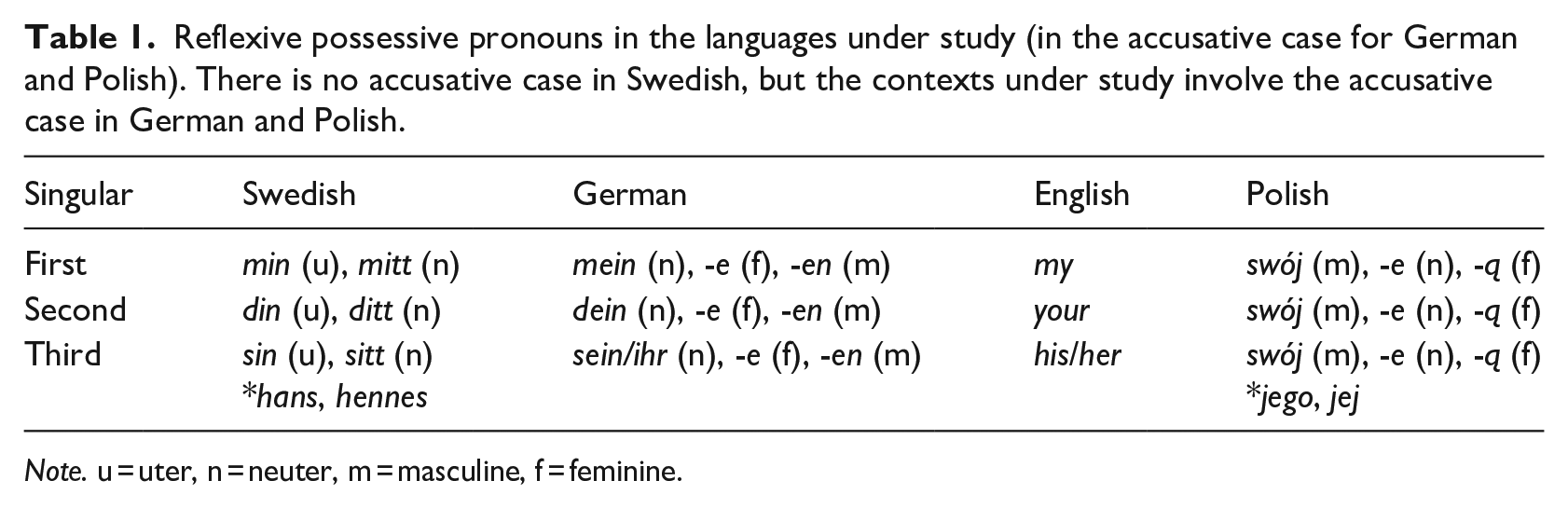
The reflexive possessive pronouns in all the languages are presented in Table 1.
Reflexive possessive pronouns in the languages under study (in the accusative case for German and Polish). There is no accusative case in Swedish, but the contexts under study involve the accusative case in German and Polish.
Note. u = uter, n = neuter, m = masculine, f = feminine.
Because of the differences between the languages in this study, L1 Polish learners who have acquired English and/or German can potentially be confronted with a conflict when processing reflexive possessive agreement dependencies in Swedish. Whereas in Swedish and German, the reflexive possessive pronoun should agree with both possessor and possessee, in English, it should only agree with the possessor. In addition, reflexive possessive pronouns in Polish should always agree with the possessee but are neutral with regard to the possessor. If learners were influenced by the English grammar, they could fail to establish agreement between a pronoun and a possessee. In the same vein, if they were influenced by the Polish grammar, they could have difficulty with establishing agreement with a possessor. Finally, learners who have knowledge of German may be advantaged in establishing both possessor and possessee agreement over those who do not, due to the similarities in reflexive possessive agreement between German and Swedish.
The study
Research questions
Bearing in mind the previous discussion and the aim of the study, the main research questions are as follows:
RQ1. Are L3/L4 learners sensitive to reflexive possessive agreement violations in offline and online sentence comprehension? Is their sensitivity modulated by proficiency in L3/L4?
RQ2. Is the ability of L3/L4 learners to establish reflexive possessive agreement in offline and online sentence comprehension affected by their native and non-native grammars? Does the effect of native and non-native grammars, if any, depend on proficiency in L3/L4?
Participants
Fourteen learners of L4 Swedish with L2 English and L3 German (henceforth, L4S learners) and 17 learners of L3 Swedish with L2 English (henceforth, L3S learners) took part in the experiment. At the time of testing, 13 of the participants were students and 18 were graduates of Swedish philology at a Polish university. They were recruited through their current or past Swedish teachers in collaboration with the author.
The participants had only started learning Swedish at university. They started learning their previous non-native languages at various ages before entering higher education. The participants’ proficiency in Swedish was measured using the Swedish placement test DIALANG – an online diagnostic system designed to assess proficiency in a number of European languages. According to the DIALANG results, their proficiency ranged from A2 to C2.
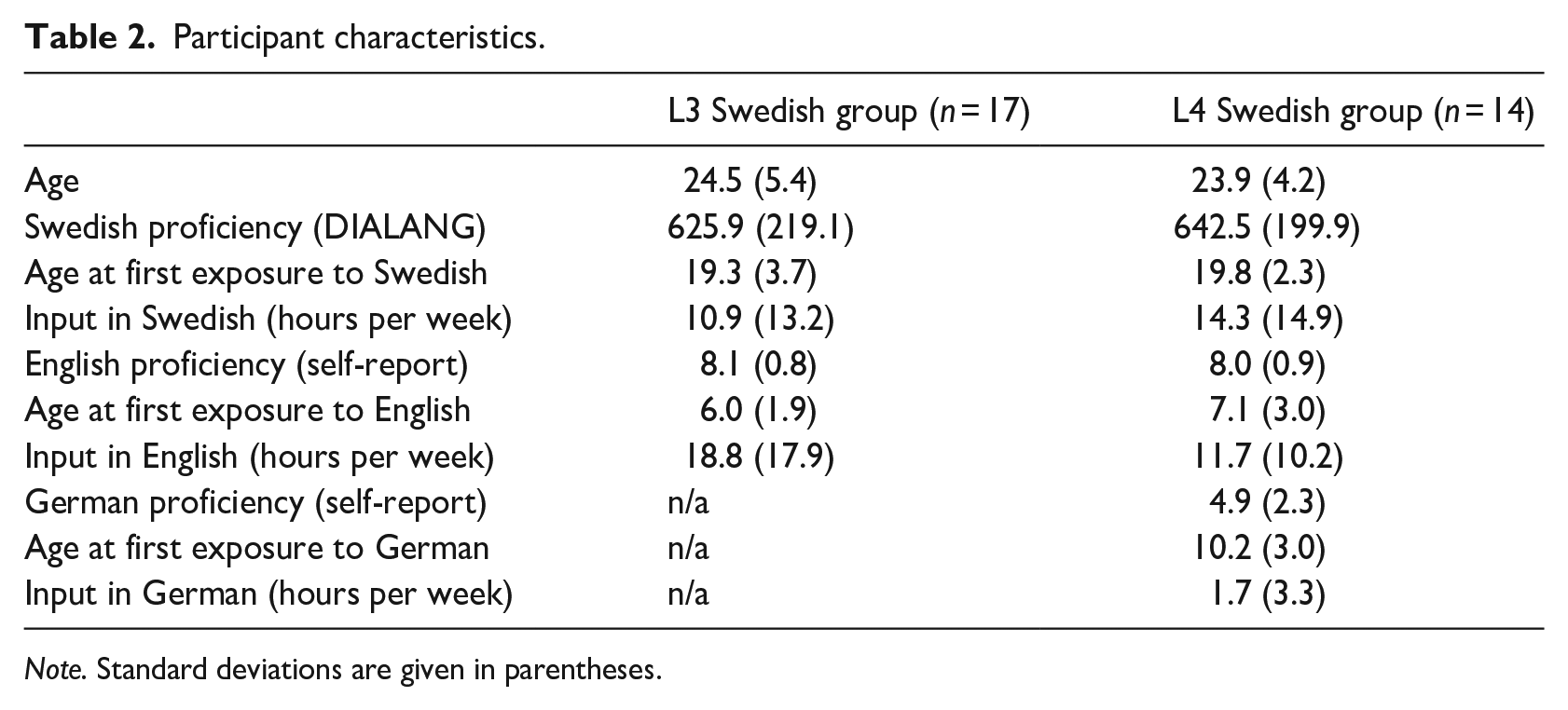
Proficiency in German and English was assessed using a language background questionnaire, because asking participants to perform additional placement tests on top of the target tasks would have been too demanding. The participants assessed their proficiency level in these languages on a scale of 1–10, separately for writing, speaking, listening, reading, grammar, and vocabulary. Overall proficiency was determined by calculating an average score from all six self-ratings. Participants were also asked to assess recent exposure to their languages in hours per week, separately for listening and reading. To calculate language input, the hours of listening and reading were added. Detailed information on both groups is included in Table 2.
Participant characteristics.
Note. Standard deviations are given in parentheses.
Two-sample t-tests showed that the groups did not differ with respect to any of the variables included in the table (all ps > .200). All participants provided written consent and received gift cards for a bookstore for their participation.
Materials
To answer the research questions guiding this study, two tasks were developed: a self-paced reading task (online) and a grammaticality judgement task (offline). In both tasks, participants read 36 target items, distributed among four conditions illustrated below, along with 30 unrelated grammatical filler items. The filler items were simple declarative sentences and did not contain possessive pronouns.
Target sentences always had the same structure. They were created in the perfect tense to make them sound more natural in Swedish. The perfect tense in Swedish is formed by using ‘har’ (to have) with the supine. Accordingly, each sentence contained (1) a personal pronoun as a possessor, (2) the auxiliary ‘har’, (3) a supine form, (4) a reflexive possessive pronoun, (5) an inanimate possessee noun, and (6) a prepositional or adverbial phrase of two words, serving as spill-over regions (SR I and SR II). Since the pronoun was always placed adjacent to the possessee, and was separated only by the auxiliary ‘har’ and a supine form from the possessor, the agreement dependencies investigated in this study can be considered local rather than non-local. In addition, Swedish has no subject–verb agreement, so participants did not need to process additional grammatical relationships before checking the referent.
Two personal pronouns in singular were included: jag (first-person singular) and du (second-person singular). The third-person singular pronouns ‘hon’ and ‘han’ were not included, as it is not possible to create a sentence in Swedish with a pronoun used reflexively in the third-person singular that would violate possessor agreement (without a preceding context). Four conditions were created in which the form of reflexive possessive pronouns was manipulated:
1. Fully congruent condition, in which the pronoun agreed with both possessor and possessee:
Jag har städat min lägenhet hela dagen.
‘I have been cleaning my flat all day’.
2. Possessor-incongruent condition, in which the pronoun agreed with the possessee, but not with the possessor:
*Jag har ändrat sin syn på livet.
‘I have changed my view on life’.
3. Possessee-incongruent condition, in which the pronoun agreed with the possessor, but not with the possessee:
*Jag har utfört min arbete som vanligt.
‘I have done my work as usual’.
4. Fully incongruent condition, in which the pronoun agreed neither with the possessor, nor with the possessee:
*Jag har missat sin flyg till utlandet.
‘I have missed my flight abroad’.
Each condition included eight sentences, with four sentences for each personal pronoun. Four lists were created, so that each participant read each sentence only once in one of the four conditions. Target and filler items were randomised on a by-participant basis. All items are given in the supplementary material.
Target tasks
In the self-paced reading task, participants read the sentences for comprehension in a linear, non-cumulative procedure with word-by-word segmentation. Participants controlled the reading speed by pressing the space key when they felt ready to uncover the next segment. One-third of the sentences were followed by a binary yes/no comprehension question targeting the spill-over region. Participants responded by pressing the keys ‘j’ (yes) or ‘n’ (no) on their keyboard.
In the grammaticality judgement task, participants read the full sentences on the screen, one at a time, and had to judge whether or not they were grammatically correct by pressing the keys ‘j’ (yes) or ‘n’ (no) on their keyboard. No time limit was imposed.
Both target tasks were preceded by instructions in Swedish on screen and a training phase with five unrelated sentences. The tasks were hosted on PsyToolkit – web-based software for programming and running reaction-time experiments (Stoet, 2010, 2017). A randomly selected half of the participants first completed the self-paced reading task and then the grammaticality judgement task, while the other half did so in reverse order.
Control tasks
In addition to the two target tasks, three control tasks were administered in Excel. The first one was an untimed gender assignment task, which targeted the possessee nouns used in the target items. Participants had to assign gender to 36 nouns by providing one of the indefinite articles ‘en’ or ‘ett’.
The second control task was untimed sentence completion in Swedish, English, and in German in the L4S group. For each language, participants were presented with four sentences lacking reflexive possessive pronouns, two for the first-person singular and two for the second-person singular, and were asked to complete them.
The third control task targeted participants’ preferences in the use reflexive possessive pronouns in Polish. Participants were presented with four sentences, two for the first person and two for the second person. They were asked to choose which pronoun sounded better in Polish, whether it agreed with the possessor or not. They could choose both if they felt that both pronouns sounded equally good.
The untimed control tasks in Polish, English, and German were considered sufficient, as their aim was to test whether learners had knowledge of reflexive possessive agreement in their previous languages that could be a source of cross-linguistic influence, and not to investigate learners’ comprehension in these languages.
All items used in the control tasks are given in the supplementary material. The control tasks, along with the Swedish placement test DIALANG and the language background questionnaire, were administered after the two target tasks. A complete experimental session lasted approximately 80 minutes.
Data analysis and results
Control tasks
Participants’ accuracy in the gender assignment task was 92.9% (L3S group: 92.6%, L4S group: 93.2%). In the Swedish, English, and German sentence completion tasks, participants performed with an accuracy of 100%, meaning that they had knowledge of reflexive possessive agreement in these languages. These results were anticipated since learners at intermediate to advanced levels of proficiency are expected to know the correct form of reflexive possessive pronouns. Finally, the preference task in Polish revealed that all participants chose the option without possessor agreement for both first and second person (i.e., ‘swój’). However, the option with possessor agreement was deemed equally good by 17 participants (54.8%) for the first person (i.e., ‘mój’) and by four participants (12.9%) for the second person (i.e., ‘twój’).
Self-paced reading
Accuracy on comprehension questions always exceeded 85%, meaning that participants were attentive during the task. Therefore, no participant was excluded from the analysis. Reading times on the supine, the pronoun, the noun, and the two spill-over words (SR I and SR II) were collected. All segments with reading times below 200 ms and above 3,000 ms were excluded from the analysis (2.2%), so were the items with unknown gender (7.1%). For the remaining data, all segments with reading times that deviated more than 3.0 SD above from the participants’ mean per reading region were trimmed (2.3%). For the analysis, the two spill-over words were averaged on a trial-by-trial basis (e.g., Lago et al., 2019). The results are given in the supplementary material. Figure 1 plots all participants’ reading times by reading region in the four conditions.
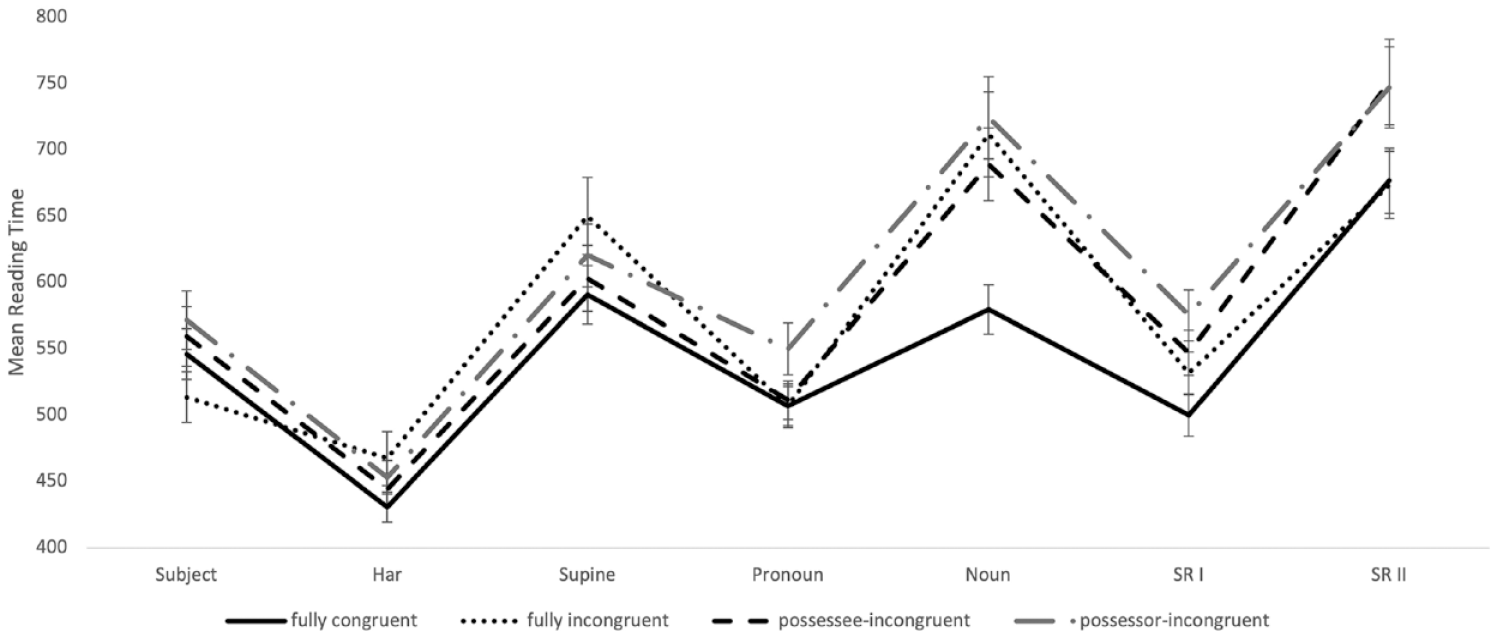
Mean reading times in the self-paced reading task.
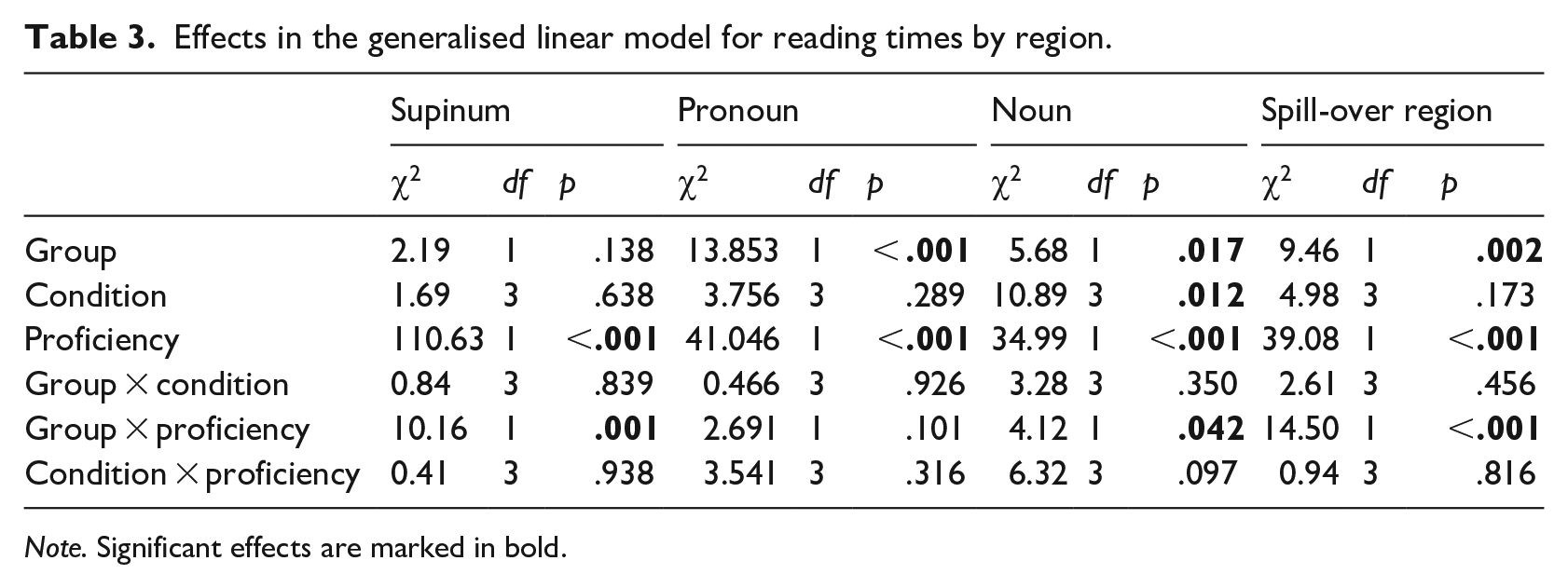
The reading data were analysed using generalised linear models with gamma distribution and log link function in SPSS Statistics 28. The factors were group (L3S and L4S), condition (fully congruent, fully incongruent, possessee-incongruent, possessor-incongruent), and proficiency (in L3/L4 Swedish). The following interactions were included in the models: group × condition, group × proficiency, and condition × proficiency. The Bonferroni test was used as a post hoc test. The models are reported by reading region in Table 3.
Effects in the generalised linear model for reading times by region.
Note. Significant effects are marked in bold.
Starting with the effect of group, L4S learners were found to read the pronoun, noun, and the spill-over region longer than L3S learners. The effect of condition was only significant for the noun. Reading times in the fully congruent condition (M = 572.93; SE = 16.57) were shorter than in the possessor-incongruent (M = 654.36; SE = 19.51; p = .024) and possessee-incongruent (M = 649.78; SE = 19.32; p = .038) conditions. Differences between the other conditions were not significant (p > .05). The effect of proficiency was significant for all regions, with shorter reading times at higher proficiency levels. Finally, the analysis of interaction group × proficiency showed that reading times on the supine and noun were shorter with advancing proficiency in both groups. For the spill-over region, the effect of proficiency was significant for L3S learners (p < .001) but not for L4S learners (p = .123). The interaction group × condition did not reach significance for any of the reading regions, nor did the interaction condition × proficiency. The estimated parameters of the models are provided in the supplementary material.
Grammaticality judgement
Items with unknown gender were removed from the analysis (7.1%). The results are given in the supplementary material. The accuracy scores are presented in Figure 2.
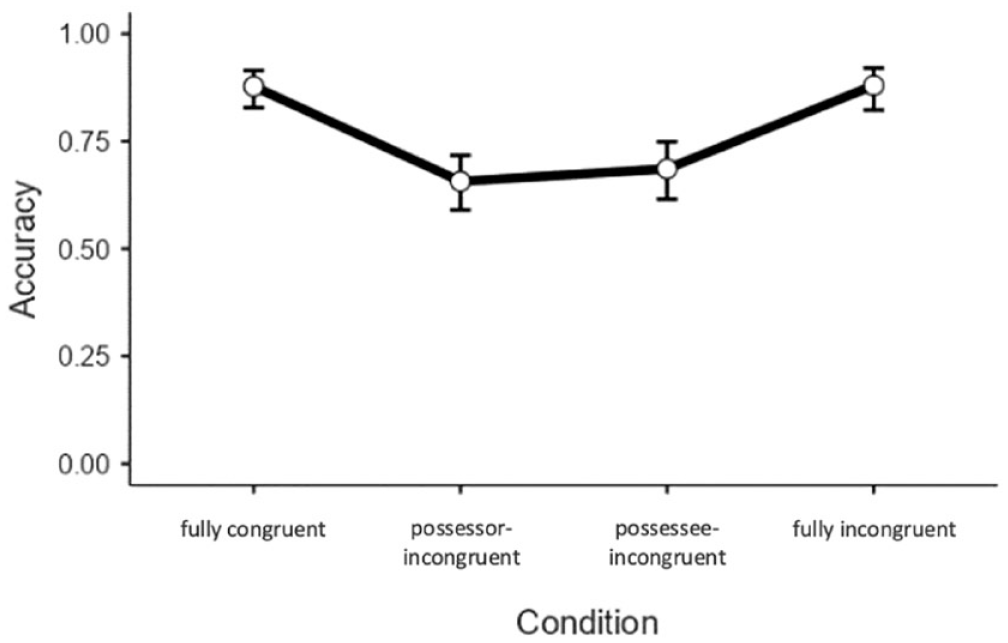
Accuracy in the grammaticality judgement task.
The judgement data were analysed using a generalised linear model with binominal distribution and logit link function in SPSS Statistics 28. The model included the same factors and interactions as in the analysis of the self-paced reading data. The Bonferroni test was used as a post hoc test. The model is presented in Table 4.
Effects in the generalised linear model for judgement accuracy.
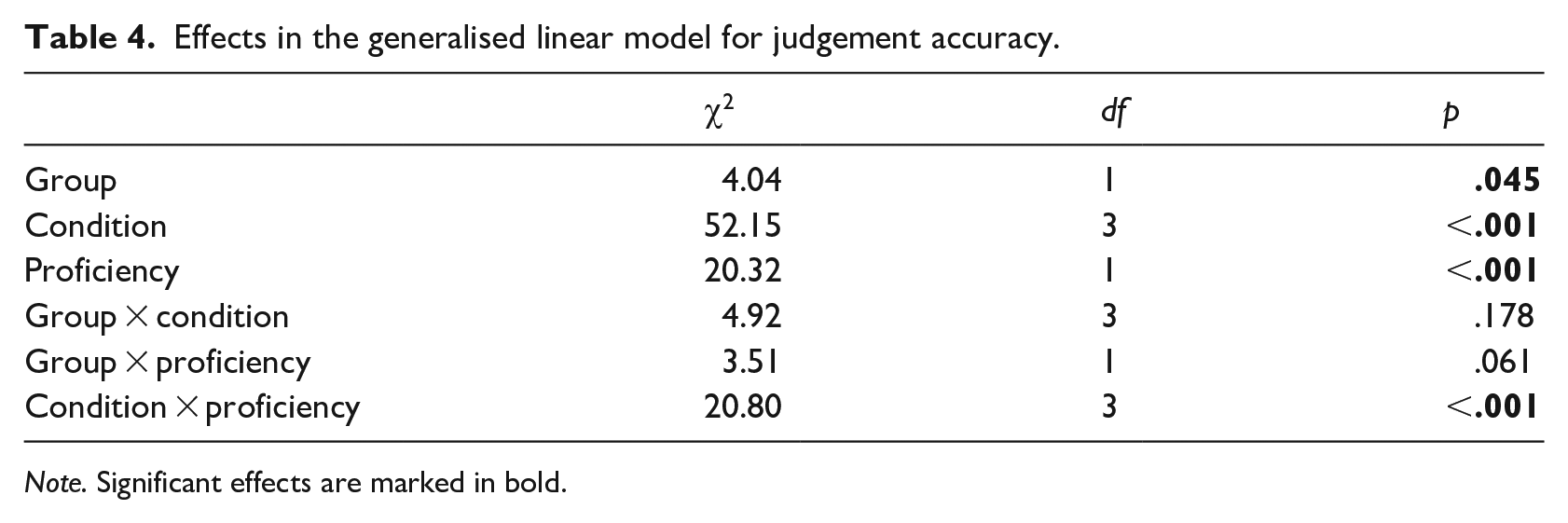
Note. Significant effects are marked in bold.
The analysis provided evidence of significant main effects of proficiency, group, and condition as well as one significant interaction: proficiency × condition. Starting with the effect of proficiency, learners performed higher with advancing proficiency in L3/L4 Swedish (β = 0.01; p < .001). As for the effect of group, L4S learners achieved an overall higher accuracy than L3S learners (79.3% vs. 72.8%; OR = 0.69; p = .047). According to the effect of condition, accuracy scores in the fully congruent condition were higher than in the possessor-incongruent (87.6% vs. 64.8%; OR = 3.75; p < .001) and possessee-incongruent (87.6% vs. 66.3%; OR = 3.29; p < .001) conditions. Also, accuracy scores in the fully incongruent condition were higher than in the possessor-incongruent (83.7% vs. 64.8%; OR = 0.26; p < .001) and possessee-incongruent (83.7% vs. 66.3%; OR = 0.30; p < .001) conditions. The difference between the possessor-incongruent and possessee-incongruent conditions was not significant (OR = 0.88; p = 1.000), nor was the difference between the fully congruent and fully incongruent conditions (OR = 0.98; p = 1.000).
The analysis of interaction proficiency × condition revealed higher accuracy levels with advancing proficiency in L3/L4 Swedish in the possessee-incongruent (OR = 1.00; p < .001) and fully incongruent (OR = 1.00; p < .001) conditions, but not in the fully congruent (OR = 1.00; p = .937) and possessor-incongruent (OR = 1.00; p = .489) conditions. The interaction is illustrated in Figure 3.
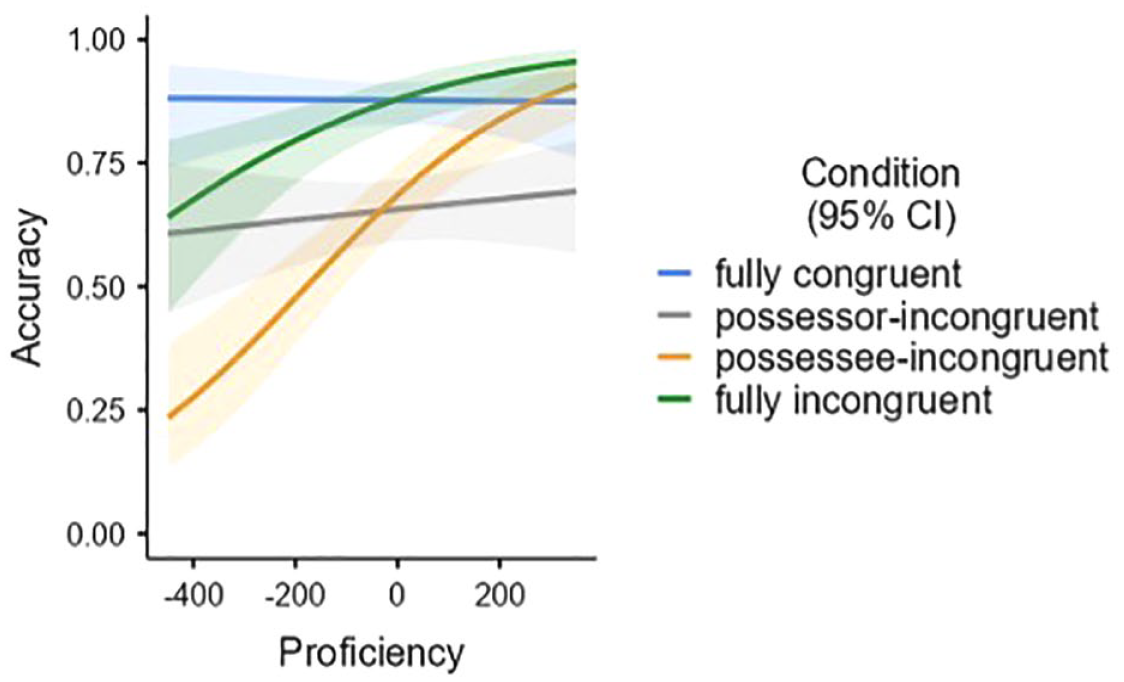
Accuracy in the four conditions as a function of proficiency in L3/L4 Swedish.
Discussion
The study was designed to probe the influence of native and non-native grammars on offline and online comprehension of reflexive possessive pronouns in L3 and L4 Swedish. The first research question concerned learners’ sensitivity to reflexive possessive agreement violations in sentence comprehension and the extent to which it is modulated by proficiency. According to the results of the self-paced reading task, L3/L4 Swedish learners slowed down on the noun in the possessor-incongruent condition. Since the point of violation in this condition was the pronoun, it is assumed that slower reading times spilled over onto the post-critical region. L3/L4 Swedish learners also slowed down on the noun in the possessee-incongruent condition. Here, the noun was the critical region where a possessee agreement violation could be detected. The elevated reading times on the noun in these two conditions indicate processing difficulties resulting from grammar violations (e.g., Jegerski, 2014). Therefore, the self-paced reading results provide evidence that L3/L4 Swedish learners were sensitive to possessor and possessee agreement violations during online sentence comprehension in L3/L4 Swedish. In the fully incongruent condition, in which both possessor and possessee agreement were violated, the elevated reading times on the noun were observed descriptively but did not reach significance in the analysis. Since learners’ reading performance in the possessor- and possessee-incongruent conditions clearly shows that they were sensitive to the violations of these two types of agreement, the lack of a slowdown effect in the fully incongruent condition is probably not indicative of deficient sensitivity. Rather, a double violation (possessor + possessee) could have been perceptually more salient or ‘obvious’ than a single violation, thus resulting in less processing difficulty.
A general effect of proficiency in L3/L4 Swedish was also found, with decreasing reading times on all regions at higher proficiency levels. However, the sensitivity to reflexive possessive agreement violations observed in online comprehension was affected neither by proficiency in L3/L4 Swedish (the interaction condition × proficiency was not significant), nor by the affiliation with a group (the interaction group × condition was not significant). Advanced L3/L4 Swedish learners were thus not more sensitive to the violations than intermediate L3/L4 Swedish learners, and L4 Swedish learners were not more sensitive to the violations than L3 Swedish learners. Due to the relatively small sample, these results must be considered tentative. The interactions mentioned above could reach significance with larger participant numbers.
Despite the sensitivity during online comprehension, L3/L4 Swedish learners accepted a large number of incorrect sentences violating possessor and possessee agreement in the grammaticality judgement task. At the same time, their accuracy scores in the fully incongruent condition, in which both possessor and possessee agreement were violated, were comparable to those in the fully congruent condition. On top of that, accuracy in the fully congruent condition was already very high at the lowest proficiency levels and did not improve with increasing proficiency, showing that L3/L4 Swedish learners had no difficulties with comprehending correct sentences in a target-like manner. Thus, these results suggest that L3/L4 Swedish learners were generally able to recognise reflexive possessive agreement violations, but at times they had difficulty establishing possessor and possessee agreement in offline sentence comprehension. Since the agreement dependencies examined in this study were local rather than non-local, the lower performance in these two conditions cannot have arisen from a generalised tendency to establish local agreement (e.g., Pozzan & Antón-Méndez, 2017). It was most likely caused by general difficulties with agreement in a non-native language (e.g., Lago et al., 2023), which are expected to be overcome by advanced learners, or cross-linguistic influence, which is discussed in more detail below.
While the results of both tasks do not fully converge, neither are they contradictory. Note that participants in this study were learners at intermediate to advanced levels of proficiency in L3/L4 Swedish, which could partly be responsible for the observed differences between the tasks. Divergent results from various measures may indicate that learners have incomplete or partial knowledge or ability with a given structure (Spinner & Gass, 2019, p. 142), which is expected in the case of varying proficiency.
Coming to the second research question regarding the extent of the effect of previously acquired native versus non-native grammars on the comprehension of reflexive possessive pronouns in L3/L4 Swedish, the judgement data are suggestive of cross-linguistic influence. L3/L4 Swedish learners achieved significantly lower performance levels in the possessor-incongruent condition, in which agreement between the possessor and the reflexive possessive pronoun was violated. Since Polish in principle does not encode possessor agreement, the learners arguably had trouble applying it during sentence comprehension in L3/L4 Swedish. This line of reasoning is reinforced by the fact that the possessor-incongruent condition was the only condition in which learners’ performance did not improve with increasing proficiency, which indicates that even advanced learners activated Polish grammar when comprehending the sentences in L3/L4 Swedish. The results are therefore in line with Antón-Méndez (2011) and Lago et al. (2019, p. 340) who found L1 effects in the comprehension of possessive pronouns in German as an additional language and ascribed them to the automatic recruitment of native processing mechanisms, which ‘may be more available and automatised than L2 mechanisms due to having been acquired earlier and used more frequently’.
The extent to which German grammar affected learners’ performance can be assessed by comparing L3 Swedish and L4 Swedish learners. The judgement data presented an overall advantage of L4 Swedish learners over L3 Swedish learners. As both Swedish and German encode possessor and possessee agreement, the accuracy advantage of L4 Swedish learners may be accounted for in terms of the similarities in reflexive possessive agreement between these languages. It is conceivable that both possessor and possessee agreement were more automatised among learners who knew German and could therefore be more easily deployed in sentence comprehension in another language. This is what has been claimed in previous L2 studies on grammatical gender processing, which have documented L1 transfer of similar gender-agreement marking during L2 comprehension (e.g., Sabourin & Haverkort, 2003). Note, however, that L4 Swedish learners also failed to establish possessor agreement in many cases, which suggests that transfer of agreement procedures from the native language superseded the facilitation effect of L3 German. This again supports the argument for automatic activation of the native grammar in L3/Ln morphosyntactic processing.
Interestingly, knowledge of German was found to affect L4 Swedish learners’ performance in yet a different way than the cross-linguistic influence depicted above. They read the critical regions, that is, the pronoun, noun, and spill-over, more slowly compared to L3 Swedish learners, irrespective of the condition. No difference between the groups was observed for the precritical region, that is, the supine. This means that L4 Swedish learners only slowed down on the regions where the violations were expected, or where self-paced reading effects typically spill over. They did so although they read the sentences for comprehension and did not need to pay special attention to the critical regions (the comprehension questions only targeted the spill-over regions). Remember that L4 Swedish learners achieved an overall higher judgement accuracy than L3 Swedish learners. Therefore, there seems to be a speed–accuracy trade-off for L4 Swedish learners conditioned by their knowledge of an additional non-native language. A stronger relationship between accuracy and speed in bilinguals compared to monolinguals has been observed in gender processing research (e.g., Di Pisa et al., 2022). The study extends that finding to multilingual contexts by showing that L4 learners may optimise their accuracy at the cost of slower reading times on detecting reflexive possessive agreement violations, compared to L3 learners.
Finally, the judgement data demonstrates that L3/L4 Swedish learners performed relatively poorly in the possessee-incongruent condition, which can be explained in two ways. First, they could have been affected by their English grammar, which lacks possessee agreement. Second, L3/L4 Swedish learners could have experienced general difficulties with possessee agreement irrespective of cross-linguistic influence. Possessee agreement in Swedish means establishing a relationship between a pronoun and the grammatical gender of a possessee noun. Therefore, knowledge of grammatical gender assignment is essential for employing this type of agreement. Although the items with unknown gender were excluded from the analysis, L3/L4 Swedish learners could at times have failed to retrieve the correct gender due to the weaker links between nouns and gender nodes, and hence less stable gender representations (e.g., Grüter et al., 2012). Gender-assignment performance is known to advance with increasing proficiency, which results in fewer gender-agreement errors. Learner accuracy in the possessee-incongruent condition was found to be positively affected by proficiency in L3/L4 Swedish, thus corroborating the interpretation in favour of general difficulties with possessee agreement rather than cross-linguistic influence.
The limitations of the study are mostly related to sampling. First, no control group of learners with a native language that encodes possessor agreement was recruited. Comparing learners in this study with such a group could have confirmed the role of cross-linguistic influence from native Polish. Second, no control group of learners with no knowledge of English was tested. However, finding such participants is almost impossible, since all university students of Swedish in Poland have some command of English.
To sum up, the study shows that L3/L4 Swedish learners are sensitive to reflexive possessive agreement violations, although they may at times have difficulty deploying possessor and possessee agreement in offline comprehension. The most likely cause of the lower performance on possessor agreement is cross-linguistic influence from L1 Polish. By contrast, the lower performance on possessee agreement seems to be linked to problems with grammatical gender assignment. L4 Swedish learners achieve an overall higher judgement accuracy than L3 Swedish learners, but at the cost of reading time. All in all, the comprehension of reflexive possessive pronouns in L3/L4 Swedish is differently affected by both native and non-native grammars.
Supplemental Material
sj-docx-1-ijb-10.1177_13670069231194341 – Supplemental material for Cross-linguistic influence in the comprehension of reflexive possessive pronouns in L3 and L4 Swedish
Supplemental material, sj-docx-1-ijb-10.1177_13670069231194341 for Cross-linguistic influence in the comprehension of reflexive possessive pronouns in L3 and L4 Swedish by Kamil Długosz in International Journal of Bilingualism
Footnotes
Acknowledgements
The author is grateful to two anonymous reviewers for their thoughtful and constructive comments on an earlier version of this manuscript. The author is particularly indebted to one of them whose remarks helped improve the methodology. Also, the author would like to express his gratitude to Michał Piosik and Natalia Kołaczek, PhD for checking the linguistic correctness of the stimuli.
Declaration of conflicting interests
The author(s) declared no potential conflicts of interest with respect to the research, authorship, and/or publication of this article.
Funding
The author(s) disclosed receipt of the following financial support for the research, authorship, and/or publication of this article: This work was supported by the National Science Centre, Poland (Narodowe Centrum Nauki) (grant number: 2019/33/N/HS2/00349).

Supplemental material
Supplemental material for this article is available online.
Author biography
References
Supplementary Material
Please find the following supplemental material available below.
For Open Access articles published under a Creative Commons License, all supplemental material carries the same license as the article it is associated with.
For non-Open Access articles published, all supplemental material carries a non-exclusive license, and permission requests for re-use of supplemental material or any part of supplemental material shall be sent directly to the copyright owner as specified in the copyright notice associated with the article.
