




Abstract
Languages differ in their realization of the subject argument: non-null-subject languages, like English, require subjects to be phonologically overt; rather, null-subject languages, like Greek, allow the subject to be overt or null. This cross-linguistic difference can lead to the transfer of grammatical properties across languages during bilingual language acquisition. The direction of crosslinguistic transfer is known to be affected by structural overlap and linguistic dominance. This exploratory study was conducted to establish whether structural overlap or linguistic dominance affect the production patterns of Greek children who acquire English at preschool. If structural overlap determines the direction of transfer, then children will overuse overt subjects in Greek; if dominance determines the direction of transfer, then children will overuse null subjects in English. Two groups of Greek children (between 3;6–4;5 and 4;6–5;8) attending a monolingual English immersion programme in Greece participated in a novel oral elicitation task that tested their use of null and overt subjects in both languages. Both groups produced significantly more null and fewer overt subjects in English than an English monolingual control group, but the same number of null and overt subjects in Greek as a Greek monolingual control group. This finding suggests that the preschoolers, who start learning English at 3;0 years, experience crosslinguistic transfer from Greek, their dominant language, to English – thus highlighting the role that dominance plays in determining the direction of crosslinguistic transfer among successive bilingual children.
I Introduction
Crosslinguistic influence (CLI) is defined as ‘the overuse or overacceptance of (morpho)syntactic properties in bilingual children’s one language under the influence of the other language’ (Van Dijk et al., 2022: 898). The phenomenon has been the topic of theoretical and empirical investigations for over two decades; these have revealed that CLI can affect all aspects of a bilingual’s language, but some linguistic domains are more susceptible to CLI than others (Serratrice, 2013). According to Hulk and Müller (2000), one of the most notable loci of CLI is the interface between syntax and discourse pragmatics (for a review, see Sorace, 2011). This interface regulates a wide range of linguistic structures that have a syntactic and a pragmatic component, such as the realization of subjects and the distribution of determiners. In turn, bilingualism researchers often focus on these structures to investigate the causes and effects of CLI (Blom et al., 2017).
In particular, the realization of subjects (and CLI effects therein) has been studied extensively in simultaneous bilingual and L2 learners who acquire a null-subject language (i.e. a language that allows subjects to remain phonologically null) together with a non-null-subject language (i.e. a language that requires subjects to be phonologically overt). The two groups do not perform alike: on the one hand, simultaneous bilingual learners – influenced by structural overlap between the two languages – tend to experience CLI from the non-null-subject language to the null-subject language and, as a result, they produce and accept more overt subjects in the latter than pragmatically appropriate (e.g. Argyri and Sorace, 2007; Hacohen and Schaeffer, 2007; Serratrice et al., 2004). On the other hand, speakers of a null-subject L1 tend to transfer its properties to their non-null-subject L2 and, as a result, they produce and accept more illicit null subjects in the latter (e.g. Pladevall-Ballester, 2016; Prenza, 2014; White, 1985) – a finding which showcases that linguistic dominance can determine the direction of transfer and even neutralize its effects in L2 learners, at least insofar as it coincides with an increase in proficiency (Pladevall-Ballester, 2012; Prenza and Tsimpli, 2013; White, 1985). Dominance (often defined as the amount of input bilinguals receive in each of their languages) is also known to affect the presence of transfer effects in simultaneous bilingual children (Argyri and Sorace, 2007; Hervé et al., 2016; Yip and Matthews, 2000).
The study presented in this article investigates the realization of subjects in Greek (a null-subject language) and English (a non-null-subject language). However, it focuses on a less-investigated population: Greek children who attend a monolingual English immersion preschool. As the starting age of L2 acquisition sees a global decrease, immersion preschools are becoming a widespread trend in Greece (Dendrinos et al., 2013). In these institutions, L1 English teachers deliver the British National Curriculum (or equivalent) in English, and without using Greek to support the pupils’ L2 learning. As such, the pupils are expected to pick up the language through mere exposure to input.
These children, who start learning their L2 at the age of 3;0 years are considered to be (early) successive bilingual learners (Chondrogianni, 2018). Some researchers suggest that early successive bilingual learners undergo the same acquisition process as simultaneous bilinguals, while others consider them to pattern with L2 learners (compare, for example, the different conclusions reached by Meisel (2016), on the one hand, and Unsworth et al. (2014) on the other). Exploring how successive bilingual children use null and overt subjects in English, and what are the factors that affect their use, over the short but formative period of time that is preschool has the potential to shed more light on how educational programmes such as monolingual immersion can shape their linguistic development. Taking these issues into account, the present exploratory study had two aims: the first was to uncover the subject realization patterns of Greek preschool learners of English in order to determine whether they are (more) affected by structural overlap or linguistic dominance, while the second was to investigate the effect of age on the preschoolers’ use of null and overt subjects.
1 Subject realization
Languages differ in their realization of the subject argument. In some languages (like English or Dutch), the subject has to be phonologically overt (1). In others (like Greek or Spanish), the subject can be overt or null (2). In null-subject languages like Greek, null subjects are considered to be the default manifestation of the subject argument and used in most conversational contexts, including topic maintenance. Overt subjects are considered to be ‘marked’ and used in specific contexts, such as the introduction of a new topic in the discourse, and the shift to a different topic (Andreou et al., 2015). In non-null-subject languages like English, overt subjects are used in all of the aforementioned situations, but different types of overt subjects might be preferred in different contexts; for instance, topic maintenance requires the use of a subject pronoun, while the introduction of a topic requires the use of a lexical DP. This information is illustrated in (3), for Greek, and (4), for English.
(1) * (He) wants an ice-cream. (2) (Afti) theli ena pagoto (She) want.3 ‘She wants an ice cream.’ (3) a. To agori fonazi ti mama tu. Kratai ena pagoto. The boy. ‘The boy is calling for his mum. He is holding an ice-cream’ b. To agori fonazi ti mama tu. Afti kratai. ena pagoto. The boy. ‘The boy is calling for his mum. She is holding an ice cream’ (4) The boy dropped his ice-cream. He wants to get another one.
2 Transfer effects: Structural overlap and linguistic dominance
Crosslinguistic transfer is expected to arise in specific conditions – with structural overlap and linguistic dominance being the main ones. The structural overlap account was put forth by Hulk and Müller (2000), who argued that transfer arises ‘if (i) one of the languages opens the possibility for two grammatical analyses of a particular construction, and (ii) the other language seems (to the child) to support one of these two possible analyses’ (p. 228). In other words, if bilingual children’s Language A allows two manifestations of the same structure, and one of these manifestations is also present in Language B, children are expected to use the overlapping structure across the board, even where Language A would require the non-overlapping structure. The authors highlighted that, for CLI to appear, another condition should be met: the target structure should be regulated in the C-domain, that is, the interface between syntax (a language-internal faculty) and pragmatics (a language-external faculty). Since the publication of Hulk and Müller’s (2000) seminal paper, extensive research has been conducted on simultaneous bilingual children’s use of subjects. There is also a substantial body of research focusing on subject realization in successive bilingual children who learn an L2 sometime after their L1 has started developing. Results suggest that CLI affects both groups’ subject use, but in distinct ways.
Research on simultaneous bilingual learners’ subject use has been conducted with various recipient languages (e.g. for Greek, see Argyri and Sorace, 2007; for Italian, see Serratrice et al., 2004; for Spanish, see Paradis and Navarro, 2003; for Hebrew, see Hacohen and Schaeffer, 2007). Regardless of the linguistic combination, the participants’ age (ranging between 2;0 and 9;0), or the modality in which the participants were tested (reception or production), studies found that children prefer to follow the language that provides unambiguous evidence for the subject argument (i.e. overt subjects) over the language that provides ambiguous evidence (i.e. both null and overt subjects). In turn, this leads children to overgeneralize the overlapping structure (i.e. overt subjects) to both languages, even in inappropriate contexts for the null-subject language.
Of particular interest in this respect is Argyri and Sorace’s (2007) study. They tested 32 seven- to nine-year-old English–Greek bilingual children on the production and acceptance of null and overt pronominal subjects, preverbal and postverbal subjects, object pronouns, and the structure of wh-embedded interrogatives. Following Hulk and Müller’s (2000) account, Argyri and Sorace (2007) expected to find unidirectional CLI, from English to Greek. Their hypothesis was confirmed by the results, since all the linguistic structures they investigated were (somewhat) vulnerable to CLI from English to Greek – albeit only for the bilinguals who were dominant in English. Regarding the use of pronominal subjects, a significant difference was observed in the acceptance of overt subjects by English-dominant bilinguals compared to Greek monolingual controls, but there were no differences in the production of null and overt pronouns between the two groups. In other words, bilingual children did not overproduce overt subjects in Greek (for a partial replication, see Daskalaki et al., 2019). This finding differs from previous research in which bilingual children produced more overt subjects in the null-subject language than their monolingual peers, and perhaps could be explained by the fact that participants in Argyri and Sorace’s (2007) study were older than those studied elsewhere.
Argyri and Sorace’s (2007) study highlights the important role of dominance in determining the presence of CLI effects, which had been noted since the beginning of CLI research. For example, Yip and Matthews (2000) investigated the speech of a Cantonese–English bilingual child between the ages of 1;5 and 3;6 and reported unidirectional influence from Cantonese to English in the case of null objects, in-situ wh-questions, and prenominal relative clauses, arguing that being dominant in Cantonese was responsible for the observed errors in his speech. Since then, a substantial amount of work has confirmed that dominance does indeed play a role in children’s transfer patterns (e.g. Argyri and Sorace, 2007).
An issue with this work is the fact that the operationalization of the term ‘dominance’ differs between studies. Indeed, such discrepancies in operationalization could influence the consistency of the studies’ findings across contexts (van Dijk et al., 2022). To this end, more recent work replaces ‘dominance’ with the term ‘exposure’ (e.g. Daskalaki et al., 2019; Hervé, et al., 2016; Serratrice and De Cat, 2020; Unsworth, 2013b; Unsworth et al., 2014). Unsworth et al. (2018) report that the relative amount of exposure that bilingual children receive can serve a reliable estimate of their linguistic dominance. Moreover, exposure is known to affect children’s linguistic proficiency and task performance (Daskalaki et al., 2019; Hervé et al., 2016; Unsworth et al., 2014).
3 Child L2 learners’ subject realization
Most of the studies on child L2 learners’ use of null and overt arguments focuses on the realization of objects. These reveal a high rate of object omissions among child successive bilingual learners (e.g. Pérez-Leroux et al., 2008; Pirvulescu et al., 2014). Rather, the number of studies focusing on the realization of subjects in this population are few, and tend to adopt longitudinal and/or observational designs (e.g. Haznedar, 2001; Ionin and Wexler, 2002; Lakshmanan, 1994).
Results from the latter set of studies suggest that null subjects are not frequent in L2 children’s production (see Paradis, 2007). For example, Ionin and Wexler (2002) looked at 20 L1 Russian children between 3;9 and 13;10 who either had moved to or were born in the US and had different amounts of exposure to the L2 (English). The study revealed that the children did not produce null subjects in the L2, despite the fact that their L1 allowed them. However, the fact that the participants’ ages spanned a decade, and the fact that their exposure to the L2 differed makes the findings questionable. Indeed, some of the study’s participants were successive bilinguals, while others were L2 learners (see Chondrogianni, 2018). The potential differences in language development and variables therein (Paradis, 2007) between these categories, does not warrant grouping them together.
It is also worth noting that the status of successive bilingual children in the literature is rather complex. There is agreement that successive bilinguals learn their L2 after their L1 has started developing – usually sometime around 3;0 (Chondrogianni, 2018; Paradis, 2007). However, the boundaries that separate them from simultaneous bilingual children on the one hand, and L2 learners on the other are not clear-cut. Chondrogianni (2018) categorizes successive bilingual children as either ‘early’ (picking up their L2 between the ages of 1;0–3;0) or as ‘late’ (picking up their L2 between the ages of 3;0 and 7;0). The former group are expected to be more similar to their simultaneous bilingual peers, while the latter are expected to pattern with L2 learners.
However, the literature is divided as to how three-year-olds perform. Sometimes, these children resemble their simultaneous bilingual peers. For instance, Schwartz et al. (2009) investigated the acquisition of irregular plurals in Hebrew and found that successive bilingual children (who started acquiring their L2 at 3;0) manifested the same developmental paths as bilingual children. On other occasions, successive bilingual children’s performance has been reported as similar to that of adults who acquire an L2. This was the case in Granfeldt et al.’s (2007) study, where children whose acquisition had started between the ages of 3;0 and 6;0 made errors typical of adult L2 learners. Likewise, Meisel (2008) investigated the acquisition of grammatical gender in French bilingual and L2 children whose acquisition started between the ages of 2;0 and 4;0. He found that the younger group outperformed the older group, and showed different error profiles. In fact, Meisel (2008) suggested that there was a critical period in the acquisition of morphosyntax at 4;0 (for a counterargument, see Unsworth, 2013a).
Under this light, it is interesting to consider a quasi-experimental study by Pladevall-Ballester (2012). The author investigated the use of null and overt subjects in 15 five-year-old Spanish children attending an English immersion programme in Spain using a more focused, cross-sectional design. The author compared the successive bilingual children’s performance in an elicited oral judgement/correction task to that of 15 age-matched English monolingual children. She reported that the bilinguals, who were dominant in Spanish, rejected fewer ungrammatical null subjects than their monolingual peers. Thus, she argued that her bilingual participants were influenced by their L1. Similar findings regarding the overuse of null subjects have been obtained in studies that focus on adult Spanish, Italian and Greek L2 learners of English (Prenza, 2014; Prenza and Tsimpli, 2013; White, 1985). These findings suggest that, among L2 learners, dominance determines the direction of transfer, overriding considerations of structural overlap.
To summarize, research on the use of null and overt subjects by L2 learners of English is divided. The earlier longitudinal investigations suggested that child L2 learners’ transfer patterns are influenced by structural overlap; as such, the children do not use null subjects in their L2. Rather, later experimental studies found that child L2 learners whose (dominant) L1 allows null subjects tend to transfer its properties to their (less dominant) L2, even if it does not allow null subjects; as a result, the children produce and accept more illicit null subjects in the L2 relative to English monolingual speakers. Moreover, age appears to make an impact on children’s subject realization patterns, with younger successive bilingual children behaving more like simultaneous bilingual ones, and older successive bilingual children patterning with L2 learners.
4 The role of age
Age is an important factor in CLI research as well (see van Dijk et al., 2022). Transfer effects observed at early stages of acquisition were found to subside as children get older (e.g. Paradis and Genesee, 1996). This finding prompted some researchers to argue that transfer might be a developmental phenomenon (e.g. Zdorenko and Paradis, 2012). Yet, others suggest that transfer is not developmental: children continue to experience transfer even as their L2 acquisition progresses (e.g. Bosch and Unsworth, 2020). The absence of an age effect would suggest that CLI is part and parcel of bilingualism. In a recent meta-analysis that explored the effects of various predictors in determining the presence and strength of CLI effects, van Dijk et al. (2022) found no significant effect of age, although they noted a developmental trend such that the older the children got, the smaller the effect of transfer became.
5 Overview of the study
The previous sections highlight that investigating successive bilingual children is an interesting and, at the same time, timely endeavour: across the globe, the starting age of L2 acquisition is decreasing, and children in numerous countries start learning an L2 at preschool (Eurydice, 2017). Greek children who attend monolingual immersion preschools fall into the successive bilingual group: born and raised in Greece by Greek parents, the age at which they join the school (3;0) tends also to be the starting age of L2 acquisition. However, not much is known about their L2 acquisition process and transfer patterns therein. In addition to the theoretical motivations for researching English–Greek successive bilingual children, studying this group is also practical, as the similarities and differences between English and Greek in terms of subject realization discussed in the previous sections of the manuscript both give rise to the transfer of grammatical properties and allow for its investigation.
6 Questions and predictions
Taking the above into consideration, this study aims to answer the following questions:
• 1: Do Greek–English successive bilingual children experience crosslinguistic transfer when compared to monolingual peers? If so, is the direction of transfer determined by structural overlap or linguistic dominance?
• 2: Does children’s use of subjects change as they get older?
Regarding research question 1, we predict that transfer will indeed affect children’s use of null and overt subjects in English and Greek, in line with previous literature on bilingual learners. If structural overlap determines the direction of transfer, we expect to attest transfer from English (the unambiguous language) to Greek (the ambiguous language). If linguistic dominance affects the direction of transfer, we expect to see transfer from Greek (the dominant language) to English (the non-dominant language). As far as research question 2 is concerned, and in line with research on L2 acquisition, we predict that older bilingual children will perform more similar to age-matched monolinguals with regards to the use of sentential subjects.
II Methodology
1 Participants
Ninety children (36 English–Greek bilingual, 27 Greek monolingual and 27 English monolingual) between 3;5 and 5;8 were recruited for the study. Of the 36 bilinguals, 28 attended an English monolingual immersion school in Athens, and 8 attended an English monolingual immersion school in Thessaloniki, Greece. The Greek and English monolingual controls were also pooled from preschools in Thessaloniki and Oxford, respectively.
To be included in the study, the bilingual children had to (1) speak Greek with their (Greek) parents at home and English with their (English) teachers at school, and (2) have started learning English from the age of 3;0 onwards (i.e. their Age of Acquisition is between 3;0 and 4;0), as a result of attending an immersion preschool. These inclusion criteria were put in place to ensure that the children we tested were not simultaneous bilinguals (who learn their L1 and L2 at more or less the same time) or child L2 learners (who start learning their L2 well after their L1 has developed; e.g. at around 6;0). Children who started learning English (or a different language) before 3;0 and/or outside the preschool context, were excluded to safeguard data quality. The inclusion criteria for the monolingual children were that they had to (1) be L1 speakers of Greek or English and (2) receive no exposure to English/another language at home or through the school.
The children were divided in two age groups: the Younger Group (YG) consisted of children between 3;6–4;5, and the Older Group (OG) consisted of children between 4;6–5;8. 1 An effort was made to balance the groups in terms of age (44 YG, 46 OG) and gender (48 female, 42 male).
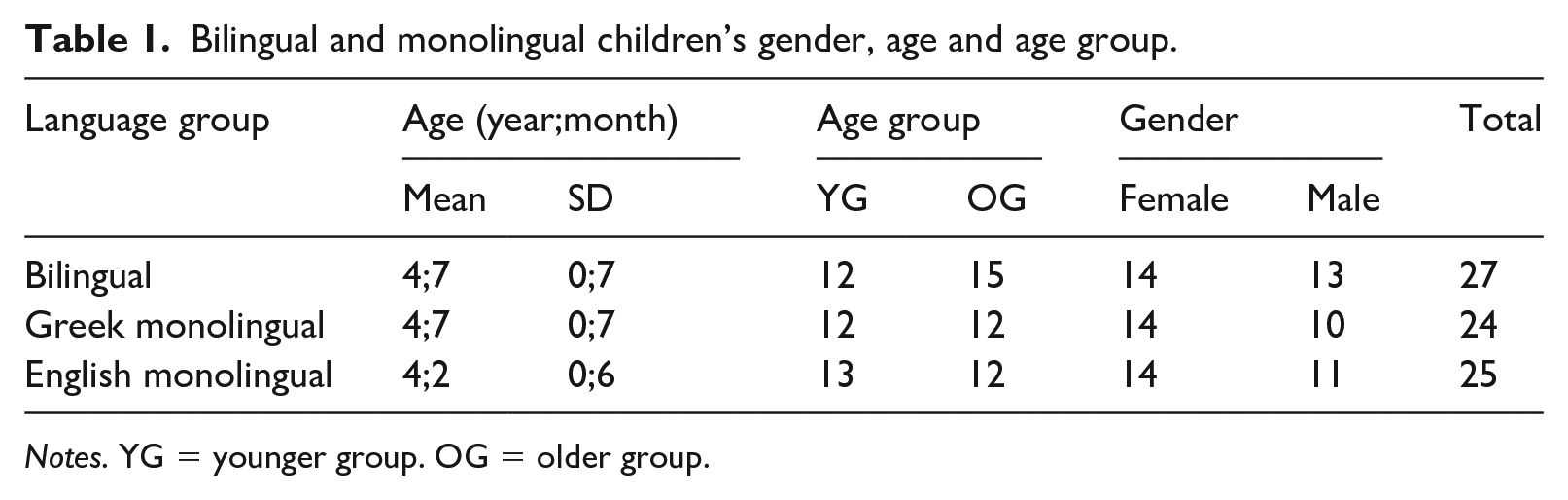
However, 14 of the participants had to be excluded: three bilingual children were eliminated because they did not participate in both treatments; another two bilingual children were incapable of completing the task in English despite their good performance in Greek; three bilingual children and one monolingual Greek child were uncooperative and were excluded from the main task; another bilingual, as well as two monolingual Greek and two monolingual English children, were unable to complete the practice trials and were consequently disqualified from the main task. Thus, the final sample consisted of 76 children, whose characteristics are shown in Table 1.
Bilingual and monolingual children’s gender, age and age group.
Notes. YG = younger group. OG = older group.
It should be noted that, given the characteristics of our participants and in the absence of concrete measures of exposure, the definition of dominance in the present study is based on contextual factors. In other words, we consider our bilingual participants to be dominant in Greek, which is their L1 as well as the majority language.
2 Background measures
a Non-verbal abilities
To establish whether the groups differed in non-verbal abilities, the Picture Similarities Test of the British Ability Scales (BAS) (Elliott et al., 1997) was administered to all participants. The BAS measures children’s thinking and reasoning abilities and can be used with children between 3;0 and 7;11. The Picture Similarities Test involves showing children a row of pictures and a card that matches one of the pictures, and asking them to put the card under the picture with which it fits.
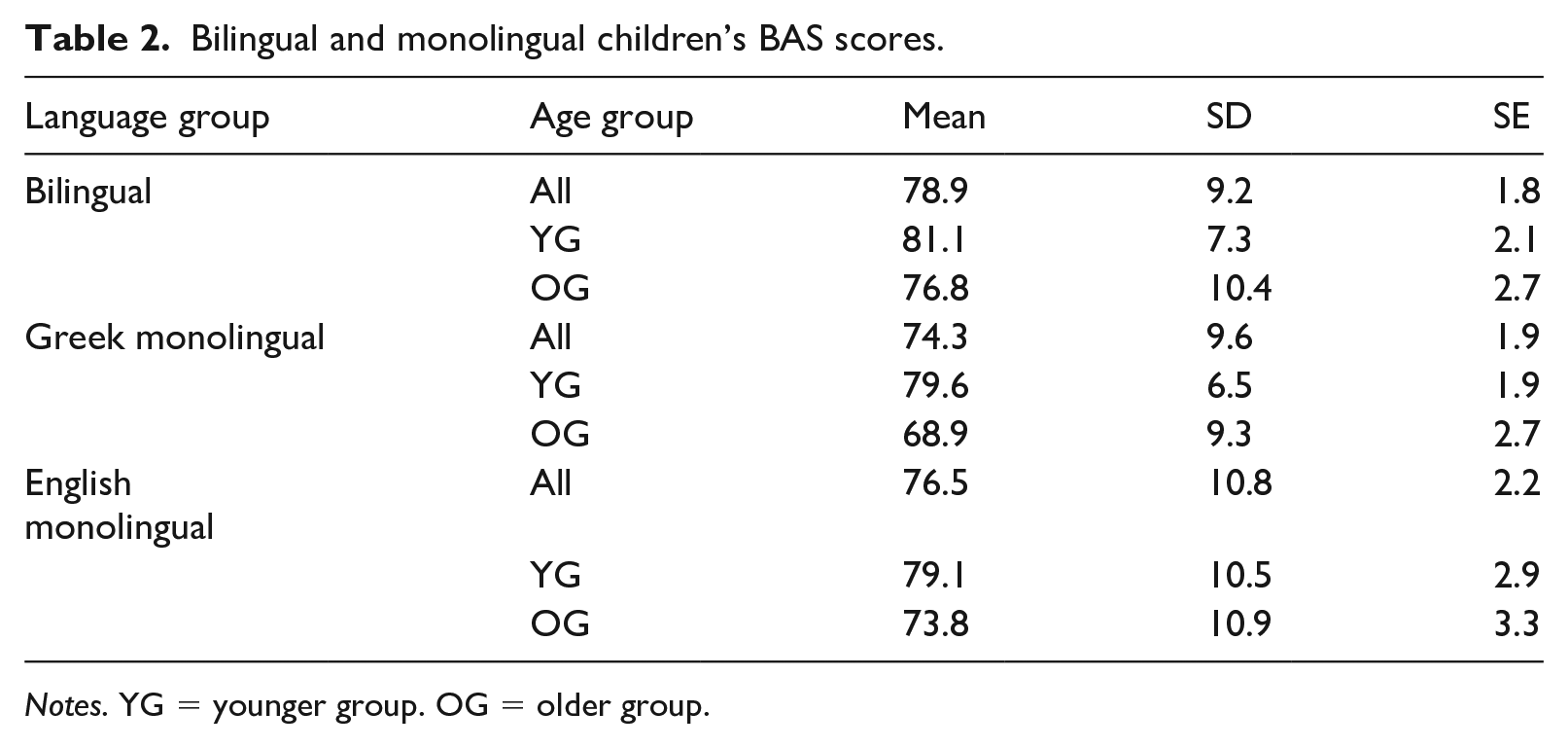
Table 2 presents the BAS scores of the three groups. A One-Way ANOVA revealed that the scores were not significantly different from one another, F(2,74) = 1.27, p = .29, η2 = 0.34. This finding suggests that all participants were functioning on a similar level of non-verbal competence.
Bilingual and monolingual children’s BAS scores.
Notes. YG = younger group. OG = older group.
b Verbal abilities
To measure children’s verbal abilities, we calculated their mean length of utterance (MLU), which would serve as an indicator of children’s language performance in lieu of proficiency tests, the use of which is not warranted in bilingual populations. Typically, the MLU is calculated in naturalistic contexts, by measuring the total number of morphemes of the child’s utterances and dividing them by the total number of utterances (Brown, 1973). Yet, since the two target languages of this investigation differ in their morphological expression and order of acquisition, the MLU was calculated using the total number of words (MLUw) (Marinis, 2003).
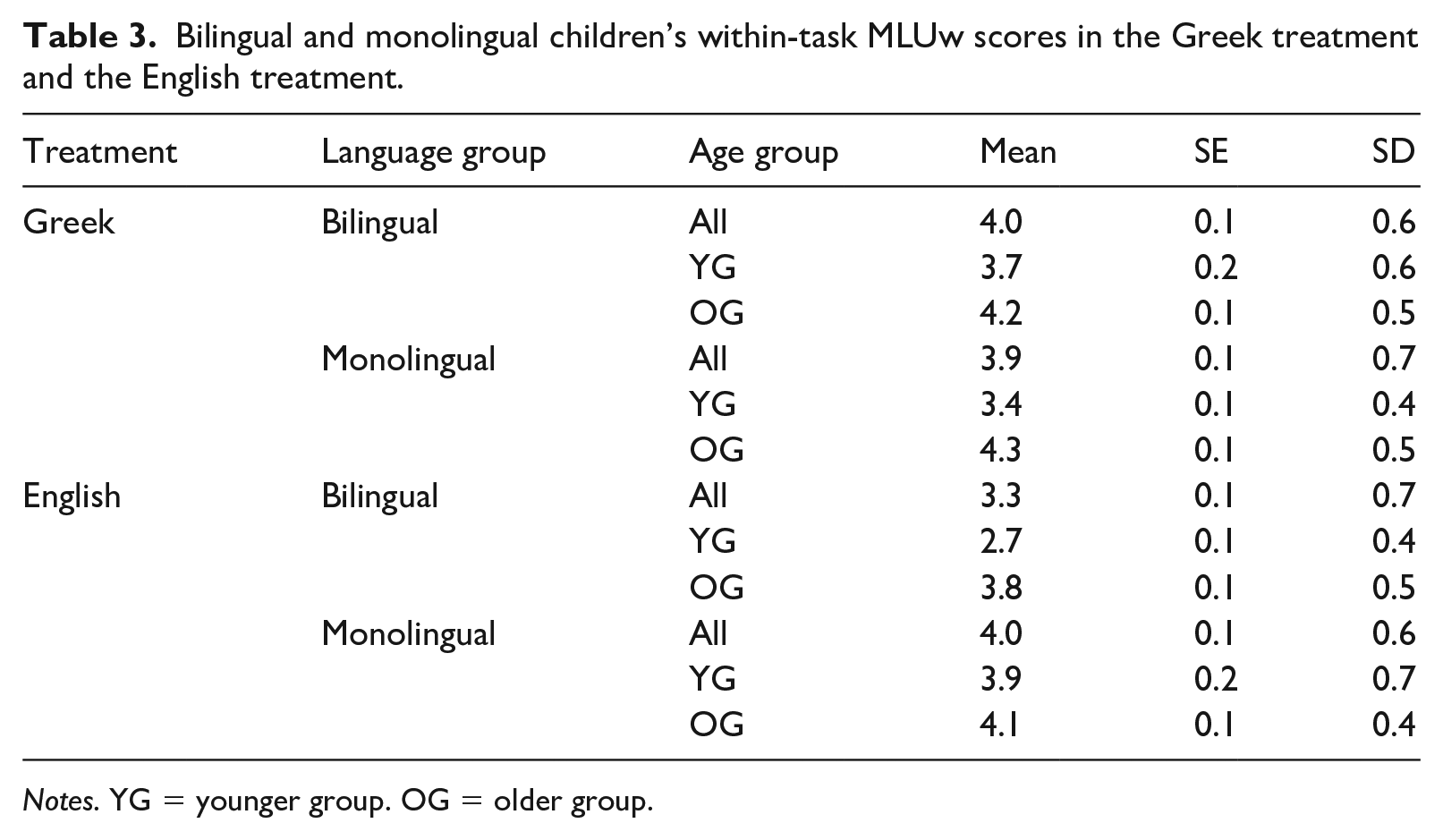
Although all MLU calculations should be based on a large number of utterances (usually 100; see Brown, 1973), time constraints did not permit the production of as many utterances in our context. Since the MLUw measurement was intended to function on a comparative level (between groups) rather than on a developmental level (for a single child), a calculation based on fewer utterances was legitimized. To allow for a larger number of utterances, it was decided that all of the utterances that children produced during the procedure (excluding those that formed part of the language elicitation task, which will be discussed below) should be included in the MLUw measurement. 2 This resulted in a total of 20–30 sentences per child. For bilingual children, the MLUw was measured separately in the two languages, and compared against that of monolingual Greek and English children’s. The mean MLUw scores for bilingual and monolingual children are in Table 3.
Bilingual and monolingual children’s within-task MLUw scores in the Greek treatment and the English treatment.
Notes. YG = younger group. OG = older group.
Independent samples t-tests with MLUw as the dependent variable and Language Group as the independent variable were performed for each language. In Greek, the difference between the groups’ MLUw mean scores was not significant: t(49) = 0.51, p = .61, d = 0.14. In English, the difference between the groups’ MLUw mean scores was significant [t(50) = −3.18, p < .001, d = 1.05], and represented a large effect.
It should be highlighted that the MLUw scores obtained are lower than those reported elsewhere in the literature (which could be due to the artificial context and/or the small number of utterances that were used for the MLUw calculation). However, the observed differences are in line with studies that find bilingual children to have lower MLUw scores than monolingual children in their non-dominant language, but comparable scores to monolingual children in their dominant language (Unsworth et al., 2018).
3 Materials
To investigate children’s use of subjects, a novel language elicitation task was created. The task was based on a card version of the game ‘Guess Who’. The child and the researcher both had a set of cards depicting the same cartoon-like faces of men and women in front of them. All faces could be differentiated in terms of their characteristics (e.g. hair colour) and the accessories (e.g. a hat). The child and the researcher picked a card from a set of yellow cards (that were the same as the red and blue cards). Then, they took turns in asking and answering questions about the person depicted on each other’s hidden card. The aim of the game was to eliminate as many of the (red or blue) cards they had in front of them as possible, and to guess the person on the other party’s hidden card.
The task was designed to provide two conditions: an ‘answer’ and a ‘question’ condition. In the former, the children had to answer the researcher’s questions about their card; in the latter, the children had to ask the researcher questions about her card. As such, the ‘answer’ condition represented a topic maintenance context, while the ‘question’ condition represented a topic (re-)introduction context. Given the discourse contexts they involved, the two conditions were expected to elicit different subjects in English and Greek. As English requires subjects to be phonologically overt in topic introduction and topic maintenance contexts, both ‘answer’ and ‘question’ trials should give rise to overt subjects. Rather, in accord with the rules of Greek, overt subjects were expected appear in the ‘question’ condition to signal a change in the conversation topic, while null subjects were expected in the ‘answer’ condition, signalling the maintenance of the conversation topic.
4 Procedure
All tasks were administered in the children’s schools, after the project received ethical clearance from the authors’ institution. The Greek monolingual children were tested in quiet rooms next to their classrooms, while the English monolingual and the bilingual children were tested in a corner of their respective classrooms. Before the administration of the tasks commenced, the first author, who collected the data, asked children a few ice-breaker questions (e.g. ‘do you have siblings?’, ‘what did you have for breakfast?’, ‘what’s your favourite animal?’) to initiate conversation and make children feel comfortable to talk.
Once rapport between the researcher and the child was established, the testing procedure began. The BAS test was administered first according to the instructions provided in the manual. As the BAS must be administered in the participants’ L1, Greek was used for the bilinguals and the Greek monolinguals, and English was used for the English monolingual participants. Bilinguals completed the test once.
The language elicitation task was administered immediately afterwards. The cards used for the task had been set by the researcher prior to the task in four rows, with five cards per row. The top row consisted of the five cards depicting female faces and was separated by the other four rows by a visible gap. The other four rows consisted of the cards depicting male faces and were close together. The ‘female’ cards (top row) were used for the practice trial because they were few and, thus, lend themselves to a shorter round of the game; as a result, the ‘male’ cards (bottom rows) were used for the experimental trials. In addition, the yellow cards were stacked next to the child and the researcher. They had also been prearranged prior to the administration of the task so that the top two cards were used for the practice trial, while the third and fourth cards were used for the task.
In the three practice trials, the researcher explained the rules of the game to the child. Then, she announced that there would be a trial round using the ‘girl’ cards. The child was asked to pick the first yellow card from the stack, while the researcher picked the second one. The researcher asked the first question and reminded the child to answer it based on his/her own card. If the child gave a nonverbal or single-word answer, the full answer was elicited. Based on the child’s answer, the researcher turned over the appropriate cards.
After the child answered, he/she was invited to ask the researcher a question. The child was reminded that he/she must ask a question to find the researcher’s hidden card. If the child could not think of a question, the researcher used prompts (e.g. ‘I asked if the girl on your card has black hair. Can you ask the same?’). If the child asked a question that he/she had already asked, the researcher elicited a different question (e.g. ‘You already asked if the girl on my card has black hair. Can you ask a different question? Can you ask about her eyes?’). If the child asked a question that was not complete (e.g. ‘brown?’ instead of ‘does she have brown eyes?’), the full question was elicited. The researcher answered the child’s question and helped the child to turn over the appropriate cards from his/her set. If the child was confused about which cards to turn over, he/she was reminded that the cards which do not agree with the answer must be eliminated. If the child managed to ask at least two full questions and to give at least two full answers in the practice round, he/she was allowed to move forward to the task. All full questions and answers were praised.
After the trial, the girls’ cards were removed from the table. The researcher explained that we would play the game again using the ‘boy’ cards. Again, the researcher was the first to ask a question. On the first round, the child was reminded that he/she should answer the researcher’s question by taking into consideration his/her own card, and that he/she should ask a question to find the researcher’s hidden card. During the experimental trials, there were no prompts to help children think of questions or elicitations to make them give full answers. Nevertheless, all well-formed questions and answers were praised in order to sustain children’s motivation. Upon the completion of the task and regardless of their performance, all children received a sticker of their choice for their effort. Bilingual children completed the task in Greek first and had to repeat the task in English a week later.
a Transcription
As the aim of the study was to explore children’s subject use, the data was analysed in two ways: first, the interaction between the child and the researcher was audio-recorded and transcribed; second, the comprehension and production of pronouns was noted.
The transcription of the interaction between the child and the researcher during the task was essential in order to provide a measurement of children’s language development. To ensure the validity of the transcriptions, 10% of the Greek transcriptions and 10% of the English transcriptions were also performed by native speakers of each language who were blind to the aim of the study. Comparing their transcriptions to the researcher’s transcriptions, an interrater reliability of 97.2% was obtained for Greek and 93.7% for English. The percentages are high, indicating that the transcriptions were accurate.
b Coding
The utterances that children produced were marked with one of three codes:
• ‘0’ stood for irrelevant, inaccurate, or one-word utterances;
• ‘1’ stood for utterances with a null subject; and
• ‘2’ stood for utterances with an overt subject (which could be either a pronoun or full DP).
Utterances marked as ‘0’ were excluded, while the number of utterances marked as ‘1’ and as ‘2’ were tallied up in order to give rise to a ‘total null subject’ and a ‘total overt subject’ score. The total scores (0–6) were then transformed into percentages of ‘null’ and ‘overt’ in order to be used for statistical analysis.
The Greek and English native speakers who transcribed the audio recordings were asked to code 10% of the Greek and 10% of the English data, respectively. Comparing their results to the researcher’s, the interrater reliability was found to be 100% for both languages.
III Results
To answer research question 1 (‘is the direction of transfer determined by structural overlap or linguistic dominance?’), we compared the bilingual children’s use of null and overt subjects on the language elicitation task to that of monolingual Greek children in the Greek treatment, and to that of monolingual English children in the English treatment. We also conducted analyses to see whether the use of null and overt subjects differed according to the discourse context (‘answers’ vs. ‘questions’). Moreover, to address research question 2 (‘does children’s use of subjects change as they get older?’), we analysed the differences between the two age groups (YG and OG) in each treatment.
1 Greek treatment
To explore the differences between the two groups in the Greek treatment, a mixed 2×(2×2) ANOVA (with Subject Type as the within-subjects factor, and Language Group and Age Group as the between-subjects factors) was carried out. The ANOVA revealed a significant Subject Type × Language Group × Age Group interaction, F(1,47) = 5.67, p < .02, η2p = .11, which is illustrated in Figure 1.
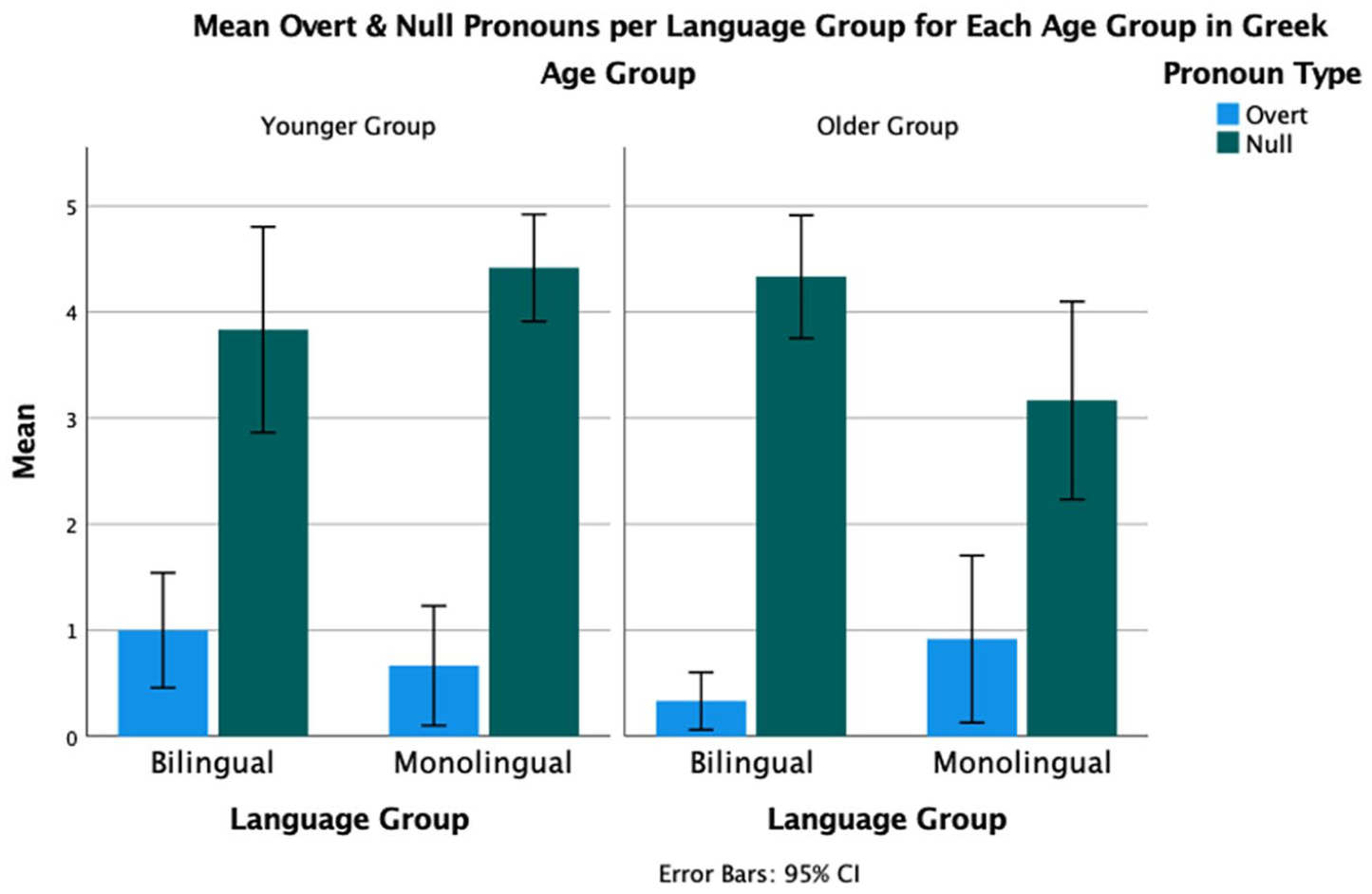
Mean null and overt subjects used by each age group in Greek.
To unpack the observed three-way interaction, we conducted separate 2×2 ANOVAs for each Language Group (both with Subject Type as the within-subjects factor, and Age Group as the between-subjects factor). These did not reveal significant Subject Type × Age Group interactions (for the bilingual group: F(1, 25) = 2.65, p = .12, η2p = .10; for the monolingual group: F(1, 22) = 2.95, p = .10; η2p = .12). In the absence of a significant interaction, no additional t-tests were conducted. It should be noted that, even though the Subject Type × Age Group interactions per language group represent medium-sized effects, they are not well powered (perhaps due to the fact that the analyses focus on subsamples of participants). Thus, the lack of statistical significance could be due to limited power.
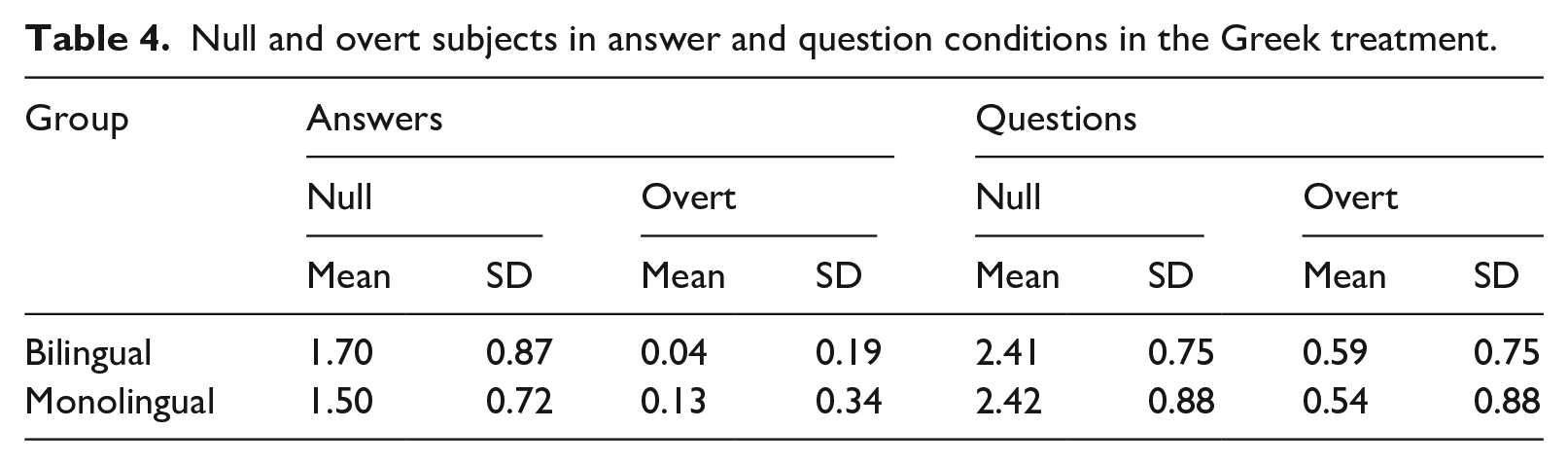
The task included an ‘answer’ and a ‘question’ condition, both of which required the use of different subjects in Greek: ‘answer’ represented a topic maintenance context and, thus, would demand the use of null subjects, while ‘question’ constituted a topic (re-)introduction context and, as such, require overt subjects instead. Analysing the use of subjects in the different sentential contexts (see Table 4) revealed that both monolingual and bilingual children were somewhat familiar with the discourse properties of subject arguments in Greek: it was observed that no child preferred to use overt subjects in the ‘answer’ condition. The opposite was the case in the ‘question’ condition, where few children displayed a preference for overt over null subjects: χ2(1,51) = 0.03, p = .86, φ = 0.03. (Examples of children’s subject use during the task can be found in Supplementary Materials for both Greek and English).
Null and overt subjects in answer and question conditions in the Greek treatment.
2 English treatment
A mixed 2×(2×2) ANOVA (including Subject Type as the within-subjects factor, and Language Group and Age Group as the two between-subject factors) was also conducted for the English treatment. It showed a large, significant Subject Type × Language Group interaction, F(1,48) = 18.56, p < .001, η2p = .28 as well as a medium, significant main effect of Subject Type, F(1,48) = 5.24, p = .03, η2p = .10.
The interaction suggests that type of subjects produced differed for each of the language groups. To understand the groups’ patterns better, two independent samples t-tests with language as the grouping variable and Subject Type as the independent variable were carried out. These revealed that bilingual children produced significantly more null subjects than the monolingual children [t(50) = 3.64, p = .001, d = 0.99], and significantly fewer overt subjects than the control group: t(50) = −4.39, p < .001, d = 1.19. These findings are illustrated in Figure 2. The ANOVA did not indicate a main effect of Age Group or any age-related interactions; no further analyses were conducted.
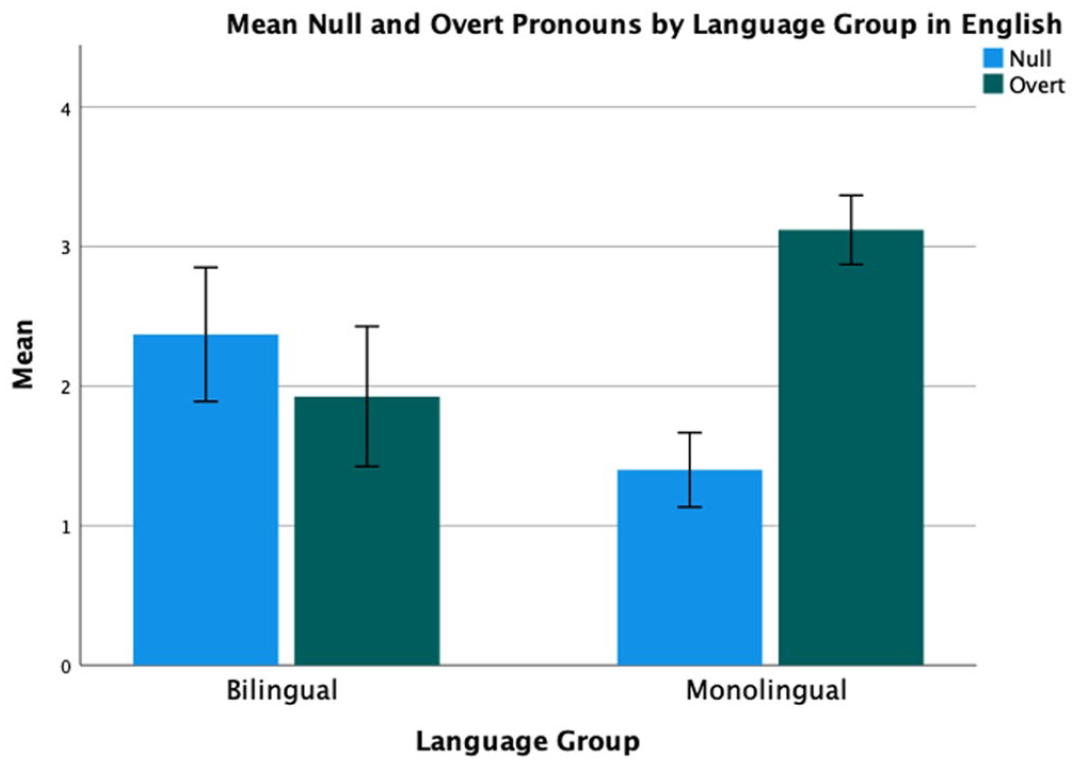
Mean null and overt subjects in English, per language group.
3 Sentential contexts
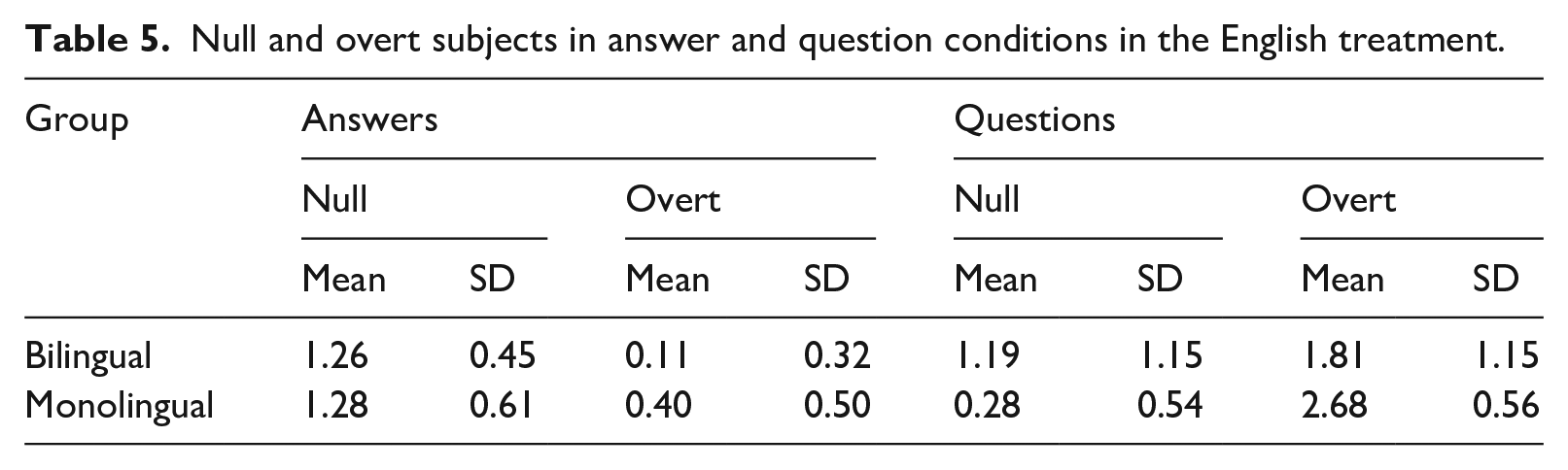
Both the ‘answer’ and the ‘question’ condition that the task required the use of an overt subject in English which, as a non-null-subject language, requires subjects to be phonologically realized in both topic introduction and topic maintenance contexts. Analysing the use of null and overt subjects in the different sentential contexts (see Table 5) revealed differences between the bilingual and the monolingual children. Surprisingly, children from both groups were found to prefer null subjects to signal topic maintenance: χ2(1,52) = 6.36, p = .88, φ = 0.26. However, bilingual children tended to use more null and fewer overt subjects in the ‘answer’ condition relative to their monolingual peers. Rather, both groups preferred overt subjects to signal topic introduction, but bilingual children produced more null and fewer overt subjects in the ‘question’ condition relative to the monolingual children: χ2(1,52) = 8.49, p = .004, φ = 0.40.
Null and overt subjects in answer and question conditions in the English treatment.
IV Discussion
Research question 1 was whether Greek–English successive bilingual children’s transfer patterns were affected by structural overlap (as per Hulk and Müller, 2000) or linguistic dominance, defined as the societal language that children had a greater experience with. Following from the literature on bilinguals and L2 learners, we expected that: (1) if structural overlap determined the direction of transfer, children would overuse overt subjects in Greek, but (2) if linguistic dominance determined the direction of transfer, children would overuse null subjects in English. In the elicitation task, bilingual children produced more null and fewer overt subjects in English relative to a group of age-matched English monolingual controls, while their use of null and overt subjects in Greek was not different from that of their Greek monolingual peers (for examples of children’s production during the task, please refer to the Appendix in supplemental material). These findings suggest that the direction of transfer is determined by linguistic dominance.
Research question 2 concerned the potential effects of age on bilingual children’s subject use. Given the results of previous studies which reported that age lessens the effects of transfer, we predicted that older bilingual children would perform more similarly to the monolingual controls. However, our findings did not confirm this prediction, since the older bilingual children did not perform differently from their younger counterparts on the English treatment of the task. Some possible explanations for these findings are discussed below.
1 Overlap or dominance?
Subject realization fulfils Hulk and Müller’s (2000) conditions for the emergence of transfer effects: indeed, it is a linguistic phenomenon that has a discourse–pragmatic component and meets a (partial) overlap condition between English and Greek. However, Hulk and Müller’s (2000) structural overlap account would predict transfer from English (the non-ambiguous language) to Greek (the ambiguous language) – a prediction that was not borne out in the present study. The bilingual preschoolers tested in the present study produced more null and fewer overt subjects in English relative to the English monolingual participants. This finding is in line with literature on child L2 learners in immersion contexts, who are known to accept and produce illicit null subjects in their non-null-subject language (e.g. Pladevall-Ballester, 2012, 2016). Thus, linguistic dominance, which would predict transfer from Greek (the dominant language) to English (the non-dominant language), appears to determine the direction of transfer effects and, thus, offer a more accurate account of the observed subject realization patterns.
The effects of dominance are well documented in the literature (e.g. van Dijk et al., 2022). For example, in Argyri and Sorace’s (2007) study, English-dominant bilinguals experienced transfer from English to Greek, but Greek-dominant bilinguals did not. Likewise, in Hervé et al.’s (2016) study, French-dominant learners were more affected by transfer than their English-dominant peers. In light of these studies, the lack of transfer effects from English to Greek is not surprising. Indeed, our bilingual participants were dominant in Greek: they were Greek speakers who lived in Greece and whose use of English was therefore limited to the school context. Therefore, they could have transferred the subject realization rules they had picked up in their ‘stronger’ L1 to their developing L2.
It should be noted that subject realization is known to be acquired early on by L1 children. Tsimpli (2014) notes that the performance of successive bilingual children, like the ones we tested, might resemble that of L2 learners in the case of such ‘early’ linguistic phenomena. Chondrogianni (2018) also notes that these phenomena are prime candidates for transfer effects. The authors’ arguments resonate with the findings of the present study, where bilingual participants transfer the subject realization rules of their L1 to their L2, like L2 learners and in the direction determined by linguistic dominance.
2 Transfer effect or developmental trend?
It is also worth mentioning that subject omissions are not specific to bilingual children. Monolingual English children have also been found to omit sentential subjects from their utterances until around 3;0 (e.g. Valian, 1991). These omissions dissipate as children become more familiar with the rules that determine the use of subjects in their language. This finding is echoed in the present study as monolingual children were found to omit sentential subjects, albeit to a lesser extent than their monolingual peers. Since the monolingual children’s use of null subjects was confined to the ‘answer’ condition (which constituted a topic maintenance context), it is uncertain whether the omissions signalled incomplete acquisition of the structure; instead, the children might have omitted the structure because they assumed that the researcher would infer the subject from the discourse context and/or through the extralinguistic cues, such as pointing, that they deployed. For example, in Hughes and Allen’s (2015) experimental study, the physical presence of and joint attention to items were found to predict English monolingual children’s use of less informative forms (such as null subjects and pronouns).
The fact that monolingual English children omit subjects in declarative, as opposed to interrogative, sentences is counterintuitive as questions represent a more challenging sentential context from a cognitive and linguistic perspective. Although studies on monolingual English children’s subject realization in yes–no questions are limited (e.g. interrogative sentences are purposefully excluded from Bloom’s (1990) investigation on children’s subject omissions), it is understood that subject omissions are less frequent after the emergence of do-support and the acquisition of subject–auxiliary inversion (Brown, 1973). Knowing more about monolingual children’s subject use in interrogative sentences would be useful for disentangling the findings of the present study: if monolingual children do not omit subjects in interrogative sentences, bilingual children’s subject omission in these sentential contexts could be used as an argument in favour of transfer. 3
Given the fact that L1 English children also omit sentential subjects at the earliest stages of acquisition, it is conceivable that the bilingual participants omitted the sentential subjects because they were undergoing a similar stage in their L1 acquisition as their English monolingual peers (for a similar argument, see Pladevall-Ballester, 2012). Then, the differences in subject use between monolingual and bilingual children would be due to the fact that the former had overcome the subject omission stage at the time of testing, rather than transfer alone. 4 Unfortunately, due to its cross-sectional design, the present study cannot elucidate the reason behind the observed effects. To disentangle the two possibilities, Pladevall-Ballester (2012) suggests two options: (1) testing a group of bilinguals whose L1 does not allow null subjects or (2) matching the monolingual group to the bilingual group in terms of exposure (e.g. by testing younger monolingual children). The task of determining whether the bilingual children’s use of null subjects represents a transfer effect or a developmental trend (or, indeed, a developmental transfer effect, as the two explanations are not mutually exclusive) is theoretically and methodologically important, and should be undertaken in future research on the topic.
3 Age effects
The bilingual preschoolers tested in the present study were divided into two age groups: the younger group was composed of children between 3;6 and 4;5, while the older group consisted of children between 4;6–5;8. It was expected that the older children would perform more similarly to (English) monolingual controls. However, the statistical analysis did not demonstrate an effect of age in the English treatment (where differences between the bilinguals and the monolinguals emerged).
This finding goes against studies that have reported transfer effects to subside as children get older (e.g. Paradis and Genesee, 1996). Our data would be more in line with studies that reported transfer effects to persist over time (e.g. Bosch and Unsworth, 2020) – suggesting that transfer is part-and-parcel of bilingualism (see also van Dijk et al., 2022). It should be noted, however, that the absence of an age effect could be due to the fact that the interval between the two age groups was not long enough for differences to emerge. Thus, it remains possible that successive bilingual children’s subject realization patterns are subject to developmental progress.
4 Successive bilingualism
The fact that our participants pattern with (adult) L2 learners, despite starting to learn English at the age of 3;0, is interesting in light of the mixed findings of previous studies with successive bilingual learners. Indeed, some of the earlier studies on members of this population (e.g. Haznedar, 2001; Ionin and Wexler, 2002) reported a virtually non-existent use of null subjects. Yet, more recent work has demonstrated that successive bilingual children with a null subject L1 produce null subjects in their non-null-subject L2 (e.g. Pladevall-Ballester, 2012, 2016).
As such, the present study’s results could serve to further the discussion about where do three-year-olds fall in the successive bilingual continuum (see Chondrogianni, 2018). As noted in Section I, this is a contentious topic, with some studies reporting that children who learn their L2 at 3;0 perform on par with simultaneous bilingual children (e.g. Schwartz et al., 2009; Unsworth, 2013a), while others find that the performance of these children is similar to that of adult L2 learners (e.g. Granfeldt et al., 2007; Meisel, 2008). Based on the findings of our study, we would argue that, although the children we tested fall in the ‘early’ successive bilingual group, they seem to be sensitive to and affected by the properties of their L1.
5 Overt subjects in Greek
An unexpected observation from the elicitation task that merits further discussion was children’s subject realization in the Greek treatment. In particular, while both bilingual and monolingual children produced many null subjects, overt subjects were almost non-existent in their utterances, even in contexts that would licence them (e.g. topic shift). The few instances of overt subjects in the children’s Greek utterances, were only observed in the ‘question’ condition, as appropriate. The bilingual children’s overt subjects tended to be lexical DPs like o kirios su (‘your gentleman’, meaning ‘the gentleman on your card’). Similar observations were made for the monolingual group. This finding is in line with Hughes and Allen’s (2015) observation that lexical DPs are the preferred referent for accessible items at earlier stages of development. The existence of few overt pronominal subjects in our study could be explained as the result of structural priming (Branigan and Pickering, 2017). In the Greek treatment, the third person singular subject pronoun was used to refer to the children’s card as a means of shifting the topic of the conversation. It is possible that the older children were (more) primed to use the same structure to refer to the experimenter’s card during their turns.
This finding is reminiscent of those reported by Daskalaki et al. (2019). The authors noted that the Greek heritage learners they tested used few lexical DPs and no overt pronominal subjects. They provide two explanations to account for the fact that overt subjects are not used in Greek, especially in their pronominal form. The first involves the lexical properties of overt pronominal subjects: as Greek pronouns are also demonstratives, they are ambiguous between an anaphoric and a deictic reading (see also Tsimpli and Sorace, 2006). The second concerns the frequency of overt subjects: as pronouns are infrequent in Greek (and, thus, do not appear often in the input), children might acquire them with delay. If the first explanation is correct, Greek children’s linguistic behaviour with respect to overt subjects should be different from that of children with other null-subject L1s (like Italian and Spanish). Rather, if the second explanation is correct, Greek children should experience an overall delay as far as the acquisition of overt subjects is concerned relative to children with L1s where overt subjects are more prominent.
Both explanations would be interesting to put to the test. Moreover, they can both be used to account for the limited use of overt subjects in the present study. Indeed, the ambiguity could make overt subject pronouns unappealing and/or difficult to use for bilingual participants. In fact, many of their uses were accompanied with a gesture to the researchers’ card; this observation could signal children’s wish to disambiguate the referent of the pronoun. As far as frequency is concerned, it is indeed conceivable that our (younger) participants were not familiar or confident with pronominal subjects and, thus, did not use them. Future work could also investigate (transfer effects in) subject realization as a function of the frequency with which overt subjects appear in the language (e.g. Paradis and Navarro, 2003).
V Conclusions
The exploratory study presented in this article had two goals: the first was to find out if the transfer patterns of Greek preschool learners of English were determined by structural overlap or linguistic dominance; the second was to explore the effect that age might have on the preschoolers’ subject realization patterns. As far as the first goal is concerned, the results of a language elicitation task suggested that dominance determines the direction of transfer among successive bilingual children, such that the use of null subjects in their null-subject L1 influences their use in the non-null-subject L2. Turning to the second goal, the results of the task indicated an effect of age, such that older bilinguals did not differ significantly from their monolingual peers in terms of the production of null and overt subjects. What remains to be determined is whether the observed effects are indeed due to transfer alone, or (also) represent a developmental effect.
The results should be considered in light of the study’s limitations. These include: the language elicitation task itself (which required substantial cognitive and linguistic resources and might have concealed children’s performance), the measurement of certain variables (e.g. age) and the omission of others. Yet, despite its shortcomings, the study managed to place the investigation of subject realization in a largely unexplored context, English monolingual immersion preschools in Greece, and used transfer as a tool for charting the linguistic development of English–Greek successive bilingual children. The findings of the study have important pedagogical implications: at present, the children who attend immersion preschools are expected to acquire their L2 through mere exposure to input, but L2 learners are known to benefit from explicit instruction and the use of the L1 (Spada and Tomita, 2010). If replicated, the findings could signal the need for a re-evaluation of the pedagogical practices that monolingual immersion preschools adopt with their successive bilingual pupils.
Supplemental Material
sj-docx-1-slr-10.1177_02676583231195308 – Supplemental material for Subject realization in Greek preschool learners of English
Supplemental material, sj-docx-1-slr-10.1177_02676583231195308 for Subject realization in Greek preschool learners of English by Faidra Faitaki and Victoria A. Murphy in Second Language Research
Footnotes
Acknowledgements
We would like to thank the staff and students of all the schools that took part in the study.
Declaration of Conflicting Interests
The authors declared no potential conflicts of interest with respect to the research, authorship, and/or publication of this article.
Funding
The authors received no financial support for the research, authorship, and/or publication of this article.

Supplemental material
Supplemental material for this article is available online.
Notes
References
Supplementary Material
Please find the following supplemental material available below.
For Open Access articles published under a Creative Commons License, all supplemental material carries the same license as the article it is associated with.
For non-Open Access articles published, all supplemental material carries a non-exclusive license, and permission requests for re-use of supplemental material or any part of supplemental material shall be sent directly to the copyright owner as specified in the copyright notice associated with the article.
