




Abstract
This paper contributes to the nascent research on Internet memes examined as items of (de)legitimising discourse, its empirical focus being memes addressing NFTs (non-fungible tokens). The mystifying NFT trade became hype in 2021, attracting massive media coverage and stimulating heated discussion across social media, which includes memetic content production. This study explores the multimodal discourses of (de)legitimisation in NFT memes. Based on a dataset of relevant 993 memes extracted manually from an automatically generated corpus of 1628 Twitter memes, a deductive-inductive multimodal analysis proves the original dichotomy (underlying the polarised views expressed through memes) insufficient. Seven memetic patterns dictated by (de)legitimisation stances are identified. In addition to NFT-legitimising and NFT-delegitimising categories, ambiguous equipotential (de)legitimisation memes, two categories of memes with blended (de)legitimising stances and two categories of elusive-stance memes are distinguished. The notion of ‘quasi-legitimisation’ is proposed to capture the memetic categories that normalise the thorny concept of NFTs.
Introduction
The year 2021 saw a new tech buzzword ‘NFT’, which grabbed the world's mainstream attention and snowballed across traditional and new media in both the financial and socio-cultural arenas. 1 As evidenced by Google Trends (Figure 1), which are indicative of Google users’ strongest interest in a given search term, ‘NFT’ generated the highest number of queries at the turn of the year, with the highest searchability worldwide (marked by 100) in January 2022. This is when NFTs gained traction thanks to high-profile digital art sales and other NFTs, along with celebrity endorsements.
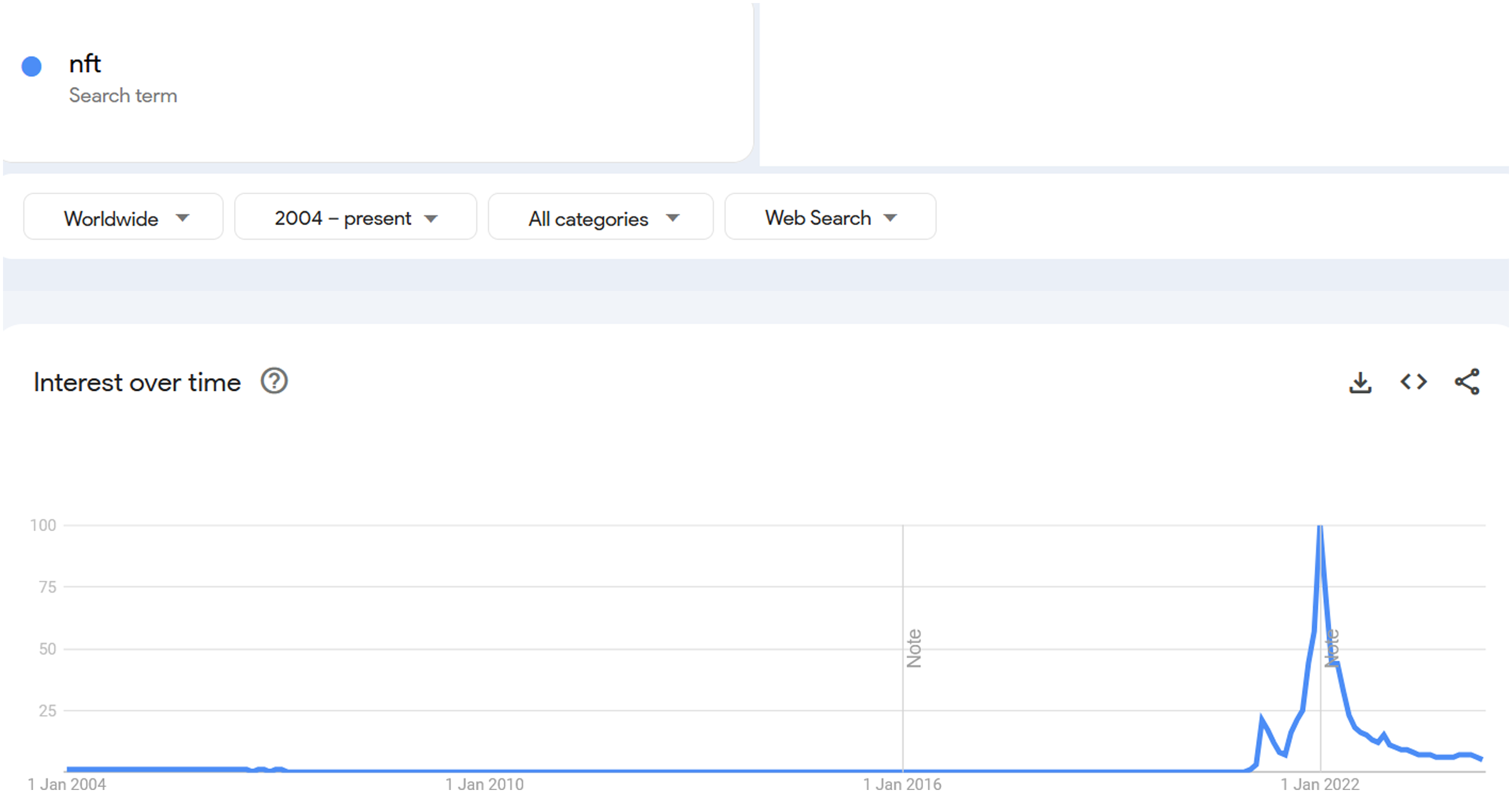
NFT's Google Trends (on 10 May 2024).
NFTs originate from the broader development of blockchain technology and the desire to represent ownership and scarcity of digital assets. The acronym ‘NFT’ stands for ‘Non-Fungible Token’, which is a cryptographic digital asset on a blockchain, that is, a tamper-proof online ledger with public records of transactions and ownership history. Thus, facilitated by blockchain technology, NFTs testify to the ownership and proof of authenticity of some unique content. Each takes the form of a digital item (e.g. an image) with its unique code and metadata. As the very name suggests, NFTs (unlike cryptocurrencies, which are fungible tokens that can be exchanged on a one-to-one basis) are unique and cannot be exchanged on a like-for-like basis. Nor can they be modified, replicated or destroyed. However, NFTs can be bought, sold, or traded on various online marketplaces and platforms, being easily moved across different online ecosystems. 2
Any human artefact or possession, whether or not palpable, can be turned into an NFT in the process of tokenisation. Thus, NFTs represent tangible real-world assets, such as artwork, possessions of all kinds and even human body parts, identities or souls. Any items minted as tokens are (or, at least, can be) exchanged or traded for real money, sometimes at exorbitant prices, while the actual items remain with the original authors or owners and/or may be easily available to the public, as is the case with songs (Krasikov, 2022) or pictures of individuals serving as meme templates. As Mackenzie and Bērziņa (2022) explain, ‘When you buy the NFT, you get a token that purports to be both a definitive indicator of ownership’ and ‘a definitive indicator of the authenticity’ of the item it represents. However, this ownership and originality cannot be guaranteed in real-world trade law, as argued for artwork (Chen and Friedmann, 2022; Mackenzie and Bērziņa, 2022).
Despite NFTs’ rather elusive and questionable nature (in both legal and epistemic dimensions), the NFT trade boomed in 2021 and 2022, attracting a plethora of NFT artists and NFT collectors, as well as leading auction houses. This is, presumably, thanks to the allure of high gains. Also, the NFT market gives users a thrill of excitement similar to gambling as they engage in the digital gold rush, enticed by famous lucrative sales and individual stories of success circulated across new media. 3
Surprisingly, the collectable NFT hype has attracted very little attention in the humanities and social sciences, with a lacuna observable in communication and discourse studies. This paper addresses this gap by zooming in on users’ views on NFTs as communicated through their memetic practices on social media. The point of departure for the present exploration is that Internet memes offer insight into multiple user perspectives on a given issue, such as the NFT market. Communicated through memes, user views are not instructed or restricted by specific survey questions and suitable for analysis from a chosen theoretical angle (cf. Scheiding, 2022). The present corpus-based qualitative investigation into NFT memes conducted through a Multimodal Critical Discourse Analytic lens concentrates on the (de)legitimisation of NFTs. The impetus for this study is to offer not only new empirical findings but also a theoretical proposal to the field of discursive (de)legitimisation and memetic humour research by teasing apart the (de)legitimising stances that users assume towards the convoluted construct. It is thus argued that, due to the complex and problematic nature of the concept of NFTs, users’ (de)legitimising stances escape the original binary distinction. Therefore, in addition to showcasing users’ evaluations of the NFT trade, this study makes an important theoretical contribution to the research on discursive (de)legitimisation, namely the concept of quasi-legitimisation that transcends the standard legitimisation–delegitimisation dichotomy.
This paper is organised into six sections. Following this introduction, the second section provides the theoretical foundation for this study; it gives a critical introduction to the notions of legitimisation and delegitimisation, and (de)legitimisation through Internet memes. Further, the methodology is detailed, with a focus on the data collection procedure and the premises underlying the analysis, which is presented in the next section. The patterns identified and unpacked in the analysis are elaborated on in ‘Discussion’. The paper closes with ‘Conclusions', offering a summary and suggesting a few avenues for future research.
Theoretical background: (de)legitimisation through memes
Legitimisation or legitimation can be roughly explained as the process of casting a practice as socially acceptable, whereas the reverse process of delegitimisation involves framing a practice as socially unacceptable. These two concepts, jointly referred to as (de)legitimisation, are used across academic disciplines and associated with a variety of analytic frameworks. In this paper, (de)legitimisation is regarded as a multimodal discursive practice, which is thus best examined from the perspective of social semiotics, which draws on Critical Discourse Analysis (CDA). According to this research tradition, legitimisation is defined as a ‘process by which speakers [or users] accredit or license a type of social behavior’, it serves as ‘a justification of a behavior (mental or physical)’ and is ‘enacted by argumentation’, with its prime goal being to seek approval and support from others (Reyes, 2011: 782). By contrast, delegitimisation may be defined as a discursive practice of discrediting and censuring a given social practice also in anticipation of garnering approval and support from others.
In line with Habermasian thought, (de)legitimisation is a subjective process, albeit dependent on negotiable cultural values and norms (Mackay 2015; Ross and Rivers, 2018). Thus, as Reyes (2011) rightly proposes, (de)legitimisation is facilitated by and reflects shared social values (see Francesconi, 1982), with each act of (de)legitimisation being oriented towards earning support and approval. In CDA, the notion of (de)legitimisation has been traditionally employed primarily with reference to the discursive legitimisation of institutions and political figures. However, discursive legitimisation can also capture concepts outside institutionalised political discourse, namely user-generated social media discourse (cf. Ross, 2018; Ross and Rivers, 2018; Yu and Yan, 2021). This is what this paper is concerned with, zooming in on the practices of NFT creation and trade and, specifically, the concept of NFTs, as represented in Internet memes.
The central aim here is to explore the (de)legitimisation stances that emanate from user-generated memes involving multiple semiotic modalities. This study is grounded in Van Leeuwen's (2007) original proposal that (de)legitimisation may be performed via not only language but also multimodal means and that it applies to not only public discourse but also everyday interpersonal communication. Shared through open social media platforms, multimodal Internet memes exhibit the properties of individual users’ discourse (which is personal rather than institutional) while, at the same time, being publicly available and potentially having a high social impact.
Internet memes (hereafter, ‘memes’ used as shorthand) are conceptualised as multimodal user-generated digital items, very often (but not always) humorous, that emerge as multiple instantiations of a selected memetic construct, the Dawkinsian meme (Dynel, 2022), and proliferate on social media through transformation and replication, thus ‘sharing common characteristics of content, form, and/or stance' (Shifman, 2013: 41). A meme's stance is the discursive orientation through which its author places 'themselves in relation to the text, its linguistic codes, its addressees, and other potential speakers’ (Shifman, 2013: 40). Most importantly, the stance can be positive or critical of the content represented in a given meme. Whether or not explicitly examining the concept of a stance, among the vast scholarship on memes that focus on pertinent socio-political issues, some papers regard memetic items as contributions to polyvocal discussions, not infrequently reporting the polarisation of user opinions (Dynel and Poppi, 2021; Makhortykh and González Aguilar, 2020; Milner, 2013; Ross and Rivers, 2017a). Not only social facts and political figures but also social practices that people engage in may invite polarised opinions reflected in memes, which thus serve as vehicles for (de)legitimisation. Legitimisation and delegitimisation, it is proposed here, are the concomitants of users’ stances, either positive or negative, which can be communicated through various discursive strategies.
According to a well-entrenched research tradition designed by Van Leeuwen (1996, 2007) widely pursued in Critical Discourse Studies, legitimisation is realised through four discursive strategies: authorisation, rationalisation, moral evaluation and mythopoesis. Programmatically, these legitimising strategies may be used jointly. However, it needs to be noted that they are not mutually exclusive by design. This is primarily because mythopoesis (i.e. storytelling/narratives through either moral tales or cautionary tales, which report on rewarding social actors for legitimate actions and punishing them for illegitimate actions) concerns one specific discourse genre (presumably, prominent in Van Leeuwen's (1996) original dataset). 4 The two types of narratives may coincide with the remaining strategies, most notably moral evaluation, which captures legitimisation through referring to value systems. According to Van Leeuwen (2007), moral evaluation is divided into abstraction (e.g. ‘forge academic links’ about writing academic emails to unknown colleagues), analogies (e.g. ‘treat your job like your child’) and evaluation (sic), which amounts to evaluative adjectives (e.g. ‘well-organised’ or ‘commendable’). Nevertheless, evaluation—it is proposed here—can be extended to cover any evaluative language, displaying varying degrees of implicitness (Dynel, 2018). Ultimately, any specific evaluative dimension boils down to the binary 'good versus bad' distinction (Hunston, 2004). On a higher plane, all forms of (de)legitimisation, including those which materialise through authorisation and rationalisation, rest on this kind of generic evaluation. In line with Van Leeuwen's (2007) conceptualisation, authorisation relies on invoking the authority vested in experts or role models (e.g. ‘My mentor says that’). Alternatively, authority may be impersonal, depending on conformity in line with tradition, custom or law (as in ‘the rules state that’). Last but not least, rationalisation is connected with the goals and utility of a social practice and is divided into two types: instrumental and theoretical rationalisation. Instrumental rationalisation legitimises practices through goal orientation or effect orientation and is ‘founded on the principle of success, of “whether it works or not”, that is, on a rationality of means and ends’ (Van Leeuwen, 2007: 101). In turn, theoretical rationalisation reflects ‘a natural order of things’ (Van Leeuwen, 2007: 101); it involves definitions reliant on objectivated and generalised notions, explanations invoking generalisations, or predictions supported by expertise. As Van Leeuwen (2007: 92) underscores, these strategies of legitimisation ‘can be used to legitimize, but also to de-legitimize, to critique’ and they can also be rendered multimodally. This is the central premise underlying the research on (de)legitimisation through memes (Montieri, 2018; Ross and Rivers, 2017b; Ross, 2018). Most of this literature has focused on the delegitimising potential of memes. As Ross (2018: 105) puts it, the fact that memes tend to ‘criticize or mock aligns with the discursive practice of delegitimization—the inverted sibling of legitimization’.
In order to account for delegitimisation through (memetic) humour, some authors have proposed inverse strategies, rather than using the original ones, to capture their data. For instance, Montieri (2018) puts forward the strategies of (un)authorisation in memes: moral (de)evaluation, (ir)rationalisation, and (anti)mythopoesis. For their part, Neag and Berger (2018), taking Reye’s (2011) classification as their point of departure, propose five categories of delegitimisation for political parody: comic relief (the use of absurd humour), a ridiculed hypothetical future, irrationality, voices of non-experts and ridiculed altruism (i.e. highlighting politicians’ self-serving actions). However, it should be stressed that these lexical-opposition-based categories are not entirely obvious (e.g. it is not clear what the opposite of the form-based notion of mythopoesis, i.e. narration-telling, formally is). Additionally, while the reverse categories may nicely capture select data or specific examples, they cannot be deemed universal or exhaustive. For example, the relevant ways of humorous delegitimisation are not limited to faulty rationality (e.g. it might suffice to refer to other forms of rationality) or non-expert voices (e.g. other expert voices may be involved). All things considered, it seems most reasonable to approach delegitimisation in memes with the toolkit provided by Van Leeuwen (1996, 2007). This classical proposal of overlapping legitimisation strategies has been shown to serve the opposite purpose, namely delegitimisation, through a variety of data-specific means (Harbo, 2022; Ross and Rivers, 2017b). Nonetheless, this is not to suggest that memes cannot perform the legitimising function, as the current study on NFT memes will demonstrate, besides putting forth the new notion of quasi-legitimisation.
Methodology
The memetic data for this study were scraped on 5 October 2022 through Twitter's API (in line with a previously obtained permission from Twitter to carry out the author's research project) based on the case-insensitive search term ‘#nftmeme’ and the media file filter. The vast and eclectic space of Twitter was preferred as the source of memetic data over any other platform devoted specifically to memes in order to pre-empt any potential bias due to social influence mechanisms within specific user communities operating at humour hubs (e.g. on Reddit or 4/chan), which tend to have clear in-group out-group dynamics. The search covered tweets submitted over a period of one year from 1 August 2021 to 1 August 2022. The selection of this specific timespan was guided by Google Trends for the search word ‘nft’ (Figure 2). Having arisen as a search term in the first week of February 2021, the notion of NFT continued to generate increasing interest, reaching the peak in January 2022, only to gradually lose its impact over the year. Therefore, the selected one-year period coincides with the concept's highest popularity (10–100 in Google Trends), which was expected to correspond with the largest number of memes showcasing a wide range of user opinions on NFTs that lend themselves to (de)legitimisation considerations.
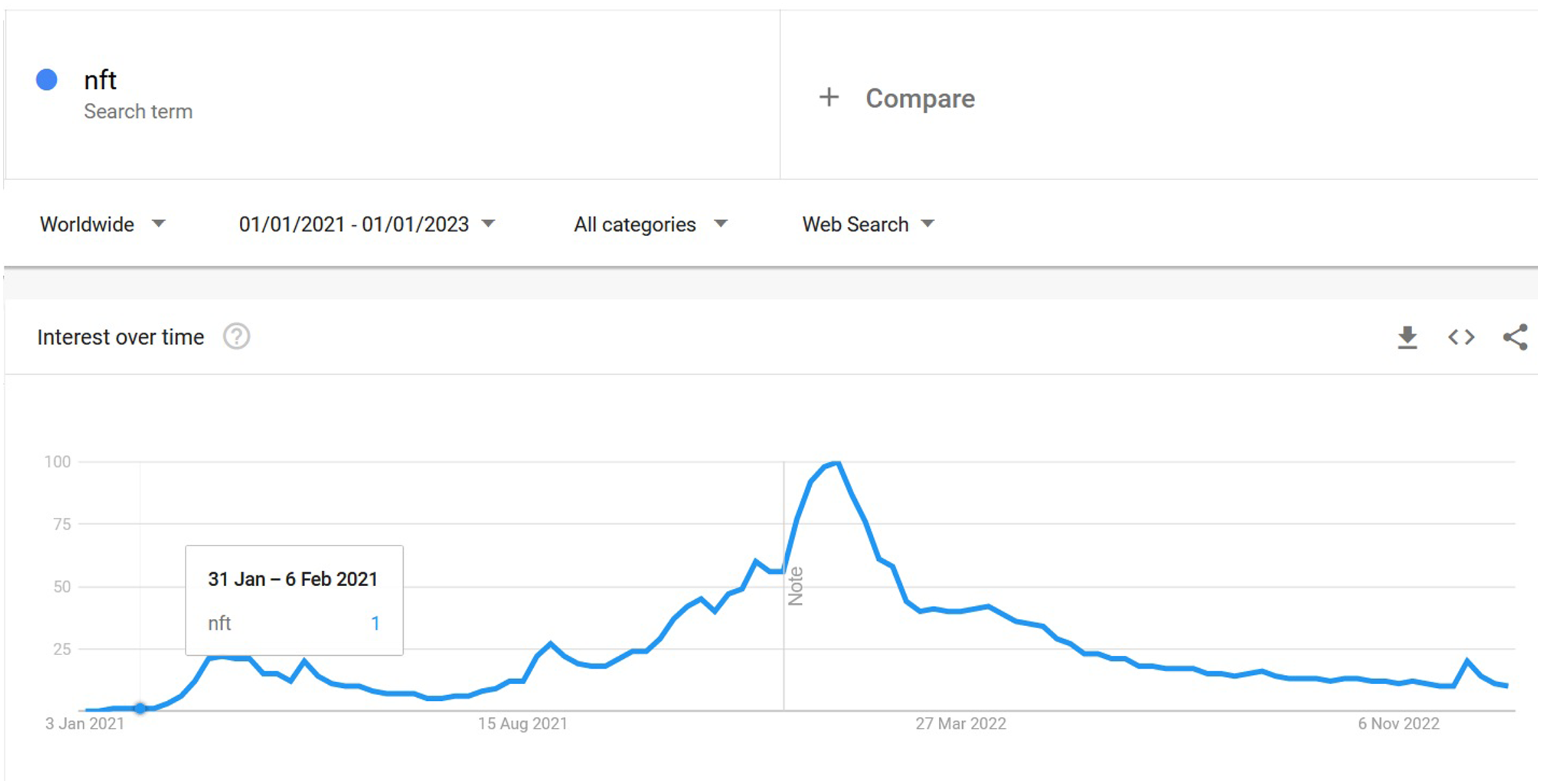
NFT's peak in Google Trends.
This automated data collection procedure yielded a corpus of 1628 items, which were carefully verified to eliminate duplicates or false positives (i.e. non-memetic content misleadingly tagged by tweeters as a 'meme’). In the next step, the harvest (altogether 1345 memes) was reviewed through the lens of Multimodal Critical Discourse Analysis, which is based on the premises of CDA applied to messages communicated through multiple modes beyond the verbal one (Machin and Mayr, 2012; Machin, 2013). What this means in practice is that various verbal and visual components of the digital items were considered, together with their socio-culturally contextualised meanings involving, for instance, intertextual references. Thereby, the memes addressing the generic concept of NFT, as seen by tweeters, were selected as the central focus of analysis, whereas memes referring to specific NFTs, their peculiar characteristics or salient stories of their sales (e.g. involving celebrities) were discarded from the main dataset given the purpose of the study. Based on this two-stage process of manual screening and trimming of the corpus, the core dataset of 993 relevant memes was extracted.
To arrive at the central (de)legitimising messages, these curated NFT data were scrutinised, again using the tool kit of Multimodal Critical Discourse Analysis, with an eye to the strategies of discursive (de)legitimisation stipulated by Van Leeuwen (2007), which may coincide and/or overlap. However, as the analysis was instigated, it soon became clear that a large part of the data eluded the binary qualification, not being amenable to (de)legitimisation distinctions. Thus, as the analysis was conducted, the deductive (top-down) procedure was supplemented by an inductive (bottom-up) one in a systematic search for patterns among the memes. An iterative procedure was applied, with the examples necessitating some relabelling as the analysis progressed, to guarantee saturation of description (i.e. to include the 993 examples). This resulted in a codebook (reflected by the categories discerned) that transcends the two-fold 'legitimisation versus delegitimisation' distinction. The purpose of this investigation is strictly qualitative, and the categories are the central focus of attention, inspiring theoretical developments for (de)legitimisation research.
The next section presents the findings of this qualitative analysis, based on a convenience sample of examples (clustered in groups of three) that best illustrate the memetic (de)legitimisation patterns and methodological issues identified in the course of the data examination process. As the stances are discussed, the generic notion of the meme author/producer is used and equated with the meme narrator (if present), although it cannot be ruled out that users might create memes in the first person for rhetorical purposes, while not talking about themselves sincerely (which cannot ever be unequivocally determined).
(De)legitimising discourse patterns in NFT memes
This analysis of discourse patterns identified starts with the straightforward types and gradually shifts to more complex and epistemically vague ones. Among the diverse patterns, only the first two correspond with the clear-cut binary distinction between legitimisation and delegitimisation.
A salient trend emanating from the dataset encompasses memes that evaluate positively, and thus legitimise, NFTs (Figure 3). In 3A, the meme author deprecatorily depicts themselves as a non-achiever, metaphorically represented in the visual by Joaquin Phoenix's Arthur Fleck in the film entitled Joker,a socially disregarded man and an underappreciated stand-up comedian who works as a clown and whose hapless life may also be interpreted as the cautionary tale strategy. The legitimisation of NFTs as a source of quick financial success arises through the meme narrator's negative self-comparison with a young but accomplished NFT author, who comes across as a figure of authority, and through the reported fact about the lucrative sale (cf. instrumental rationalisation). NFTs are thus legitimised by being associated with positive values (skilfulness and financial success) and contrasted with the quintessential underachiever's mundane means of scraping a living. Adopting similar self-disparaging rhetoric and comparison to an extremely naïve person (through the intertextual reference to Jim Carrey's character featuring in what is known as the ‘dumb and dumber limo’ template), the author of the meme in 3B appears to express their zealous interest in NFTs, which they have extreme difficulty grasping, nonetheless. In this memetic instantiation of the template, NFTs are conceived of as the object of attention and desire from the perspective of an individual who stands no chance of attaining it. This NFT-legitimising meme also casts ‘people talking’, who seem to be pictured as individuals with more know-how, as authorities and asserts the status of NFTs through social validation. Thirdly, in the rather self-explanatory meme in 3C, the juxtaposition of the two shots from Squid Game (Yeong-su Oh's character in two different emotional states: sadness and happiness) positions the NFT trader as a happy, successful person (as opposed to a different cryptocurrency trader) in line with the strategies of authorisation and instrumental rationalisation. This comparison-based meme unequivocally legitimises NFTs, pointing to their superiority over an alternative digital asset.
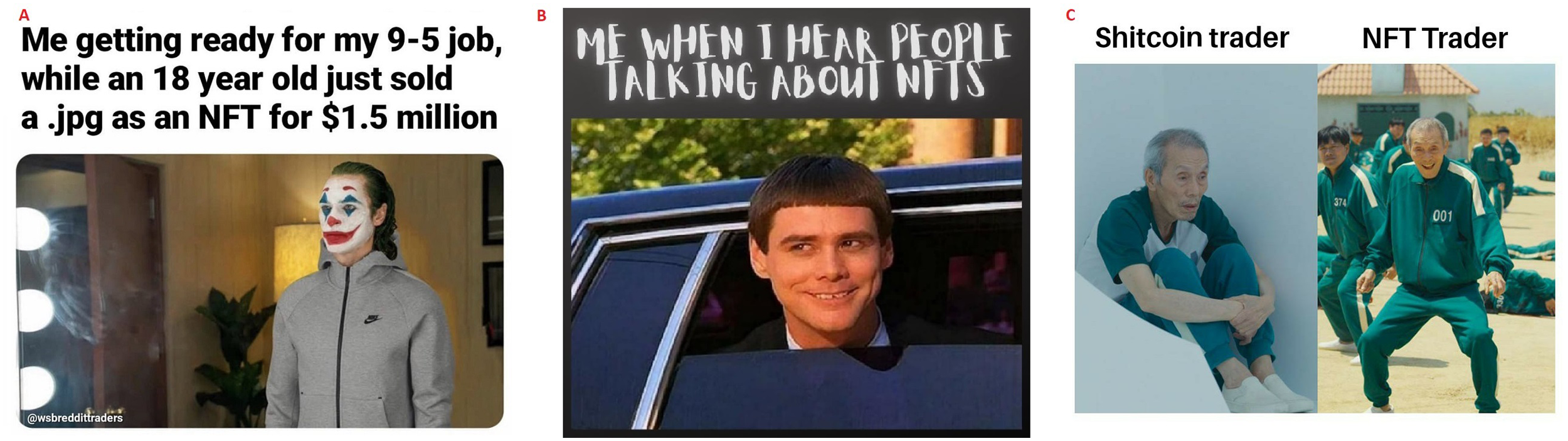
Legitimising stance.
To take stock, in these three memes (similar to other legitimising memes in the dataset), NFTs are depicted positively as conceptually attractive ideas and valuable assets that bring traders financial successes (regarded as a key goal in life or a source of happiness). By contrast, the delegitimising memes category places emphasis on the perceived absurdity of NFTs’ nature as such, which the examples in Figure 4 illustrate.
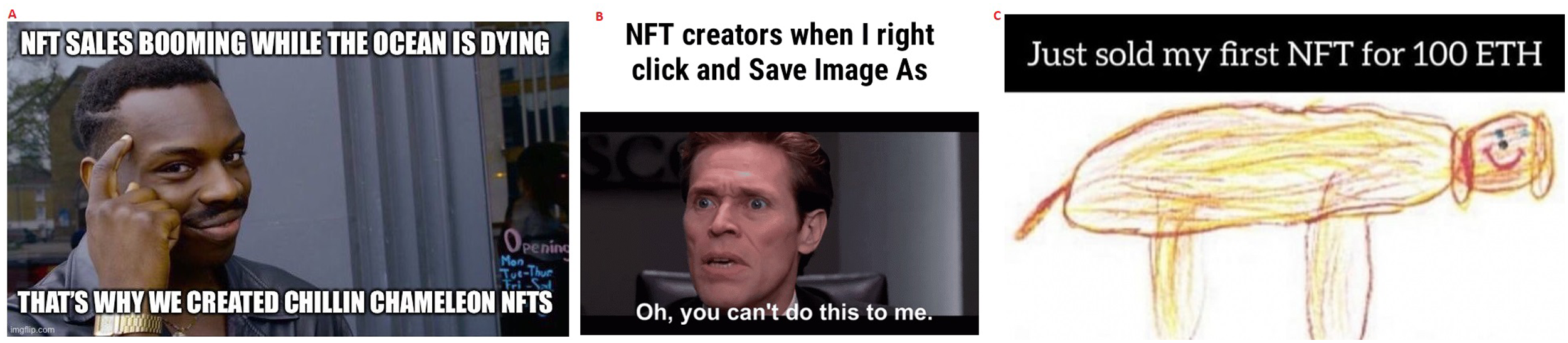
Delegitimising stance.
Echoing and ridiculing the collective authority voice of NFT traders, the author of the meme in 4A points out the dubious ontological status of NFTs and their ultimate insignificance. Specifically, anchored in the Roll Safe meme template, which is conventionally used in memes that ridicule poor thinking or decision-making, 5 the meme mocks the faulty logic of NFT traders. Faced with the rather wild accusation (presented for the sake of the rhetorical effect through an appeal to emotions), NFT traders are shown as if they truly believe that a selected group of images of chilling chameleons, which are ideologically focused on ocean conservation, could stave off natural disasters. By pointing out this ascribed irrational argument, the meme appears to delegitimise NFTs. 4C achieves the same objective, calling attention tothe basic property of NFTs, which makes them verge on absurdity; NFTs are predicated on a condition that can be easily violated through downloading and saving a digital image, to the chagrin of NFTs’ creators, whose outrage is visualised by Willem Dafoe's expression in a shot from Spiderman. Again, the meme's author invokes the NFT traders’ perspective only to disparage it. Finally, in 4C, again taking the voice of an NFT creator, the user purports to brag about their first NFT-related financial success, which stems from what resembles/is a small child's unsophisticated drawing of a dog. Its rudimentary form serves as a cue that the success story cannot be genuine, and the meme author is simply ridiculing the NFT trade as involving no skills on the artists’ part and resting on buyers’ naïvety (given their belief that they can acquire something worthy). Thereby, the notion of NFTs is discredited through undermined instrumental rationalisation.
While the meme authors’ stances translating into legitimising versus delegitimising aims that polarise the social media community seem to be quite evident in the cases illustrated by the six examples above, many memes resist this simple binary qualification. The first group of such memes can be considered to represent both legitimisation and delegitimisation, constituting blends of the two divergent stances, as the next two categories indicate.
The memes in Figure 5 represent conflicting stances on NFTs: the meme narrators’ legitimisation operates in tandem with the reported delegitimisation performed by other individuals, such as their family members and friends. Unlike in the previous category, neither of the perspectives appears to be evidently favoured or prioritised, but rather sincerely presented, with the meme authors simply recognising the existence of the conflicting stances. The users legitimise the NFT activity through instrumental rationalisation, admitting that they engage in it (5B) to amass wealth (5A) or that they are eager to talk about NFTs (5C). Simultaneously, however, NFTs are conceptualised as being incomprehensible to other people, such as the impervious mother (cf. the brick wall metaphor in 5A). Alternatively, the memes report that NFTs are regarded as being so preposterous as to cause derisive laughter in the trader's family members (embodied by the American politicians in 5B) or are dismissed as a conversational topic by the user's friends (5C). These discourses of delegitimisation are based on personal authorisation by people valued by the meme narrators.
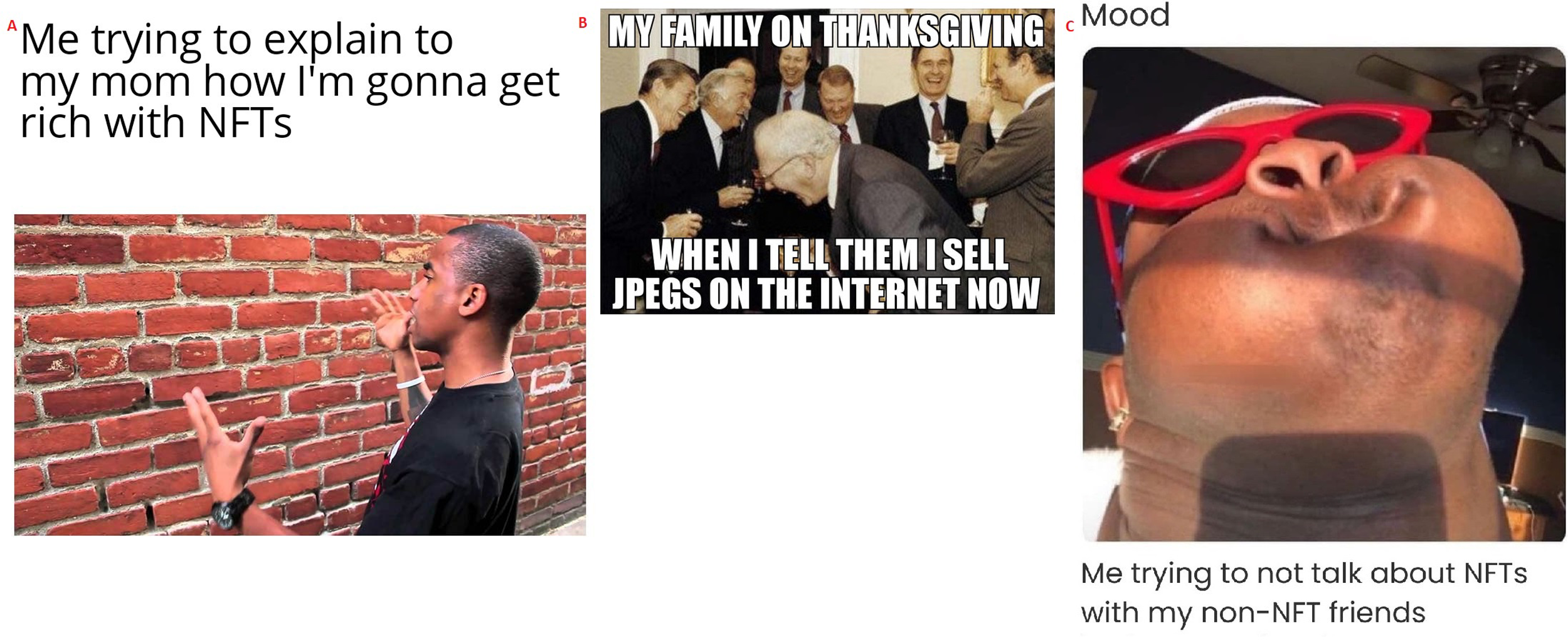
Juxtaposed legitimising and delegitimising stances.
Besides acknowledging a conflict of opinion between themselves and others, meme authors sometimes explicitly admit to having mixed feelings about NFTs, again with neither positive nor negative stance taking priority.
The memes in Figure 6 focus on the internal conflicts that NFTs provoke in traders themselves. 6A juxtaposes the NFT trader's two emotional states (based on two images of little girls) to capture their deriving pleasure from NFT creation and their suffering at work irrespective of the profit that it brings. This meme indicates that NFT creation is pleasurable (cf. legitimisation) even though it is not financially rewarding (delegitimisation). Alluding to the Arthur Fleck—Joker split image (another intertextual reference to Joaquin Phoenix's character), the meme in 6B presents the conflicting forces driving the NFT trader, who may be losing faith in their NFT success (delegitimisation) whilst continuing to encourage others to engage in the practice (legitimisation). Finally, another meme capitalising on two shots from Squid Game (6C) illustrates the temporal shifts in NFT traders’ emotional experience depending on their actions; a major financial investment in NFTs causes frustration upon the realisation of the money having been wasted (delegitimisation), whereas a nonmaterial achievement is a source of joy and satisfaction (legitimisation). These contradictory (de)legitimisation effects are exerted through rationalisation. From an outsider's perspective, these memes may be taken to suggest the irrationality of meme narrators, who disregard their financial losses and are over-excited about the activity as such or encourage others to join in the NFT trade despite their own financial losses and failures in this respect. However, the meme narrators/creators may genuinely believe that the non-material values balance (or even outweigh) any financial disadvantages and that the activity is worth undertaking against all odds.
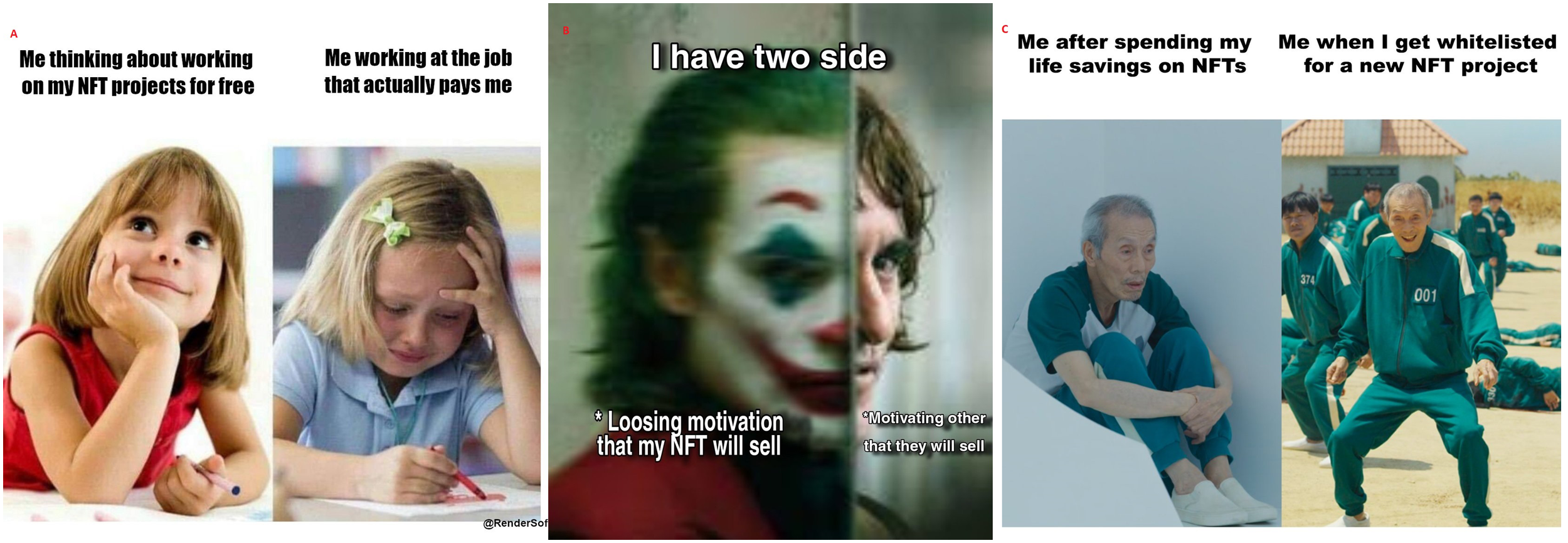
Ambivalent (de)legitimising stance.
Moving forward on the complexity continuum, memes such as those in Figure 7 appear to be geared towards (de)legitimisation effects, but it is difficult to determine the meme producer's stance.
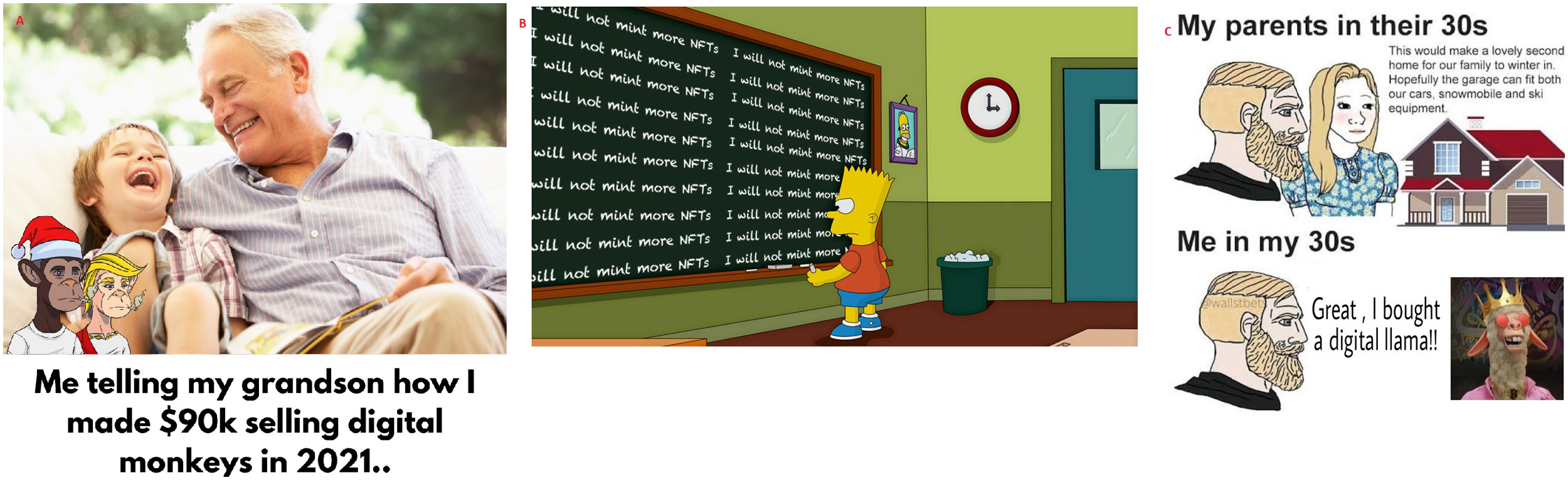
Ambiguous (de)legitimising stance.
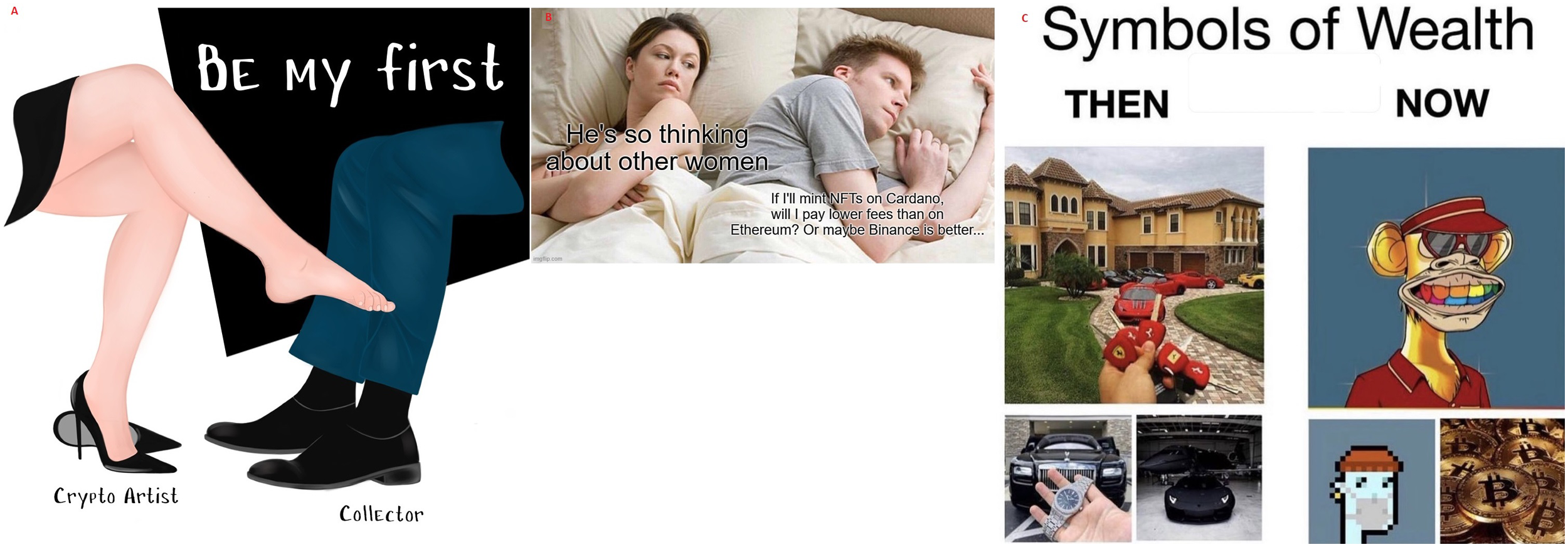
Elusive (de)legitimising stance (the NFT reality).
The meme in 7A may be interpreted as a moral or cautionary tale, picturing the hypothetical future of an NFT creator regaling his grandson with stories from the past. However, it is impossible to tell whether the two are laughing at the absurdity of the grandfather's NFT deal (delegitimisation) or rejoicing at the small fortune that NFTs brought the trader and his family (legitimisation). The delegitimisation-legitimisation ambiguity also applies to the edited screenshot from The Simpsons featuring Bart writing lines (7B), which is a rather old-fashioned form of punishment handed out to misbehaving pupils and based on copying a sentence that reflects the reason for the punishment. This meme invites two alternative interpretations. Minting NFTs is considered either a genuinely punishable activity in which young people are engaged (delegitimisation) or a prevalent practice that even pupils at school will follow rather than focus on lessons, regardless of the (mild) punishment this may bring them (legitimisation). Finally, 7C juxtaposes the priorities of contemporary tricenarians and their parents. While the latter are shown to have focussed on the acquisition of properties for the sake of their family's comfort, the former are presented as single people investing in ephemeral NFTs. Again, this opens up two interpretative possibilities about the meme author's stance: either contemporary tricenarians, epitomised by the meme narrator, are ridiculed for investing in worthless and ridiculous items (cf. delegitimisation), or they are simply depicted as having priorities other than their predecessors, who may actually be considered overly materialistic. On this latter reading, however uncanny NFTs may be, they are presented as a hallmark of today's socio-economic reality, which places less emphasis on the accumulation of material goods, suggesting that people may favour and find pleasure in impalpable purchases. Despite the narrative construction of the meme, which might suggest that the meme narrator empathises with the latter view, the actual (de)legitimising stance cannot be determined.
While each individual may have their preferred readings for these three cases in Figure 7 (possibly even being oblivious to the ambiguity detected through analysis), it is impossible to tell which of the interpretations is the one intended by the meme author. It is reasonable, however, to claim that each of the memes does have an evaluative thrust, because it emanates from the multimodal content as the central message, and thus a (de)legitimising goal. By contrast, in other epistemically elusive cases, it is not always certain whether or not the memes have this evaluative or (de)legitimising objective. This concerns the memes that specifically address NFTs’ impact on traders’ lives (Figure 8) and the NFT-affected contemporary world (Figure 9), with no analytically decipherable evidence of any judgement being passed.
The meme in 8A metaphorically showcases one of the characteristics of NFT trading: each beginning crypto artist (i.e. an NFT creator) needs to lure the first buyer so that others follow suit. This basic process, likened to a woman's flirting sneakily with a man under a table, does not seem to be the subject of the meme author's evident evaluation. Hence, the meme neither legitimises nor delegitimises NFTs. Similarly, based on what is known as the ‘I bet he is thinking about other women’ template, 8B presents the worries of an NFT trader that affect his personal romantic life. This negative outcome of the NFT business is manifested in the proverbial vignette of the suspicious woman and the disinterested man, whose thoughts revolve not around a mistress but around NFTs. However, it cannot be concluded that NFTs are thus delegitimised. Rather, the NFT trade is conceived as a contemporary line of business, which involves strategic decision-making. Finally, the meme in 8C objectively posits NFTs as socially recognised assets in the contemporary world (even if hyperbolically presenting material possessions as a thing of the past). Unlike 7C (which may look similar), this one does not display any evaluative aspirations as the past and current symbols of wealth are only factually contrasted.
A related category illustrated by the memes in Figure 9 addresses NFTs’ impact on contemporary reality with no evident (de)legitimising thrust through considering NFTs to be as prevalent as to manifest themselves in well-known cultural artefacts (see Dynel, 2022 for a similar memetic trend).
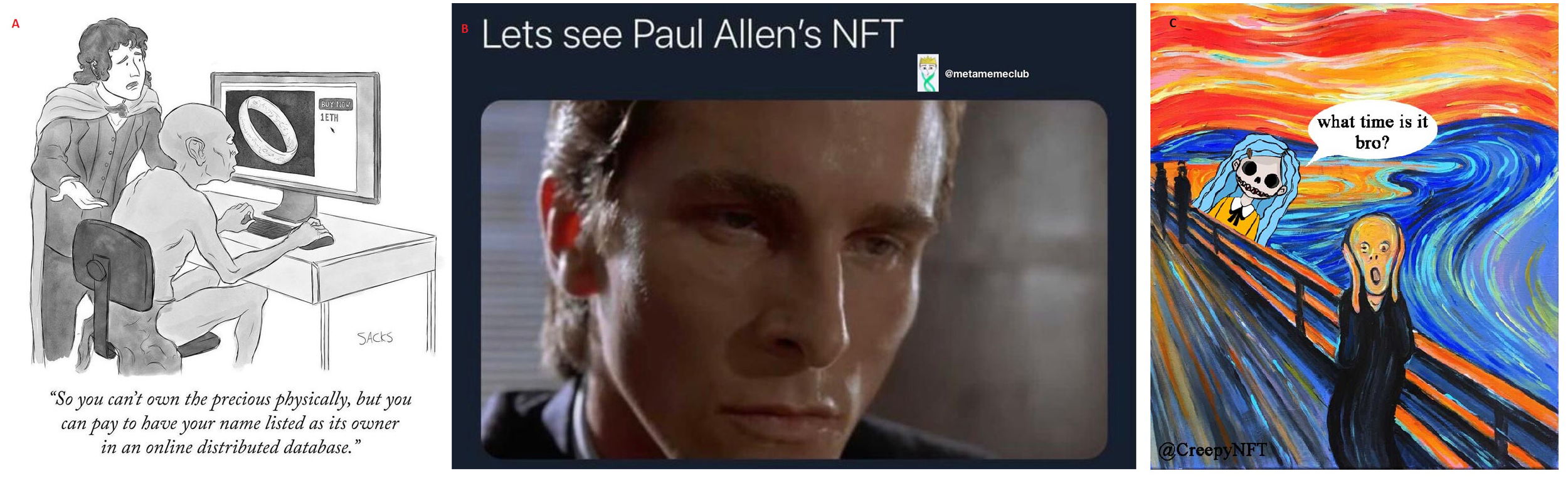
Elusive (de)legitimising stance (NFTs in cultural artefacts).
The rather exceptional item in 9A may be seen as both an objective definition of the nature of NFTs (falling into the previous category) and a case of NFTs’ permeating Tolkien's fictional world. The original drawing, 6 decontextualised and tweeted as a meme (cf. Dynel, 2024),transposes the concept of NFTs into the realities of the fictional world of The Lord of the Rings, where the physical possession of the ring (Gollum's ‘precious’) was originally the ultimate goal. With the arrival of NFTs, this is not possible anymore, as Frodo Baggins is explaining to Gollum, who is staring in awe at the computer screen. On the other hand, 9B is anchored in a still from American Psycho so that an NFT is conceptualised as yet another dimension in which Patrick Bateman (portrayed by Christian Bale) will obsessively crave to outdo his colleague. Finally, 9C is a version of Edvard Munk's The Scream, with a frightening NFT superimposed on it as if it is the cause of the eponymous scream. As these examples show, grafting the concept of NFTs onto works of art or images directly taken from, or referring to, fictional worlds serves primarily as an acknowledgement that NFTs are commonplace, while no evidence of any clear (de)legitimising stance on this fact can be analytically discerned in the multimodal content.
Discussion
The findings of this empirical study reveal that Van Leeuwen's (1996, 2007) original (de)legitimisation framework does not suffice to capture the memetic data at hand. However, this is not a matter of any specific discursive strategies of (de)legitimisation within the humorous dataset, as may have been the case with other data (Montieri, 2018; Neag and Berger, 2018). Rather, the insufficiency of the theoretical apparatus stems from the fact that the NFT concept is a thorny one; it is difficult to grasp, and its characteristics provoke various doubts of legal, financial and—most importantly here—conceptual nature, while its main allure resides in the salient stories of lucrative sales and the pleasure that NFT creation and trade give to users.
Among the memetic trends identified in the dataset, two categories are in line with the original proposal; they encompass NFT memes with either a legitimising stance or a delegitimising stance (both realised through the classical (de)legitimisation strategies, most notably instrumental rationalisation), being indicative of users’ polarised opinions. In the former case, NFTs are presented as appealing, stimulating and financially rewarding, whereas in the latter case, NFTs are depicted as being questionable or even intrinsically absurd. However, much of the data escapes this neat dichotomous distinction.
Firstly, two categories of memes discerned here rely on the blending of legitimising and delegitimising stances that are brought together on an equal basis. The items in one category juxtapose the stances of different individuals, namely the meme author's legitimisation and someone else's delegitimisation of NFTs, again testifying to the polarisation of vantage points, of which the meme authors are aware and which they report without unequivocally favouring either, not even their own. The memes in the other category display the meme authors’ ambivalent stance, which combines legitimisation with delegitimisation, reflecting each user's internal conflict concerning the practice they (are claiming to) follow. These two memetic categories inspire an elaboration of the existing (de)legitimisation theory: one specimen of multimodal memetic discourse may combine legitimisation effects with delegitimisation effects when conflicting vantage points of different individuals are brought together (echoing existing societal disputes over NFTs) or when the social practice addressed causes an internal conflict in the author of the discourse.
Secondly, some memes exhibit an ambiguous (de)legitimising stance, inviting alternative equipotential interpretations, without offering sufficient multimodal evidence in support of either (Dynel and Poppi, 2021; Dynel, 2021). This category is the upshot of the polarised (de)legitimising stances detected in all the previous categories, which invite a conclusion that no plausible reading should be discounted, as users’ spectrum of opinions and beliefs is wide and diversified. Without further contextual information about the meme or its author (which cannot be ethically recovered), it is impossible to establish the author-intended import of each of these memes or, at least, to extrapolate a convincing interpretation from the evidence provided. Also, a possibility remains that some of the memes have been purposefully designed to be ambiguous. Whatever intention lies at the heart of these memes, they can be claimed to rely on equipotential (de)legitimisation. Such memes do not merely give much interpretative leeway but rather defy any plausible analysis.
Thirdly, the remainder of the dataset displays no evident (de)legitimising stance. These elusive-stance memes fall into two categories: those which report in a seemingly factual manner on the NFT-affected reality, and those which position NFTs in the fictional worlds of film and art, and thereby implicitly comment on the prevalence of NFTs, a fact that is not clearly evaluated as either good or bad. These two categories of elusive-stance memes emanating from the dataset might be considered not to be amenable to (de)legitimisation consideration at all. However, this would not be adequate. The fact that the practice of NFT creation and trade generates memetic discourse indicates the users’ recognition of its existence, whether they approve of the practice or not. It seems reasonable to claim that these NFT memes are indicative of the normalisation of NFTs.
'Normalisation' is a polysemous term used across disciplines. CDA research tends to deploy the notion in a Foucauldian tradition as a tool used by those in power to impose new ‘norms’ (Krzyżanowski, 2020). Here, however, normalisation—in line with the contemporary folk use of the word—is understood as a practice performed by multiple individuals on a micro-level, which ultimately leads to macro-social processes, whereby deviant or simply new behaviours are sanctioned and asserted as ‘normal’. This aligns with sociological thought on processes, which may concern (multimodal) discourse, whereby practices grow to be embedded in everyday life and integrated into social contexts (May and Finch, 2009). Hence, whether or not expressing any stance, by generating and/or posting memetic discourse about NFTs, users tacitly testify to the recognition of the phenomenon of NFTs and its social relevance. The fact that the concept of NFTs is addressed suggests that it is recognised, and thus appropriated, as a social phenomenon and something that deserves attention as a memetic focus.
NFTs' normalisation is most pronounced in memes commenting on the fact that the NFT trade is commonplace or has various consequences on users’ daily reality, while no evident evaluation is expressed and no (de)legitimisation stance is taken on NFTs. It may be proposed that such normalisation, in the absence of any (de)legitimisation cues, is a discursive strategy of quasi-legitimisation. Quasi-legitimisation does not mean that a given practice is approved of, which would need to involve positive evaluation typical of legitimisation. However, it does mean that the existence of a social practice (in which people can be involved) is recognised as a socio-cultural fact. Ultimately, this normalisation and quasi-legitimisation may reflect the general tendency in contemporary societies: people choose to be politically correct and open-minded, actively acknowledging the presence of new social facts, even when they cannot fully embrace them or hold no opinions about them. This often involves users’ publicly voicing their acknowledgement on social media (through memes or otherwise) to advertise their keeping abreast of the latest news and receptiveness.
Conclusions
This paper has contributed to the research on the deliberative capacities of humorous memes, thus seen as multimodal contributions in online discussions on socially valid topics. Specifically, this study has examined memes as multimodal discourses of (de)legitimisation, zooming in on the socially valid but awe-inspiring notion of NFTs. A relevant dataset of memes addressing the generic notion of NFTs was manually selected from an automatically generated corpus of Twitter memes. Taking as its point of departure the assumption that these memes would express either a legitimising stance or a delegitimising stance on the notion of NFTs, the empirical study set out to explore the polarised multimodal discourses of (de)legitimisation in the dataset.
The findings attest that NFTs are associated with conflicting social values, which is manifest in the multimodal (de)legitimisation rhetoric of the memes. However, the observation that the processes of legitimisation and delegitimisation, with the previously recognised multimodal discursive realisations, did not exhaust the data at hand was taken as a springboard for the proposal of new (de)legitimisation categories, which reflect the thorny status of the NFT construct. While previous studies have put forward alternative (de)legitimisation frameworks to capture specific language material, here, a proposal was made to develop the original theory beyond the ideal ‘legitimisation versus delegitimisation’ dichotomy.
The proposal of equipotential (de)legitimisation and legitimisation-delegitimisation blends, representing juxtapositions of different individuals’ stances or the meme author's ambivalent stance, are consequent upon the thorny conceptual status of NFTs. Similar to the ideal single-goal discourse types, legitimisation-delegitimisation blends testify to the polarisation of opinions, which the users themselves recognise. The notion of quasi-legitimisation was put forward to capture the memes that do not appear to communicate either legitimisation or delegitimisation stances; rather, they appropriate the practice at hand and approve its existence. A potential goal of future studies may be to examine another dataset of NFT memes or other NFT discourses in quantitative terms to gauge public opinion on selected social platforms. This kind of research may also be conducted from a diachronic perspective to report potential changes in evaluations relative to the development of blockchain platforms. The history of NFTs is still unfolding, and their future outcome remains to be seen, which is also bound to affect user evaluations.
The categories of (de)legitimisation proposed here for NFT memes beyond the two ideal types, that is pure legitimisation and delegitimisation, are not claimed to be necessarily universal, that is manifest in all memetic datasets. However, a statement may be ventured that they can also be found in other discourses addressing other conceptually, morally or otherwise problematic notions, which future empirical studies may validate. There will be many a notion that should undergo investigation as they not only polarise the society but also give rise to other non-binary, ambiguous or ambivalent, evaluations, which is worth pursuing as a research topic. The NFT dataset used in this study reveals the fact that the contemporary memetic landscape may contain many grey areas of memes characterised by equipotential (de)legitimisation, which should not be dismissed as insignificant and removed from datasets; instead, such memes should become the central foci of academic investigation. Most importantly, the idea of quasi-legitimisation as the outcome of discursive normalisation could be proved to hold for many other practices that may be rife but meet social recognition and approval. These are the primary theoretical contributions that I submit for future studies on memes and other discourse types to verify.
Footnotes
Declaration of conflicting interests
The author declared no potential conflicts of interest with respect to the research, authorship, and/or publication of this article.
Funding
The author disclosed receipt of the following financial support for the research, authorship and/or publication of this article: This work was supported by the Narodowe Centrum Nauki (grant number 2018/30/E/HS2/00644).
