




Abstract
Using a combination of descriptive statistics, sentiment analysis and close readings of a collection of 74,336 Swedish tweets, this article explores the platform usage patterns of users who are influential in a Swedish far-right discourse on Twitter and how these users help to (re)produce far-right discourse. Specifically, it focuses on their use of platform functions and on language use. The analysis shows that influential users have a narrow focus in terms of the content they post and how they profile themselves. They are highly active, have more followers and produce more original content than other users. Surprisingly, while previous research has found that emotionally charged tweets are retweeted more and that highly popular and influential Twitter users tend to express more emotion while tweeting, influential users in this dataset often posted far-right content concealed as neutral, factual statements. This use of seemingly neutral language creates an inclusive far-right context, lets influential users evade responsibility for their content as well as facilitates more overtly hateful interpretations.
Introduction
Far-right 1 views are rapidly being mainstreamed into established politics throughout Europe, and also in Sweden. Far-right discourse is also highly prominent on social media, where it successfully engages many social media users. This social media activity helps push the boundaries of what is considered mainstream political discourse, which, in turn, helps normalise and enable the influence of far-right politics in general (Bliuc et al., 2018; Ekman, 2015). Understanding how far-right discourse functions on social media is therefore critical in order to deal with the threat posed by far-right politics on democratic values (Toepfl and Piwoni, 2018).
Essential to understanding how far-right discourse on social media is (re)produced is learning how power is exercised among those who engage in it. While Swedish far-right discourse on social media is receiving scholarly attention (e.g. Ekman, 2015; Merrill and Åkerlund, 2018; Törnberg and Wahlström, 2018), research into far-right discourse has tended to focus on collectives of users, concealing the power of those with greater influence over what is said, that is, those who have the potential to shape others’ political opinions (see Van Dijk, 1993).
However, differences between influential and non-influential users may be subtle, both in terms of their platform activities as well as regarding the types of content they post (Räbiger and Spiliopoulou, 2015). This article aims to analyse such differences in a Swedish far-right discursive setting on Twitter. It looks at how the social media usage patterns of influential users differ from those of others, with a particular focus on their use of language. The specific focus on language is important because the power that influential users possess is discursive. Discursive influence means control over discursive content and the ability to affect the minds of others (Van Dijk, 1993). By extension, influential actors could even have the potential to affect societal structures (Wodak, 2009).
The article uses a combination of descriptive statistics, sentiment analysis and close readings of a collection of 74,336 Swedish tweets sampled via far-right hashtags. The research was guided by the following question:
In what ways are influential users’ use of Twitter’s functions, and their language use, different from that of other users, and how do these social media usage patterns contribute to (re)producing far-right discourse?
Social media and far-right discourse
This age of deep mediatisation (Couldry and Hepp, 2017), where everyday life is increasingly entangled with various forms of mediated communication, has had considerable consequences for the social world. Online platforms are central to this transformation, as van Dijck, Poell and de Waal (2018) argue,
platforms have penetrated the heart of societies – affecting institutions, economic transactions, and social and cultural practices – hence forcing governments and states to adjust their legal and democratic structures. (p. 2)
Beyond a mere technological development, online platforms provide opportunities for participation and inclusion and afford people new personalised ways to manage identity, relationships and information (Schmidt, 2014). However, online settings have also been proven to facilitate and mainstream hateful content (Daniels, 2012; Klein, 2012; Merrill and Åkerlund, 2018), as far-right actors leverage mainstream platforms for their own purposes (Ekman, 2014).
Social media platforms are not restricted by the editorial processes of traditional media, allowing far-right actors to spread their ideas widely, with little filtering (Albrecht et al., 2019). Besides gaining public visibility and reaching new audiences (Ekman, 2014), social media platforms are used by far-right actors to create a sense of unity (Merrill and Åkerlund, 2018), to mobilise grassroot counterpublic activity (Törnberg and Wahlström, 2018) and to incite hate and create alternative narratives. For instance, through forging content (Farkas et al., 2018), through selective referencing to mainstream media (Haller and Holt, 2019) and by bypassing mainstream media entirely, with ‘alternative’ online news sources (Schroeder, 2018).
Central to the (re)production of far-right (populist) discourse both online and offline is the creation of an us and them (Hameleers and Schmuck, 2017; Sakki and Pettersson, 2016; Van Dijk, 1993; Wodak, 2009), including the presentation of an imagined homogeneous, victimised in-group (Hameleers et al., 2019) and the justification for the exclusion of out-groups (Krämer, 2017).
Out-groups include immigrants who are seen as a threat to native culture, values, traditions and heritage and a strain on welfare, housing and employment (Hameleers et al., 2019; Merrill and Åkerlund, 2018) and who should thus be deported (Engesser et al., 2017). The in-group often express a nostalgic desire to restore a lost age of native glory, reconstructed as an idealised time before immigration (Elgenius and Rydgren, 2017; Engesser et al., 2017; Hellström and Nilsson, 2010). Important is also an anti-elitist opposition to mainstream politics and media, as these groups are seen as not representing the imagined homogeneous native ‘people’ (Krämer, 2017).
While research has shown that out-groups online can be highly formed by small numbers of influential users (Scrivens, 2017), little is known in regard to how influential users help (re)producing far-right discourse on social media.
Influence on social media
The manner in which discourse is formed on social media has been described by some as leaderless (Castells, 2012), based on connective action in which horizontally organised networks of users replace the need for a collective us (Bennett and Segerberg, 2013). However, others highlight the importance of leaders and collective identity, especially in less formally organised contexts on social media (Bakardjieva, 2015; Poell and van Dijck, 2018).
Furthermore, while all social media users can create content, possibilities of reaching large audiences with such content differs because of how platforms favour certain content and users (van Dijck and Poell, 2013), but also because user-generated content tend to follow a power-law distribution, where some users come to be more highly connected and produce the majority of content (Merrill and Åkerlund, 2018; see also Barabási and Albert, 1999). This inevitably leads to some users holding more influential positions than others.
Influence on social media can be best defined in terms of who is being listened to and acknowledged by others as being important (Huffaker, 2010). It is a performative sort of influence, where users must ‘continuously produce influential discourse’ (Bakardjieva et al., 2018: 912). Users like these have been called opinion leaders (Post, 2019; Weeks et al., 2017; see also Lazarsfeld et al., 1944) and ‘crowdsourced elites’ who gain recognition and status when their content is shared and mentioned (Papacharissi and Oliveira, 2012).
Previous research has found that uses of platform functions differ between influential and non-influential users, indicating a more strategic use of social media by influential users. Influential users are, for instance, often more active and politically interested (Weeks et al., 2017), have a narrow topical focus (Cha et al., 2010), and actively try to persuade others (Winter and Neubaum, 2016) and attract followers (Hwang, 2015). Extant literature has also made clear that language use differs between influential and non-influential users, where influential users have been found to have more affective and assertive language (Huffaker, 2010), and expresses more negative emotion than other users (Quercia et al., 2011). This is also the case in dedicated far-right settings online, where influential users’ posts are more emotional and derogatory than others’ (Scrivens, 2017).
However, there is also reason to consider the role of specific social media contexts when attempting to understand influence in far-right discursive settings. The different functions of social media platforms, because they enable and constrict certain social actions (Poell, 2014), affect how hate can be expressed (Costello and Hawdon, 2018), but also how influence can take shape.
On Twitter, groups of users form and reform around hashtags and issues in temporary and changeable constellations (Bruns and Burgess, 2011), making influential users harder to detect. The platform also has its own set of regulations and reporting systems (Crawford and Gillespie, 2016), affecting how far-right discourse can be expressed.
Exploring influence in far-right discourse on Twitter, which is not a dedicated far-right forum, helps further understanding of how far-right discourse is (re)produced on social media by providing insight into how those with more power leverage mainstream social media platforms for their own purposes.
Measuring influence
Following established practice of determining influence by interaction with users’ content (e.g. Baviera, 2018; Cha et al., 2010), this article measures influence in two ways, relating to a specific interactive measure – retweeting.
First, by the number of times a user has been retweeted and, second, by the number of individual users who retweet each user. There are numerous examples of studies that sample influential users by the number of times they have been retweeted (e.g. Chorley et al., 2015; Xiao et al., 2014). Retweets illustrate the users’ perceived credibility (Kuo, 2018), as well as their power to reach beyond their immediate network of followers (Cha et al., 2010). Retweets can be seen as an indicator of the importance of a message and, by extension, of the account posting it (Kwak et al., 2010).
By also sampling the number of individual users who retweet a specific account, spam and self-promoters are filtered out from the most influential users. Messages retweeted to a larger group of users have a greater chance of influencing many compared with posts retweeted repeatedly by the same few users. This is because discursive influence is often connected to ‘[m]ore control over more properties of text and context, involving more people’ (Van Dijk, 1993: 257).
Material, data and methods
Tweets were sampled via hashtags aimed at capturing Swedish far-right discourse on Twitter. On Twitter, hashtags have an important organising role as they help to quickly circulate and coordinate discussions (Kuo, 2018), as well as enable user engagement (Jackson et al., 2018).
The hashtags were selected via manual searches on Twitter, starting, due to speculation regarding the potential electoral success of Sweden’s largest far-right party, the Sweden Democrats (SD), with the hashtag ‘#SD’. Additional hashtags were then selected through snowball sampling, where tweets with one hashtag directed the search to other co-occurring hashtags. In total, 23 hashtags 2 were sampled because of their re-occurring use in far-right discussions, ranging from those with party political affiliations and relating to the election, to those that more generally concerned anti-immigration perspectives, as well as those that were more or less covertly racist.
While not specifically focusing on the Swedish general election, this article takes advantage of a timespan when political discussions were particularly prominent in Swedish social media settings. The sample period – beginning on 2 September 2018, briefly before the election, until 22 November 2018 – encompasses a time of political uncertainty in Sweden, due to inconclusive election results. These led to a hung parliament in which negotiations lasted for 131 days before a new government could be formed. In total, the dataset collected, contains 74,336 tweets, retweets, replies and quote tweets, 3 posted by 6809 users.
The unstructured nature of social media data requires methodological flexibility and adaptability (Lindgren, 2016). Automated text analysis can be used both to get an overview of vast datasets and to avoid cherry-picking of qualitative data (Merrill and Åkerlund, 2018). However, these methods should not be understood as a substitute for in-depth, interpretative analysis (Couldry, 2014), particularly in far-right discursive contexts, where language use can be subtle and coded (Merrill and Åkerlund, 2018). Accordingly, this article adopts an approach incorporating both quantitative and interpretative elements.
To respond to the research question, the analysis is divided into two parts: The first focuses on use of Twitter’s functions, and the second focuses on language use. First, influential users were defined, as discussed earlier, by identifying those who had been retweeted the most by the largest number of individual users. Subsequently, these profiles were explored on Twitter. Then, descriptive statistics of how influential users used Twitter’s functions were compared with the patterns among non-influential users. Thereafter, sentiment analysis and qualitative close readings of the dataset contributed with understandings of language use.
Sentiment analysis is a specialised method of understanding emotions in text and, in this article, the Valence Aware Dictionary and sEntiment Reasoner (VADER) was used. VADER is an open-source sentiment lexicon, which is particularly well-suited to microblogging texts as it understands, for instance, emoticons and slang often used on social media (Hutto and Gilbert, 2014).
Finally, all tweets posted by the influential users, 2598 in total, as well as a large sample of non-influential users’ posts and comments, were systematically read and coded with the aim of identifying patterns in users’ representation of far-right discourse, in relation to the levels of sentiment in the tweets.
Ethical considerations
The large amount of user-generated data available on social media requires a number of ethical considerations. Social media information is easily traceable. Hence, there is a need to exercise caution in order to protect user privacy. While social media data can, to some extent, be considered public, it must be recognised that users might not be fully aware or comfortable with their information being used outside of any specific social media setting (boyd and Crawford, 2012). It is also important to emphasise that not all users who post with these hashtags necessarily associate themselves with far-right discourse. Some users perhaps use the hashtags unaware of their concurrent use in far-right discourse, while some users might use them consciously as a form of protest or counteraction.
Furthermore, as this article explores a smaller group of users in depth, particular care was taken not to reveal these users’ identities. Even though the dataset contains public figures, which Williams et al. (2017) suggest require less consideration in terms of anonymity, disclosing their identity could still have repercussions for them. Thus, a minimal number of quotes are presented in the analysis. The few quotes that have been used are, in all instances, translated from Swedish and have been slightly altered so they cannot be traced back to their source. Most often, data are presented at an aggregated and abstracted level to protect anonymity, and statistics concerning users’ accounts are presented using centrality measures so that no individuals can be identified.
The research project has also undergone ethical vetting by an institutional review board.
Platform usage patterns
In this dataset, 739 user accounts, a little over 10% of the 6809 users, have been retweeted at least once. Of these, 16 accounts stand out as having been retweeted more often by a larger number of individual users (see highlighted area in Figure 1). These accounts had been retweeted 729–3226 times by 308–1417 users. Two of the accounts within this span are highlighted in grey. These are the official national Twitter accounts of the far-right political parties Sweden Democrats and Alternative for Sweden. Because far-right organisations have other goals and strategies with their communication than individuals expressing far-right sentiment (Bliuc et al., 2018), and as it is beyond the scope of this article to analyse organisational discourse, these two accounts have not been included in the following analysis.
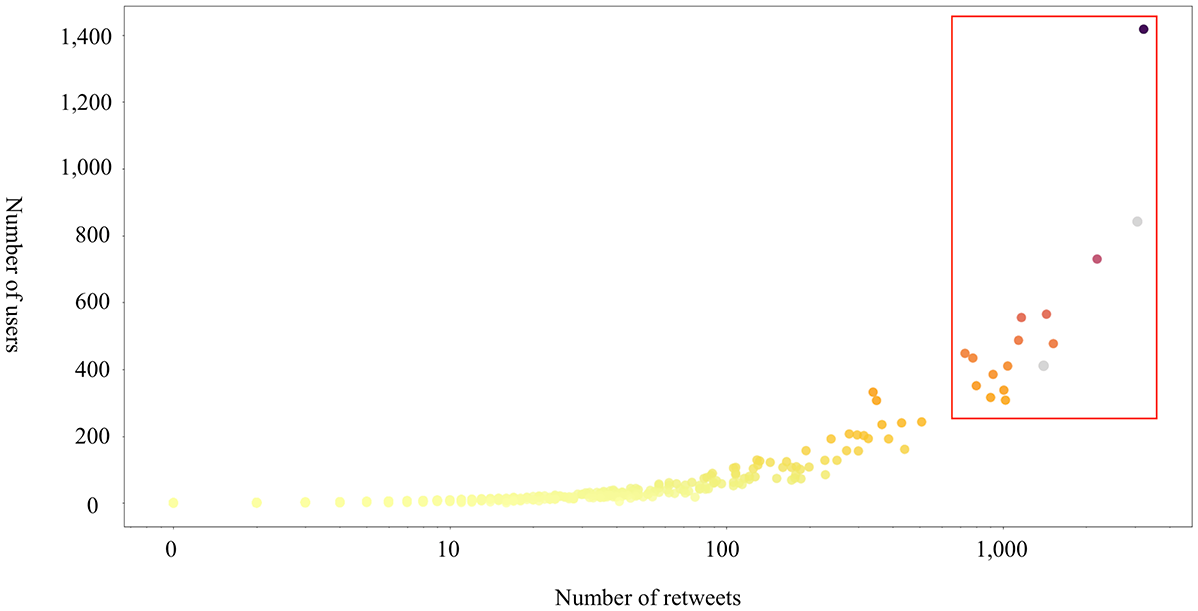
Count of retweets by number of individual users.
The 14 remaining accounts belong to people holding official positions within far-right organisations, to private individuals and to anonymous accounts providing no personal information, all supporting far-right organisations such as Sweden Democrats, Alternative for Sweden, Citizens’ Coalition or far-right politics in general.
When examining the influential accounts more closely, it is obvious how they have profiled themselves entirely focusing on far-right politics – both in terms of the content they share and also in their presentations of themselves in their profiles, making them easier to find compared with users with less detailed profile presentations. Part of their success is potentially due to this narrowness in focus (Cha et al., 2010).
Table 1 provides an overview of differences in platform usage patterns between influential and non-influential users. As seen, influential users are generally more active in posting content 4 compared with other users in the dataset. However, flooding content is often not an influential behaviour, as 10 of 15 of the most active users are not influential, and five of the most influential users are not even among the 100 most active user accounts. Influential users also tended to be much more active ‘likers’ compared with other users in the dataset, giving them further opportunity to get noticed and endorsed by others.
Descriptive statistics of platform usage patterns.
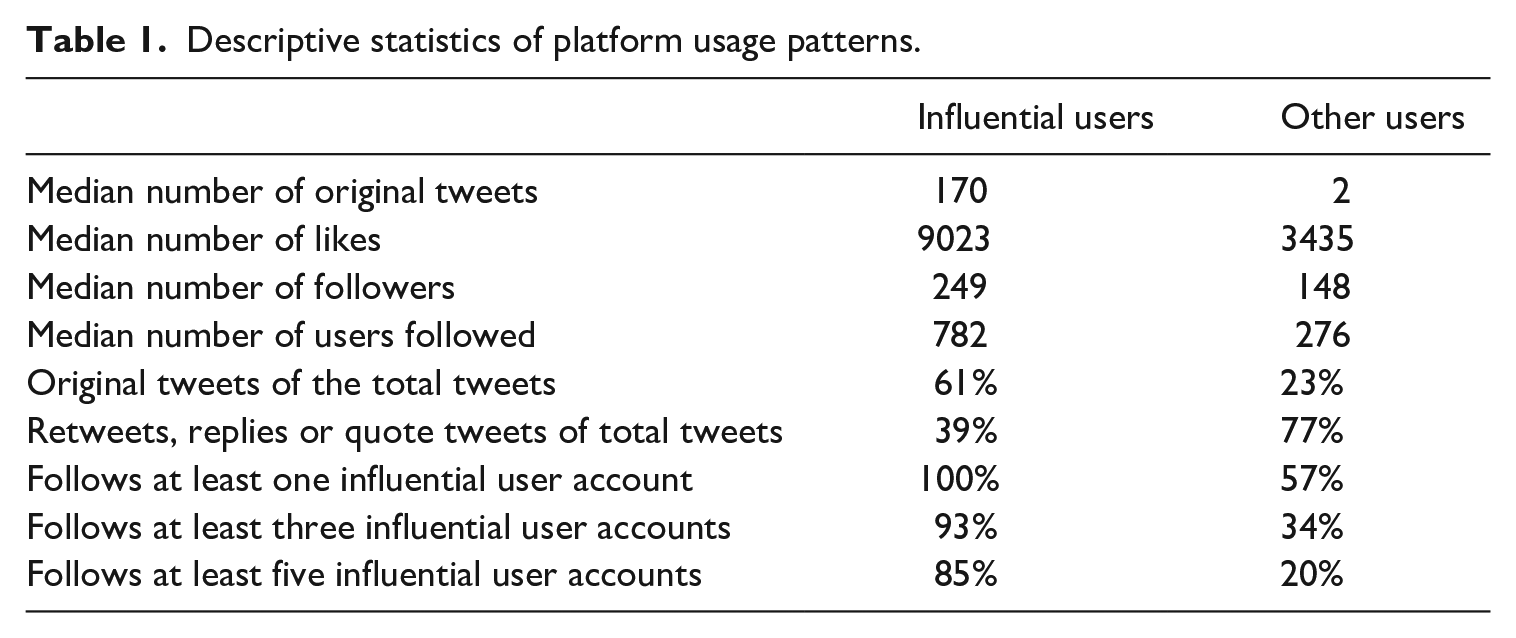
While previous research has shown that a large follower base does not necessarily translate into influence (Cataldi and Aufaure, 2015; Cha et al., 2010), it was found that influential users in this dataset generally have considerably more followers and friends compared with other users. Furthermore, as seen in Table 1, many of these followers are other users in the dataset. This is in line with previous research showing that social media users tend to prefer to consume content posted by users they know and ‘follow’ (Chorley et al., 2015). The influential users themselves also follow each other to a high degree and overall a large proportion, almost 40%, of the users they follow are in the dataset.
Furthermore, Table 1 shows how influential users are more often the creators of original content than other users. While it is obvious that influential users are highly retweeted, this does not necessarily mean that influential users themselves would retweet less often, or that other users would post a minimum amount of original content. However, this finding suggests that influential users might be more opinionated, keen, or confident about sharing original content, while others prefer to pass on ready-made ideas. Taking into account that influential users rarely mention others – in less than 2% of their original tweets, compared with 12% of other users’ original tweets – there is an indication that they are not engaging in conversation themselves but rather defining the conversation for others to engage in.
As such, far-right discourse in this context is formed in the interests of a few and supported and trusted via retweeting to a larger group of recipients. In a sense, these influential users ‘set the tone’ (Post, 2019: 217) and share certain similarities with traditional ‘elites’ who have the power to set the agenda and, consequently, wield great power over public discourse (Van Dijk, 1995). Influential users might not retweet or mention others due to a lack of interest as they will still receive attention without engaging in such tweeting practices. It could also be a deliberate strategy to ensure that they do not promote other users and their content, thus risking inviting others to compete for attention.
The analysis so far has shown that the influential users are active in their uses of the platform, providing them many opportunities to maintain and increase their influence. Rather than capturing a coincidental and temporary formation of users (cf. Bruns and Burgess, 2011), the high numbers of mutual followings within the dataset suggest a seemingly stable constellation of accounts who actively engage in personal connections with one another. However, this does not mean that everyone participates equally. Influential users are highly responsible for content creation in this context, and thus for the (re)production of far-right discourse also in terms of volume.
Language use
Due to ongoing discussions regarding the formation of a new Swedish government, and in line with previous research (Elgenius and Rydgren, 2017), many of the tweets are concerned with defining the ‘establishment’ as a common enemy. However, what exactly constitutes the in-group is less well-defined (Hellström and Nilsson, 2010; Törnberg and Wahlström, 2018). Issues concerning immigration and crime are rated most negative by the sentiment analysis. The influential users describe immigrant men as violent, criminal, Islamist thieves, rapists, terrorists and murderers, and the ‘new’ Sweden, a Sweden with immigrants, as unsafe.
Interestingly, the sentiment analysis has misread some sarcastic and ironic tweets as positive content (see Balahur and Jacquet, 2015). Sarcasm and irony allows the users to express more extreme positions without explicitly stating them (Marwick and Lewis, 2017). Mainly, these tweets address the ‘success’ of established politics in maintaining Sweden’s welfare, traditions and culture. The claims concern, for instance, the end of Christmas as a Swedish tradition in favour of Ramadan, Sweden’s leniency towards immigrant criminals, the benefits of multiculturalism and Sweden as an increasingly safe country to live in. Sarcasm and irony makes hateful content seemingly less serious, which can help attract those who are less radical to far-right-discursive settings.
Figure 2 shows the compound scores 5 for each user in the dataset, based on the median scores of all original tweets they have posted, demonstrating the level of emotion between influential and non-influential user. Surprisingly, as seen in Figure 2, influential users stand out in their neutral way of tweeting. Close readings show that these neutral tweets often concern seemingly value-free claims, suggestions and factual statements. These sometimes comprise directly quoted or adapted headlines from alternative (far-right) news sites, as well from mainstream media outlets, perhaps as a way of legitimising their statements (Bliuc et al., 2018; Haller and Holt, 2019). It could be claimed that the openness of influential users’ tweets allow them to be relatable to a large number of users (see Bennett and Segerberg, 2013), making them more relevant for many to retweet.
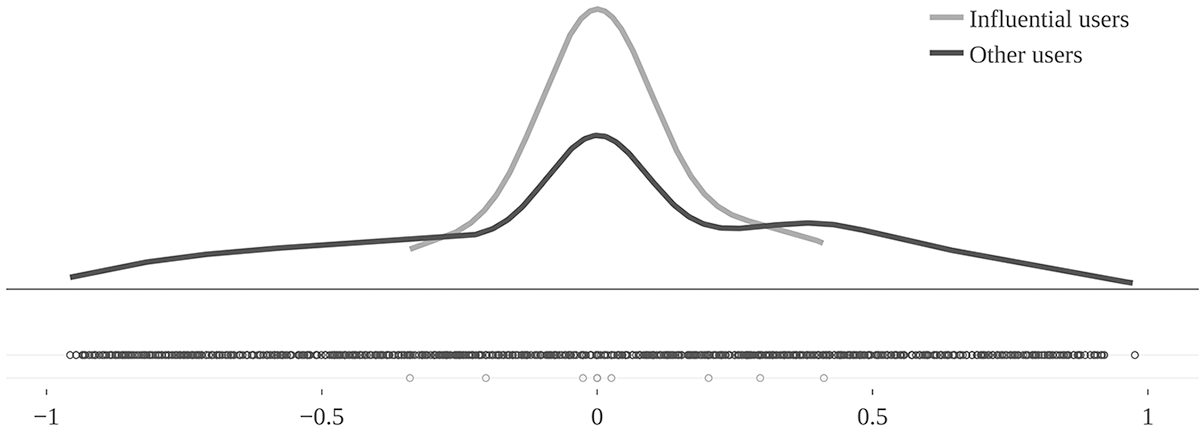
Median compound scores of all users based on their original tweets.
The analysis shows that the neutral tweets rarely contain the influential users’ own opinions. Instead, much interpretation is left to the reader. Moreover, the analysis shows that in comments to these neutral tweets, what is implied by influential tweeters is sometimes taken further by other users – explicitly stating what the influential user is implying. Such commentary is conducted with various levels of nationalist, conspiratorial, anti-establishment, anti-globalist and anti-immigrant convictions.
Some of the tweets that scored neutral in the sentiment analysis facilitate negative comments about the appearance of others. For instance, an opposition agitator at a rally is presented together with their picture in a tweet. This led others to comment on their (ugly) looks, even urging them to burn in hell. One influential user posts pictures of women of different ethnic backgrounds and asks for others’ preferences regarding their appearances. One commenter thinks that the entire issue is absurd, wondering how ‘sick you would need to be to be attracted to someone wearing a burqa’.
Other neutral posts concern the supposed behaviours and inherent characteristics of immigrants. In yet another tweet containing pictures of women of different ethnic backgrounds, the comments switch to discussing how immigrants ‘multiply like rats’. Another influential user shares an article from a mainstream news outlet regarding a crime, simply repeating its title as the tweet text, whereupon someone replies that ‘the perpetrators are most likely Afghans’, because ‘they enjoy raping and thieving’. In a tweet about homelessness, a commenter describes immigrants as ‘privileged filth’, and in a tweet specifically about homelessness among asylum seekers, someone comments that such news excites them. Another neutral tweet about planned immigrant housing renders a commenter nauseous.
While some of the hateful comments could have been removed by now, there is still evidence that some neutral posts have opened up for overt hate. An influential user tweets about how a Swedish politician is part of the ‘establishment’, asking for the opinions of others about the person. The politician is consequently described as a ‘fucking bitch’, a ‘sacrilegious cow’, a ‘psychopath’, ‘sociopath’ and a ‘pest’. Others go further, suggesting they should be murdered. For instance, the same politician is described as a ‘witch who needs to be sorted out’. When an influential user tweets about a fast-food chain serving halal meat, many commenters call for a boycott of the chain, although a more extreme suggestion in one of the replies is to just ‘remove the Muslims’. Yet another neutral post, which describes a town as having a high percentage of immigrant residents, receives a comment about how the situation could be dealt with through an air strike.
The neutral posts of influential users are intended to provoke, and they sometimes do. By asking open questions and vaguely suggesting wrongdoings or injustice, influential users are able to provoke other users – who are less concerned about the consequences of their statements – to respond in more extreme and overtly hateful ways.
Overall, many of these influential users maintained their influential positions throughout the sample period. These influential users are possibly using Twitter actively in such a way as to not get reported, tweeting content which has a clear far-right tone, but which does not explicitly express any negative sentiments regarding what is being discussed. Other users, adopting more extreme language, who could attract attention and momentarily be in an influential position, are at a higher risk of being reported and consequently suspended by Twitter. The influential users are able to leverage platform restrictions and spread hateful content which, due to its slipperiness, is hard to detect and police. In turn, neutrality could help normalise far-right discourse by attracting less extreme users, as far-right discourse expressed in this way is disguised as (somewhat) normal, political opinion.
The importance of neutrality in (re)producing far-right discourse
The analysis shows interesting insights into how influential users are successful at creating and maintaining the involvement of others. While others have found that strong emotional expressions help sustain involvement (Papacharissi and Oliveira, 2012), this is not the case in this context.
It could be assumed that influential users in far-right discourse would lead the way in terms of extremist content. The language of influential users has been described elsewhere as ‘rich’ and ‘colourful’ (Huffaker, 2010: 611) and in radical right online environments as ‘powerful’, ‘derogatory’ and ‘emotional’ (Scrivens, 2017: 113). Previous research has also found that emotionally charged tweets get retweeted more (Stieglitz and Dang-Xuan, 2013), that highly popular and influential Twitter users tend to express more emotion while tweeting (Quercia et al., 2011) and that those with neutral language are the least influential (Scrivens, 2017). However, contrary to previous research, the influential users in this dataset were remarkably neutral in their use of language compared with other users and often posted far-right content concealed as neutral, value-free statements (see also Merrill and Åkerlund, 2018).
Tweeting neutrally can be considered a strategy to avoid being suspended from the platform. Whereas some types of behaviour may result in the user account being reported, a low profile helps reassure influential users that their content and accounts will not be removed. Similar to how so-called ‘lone actors’ act on beliefs held within extremist social networks and formulated by authority figures (e.g. Schuurman et al., 2019), neutrality might be a way for influential users to spread hate without having to be responsible for, and accept the consequences of, such content themselves. Thus, it is not surprising that those who easily experience a sense of belonging and who trust others online are more likely to post hateful content (Kaakinen et al., 2018).
This posting behaviour can also be considered a discursive strategy that allows influential users to please a larger crowd with their content. In a sense, these neutral tweets could be seen as personal action frames (Bennett and Segerberg, 2013) – easily personalised political content which is open enough to let users understand and attach a wider range of meanings to far-right discourse based on their own personal motives. Users’ participation in this far-right discourse on Twitter works through a connective logic in the sense that it has no formal organisation or membership, and users contribute for self-motivated, personal reasons, co-creating and co-sharing content with likeminded others in large networks (Bennett and Segerberg, 2013).
Nevertheless, it could be discussed whether personal action frames and connective action are important for all users’ participation, all the time, or if influential users work as gatekeepers who tweet inclusively enough to make the far-right discourse appealing to a larger crowd of interested users, who first interact out of highly personal motives but then form stronger bonds and collective identity with, as the analysis showed, the relatively stable group of users involved in the discursive setting.
Mainly, influential users in this dataset enable engagement and (re)production of far-right discourse through the openness of their neutral tweets, which allows for an inclusive and vague ‘us’ that permits a wider range of users to identify with far-right discourse (see also Bakardjieva et al., 2018). By extension, this might enable the mainstreaming of far-right discourse.
Conclusion
This article has used a combination of descriptive statistics, sentiment analysis and close readings of a collection of 74,336 tweets to explore the platform usage patterns of those who are influential in a Swedish far-right discursive setting on Twitter. The article makes several contributions. First, the analysis shows how influential users use Twitter differently than other users. They are, for instance, highly active and have more followers and friends. Rather than capturing a coincidental and temporary formation of users (cf. Bruns and Burgess, 2011), the sampling of the dataset through a number of far-right hashtags, shows a seemingly stable constellation of accounts who actively engage in personal connections with one another.
However, this does not mean that influential and non-influential users participate equally. Influential users stand out by posting more original content and are thus more highly responsible for the (re)production of far-right discourse also when it comes to volume. Influential users also retweet and mention others to a less extent than other users. As such, there is an indication that they are not engaging in conversation themselves but rather defining the conversation for others to engage in.
Influential users also stand out in terms of their language use. Most notably, and contrary to previous research, influential users have a seemingly more neutral language than other users. This way of posting conceals far-right sentiment in open questions and seemingly value-free claims and suggestions. Neutral tweeting lets influential users evade responsibility for their hateful content, facilitates overtly hateful interpretations and creates an inclusive far-right context in which hate is disguised as (somewhat) normal, political opinion, which in turn could potentially enable the mainstreaming of far-right discourse.
Future research should investigate influential users in far-right discourse over longer periods of time, on other platforms, in the context of other sampling criteria, as well as across political subjects.
Footnotes
Funding
The author(s) received financial support for the research, authorship and/or publication of this article: The research for this article was funded by the Swedish Research Council (Vetenskapsrådet) grant 2016–02971, ‘Social Media Elites: Mapping informal political influence online’.
