




Abstract
The terrorist attacks in Norway in 2011 and New Zealand in 2019 have revealed that the far-right worldwide uses the memory of the Yugoslav wars for online mobilization. Scholars working on memory activism usually deal with the liberal, self-critical memory emerging from the bottom-up activism of human rights groups while neglecting the activism of the far-right. This article fills the gap by addressing the global circulation of two memes, Remove Kebab and Pepe the Frog, as examples of far-right memory activism. In order to address the transnational circulation of memes as memory activism, this article employs the concept of ‘traveling memory’ while relying on multimodal discourse analysis to unveil the processes of memetic transformation, imitation, iconization and narrativization. The analysis reveals an alternative memory of Yugoslav wars that depicts Serbia as the first case of ‘white genocide’ in Europe, reversing the roles of war criminals and victims while propagating violence and celebrating genocide. The article argues that memory studies can no longer ignore memory production of far-right communities and, at the same time, outlines the method for examining far-right digital memory activism, revealing a whole set of mnemonic practices developed among the anonymous fringe communities of the far-right.
The viral spread of the Remove Kebab meme celebrating the genocide against Muslims in Bosnia and Herzegovina captured the attention of the broader public only after the terrorist attacks in New Zealand. The meme originated from the Bosnian war song honouring the then-president of Republika Srpska, Radovan Karadžić, who was later convicted of a number of atrocities, including genocide in Srebrenica. During the Christchurch attack, the terrorist streamed a video of the insult on Facebook, starting with the car ride to several mosques, during which he was listening to the song. This was not the first time a disturbing connection between war criminals and extreme-right terrorists was unmistakable. Eight years before the Christchurch attack, Anders Breivik killed 69 participants at the annual summer camp of the Workers’ Youth League on Utøya Island, Norway. He published a manifesto under the pseudonym Andrew Berwick, saturated with references to the Balkans and Serbia and praising Karadžić as a true European hero.
Terrorist attacks inspired by global far-right networks like the one in Norway in 2011 and New Zealand in 2019 were not the last words of digitally facilitated far-right terrorism. Another two mass shootings took place in 2019: in El Paso Texas – when 23 people were killed in a Walmart store – and in Halle, Germany – when 2 persons were killed after the shooter failed to break into a synagogue (Auger, 2020). In all these cases, attackers seem to be part of ‘loose international networks and subcultures’ connected virtually through ‘extremist story-telling’ (Ebner, 2018: 21). The memory of the Yugoslav wars seems to form one of the important threads in this far-right storytelling.
This article focuses on the digital activism of the far-right through the lenses of memory activism. Employing the concept of ‘traveling memory’ (Erll, 2011), the article analyses the transnational circulation of two memes, focusing on the processes of memetic transformation, imitation, iconization and narrativization, arguing that we are witnessing the emergence of far-right digital memory activism.
The far-right, understood as an umbrella term for both the extreme and the radical right (Mudde, 2019), consolidated in the Balkans during the Yugoslav wars of the 1990s. Radical right parties and extremist organizations in Croatia and Serbia, as well as Islamist organizations in Bosnia, are still active in the region (Perry, 2019). Political parties such as the Serbian Radical Party (SRS) or the Croatian Party of the Right (HSP) are usually listed as parties fulfilling Mudde’s definition of the radical right as a combination of a strong state, welfare chauvinism, xenophobia and nationalism (Stojarová, 2012: 143). A number of smaller organizations emerged in the last two decades organized around extremist ideology, including Dveri, Obraz, Nacionalni Stroj, Krv i čast, Srbska Akcija and Srpski narodni pokret 1389 (Bakić, 2013; Perry, 2019). Members and sympathizers of these groups presumably form the core of far-right activism in Serbia. They have embraced social media, sharing with other far-right groups the conviction that ‘solving the conflict is only possible by eliminating “the other,” metaphorically or literally’ (Ebner, 2018: 27). The current resonance of the Serbian radical right with other far-right groups rests on shared Islamophobia (Kallis, 2018) and the narrative of ‘freeing’ Europe from Muslims (Mujanović, 2019). It is therefore no surprise that those convicted of genocide of Muslims in Bosnia – Radovan Karadžić and Ratko Mladić – would appear as the main protagonists in the ‘liberation’ narrative of the far-right 20 years after the war.
The transnational connections and global reach of the far-right are not a novelty enabled through digital technology (Froio and Ganesh, 2019; Gaudette et al., 2020; Perry and Scrivens, 2016). Rather, research shows a long tradition of transnational cooperation, networking and institutionalization since the mid-1930s (Mammone et al., 2012), with the process intensifying in the 1990s (Whine, 2012). Research by Caiani and Kröll indicates that there are transnational ties among activist across seven Western countries, although the level of organization and connection varies (Caiani and Kröll, 2015). Central ideological elements include pan-Aryan racism, including all ‘white Christians’ who fight globalization by fostering transnational cooperation (Grumke, 2017: 45). Although one might question the overlaps between far-right and alt-right movements, they include diverse groups as neofascists, identitarians, misogynists and White supremacists (Ganesh, 2020).
Social media are seen as important facilitators of communication and organization within the far-right, creating a virtual place of autonomy and a repository of illegal material (Fielitz and Marcks, 2019; Koehler, 2014). Specific features of social media communication like algorithm-driven amplification of the shocking, sensationalist content, as well as simplification of messages and their reduction to visual and emotional punchlines, have proven highly successful, with virality downgrading veracity and promoting alternative facts and fake news (Bakir and McStay, 2018). A number of researchers have looked at the far-right and radical right networks on different platforms like Twitter (Froio and Ganesh, 2019), Reddit (Gaudette et al., 2020) or the 4Chan/pol imageboards (Milanović, 2019) with regard to narratives of threat, identity-building or transnational connections often made with the explicit use of memory in the process. Commemorative digital practices like celebrating Adolf Hitler’s 127th birthday on social media have also been addressed by media scholars, revealing what Christian Fuchs calls ‘Fascism 2.0’ (Fuchs, 2017). Considering that there has been such in-depth research on the far-right in media studies and social sciences exploring its transnational connections, communication and mobilization, as well as indications of the memory work employed, there is a surprising absence of the research of far-right memory in memory studies.
Far-right memory activism as a blind spot of memory studies
In contrast to the large amount of literature addressing human rights memory activism and its opposition to state-promoted memory, far-right activism is hardly a subject of research in memory studies. Anna Reading criticizes the focus on the connective and connecting, asking about the disruptions and destructive uses of social media when memory is mobilized for political goals (Reading, 2020). Similarly, Neil Levi and Michael Rothberg warn that memory studies have long overlooked the far-right engagement in memory production, ignoring that ‘nationalist, racist, and reactionary memories also help transmit the traditions of nativism, populism, and fascism that are referenced in far-right movements today’ (Levi and Rothberg, 2018: 356).
In general, memory activism can be situated at the intersection of research on social movements, new media and memory studies (Merrill et al., 2020; Zucker and Simon, 2020). Research on digital activism in the social sciences looks more at the process of mobilization and framings (Poell and van Dijck, 2018; Snow et al., 2018), while cultural studies deal primarily with contextualization, focusing on the social actors working with symbols and narratives about the past with the aim of creating, changing or preserving the collective memory. As a specific kind of activism, memory activism is seen as ‘the processes of symbolic transformation and elaboration of meanings of the past’ (Jelin, 2003: 5). Memory activists might engage in creating alternative memory by establishing counter-narratives and calendars (Fridman, 2015) or work on preserving memory by organizing guided tours and archives against the forgetting of expelled communities (Gutman, 2017). Mnemonic actors can primarily be seen as a part of official memory (Bernhard and Kubik, 2014), but they can also be addressed through the prism of transnational memory politics, focusing on global dynamics and the different scales on which this activism is taking place (Wüstenberg and Sierp, 2020). Different examples range from human rights memory activists using digital media from the online campaigns like the #WhiteArmbandDay (Fridman and Ristić, 2020) to the iNakba project, enabling users to see Palestinian villages on the map before the Nakba (Tirosh, 2018). What is shared in this kind of approach is a common assumption that such alternative activism is one supporting ‘moral memory’ or, in the words of Ashuri, ‘the ethical dimension of collective memory’, which looks at the contribution of digital technologies to combat the denial or forgetting of the immoral past (Ashuri, 2012: 441).
Among some exceptions in memory studies is the research conducted by Thomas Birkner and André Donk on the memory wars between hegemonic memory as performed in main stream media and politics in Germany, as well as the alternative radical right narrative emerging on social platforms, indicating the decisive role social media are playing in creating a new historical consciousness and radical right sentiments (Birkner and Donk, 2020). Similarly, the use of the past by the Pegida movement in Germany and the attempt to appropriate the 1989 revolutionary slogan ‘Wir sind das Volk!’ (We are the people!) shows symbolic value of the past for the new movements (Richardson-Little and Merrill, 2020). This research indicates that the digital environment has facilitated fragmented mnemonic communities and highly contested narratives about the past. The far-right activism in anonymous imageboards like 4Chan/pol and 8Chan, or in terrorist manifestos, is hardly addressed in memory studies. An exception is the paper by Phillip Stenmann Baun, who analysed the manifesto of Brenton Tarrant and mishmash of historical references that go back to the eighth century (Baun, 2021). And while Baun’s analysis reveals a whole set of different historical periods, battles and heroes that are loosely connected in Tarrant’s writings, this article focuses more on one of these references, namely, the 1990s wars in former Yugoslavia and counter-memory emerging in transnational far-right networks.
Memes as memory: methodological considerations
Far-right digital activism and their use of memes for mobilization has been addressed by researchers focusing on visual narratives and mobilization strategies (Bogerts and Fielitz, 2019; Doerr, 2017). In memory studies, the digital or ‘connective turn’ shifted the research towards the memory created through the ‘“virality” of digital immediacy, mobility, flexibility and interactivity’ (Hoskins, 2014) and away from traditional memory sites and structures. Following the first conceptualizations of new memory in what was imagined as an open sphere, without clearly defined communities of remembrance (Bond et al., 2016), researchers focus on the personalized message and its global spread in the digital environment (Assmann and Conrad, 2010; Olesen, 2018). Following the logic of ‘connective action’ (Bennett and Segerberg, 2012), scholars look at sets of mnemonic activities, from commemoration to curation, and how they have been adjusting to the interactive and participatory logic of the Web 2.0 (Merrill et al., 2020). In exploring further ‘memory-activism nexus’ (Rigney, 2018), concepts like hashtag memory activism were introduced to encompass the ‘creation of alternative platforms for remembrance, with the aim of sharing and disseminating alternative knowledge about a contested past’ (Fridman, 2020). This paper looks at memes, another digital genre of online communication, asking if and how they are employed in memory activism. In order to conceptualize memetic activism as memory activism, I employ Astrid Erll’s concept of ‘traveling memory’, which aims to capture the creation of memory through the constant motion of ‘people, media, mnemonic forms, contents and practices’ (Erll, 2011: 12). Considering the clandestine status of the actors in the far-right community, I follow travelling of memes and their alterations. Identifying each of the five dimensions introduced by Erll in the analysis of memes, this article argues that far-right digital memetic activism could be understood as memory activism proper.
I look at two popular memes, namely, Pepe the Frog and Remove Kebab, both with high visibility on a number of platforms (Zannettou et al., 2018). Particular platforms like imageboards 4Chan/pol and 8Chan have been favoured by the far-right due to complete anonymity, while the Remove Kebab meme has been especially successful within Serbian far-right networks (Milanović, 2019).
For the analysis of memes as a mnemonic form, I draw upon the work of media scholar Limor Shifman and her seminal work on memes, which she defines as ‘a group of digital items sharing common characteristics of content, form, and/or stance, which were created with awareness of each other, and were circulated, imitated, and/or transformed via the Internet by many users’ (Shifman, 2014: 41). Instead of the concepts of content, form and stance, I rely on multimodal discourse analysis (Van Leeuwen, 2008; Wodak and Richardson, 2012), which takes each communication mode as a source of meaning in its own right (Kress, 2011). Hence, video, image, text and music are addressed as individual modes with different affordances (Kress and van Leeuwen, 2010), where each potentially undergoes a process of imitation, transformation and circulation. In each of the transformations, special focus is directed towards intertextual references as well as the social and historical contexts of their production and consumption, in accordance with the general concern of discourse analysis with language as a social practice (Koller, 2009; Van Leeuwen, 2008). Processes of transformation are addressed through iconization, capturing the universalization of meaning in the visual symbol or textual slogan and the accompanying process of narrative creation (Erll, 2014; Olesen, 2018). Finally, discourse analysis of different memetic forms and their recontextualization is conducted, focusing on the four main categories characteristic of far-right discourses, namely, creation of threat, enemy construction, victims-perpetrators reversal and proposed solution (Wodak, 2015; Wodak and Richardson, 2012).
Material was collected on the platforms YouTube and 4Chan/pol, mainly through its 4Plebs archive (Rieger et al., 2021). The collection of video material started with YouTube, following the search words ‘Remove Kebab’ and ‘Serbia Strong’. I viewed the first 20 most seen videos and selected one with the original video with inserted atrocity images and videos showing transnational circulation for analysis. For the circulation and contextualization of the Remove Kebab memes, I collected 10 threads on the 4Chan/pol from January 2015 until January 2020. The threads were identified following the search ‘Remove Kebab’ and image hash 1 focusing on those explicitly addressing the memory of the Yugoslav wars. Finally, Breivik’s and Tarrant’s manifestos were added to the collection of material and analysed in order to understand the broader context within which the memes emerge.
The analysis is conducted in four stages: (1) the original video and its transformations are analysed following alterations of meaning and the discursive contexts of their production; (2) the transition from video to image is analysed, examining the processes of universalization and the iconization creating visual and textual symbols of the protest; (3) the narrativization and contextualization of findings are explored within the 4Chan/pol/pol imageboard rooms and manifestos of far-right terrorists; and finally, (4) the global circulations are taken note of, following the playing or performance of music across the globe, as well as the opposite example of appropriation of an American alt-right meme in a local context.
Analysis
The song ‘Od Bihaća do Petrovca sela’ (From Bihac to Petrovac village) was recorded in the town of Knin during the Yugoslav wars in the 1990s. The video features four soldiers in uniforms playing a folk song in honour of the then-president of Republika Srpska, Radovan Karadžić. The song itself never achieved any significant popularity and was part of the broader turbo-folk genre, often described as ‘the Serbs’ exotic and hyper-sexualised “soundtrack for genocide”’ (Čvoro, 2014: 179). Understood as part of typical far-right discourse, the text creates a crisis depicting the threat, singling out the enemy and proposing a solution. The lyrics situate the threat to the Serbian land (hence the title, which names two towns in Bosnia near the Croatian border) while the enemies are identified as ‘Croatian Ustashas and Turks’. The song calls upon Karadžić to lead the Serbs into battle and to show the enemy that Serbs are not afraid. The visual is composed of a middle shot of the musicians, starting with the trumpetist, moving to the singer and harmonica player and then to the synthesizer player. The whole video comprises slow zoom ins and zoom outs between musicians and is highly amateur in design and production. It confirms that bad videos make good memes, as they invite parody and edits (Shifman, 2014).
The first variation of the song, according to the Knowyourmeme.com website, was uploaded to YouTube in 2006 as a remix with inserted images of Karadžić in the courtroom of the International Criminal Tribunal for former Yugoslavia (ICTY), as well as a set of iconic images from the Bosnian war. Images from the camps of Trnopolje (Image 1, frame 3) and Manjača (Image 1, frame 4) create contrast between a text about heroic Serbs and the deplorable atrocities committed during the war. The Trnopolje and Omarska camps were organized in 1992 near Prijedor, with the images from the Trnopolje camp being taken on 6 August 1992, following the report of the British Independent Television News (ITN) channel. They caused a serious outcry, initiating public debates on the ongoing genocide in Bosnia (Campbell, 2002; Hansen, 2006; Hoskins and O’Loughlin, 2010). Photographs of the Manjača camp were recorded at the same time by American journalist Roy Gutman, who wrote one of the first accounts of the genocide in Bosnia (Gutman, 1993). The iconic status of these images was created thanks to their intense circulation, authentication and canonization (Brink, 2000) within the global transitional justice networks and media. They were used as evidence in the ICTY trials, albeit with ambivalent success in the process of dealing with the past in Serbia (Petrović, 2015; Ristić, 2019). If this version was created by Croatian film director Pavle Vranjican, as claimed in some Internet forums, 2 then the effect of the iconic images was to contrast the heroic narrative of the text and make fun of the song, its creators and the army or nation they represent. This remix created a significant change in the meaning, turning it into a parody critical of the original and derisive of the goal declared in the song.
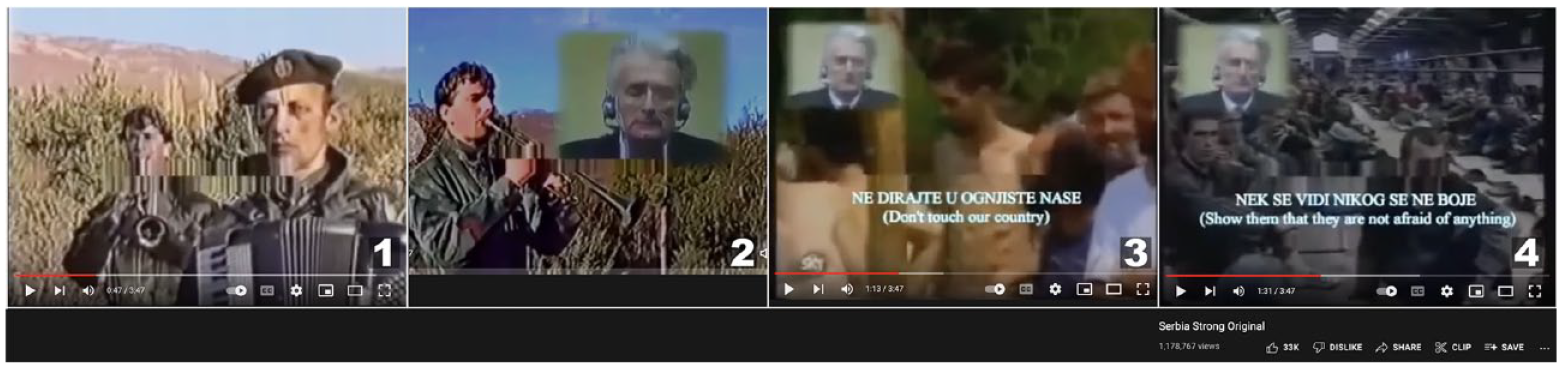
Video ‘Od Bihaća do Petrovca sela’ edited with iconic images from the war in Bosnia.
In the response to this version, another remix of the video was uploaded by the user Kocayine under the title ‘Serbia Strong/God Is a Serb’, where edits of atrocity videos were removed, and the lyrics and translation in English were added. This time, the attempt of the author was more directed towards the promotion of Serbian war efforts, although some comical elements – such as inserts of Karadžić sipping coffee – remained.
The elements noted in the video – its simplicity, amateur design, humour and flawed masculinity – neatly fit Shifman’s list of as essential features for the memetic success of the video (Shifman, 2014: 86). Especially important is the comical effect, whether stemming from incongruity or superiority, which creates a double-coded, contradictory message, provoking laughter (Bergson, 2014). Karadžić sipping coffee and the face of accordionist both create incongruity and comical effects.
In March 2019, after the Christchurch attacks and the direct reference to the song by the terrorist, the original video with 9 million views was removed from YouTube. Nevertheless, it is constantly reuploaded by other users, and currently dozens of different versions are available on YouTube. 3 Between the ‘Serbia Strong’ remix and the Christchurch attack, another significant transformation took place, turning one image from the video into an icon accompanied by the ‘Remove Kebab’ slogan, which thus became a memetic photo and the worldwide symbol of the far-right fight against ‘white genocide’. This transformation is addressed in the following section.
Becoming a symbol: creation of icon and slogan
The second process of transformation that actually enabled the universalization and finally the viral spread of the meme was the transformation of the image of the accordionist, Novislav Džajić, from the video into the still photo and creation of the slogan. One of the most used versions was created in 2011 by Ralph Thompson, then an art student, who uploaded it onto avarist.deviantart.com, a well-known artistic community on the web (Image 2, frame 1). The image has had around 5000 views, while the text states that the author does not ‘endorse any political activity made with this image’. 4 In a short exchange on Facebook Messenger with the author, Thompson explained entertainment and humour as being the two main reasons for his engagement, noting he has a very superficial knowledge about the Yugoslav wars and condemning the violence it inspired.
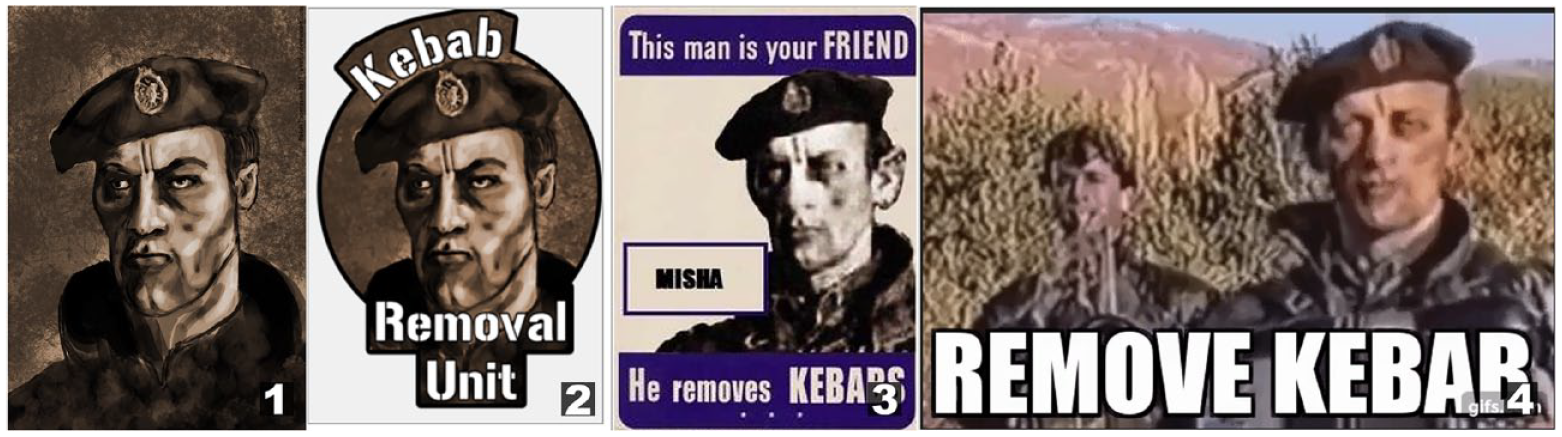
Remove Kebab/Serbia strong meme.
The process was completed once the textual component, a slogan ‘Remove Kebab’, was added to the image, creating the primary unit for further memetic protest. The radicalization, which was achieved in this step, goes way beyond the meaning created in the song, which is less explicit about violence and more directed towards raising the spirits of the soldiers. In the memetic photo, ‘Removal’ explicitly invokes physical expulsion, while ‘Kebab’, metonymically standing for any Muslim, enables the transition from particular enemies to the universalized other. 5
In the next alteration, the image of the accordionist is turned into a so-called Dat-soldier face, with the hands on the face signalling general satisfaction (Image 3). With this new meaning, the dot-soldier face can be stamped over the atrocity images from the Yugoslav wars, creating a direct re-evaluation of the conflict. Such examples with references to the Yugoslav wars include images of the mass burial in Srebrenica (Image 3, frame 1) or Ron Haviv’s Bijeljina photography (Image 3, frame 2). The first one depicts the mass burial on 11 July during commemorations of the genocide in Srebrenica, showing the scope of the atrocity. The second one was taken by the famous war photo reporter Ron Haviv (Image 3, frame 2), and it was one of the most reprinted of the war photographs. It shows a Serbian soldier kicking the dead body of a Bosniak women in the small Bosnian town of Bijeljina, and it is often commented on as a photograph revealing the nature of the Bosnian war (Petrović, 2015).
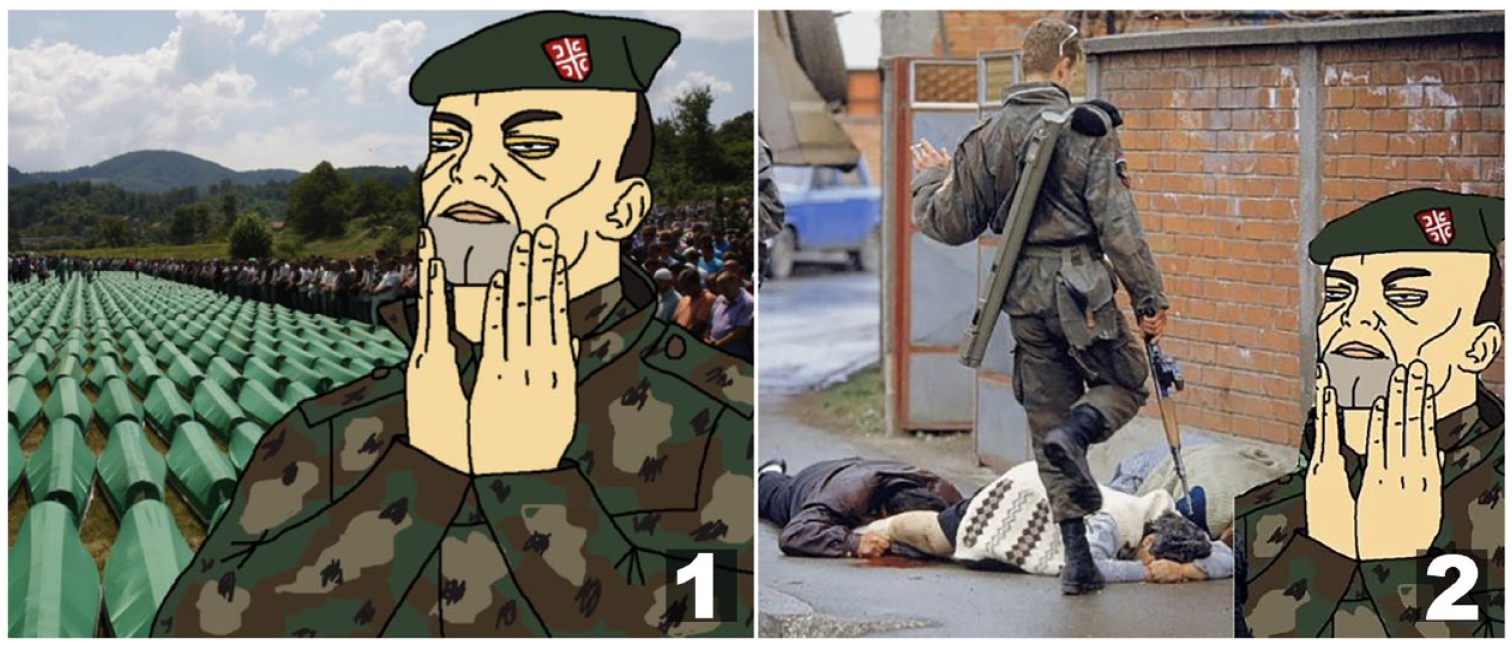
Memetic use of iconic photographs from the war in Bosnia.
The comical effect, which is often reported as guiding the spread of memes, builds on the clear contradiction between the two messages, breaching the rules and exposing the deviance, as humour often does (Davies, 2011). At the same time, it is signalling that the crimes need to be considered not only a shame and a burden but also a source of laughter and fun, serving as a vehicle for far-right mobilization (Billig, 2001; Fielitz and Ahmed, 2021). This normalization of atrocities through laughter and their inclusion in the popular culture is part of a broader digital practice, as Rosenfeld has shown in the case of Nazism (Rosenfeld, 2014).
Narrativization
Although some intention vis-à-vis memory creation is already visible, to fully understand the narratives that are only signalled in the memetic photos and videos, we need to analyse the broader social context within which they are produced, especially the imageboard forums where these memes are mainly placed, as well as the broader far-right community. Following Ruth Wodak (2015), I focus on four categories, namely (1) threat, (2) enemy, (3) reversal of victims and perpetrators and (4) solution.
The transition of the threat from war enemies (Bosnian Muslims and Croats) to Serbian land, as depicted in the original song, to the threat of ‘white genocide’ wolrdwide constitutes the key transformation that makes the meme usable for the far-right globally. The war in Bosnia and the independence of Kosovo now appear as cases of ‘white genocide’ as the main threat Europe is facing, with the possibility of extinction (Bromley, 2018). Grumke describes this Weltanschauung as pan-Aryan worldview, which connects the ‘white world’ and rejects Slavophobic accounts characteristic of Nazism (Grumke, 2017). Serbia becomes the first European state losing part of its territory to Muslims with the support of the North Atlantic Treaty Organization (NATO) and the European Union (EU). In the words of the Norwegian terrorist, The so-called Bosniaks and Albanians had waged deliberate demographic warfare (indirect genocide) against Serbs for decades. This type of warfare is one of the most destructive forms of Jihad and is quite similar to what we are experiencing now in Western Europe. (Berwick, 2011: 1407)
The genocide in Srebrenica now turns into a defensive battle fought on behalf of White, Christian Europe, turning the crime into a moment of pride and glory. The decades-long trials in the ICTY and liberal memory culture – which took the Srebrenica genocide as a defining moment of European and global memory politics (Delpla et al., 2012; Milošević and Trošt, 2021) and which paralleled the nationalist denial and minimalization of responsibility (David, 2020; Ristić, 2014) – are here reversed to celebrate genocide and glorify war criminals. The reversal is established by dehumanizing Bosniaks, who are transformed into fundamentalists and Islamists.
The glorification of genocide against Muslims and its transformation into a source of pride comprises visual cues, like the dot-soldier face over the Srebrenica burial photo, and textual formulations praising Karadžić, as several threads on 4Chan/pol demonstrate. One thread, #68585265, started by an anonymous user under the headline ‘ITT we await the Hague verdit [sic] for Radovan Karadzic’, describes Karadžić as ‘one of the great heroes and martyrs of today’s age’.
6
The first response comes only a minute later, asking, ‘Is that the guy sipping water in the kebab removal video?’, while another answers, ‘Serbian president during the Balkan Wars, he removed a lot of kebab’.
7
The exchanges reveal both ignorance and interest among the users, while opponents challenge the heroic status, denouncing crimes committed against children and civilians. In contrast to contested images on 4Chan/pol, an unequivocal image of Karadžić as a true European hero is stated in Breivik’s manifesto: For his efforts to rid Serbia of Islam he will always be considered and remembered as an honourable Crusader and a European war hero. As for the NATO war criminals, the Western European category A traitors who gave the green light, they are nothing less than war criminals. (Berwick, 2011: 1407)
It is within this broader context that, in far-right circles, Serbian war criminals become defenders of Europe from Muslim invasion while the Western military alliance – NATO – is turned into war criminals.
Finally, the violence exercised during the Yugoslav wars makes narrative about the war even more appealing to the militant far-right users. On the thread ‘Today is the 20th anniversary of the Srebrenica massacre’, #47853970, started by SmooveB, a number of users answer the question ‘How do we feel about this?’ by posting variations of the Remove Kebab meme, one adding ‘Feels good, man’, while another writes ‘A good day for a BBQ and some Kebab’. 8 The thread ends a day later with a post from Romania thanking the Serbs ‘for making an actual legitimate effort to remove kebab from our continent’. 9
Global circulations
That this mishmash of historical references and Islamophobic grievances could actually find resonance in the digital communities is certainly not a self-explanatory phenomenon. Only after Remove Kebab was successfully transformed into the universal symbol of Islamophobia and ethnic hatred could it be appropriated by actors in other contexts. The following section deals with the way the song travelled the globe, as it was played or performed by users in different contexts – from the Christchurch shooter in New Zealand to China and the Americas.
The Australian shooter playing the song in his car immediately before a terrorist attack is the most disturbing instance of its circulation, which pushed the song from the fringe web communities into the mainstream media. The media were quick to find the connection with Serbian extremist nationalism and the campaigns of ethnic cleansing that characterized the wars in Bosnia, Croatia and Kosovo (Mujanović, 2019). And although this was by far the most reported instance of replaying the song, it was by no means the last such case. Among the YouTube videos analysed, two more videos deserve additional attention as they testify to the global circulation of the song. Under the title ‘Chinese soldiers singing “Remove Kebab”’, 10 there is a video of five men singing the song with the three-finger Serbian nationalist salute (Image 4, frame 1). Although they are struggling with the words and pronunciation, they manage to sing the whole song until the end, even indicating the emotional highlights. From the video itself, it is hard to tell anything about the participants, although some ammunition can be seen together with military uniforms. Without more information about the context, one can only speculate that the recent intensification of state policies towards Muslim Uyghurs and the creation of the ‘Uyghur problem’ by the state and media (Luqiu and Yang, 2020) might be an incentive for the performance.
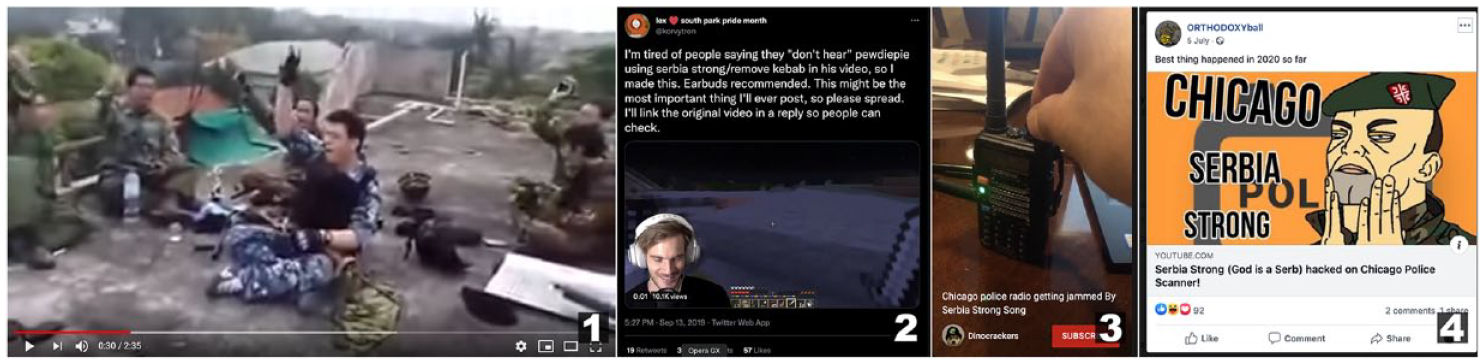
Global circulation of the Remove Kebab song.
Another similar, politically related appropriation was demonstrated in May 2020, when a Chicago police station radio was jammed and the Remove Kebab song was played. In the midst of the tensions surrounding the murder of George Floyd, the hacking was followed by comments sending ‘support to police/Trump from Serbia’. 11 The original post, which was in the meanwhile removed from YouTube, received more than 200,000 views, and several Internet newspapers reported on it. The Chicago police station jam was quickly turned into a meme, with images and photos spreading across the Internet (Image 4, frames 3 and 4).
All these examples, although revealing its widening use, did not secure the meme’s popularity and global visibility. In September 2019, a Twitter user lex (
The Remove Kebab meme travelled from the Balkans to a global far-right community. In the next section, I look at the Pepe the Frog meme, which was made viral by the American alt-right and its Balkan appropriation.
Local appropriations of Pepe the Frog
Pepe the Frog was created in 2005 by Matt Furie. Although originally having no far-right connotations, Pepe was appropriated by the alt-right and turned into a ‘white supremist icon’ (Daniels, 2018). As the most famous icon of the alt-right, it reached its peak of popularity during the election campaign of Donald Trump (Nagle, 2017). According to Miller-Idriss, at least one part of its appeal lies in the specific attitude of the character, described as ‘a kind of superior nonchalance towards others, helping to normalize hostile attitudes towards minorities and political opponents’ (Miller-Idriss, 2019: 127). Such subversive and humorous memes have turned into a main vehicle for the mobilization of the far-right. Milo Yiannopoulos, one of the faces of the alt-right in America, noted, ‘Conservatism is the “new punk” because it’s “transgressive,” subversive, fun’ (Nagle, 2017: 69).
However, although humour and subversion might constitute some of its appeal, it is often translated into a message of hatred and violence. Variations of Pepe the Frog in the approval, normalization or even celebration of the Holocaust include Pepe posted over images of Auschwitz, or Pepe as Hitler. An example of the appropriation of Pepe the Frog in the regional, Balkan context is the Orthodox Pepe, a calm and respectful Orthodox priest (Image 5, frame 1), posted on YouTube by the user Internet nebo Srbije. 12 In the video titled ‘Pravoslavna Džamahirija’, 13 Pepe promotes political change in Serbia, which starts with violence against the liberal-left Belgrade elite, with the figures being killed in cold blood while the score of dead keeps popping up in simulation of a computer game (Image 5, frame 3). 14
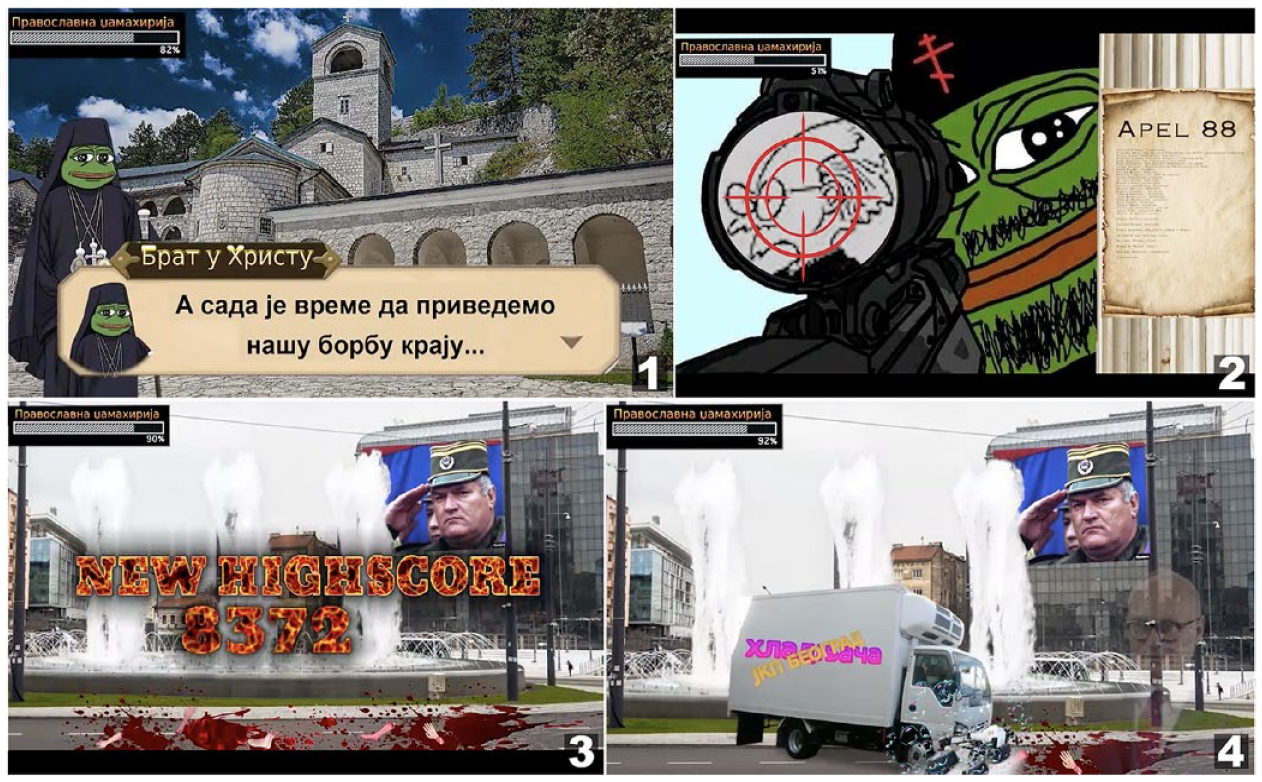
Pepe the Frog as intermediator and main narrator of the film.
The act of killing is presented in a gaming aesthetic, with numbers like 1389 or 8372 popping up on the screen. Once the killing is over, the building in the background turns into a display of a billboard of Ratko Mladić saluting the scene (Image 5, frames 3 and 4) while a refrigerator truck collects the bodies from the street. Although this sequence of violent images might seem arbitrary, those with more knowledge about the Yugoslav wars would recognize the symbols used. Starting with showing the numbers 1389, the year of the Battle of Kosovo, and 8372, the exact number of Srebrenica victims, while executing liberal elite, the video connects both arch-enemies of the far-right today – globalist multiculturalists and Muslims. Finally, the refrigerator truck is reminiscent of the gruesome transfer of bodies of Kosovo Albanians to Serbia during the NATO intervention and Kosovo war. The evaluation and justification of the violence are provided by the image of war general Ratko Mladić, who salutes the mass murder (Image 5, frames 3 and 4). And while all these symbols are showing the video as being embedded in the local memory, Pepe the Frog appears as an intermediator and narrator connecting local grievances with global far-right ideology.
Conclusion: far-right digital activism as memory activism
Scholars working on digital memory activism usually deal with the liberal, self-critical memory emerging from the bottom-up activism of human rights groups, challenging illiberal memory pursued by official memory politics. Digital memory activism of the far-right has been mainly neglected in the research. This article proposes that far-right digital activism should be addressed from the perspective of memory studies and through the lens of digital memory activism. Considering the clandestine status of far-right actors, the article employs the concept of ‘traveling memory’, focusing on memes as new mnemonic forms, and developing a method for their analysis through contextualization and narrativization. The article follows the processes of memetic transformation, imitation and iconization, each contributing to the creation of a new memory of Yugoslav wars. Although the meaning of memes is fragmented and in constant flux, the narratives within which new mnemonic forms operate could be illuminated through the broader narratives created by far-right communities. The analysis of 4Chan/pol threads and terrorists’ manifestos reveals a revisionist memory of Yugoslav wars depicting Serbia as the first case of ‘white genocide’ in Europe, reversing the roles of war criminals and victims while propagating violence and celebrating genocide.
Far-right actors engage in memory activism by creating and spreading memes, offering counter-narratives and developing separate mnemonic practices. The 4Chan/pol threads reveal such practices, following the commemorations of Srebrenica genocide, anniversaries and ICTY judgements by posting memes and saluting the crimes. In other words, digital memory activism is no side effect of far-right activism. Rather, it is crucial for establishing the threat, legitimizing the far-right and defining the proper solution through violence and genocide. Yugoslav wars are only one element of the broader revisionist memory emerging in the far-right digital communities. Further research is needed to shed more light on the current far-right digital memory activism and its global connections.
Footnotes
Acknowledgements
I wish to thank the two anonymous reviewers of this article for their insights and fruitful feedback. Orli Fridman, Matthias Middell and Florian Bieber provided helpful comments on the previous drafts of the article. Nikola Ristić and Andrija Popović helped me navigate 4Chan/pol and better understand youth memetic culture in general.
Funding
The author(s) received no financial support for the research, authorship and/or publication of this article.
