



Abstract
Many studies examine the internationalisation processes of migrant entrepreneurs, whether they are moving to a new country or returning to their home country. However, research on the adaptation of their human capital throughout this journey remains limited. To advance understanding in this area, we investigate returnee entrepreneurs (REs) and their human capital adaptation journey between China, as their country of origin, and OECD countries. Applying a liminality lens, we commence with the individual dimension when they travel abroad to acquire education and experience, to then consider organisational factors when REs return home to start or invest in new business ventures with a new international outlook. Findings confirm that prospective entrepreneurs travelling abroad for school or work adapt their human capital to the new environment; we demonstrate how this happens. Our main contributions relate to the journey element when REs return experiencing a poor fit with their home business environment, but being motivated towards international entrepreneurship as an opportunity for personal validation and organisational impact. We propose a dynamic and holistic model of internationalisation as a human capital adaptation journey which contributes to human capital theory in international entrepreneurship research.
Introduction
The contemporary global economy has become less about trade, and more about people when pursuing entrepreneurial opportunities (Terjesen et al., 2016). In response, growing emerging Asian, African and Latin American markets are increasingly attracting back their human capital in the form of returnee entrepreneurs (REs) (Chand, 2019; Filatotchev et al., 2009; Gruenhagen et al., 2020). The term ‘REs’ refers to those individuals who, having studied or worked in Organisation for Economic Co-operation and Development (OECD) countries, decide to return to their home country to start new ventures (Dai and Liu, 2009). The human capital of those travelling abroad for school or work changes, but upon their return, this can cause tensions in the home businesses as well as opportunities for internationalisation (Tung, 2008). Entrepreneurship research has explored the internationalisation experience of those going abroad and returning home separately as migrant entrepreneurship (Ram et al., 2017) and, to a lesser extent, returnee entrepreneurship (Gruenhagen, 2021). However, to our knowledge, few if any previous studies have conceptualised and researched in detail the international human capital adaptation experienced by these REs. Responding to calls to contribute to the international entrepreneurship (IE) literature in this direction (Buzavaite and Korsakiene, 2019), we use and advance human capital theory in the context of internationalisation for entrepreneurship as a liminal human capital adaptation journey.
Human capital is defined by Becker (1994, p. 16) as a person’s ‘knowledge, skills, health or values’. Human capital theory is applied and expanded in the context of REs, considering that both their social and human capital are important to recognise opportunities and internationalise new ventures (Ma et al., 2019). Most human capital theory literature is related to labour migration and to how highly trained individuals relocate from developing nations to developed ones in a brain drain/brain gain process (Bhardwaj and Sharma, 2023; Docquier and Rapoport, 2012). However, the focus has gradually shifted from brain drain/brain gain to brain circulation (Blagojević et al., 2023; Filatotchev et al., 2009; Farquharson and Pruthi, 2015; Saxenian, 2005). More highly educated entrepreneurs have greater access to network contacts and are thus, able to identify more entrepreneurial opportunities than their less educated counterparts (Liu and Almor, 2016). Recent human capital literature suggests that an international education background has the power to shape the individual beliefs, thinking patterns (De Cock et al., 2021) and behaviour of REs regarding how they perceive the business world and thus, ways to practice their management.
Research has analysed integration (Zhang et al., 2024), acculturation (Jones Christensen and Newman, 2024), or assimilation (Chan, 1997) in the context of migrant entrepreneurship, and re-entry (Adler, 1981), re-acculturation (Stringham, 1993), re-repatriation (Furuya et al., 2009) or re-adaptation (Apsite-Berina et al., 2020; Dziekońska, 2024) in the case of migrant entrepreneurship. However, since these individuals are boundary spanners, leading organisational learning and shaping performance (Liu et al., 2015), a holistic view of both processes in the context of their human capital transformation is necessary. For this, how REs adapt their international education and experience to pursue international entrepreneurial opportunities remains under-researched and is inadequately understood (Mao and Gong, 2023). Aiming to capture the whole internationalisation journey of REs as a liminal process (Chen et al., 2021; Garcia-Lorenzo et al., 2018; Muhr et al., 2019), this article focuses on the role of internationalisation as a human capital adaptation journey. Adopting an individual level of analysis for the entrepreneurs when they go abroad to expand their general human capital, and adding an organisational perspective for the ventures, they create or influence as REs, the central question of our study therefore, is How does internationalisation affect the adaptation of human capital for entrepreneurship?
By addressing the above research question, this study aims to make three contributions. First, utilising human capital theory (Becker, 1994), we reveal the specific characteristics of individuals leaving their country to study or work, and then become REs. This research contributes by operationalising the rather static propositions of the theory, suggesting a dynamic process-orientated model of human capital adaptation. Second, evidence from Chinese SMEs has been selected to include an organisational to the individual perspective in international human capital adaptation related to entrepreneurship. This differentiates our study from those that have focused on corporate and employment human capital. The Chinese SMEs were chosen to provide the contextuality and perspective of the business environment that exists in emerging markets. Finally, by understanding international human capital adaptation forces and processes, we contribute not only to research but also to policy and the practices of international human capital adaptation for entrepreneurship across borders.
The article is structured as follows: After the Introduction, a brief overview of the Chinese RE research background is presented. The Literature Review introduces a conceptual framework of human capital adaptation for international entrepreneurship. The Methodology section explains that 48 semi-structured interviews were conducted with Chinese REs and their staff in 26 sample firms over two stages, triangulating them with secondary data which helped us to refine our findings. This evidence is analysed and reported using an inductive qualitative research approach as proposed by Gioia et al. (2013). The final discussion presents our international human capital adaptation model, identifying processes for international entrepreneurship, followed by a careful consideration of the limitations and suggestions for future research.
Literature review and theoretical framework
Returnee entrepreneurship liminality in internationalisation research
International entrepreneurship (IE) is a broad area of research looking at the speed of internationalisation (Oviatt and McDougall, 2005), international business opportunities (Mainela et al., 2014), comparative advantages (Terjesen et al., 2016), methodological issues (Coviello and Jones, 2004) and even resilience in recovering from a crisis such as Covid-19 (Zahra, 2021). In these studies, human capital flows are often considered in the context of firm-level internationalisation, focusing on cross-border labour mobility and knowledge flow patterns between the source firm and the receiving country (Oettl and Agrawal, 2008). We contribute by focusing upon the individuals that become REs, and their internationalisation human capital adaptation journey. The evidence generated from this study can be linked to features specific to East Asian countries, such as returnees being driven by a sense of duty to return home and fulfil entrepreneurial ambitions, particularly in the context of China and Chinese returnees. The returnee entrepreneurship phenomenon falls under the IE literature as an extension of the expatriate/repatriate literature in global labour mobility. The traditional repatriate literature looks at the re-employment situation regarding the work- or non-work-related adjustments in the home organisation, and they emphasise key terms such as job satisfaction (Au and Fukuda, 2002), organisational embeddedness (Chen and Shaffer, 2017) and promotions (Brewster et al., 2021). In the expatriate/repatriate literature, self-initiated expatriates refer to individuals who independently decide to work or live in a foreign country (Suutari and Brewster, 2000). However, these studies have rarely focused on the domain of entrepreneurship and the start-up phase of SMEs which involve innovative approaches to organisational construction, reconstruction and related business practices (Pruthi, 2014). REs in this study are a sub-type of returned self-initiated expatriates, working in privately owned enterprises and becoming entrepreneurs as a living style rather than waiting to be employed by an organisation.
REs, similar to immigrant entrepreneurs who are often discussed with an emphasis on their ethnicities in host countries as outsiders (Ram et al., 2017), require particular attention to highlight their positive role as business owner/managers facilitating growth in the mainstream Chinese business market. Previous RE literature discusses how REs direct learning and external knowledge acquisition that have an impact on firm performance (Liu et al., 2015); if an RE’s overseas experience is closely related to the firm’s activities, and persists over time, it becomes more valuable to the firm’s internationalisation process (Hajdari et al., 2024). Responding to calls for better contextualisation of entrepreneurship research (Gruenhagen, 2021) and the need to enrich the predominant construct of high-tech returnee venture studies in China (Lin et al., 2019; Liu et al., 2010; Ma et al., 2019), we examine returnee entrepreneurship from its internationalisation origins when individuals go abroad, until they return home to start new ventures. To offer a holistic perspective on international human capital adaptation from leaving home to returning as entrepreneurs, liminality explains these individuals’ ‘in-between and betwixt’ status as they belong neither to their country of origin, nor to their host country (Garcia-Lorenzo et al., 2018: 8). Instead of a temporary status, liminality involves a lasting experience of in-betweenness, which results in some degree of disconnection, alienation and even xenophobia from others (Muhr et al., 2019). Van Gennep (1908) developed the concept of liminality by looking at a ‘rites of passage’ framework and the process of transition from one status to another (p.10). However, it is Turner (1969) who identified the potential of liminality and further developed and promoted the concept and application of liminality. Research on the liminality of self-initiated expatriates and their transition to the host country (Chen et al., 2021) pays limited attention to their adaptation into the home environment within the context of entrepreneurship. These studies suggest that the human capital adaptation of REs is aimed at escaping the lasting liminal condition in a looping process of understanding of the environment they are in, adapting behaviour attached to established managerial practices in it, seize opportunities through new ventures and by maintaining social relationships. RE’s buy-in of overseas human capital in China can be regarded as a re-connection with the host countries, or at least the Western business world.
A human capital theory approach to international adaptation
We frame internationalisation as a liminal individual human capital adaptation journey when REs go abroad, and as an organisational journey when they return home to create or run ventures with an international outlook while also, affecting others. They can do so by acquiring and using foreign expertise, knowledge, skills and other capabilities which enable them to use various resources to conduct business globally (Cui et al., 2015). This expertise is related to the context in the foreign countries, so efforts are required to adapt it into different national environments (Lin et al., 2019). Transferring the new knowledge internationally requires the REs to develop the ability of re-contextualisation, that is, the ability to process knowledge by giving it new meanings in the new business cultural context (Tran and Truong, 2022). In practice, the maturity of the RE’s general management skills and decision-making processes previously exposed to a different national environment can benefit the firm (Chung et al., 2015). Thus, international human capital can influence the scope of the business and its growth aspirations (Onkelinx et al., 2016), but the underlying processes that make this happen remain under-explored. The concept of human capital was initially noted by Schultz (1961) and later developed by Becker (1962, 1994). Human capital is categorised into general and specific; the former refers to any knowledge or skills that can easily be transferred across commercial settings (Becker, 1993), such as an entrepreneur’s gender, age and education. The latter refers to knowledge and skills that are less transferable and applicable (Gimeno et al., 1997). The specific human capital possessed by REs refers to their management know-how and industry know-how (Westhead et al., 2001). Considering also the social dimension of human capital for entrepreneurship (Davidsson and Honig, 2003), we explore general human capital by focusing on education, and specific human capital by focusing on experience gained, adapted and used throughout the internationalisation journey.
Examining the international human capital journey of REs in the context of SMEs offers new insights compared to what is known from evidence drawn from large multinational corporations (MNCs) (Gruenhagen et al., 2020). In emerging economies, such as China, where the structure of SMEs is flatter, the entrepreneur has a dominant decision-making role in the absence of management boards such as those in MNCs. Such a hands-on approach in Asia is important to secure buy-in and commitment to maximise human capital for growth (Martin-Chua, 2009). In the context of our study, this is contrasted with the education and experience (human capital) of the RE owner/manager who often determines the prospect and international expansion of the company in an emerging market (Buzavaite and Korsakiene, 2019). Thus, REs taking leading roles in SMEs are suited for the exploration of firm and individual-level questions on internationalisation (Davidsson and Wiklund, 2007). We pursue this direction of research by recognising the complex individual/firm relationships found in the SME context of international human capital (Gruenhagen et al., 2020) brought in and used not by their employees, but rather by the RE owner/managers.
Duty and ambition are important motivators for REs to succeed in their internationalisation journey, especially in the context of Chinese entrepreneurship (Zhang and Chun, 2018). Research from emerging economies confirms the sense of duty and moral obligation REs have as they maintain strong informal network ties with their home country (Williams et al., 2023). Ambitions for growth and independence are influenced by multiple pull and push forces between the host and home countries (Gruenhagen, 2018) given the internationalisation contrasts. In response, the REs endeavour to bring to their home countries a spectrum of overseas human capital – such as new knowledge, high-technology and different management styles (Farquharson and Pruthi, 2015). Maintaining close home-country ties while abroad and analysing contrasts and opportunities in their internationalisation journey helps to reveal the potential for entrepreneurship (Prashantham and Birkinshaw, 2015). This gives a sense of purpose and motivation to succeed and ‘prove’ themselves when they return home by putting the foreign human capital acquired to good use. We aim to deliver new empirical evidence and insights from China to advance the application of human capital theory in explaining how REs adapt their knowledge, skills and experience to create transnational opportunities for their SMEs.
To build a conceptual framework, general human capital refers to the RE’s international education background (Zhou et al., 2016) and international working experience (Wu and Ma, 2018), as shown in Figure 1. These are two dimensions proposed as the main pillars of the theory by Schultz (1961), and Becker (1962, 1994: 16). Cultural factors may play a part in this process, and indeed, there may exist other factors affecting the individual’s cosmopolitan predisposition to be global citizens (Szerszynskiand and Urry, 2002) as well as entrepreneurs. The experience of studying and living in different business environments creates an international mindset for REs who seek overseas opportunities from the onset of venture creation (Xiao and Ramsden, 2016). However, to maintain the focus of this study on international human capital adaptation, we have maintained the core focus of the theory on education background and overseas working experience, as shown in Figure 1. Here, we are not looking for heterogeneity, but we are looking for relative generality in these reverse migrant groups.
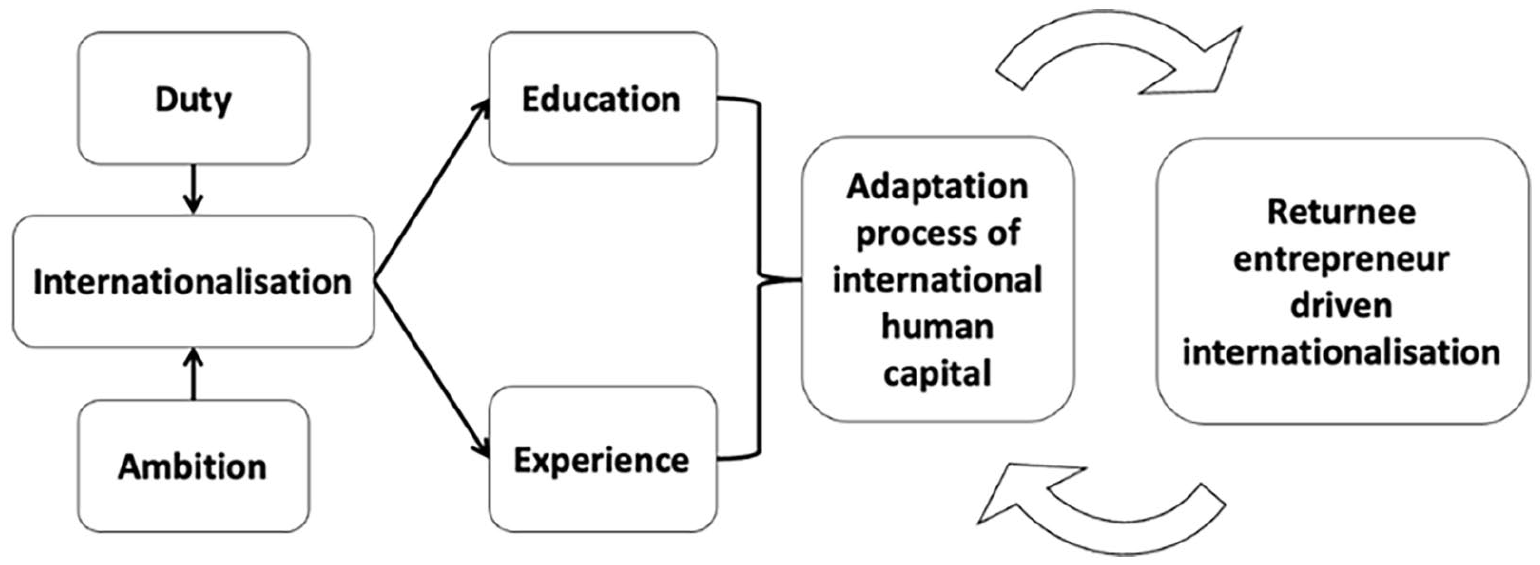
A human capital adaptation framework for internationalization.
Most of the existing RE literature focuses on isolated aspects of this phenomenon, such as only using firm-level analysis and quantitatively determining the factors influencing enterprise performance or growth, which lacks depth in exploring the voice, opinions and experiences of REs (Mreji and Barnard, 2021). There is limited research that emphasises the re-adjustment difficulties of REs and the role of an individual’s ability to address the adaptation to the changes (Bryant, 2014; Lin et al., 2019). Contributing to this debate, the focus of this article is on the international human capital adaptation by REs. Framing internationalisation as a journey driven by duty and ambition, we use human capital theory to study how education and experience acquired overseas are adapted. We continue to propose adaptation as a constant process experienced by REs in SMEs during the early stage of their return. In so doing, we reveal new facets, processes and challenges faced in the international human capital adaptation journey to inform theory and practice.
Methodology
Background and research settings
China represented an excellent context for our study because, by the end of 2020, of 929,300 Chinese students studying abroad, more than 777,000 had returned home in the same year (State Information Centre of the P. R. China, 2021) with some entering self-employment. Approximately 63,000 returnees were recorded as having set up a new venture locally between 1978 and 2014 (Lin et al., 2019). Following the 1978 Reforms and Opening Up Policy, the Chinese leader Deng Xiaoping decided to send 3000 students abroad annually, and overseas education began to expand rapidly (Kenney et al., 2013). By the end of 1997, only 31.8% of the 22,410 overseas Chinese graduates had chosen to return to China (National Bureau of Statistics of China, 2009), but by the end of 2021, the overall return rate increased to 84.74% (State Information Centre of the P. R. China, 2021). This can be explained by the increasing power of China on the global stage and by the vibrant Chinese economy offering better opportunities for returnees with international education backgrounds and overseas working experience.
Paradigm and sampling
Some recent IE studies have shifted their attention towards Chinese SMEs, analysing international human capital using quantitative methods (Dai and Liu, 2009; Filatotchev et al., 2009; Lin et al., 2019). We took an interpretivist approach, compatible with an exploratory theory-building research design (Andrade, 2009), with the aim of exploring returnee entrepreneurship internationalisation and human capital issues. Given the uncertainty surrounding the issue of the Chinese returnee entrepreneurship phenomenon in the low- and medium-tech sectors, and the limited human capital literature concerning this issue, we adopted an inductive data analysis approach (Zhou et al., 2016). We considered an exploratory, theory-building method to be the most appropriate to emphasise the process-orientated (Duanmu and Fai, 2007) ‘how’ question which is central to the international human capital adaptation phenomenon. One of the researchers who conducted the interviews has acted as an insider to obtain trust and build bonds with Chinese REs, which is important to study a less-represented empirical setting in the IE literature (Reuber et al., 2022).
A sample of REs and their staff from Hangzhou and Wenzhou, in the Zhejiang province of China, was chosen for this study, and 48 semi-structured interviews were conducted. Two interview groups, REs and staff, were chosen to provide a comprehensive answer to the central question regarding how a RE engages with the SME and fulfils the intra-firm human capital transfer and adaptation. The design of two interview datasets served to add an alternative data source, triangulate the existing RE interview data, gain multiple perspectives and perform data validation (Miles et al., 2014). Due to its geographical links to the international market – through, for instance, the ports of Hangzhou, Wenzhou and, halfway between the two, Ningbo-Zhoushan – this coastal province is arguably the most entrepreneurial in China. Also, it tends to be internationally orientated with regard to its new venture start-ups (Liu et al., 2022). In 2020, the total number of standard containers passing through Ningbo-Zhoushan Port reached 27.05 million, 11.63 million of which were outbound ranking it second in China after Shanghai Port (Ningbo Government, 2021).
The sample firms were selected according to theoretical criteria (Breckenridge and Jones, 2009) related to the definition of REs and human capital theory principles in the international SME context of this study. Accordingly, each of our respondents needed to satisfy the following criteria:
1) The RE has acquired education and experience abroad.
2) The RE is a founder, co-founder or manager of a new SME in their home country.
3) The RE has influenced the firm they founded or manage to be international and has exporting activities.
Considering the context of this study, the Chinese definition of SMEs was used to select REs, referring to those enterprises that have an annual turnover not exceeding ¥300 million (£33.17 million), have company assets to a value of less than ¥400 million (£44.23 million), or employ fewer than 2000 staff (Zhang et al., 2012).
Research methods
To engage in exhaustive interactions with our respondents and to uncover their true, influence-free feelings in relation to the returnee entrepreneurship phenomenon, we conducted in-depth semi-structured interviews (DiCicco-Bloom and Crabtree, 2006). The interviews followed an open-ended protocol (Liu and Meyer, 2020) that enabled our participants to describe both their overseas educational and working experiences and the changes these had produced in them throughout the adaptation process. Table 1 presents the main interview questions for REs and staff.
Semi-structured interview guide.
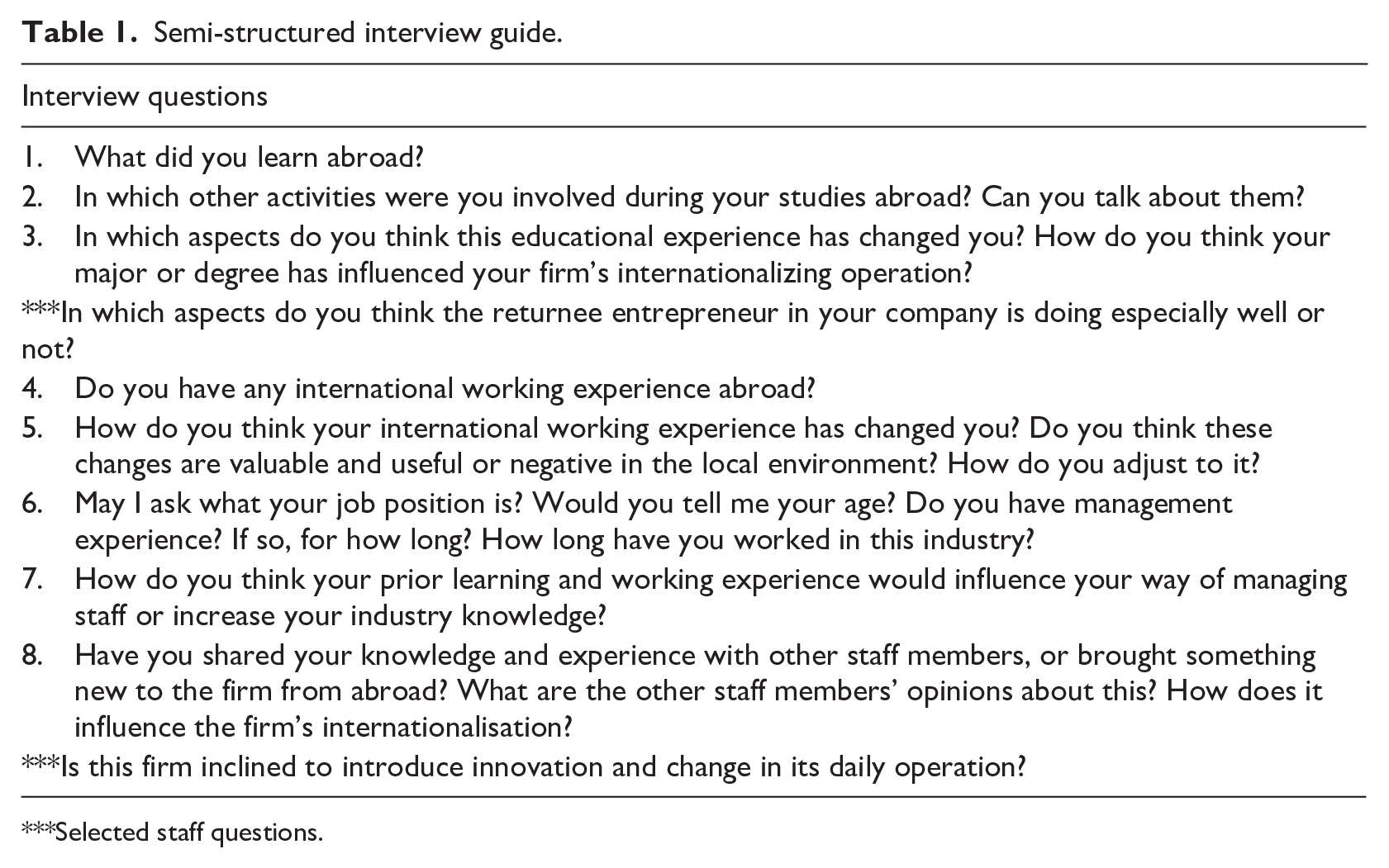
Selected staff questions.
One author conducted a total of 45 interviews with 29 REs and 16 employees in August 2018 and between June and August 2019. She then conducted a second round of interviews with three participants, bringing the total to 48. We decided to interview two groups of interviewees in REs and their staff, for instance, namely the local business partner, family member, and staff who has worked in the SMEs for years, to triangulate the data (Miles et al., 2014), uncover the truth and add an extra layer of richness to the data. Specifically, we tried to avoid conducting our interviews with employees in the presence of REs.
As we are investigating the impact of the RE’s adjustment of their overseas human capital in home-country SMEs, it is important to understand how REs reflect upon their own role and abilities. It is also valuable to know how others perceive them and the changes that they have brought to the firm; thus, Table 2 lists detailed information about our 45 interviewees – most of whom are REs, while some are managers and employees in the 26 sample firms we studied.
Firms and participants information table.
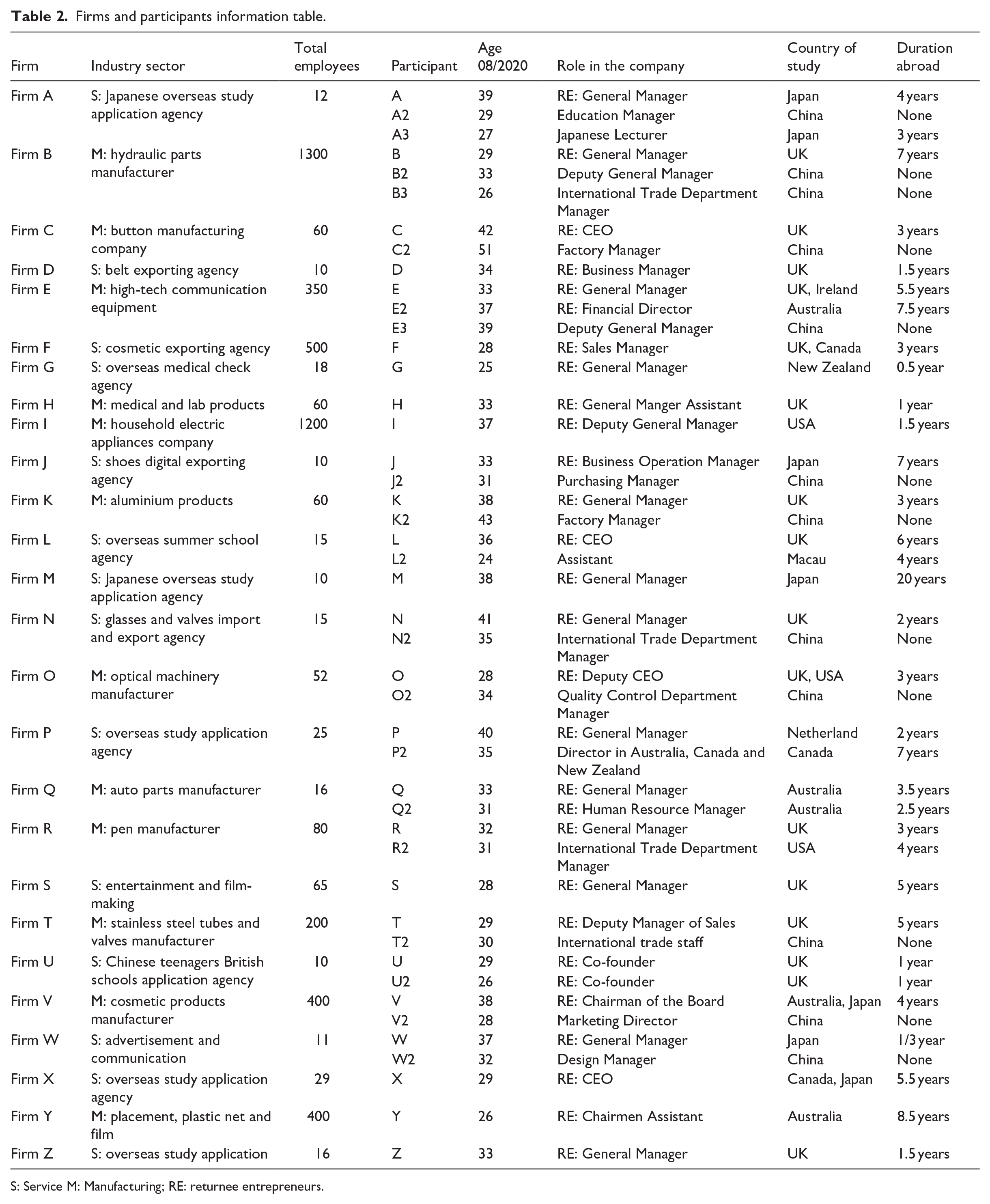
S: Service M: Manufacturing; RE: returnee entrepreneurs.
Forty-one interviews were conducted face-to-face, and seven – five audio and two video – through WeChat (a Chinese social media and messaging platform). The average duration of each interview was 41 minutes. All interviews were conducted in Mandarin, paying close attention to preserving the highest level of expression richness in translation (Tsang, 2001) by checking a sample of them with another Chinese and English speaker. The data collected in this study comes from the period 2018 to 2019; and thus, is restricted by limited implications to reflect social and geopolitical changes, such as the pandemic, China–US relations, China–Taiwan relations and the Ukraine crisis, together with the effects of these on the resulting managerial practices in China.
First research stage and analysis: REs in the international context
The first stage of analysis consisted of two rounds of coding to reach conceptual maturity (Miles et al., 2014). The first was performed in November 2018 on the initial 10 interviews conducted with REs, resulting in 64,213 words of English transcription. The first-order codes and categories were constructed based on these interviews. The second round of coding on the 19 further RE interviews was performed in December 2019, resulting in about 98,500 words of English transcription. The second round’s focus on analysis was intended to perform a more in-depth exploration of individual-level behaviour. As the codes combined, research themes emerged to create more abstract and theoretical constructs, which shifted the process from open to axial coding (Locke, 2001). This first research stage of analysis helped us to identify the changes REs experienced. Two aggregate dimensions of this research stage emerged: ‘change in understandings and behaviour’ and ‘misfit with local business environment’.
Second research stage and analysis: International human capital adaptation
For the second stage of the analysis, reflecting on the first stage, we decided to focus on and explore the adaptation processes in more depth. This was informed by a third round of coding of 16 employee interviews – conducted to verify the within-firm impacts of the RE’s adaptation mechanisms – which yielded a 54,734-word transcription completed by June 2020. Interview quotes from the REs were triangulated with those of their employees, and secondary data was collected from official online archives and from the Chinese private business data search app Tianyancha.com to track operational links over time in our study. Different theoretical categories were explored by relating our results to existing human capital theory concepts and aggregating theoretical dimensions (Gioia et al., 2013).
After the coding, we brain-stormed and revised the existing theoretical framework, and finally re-examined whether the data did or did not fit the emerging theoretical understanding (Miles et al., 2014). This resulted in the three human capital adaptation processes identified in the second research stage: ‘buy-in of foreign human capital for entrepreneurship’, ‘managerial human capital adaptation for organisational change’ and ‘international human capital legitimation as a growth opportunity’. We present the detailed analysis procedures with their iterations and related coding graphics in Sections ‘First stage: International human capital adaptation when going abroad’ and ‘Second stage: International human capital adaptation when returning home’, together with our findings.
Findings
First stage: International human capital adaptation when going abroad
Figure 2 depicts the first research stage and shows the international human capital adaptation REs go through when first going abroad for study or work. Education and experience are the theoretical starting points for understanding how REs start their international human capital adaptation journey. Following the coding procedures set out by Gioia et al. (2013), the second-order themes emerged because of a critical analysis to consider different aspects and interpretations of the codes through and beyond the human capital lens.
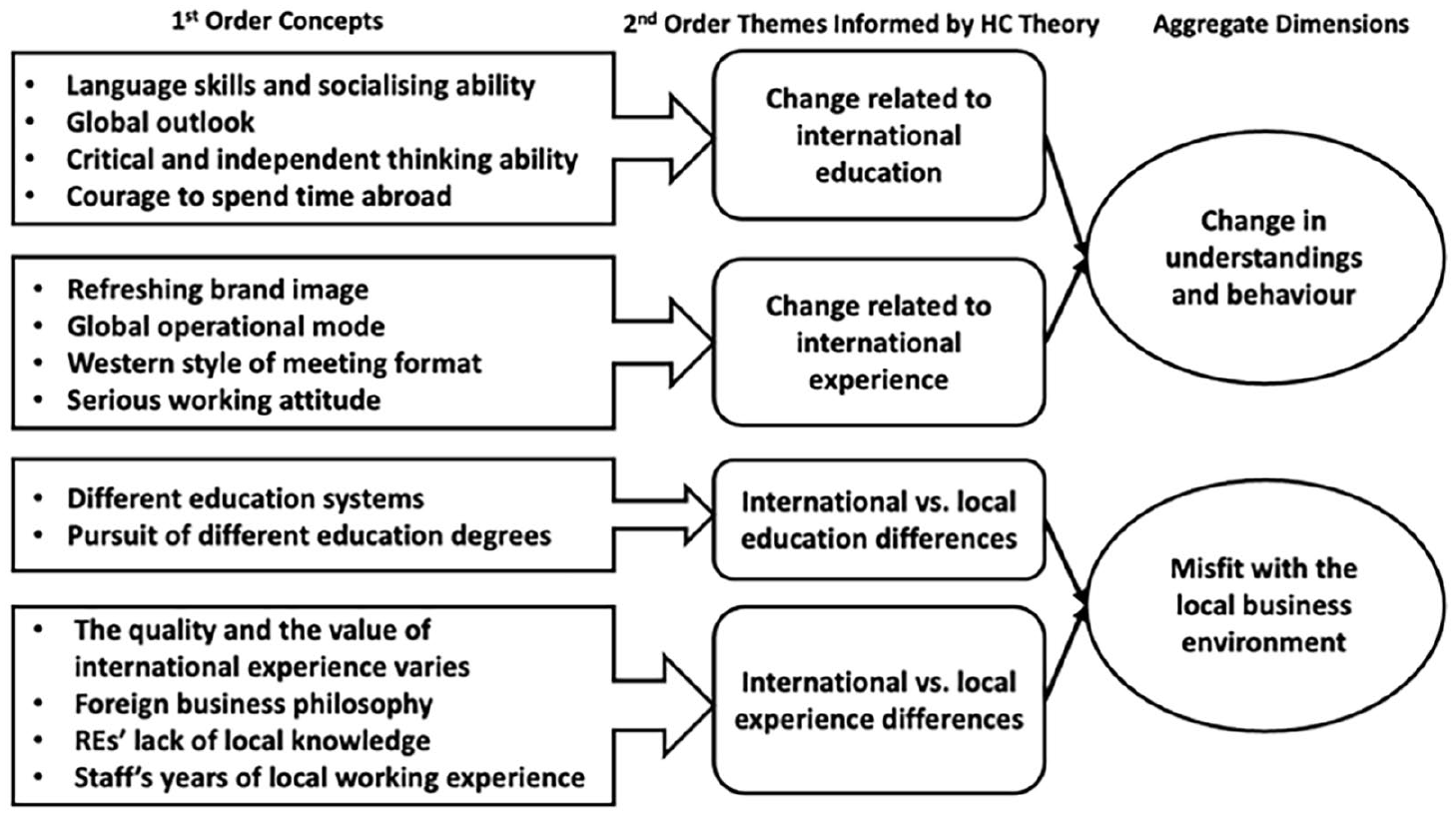
First stage: International human capital adaptation when going abroad.
Internationalisation creates new educational and experiential opportunities, and our study reveals insights and empirical evidence relating to how these affect entrepreneurship via human capital theory. We found that both education and experience affect the RE’s understanding and behaviour due to exposure to Western business culture with regard to a global outlook/global operational mode for their SMEs; this is verified in Participant C & F’s cases. Yet, how misfits were manifested or addressed remained unanswered from this first stage of research. As our findings and discussion show, in some cases, the RE’s professional skills and international working experience may have caused a misfit with the demands of the domestic market, as the knowledge and skills they had acquired overseas could not be applied directly to the local socio-cultural environment. Thus, we identified second-order codes as ‘international versus local’ educational or experience ‘differences’, which led to an aggregate dimension of ‘misfit with the local business environment’.
Change in understandings and behaviour
We believe that the most significant changes experienced by our sample REs had caused them to feel a sense of alienation from those who had not benefited from a period abroad. This particularly related to their improved foreign language skills, better communication skills and social abilities and to their increased critical and independent thinking capacity.
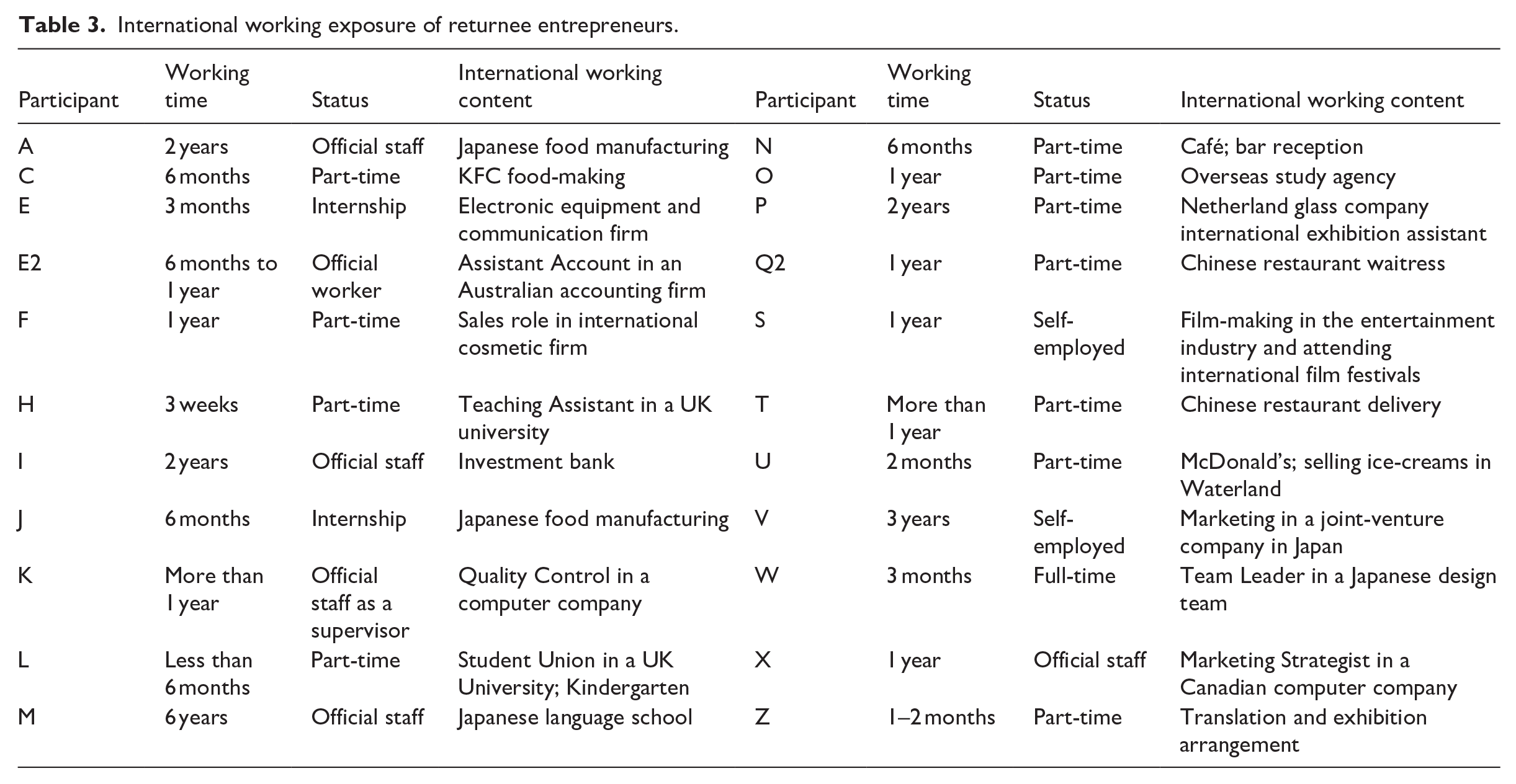
Among the 29 sample REs, 22 had had international working experience ranging from two months to six years in entrepreneurship, internship or formal employment. The service sector group had accumulated more related industry experience, such as working as a salesperson for an international cosmetic company and later establishing a similar firm. In contrast, the manufacturing sector group had less-related international working experience; for instance, Participant K had gained managerial experience working as a quality control supervisor in charge of three people. Duty, family responsibilities and ambition drove the REs to return home, believing in using their liminal status as an advantage to leverage resources across betwixt places and transform business practices in China.
Participant R. The family needed me to return to take over the business, and I believed the factory had potential for growth. Participant V. China needs me – it is as simple as that. I believe in a strong China, which is why I wanted to return.
Overall, having international working experience had improved the RE’s foreign language communication skills, understanding of foreign business culture and given them foreign manufacturing and managerial experience. Table 3 shows the details of the RE’s international working exposures in their host countries.
International working exposure of returnee entrepreneurs.
Participant F. It helps me to understand the operational mode of a global cosmetic firm. My current firm follows the operational mode of my previous cosmetic employer. So, I can directly transfer my working experience there into my current firm.
There was an issue regarding the adoption of different business philosophies resulting from educational differences. For example, Participant J2 had chosen to adopt the Xin Study of Mingyang Wang (a form of traditional Chinese philosophy), which teaches a casual attitude towards money and a tolerant management style. While influenced by a successful Japanese entrepreneur called Kazuo Inamori, his elder brother – Participant J – had come back from Japan after 7 years with a Japanese-style attitude towards work believing a military-style of management to be particularly efficient. This issue affects REs who study abroad and acquire explicit knowledge, but lack the tacit know-how possessed by experienced local professionals who have worked in the industry for years, as summarised by the following statement.
Participant T. When I first entered the firm, I believed that a degree was what mattered most. Since becoming a boss, I have understood that practical experience is more useful.
Misfit with the local business environment
The overseas human capital acquired by our sample REs was not always compatible with or useful to their business activity on returning home. For example, Participant K had worked for some time in a UK computer company as a quality controller; his international working experience was not directly compatible with his current aluminium production manufacturing business; this led to a poor fit with the local business environment.
Participant K. This upset me. What I learned about management is valid within the UK system, but the British management style is not suitable for Chinese enterprises.
Acknowledging these differences created a degree of frustration, especially after a long stay abroad, but at the same time, it helped to initiate the adaptation of human capital as a self-awareness process.
Participant M. My return to China [after 20 years] made me realise the significant cultural differences between my Chinese staff and myself, and I could not understand their way of thinking. It is so difficult for a person growing up in one environment to manage a group of people growing up in a different one.
After being absent from home, many of the REs were faced with an estrangement from the local market. This was due to a lack of access to local networks, poor understanding of the local market and neglecting to observe local customs and norms (Gruenhagen, 2018). More importantly, their understanding of the consumption behaviours of foreign customers may have resulted in a poor fit with the expectations of Chinese customers. From the interview contract with Participant J and J2, it is evident that while REs sensed a misfit between overseas human capital and local business conditions, they struggled to pinpoint the reasons. From a family/business partner perspective, Participant J2 highlighted the rationale behind his brother’s weakness and called for adaptation.
Participant J. Honestly, it was hard to adjust in the first year. Before joining the family business, I ran a wellness centre, but it closed in less than a year. The products I chose at the time were quite expensive. Participant J2 (younger brother). His (Participant J) weakness is that he is unfamiliar with the current situation in China, such as the latest policies or interpersonal relationships. And he is no longer familiar with Chinese traditional customs and logics.
Second stage: International human capital adaptation when returning home
Figure 3 shows the second stage of our research on international human capital adaptation processes, focusing on the process of becoming a RE for managing organisational change through an international acceleration strategy.
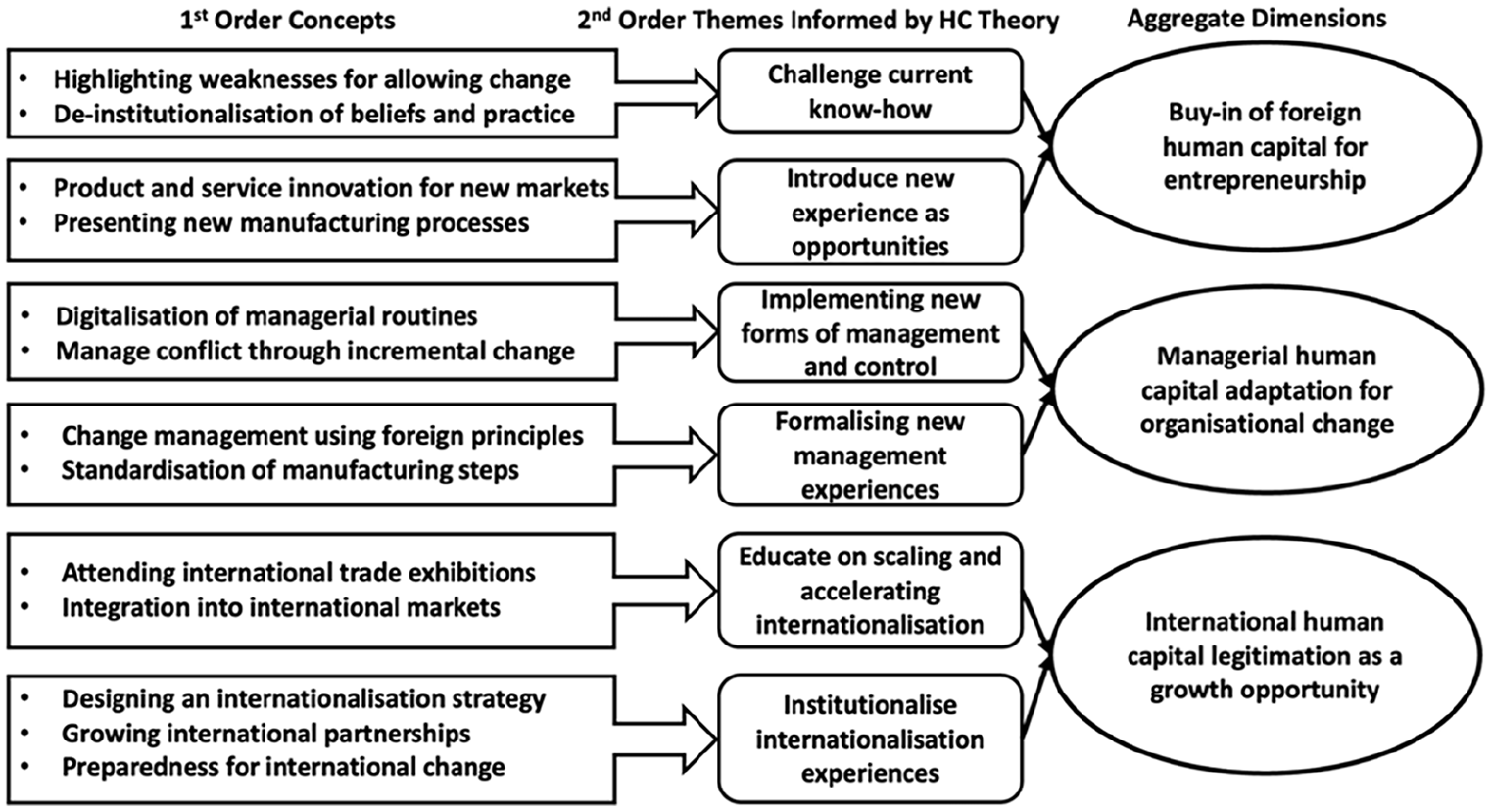
Second stage: International human capital adaptation when returning home.
During the coding process, the interview transcriptions showed that REs may use either tacit or some types of explicit entrepreneurship knowledge within their firms. As a result, second-order themes emerged concerning the fact that an individual’s life experience creates a knowledge corridor that enables that person to recognise opportunities. Starting with the internal buy-in of foreign expertise of REs into their home-country organisations, the outcome was an adaptation of the specific human capital from entrepreneurship opportunity recognition to management for organisational change and international acceleration. After exploring the local organisation managerial constraints and domestic industry niches, more information on how REs adapted their products and managerial practices in order to meet the requirements of the home and international markets was revealed.
Buy-in of foreign expertise for becoming a returnee entrepreneur
The buy-in of foreign expertise started with a reflection on the degree of change from the time abroad; this was largely a function of the duration of the RE’s stay overseas. For example, those who had only stayed in the UK for one year to undertake a post-graduate degree said that they did not face any adaptation issues. Those who left their home country after high school – and whose values and ways of thinking were shaped by Western company culture over many years – reported struggling with adaptation difficulties. This finding verified Hippler et al. (2015) and Brewster et al. (2021)’s studies and offered new evidence that returnees with a different length of stay in the host country experienced different degrees of difficulty with adjustment on their return home.
Participant E2 (cousin RE). I left China after my second year of high school, so my views were formed during my [seven to eight years] stay in Australia. When I came back and went to work in my family firm, I found that many of my ideas were different from those of my staff.
To secure buy-in of their ideas, the REs first had to filter what was suitable for the new home environment. This required a re-evaluation of their own identity by interacting with the host culture in relation to their future business area. It is, therefore, not surprising that some experienced the reverse cultural shock and related adjustment problems after their return. However, this process could also broaden the RE’s horizon, leading to new ideas and opportunities by considering the two distinct business environments.
Participant U2 (returnee wife). The one-year Master education experience in the UK has increased my general knowledge about the UK education system, different university locations and overseas student daily life. It benefits me a lot with my current business when I chatted with parents and offer living tips for their kids.
If the RE had previous educational or working experience overseas in a specific industry, they were more likely to use their existing knowledge for similar business models if there was a niche market opportunity in the home country.
Participant M: I have worked in a Japanese language school for more than ten years. I returned in 2007 to help it enrol Chinese students in China. In 2017, I opened my own company as a joint venture to continue the Japanese school enrolment service here.
The process of buying-in the transformed international human capital gave them a purpose to become REs and prove that the foreign human capital they had acquired, and the time spent abroad, was not in vain. Buying-in foreign human capital at home is not difficult for them, but effectuating it to prove themselves as REs in the home business environment was a challenge that required adaptation of managerial practices – discussed in the next section.
New processes and management for organisational transformation
There were significant differences across industries on how human capital adaptations were managed, faced resistance or were welcomed. Having studied and worked abroad, our sample REs in the manufacturing group had accumulated foreign expertise which had enabled them to recognise opportunities during the internationalisation of their SMEs. Most of these were working in their family manufacturing firms and were in charge of internationalisation. Their ability to recognise opportunities was related to the specific human capital output of management and industry know-how practices. Recognition of the firm’s incapability in maintaining consistent levels of quality had led them to apply their industry know-how to the standardising of manufacturing procedures.
Participant B. In foreign countries, the steps of the manufacturing process would be covered by an instruction guide; however, in the past, our firm relied solely on its workers’ expertise.
Another challenging aspect of human capital adaptation was the difference between formal and informal processes abroad compared to the home environment. This uncovered differences and tensions between traditional Chinese styles and the Western concepts of management know-how. From the perspective of business partner Participant V2, the RE had successfully navigated the adaptation process and managed effective communication styles among suppliers and staff. Opening up and being inclusive towards the views of employees, and doing so using an international and more open communication style, also resulted in enhanced productivity.
Participant V. I had difficulty in adapting to the home working environment, especially concerning ways of dealing with Chinese people and understanding the way they talk. We speak to foreigners in a straightforward manner, but the Chinese are different. Only now am I beginning to understand what they want to convey beyond the surface meaning of their words. Participant V2 (business partner). What Participant V did was popular with our staff. Our staff are young and they have little experience. We give them the power and opportunity to do something they like. This is the reason we have grown our company to its current size from an initial team of 20 members.
New technologies and digital innovations were strategically introduced to facilitate the adaptation of international human capital for management and organisational transformations, introducing new technology-driven ways of communication. For example, digital promotion channels and business models were used by our sample REs working in the service industry to legitimise trying new things.
Participant J. Our business model is different from those of traditional manufacturing firms. We upload pictures of our products on Ali Express [a Chinese overseas digital sales app] and only contact the factories and purchase the actual products once we receive the orders from our customers.
In summary, their international educational background and global experience enabled REs to justify their new managerial approaches by cultivating critical and independent thinking abilities for acting on long-term industry development. This was most notably expressed in their ability to project internationalisation opportunities discussed in the following section for justifying and leveraging managerial human capital adaptations.
International acceleration for legitimising change
Many REs chose to internationalise their enterprise as a natural way to run the business, instead of regarding it as an overcomplicated process compared with other local entrepreneurs. In addition to their personal preference to interact with international customers, REs used their fluent foreign language skills as a competitive advantage to succeed in the local market. With time, as such strategies started to bear fruit with the internationalisation process accelerating, this became a matter of identity for REs to legitimise their position in the firm and allow them to adapt more international practices. A common strategy applied by REs was to utilise their language skills and communication abilities to become the first in their enterprises to seek new promotional channels. This involved establishing international digital sales platforms or attending international trade exhibitions to sell their products overseas and internationalise their business.
Participant C. I have built two brands for my family business which are highly ranked on the Chinese Tmall.com and Taobao.com digital platforms. Compared with my local peers, I was quicker in seizing the opportunity to take advantage of digital platforms, always staying one step ahead of them.
In addition, REs sourced local information and produced specific human capital output of new management and industry know-how, which eventually led to the business process transformation of their SMEs.
Participant E. We have set up an online system in order to digitalise our management routines, such as for when a member of staff would like to apply for some time off, or apply a seal to a document. This prevents any bias stemming from personal relationships, as all the information is transparent.
These changes led to international growth opportunities. For example, in the service sector, some sample REs converted their international general human capital into transnational industry know-how. In doing so, they were enriching their product portfolio and transforming their traditional overseas study consultation business modes.
Participant L. I predicted that the global and domestic economic situation would not be so good this year and that our high-priced international summer school products would be hard to sell. So I changed my strategy and expanded our domestic camp products. This product line has sold well.
Although internationalisation practices were generally well-received, they were not without certain challenges, especially when the REs lacked local support in the home environment. Such challenges were related to the acquisition of Western managerial practices, foreign technological knowledge, or international human resources together with continuous feelings of being a misfit.
Participant N. I felt frustrated when I stared the company as I could not make sense many things to my workers. They do not care when I talked about management, company culture or learning. But I indeed bring some knowledge and experience to our staff in an unnoticed way. An obvious feeling this year is that I kept changing and adjusting this company.
In response, once the REs realised the lack of fit between their overseas knowledge and experience and the Chinese business environment, they tried to selectively apply the useful skills learned abroad to the domestic working environment only when they felt that these were suited to the latter.
Participant K. I can only use the knowledge and skills that work in China and had to abandon the rest. If I could use 30%–50% of what I learned in the UK, it would be nice. I will not be able to use all of it because of the differences between the British and Chinese ways of thinking.
The data collected from this study dates back to 2018–2019; thus, our findings may have limited implications to incoming geopolitical or social changes. The data indeed reveals a RE’s reaction to the beginning of the China–US trade war when Donald Trump was in his first presidential term, as Participant L used a de-internationalisation strategy to expand the domestic product portfolio to make up potential loss for traditional overseas summer school routes to the USA. In conclusion, although internationalisation opportunities for growth were generally well-received once the REs could confidently prove them in practice using an inclusive approach, adapting the local resources and capabilities to new international environments took time thus, limiting the scope of international growth.
Discussion
Theoretical contributions
International entrepreneurship decisions are influenced and limited by previous knowledge and experience, and by the external environment in which entrepreneurs operate (Zahra, Korri, & Yu, 2005). Building on previous research from Knight and Liesch’s (2016) and Graves and Thomas’s (2008) on accelerated internationalisation and on its pathways in family firms, the study focuses on the returnee entrepreneurship phenomenon in China, especially their adaptation journey as a form of internationalisation. To explain such processes, research on liminality has looked at the adaptation process of self-initiated expatriates and their transition to the host country (Chen et al., 2021); a liminal lens highlights different sources of liminality and its impact when considering integrating refugees into the workplace (Loon and Vitale, 2021). In these, and similar studies, internationalisation has traditionally been seen as something that happens, or that entrepreneurs do, but not as a human capital adaptation journey. Advancing this perspective both theoretically and empirically in this study is intended to make a theoretical contribution. For this, the liminality literature provides a valuable perspective yet, we know little about the in-between adaptation processes of the general international human capital that help to turn individuals traveling abroad for studying and work into REs in the home country.
Contextually, we start our investigation by showing that because of their internationalisation journey, returnees also adapt the inaccurate expectations of their home country. For instance, this could be regarding the remuneration levels found back home, and they could have been left perplexed by the frustrating reality of work at home (Tran and Truong, 2022), pushing them to become REs. This was verified by Participant U, who believed he was well qualified to get a job in Shanghai but ended up starting an international new venture in his hometown, Wenzhou. To explain such processes, and advance human capital theory by considering internationalisation as an adaptation journey, Figure 4 shows an updated version of our initial theoretical framework informed by our findings.
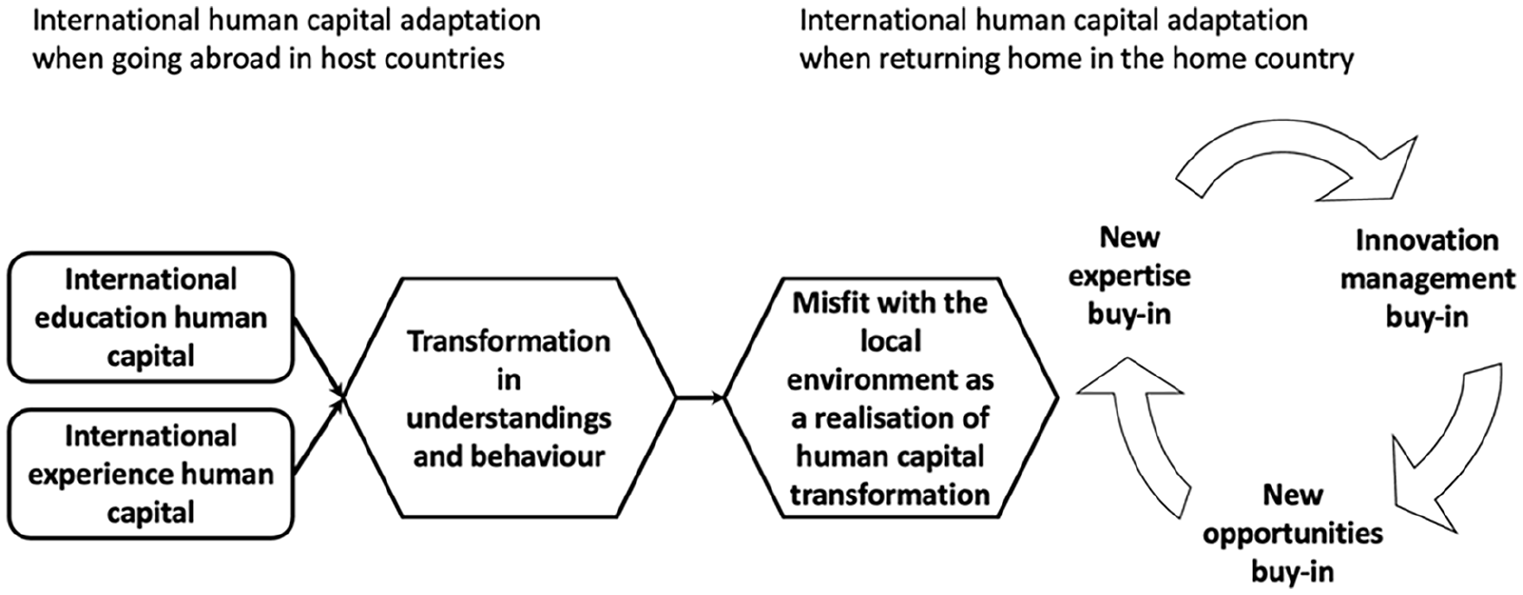
The international human capital adaptation journey of returnee entrepreneurs.
The boundary between the foreign and domestic contexts lies when REs left host countries and returned to China deciding to start a business. The distinction is vague in Figure 1 as it is located around the adaptation process and it grows obvious in Figure 4. Our proposed model advances the initial theoretical framework initially presented in Figure 1 by visualising the adaptation process into two stages – ‘international human capital adaptation when going abroad’, and ‘international human capital adaptation when returning home’. We expand the part of ‘adaptation process of international human capital’ in Figure 1 into two phases of ‘transformation in understandings and behaviours’ (adaptation in host countries) and ‘misfit with the local environment’ (reverse adaptation in the home country) in Figure 4. This article contributes to human capital theory by revealing empirical insights and emphasis on the second phase of adaptation after the RE returned home – this is rarely investigated or at least unclear in previous IE literature (Kenney et al., 2013; Lin et al., 2019; Wu and Ma, 2018). The findings show that REs go through a transformation of their understanding and behaviour due to their international exposure. Later they recognise that their overseas knowledge and skills may not always fit well with the local environment; this encourages them to transform their international human capital when in China. At this stage, we identify three international human capital adaptation processes which REs use to cope: (1) internal buy-in of foreign expertise to become REs, (2) organisational transformation through international human capital, and (3) human capital adaptation for international acceleration. Such processes are to be considered as a circular model, feeding into each other as the adaptation and integration of REs is aligned with their international business ventures and goals.
This article contributes to international entrepreneurship research and knowledge by exploring internationalisation as a human capital adaptation journey in the context of REs, and not simply as something that happens to them, or that they do. The RE phenomenon and reverse migration are broadly discussed in Africa (Chand, 2019), and Asia (Saxenian, 2005). The literature stream of this article is built from previous quantitative studies regarding the knowledge spillover of Chinese REs in high-tech SMEs, such as Wright et al., (2008), Filatotchev et al., (2009), and Liu et al., (2015). We admit the scope of the findings derived from this study has its specific contextuality rooted in a Chinese socio-cultural background. However, we believe that what we have discovered in the Chinese RE group shares its underlying universal rationales with the RE phenomenon in other emerging markets, especially Asian countries which are influenced by Confucian culture.
Our contribution to human capital theory is centred around the less-investigated entrepreneurial behaviour of REs and their adaptation practices using qualitative empirical data in the IE literature. Our study suggests that internationalisation is enacted as a process of converting and transforming overseas human capital. We advance previous quantitative studies such as Filatotchev et al., (2009), and Liu et al., (2015) by emphasising returnee entrepreneurship as a specific response to geographical barriers. Viewing internationalisation from an individual perspective, this study contributes to human capital theory by confirming the human capital transformation process of REs. It reveals that learning how to adapt the knowledge they acquired abroad to local business routines, and their experience of success and failure, can influence the mindset of a RE in ways that profoundly impact firm culture and shape future internationalisation decisions (Brannen, 2004; Tran and Truong, 2022). It further explains why some of our REs that ran international firms took a proactive approach to internationalisation – which means initiating managerial change by launching a new digital business model for rapid and large-scale internationalisation (firms G and J). Another set of our sample REs, with overseas consultation agencies, sensed the risks linked to international political environment uncertainty and therefore, enacted the managerial practice change of enriching their domestic product portfolios. By implementing a de-internationalisation strategy, they had indirectly decreased their exporting percentages, avoided potential risk, and made up for any international trade loss (Firms L & N).
We offer a further contribution to human capital theory by researching and conceptualising the inner general-to-specific conversion of human capital that occurs during the adaptation process of REs, not considered in related studies such as those by Westhead et al. (2001) or Zhou et al. (2016). The REs convert their general overseas human capital, combine it with local information, produce local know-how and eventually generate new management and industry know-how that is applicable across national boundaries. Our findings extend those of Zahra et al. (2005) by identifying in detail the activities pursued by REs once they have recognised an opportunity, and by further listing the various forms of managerial system changes that occur during the RE’s business process transformation. For instance, the launch of a new product range to fill a local market niche (participant U), the establishment of international digital sales channels (participants C, J & F), the perfection of a traditional management style using Western managerial concepts (participant V), and the standardisation of manufacturing steps to bring them in line with global practice (participants B & K). The REs localise the business philosophy of Western concepts into transnational management and industrial know-how: they understand that monetary incentives work better for local Chinese employees, instead of work–life balance or the mental health well-being (Participant T). While stating a value towards external environmental/societal responsibilities aimed for the global market, a good balance between the price and the quality of the product is pursued by Chinese local customers (Participant J).
This article presents internationalisation as a journey shaping an individual’s human capital that can be utilised to create or manage SMEs as REs in various social-cultural settings. Internationalisation acts as a catalyst to shape, transfer and develop explicit and tacit human capital across geographical boundaries, which eventually can be applied in international entrepreneurship practices. We have shown the flow of human capital adaptation and development via numerous examples of Chinese REs, their SME contexts and resulting challenges. Such new evidence and novel insights contribute to human capital theory by explaining the interrelatedness of education and experience dimensions in the transformational processes for the individual and the firm’s internationalisation. As demonstrated in Figure 4, individual-level internationalisation of adaptation begins in the host countries on the left side of the diagram and continues through the individual and organisational-level internationalisation loop on the right side in the home country. It is during this process that REs transfer various forms of human capital between the SMEs, themselves and the individuals working within the SMEs, who are affected by the RE’s business practices. Our findings reveal that those REs who recognised a lack of fit with the local Chinese business environment and thus, initiated a transformation of perceived overseas human capital, there followed a looping three staged adaptation processes.
Implications for policy and practice
In practice, this study shows that if some REs experience a lack of fit with the home context when returning home to set up a business, the international human capital adaptation process enables them to cut through the understanding barriers within different business cultures. This enables them to recognise opportunities neglected by local entrepreneurs, and find ways to introduce global market management routines, revalidating themselves as valuable individuals in the home society and in the organisational context of the new international ventures they lead. To achieve this, the REs need to use part of their overseas expertise in the Chinese socio-cultural context, learning-by-doing in the workplace and transferring their international human capital into local know-how. The context of this study is that of Chinese privately owned SMEs, where governmental supervision has been absent for a long time. With less influence from policies and geopolitical factors, owner/managers have some degree of freedom to choose their managerial practices around internationalisation processes. Even then, as evidence here shows, although REs encounter resisting forces from within the business environment, they also have sufficient space to use the obtained international human capital for transforming their organisations and influencing their peers who play a managerial role in MNE internationalisation.
From a policy perspective, our research shows that service firms generally internationalise faster than their manufacturing peers, as most of them are young entrepreneurial companies. Consequently, the REs in service firms adapt less of their overseas human capital than their manufacturing equivalents, and transform business routines more easily. In other words, the REs in service firms suffer from fewer human capital gaps with their young staff and are a better fit with their local environment. As such, they face fewer adaptation difficulties, and their SMEs absorb their foreign knowledge more quickly and internationalise faster. Conversely, the REs working in family-owned manufacturing firms may face more generational human capital gaps and communication difficulties with managers and staff members at various levels, due to overseas versus domestic educational differences and established managerial routines. Thus, the REs find themselves subject to greater pressures and difficulties in their adaptation. These findings suggest that policy support for the adaptation of REs should focus more on manufacturing family firms.
The adaption difficulties experienced by the REs could be eased by more frequent domestic contacts while abroad. This strategy is likely to be successful because a high level of domestic engagement while overseas could engender in the REs a shared identity with and an understanding of their home-based compatriots (Wu and Ma, 2018), which would keep them updated with local knowledge, and improve their ability to adapt after their return. Gu (2009) suggested that it would take returnees more than one year to re-adjust to their home environment. This study suggests that no matter the length of time since the REs returned home, the most important factor is when they started the adaptive transition cycle and how long it takes. The sample REs in our study often faced difficulties in their first year, and their adaptation process had taken between one and two years.
Limitations and directions for future research
This study has the following limitations. To provide a comparison with previous Chinese returnee entrepreneurship studies that focused on high-tech industries (Filatotchev et al., 2009; Kenney et al., 2013), we targeted SMEs in low- and medium-tech industries such as in manufacturing and service. Therefore, the findings of this study should not be applied to different sectors without due caution. Although the observations and findings related to Chinese SMEs may appear like those relating to other emerging markets, there may be differences in terms of organisational structure and governmental policies (Wu and Ma, 2018). The findings of this study are also characterised by the period in which the data were gathered before the pandemic, during the summer of 2019. This study proposes that Chinese RE adaptations in private SMEs in the entrepreneurial domain, and future studies in the field, could look at the adjustment of expatriates from different countries of origin working for alternative forms of institution, and the impact of their experience. Future studies could utilise data collected from other emerging economies to test our human capital internationalisation and adaptation model. In addition, this study borrowed a few concepts from IE theory; thus, more research is required into the relationship between human capital and its impact on the accelerated internationalisation of SMEs through returnee entrepreneurship in low- and medium-tech industries. Future studies could make further advances with respect to the relationship between the international exposure of REs and new venture SME internationalisation prospects, such as internationalisation speed, scale and pathways.
Conclusions
This study contributes to human capital theory by proposing a conceptual framework for the acquisition, adaptation, and utilisation of the various types of human capital possessed by REs in their internationalisation journey, explaining how and why these mechanisms and processes evolve over time. It offers a further contribution by revealing three transformative processes important when considering the adaptation behaviour of REs in integrating their international human capital into local business routines. These processes are foreign knowledge buy-in leading to becoming a RE; the subsequent transformation of business processes by converting overseas general human capital into specific outputs of cross-national know-how; and the eventual legitimisation of changes through internationalisation managerial practices as a growth opportunity. Relying on reverse adaptation to the local market in the home country and being perceived as boundary-spanner help REs to achieve faster internationalisation in their home ventures.
Footnotes
Funding
The author(s) received no financial support for the research, authorship and/or publication of this article.
