




Abstract
This article explores the role of start-ups within entrepreneurial ecosystems in driving the transition towards a circular economy. It emphasises the importance of understanding and supporting circular start-ups for broader sustainability impacts. Unlike established firms, start-ups can readily adopt ambitious circular business models (CBMs) without the risk of business model cannibalisation and with the agility to adapt to market trends. CBMs enhance value creation, delivery and capture resource flows in an optimised non-linear fashion. Scaling up CBMs is crucial for overall economic, social and environmental benefits. Hence, leveraging the key entrepreneurial ecosystems actors, such as universities, business incubators and related venture development intermediaries, is vital for start-up support. In this special issue, we have invited researchers to submit contributions that delve into the dynamics among start-ups, entrepreneurial ecosystems and the circular economy, aiming to enrich our understanding of the early stage start-up development process with the aim of promoting the circular economy at a firm, regional or national level.
Keywords
Introduction
The current predominantly linear economy is characterised by unsustainable levels of consumption, premature product disposal and significant amounts of waste. In contrast, the circular economy operates on principles such as ‘value retention’ to keep the value of products and materials on the highest level of utility for as long as possible (Achterberg et al., 2016), ‘closing loops’ to reuse materials (Geissdoerfer et al., 2020), ‘dematerialisation’ to utilise minimal materials to start, following the principle of ‘regeneration’ by using renewable energy and resources as well as reviving for natural solutions (Konietzko et al., 2023). Understandably, circular start-ups pursue business strategies that strive for narrow resource loops (use less), slow resource loops (use longer), close resource loops (reuse materials) and regenerate resource loops (revive nature) (Bocken and Geradts, 2022; Konietzko et al., 2020a). Hence, Circular Business Models (CBMs) focus on optimising resource loops and extract value from various resources through principles of circularity. Often, products in service business models (e.g. rental, lease, subscription) are pursued to enable the closing and slowing of resource loops, as the service provider would retain ownership of the products and materials (Tukker, 2015). Start-ups are particularly well-suited to embrace circular principles due to their agility and absence of entrenched business models and investments (Kanda et al., 2022). However, the infancy of these start-ups coupled with ambitions to disrupt established pattens in business ecosystems, can hinder or slow the development and scale-up of their CBMs (Han et al., 2023), a phenomenon referred to as ‘liabilities of newness’ (Djupdal and Westhead, 2015; Gimenez-Fernandez et al., 2020). In practice, both new and established firms can adopt CBMs, albeit to varying degrees, incorporating them as add-ons, side businesses, or central operations (Bauwens et al., 2020). However, one circular strategy could dominate a firm’s business model, dictating the highest budget allocation and revenue generation (Henry et al., 2020).
Research on the obstacles faced by new circular start-ups is limited, with existing studies broadly focusing on generic issues such as financial, market and knowledge barriers to CBMs (Vermunt et al., 2019). While some research investigates challenges faced by small- and medium-sized businesses in adopting circular models, they primarily view the transition from a business model perspective and overlook those circular start-ups which start from their inception (Kanda et al., 2020). The extant literature identifies both internal and systemic barriers to CBMs, with systemic barriers often outweighing the internal issues due to the systemic nature of the circular economy. External barriers typically involve required shifts in linear supply chains, market readiness gaps and incongruities between circular practices and regulatory frameworks, making start-ups particularly vulnerable in their early stages (Kanda et al., 2020). Start-ups are pivotal in developing CBMs, being able to adopt holistic circular approaches from the outset, unlike established firms (Henry et al., 2020). They often experience limited risks associated with business model cannibalisation and can respond swiftly to market changes, embrace higher levels of circularity strategy compared to incumbents (Henry et al., 2020). A CBM revolves around slowing, closing, narrowing and regenerating resource loops to create, deliver and capture value (Bocken et al., 2016; Konietzko et al., 2023). However, developing such models is complex; this necessitates diverse knowledge domains and collaboration between multiple stakeholders and economic sectors (Geissdoerfer et al., 2020).
Incumbent firms may also resist the shift to circular models due to vested interests in existing linear systems (De Clercq and Voronov, 2011). Start-ups often grapple with limited financial and human resources, requiring them to address social, environmental and economic sustainability while navigating challenges associated with the liability of newness (Bank et al., 2017; Kuratko et al., 2017; Riandita et al., 2022). Hence, start-ups need support in gaining access to crucial resources such as knowledge, finance and networks at various stages of their development (van Gelderen et al., 2006). Geographical, institutional and relational support, conceptualised as an entrepreneurial ecosystem, play a vital role in nurturing such start-ups (Brown and Mason, 2017). Essentially, entrepreneurial ecosystems consist of actors and factors that enable productive entrepreneurship in a particular territory (Stam and van de Ven, 2021). CBMs operate on distinct value generation logics compared to traditional models, encountering particular challenges and drivers (Tura et al., 2019). Currently, entrepreneurial ecosystem actors lack extensive experience with CBMs reflecting the dearth of research that applies the concept of entrepreneurial ecosystems to the circular economy (Konietzko et al., 2020b). Moreover, limited research focuses directly on the sustainability-related aspects of entrepreneurial ecosystems (Volkmann et al., 2021). While prior research on sustainable entrepreneurship has explored various related facets, the application of sustainable entrepreneurship to the circular economy remains relatively unexplored, particularly concerning start-ups (Henry et al., 2020). Research addressing this gap can yield theoretical, practical and policy insights on effectively supporting circular start-ups to survive, sustain and scale-up, driving real sustainability impact beyond niche markets.
Circular start-ups and their growth and development
According to Henry et al. (2020), circular start-ups can be categorised into five distinct archetypes: Design-based (e.g. introducing a product design that requires less material in production); Waste-based (e.g. utilising waste as input material); Platform-based (e.g. consumer-to-consumer marketplaces for sharing or selling pre-owned products); Service-based (e.g. substituting ownership for access); and Nature-based (e.g. harnessing natural ecosystems for production without causing harm). These categories transcend industry boundaries; it is possible for start-ups to combine several categories within a single venture.
Circular start-ups are poised to play a crucial role in driving the transition to a circular economy and achieving sustainability goals. Their agility in adapting to changing market conditions and their propensity to adopt radical CBMs set them apart from incumbent firms (Han et al., 2023; Henry et al., 2020). Consequently, they are expected to possess competitive advantages and excel in terms of development and growth. However, akin to conventional start-ups, circular start-ups may encounter substantial barriers to scale-up potentially exacerbated by their simultaneous pursuit of propositions that are desirable, feasible, viable, circular and sustainable (Baldassarre et al., 2020). These barriers often stem from a lack of resources or capabilities during the developmental phase of their ecosystem. In the process of developing CBMs, start-ups must remain vigilant about their impact and stay mindful of potential negative rebounds (Das et al., 2023; Zink and Geyer, 2017). This awareness is crucial to navigating the complexities inherent in the circular economy landscape. Concerning growth, while ‘scaling up’ is the most used and accepted term, recent studies have expanded on this concept by distinguishing between scaling up, scaling deep and scaling out (André and Pache, 2016; Bauwens et al., 2020; Bi and Yu, 2022; Lam et al., 2020). Scaling up involves increasing the geographical scale of a venture, scaling deep focuses on being more locally anchored whilst scaling out centres on expanding the range of services offered (Bauwens et al., 2020; Kim and Kim, 2022). In a related vein, Han et al. (2023) identified scaling patterns for circular start-ups based on their achievement of scale and categorised them into purely commercial strategies, phased strategies where impact strategies follow commercial ones and synced strategies where firms concurrently pursue both impact and commercial strategies. These findings build upon earlier research that differentiated start-ups as either ‘born circular’ or ‘grown circular’ later (Briguglio et al., 2021; Geissdoerfer et al., 2020).
Transitioning to the circular paradigm, Blomsma et al. (2023) outlined how the shift from a linear to a circular approach could occur; these observations can be applied to circular start-ups at the micro-level. It is suggested that a phase of acceleration in this paradigm shift involves business experimentation encompassing ‘targeted testing of ideas’ (Blomsma et al., 2023: 1021), an active search for alignment between existing dominant systems and new CBMs, and a process of social and political mobilisation to garner societal support and acceptance. These processes are observable on the micro-level where entrepreneurs and start-ups frequently experiment and interact with established systems while informing and influencing their customers and stakeholders. This broader orientation, extending beyond fine-tuning business models and building customer bases, may pose new challenges for the entrepreneurial ecosystems in which circular start-ups operate.
Supporting circular start-ups in entrepreneurial ecosystems
Start-ups engaged in the circular economy typically embrace particular business models that demand distinct resources and expertise tailored to an economy’s specific contextual needs. Furthermore, entrepreneurs in the economy require comprehensive support to grasp the intricate dynamics of related sectors, such as resource recovery supply chains and the valorisation of second-hand resources. They must also effectively engage with the ecosystem’s network, often characterised by its weak and nascent connections (van Rijnsoever, 2020). Currently, policymakers interested in providing new venture development support, particularly through targeted entrepreneurial growth, actively pursue incubation strategies (Mian et al., 2016). Therefore, depending upon the sponsor’s objectives incubation mechanisms (incubators, accelerators, science parks, etc.) are considered preferred policy tools for seeding new and innovative ventures. They have now become the lexicon of entrepreneurship ecosystem development in various parts of the world (Mian et al., 2021). Incubation mechanisms, integral to the entrepreneurial ecosystem, are crucial in seamlessly integrating these start-ups into specialised business networks and shaping the burgeoning circular economy’s structure. Given the unique attributes of the circular economy, conventional incubation methods might not be entirely suitable for the needs of such start-ups (Millette et al., 2020). Research on the circular economy, still in its infancy, offers limited insights on effective support mechanisms for these businesses. Notably, Millette et al. (2020) observed that entrepreneurs aiming to establish and grow within the circular economy frequently struggle to pinpoint viable business opportunities, and traditional incubators often fall short in providing the essential knowledge and support needed for identifying and capitalising on these opportunities.
Addressing this, incubators and accelerators, like the start-ups they assist, should adapt their business models to align with the circular economy’s distinctive characteristics. This adaptation is essential for fulfilling the entrepreneur’s specific needs. Innovation in business models of support structures is imperative for researchers and practitioners in the field of entrepreneurial support. Incorporating circular economy principles, such as waste minimisation, resource recycling and redefining product life cycles, into the business strategies of incubators could be highly beneficial. Additionally, re-evaluating and enhancing the list and profiles of partners for entrepreneurs to establish and strengthen significant connections is crucial (Millette et al., 2020). Providing access to mentors with expertise in circular economy, sustainable supply chain management, carbon footprint reduction and the rejuvenation of used resources would also be advantageous. In addition, to tackle the barriers impeding start-up growth, personalised training tailored to aid entrepreneurs in crafting scalable and innovative business models is advisable (Bank and Kanda, 2016). Focused assistance to navigate the frequently challenging regulatory landscape, which may not always be conducive to circular economy practices, is of vital importance. Finally, to improve consumer awareness about the significance of circular economy products, mentors should enhance their new venture development support for entrepreneurs in devising targeted marketing strategies.
Summary of contributions and formulating a future research agenda
In this special issue, we have gathered contributions from various perspectives and methodological approaches that analyse the interplay between start-ups, entrepreneurial ecosystems and the circular economy. Of the papers submitted, we have selected the following six for publication in our special issue after a rigorous formal review (see summary in Table 1). The papers are presented in order of their analytical focus from the national, regional to the firm level.
Summary of papers in the special issue.
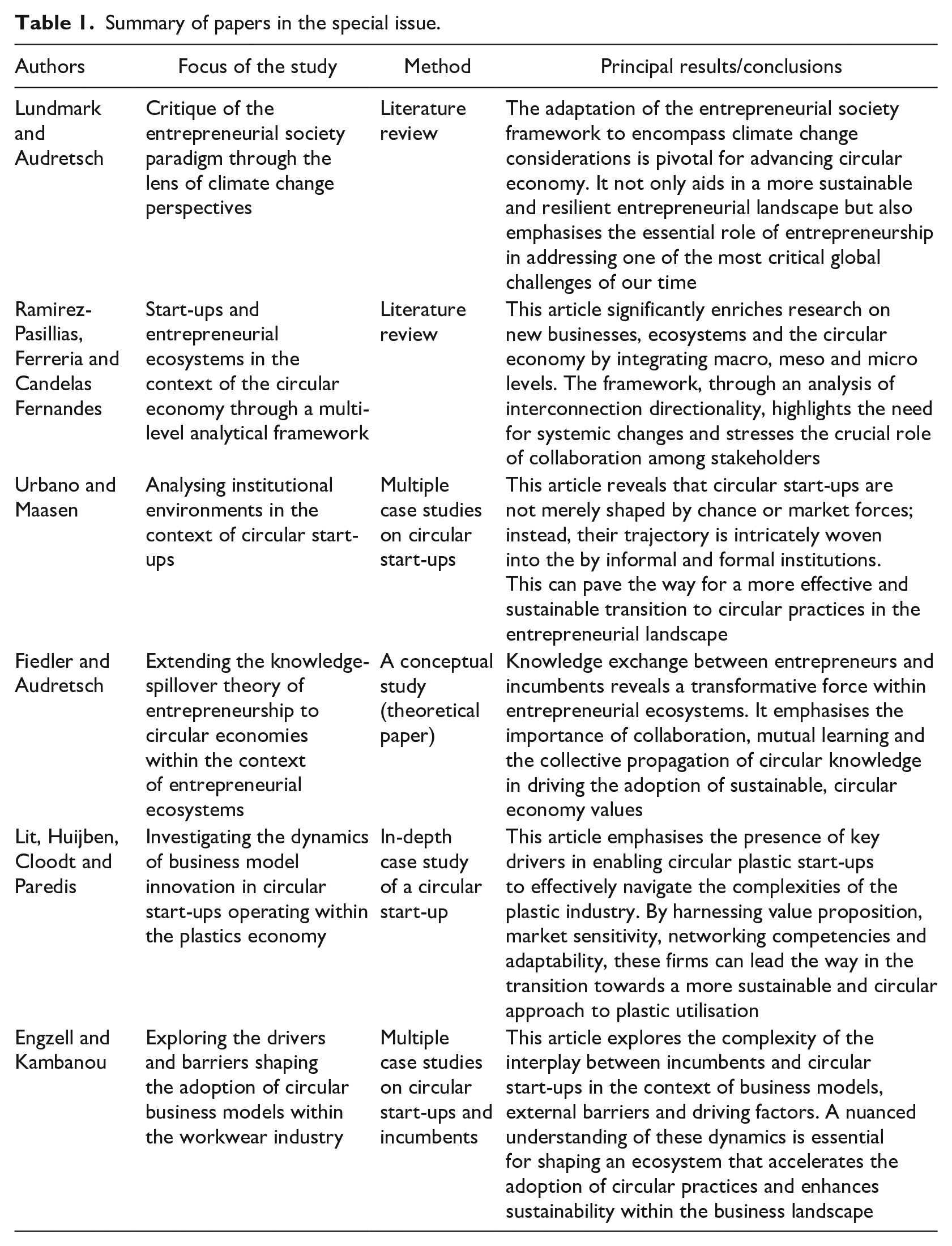
Lundmark and Audretsch delve into the theoretical construct of what they have coined ‘the Entrepreneurial Society’, which holds a pivotal role not only within the sphere of academic research but also in the discourse surrounding policy considerations concerning the influence of start-ups in catalysing transformative shifts to address emerging challenges. The framework was originally conceived during an era when societal disruptions held lesser prominence, primarily accentuating Schumpeterian disruptions. In their discussion, they revisit the Entrepreneurial Society framework, considering the ever-pressing imperative to address climate change, a challenging source of contemporary societal disruptions. The article makes three distinctive and significant contributions. First, it furnishes contemporary insights into the Entrepreneurial Society paradigm, capturing contemporary critiques and concerns that have arisen since its inception. Second, it delineates the primary conceptual challenges that the Entrepreneurial Society confronts considering the multifaceted challenges posed by climate change. These challenges entail a reevaluation of the framework’s assumptions and scope, necessitating a recalibration to align it more robustly with the intricate dynamics of a climate-threatened world. Finally, the article offers a series of proposals aimed at refining and enhancing the Entrepreneurial Society framework, rendering it more adaptive and responsive to the demands of a world grappling with the implications of climate change. These proposed refinements are set to provide a guiding compass for entrepreneurial endeavors, steering them toward the principles of a circular economy, which, in turn, aim to foster sustainability and address the contemporary challenges of climate change and natural resource depletion.
The systematic literature review by Ramirez-Pasillias, Ferreira and Candelas Fernandes embarks on an extensive exploration of the landscape that encompasses start-ups and entrepreneurial ecosystems within the domain of the circular economy. This in-depth analysis of existing literature, underpinned by a theoretical framework, is methodically conducted to not only delineate the characteristics of scientific production but also to elucidate the underlying theoretical foundations. This endeavor aspires to unearth primary research themes while discerning their theoretical underpinnings and potential contributions to advancing this growing body of work. The protocol adopted in this review entails an examination of a sample of 90 articles methodically curated from sources such as the Web of Science and Scopus. The bibliometric analysis is employed as a theoretical lens to decipher the bibliographic connections interlinking these articles, revealing the complex web of knowledge exchange within this scholarly domain. The content analysis, guided by theoretical constructs, is instrumental in discerning the principal research themes that have germinated within this theoretical landscape. The study significantly enriches research on new businesses, ecosystems and the circular economy by integrating macro, meso and micro levels, surpassing fragmented discussions and emphasising the importance of both top-down and bottom-up approaches. The framework, through an analysis of interconnection directionality, highlights the need for systemic changes and stresses the crucial role of collaboration among stakeholders. The research agenda guides future studies on the interaction between start-ups and entrepreneurial networks, emphasising the circular economy’s potential and the role of start-ups and sustainable entrepreneurship in policy formulation. Tailor-made contextual policies at macro, meso and micro levels are essential for promoting circular economic systems.
Urbano and Maasen undertake an exploration into the relationship between institutional environments and circular start-ups, grounded in the theoretical framework of institutional theory. This theoretical foundation is providing insights into the multifaceted ways these nascent enterprises are influenced within the dynamic entrepreneurial landscape of Catalonia, Spain. Their research delves into the various dimensions of this influence, shedding light on the pivotal role played by both informal and formal institutions. The study’s methodological approach, characterised by a multiple case study of circular start-ups, offers knowledge on how these firms operate and evolve in response to the institutional setting. Within this theoretical landscape, it becomes evident that the development and operational models of circular start-ups are intricately shaped by a dual interplay of informal and formal institutions. Informal institutions, encompassing founders’ motivations, their ability to identify opportunities and societal values, are identified as salient factors that theoretically guide and mold the trajectory of circular start-ups. Their motivations, ingrained in the entrepreneurial spirit, are instrumental in shaping the innovative and sustainable character of these firms. This, in turn, influences their propensity to embrace circular principles. On the other hand, formal institutions, ranging from the founder’s prior experience, the presence of ecosystem partners and the existence of supportive legal and regulatory frameworks, are indispensable aspects that theoretically affect the performance and evolution of circular start-ups. These formal institutions provide the infrastructure upon which these enterprises build and grow, ensuring their alignment with the circular economy. The implications of their findings go beyond the confines of academia, offering valuable insights and theoretical perspectives for policymakers. Their research provides theoretical guidance for the development of effective support mechanisms aimed at nurturing and advancing the growth of circular start-ups and facilitating the larger societal transition towards a more sustainable and circular economy.
The study by Fiedler and Audretsch serves as a theoretical exploration that delves into the integration of the knowledge spillover theory of entrepreneurship within the complex landscape of circular economies while also clarifying the influence of values within entrepreneurial ecosystems. Their theoretical framework seeks to marry the knowledge spillover theory of entrepreneurship with the broader entrepreneurial ecosystem literature, tuning it to suitably nature of circular economy. Within this theoretical construct, they articulate a conceptual framework designed to expedite the evolution towards circularity within these ecosystems by facilitating the exchange of knowledge among diverse actors. Furthermore, their research illustrates the role played by the evolution of values in shaping the landscape of knowledge and its commercialisation within entrepreneurial ecosystems. Their proposition is that entrepreneurial-driven transformation can significantly contribute to broader utilisation of knowledge for circular economy opportunities. This theoretical perspective emphasises the potential of entrepreneurs to wield influence over the knowledge landscape and mechanisms within entrepreneurial ecosystems, fostering a theoretical interplay that is instrumental in advancing circularity. In the intersection of traditional knowledge spillovers emanating from established firms and reverse spillovers of frugal innovation, a theoretically profound shift occurs. This shift, underpinned by the values and CBM knowledge, gives rise to a symbiotic relationship that theoretically advances the developments towards circularity. Their research concludes with the development of a theoretical model, highlighting the theoretical shifts in knowledge exchange that emerge between entrepreneurs and established firms within the landscape of the circular economy.
In a case study on circular start-ups in the Dutch plastics industry, Lit, Huijben, Cloodt and Paredis identify four critical success factors – circular value proposition design, market sensitivity, networking prowess and circular ambidexterity – that empower circular start-ups in the plastics industry. Their findings indicate that circular start-ups strategically apply these success factors to overcome barriers. However, there is a prevalent focus on recycling-centric business models among these start-ups, limiting their capacity to drive a more profound transition within the waste hierarchy. This emphasises the necessity for support from entrepreneurial ecosystems and a multi-stakeholder perspective recognising the interconnectedness of their business models with other actors in the plastics value chain. Additionally, their study explores the theoretical concept of strategic adaptability, shedding light on how circular start-ups adeptly navigate various facets of their business models. Acknowledging strategic adaptability as an essential capability, the study illustrates how it empowers these enterprises to navigate theoretical barriers encountered in their development. The paper significantly advances the understanding of challenges in CBM innovation, offering practical approaches and strategies employed by circular start-ups to address and overcome these obstacles.
Finally, the article by Engzell and Kambanou delves into a comparative analysis of incumbent firms and newly established circular start-ups within the workwear industry, aiming to uncover the organisational and individual factors that drive or impede the transition to a circular economy. Conducting a qualitative investigation, they utilised semi-structured interviews with a diverse array of case study organisations operating within the workwear sector in Sweden. Their findings indicate that incumbents tend to offer either traditional long-life workwear models or access-based models. Conversely, circular start-ups introduce a spectrum of innovative CBMs with the gap exploiter model being the most prevalent. Notably, both incumbent firms and circular start-ups are propelled by strong internal motivations rooted in environmental concerns, while external drivers are less conspicuous. Furthermore, the study identifies two prominent barriers in this context: the affordability of producing new workwear and a lack of customer demand for circular workwear products. For incumbents, enhancing the entrepreneurial spirit within the organisation plays a pivotal role, and fostering valuable networks is central to entrepreneurship. This article significantly contributes to our understanding of the factors, both at the organisational and individual level, that influence the successful implementation of CBMs in the workwear industry.
Conclusions, implications and future research
This special issue strives to enhance our understanding of circular start-ups within entrepreneurial ecosystems and their pivotal role in propelling the transition towards a circular economy. It seeks to provide valuable and actionable guidance for policymakers and entrepreneurs dedicated to embracing circular practices; these are of the utmost importance, considering the pressing need to address climate change and resource challenges. The diversity of contributions within the field is highlighted – drawing from various perspectives and methodologies – thereby highlighting the growing interest in and acknowledgment of entrepreneurship and start-ups in the circular economy as a vital domain of research. Furthermore, it extends the possibilities of circular economy research, not solely concentrating on fundamental concepts but also delving into the practical difficulties faced by circular start-ups, established businesses and the broader entrepreneurial ecosystem. The research emphasises the central roles played by both formal and informal institutions, the significance of aligning values, and the exchange of knowledge in shaping the landscape of the circular economy. Moreover, it offers practical insights that transcend theoretical discussions, providing tangible real-world solutions. Policymakers can connect these findings to devise more effective support mechanisms for circular start-ups, while entrepreneurs can extract valuable lessons from the success factors and strategies employed by circular businesses to overcome their challenges.
Future research on start-ups and entrepreneurial ecosystems should deepen our understanding of the potential role of circular start-ups in driving circular economy transitions. Investigating how these circular start-ups contribute to broader economic changes and facilitate the transition toward sustainability is crucial. Such research can offer valuable insights into their contributions to achieving sustainability goals, encompassing environmental and economic objectives. When studying circular start-ups, it is vital to adopt a comprehensive perspective that encompasses the entire organisation of the start-up (cf. Davidsson and Klofsten, 2003). This viewpoint should encompass not only the internal business processes but also the dynamic entrepreneurial team at the organisation’s core and the continually evolving external environment.
When delving into the world of future circular start-ups, this approach deepens further, expanding to encompass a range of critical explorations, as outlined in Table 2. These inquiries explore key aspects such as the fundamental concept underpinning the start-up, the problem it seeks to address, the level of market acceptance for its product or service, the driving forces and commitment propelling the firm, and, significantly, the availability and quality of customer relationships. The quality of these relationships can determine a start-up’s capacity to independently generate the necessary resources for its growth and development. Moreover, the table poses questions that explore the core of the start-up, probing its fundamental concept and its responsiveness to societal needs. Furthermore, these questions investigate the realm of product and service acceptance as a test for alignment with prevailing market demands. The analysis extends further into the intangible dynamics within the start-up, particularly focusing on the key roles of commitment and resilience in propelling its growth trajectory. Ultimately, this exploration centres on the assessment of the start-up’s ability in nurturing a resilient and sustainable network of customer relationships. It is within the depth and strength of these relationships that the start-up’s ability to independently generate the requisite resources for its evolution and development is discerned. Finally, future research could explore innovative policy strategies and mechanisms designed to promote the growth of circular start-ups within entrepreneurial ecosystems. Understanding the effectiveness of policies that support circular movements and identifying best practices can provide policymakers with invaluable guidance for creating more favourable environments for circular entrepreneurship.
Questions for a future research agenda. a
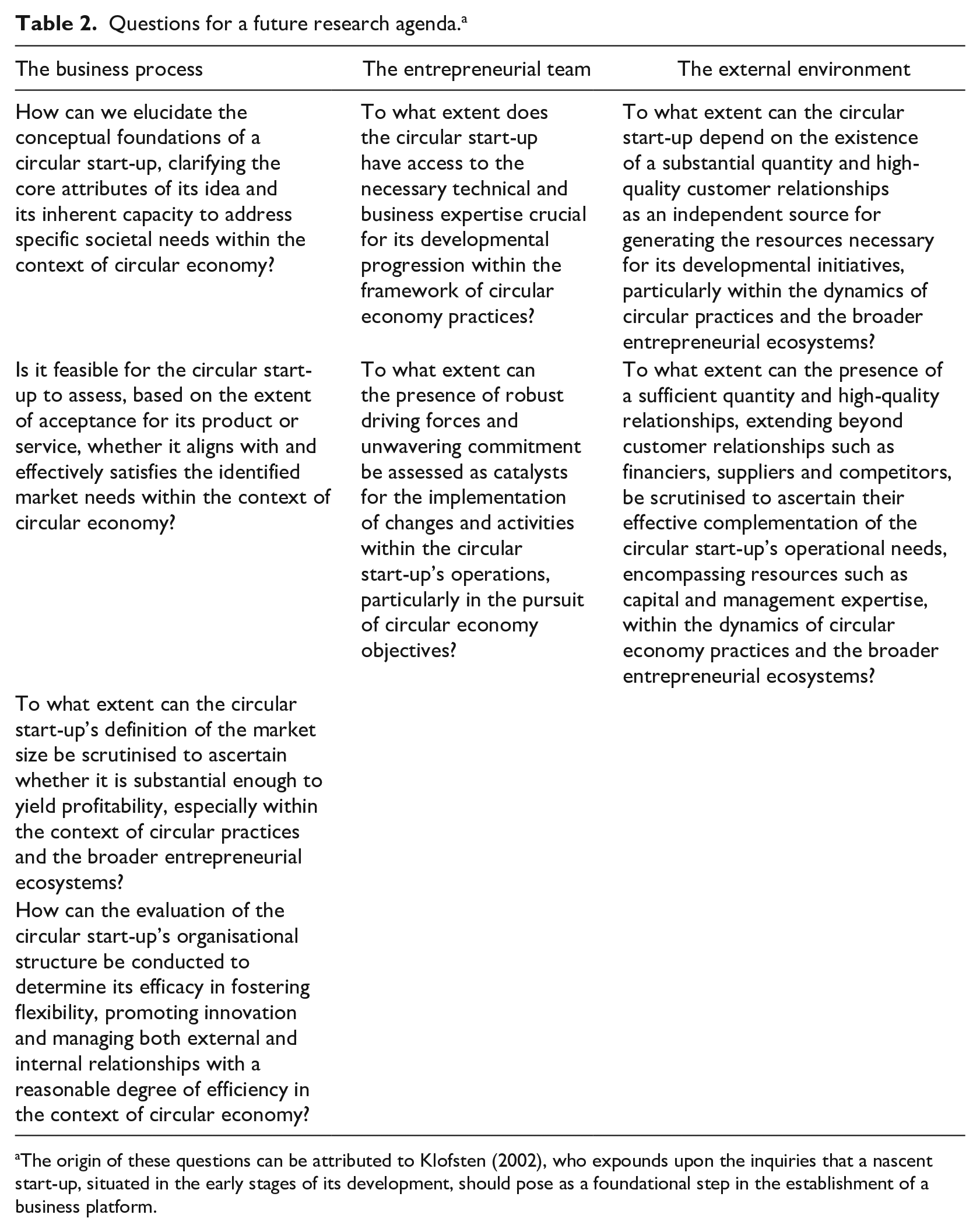
The origin of these questions can be attributed to Klofsten (2002), who expounds upon the inquiries that a nascent start-up, situated in the early stages of its development, should pose as a foundational step in the establishment of a business platform.
Footnotes
Funding
The author(s) disclosed receipt of the following financial support for the research, authorship, and/or publication of this article: We are grateful for financial support from FORMAS – A Swedish research council for sustainable development (Grant number – 2020-00815) for funding our project “Entrepreneurial ecosystems for start-ups developing circular business models” that has made this special issue possible.
