




Abstract
Circular start-ups (CSUs) are crucial for implementing a circular economy; yet, little research has been undertaken on the specific barriers they face. Through a case study of CSUs in the Dutch plastics industry, we identify several key barriers encompassing technology dependence, poor credibility, constrained resources, collaboration challenges, lack of knowledge and inadequate institutional support. Additionally, we highlight four success factors (SFs) that enable CSUs to compete in circular plastics: circular value proposition design, market sensitivity, networking prowess and circular ambidexterity. Our study shows that CSUs can enact these SFs as strategies-in-use to overcome barriers. Yet still, CSUs in plastics continue focusing on recycling-centric business models, limiting their potential to drive the transition more radically along the waste hierarchy. This calls for support from various entities such as entrepreneurial ecosystems as well as a multi-stakeholder perspective that considers their business models as interdependent with other actors in the plastics value chain.
Keywords
Introduction
Plastic is one of modern life’s most ubiquitous materials (Bucknall, 2020; Khan et al., 2020). Versatile, lightweight and durable, plastics can reduce our resource and energy footprint, paving the way to a more resource-efficient, circular and sustainable world (Lindahl et al., 2022). However, we are still producing plastic based on short-term rather than future recycling or reuse requirements, reinforcing its reputation as a symbol of the ‘wear and tear of consumer society’ (Lindahl et al., 2022: 2). Mostly made from planet-warming fossil fuels, plastic causes widespread pollution and environmental harm throughout its lifecycle, producing 1.8 billion tonnes of greenhouse gas emissions (3.4% of the global total) in 2019 (OECD, 2022). One solution for reconciling the sustainability potential and negative environmental impact of plastic is to shift it from a linear to a circular logic by creating a circular plastics economy where value is preserved in resource loops. Material previously perceived as waste is then seen as a resource, resulting in less extraction of virgin raw materials and disposal via landfill or incineration (Geissdoerfer et al., 2017), thus reducing pressure on planetary boundaries (van Opstal and Borms, 2023).
Most research on achieving a circular economy (CE) for plastics addresses a specific technology, plastic product or material (King and Locock, 2022). However, this transition cannot be achieved through technical approaches alone since business models determine the viability of such solutions. Hence, businesses, no matter their size or goals, play a vital role in the transition to a circular (plastics) economy by innovating their business model (Barford and Ahmad, 2023; Henry et al., 2023; van Opstal and Borms, 2023). Circular business model innovation (CBMI) is ‘the conceptualisation and implementation of circular business models (CBMs), comprising the creation of circular start-ups (CSUs), the diversification into CBMs, the acquisition of CBMs or the transformation of a business model into a circular one’ (Geissdoerfer et al., 2020: 8). By developing and implementing CBMs, firms can deliver superior value propositions while closing, slowing and narrowing resource loops (Bocken et al., 2016), thereby minimising the resource input into the system and the waste generated (Geissdoerfer et al., 2018).
There is growing interest in (born-) circular start-ups as role models for CBMI (Henry et al., 2020; Ostermann et al., 2021b; van Opstal and Borms, 2023). CSUs, defined as ‘new, independent and active companies pursuing a CBM’ (Henry et al., 2020: 2), are further explained in the next section, ‘Theoretical background’. Start-ups have structural advantages (Henry et al., 2023), allowing them to pioneer new, disruptive and radical technologies or practices in their field (Ostermann et al., 2021a). They respond effectively to unsustainable trajectories and systemic shocks (Borms et al., 2023; Ostermann et al., 2021b) and valorise circular practices from the outset (Henry et al., 2023). Given the culture during the start-up period (De Mattos and De Albuquerque, 2018), ventures are unencumbered by typical past investment lock-ins and existing supplier relationships giving them more freedom to incorporate circular elements holistically into their business models from the outset (Henry et al., 2023; Hockerts and Wüstenhagen, 2010). As a source of new visions and strategies for implementing circular principles, CSUs serve as a ‘powerful engine for the innovation processes needed to support a circular transition’ (van Opstal and Borms, 2023: 2). By scaling-up or stimulating systemic shifts in a co-evolutionary dynamic with incumbents, start-ups can propagate such visions, strategies and innovations to gain broader impact (Hockerts and Wüstenhagen, 2010; Schaltegger et al., 2016). An accelerated emergence of circular ventures such as CSUs is necessary for the widespread application of the CE across sectors and geographic regions (Bauwens et al., 2020; Henry et al., 2023).
In CBM research, a popular approach is to identify the antecedents (e.g. barriers and drivers) to CBMI (Santa-Maria et al., 2021). Indeed, extensive work has focused on barriers to CBMs; however, not many looked at the barriers specific to CSUs (van Opstal and Borms, 2023). Furthermore, even fewer discuss how to overcome or at least manage these barriers (Bressanelli et al., 2019; Henry et al., 2020; Suchek et al., 2022). Solutions are vital as these barriers affect successful implementation of CBMs by start-ups (Hina et al., 2022). CSUs are underexplored and remain in the early stages of academic research (Demirel et al., 2019; Ostermann et al., 2021a). In particular, Ostermann et al. (2021b) call for more research on the innovative and circular business models of start-ups, whereas van Opstal and Borms (2023) pointed out the scarce empirical work on the selection and implementation of circular strategies by CSUs. In our view, these issues have not been sufficiently explored in the highly polluting plastics industry which is under intense pressure to adopt circular practices and innovate its business models.
We pose two questions: what barriers are CSUs facing in the plastics sector, and what are their strategies to overcome these barriers? To address these questions, we apply a business model lens to a case study of Dutch start-ups in the plastics industry conducting semi-structured interviews with start-up founders in different areas of the plastics value chain, complementary interviews with experts and sourcing online archival data. Identifying CSU strategies enabled us to pinpoint four key success factors (SFs) for CSUs to overcome barriers in the burgeoning circular plastics economy: circular value proposition design (CVPD), market sensitivity (MS), networking prowess (NP) and circular ambidexterity (CA). These SFs allow CSUs to tweak their value proposition, value creation and delivery, and value capture approaches to fit the demands of a circular environment. Guided by these SFs, various enabling actors in CE ecosystems, in general, and entrepreneurial ecosystems, in particular, can better empower CSUs to overcome barriers, access resources to increase their success and develop business models that better bridge individual CSUs to the broader networks they inherently rely on. Through this empirical work, we expand the literature on CBM barriers beyond identification and categorisation, revealing how start-ups address these barriers in practice. Reflecting on what we perceive as a constrained potential among CSUs – in going beyond recycling to embrace more radical waste hierarchy approaches – we call for a broader perspective of their business models as interdependent with those of other actors in the plastics value chain.
Theoretical background
Circular business models
A business model is a holistic description of how a firm does business (Bocken et al., 2014; Zott and Amit, 2010), acting as a blueprint for the underlying core logic and strategic choices (Shafer et al., 2005; Teece, 2010). A business model has three basic components: (1) the value proposition - what the firm offers its target customers and why they are willing to pay for it; (2) the value creation and delivery system - how the firm creates and delivers its value proposition, such as its resources, capabilities, activity system and value chain and (3) the value capture system - how the firm generates revenue and makes a profit (Richardson, 2008). Traditional business model scholarship has explored the creation and capture of economic value for a firm and its value chain (Teece, 2010; Zott et al., 2011). Several scholars have expanded this to a broader view of value and stakeholders (social and environmental value beyond a firm’s boundaries) under the sustainable business model (SBM) concept (Bocken et al., 2014; Boons and Lüdeke-Freund, 2013). However, designing SBMs to capture economic value while creating environmental and social benefits is challenging (Schaltegger et al., 2012), and the literature does not provide clear directions (Henry et al., 2020; Stubbs and Cocklin, 2008).
CBMs are considered a more concrete sub-category of sustainable business models (Bocken et al., 2014; Guldmann and Huulgaard, 2020) that integrate CE elements (Henry et al., 2020; van Keulen and Kirchherr, 2021). This means designing the basic components of a business model so that it slows down, closes, narrows, intensifies and/or dematerialises resource loops (Bocken et al., 2016; Geissdoerfer et al., 2018). Materials thus, remain in use as long as possible rendering the ‘end-of-life’ concept obsolete and minimising excessive production, consumption, resource extraction and waste generation (Henry et al., 2020; Kirchherr et al., 2017). In theory, the business logic shifts from customary one-off sales to logics that continually create, deliver and capture (smaller increments of) value over time (Guldmann and Huulgaard, 2020). Consequently, firms benefit in several ways: reduced resource dependence, less volatile revenue, improved reputation, higher profitability and lower churn (Bocken et al., 2016; Vermunt et al., 2019; Werning and Spinler, 2020).
Role of start-ups in the CE transition
Businesses and business model innovation has a pivotal role in advancing the transition to a CE (Lewandowski, 2016). The premise is that if CBMs are scaled up and become mainstream, we can reap the full economic, environmental and social benefits of the CE (Vermunt et al., 2019). Accordingly, research on CBMs has significantly expanded in recent years (Centobelli et al., 2020; Ferasso et al., 2020; Hina et al., 2022). However, despite the support, interest and widely purported benefits of circularity for firms, the adoption and implementation of CBMs remain low (Vermunt et al., 2019; Werning and Spinler, 2020). Powerful incumbents understandably adhere to the existing linear regime (Milios, 2021), favouring circular solutions that are arguably more incremental, easier to implement and well-aligned with their existing assets (Henry et al., 2020; Hockerts and Wüstenhagen, 2010). Unfortunately, without more drastic, radical action from influential incumbents, it will be challenging to steer markets towards circularity and advance a circular transition.
The sustainable entrepreneurship literature suggests that one way of influencing incumbents to favour an industry’s sustainable transformation is to focus on start-ups. Unlike existing firms, CSUs and other born-sustainable pioneering firms (Todeschini et al., 2017: 765) are conceptualised with circular elements at their core from the outset. According to Henry et al. (2020: 2), CSUs are ‘new, independent and active companies pursuing a CBM’. Defined by an alignment of their business model with CE principles (Ostermann et al., 2021b), this term closely relates to ‘circular-born’ firms (Colucci and Vecchi, 2021: 870), in turn connected to the broader umbrella of born-green or born-sustainable firms. Such firms build on sustainable, collaborative and innovative products and processes from the outset (Ostermann et al., 2021a; Todeschini et al., 2017). They typically have a pioneering spirit, operate in an uncertain and risky environment, and find it difficult to balance profitability with environmental goals (Ostermann et al., 2021a). Unencumbered by lock-ins, they are more likely to experiment with and embrace higher levels of circularity and radical innovations than incumbents (Henry et al., 2020; Hockerts and Wüstenhagen, 2010).
Academia acknowledges and yet is confused by the extent of overlap between sustainability and circularity concepts (Asgari and Asgari, 2021; Blum et al., 2020; Geissdoerfer et al., 2017), reflected in subtle differences between sustainable and circular start-ups. In our study, we view CSUs as a subset of sustainable start-ups (Bocken et al., 2014; Geissdoerfer et al., 2017) as they adopt a more narrowly defined set of approaches to sustainable value creation (Cullen and De Angelis, 2021; Henry et al., 2023). These include R-strategies such as rejuvenating nature, refusing or reducing material use, reusing, refurbishing or remanufacturing products and recycling materials into resources (Henry et al., 2020).
Barriers to CBMs
As CBMs operate under a different value creation logic (Fehrer and Wieland, 2021), circular businesses face different barriers than linear businesses (Tura et al., 2019). There have been substantial efforts to identify barriers to CBMs in general. In a recent review, Hina et al. (2022) found and analysed 126 studies on the drivers of and barriers to CE business models between 2016 and 2021 and new papers are continually emerging (Galvão et al., 2022; Geissdoerfer et al., 2022). These, and earlier works, have investigated CBM barriers in varying industries, regions and methodologies (literature reviews, case studies, surveys). However, despite this breadth of scholarship, studies that focus specifically on circular start-up barriers remain scarce, with two notable recent exceptions: van Opstal and Borm’s (2023) survey on CSUs in Belgium found that they faced significantly different barriers depending on their circular strategies, whereas Von Kolpinski et al.’s (2023) case study of young and small-scale firms with sustainable CBMs in Germany found that they tend to overcome barriers through their internal strengths. Nevertheless, barriers to concepts closely related to CSUs, such as born-circular firms or born-sustainable start-ups, have been investigated by Briguglio et al. (2021), Ostermann et al. (2021a) and Todeschini et al. (2017). They noted several prominent barriers for start-ups: the need for greater consumer awareness, lack of consumer demand, obstructive policy, insufficient financial support, inadequate alignment of values along the supply chain and the difficulty operating a circular logic in a linear system.
In our view, the plastics context is also under-researched regarding CBMs, with the exception of Bening et al. (2021) on packaging; Dijkstra et al. (2020) on plastics management; and Paletta et al. (2019) on manufacturing plastics; note that none of these focused on CSUs. Scholars, including Cantú et al. (2021), Kirchherr et al. (2018) and Werning and Spinler (2020), highlight the importance of context as an influence on the type of barriers that firms face thus, reinforcing calls from other authors for sector-specific explorations of CBM barriers (van Keulen and Kirchherr, 2021; Vermunt et al., 2019). Tura et al. (2019) concluded that circular business barriers and drivers are inevitably context-specific and cannot simply be transferred from one context to another. Echoing this view are Bassi and Dias (2019), Briguglio et al. (2021) and Demirel and Danisman (2019), which motivated our investigation into CSUs in plastics – a particular context that deserves research attention but remains underexplored.
Furthermore, studies on CBM barriers, except for Galvão et al. (2022), have often (perhaps unintentionally) portrayed them as almost-insurmountable blockades. One potential reason is that knowledge on how to overcome these barriers is scarce (Bressanelli et al., 2019), understandably so given the agreement among scholars that there is no panacea for addressing and overcoming all these challenges (Galvão et al., 2022: 1505; Werning and Spinler, 2020: 3). Nonetheless, we believe there is potential to explore how these barriers are addressed in practice (cf. von Kolpinski et al., 2023). By focusing on CSUs as engines of innovation, we expect them to be naturally agile and equipped to at least attempt to overcome their circular business modelling barriers. To this end, we employ the concept of SFs, the minimum requirements to ‘prepare a company for competition’ in a particular industry, as used by Ketelhöhn (1998: 335). For a new context such as the CE with its specific set of barriers, we see SFs as ‘entry requirements’ to overcome, or at least address these barriers in order to compete in the world of circular plastics, with the implicit notion that competitiveness is linked to navigating CE barriers successfully.
Methodology
We conducted an explorative case study of start-ups connected to the plastics value chain in the Netherlands. Explorative approaches can achieve an in-depth understanding of a complex social context (Guba and Lincoln, 1994), whereas case studies delve deeper into multi-dimensional phenomena not as easily accessed via other methods (Yin, 2003). Our material focus is plastic, a unique and ubiquitous material that evades efforts to bring it into a CE (Johansen et al., 2022; Schirmeister and Mülhaupt, 2022), whose technical value is destroyed by a prevailing linear model (Hahladakis and Iacovidou, 2019), and whose lifecycle remains ‘far from circular’ (OECD, 2022: 14). We consider plastics as a key case (Thomas, 2016) that commands interest by virtue of its environmental impact, prominence in current discourses and above all unique role in 21st-century society. Deeply ingrained in modern life, plastics can both enable us to live more sustainably and lead us further down a path of environmental destruction. The following subsection elaborates on the relevance and nuances of this context.
Case description: Plastics in the Netherlands
Materials that transform society – such as stone, bronze and iron – inspire the names of historical epochs, and the one we now live in is the plastic age (Schirmeister and Mülhaupt, 2022). Plastic has left an indelible mark on the planet: it is one of the geological markers of the Anthropocene (Zalasiewicz et al., 2016). As a versatile material that can be produced at an attractive price/performance ratio, plastic has become essential for almost any kind of consumer product (Bening et al., 2021; Bucknall, 2020; Schirmeister and Mülhaupt, 2022). Its design flexibility in terms of properties and applications outclasses other materials, as it can be tailored to solve a particular problem in a way that outperforms all others. As a resource-efficient, lightweight and low carbon footprint material, plastic can be designed to enable sustainability in areas such as mobility (lightweight transport), consumer goods (protecting contents and extending lifetimes), agriculture (enhancing output while reducing the need for pesticides) and the built environment (improving energy efficiency in buildings) (Schirmeister and Mülhaupt, 2022). Indeed, plastics have been continuously (re)invented for decades to help advance other fields (e.g. electrification and communication technologies), enable our modern lifestyles (widespread and secure access to energy, water, food and medication) and reshape the world, and they will continue to do so (Payne and Jones, 2021; Schirmeister and Mülhaupt, 2022).
Plastic production involves several processes in a long and complex value chain (see the blue arrows in Figure 1): from fossil fuel feedstocks, monomer building blocks are produced, polymerised into flakes or pellets, and further processed and converted into plastic intermediates. These become the plastic products we interact with and which we can potentially reuse, repair, refurbish or repurpose during their lifetime. Eventually, these products are disposed of, collected and managed as waste. CSUs offer solutions to divert these materials from landfill or incineration and return them to the value chain. One pathway is to valorise waste (the red arrows in Figure 1) through various degrees of recycling (Hahladakis and Iacovidou, 2019), resulting in alternative feedstock, monomer, polymer and intermediate material streams of varying quality and potential applications. While recycling improves the planetary footprint of plastics (Bening et al., 2021), alone it is insufficient to achieve sustainability and would eventually overshoot planetary boundaries (Bachmann et al., 2023). In addition, Bachmann et al. (2023) recommend switching feedstocks not only to plastic waste but also to renewable resources. This pathway occurs in parallel (the green arrows in Figure 1), where start-ups offer a bio-based, renewable substitute to fossil fuels, reducing emissions and even allowing for biodegradability in some instances.
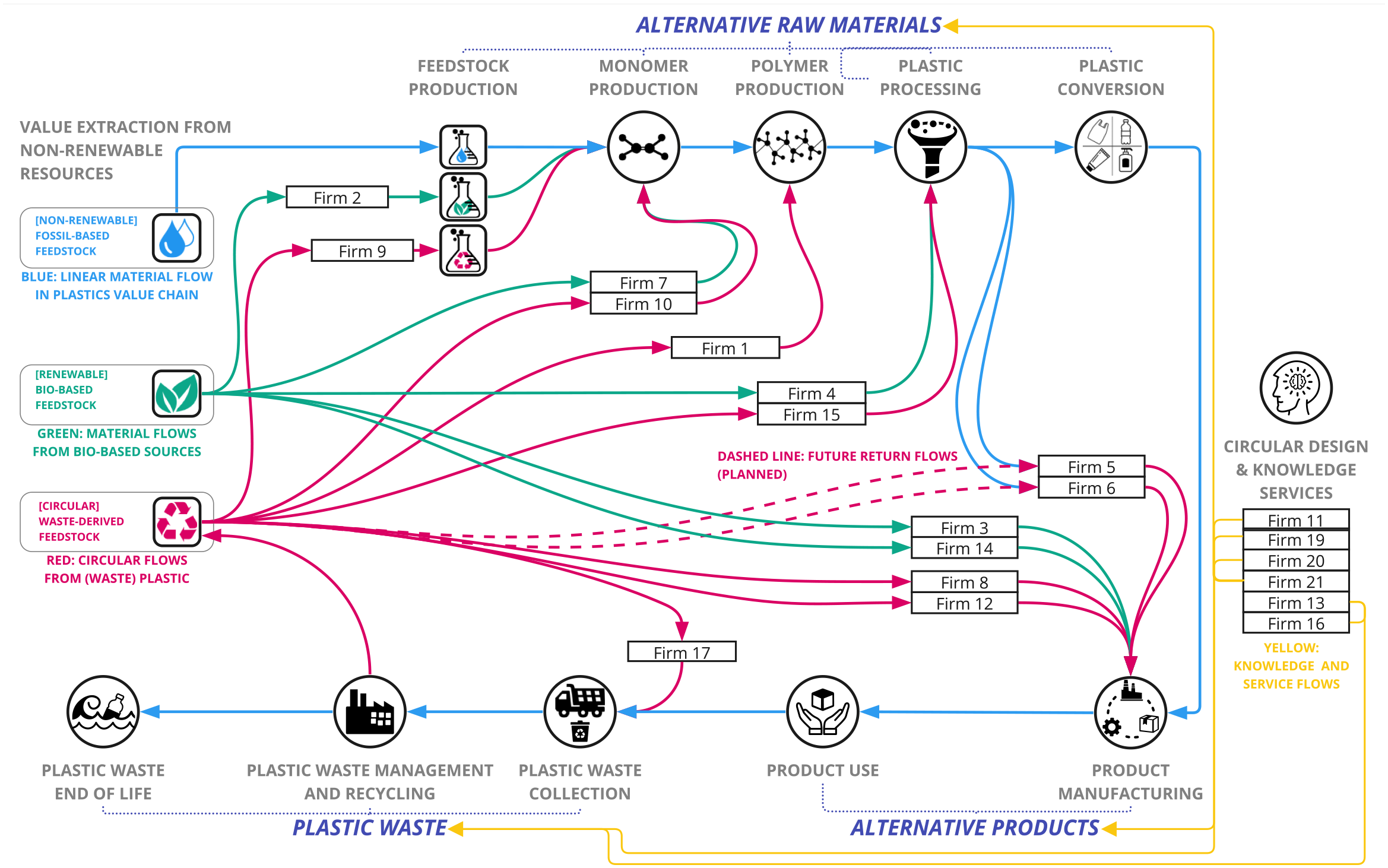
Material, knowledge, and service flows of circular start-ups creating new paths in the linear plastics value chain.
While Figure 1 is simplified to show a single, linear flow of homogeneous ‘plastic’ material, myriad types of plastic can be tailored to equally diverse applications. This results in waste streams of diverse properties, recyclability and ultimately more complex (often inadequate) end-of-life management (Schirmeister and Mülhaupt, 2022). In 2022, only 5% of mixed post-consumer plastic waste was recycled, whereas 38% was landfilled and 57% was sent for energy recovery (PlasticsEurope, 2022). Coupled with a heavy dependence on fossil inputs (Bening et al., 2021), unsurprisingly, plastics have been linked to high emissions, pollution and environmental harm (Johansen et al., 2022; Nielsen et al., 2020; Singh and Ordoñez, 2016). However, because this value chain has evolved to become highly efficient under a linear system, it is difficult to reconfigure; in fact, volumes are projected to grow further (Bauer and Fontenit, 2021; Geyer et al., 2017; Jambeck et al., 2015). Clearly, the plastics industry faces immense pressure to take action and innovate its business models.
We investigated the plastics value chain in a circular innovation hotspot: the Netherlands. The Dutch have long aimed to be a pioneer in recycling, a role model for circular business and a nation that will be fully circular by 2050 (Calisto Friant et al., 2022; McCarville, 2019). Specifically, the Dutch CE Action Plan identifies plastics as a strategic sector (Calisto Friant et al., 2022; van Leeuwen et al., 2018). However, despite considerable progress, the Netherlands is still far from achieving its goal: current CE practices and policies are doing little to transform the country’s linear production and consumption of plastics, according to Calisto Friant et al. (2022). As the EU’s largest natural gas producer and with a booming chemical industry (McCarville, 2019), the Netherlands is a key global player whose economic and geopolitical interests are intricately locked into the plastic industry (Calisto Friant et al., 2022). We set our case study within the paradoxical context of a country leading circularity initiatives yet, failing to surpass linearity because it gives us the opportunity to uncover complex and interrelated barriers to implementing CBMs, potentially radical innovations by CSUs to navigate this complexity and a better understanding of how start-ups contribute to the circular plastics transition. This also responds to calls for in-depth field studies on circularity in complex value chains (van Keulen and Kirchherr, 2021) and circular plastics aspects beyond the technical realm (Calisto Friant et al., 2022).
Data collection
We collected data using diverse selection criteria (Seawright and Gerring, 2008), involving a wide range of start-ups to explore their potentially different CBM configurations across the plastics value chain (Figure 1). For our study, we divided the value chain into three groups (Figure 2): alternative raw material providers, alternative product providers and knowledge and service providers. Alternative raw material providers are CSUs that provide more circular substitutes for fossil-based plastic raw materials and feedstocks. These are either bio-based or waste-based in our sample. Alternative product providers offer more circular plastic in lieu of traditional products. Knowledge and service providers are CSUs offering knowledge and services for plastics circularity.
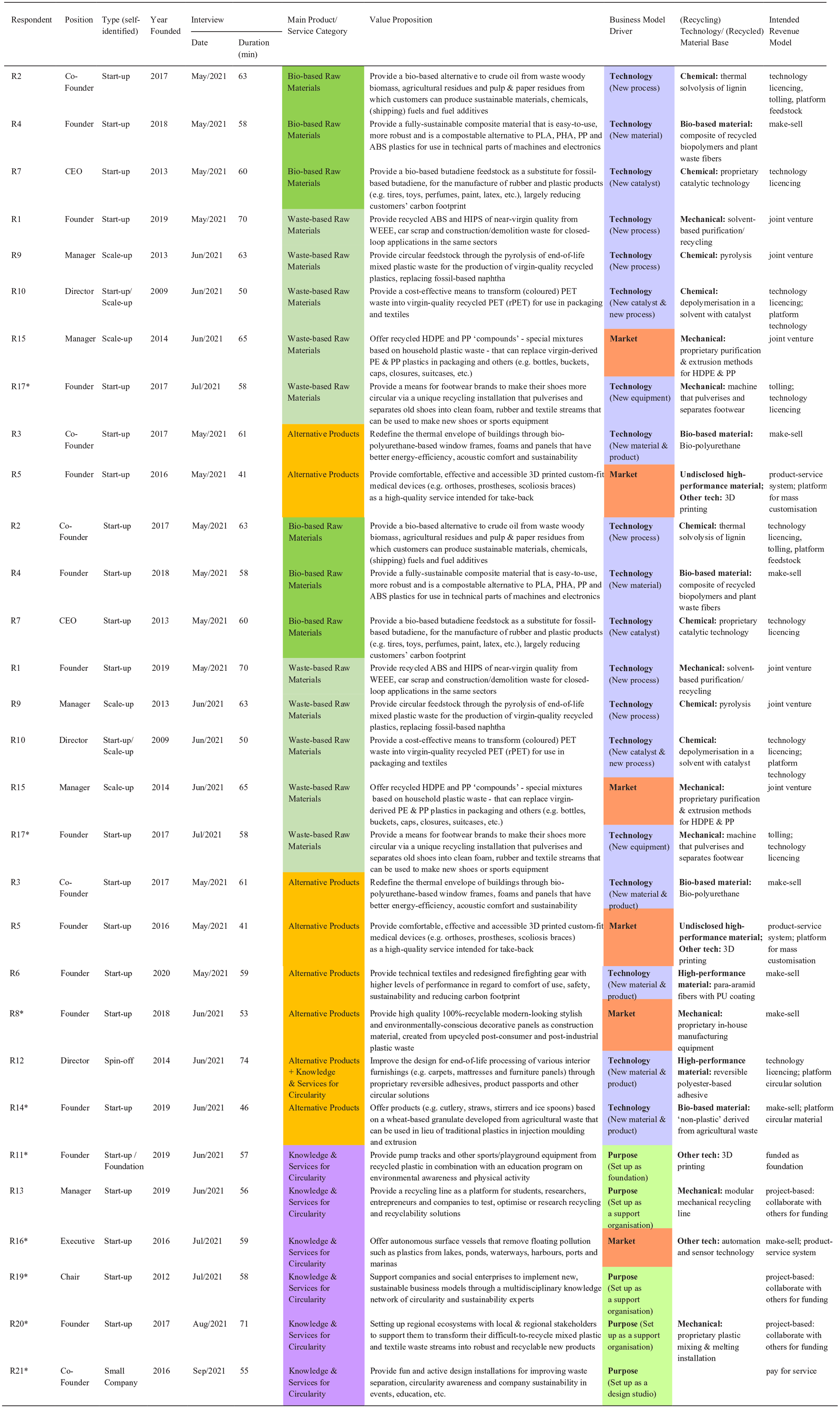
Basic information on respondents.
Through collaboration with an industry-affiliated CE researcher, we recruited 12 start-ups hosted at a circular hub in the Netherlands. In addition, we contacted start-ups outside the hub through their websites and LinkedIn, and eight agreed to participate. These firms were selected based on size, fit in the plastics value chain, use of circular strategies in their business model, regional affiliation and relative success. In other words, they had to self-identify or be identified by third parties as start-ups; provide either raw, intermediate or waste materials for the plastics value chain, plastic-dominant products or products/services that complement or boost circularity; employ strategies that slow, close, narrow, regenerate or dematerialise loops (Geissdoerfer et al., 2018; Konietzko et al., 2020a); and be currently operating in the Netherlands (i.e. surviving or on the way to greater success). These criteria allowed us to investigate the barriers for start-ups at various parts of the Dutch plastics value chain and how start-ups overcome them.
We conducted 20 semi-structured interviews with start-up (co-)founders, executives and top managers between May and September 2021. Semi-structured interviews allow respondents more freedom in answering questions and offer unexpected insights while retaining sufficient structure to elicit data that answers the research question (Saunders et al., 2009). Each interview lasted between 41 and 74 min and covered the history and motivation for creating the start-up; the value proposition, value creation and delivery, and value capture elements of the business model; the challenges in developing and implementing it; actions they (plan to) take in response and their future vision for the firm. One researcher took notes, whereas another led the inquiry. Aside from the core 19.5 h of interviews, we approached experts to verify our initial findings and obtain further insight into parts of the value chain where we had little data. We conducted 2 h of expert interviews with (1) a Dutch circularity hub business manager familiar with the advanced materials trade, (2) a recycling executive who supplies start-ups with waste for their products and (3) two senior scientists at a large polymer producer who are familiar with the plastics value chain. All interviews were undertaken online due to the COVID-19 pandemic; each was recorded and transcribed using Microsoft Teams and Word with the interviewee’s informed consent. The interview recordings, transcripts and notes were stored in accordance with ethical review board guidelines. Furthermore, to establish construct validity and improve credibility (Yin, 2003), we examined archival data before and after interviews, for example websites, press releases and other material shared by the interviewees.
Data analysis
Given the exploratory nature of this work, we employed provisional coding as a jump-off point for our data analysis: here, a ‘start-list’ (Saldaña, 2009: 118) of provisional codes derived from the literature facilitated our coding of CSU business model elements and barriers. However, for SFs – a less explored topic for which provisional codes could not be made – we used structural coding (Saldaña, 2009): segments of data on CSU actions to address barriers were tagged with a conceptual phrase and clustered around five emerging topics. These first-cycle coding strategies laid the foundation for subsequent second-cycle coding (Saldaña, 2009) (see Appendix 3 for a coding summary). Beginning with the first-cycle codes, we deconstructed them into more nuanced sub-codes and visualised their interrelationships on a conceptual map. Going back and forth between the visualisations, transcripts and archival data enabled us to both (re)familiarise ourselves with the data as well as identify the most relevant interrelationships. In parallel, this process allowed us to combine codes into themes, review themes and create initial clusters of themes (Braun and Clarke, 2006): five sets of interrelated barriers, four SFs and several strategies-in-use for each success factor. As some of their elements were more closely related to others, we consequently reshuffled themes for our final configuration. Coding was done in NVivo 12 to facilitate collaboration within the research team. All interviews were double-coded to stimulate discussion, share alternative perspectives and address potential bias. Moreover, several interviews were triple-coded to ensure the research team commonly understood the code definitions (O’Connor and Joffe, 2020). The coding process is presented in Appendix 4.
Barriers to circular plastics start-ups
We uncovered the five themes described below that capture the intertwined barriers which CSUs face when implementing their business models.
High capital requirement but unconvincing business case deters investors
We begin our discussion of CSU barriers with a recurring theme during the interviews: the prominence of (new) technologies and novel materials. Start-ups said they often responded to CE opportunities through technocentric solutions. This included processes for turning waste into high-quality raw materials and feedstocks (thermal solvolysis, depolymerisation, pyrolysis), novel materials (bio-based materials and high-performance polymers) and 3D printing. Typically, these solutions are expensive and not yet proven on a large scale (R1–5, R7–13, R15, R17, R20–21). However, because these solutions are positioned as substitutes to virgin plastic (raw materials and products), potential customers could only be convinced to switch if they are guaranteed an ample and stable supply: ‘You need a full-scale plant, the first one [so] that you can show that you established yourself on the market as a supplier. You have to build trust in the market; you cannot build it with a proof of concept, right? You can only do it with a running operation’ (R1).
This set CSUs on a path of first having to prove their solution, technologically and at scale, which often takes a lot of time and effort, for example going from laboratory to pilot and then to demo plant scales, with several rounds of product testing, customer validation and funding acquisition, while still not producing substantial quantities of the product – a risk for investors: ‘. . .you need millions of funding without actually producing any product, and that is some disconnection between the finance guys and R&D guys. And it’s very difficult to overcome it’ (R7).
Beyond the amount of funding they require, circular plastic start-ups are also limited by a long payback period: ‘When you develop something from scratch like we do, we have an extremely long development cycle. It’s not long for us. . . but it’s extremely long for the established market, including a venture capital market’ (R7). This made it hard for CSUs to convince investors to fund their venture. Respondent 10 laments how ‘a lot of investors want to make quick money’ and ‘get cash the next year’. This forces CSUs to find ‘very patient investors’ (R10) with ‘deep pockets’ (R12) who were willing to invest for many years before making a profit or pivot their business to something else that could bring in cash faster (R10–11).
The combination of unproven technology, high capital requirement and long payback period deters investors from funding circular plastics ventures because the associated risk is ‘just too high. . . because so many things actually could, on paper, go wrong’ (R20). In most cases, this risk is framed in financial terms: ‘. . .if it doesn’t work out, do I feel OK about putting money into that project?’ (R15). Getting investors to trust CSUs is difficult because CBMs have neither been ‘proven’ nor are mainstream. Respondent 20 perceives this as a barrier from linear mindsets: It’s very difficult to finance a business model which has not been proven. . . And circular business models are not proven or are not mainstream. . . So I think that what commercial institutions look at. . . [is] your business case, and it should be a viable business case or a positive business case in a linear economy. (R20)
Low credibility makes it hard to enter and influence complex markets and industries
For similar reasons, CSUs also found it hard to convince potential customers of their CE-oriented business case (R2, R6–7, R12, R15). Among alternative raw material providers, big customers did not find small-scale offers (like from CSUs in the early stages) attractive because of a mismatch with their large-scale operations (R2, R10, R20). On the technical side, a mismatch could come from customer perceptions of a shift to circular materials as a reason for changing ‘everything’ (R7). Fundamentally, it is a matter of risk: They want to understand how they will eliminate risk, and there is no good solution for that. . . In many cases. . . companies decide in favour of already existing technologies or not doing anything because otherwise, they cannot validate the risk they have (R7).
This distrust of novel solutions also applies to alternative product providers: ‘Even if you end up having a great product, if the market is not yet ready for it, then you have to tackle that challenge as well’ (R12). Respondent 6 found the firefighting equipment market ‘very traditional and conservative’, ‘used to dealing with the same company for dozens of years’, with such ‘a long history of relationship and building up trust’ between customers and suppliers that it didn’t matter ‘whatever brilliant product’ you had. Echoing these words, Respondent 3 noted that the construction market is ‘highly conservative’ and hard to enter: especially due to a lack of history, customers have no prior experience with a novel product. In the ‘traditional’ and ‘hesitant’ carpet and furniture sector, Respondent 12 was forced to create proof points to influence the market.
Moreover, CSUs lamented the linear mindset of some potential customers: despite generating a lot of waste that CSUs could resolve, these customers still opted for cheaper but more polluting material (R8) or accepted greenwashing as the way forward (R17). Getting firms to switch to circular materials at a price close to virgin was one of their biggest challenges (R1): it was like ‘fighting against an established economy who ten years ago was not looking for recycled content’ (R10). As a recourse, many CSUs work to bring down costs and prices ‘to make it interesting’ (R21) for customers. However, bringing prices below virgin alternatives is not always feasible because production volume is insufficient to achieve ‘cost efficiency’ (R8) – which Respondent 8 believes applies to many circular products. To compensate, they sell with a premium: ‘It costs more than virgin plastic. . . But we are selling it with the premium mode, not because we would like to earn more money. . . [but] because we cannot. . . achieve a better cost structure [at current production volumes]’ (R8).
Furthermore, CSUs faced additional complications from the interconnectedness of the plastics value chain. For several alternative raw material providers (R1–2, R7, R9–10, R15), selling products involved convincing not only their direct customers but also those customers further downstream who might interact with products made by their direct customers, for example, waste suppliers, converters, brand owners and end-users: ‘. . .both the converter and the brand owner need to agree to sell your material. It’s very difficult for a small company to get in there’ (R15). This was not always straightforward because the specifications of various value chain actors were not always aligned with each other or with the CSU’s: ‘There’s a two-fold customer because the brand owners have different priorities than those that are converting, which means that things that we have to do for the customer [become] slightly. . . difficult. What is nice for one is too expensive for the other and vice versa, so that makes our lives difficult’ (R15). Even for alternative product providers, complexity in market segments is a challenge. Working with medical devices, Respondent 5 had to be able to distinguish and consider the user (patients), payer (insurance companies) and decision-maker (doctors). Despite the value of their product for patients, Respondent 5 encountered immense resistance from providers because they benefit less from the innovation. Respondent 12 compares this struggle with ‘building the mountain’, ‘even more so when you enter markets that [are] still developing’, referring to the associated work as ‘massaging’ and ‘preparing the market for your competitors’.
The value chain has to reorganise and collaborate more closely: That is no easy matter
CSUs also faced challenges from being part of a budding circular plastics industry – that is complex, expensive and requires closer collaboration in the value chain to close the material loop: We’ve been looking at the whole circular economy model around waste and how waste can be processed into new products or new materials. . . you cannot do it on your own. It is so complex, so expensive, and probably that’s one of the reasons why it’s not in place (R16).
With the market for high-quality recycled plastics still in its infancy, a critical bottleneck for CSUs was a lack of stable, good quality and suitably priced waste feedstock (R7, R15), whose availability was ‘much smaller than the potential market’ (R7). Even for the same polymer (e.g. PET plastic), certain applications and technologies required uniform input streams: for instance, food application PET waste should not be mixed with that used for non-food applications (R15). This presented supply challenges because sorting and collection systems were not always compatible with CSU technologies. Respondent 7 found that securing feedstock was the most important activity, which required ‘extended network and negotiations and knowledge of the market: where to find the right material and the right quality’. Without proper feedstock, CSUs could not make products according to customer specifications or incurred additional costs to do so (R15). Ultimately, this placed plastic recycling CSUs at a disadvantage: the success of their solutions was at the mercy of upstream suppliers who did not always supply the requisite quantity or quality. At the same time, they shouldered additional costs to process complex inputs without being able to pass these costs downstream (R1, R6, R8–9, R15, R17).
With little power and status, start-ups in circular plastics relied on collaboration with other value chain actors and industries in order to improve their offering (R6–7, R9, R11, R15, R20): ‘It is really unique – the whole supply chain – because you’re so much in a development business. We all need each other to learn and develop together’ (R9). Respondent 10 sums this up as having to ‘work the whole value chain: the waste recyclers and the packaging industry and the plastics producers and FMCG brands’. Among alternative raw material providers, it is vital to develop in parallel with target customers: for instance, while Firm 9 develops their technology, their customers (petrochemical firms) also ‘have to learn and find out what can they change in their process, [to be] able to process more and more converted plastic’. Meanwhile, among alternative product providers, Respondent 12 highlights that their ability to redesign products for circularity will only work if the recycling industry also develops the capacity to handle them.
Ultimately, several CSUs find collaboration limited (R1, R11, R19): it is ‘difficult to work in a chain in an open way’ and ‘it’s also a matter of power’ (R19). For example, patents and non-disclosure agreements to protect the competitive advantage brought about by novel technology can hinder speeding up the development of a circular materials market and corresponding technologies (R7, R9).
CSUs have limited resources and no ‘knowledge bibles’ for improving their business model
The importance of resources cannot be understated for CSUs: ‘as long as you have funding, you can deal with all other bears on the road’ (R12). Otherwise, you might ‘feel like a dog in a circus. You have to jump through the hoops every time’ (R10). With limited funding, CSUs might find themselves lacking decent equipment (R4, R8), poorly equipped to enter established markets (R6), constrained to small-scale production (R5), unable to develop ideas in parallel (R11–12, R10, R20) or with insufficient personnel to accelerate growth (R10, R12, R14). Moreover, they might be forced to decide their business models early on (R11, R15–16), which could also limit their desired or potential socio-environmental impact (R5, R10–11, R20); for example, it is not feasible to enforce ‘a complete 360° business model from the start because that is very difficult’ (R20). Most importantly, without funding, CSUs have little leeway to experiment and make mistakes: ‘In the sense of funds and all kinds of things, you have very little space to make those mistakes nowadays, and that makes it pretty difficult’ (R1).
While start-ups obviously need to obtain more funding, searching for it actually competes with other important activities: ‘Even to go through the process of trying to find the financing is very difficult. . . You have to give a lot of information, and it takes a lot of time which you can also spend differently’ (R20). Respondent 12 also feels this time constraint: ‘The clock speed is so high. . . you don’t really sit down. . . and have the time to analyse’. With so many activities competing for attention, how should CSUs allocate their time and where do they make compromises? Here lies another challenge for CSUs: there is no ‘knowledge bible’ they can follow to know how and how much circularity to include in developing a viable CBM (R3, R5, R9, R11–13, R15, R17, R19–20).
To address this, Firm 19 helped other actors with circular innovation. They found that many firms struggled with its interdisciplinary nature: ‘they were all struggling with circular or sustainable innovations because. . . you need knowledge from the social side, from the ecological side, from the economic side, from the technical side’ (R19). For instance, they struggled to develop revenue models for products in a cycle, where the linear model of making something and selling it once is not enough (R19; also with R11, R20). Indeed, Respondent 20 admitted that it was still difficult to finalise their business model and position in the value chain: ‘Am I someone who’s building factories there, who’s a technology provider? Or am I a project developer and an implementer who brings it all together? Or am I a consultant?’. Respondent 19 observed how firms struggle to measure the positive impact of using alternative models such as leasing and product as a service. This is echoed by Respondent 5, who found it difficult to quantify the impact of including take-back schemes: ‘We made this recyclable. Now we’re trying to make it circular. . . it’s unclear, the specific [. . .] cost impact it will have’ (R5).
Another challenge is the lack of role models (circular firms) to emulate because most CSUs are frontrunners (R12, R17). Respondent 12 notes that firms are moving in parallel without ‘articles’ about how to design and implement CBMs successfully. Not knowing how to best integrate circularity into the business, CSUs have to develop knowledge themselves by gathering a lot of information (R1, R4) or otherwise rely on assumptions on both the technology and business model (R1, R11, R20–21): There are so many factors that you have to take into account: the technology, how long it will take to develop, how much it will cost and all kinds of things. A mistake is easily made. . . assumptions are the mother of all [screw]-ups. And it’s true: if you don’t have proven data on everything, you have to assume things, but the quality of your assumptions, whether it is technological or business-wise, determines how well you will perform. (R1)
Institutional elements are not yet geared towards shifting markets to circularity
Institutional elements that could help CSUs overcome barriers have not yet been fully developed for circularity. For instance, a key impediment to recycling plastics is a prevailing misconception: ‘in the discussion about circularity, plastic has a very. . . negative value’ (R13) associated with ‘a lot of low-quality connotations’ (R20). This poor perception applies to both plastic waste and recycled plastics. From a historical perspective, ‘an important argument for using recycled plastic was the lower price, and a lot of products were developed for recycled material for the [lower] quality that they could produce’ (R1). The novel technologies of circular plastic start-ups now allow recycled plastics to be of virgin-like quality but at a higher cost. Until recently, the market was ‘not ready to pay for the extra costs’ for circularity (R1), and in some cases, virgin plastic is still cheaper than recycled plastics (R19). The problem could be a broader aversion against paying for circularity – and in a wider sense, sustainability in general (R2–3, R5, R7, R21): ‘if they don’t feel it in their wallet, people are willing to become more sustainable’ (R2). While a societal shift is happening in favour of sustainability, Respondent 2 believes this applies to ‘outliers’ and CSUs cannot build a business around them.
CSUs recognise the vital role of supportive regulations for launching circular products and services. In Respondent 21’s words, ‘if they try to launch a special service or product. . . you have to have good regulations. . . [if] you have to deal with [unfavourable] regulations, then it can be quite a bit harder’. In some cases, laws, rules and regulations can be ‘in the way’ (R15; also R4), conflict across borders (R5), or be inadequate, such as for product labelling (R14), water waste (R16) and deposit-return schemes (R20). Similarly, standards and certifications may be additional requirements to fulfil before novel products for the CE can be launched in the market (R4 mentions material processing, R6 protective gear design, R9 waste declarations). Some standards could even deter greater circularity: ‘there is a European standard which regulates the properties, design, quality, etc. of firefighting gear, but it was made without thinking about sustainability and ecological problems’ (R6).
A few support mechanisms that CSUs would like to see in place are lacking, such as subsidies for biodegradable materials and government funding (R4, R8, R17). These factors sometimes have regional and cultural elements (R2–4, R8, R16). Respondent 4 found it hard to get funding for bio-based materials in Russia: with an economy largely based on oil, industrial and economic interests did not favour disruptive substitutes. In America, convincing investors (R2) and finding early adopters was easier (R16). In general, the geographical region could be a factor: for Firm 8, ‘it’s impossible to sell this product in developing countries. Only developed countries are ready for this product, I’m afraid. . . it’s too early to go to developing markets with CE start-ups’ (R8).
Success factors and strategies for overcoming barriers
Based on the business modelling practices and philosophies that CSUs use to manage barriers, we identified four key success factors that they need to compete in the circular plastics economy: circular value proposition design (CVPD), market sensitivity (MS), networking prowess (NP) and circular ambidexterity (CA). In practice, CSUs can operationalise these factors as different strategies-in-use to overcome or at least cope with barriers arising from the circular plastics context. In this section, we discuss each success factor and its accompanying strategies (see Appendix 3 for coding details and Appendix 5 for the incidence of each SF/strategy among the CSUs). In the discussion section, we explain how these firm-level SFs are inextricably linked to meso- and macro-level factors (Figure 3).
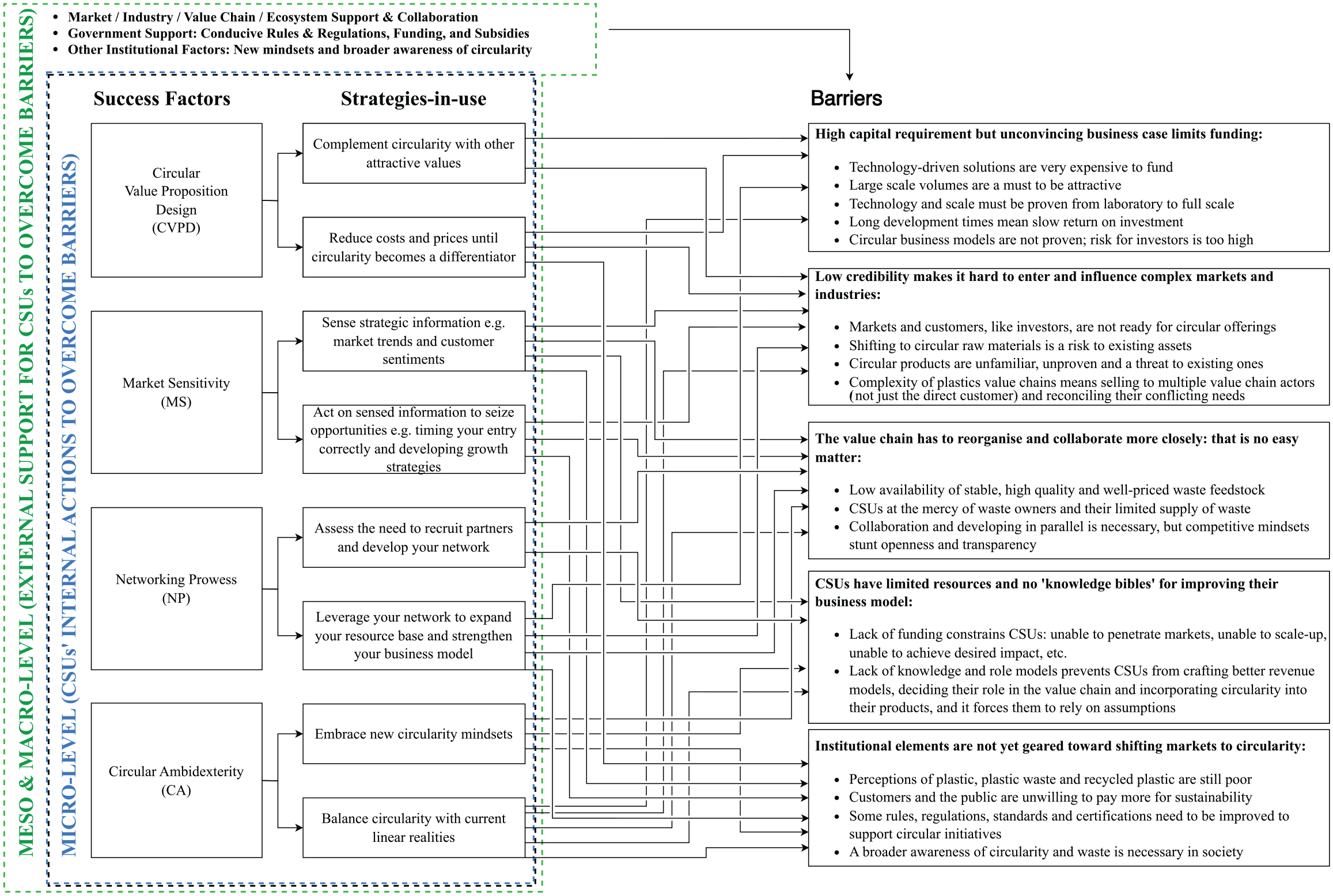
Framework showing the success factors for circular plastics start-ups to overcome barriers.
Circular value proposition design
CVPD is the ability of CSUs to design compelling value propositions that combine circularity with customer needs and wants. This success factor stems from CSUs needing to create offerings that embody a delicate balance between circularity (recyclability, take-back schemes, bio-based materials, reduced material footprints, etc.) and other customer demands (premium quality, convenience, affordability). Although any start-up is expected to have highly-compelling value propositions (R21), CSUs must achieve the same while burdened with often-costlier circular value for which not all customers are willing to pay a premium: ‘[if] you’re doing something circular, you’re actually adding additional costs to make it circular, right? So we kind of try to figure out how do we not do that and still be circular’ (R5). In the circular plastics context, we see this success factor being applied as CVPD strategies-in-use for (1) complementing circularity with other attractive values or (2) reducing costs and prices until circularity becomes a differentiator.
CVPD 1: Complement circularity with other attractive values
All the participating CSUs included circularity in their business model through one or several methods combined: pollution prevention, waste valorisation, virgin resource use reduction, environmental footprint reduction, material value preservation and societal impact (see Appendix 1). Generally, customers demand these from businesses but are not sufficiently willing to pay for them. Essentially, circular products and services are desirable not primarily because of their circularity potential but for the combination of circularity with something else that customers value even more.
In practice, we found that circular value propositions could be extended to include many other types of values that improved product quality and performance: aesthetics (R8), energy efficiency (R3), comfort (R5–6, R12), health (R5, R12), customisation (R5, R8), convenience (R5), education (R11, R13) and even a sentimental connection between a firm’s own waste and products (R20) (see Appendix 1 for details). By shifting the focus to these values but still highlighting circularity as a core complement, CSUs could build a stronger case for both investors and customers who sometimes found it difficult to perceive the added-value of circularity. For example, customers sometimes notice and value comfort more, even though the product design ‘starting point’ (R12) is circularity: ‘. . .we redesign it, namely, that the mattresses are less warm. . . [have] a better airflow. So it turns out that everybody who. . . ends up buying the mattress. . . says “wow, it’s way less warm on this mattress than before”’ (R12).
CVPD 2: Reduce costs and prices until circularity becomes a differentiator
On the other hand, several start-ups – often those providing alternative raw materials – offered feedstocks and intermediate goods that were difficult to differentiate from the competition, for example, circular substitutes for fossil-derived commodities. Even though these CSUs complemented their offer with higher quality and performance, compatibility with existing assets, compliance with regulations and reliability, price remained a major factor in their customers’ purchasing decisions. Thus, these CSUs had to channel their efforts into cost-cutting and price reduction to a point where they could offer a competitively priced substitute so that customers could easily switch. However, these CSUs still had to ensure that their alternative raw materials matched the client’s technical specifications. Being strongly technology-driven, they focused on reducing the complexity of their novel processes and equipment while staying mindful of customer requirements. Essentially, the pain that these CSUs solved for their customers was the complexity and costliness that often came as a prerequisite to integrating circularity in existing value chains. Ultimately, CSUs should be able to address customer pains and gains without creating substantial additional costs for them (e.g. due to retrofitting existing assets or investing in expensive new assets): You should look at market opportunities where a bio-based solution wouldn’t really impact the bottom line of your customer too much in a negative sense. . . whereby the marginal cost of making it bio-based, making it sustainable, is not really felt to heart in the consumer price. . . [It] is negligible or as low as possible, because then the barrier for such a customer to accept your technology and co-invest will be low, because the rewards are high and the costs are low. (R2)
Market sensitivity
MS is the ability of CSUs to sense the current market trajectory and react accordingly despite the uncertainty of the context in which they are embedded. The CSUs we interviewed operated in an industry in transition, where identifying customers could initially be problematic, customer sentiments and preferences could change over time and market evolution is not easy to predict. They therefore, need to gather data from a wide range of sources, make sense of it and act on often incomplete information to (re)design their business model and craft strategies for initial success and future growth. In the circular plastics context, we observed this success factor manifesting as MS strategies-in-use for sensing strategic information such as market trends and customer sentiments and for acting on sensed information to seize opportunities, for example, by timing your entry correctly and further developing growth strategies.
MS 1: Sense strategic information
The CSUs regularly monitored their operating environment and market trends (e.g. increasing targets for recycled content in packaging), societal shifts (e.g. increasing support for CE among the general public), material opportunities (e.g. unoccupied niches such as ‘unrecyclable’ products), unexpected threats (e.g. the COVID-19 pandemic) and the competitive landscape (benchmarking competitors). This strategic information helps CSUs uncover unfulfilled needs (e.g. increased demand for high-quality recycled plastic and CE-oriented recycling solutions, lack of solutions to valorise a high-value waste stream, etc.) and understand the impacts of their technology and material offerings on their customers’ business. As resource-constrained entities, CSUs integrate this capability into the organisation through hiring practices, organisational restructuring and team curation: . . .you need to have a very diverse group [. . .] that is very able to quickly capture new knowledge, or that is capable of reaching out to other people quickly, building that network and then gathering the information really quickly. And you need people ‘antennae’. . . You listen constantly to what is happening in the market. Also on a governmental level. (R12)
However, the key data source for most CSUs is still customer sentiments. Sensing this information is a recurring challenge because it is tricky to identify the multiple key informants who dictate business model requirements. Several CSUs had effective methods for identifying potential customer segments and gathering their insights. These include using prototypes (R6, R11–12, R16–17, R20–21), experimentation and hypothesis testing (R4, R12, R20–21), failing fast and learning iteratively (R4, R7, R11, R20–21), etc. The acquired information could be used to improve the product, fine-tune the value proposition and validate the business model: . . .rather than thinking a lot about who is the best customer, we need to get some very good results. . . you just need to make a lot of iterations. . . just continuously test understanding. . . it’s absolutely normal that if you go to 10 potential customers and 9 of them will never come back to you. . . they will provide you some pieces of information which you will be able to use in order to set another offer to them, or another segment of customers which are more valuable to you. (R7)
MS 2: Act on sensed information to seize opportunities
MS is also essential for CSUs to act on this ‘real world’ knowledge (R20) and use it to seize opportunities. This includes improving products and technologies to fit customer demand better, creating revenue models that do not rely on selling something new just once but capture value in creative ways and guarding competitive advantage through intellectual property (IP) protection for example. Such strategy-in-use also reflects the requisite decisiveness CSUs need in setting the direction of their business models. To illustrate, most CSUs we interviewed had a capital-intensive, strongly technology-driven core which was still under development or inadequately scaled. Thus, these CSUs faced a dilemma: do they spend more time and resources on ‘perfecting’ their product or technology to a better quality and scale (and potentially miss a window of opportunity), or do they launch early with a work-in-progress and use that to secure additional funding for future product development (at the risk of performing poorly and eroding trust)? In other words, CSUs must time their market entry strategically by carefully weighing all the information on their internal situation compared to the external environment.
We observed two types of entry strategies: being first and timing it right. Being first is common with alternative products, where start-ups aim for a first-mover advantage (R10), rush to develop a prototype, launch it as quickly as possible and use it as a tool to gather customer insights. In principle, this would allow the start-up to rapidly advance the prototype to the point of product-market fit and gain enough scale to be noticed by their first customers and investors (R11). In contrast, other start-ups – often in alternative raw materials – attest to the critical role of not entering too early and instead waiting for the right timing: ‘We all know that timing is half the job’ (R1). Respondent 3 notes that most start-ups are told to go to market immediately but finds this is not always the case: ‘in the construction market, it’s not exactly like that. You need to wait a little bit until you have a good product you can [rely on]’.
For Respondent 1, MS is a response to start-ups facing resource scarcity. Without resources to ‘set trends’ and influence the market, CSUs must be able to take advantage of market opportunities through timely action. They must apply this capability for both their initial success (entry) as well as future growth. Several start-ups we interviewed had already developed a vision for their path to growth, including via diversification, expansion or adaptation to threats. Diversification refers to finding other ‘deep markets’ where the same base technology can be applied (R10) or pivoting to other products that are ‘easier to make, quicker to earn money, but that still meet our objectives’ (R11). Expansion can mean developing a blueprint for licencing (R9–10) or setting up the same business model (‘copy-paste’ – R14) in other regions (R5, R8, R14). Adaptation to threats can mean changing customer segments in response to uncontrollable external forces (e.g. COVID – R21) or reassessing the competition after shifting your position in the value chain (R14).
Networking prowess
NP is the ability of CSUs to evaluate their resource base and expand it through the external network, as well as influence and leverage that network to their advantage, for example, to access resources and capabilities outside the organisation or increase the number of opportunities available. CSUs need this success factor to overcome or manage resource constraints, offer their customers holistic circular solutions and navigate the complex markets, industries and value chains in which they operate. We observed this factor being applied in two NP strategies: assess the need to recruit partners and condition yourself to network, and expand your resource base and strengthen your business model by leveraging from your network.
NP 1: Assess the need to recruit partners and condition yourself to network
NP begins by looking inward – CSUs must understand the limitations of their internal resource base: ‘You cannot do it on your own [. . .] in my opinion, or at least not efficiently’ (R1). Once this is clear, CSUs can easily identify which outcomes they aim to achieve from networking: access to complementary resources and capabilities (R1, R5–6, R8–16, R20), faster scale-up to attract investors/customers (R2, R4, R17, R20), cooperative learning with peers (R3, R9, R12, R20–21), experimenting and testing ideas (R10, R12, R20) and access to your network’s network (R16, R17, R19–21).
Close collaboration between various actors is a given in the CE. For circular plastics in particular, active engagement with partners and networks helps secure the unstable supply associated with recycled feedstock (R8–9, R15), find providers of specialised materials for circular applications (R5–6) and attain a holistic approach to recycling (R13). Ideally, CSUs should embrace a collaborative mindset (R3, R7, R9, R12, R20–21), which includes open innovation and open-source thinking, greater transparency and welcoming competitors into the circularity space. In some cases, this also requires CSUs to convince actors in their value chain to create a pro-circularity market collaboratively (R10, R12), ‘act as the link for these companies to speak to each other, to transmit the value which they can bring to each other using [our] technology’ (R7), and work with them to shift regulations in your favour (R6, R9).
NP 2: Expand your resource base and strengthen your business model by leveraging your network
Once a CSU’s needs are clear, they can expand their resource base and strengthen their business model through NP by (1) finding and selecting the right partners (R6, R11–16, R19) or (2) working with other actors outside the traditional plastics value chain (R3, R6, R8, R17, R19–21). Having the ‘right’ partners is crucial for CSUs to implement a successful business model. This could mean partners who share the same values and ideologies (R3, R5, R12, R14, R19); for instance, Respondent 14 seeks people who have personal experience with the plastics problem. Without alignment on a shared purpose, CSUs might struggle: ‘the only way you can keep doing it is if you indeed know or feel at least that you’re working on something that is relevant. So the purpose-driven [aspect] of this industry is key and it’s very inspiring.’ (R12).
The right partner could also mean an actor who matches the CSU’s long-term vision. For example, Respondent 12 found that developing a market for their product was a necessary first step. To achieve this, they recruited partner-clients in a mutually beneficial relationship: for the niche partners, the CSU’s technology allowed them to be innovative frontrunners in the market. The CSU was able to fine-tune their technology to match future client needs and stimulate market demand. In the long term, their shared vision is to attract larger players who will purchase the partner’s manufacturing equipment and become high-value customers for Firm 12. Finally, the right partners could also be influencers who lower the entry barriers for CSUs, granting them easier access to established or complex markets that are typically difficult for small firms to penetrate (R4, R6, R12, R17). Respondent 4 did not have enough scale to convince large firms to try their material, but they could reach alternative customers through a partnership with an equipment seller offering samples of Firm 4’s material alongside any sale of injection moulding equipment.
CSUs can also leverage actors outside their value chains to boost their network reach and increase their chances of discovering high-value opportunities. Such actors include trade associations (R17, R20), government (R19–20), standardisation organisations (R6), universities (R8, R19), non-profits (R8) and accelerators (R3, R19, R21). In Vietnam, Respondent 20 approached a coalition of local players and the embassy to jumpstart his knowledge of the local waste recycling market. In other cases, CSUs can take a more explosive (untargeted) approach to network expansion, for example, by joining fixed-term, cohort-based programmes in start-up accelerators. For early-stage CSUs, this can provide knowledge, tools, entrepreneurial advice, mentoring, peer support, space and a networking boost (R3, R11, R13–14, R20–21). Alternatively, being hosted at an innovation hub can provide similar advantages to an accelerator. Some participating CSUs were hosted on a Dutch innovation campus, which also helped bolster their networks and cross-collaborations. Respondent 14 perfected their product thanks to the expertise of on-campus collaborators, whereas Respondent 13 accessed broader knowledge through on-site knowledge institutes, materials science firms and other start-ups.
Circular ambidexterity
CA is the aptitude of CSUs to switch between or combine linear and circular logics to their advantage. CSUs typically operate in an environment characterised by an ‘emotional rollercoaster of. . . ups and downs’, with ‘many frustrations on things not working or taking longer’ and ‘people not getting what you want’ (R12). Only purpose-driven individuals and teams can succeed on this path: ‘It is important that someone really has the inner drive. . . that you really want to do something circular and not only [do it] as a window dressing, because [on] this path, we are still in an early phase. . . and we see that many initiatives just [fail]. . .’ (R1). However, committing to something truly circular does not translate to naïve idealism in practice. Working in the circular plastics context requires CSUs to strike a careful balance between fully implementing circularity and playing the still largely-linear ‘rules of the game’. In essence, this means critically evaluating their desired circularity impact against their continued existence: ‘. . .you can do all those “saving of the planet” if you want, but if you don’t have customers, then you don’t have investors, then you’re not going to exist’ (R16). We observed this success factor manifesting as two CA strategies-in-use: (1) embracing new circularity mindsets and (2) balancing circularity with current linear realities.
CA 1: Embrace new circularity mindsets
The CSUs demonstrated a deep understanding of circular logics applicable to the plastics context. This included an appreciation of how massive the plastics problem is (R9, R14, R16–18) and how CSUs must strive to go beyond greenwashing and aim for real impact (R3, R5, R8, R14, R17, R19): ‘the first thing [for] a circular entrepreneur is not to make money; it is to make [an] impact’ (R3). In particular, this meant valuing the ecological contribution over money, accessibility of circular offerings over exclusivity (R3, R5, R8) and life cycle and systems thinking over linear thinking (R1, R6, R8, R11, R13–15, R17–18, R20).
A handful of CSUs also acknowledged that circularity goes beyond a shift to products made from recycled and/or recyclable materials. It entailed helping the recycling industry develop capabilities to handle these new circular products (R9, R12), shifting taxes on labour, pollution and virgin resources (R20), plus transitioning to circularity in industries other than plastics (R11, R19). Furthermore, the CE context acts as a driver for rethinking collaboration and competition: . . .I think in the circular economy [. . .] we need every company [. . .] that is trying [and] helping to make this transition happen. . . So instead of competition, I think it’s very important that we find each other and that we work together rather than try to compete (R20).
Indeed, several CSUs perceive circular plastics and its novel technologies as a nascent, developing arena where the priority is to ‘learn and develop together’ (R9) and work with a collaborative mindset: What you notice in this industry is that it’s so easy to connect with others, so if you reach out to others and ask for help [. . .] or advice or anything, you [are] immediately part of a community because everybody is working on the same shared challenge, opportunity. (R12)
CA 2: Balance circularity with current linear realities
CSUs acknowledged that their business models are still strongly influenced by existing systems deeply embedded in linear thinking. Many industries, investors and customers still distrust circular solutions and see them as risky and uncertain. This was particularly pronounced in the need of start-ups to progressively prove their offerings technically and commercially. CSUs recognised that the rules of the game are not fully in their favour and that they need to earn trust, show authenticity and build credibility over an extended period (R6, R8, R11–12, R16–17, R20–21), perhaps more than their peers operating under a linear logic. They do this through personal contacts (R20), storytelling (R3, R7–R8, R16, R21), product demonstrations (R1, R12, R17, R20–21), a persuasive track record (R21), science-backed claims (R12, R20) and compliance with standards and regulations (R6, R9, R21).
Moreover, CSUs demonstrated an ability to suppress their passion to contribute to circularity and instead, adhere to with certain linear realities. For instance, several start-ups focused on offering simple solutions that demanded less drastic changes for the value chain, customers and users, increasing the chance of these solutions being adopted (R1, R4, R6, R9, R13, R17, R20). In addition, some CSUs subscribed to the mindset that achieving circularity is a long and slow process that can be approached step by step. This meant learning about circularity in collaboration with their customers (R11–12), progressively improving the circularity of their products and business models over time rather than all at once (R20–21) and increasing their socio-ecological contribution and recycling capability cumulatively over an extended period (R3, R11, R13, R15, R21).
Essentially, this mindset is a reflection of the need to balance ‘saving the planet’ with financial feasibility (R7, R10–12, R14–17): ‘because your resources are limited, so you always need to find out. . . where is the most value in your system, and so where do you focus your work? Where do you focus your resources to make sure that you earn money as soon as possible?’ (R15). In the current business environment, the market still expects recycled plastics to be cheaper than virgin plastic (R1–3, R7–8, R15, R19), even though technology maturity, scale, product quality and economics work in favour of a linear model. This required many CSUs to devise their revenue models creatively (R2, R7, R12, R14, R16–17, R19, R21).
Taking a pragmatic view of a firm’s cost structure was vital. Respondent 11, for instance, had aimed to combine circularity, sports and education for a wide-ranging impact but barely had resources to spare for product development. This forced the firm to reduce their circularity ambitions and commit early on to one path for achieving better cash flow. In some cases, being forced to make choices early on can limit ‘success in the first years’ (R15); thus, CSUs ‘need to ensure that in the years after that. . . you have sufficient money to make good on the stuff you didn’t do good the first time around’ (R15). This emphasises the constant struggle of CSUs: having limited resources to generate substantial circular impact, being forced to make pro-linear choices and then needing to secure more resources to rectify the consequences of those earlier choices.
Discussion
This article aimed to improve our understanding of how CSUs overcome barriers in implementing their business model within a budding CE context. We identified what barriers CSUs in the plastics sector are facing and distinguished five central themes: (1) high capital requirement but unconvincing case deters investors; (2) low credibility makes it hard to enter and influence complex markets and industries; (3) the value chain has to reorganise and collaborate more closely: that is no easy matter; (4) CSUs have limited resources and no ‘knowledge bibles’ for improving their business model and (5) institutional elements are not yet geared towards shifting markets to circularity. Secondly, we investigated how CSUs act, respond to and sometimes overcome these barriers, distilling this into four SFs: circular value proposition design (CVPD), market sensitivity (MS), networking prowess (NP) and circular ambidexterity (CA). CSUs apply and adapt these factors to a given context as strategies-in-use for overcoming barriers. We illustrate how each success factor and strategy-in-use can be applied to several barriers in a framework (Figure 3).
Broadly speaking, we see these SFs and strategies-in-use as mechanisms for CSUs to manipulate the core components of their business model. In circular plastics, CVPD strategies improve the offering of CBMs: they enable the redesign of value propositions to better reflect what mix of circular and non-circular values customers want. NP strategies mainly focus on adjusting the value creation and delivery of CBMs: they stimulate CSUs to expand their resource base through partnerships that can provide complementary resources and capabilities for them to deliver on their intended value proposition. CA strategies contribute to value capture by ensuring that a CSU’s business model remains profitable within a largely linear business environment. MS contributes to all dimensions as well as strategic agility and responsiveness to external stimuli by enabling CSUs to gather a lot of information, reduce uncertainty, and act upon opportunities, increasing their chances of profitability, survival or even growth.
Our findings align well with the scarce, yet growing, body of literature on CSU barriers. In particular, van Opstal and Borms (2023) highlight how CSUs find it harder to develop a profitable business model when implementing circular strategies, pointing out that diseconomies of scale, lack of time to grow a strong circular value proposition and a linear organisation of industry are major impediments. Von Kolpinski et al. (2023) found similar internal barriers for circular start-up founders: risk aversion among customers, lack of funding, lack of circular business modelling competence and difficulties in perceiving opportunities. Finally, Ostermann et al. (2021a) highlighted an important issue inadequately addressed by previous research: a critical barrier to CSUs is operating a CBM in a dominant linear logic – something we alluded to in several of our barriers. In contrast, CSUs in plastics seem to struggle more with the techno-centric aspects of their business models: high-tech solutions, immense capital requirements, long development times, slow payback periods and a strongly interlinked yet traditional value chain feature more prominently compared to fashion, where consumer awareness and expectations are more prominent (Ostermann et al., 2021a; Todeschini et al., 2017) or to born-circular firms (Briguglio et al., 2021), where obstructive policy, bureaucracy and lack of financial support are more notable barriers.
Previous work also confirms several of our SFs; specifically, van Opstal and Borms (2023) noted that it was crucial for CSUs (1) to be able to convince investors and financiers of the presence of a market for complex innovations, (2) to have extensive knowledge of the industry, network, credibility, customer focus and sensitivity to business and policy evolutions and (3) to develop strong value chain collaborations, far more than their less-circular counterparts. Their findings and those of von Kolpinski et al. (2023) support our view that CSUs (as individual firms) have considerable agency: their intentional actions matter and contribute to the successful implementation of their CBMs. This serves as an important complement to existing CBMI barrier literature that remains mostly silent on the role of agency in overcoming barriers. Exceptions are Bocken and Geradts (2020), who discuss the manipulation of business model desirability, feasibility and viability elements; Galvão et al. (2022), who argue that barriers can be turned into obstacles that create a competitive advantage and von Kolpinski et al. (2023), who identified four strategies (human-centredness, managerial commitment, organisational skills and competences or cultural aspects) to overcome barriers to CBM implementation. Note that their strategies do not match the ones we identified, perhaps because of their focus on the internal dynamics and barriers in CSUs. This difference also confirms that tailor-made solutions are necessary to support diverse CSUs depending on their circular strategy (van Opstal and Borms, 2023), and, by extension, their context.
Theoretical implications
We conducted this case study in response to the growing interest in CSUs and their role in advancing the circular transition. Previous research has posited how CSUs would play a key role in the circular transformation of various industries (Henry et al., 2020; Hockerts and Wüstenhagen, 2010). This is based on the assumption that CSUs, as newly created and often, born-circular entities, would have greater freedom to experiment with, develop and implement radical CBMs. We observed this does not seem to be the case in circular plastics – many start-ups in our study contribute to and focus on plastics recycling (cf. Dijkstra et al., 2020), a strategy further below the waste hierarchy (Bening et al., 2021) that requires less drastic shifts from prevailing business models (Henry et al., 2020). While recycling is necessary for the plastics industry to reduce its planetary footprint (Bachmann et al., 2023; Bening et al., 2021), it is insufficient to achieve a sustainable circular plastics economy (Calisto Friant et al., 2022). The CSUs in our study were developing businesses that would displace fossil fuels with arguably cleaner alternatives. Yet, few attempted to fundamentally change prevailing production and consumption patterns through strategies such as reuse, repair or product-service systems. Only a minority of start-ups could go beyond dealing with the waste problem and address such societal issues as accessibility and distributive justice, global health and well-being.
This highlights the limitations to the purposeful attitude of CSUs towards advancing a circular transition despite the agency implied by the SFs concept. A potential explanation is that circularity is a property of a system (Fehrer and Wieland, 2021), and the transition towards a CE requires an exchange of ideas and knowledge between various actors, such as incumbents, start-ups, suppliers and consumers (Adams et al., 2016; Ceschin and Gaziulusoy, 2016). On the one hand, we do witness an exchange of ideas and knowledge among the CSUs we studied. For example, NP is a critical success factor for CSUs to expand their resource base through partnerships that can provide complementary resources for them to deliver on their intended value proposition. This network includes entities outside the direct value chain, such as government, accelerators, trade associations, standardisation organisations and universities.
Nonetheless, for CSUs concentrating on alternative raw materials and products, apparently, the major collaborations are still with direct suppliers and customers, highlighting a firm-centric focus on value proposition, value creation and delivery and value capture. Thus, other actors inside and outside the value chain, as well as end customers, are seen as ‘barriers’ to overcome, not as entities for jointly creating value. Consequently, fewer radical innovations have emerged, as previous studies found: when firms decide to establish bilateral collaborations with suppliers or customers, they generate incremental innovations rather than the more comprehensive innovations required for radical CBMs (Brown et al., 2020; Velter et al., 2022).
Consequently, at the ecosystem level, the focus needs to be on the multilateral interrelationships between a firm and other actors that co-create and share value together (Blomsma, 2018; Bocken and Geradts, 2020; Boons and Lüdeke-Freund, 2013). Also, this implies that partner firm business models are just as critical to consider as the focal firm’s (Adner, 2017). Implementing a more radical CBM, therefore, requires not just one but multiple actors to change what they do (Konietzko et al., 2020b). Often, these ecosystem-level processes are beyond the control of individual start-up firms and create a certain degree of unpredictability and dependency on other actors (Kanda et al., 2021). This prevents them from enacting their radical innovator role in the transformation of industries, in turn slowing down the transition of businesses and society to a CE.
In summary, we observe that start-ups in circular plastics find themselves focusing on the implementation of more incremental CBMs despite the theoretical argument that CSUs would have greater freedom to experiment with, develop and implement radical CBMs (Henry et al., 2020; Hockerts and Wüstenhagen, 2010). Our study thus deviates from and brings nuance to Henry et al.’s (2020) novel contribution where start-ups pursue higher-level CE strategies than corporates. We also expand Hockerts and Wüstenhagen’s (2010) view where the freedom of start-ups to be innovative and radical with their business models advances an industry’s sustainability transformation. What we witness in the plastics industry is that start-ups do hold agency over their business model elements to a certain extent yet are unable (or perhaps do not even want) to advance the circular transition more radically (cf. Hofmann, 2019 for the role of firm agency in implementing CE). This is a second important contribution suggesting that several exogenous influencing factors still put a ceiling on the role of agency to drive the circular transition more radically.
Indeed, Aarikka-Stenroos et al. (2021) noted that local and regional institutional settings and social institutions shape and constrain the ability of individual actors (e.g. customers, firms and governments) to act for the CE. Consequently, to advance the circular transition, CSUs need crucial external support and engagement at a meso-level with developing their business models (e.g. increase collaboration within and across industries and value chains) and at a macro-level (e.g. create policies that stimulate them to develop CBMs around higher value retention options beyond recycling) (Bidmon and Knab, 2018; Huijben and Verbong, 2013; Verleye et al., 2023). Accordingly, we call for future research to enhance our understanding of the embeddedness and role of CSUs in CE ecosystems 1 and their potential to engage and support CSUs in achieving a more radical circular transformation of the plastics industry.
In particular, entrepreneurial ecosystems 2 (EEs) – regional communities focused on facilitating the start-up and scale-up of new entrepreneurial ventures – have been found to largely determine the rate of emergence and rate of stability of start-ups (Bala Subrahmanya, 2017) and play a central role in the transition towards more CBMs (Pizzi et al., 2022). The strength of these ecosystems (in terms of financial support, mentoring and provision of material and intangible resources) improves the stability, scalability, competitiveness and ability of such ventures to have a greater impact on the economy (Bala Subrahmanya, 2017, 2022; Santisteban et al., 2021). In essence, entrepreneurial ecosystems empower start-ups by providing them access to several SFs we identified. As such, in the CE, EEs represent emerging structures with the potential 3 for transformative change (Berghuis et al., 2023).
Thus, although CSUs should take agency in adopting a broader view and move from a firm-centric focus towards an intensive interaction with CE ecosystem actors (Pieroni et al., 2019), a corresponding response from the entrepreneurial ecosystem side is also needed. Important research questions are: What is the extent of agency and role of CSUs in ecosystems? How do we facilitate CSU collaboration and support within the value chain and ecosystem for a more radical transition to a CE? How do we orchestrate BMI at firm and ecosystem levels to achieve transformation towards the CE? How do we engage future intra- and inter-industry stakeholders needed for operating these collaborative business models? Also, for entrepreneurial ecosystems in particular, what competences do they need to engage and support CSUs to play a key role in a more radical circular transformation of the (plastics) industry? What kinds of programmes, services, tools and knowledge can EE actors develop (e.g. universities, incubators, science parks, etc.) to help CSUs develop or gain access to key SFs?
Managerial implications
These theoretical implications point to several managerial implications. Firstly, beyond identifying and categorising barriers, we provide in-depth empirical insight, as strategies and SFs, for CSUs to influence elements of their individual business model and overcome barriers. Our research also shows that they cannot design or shape the entire ecosystem business model alone. A multi-stakeholder collaborative process is not easy, as stakeholders often have different business models that hinder alignment (Oskam et al., 2020). Value in a circular ecosystem is created, delivered and captured differently than in a linear value chain and requires diverse partners to align their activities (Linde et al., 2021). This means that business model elements must not just be internally consistent and aligned (Ritter, 2014). For an ecosystem business model to work, CSU managers must also continually iterate their business model components to (re)align with relevant ecosystem stakeholders. Equally, Hofmann and Jaeger-Erben (2020) confirmed that CBMI requires new value creation spaces for organisational realignment. Thus, in view of the need for continuous strategic alignment and realignment as ecosystems evolve, CSUs must develop dynamic capabilities. In particular, the ability of their management teams to design, refine, implement and transform business models is an outturn of their higher-order dynamic capabilities (Teece, 2018). For future research, it would be interesting to offer insights into the specific micro-foundations underlying the dynamic capabilities CSUs require for implementing more radical CBMs.
Limitations
Despite our efforts to design and conduct this research conscientiously, it has several limitations. Firstly, our results are valid for the context we explored: start-ups in the Netherlands connected to the circular plastics value chain. However, the term ‘plastics’ covers many polymers with different properties and circularity potential. We attempted to simplify this by grouping CSUs under alternative raw materials, alternative products and knowledge and services for circularity. Still, CSUs within each group will experience a different intensity of related barriers and SFs. Moreover, the majority of participating start-ups approached ‘circularity’ through recycling and product design. This could have been influenced by our selection criteria: we excluded businesses with only partially plastic products (e.g. appliances and gadgets); thus, business models considered more radical (product-service systems, reuse and repair schemes) were not strongly represented in our sample. While we attempted to recruit digitalisation-enabled, service-oriented (potentially more radical) start-ups, they did not respond. Considering these business models could differ substantially from product-focused models, we anticipate that additional (or different) SFs will apply to them. Finally, the SFs we identified are largely influenced by the fact that the transition to circular plastics is in its infancy. As this progresses and barriers evolve – current ones will be overcome, but new ones will appear – the corresponding strategies-in-use are also expected to change.
Conclusion
In this article, we sought to identify the barriers CSUs are facing in the plastics sector and what strategies they use to overcome them. Through a case study of Dutch start-ups in the plastics industry, we identified several barriers encompassing technology dependence, credibility challenges, resource constraints, collaboration issues, knowledge gaps and inadequate institutional support. To overcome these and compete in a burgeoning circular plastics economy, we found that CSUs rely on four success factors (circular value proposition design, market sensitivity, networking prowess and circular ambidexterity) applied as strategies that adapt their business models in response to such barriers. Guided by these SFs, actors such as those in entrepreneurial ecosystems can better empower CSUs to access resources and help them succeed. Our empirical work expands the literature on CBM barriers and goes beyond identifying and categorising them: we also reveal how start-ups address these barriers in practice and reflect on the predominant focus on recycling despite the considerable agency implied by these SFs. In response to this constrained potential – of being able to surmount hurdles yet, hesitating to take more radical approaches to circularity – we call for a broader multi-stakeholder perspective that views CSU business models as interdependent with, not independent of, other actors in the plastics value chain.
Footnotes
Appendix
Coding scheme for first and second cycle coding.
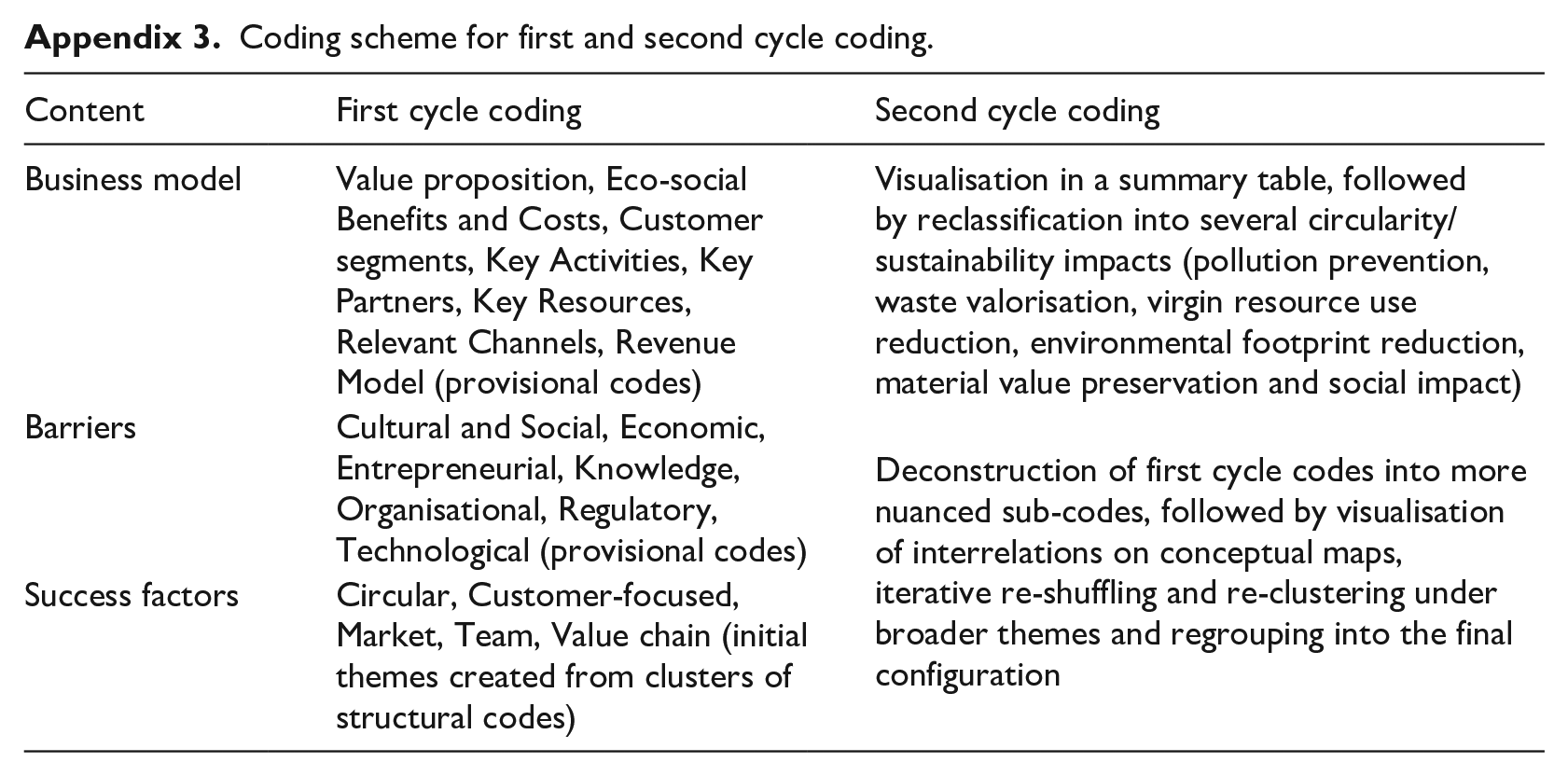
| Content | First cycle coding | Second cycle coding |
|---|---|---|
| Business model | Value proposition, Eco-social Benefits and Costs, Customer segments, Key Activities, Key Partners, Key Resources, Relevant Channels, Revenue Model (provisional codes) | Visualisation in a summary table, followed by reclassification into several circularity/sustainability impacts (pollution prevention, waste valorisation, virgin resource use reduction, environmental footprint reduction, material value preservation and social impact) |
| Barriers | Cultural and Social, Economic, Entrepreneurial, Knowledge, Organisational, Regulatory, Technological (provisional codes) | Deconstruction of first cycle codes into more nuanced sub-codes, followed by visualisation of interrelations on conceptual maps, iterative re-shuffling and re-clustering under broader themes and regrouping into the final configuration |
| Success factors | Circular, Customer-focused, Market, Team, Value chain (initial themes created from clusters of structural codes) |
Acknowledgements
We would like to thank Danielle Twardy-Duisters and Joris Schalken for their contributions to this study, as well as all our participants, two anonymous reviewers, the special issue guest editors and the Editor for their time, effort, and invaluable feedback which has helped shape this article.
Funding
The author(s) disclosed receipt of the following financial support for the research, authorship, and/or publication of this article: This work has been performed in the framework of the C-PlaNeT project which has received funding from the European Union’s Horizon 2020 research and innovation programme under the Marie Sklodowska-Curie grant agreement No. 859885.
Author Biographies
 ), his work connects plastics circularity with the design, development, and socio-political implications of circular economy business models.