




Abstract
The circular economy became a widely accepted economic model among businesses and policymakers as it aims to maximise resources while reducing waste, and energy usage, and mitigate the impact on climate and the environment. The digitalization and digital transformation of the circular economy make this business model even more sustainable and inclusive by improving resource flow and empowering consumers to make better-informed decisions. This case focuses on how Oddbox—a circular economy enabler company, uses digital transformation to facilitate a food rescue mission and promote sustainable growth. The discussion centres on how digitalization and digital transformation in the circular economy have enabled a more sustainable business model that creates social impact and captures value.
Keywords
Introduction
According to the Food and Agriculture Organisation of the United Nations (FAO), global food waste was estimated at 931 million tonnes, equivalent to about 17% of the total food available to consumers (FAO, 2022). The estimated cost of this waste to the global economy is 936 billion US dollars per year (World Economic Forum, 2021). The United Nations Sustainable Development Goals (SDG target 12.3) aims to fight against food loss and halve food waste by 2030, due to its significant economic, environmental, and social implications (United Nations, 2021). To counteract waste and linear consumption, the circular economy (CE) proposes an economic model that minimizes resource use and environmental impact by designing out waste and maintaining the value and benefit of materials and resources for as long as possible (Ranta et al., 2018). One company that utilises this model is Oddbox, which was established in 2016 to rescue surplus or imperfect fruit and vegetables from farmers and resell them to consumers, preventing them from going to waste (The UKRI National Circular Economy Research Hub, 2022).
Considering that food is a perishable material (Narvanen et al., 2021), to provide a more sustainable circular economy, Oddbox is using its digital platform to create a more sustainable circular economy by bringing together different actors, such as farmers and customers, and enabling quick and effortless transactions while also tracking environmental impact. Through its digital system, Oddbox allows customers to track last-minute rescues from farms and rescue a wider variety of produce, thus promoting more holistic and sustainable value creation in the circular economy. Could digitalization and digital transformation be the way forward for the circular economy?
In the following sections, first, the circular economy and Oddbox as a company are introduced. Second, digitalisation and digital transformation in the circular economy are presented. Then, reflections on how Oddbox enabled its digital transformation and its reflections are discussed.
Food waste and digitalisation within the circular economy
Food waste refers to food that is suitable for eating, yet that is discarded despite being of adequate quality for consumption before or after the food spoils. It is predominantly observed at the retail and consumption stages of the food supply chain (World Resources Institute, 2013) and in households (Papargyropoulou et al., 2014). According to a report by the United Nations Environment Programme (UNEP), nearly 570 million tonnes of 931 million tonnes of global food waste occur at the household level, which is equivalent to 61% of the global food waste (UNEP, 2021). It has been highlighted by the UNEP that consumer food waste was underestimated and therefore neglected for a long time, where its actual contribution was more than twice the previous estimates (Gustavsson et al., 2013). This realisation worked as an enabler and triggered United Nations to create the Sustainable Development Goal 12.3 in the 2030 Agenda for Sustainable Development which mandates a 50% reduction in per-capita global food waste at the retail and consumer levels, as well as a decrease in food losses throughout production and supply chains, including post-harvest losses.
In response to Sustainable Development Goal 12.3, the circular economy has gained increasing momentum as a solution for businesses. It is considered a unique pathway to generate employment opportunities, yield cost efficiencies, enhance resource productivity, and yield ecological benefits, thereby providing commercial enterprises and societies with a viable operating framework that operates within the confines of planetary resources and contributes to the establishment of a sustainable economic system. The circular economy theory simply posits the identification and implementation of various strategies aimed at enhancing resource efficiency and minimising waste throughout the entire lifecycle of manufactured goods in order to reveal an untapped source of economic potential, capable of fostering economic growth (Ghisellini et al., 2016; Witjes and Lozano, 2016).
Digital transformation in the circular economy
Alongside the key players in the food industry, the circular economy has accelerated sustainable start-ups to tackle food waste at various levels in the consumption chain. To tackle the food waste that emerges at various stages, from household to supply chain, sustainable start-ups have undergone a digital transformation as a key enabler to observe and optimise the use of resources and make the information available in real-time (Neligan, 2018).
An example of these businesses could be ToGoodToGo (www.toogoodtogo.com) which focuses on the promotion of food surplus that occurs in restaurants and stores through its mobile application by connecting customers to restaurants and stores that have surplus unsold food. Another start-up, KITRO (https://www.kitro.ch/), tackles avoidable food waste in commercial kitchens by identifying and monitoring the sources and quantities of food waste, as well as the hidden costs of food waste, using AI-driven software. On the other hand, Cozzo (https://cozzo.app/) another example of a sustainable start-up, creates a digital inventory of an entire kitchen, generates shopping lists and meal planners, and tracks expiry dates through a multifunctional barcode scanner and receipt reader via its mobile application.
While promoting their digital infrastructures and utilising digital transformation within the circular economy, all these use design-driven principles that underpin the circular economy model as follows: (1) elimination of waste and pollution, (2) circulation of products and materials at their highest values, and (3) regeneration of nature (Ellen McArthur Foundation, nd).
The case: oddbox
Oddbox’s history began in 2016 when co-founders Emily Vanpoperinghe and Deepak Ravindran saw funny-looking but super delicious fruits and vegetables during their visit to the fresh fruit market in Portugal, as it differed significantly from the uniformity prevalent in UK supermarkets. They started questioning why the fresh fruits and vegetables in the UK’s supermarkets look so good but don’t taste as “good.” Upon their return, they discovered that a significant volume of production, approximately 40%, is being discarded due to stringent EU “specific marketing standards” (SMS) (e.g., Commission Implementing Regulation EU, 2011) or being deemed surplus to requirements. This implies that fresh produce is being thrown away because it does not meet certain specifications, such as being too bent, unattractive, the wrong colour, or too large or small.
To rescue the misshapen, wonky or surplus fruits and vegetables, Emily and Deepak decided to found Oddbox, where they decided to work directly with farmers by taking their excess or misshapen stock by offering direct delivery to the end consumer. They founded Oddbox on a fair supply-led model, which means they decided to partner with farmers whenever needed rather than setting up contracts. CEO and Co-Founder of Oddbox Emilie Vanpoperinghe said that: “This is not how nature works and leads to a large amount of over-production and waste. We’ve flipped this on its head. Our partner growers come to us when they need our support to distribute delicious produce which supermarkets won’t take. This enables us to be flexible with the variety of fruit and veg we offer to our customers while fighting waste.” (Circular, 2021).
In the first quarter of their operations, they worked with two producers, where they source misshapen and surplus produce at a fair price. Oddbox initially had only ten customers and Emily and Deepack packed and delivered the fruits and vegetable selections for the end customer based on a subscription model across South-West London only themselves.
Reflections on how oddbox enabled its digital transformation
As their small-scale trial was highly successful, they started working with five local producers from Essex to Kent and expanded their zone delivery within East and West London. Manually exporting data was their approach to reporting at first, however, with the increasing number of producers and customers, this methodology proved to be limiting as it precluded data drill-down and prevented the client’s team from generating bespoke reports (Infinite Lambda, nd). Therefore, they started using automated data transformation processes that directly supported business operations and contributes to data-driven decision-making processes. They also implemented a Customer Relationship Management (CRM) system and a new sales process to drive a large volume of B2B and B2C enquiries while building up a sales pipeline. This allowed them to expand their supplier network overseas (Rushe, 2018). During this intervention towards digitalisation, they have also prioritised digital solutions for transparent supply chain mapping. In 2020, Oddbox received its B Corporation certification, which adheres to the most rigorous social and environmental performance standards, transparency and accountability (B Corporation UK, 2023). With the B Corporation certification, Oddbox overcame one of the risks that emerge from the digitalisation of the circular economy, which is the issue of transparency (Bartekova and Borkey, 2022).
Oddbox’s subscription-based digital platform working principles are fairly simple: upon signing up in Oddbox, customers are required to specify their preferences regarding the contents and frequency of the delivery. The options available include either fruit, vegetables, or a combination of both, which can be delivered on a weekly or fortnightly basis. Additionally, customers are prompted to select the size of the box, which comes in small, medium, or large. Following this, the platform allows customers to select a delivery date, depending on their location, and 6 days before delivery, a preview of the contents is revealed via email. If customers want to remove or “rescue” more items, they can easily alter or manage the box before the cut-off date. The digital platform and digitalisation allow customers to be flexible in their preferences whilst fighting against food waste. To keep their carbon emissions as low as possible, they use recyclable boxes for deliveries and all boxes are delivered overnight. They also donate their leftover produce to their charity partners, such as Fareshare. KIND or City Harvest (Do Good Report, 2021), which promotes Oddbox being a sustainable circular economy figure.
In addition to their digital transformation, to increase their brand awareness, they have collaborated with food-waste activist and viral “Tik Tok” chef, Martyn Odell and launched their cookbook “Crunch Time” in 2022 (OddBox Team, 2022). Oddbox also launched its first-ever TV ad in January 2023 to increase awareness and reach its customer base highlighting food waste while tackling the cost-of-living crisis (Figure 1). According to Google Search of “Oddbox” shows that it generated a considerable buzz (Figure 2) the results show a spike around the same time. That being said, with the positive contribution of Oddbox’s digital strategies and digital transformation, their monthly organic traffic is gradually increasing, according to SEMrush (Figure 3). As of 2023, Oddbox has delivered nearly six million boxes and has a subscriber base exceeding 75,000 customers, which represents a reach of 66% in the UK. Additionally, one out of five of their customers joined through word of mouth, and the brand has achieved an impressive 52.5% aided brand awareness across the UK and 71.2% in London (seedrs, 2023). This could also imply that Oddbox’s strong focus on digital transformation Oddbox’s first TV campaign asks people to join the fight against food waste, launched on 25 January 2023. Google search trends: interest over time (keyword: OddBox)/1 November 2016–1 April 2023. Oddbox UK website organic traffic: 103,254/ month, acquired from SEMrush.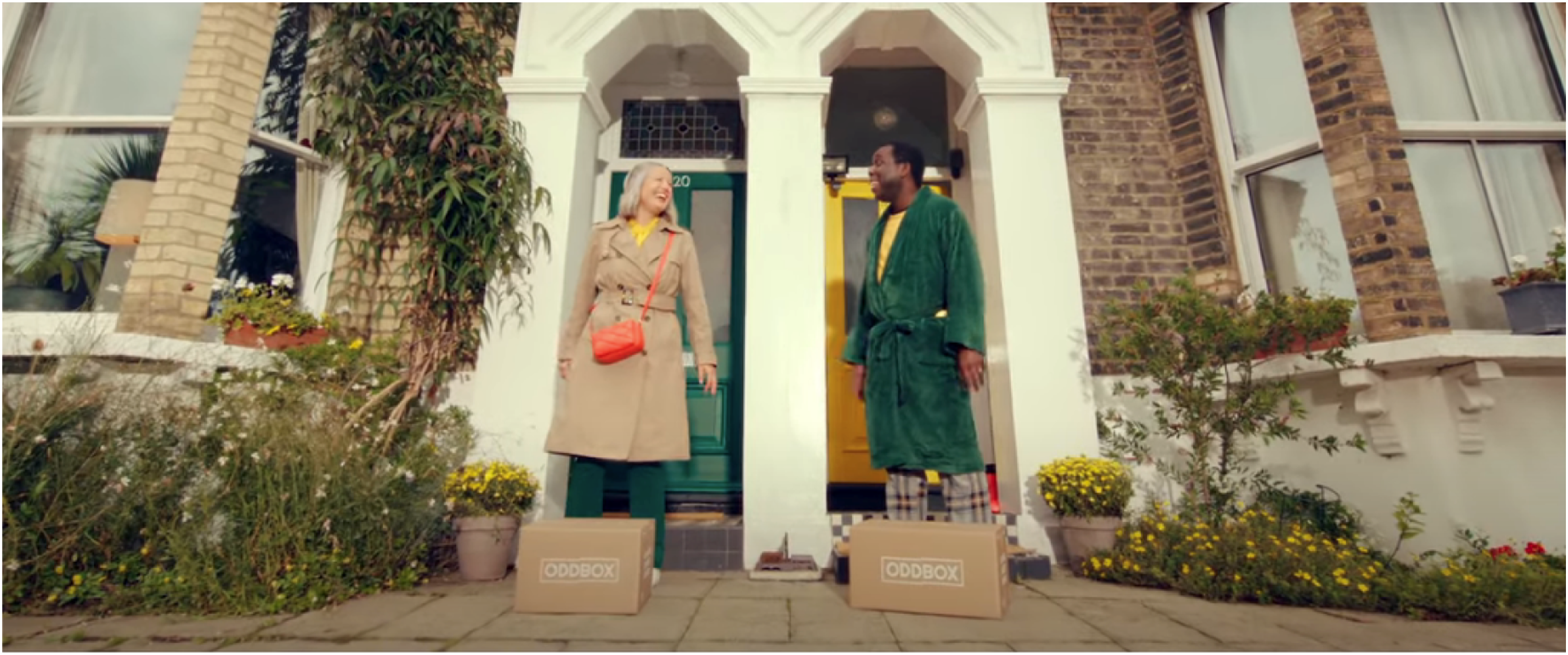


Challenges and setbacks
The digital transformation led Oddbox to be a sustainable circular economy model and it is proven that digital transformation led Oddbox to grow its market reach. However, the focus on recirculating resources, as one of the principles of circular economy, unfortunately, disregards the limitations associated with such approaches, such as substantial logistic footprints, like in the case of Oddbox (Bocken and Short, 2022). Considering the extended reach of Oddbox from South East London to the UK, there will be a need for transportation costs with the least carbon footprint and low value.
A second adverse effect of circularity might be overconsumption due to digital convenience, where consumers might develop a tendency to see the circular products, it is Oddbox produce in this case, ready to use and relatively cheaper (Zink and Geyer, 2017) and spend their money on unsustainable products, or just simply make overconsumption. Could there be a path forward to create an engagement with customers to highlight “sufficiency” in this case while embedding a message on the environmental impact of rescued produce? (Bocken and Short, 2021).
The digitalization of the circular economy presents several potential risks that require attention. Although the integration of digital technologies into circular business models can result in many positive changes, there is also the possibility of negative consequences. The use of digital technologies carries general risks related to data security, privacy, ownership, and usage, which are similar to other areas where digital technologies are widely adopted. With the rising awareness of food waste among consumers, which has more than doubled in the past 2 years due to escalating food prices, supply chain difficulties, the pandemic, and concerns about sustainability (Capgemini, 2022), addressing digital data and privacy-related concerns will become essential for consumers who are early adopters.
Discussion questions
1. How can digitalisation and digital transformation help reduce food waste in the retail and consumption stages of the food supply chain, and what are the challenges businesses face in implementing digital solutions for this purpose? 2. How is Oddbox using its digital platform to bring together different actors in the circular economy, and how does it track its environmental impact? 3. Can digitalisation and digital transformation be considered the way forward in the circular economy? What are the potential benefits and challenges associated with this approach? 4. How can businesses use digital marketing strategies to raise awareness about the issue of food waste and promote circular economy solutions, and what role can social media play in engaging consumers and building communities around sustainability initiatives?
Footnotes
Declaration of conflicting interests
The author(s) declared no potential conflicts of interest with respect to the research, authorship, and/or publication of this article.
Funding
The author(s) received no financial support for the research, authorship, and/or publication of this article.
