



Abstract
A circular economy (CE) addresses the shift in economic systems from an unsustainable linear approach to a sustainable circular approach through start-ups and entrepreneurial ecosystems (EE). A single level of focus on CE research limits an understanding of the mechanisms fostering a transition towards CE. We conduct a systematic review of the macro–meso–micro interconnections between start-ups and EE in CE using bibliometric and content analyses to scope the literature without time boundaries. This exercise led to 90 articles from the Web of Science and Scopus databases. We contribute to literature on entrepreneurship and CE by building an integrative multi-level framework linked to the just and safe planetary boundaries by bridging macro-level explanations (public policies, regulations and infrastructure) and the meso-level (circular supply chains and circular ecosystems) and micro-level (circular start-ups and circular business models). The framework highlights social and environmental sustainability challenges, and just and safe close-loop production patterns.
Keywords
Introduction
A circular economy (CE) has established itself as a central theme across literature, policies and practices as a response to tackling grand environmental and social sustainability challenges (Geissdoerfer et al., 2017; Ghisellini et al., 2016; Korhonen et al., 2018; Rodriguez-Anton et al., 2019). CE proposes the development of an economic system that is based on business models which replace the ‘end-of-life’ concept with reducing, alternatively reusing, recycling and recovering materials in production/distribution and consumption processes, thus, operating at the micro level (products, firms and consumers), meso level (eco-industrial parks) and macro level (city, region, national and beyond), with the aim to accomplish sustainable development, which implies creating environmental quality, economic prosperity, and social equity, to the benefit of the current and future generation (Kirchherr et al., 2017: 224–225). In this sense, CE seeks to shift economic systems from an unsustainable linear approach to a sustainable circular approach (European Commission, 2014; Prieto-Sandoval et al., 2018; United Nations, 2015) operating while considering planetary boundaries (Richardson et al., 2023).
In a CE, systems are based on slowing, closing and narrowing resource loops (Bocken et al., 2016). Therefore, transitioning to a CE system requires novel business approaches (Bocken et al., 2014; Centobelli et al., 2020; Fernandes et al., 2022; Ferreira et al., 2022) for answering the challenges of the Anthropocene and embracing (more) social and environmental sustainability (Dzhengiz et al., 2023) in line with safe and just planetary boundaries (Rockström et al., 2023). CE goes beyond the incumbent firm as the focal unit of analysis (Frishammar and Parida, 2019; Gandolfo and Lupi, 2021; Santa-Maria et al., 2021) and emphasises the role of agency through other forms of organisations and levels (Dzhengiz et al., 2023). This includes start-ups, entrepreneurial ecosystems (EE) and CE systems. At the macro-level, a CE system calls for public policies and regulations triggering the development of cities, provinces or regions for integrating industrial systems, service delivery and the social system (Ghisellini et al., 2016; Prieto-Sandoval et al., 2018). At the meso-level, (circular) ecosystems include mechanisms and structures triggering opportunities in mainly the environmental and economic dimensions (Kanda et al., 2021; Snihur and Bocken, 2022; Trevisan et al., 2022); circular ecosystems entail new value logic strategies for cycling, extending, intensifying and dematerialising products and services (Geissdoerfer et al., 2020). A circular EE relies on multi-stakeholder collaborations across supply chains and promoting the circulation of products and materials (Farooque et al., 2019; Govindan and Hasanagic, 2018), fostering entrepreneurial activities that can lead to sustainability outcomes (Bischoff and Volkmann, 2018; Castro Oliveira et al., 2021; Fernandes and Ferreira, 2022; Raposo et al., 2021). At the micro-level, circular start-ups are driven by environmental and economic values (Henry et al., 2023) and even socially sustainable values (Suchek et al., 2022); they adopt the rationale of a circular business model from inception (Ferasso et al., 2020; Geissdoerfer et al., 2020) and advance transitioning towards a CE system by closing product or material loops (Ferreira and Dabic, 2022; Henry et al., 2020). CE business models include processes and strategies by which firms create, deliver and capture sustainable values (Centobelli et al., 2020; Urbinati et al., 2017), experiments with circularity (Bocken et al., 2017), enact bioeconomy innovations (Donner and de Vries, 2021) and adopt contextual approaches (Daňo et al., 2020).
Despite the rapid increase in research on (circular) start-ups, (circular) EE and public policies in the CE’s context, the single level of focus in CE research limits a broader understanding of the mechanisms fostering the transition towards CE. Studies on CE focus on, for example, either the business model (Centobelli et al., 2020; Geissdoerfer et al., 2020), or the supply chain (Govindan and Hasanagic, 2018), or technology as a driver of CE (Patyal et al., 2022), or innovations (Suchek et al., 2021), or circular entrepreneurship (Suchek et al., 2022), or sustainable performance (Ferreira and Dabic, 2022). Recent calls encourage research on the inter-relations between EE and sustainable entrepreneurial activities (Theodoraki et al., 2022; Volkmann et al., 2021), specifically CE’s macro–meso–micro interconnections for exploring the role of businesses in a transition to CE. However, few efforts have adopted the integration of macro–meso–micro levels (Dzhengiz et al., 2023; Ghisellini et al., 2016) or relating to the planetary boundaries (Richardson et al., 2023; Rockström et al., 2023). For instance, Ghisellini et al. (2016) build a literature review on the CE’s context in addressing the implementation at the macro-level (city, province, region, nation), meso-level (eco-industrial parks) and micro-level (single company or consumer). While identifying the elements within the levels is important, the levels are operationalised as separate pillars without connections among them. Thereby, Dzhengiz et al.’s (2023) call for a multi-level perspective for grasping firm interaction with other societal stakeholders for identifying how grand challenges are being addressed through CE. Responding to these calls, this article reviews literature on start-ups and EE in the context of CE to further our knowledge of the macro–meso–micro interconnections prompted by start-ups and EE for transitioning towards CE. This review addresses the following research question (RQ): What key paths can be explored to advance the interconnections between start-ups and EE that prompt transitions towards CE?
Following Tranfield et al. (2003), we conducted a systematic literature review (SLR) without time boundaries that led to 90 articles in bibliometric (Cobo et al., 2011) and content (Hassan et al., 2023) analyses. In contrast with previous reviews, our review identified the main macro–meso–micro interconnections between start-ups and EE in the context of CE. Our review is the first to systematically identify macro-meso-micro mechanisms exposing multi-level combinations that can help us better understand transitions to CE and CE as a social-ecological-economic system. We contribute to literature on entrepreneurship and CE by building an integrative multi-level framework on the macro–meso–micro interconnections linked to just and safe planetary boundaries bridging the macro-level explanations (public policies, regulations and infrastructure that create a CE supportive environment for responsible resource use and consumption), the meso-level (circular supply chains and circular ecosystems) and the micro-level (circular start-ups and circular business models). We argue that for building theory and empirical research, a multi-level approach can help unravel the influence of top-down and bottom-up linkages in circular entrepreneurial activities in the context of CE. Finally, this article suggests promising paths for future studies to advance literature on start-ups and EE in the context of CE based on multi-level interconnections and planetary boundaries (Richardson et al., 2023; Rockström et al., 2023). A closer recognition of circular supply chains and circular ecosystems to circular entrepreneurial action can aid research in addressing critical gaps in literature and contemporary policies and practices for building a radical agenda that enables a transition to CE with safe and just close-loop systems.
Methodology
SLRs are based on predefined and transparent methods for reviewing literature related to specific objectives and RQ that they seek to address (Snyder, 2019; Tranfield et al., 2003). To maintain rigour, consistency and for ensuring the relevance of the results, the protocol of the SLR is explicit, systematic and reproducible (Belur et al., 2021; Kraus et al., 2022). Thus, our review follows the three-stage-process suggested by Tranfield et al. (2003) for planning and conducting the review and reporting our findings. The data synthesising process employed in this review consists of bibliometric techniques (Cobo et al., 2011), namely the bibliographic coupling of documents (Kessler, 1963). This method clusters documents according to the references they have in common. Bibliometric reviews that rely on quantitative approaches for synthesising the main findings tend to be criticised for a lack of critical analysis (Paul and Barari, 2022; Paul and Criado, 2020). The approach in our review includes a content analysis for exploring the body of articles in each cluster formed according to the bibliographic coupling of documents and thus provides a comprehensive overview of extant research focused on start-ups and EE in the context of CE.
Hence, on the one hand, a quantitative approach used in the data analysis delivers an objective and unbiased evaluation of the research under exploration (Zupic and Čater, 2015). On the other hand, the content analysis technique enables a comprehensive, in-depth overview of this research field (Hassan et al., 2023; Wu et al., 2020). Therefore, this research approach seeks to comprehensively contribute to literature and practice (Reis et al., 2021). The research protocol used is presented in Figure 1 and is then discussed.
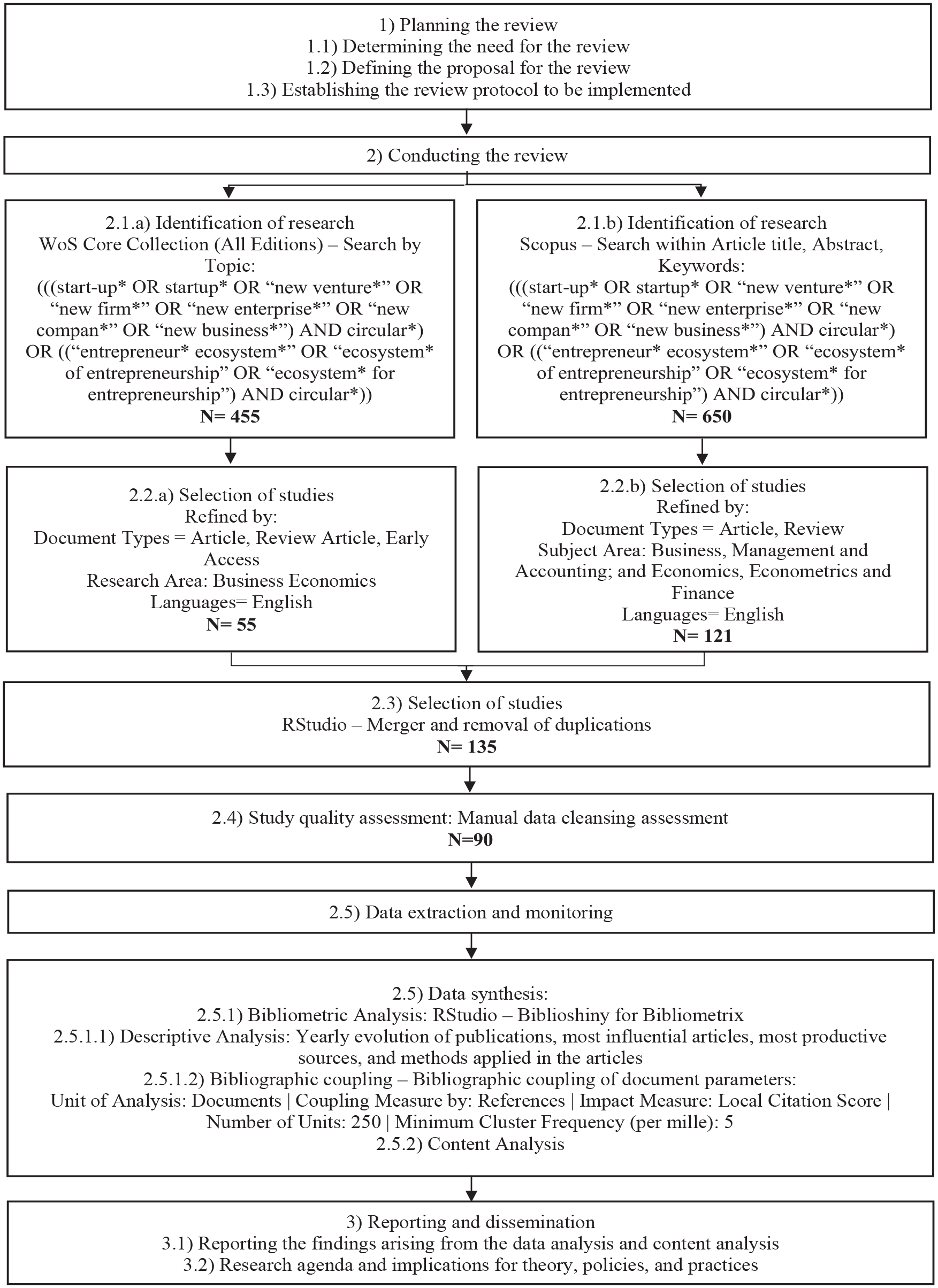
Research protocol.
Planning the review
As shown in the first step in Figure 1, we determined the research gap that this review wanted to address (i.e. identification of macro–meso–micro interconnections between start-ups and EE in the context of CE) for validating the need for developing a SLR. Following preliminary searches, the authors agreed on the scope of the review in terms of the objective, RQ and the domains (Business and Economics) for guiding the review. Furthermore, the research string and inclusion/exclusion criteria were also defined following the extensive preliminary searches that were undertaken. The search string encompassed a series of terms closely related to the core concepts under the scope (start-ups, EE and CE). It is important to emphasise that the word: circular* is a comprehensive concept intended to allow for the inclusion of all terms related to CE, circular business models, and the derivations thereof, namely circularity. We underline that multiple literature searches informed our search string. As our review’s goal analysed literature on start-ups and EE in the context of CE, we opted not to include the notion of sustainability in the string. Sustainability is a multidimensional concept incorporating environmental and social aspects. Compared to the notion of ‘sustainable’ or ‘sustainability’, the concept of circular is more tangible and advanced, describing a path to achieving sustainability through restoration and regeneration of the biosphere and human well-being (Dzhengiz et al., 2023; Henry et al., 2020). Therefore, using the notion of circular* (and all the derivations thereof), we assured that we analysed literature related to the objective and RQ that guided this review. The search string was also designed to ensure the search range by including Boolean operators.
To maximise the scope of the search while ensuring the quality of the identified data, the search was done in the Web of Science (WoS) and Scopus databases; this is a common practice in review studies for achieving this goal (Hassan et al., 2023; Padilla-Meléndez et al., 2022; Ponomareva et al., 2022). Furthermore, based on recent review studies (namely, Hassan et al., 2023), we defined the following inclusion criteria:
Inclusion criteria: Peer-reviewed articles published in English. Articles on business economics. Articles published till November 2022 (date of the search). No time frame was defined. Articles related to the role of start-ups and/or EE in contributing towards CE. To be included in the review, the articles had to fulfil all these criteria. Once the authors established and agreed on the research protocol, we proceeded to the next step.
Conducting the review
As depicted in the second step presented in Figure 1, this step encompassed a series of procedures. We performed the searches based on the search string, search engines and search boundaries defined in the first step. In identifying the research, similar search procedures were developed in WoS and Scopus, leading, to identifying 455 and 650 documents in each database respectively. Next, in selecting the studies, the results were filtered based on the inclusion/exclusion criteria previously defined related to document types and research areas. Following this procedure, the pool of identified articles dropped to 55 and 121 in WoS and Scopus, respectively. Then, it was necessary to merge the individual WoS and Scopus files into one dataset. This was accomplished through the RStudio software (Aria and Cuccurullo, 2017). Therefore, merging and removing duplications led to a unified data file comprising of 135 documents.
The study quality assessment was based on a manual data cleansing process in compliance with the inclusion/exclusion criteria defined in the first step, namely, assessing if the articles identified were related to the role of start-ups and/or EE in contributing towards CE. It is important to emphasise that we adopted a broad criterion in this procedure. For instance, if the article addressed business models, strategies or practices that could be applied by start-ups or were related to EE in the context of CE, it was included. To ensure consistency in this procedure, an author was responsible for analysing the articles based on the inclusion and exclusion criteria previously defined; in case of any doubt during the manual data screening, the other authors were consulted. The manual data cleansing process was done in two rounds. Firstly, the pool of articles was screened entirely and coded (as Definite Exclusion, Definite Inclusion and Possible Inclusion). Then, the full database was screened a second time to maximise reliability. Following these steps, the pool of 135 articles came down to 90 due to the following reasons:
Removal of six articles not peer-reviewed.
Removal of three duplicate articles.
Removal of 36 articles that had little or no relevance to the role of start-ups and/or EE in contributing towards CE. Specifically, after reading the article titles, abstracts and keywords, 28 articles were classified as definite exclusions, 44 as definite inclusions and 54 as possible inclusions. The 54 articles classified as possible inclusions were then subjected to a complete reading analysis that led to the inclusion of 46 articles out of these in the final pool of articles (thus, excluding 8 from 54).
Then, we proceeded to the data extraction and monitoring step. Specifically, we retrieved full versions of the final pool of articles and coded them according to their descriptive and content features. The next step consisted of synthesising the data by resorting to a bibliometric analysis using Rstudio through biblioshiny for bibliometrix (Aria and Cuccurullo, 2017). The data analysis included a descriptive analysis (describing the research profile of the sample articles) and the bibliographic coupling of document analysis (Kessler, 1963). The bibliographic coupling of document analysis (Kessler, 1963) was undertaken by applying the parameters described in point 2.5.1.2) of Figure 1 at biblioshiny for bibliometrix (Aria and Cuccurullo, 2017). After the clusters were formed, we did a content analysis (Hassan et al., 2023; Wu et al., 2020) for analysing the research themes on the topic comprehensively.
Reporting and dissemination
As described in Figure 1, the final step consisted of discussing the findings that emerged from the bibliometric and content analyses. By leveraging the findings from the review, it was possible to advance an integrative multi-level framework that connected the main research themes (the clusters identified), highlighting the macro–meso–micro interconnections between start-ups and EE in the context of CE thus, helping in an understanding of this stream of literature. This comprehensive review placed us in a favourable position to suggest a comprehensive agenda for future research that could pave the way for the development of future studies on this topic. Finally, we discuss the study’s implications for theory, policy and practice.
Results
Descriptive analysis
Figure 2 gives the yearly evolution of publications on this topic.
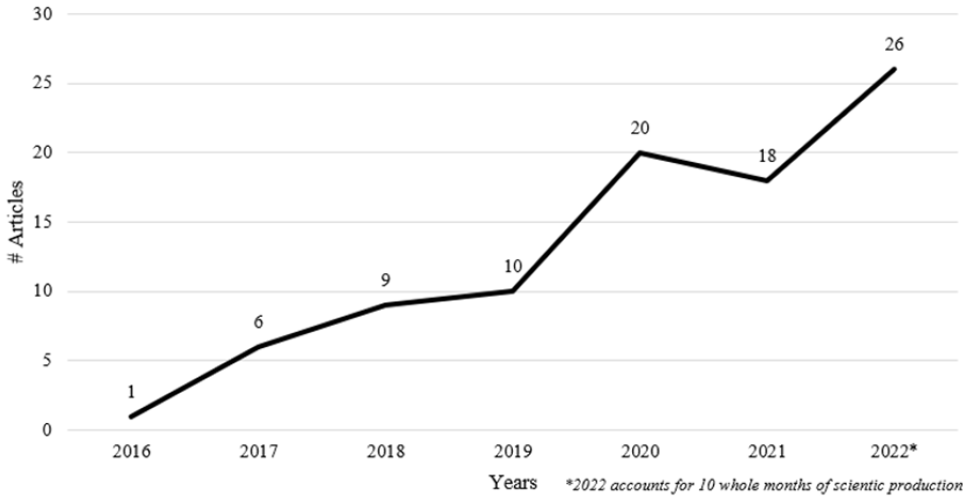
Yearly evolution of publications.
As presented in Figure 2, the 90 articles identified were published between 2016 (one article) and 2022 (26 articles, in about 10 months of scientific production). Despite being recent, this is an emerging research topic stirring growing interest in scholars, as evidenced by the pattern of publications corresponding to an annual growth rate of 72.12%. Even though 2022 accounted for 10 months of scientific production (as the search for this review took place in November), it was the most productive year (26 published articles), surpassing the 20 articles published in 2020.
Table 1 presents the 10 most influential articles regarding total citations and total citations per year.
Most influential articles.
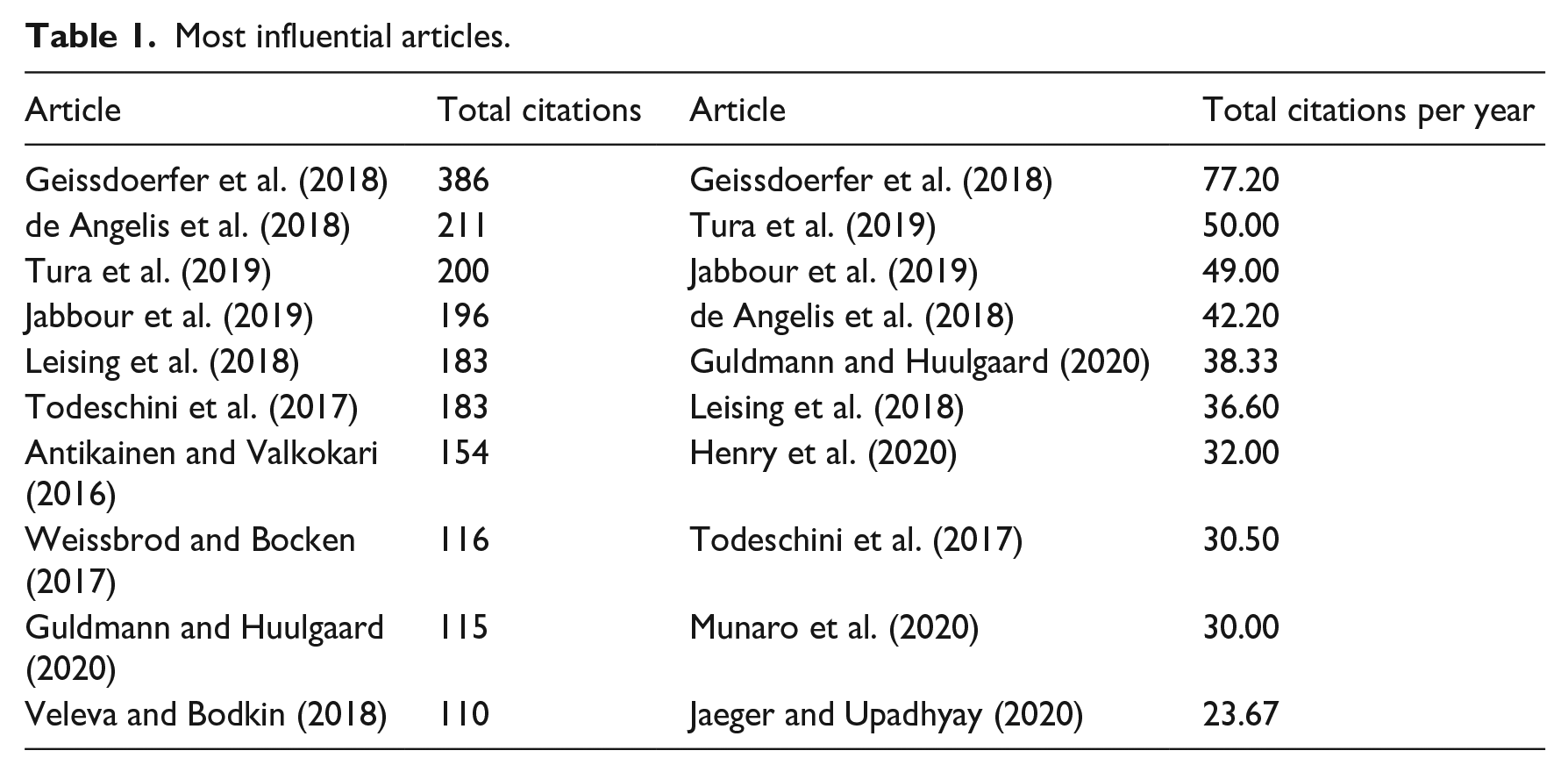
As shown in Table 1, the review by Geissdoerfer et al. (2018) stands out as the most influential article in the sample due to its total citations and total citations per year. Furthermore, the articles by de Angelis et al. (2018), Tura et al. (2019), Jabbour et al. (2019), Leising et al. (2018), and Todeschini et al. (2017), and Guldmann and Huulgaard (2020) also stand out as highly influential in both indicators.
Table 2 presents the sources responsible for two or more publications.
Most productive sources.
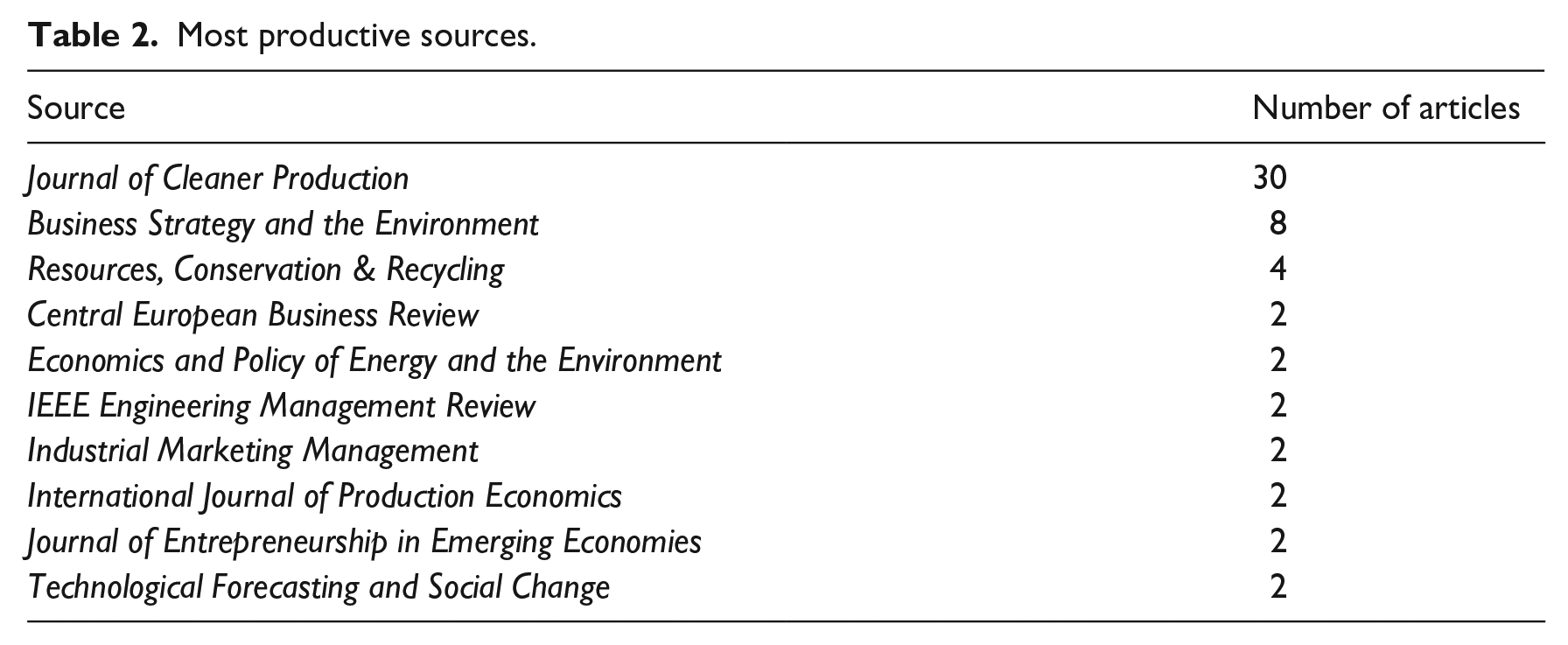
As shown in Table 2, the Journal of Cleaner Production is, by far, the most productive source in the sample. In the second and third places, we find Business Strategy and the Environment and Resources, Conservation, & Recycling, respectively. These three sources essentially deal with research related to sustainable systems of production and consumption and environmentally related issues, therefore they are closely connected to the core focus of this review. Seven sources were responsible for two publications on the topic, whereas 34 sources published one article each.
Figure 3 depicts the methods applied in the sample articles.
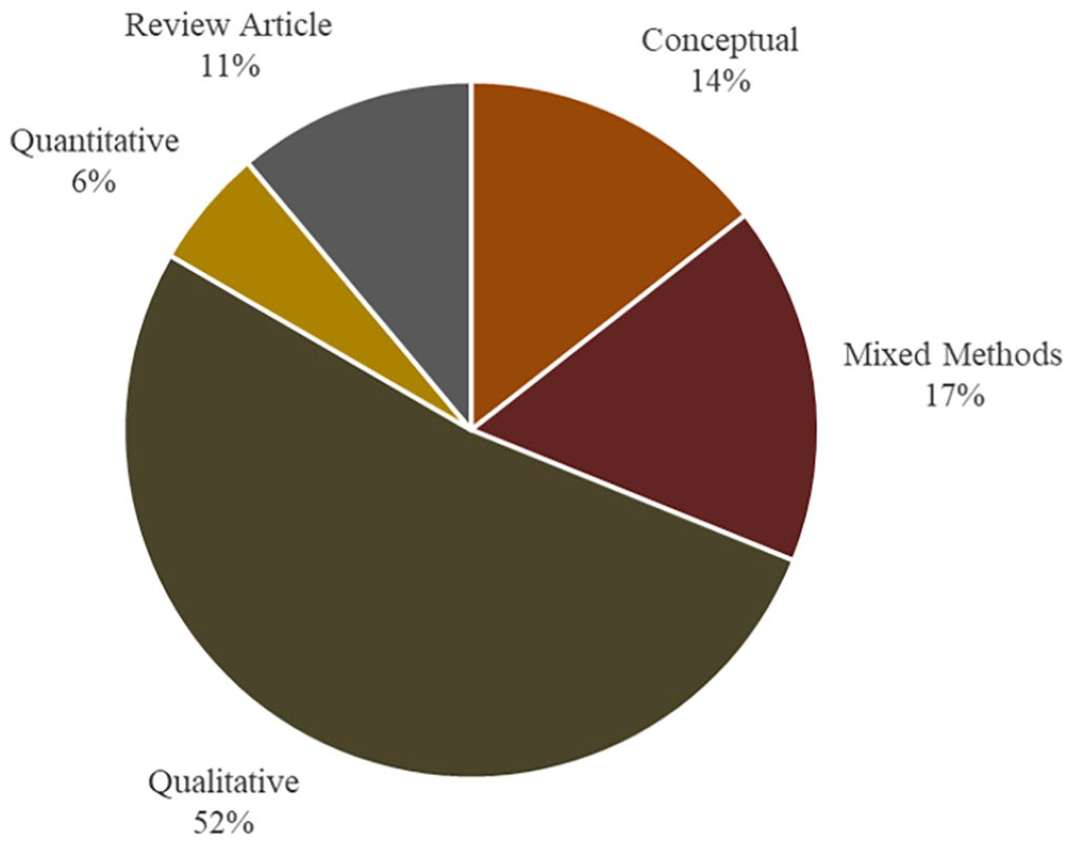
Methods applied in the sample articles.
As shown in Figure 3, most of the identified articles (n = 47) applied qualitative methods, namely the case study methodology. This attribute reinforces (as already depicted in the yearly evolution of publications) that this is still an emergent research topic in the phase of theory development (Kraus et al., 2020). Next, the 15 articles are mixed methods articles, that is, articles that combine two or more research methodologies. We also observe 13 conceptual articles, that is, articles that do not carry any empirical analysis. Ten review articles, essentially SLRs and one bibliometric review, are also detectable. Finally, the quantitative articles are the least common in the sample (n = 5).
Bibliographic coupling of documents
The bibliographic coupling of document analysis (as detailed in the ‘Methodology’ section) led to four clusters encompassing 84 articles. Figure 4 presents the cluster map according to the bibliographic coupling of documents. The map is based on two dimensions: centrality (according to Callon’s centrality index) and impact (by the mean normalised local citation score) (Aria and Cuccurullo, 2017).
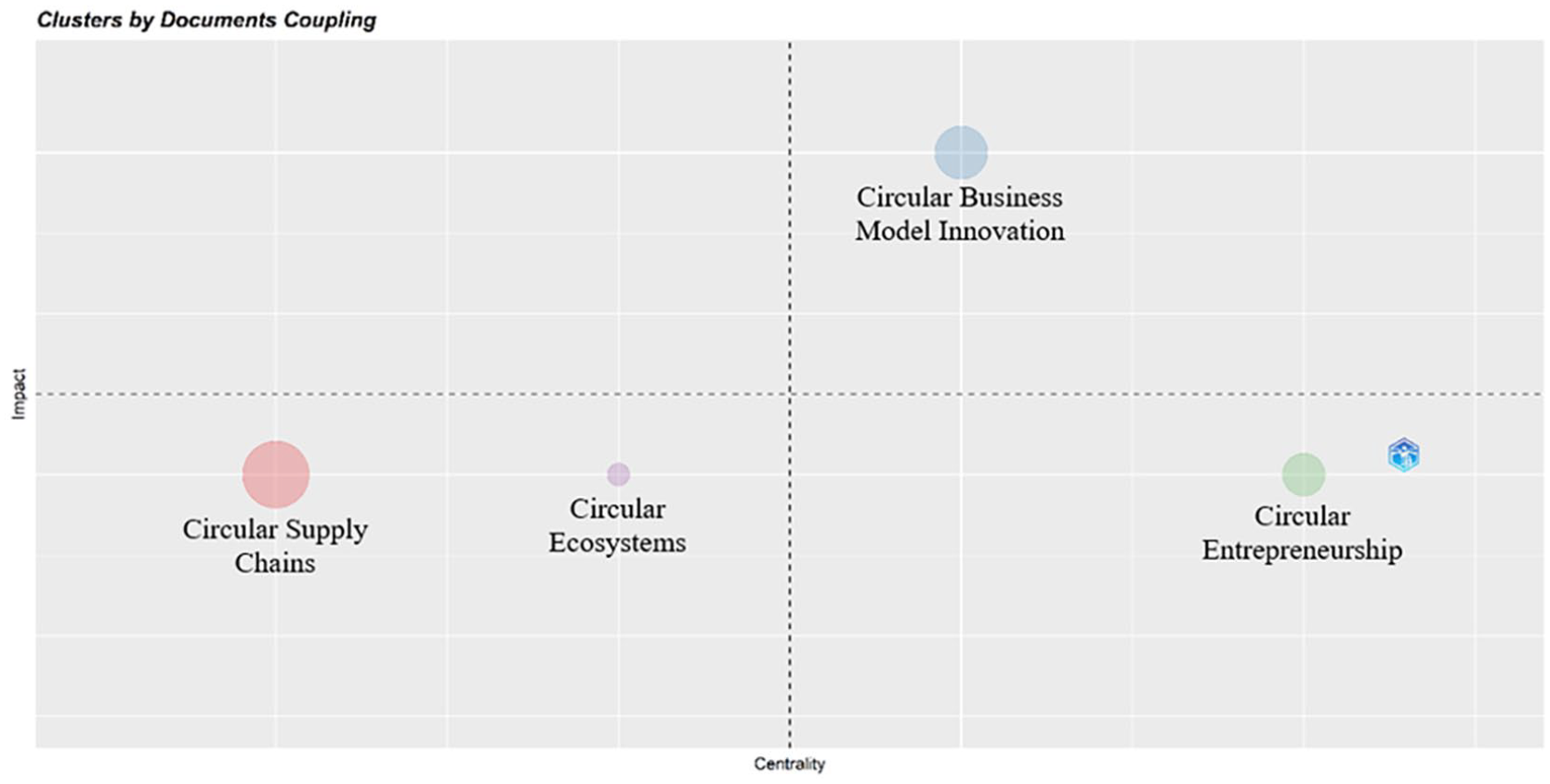
Bibliographic coupling of documents map.
As indicated by the cluster map, both the Red Cluster (the most significant cluster) and the Purple Cluster (the smallest cluster) show average centrality (Red Cluster: 1.05; Purple Cluster: 1.19) and average impact (Red Cluster: 1.00; Purple Cluster: 1.00), revealing average ties with other clusters and average impact in the overall literature. The Blue Cluster reveals high centrality (1.24) and above-average impact (1.04), indicating strong interactions with other clusters and high impact overall. Finally, the Green Cluster shows high centrality (1.43) and average impact (1.00), thus indicating strong interactions with other clusters and average impact overall. The content analysis of each article included in the clusters enabled the identification of the main research themes leading to the following designations: Red Cluster – Circular Supply Chains; Purple Cluster – Circular Ecosystems; Blue Cluster – Circular Business Model Innovation; Green Cluster – Circular Entrepreneurship.
Circular supply chains
Contributions in this cluster explored multiple facets related to (circular) supply chains. Accordingly, this cluster was more comprehensible at the meso-level, detailing how CE entails integrating and reinforcing circular multi-level collaborative approaches by the stakeholders from the public and private sectors that foster circular outcomes. Türkeli et al. (2018) provide a comprehensive overview of the research on CE, with a special emphasis on the scientific production in the European Union and China. Wiesmeth (2020) argues that successful transitions towards CE require systemic change that redirects societal path-dependencies, underlining that they present enormous challenges to business models in the CE context. In a related approach, Mathews (2020) discussed the evolutionary economic dynamics of greening, suggesting that the emergence of green business platforms creates new possibilities for green growth that will lead to new business strategies that, through the forces of creative destruction, will erase old business models related to fossil fuels and resource waste. Moshood et al. (2022) investigated a particular facet of green innovations, exploring biodegradable plastic product innovations and advancing multi-level implications on the broader scope of green product innovations. Focused on green circular start-ups, Ariztia and Araneda (2022) explored the value of the narratives developed, suggesting that economic and environmental gains reinforce each other in discourses based on three major intertwined areas: business opportunities and business models, clients and investors and economic survival (which tends to prevail over environmental considerations). In a related research line, Henry et al. (2023) investigated the motivations and identities of the founders for circular start-ups describing that such entrepreneurs are primarily driven by non-economic motives and social altruism while revealing an inventive mindset. In this sense, the authors advance a novel categorisation for such entrepreneurs, portraying them as ‘grassroots circular entrepreneurs’ or ‘circular founders’. Another relevant topic related to transitions to CE is the role of circular purchasers in transitions studied by Neessen et al. (2021), who analyse the effect of organisational citizenship behaviour towards the environment and intrapreneurship.
Several contributions in this cluster advance business model archetypes and frameworks in the context of CE. Husain et al. (2021) ranked business model archetypes for a successful adoption of CE, suggesting that some business models outperform others. Lopes de Sousa Jabbour (2019) advanced a multi-level framework comprising market environment, organisational change and tools and frameworks for assisting organisations in fostering their readiness for CE. Seeking to assist firms in analysing their internal and external business environments when implementing CE initiatives, Tura et al. (2019) built a framework of drivers and barriers for CE businesses based on seven categories of factors (environmental, economic, social, institutional, technological and informational, supply chain and organisational). Rosado and Kalmykova (2019) proposed a framework for designing and developing economic clusters based on industrial symbiosis and sustainable supply chain management, underlining that such an approach fosters CE agendas. Huynh (2022) developed a categorisation of three digital-based circular business models in the fashion industry that could assist fashion businesses (start-ups and incumbent firms) in leveraging digital innovations and business model innovation for improving their sustainable performance. Also underlining the potential of digital technologies towards CE, Jabbour et al. (2019) suggested a relational framework that combines CE, new business models, big data and key stakeholders in organisational sustainability for advancing insights on the integration of CE and big data. Furthermore, Kalogiannidis et al. (2022) suggested the potential of digitalisation in fostering circular business models, describing a positive association between implementing digital business practices and innovations and the success of circular economies. Innovation is also described as a fundamental factor for advancing CE agendas. Greer et al. (2020) explored how circular start-ups foster CE through niche innovations (related to cleaner production) that can be extended to incumbent practices facilitated through networks of circular entrepreneurs. Focusing on a particular type of innovative start-up, Huynh Evertsen et al. (2022) proposed a taxonomy for academic spin-offs based on types of innovations and CE characteristics, suggesting that such firms play an important part in CE by developing outcomes based on scientific knowledge and radical innovations.
Several contributions in this cluster detail different aspects of waste management in the CE context. An important issue in this regard is brought out by Greer et al. (2021), who explored the Waste-Resource Paradox to illustrate situations that can result in circular practices further reinforcing the behaviours of a linear economy related to waste management. Following their SLR, Paes et al. (2019) advanced a SWOT analysis of organic waste management through CE’s principles. Also, based on a SLR, Do et al. (2021) developed a taxonomy for integrating the main research themes on food loss and waste management under CE, advancing the multi-level implications arising thereof in terms of logistics and supply chain management, markets and policy. Xavier et al. (2021) explored waste electrical and electronic equipment (e-waste) management at the macro-level, indicating differences in regulatory frameworks and suggesting the need for cohesive legal measures that foster CE strategies (that reflect on harmonised regulations, new business models and sustainability for citizens). In a related research line, Ryen and Babbitt (2022) explored United States federal and state policies related to circular food waste management, suggesting that the heterogeneity and lack of harmonisation policy-wise can hinder CE agendas and even limit new business models and stakeholder participation.
Sarti et al. (2017) studied the role of food sharing platforms in contributing towards food waste prevention and advancing a categorisation of social initiatives and business models applied by these, indicating that the high fragmentation of users among the platforms and the lack of appropriate food safety regulations can hinder a platform’s contribution to preventing food waste. Närvänen et al. (2021) explored the institutional work developed by start-ups to prevent and reduce food waste, suggesting that start-ups could play a key part in changing institutional pillars towards CE. Leder et al. (2020) advanced a framework for a waste valorisation circular business model that creates value by transforming alleged waste, by-products or residues into valuable material, signifying that multi-stakeholder (public and private) technology-enabled collaborations play a relevant part in fostering such a business model. In this line of research, Hedlund et al. (2020) argued that value stream mapping assists firms in transforming their business models towards CE by implementing circular value streams that leverage waste as a resource utilisation opportunity. This carries further implications as, according to Jaeger and Upadhyay (2020), manufacturing firms tend to mainly focus on recycling and waste reduction practices that hardly reflect on transitions to CE while detailing the multiple barriers that they face in implementing transitions to CE. Furthermore, Aid et al. (2017) explored the barriers faced by the waste management industry in transitioning towards a more sustainable paradigm, suggesting that firms in this sector need to implement substantial changes related to implementing long-term partnerships, leveraging knowledge sources and exploring new business models. Veleva and Bodkin’s (2018) study proposes a framework for corporate–entrepreneur collaborations in CE, stating that (circular) entrepreneurs introduce innovative business models, products and services that tackle environmental problems and generate social benefits while at the same time, large corporations struggle in implementing CE practices. Thus, the authors underline the importance of strategic collaborations that foster CE practices in the reverse supply chain.
The circular supply chain receives more attention. Following their SLR, Agnusdei et al. (2022) underlined the potential of Industry 4.0 solutions in logistics management, making suggestions for implementing new business models that integrate the requirements of implementing CE and Industry 4.0 paradigms. Also based on a SLR, de Angelis et al. (2018) advanced the circular supply chain concept by integrating the principles of CE and supply chain management. Focused on the reverse logistics of the (circular) supply chain in the expanded polystyrene industry, de Oliveira et al. (2019) developed strategy archetypes for improving reverse logistics in the context of CE. Leising et al. (2018) introduced a framework and collaboration tool for aiding the development of supply chain collaborations in circular buildings. Munaro et al. (2020) developed a SLR on CE in the built environment, highlighting that a bulk of the research focused on minimising and reusing construction and demolition waste while suggesting the need for future research on the topic.
Gregg et al. (2020) studied the value chains for bio-residual valorisation in the brewery, dairy, slaughterhouse and forestry sectors, suggesting the need for developing valorisation pathways based on a market pull (rather than a technology push) for bio-residuals. Focused on the dairy industry, Nasution et al. (2020) suggested an optimal design of a circular business model’s canvas that could support the pursuit of sustainable development goals. Focused on the forest sector, Näyhä (2020) described the importance of resources and dynamic capabilities in developing circular bioeconomy business models. In the same line of research, Näyhä (2021) underlined that such firms seek to implement new sustainable business models that enhance their growth perspectives and foster new product development.
Circular ecosystems
Contributions in this cluster advance research related to circular ecosystems. In this sense, the meso-level is the most detectable unit of analysis taken by the authors in this cluster, extending implications for the macro- and micro-levels in a reinforcing and interdependent loop.
Palmié et al. (2021) stated that business models play a fundamental part in sustainable transformation at the industry level. The authors compare start-up business models and those of incumbents across countries that reflect on green industry transformation. Antikainen and Valkokari (2016) developed a multi-level framework for sustainable circular business model innovation. The framework addresses the sustainability and circularity evaluation of the business model at two inter-related levels: the business ecosystem and business level. The levels are connected to sustainability impacts, including requirements and benefits. Also arguing for the need for business model reconfiguration towards CE, Czikkely et al. (2019) elaborated on a framework to direct waste water management processes towards circular systems of technological cycles supported by a circular value chain and business ecosystems. Furthermore, Silva and Sehnem (2022) integrated Industry 4.0 technologies in the context of CE, suggesting that organisations leverage such technologies for implementing sustainable operations that foster CE success. Hanuláková et al. (2021) explored the perceptions of firms regarding business model transformations in circular business models, suggesting that implementing CE business models requires policy, financial and consumer support. Focusing on rural SMEs, Uvarova et al. (2020) showed how lack of knowledge and adequate policy support hinders the implementation of circular business models in firms. Also focusing on a challenged region, Carrick (2022) described how competing and conflicting interests of multiple stakeholders embedded in an EE hinder sustainable development policy agendas at the regional level in developing economies. On a related subject, del Vecchio et al. (2021) explored how the dynamics of digital innovation ecosystems foster stakeholder engagement and digital CE agendas, describing the fundamental part played by stakeholders in supporting the development of a digital innovation ecosystem focused on CE.
Circular business model innovation
The contributions in this cluster examine the role of circular business models and related business model’s innovation in advancing CE agendas and highlight drivers and barriers in this regard. As such, this cluster reveals a strong emphasis on the micro-level approaches that foster meso- and macro-level transitions while circular business model’s innovation also depend on cascading macro- and meso-level effects. In an influential article in this research stream, Geissdoerfer et al. (2018) review literature on sustainable business model innovation, highlighting definitions, pointing out overlaps and differences, depicting strategies and stating the challenges identified in the scope of the business models (innovation), sustainable business models (innovation), circular business models and describing the design–implementation gap. Planing (2018) categorised existing business models in the context of CE in closely related research and developed a novel taxonomy and hierarchical structure of business model archetypes that could foster CE.
Fostering CE business models sometimes requires organisations to (re)design them. In this sense, business model experimentation can enable such transitions. Thus, different aspects of business model experimentation are underlined by Weissbrod and Bocken (2017), Bocken et al. (2017) and Konietzko et al. (2020). Weissbrod and Bocken (2017) suggested a radical innovation framework and a lean start-up approach for assisting large firms in fostering triple-bottom-line value creation through sustainable business experimentation. Bocken et al. (2017) portrayed business model experimentation for circularity as an iterative process, where emerging circular business models co-exist with existing non-circular ones, advancing a framework that assists large organisations in developing lean start-up type business model experimentation while suggesting the need for more research that explores how collaborations between established organisations and sustainable start-ups can unfold in this process. Furthermore, Konietzko et al. (2020) took an individual level approach to business model experimentation, suggesting principles that foster circular business model experimentation by better accommodating the circularity assumptions of participants. A specific type of sustainable business model is explored by Bocken et al. (2018), describing that pay-per-use business models can promote more sustainable consumption behaviours. Focused on the agrifood sector, Donner and de Vries (2021) advanced a circular business model innovation framework that attests to the interplays among external and internal drivers, multiple stakeholder synergies in fostering value co-creation for achieving circular business model innovation related bio-technological innovations. Furthermore, Basile et al. (2021), focused on offshore platform decommissioning and sustainable business models and extended the implications to business model innovation in firms, suggesting the need for value co-creation for all stakeholders balancing self-interest and sustainability issues and (re)designing (circular) ecosystems and (circular) value chains.
Pialot et al. (2017) suggested a new paradigm of production and consumption based on upgradability, meaning that such systems require transforming the value network towards a service-oriented approach. In a related line of research, Kreye and van Donk’s study (2021) on business-to-consumer servitisation extends the implications regarding CE like considering the mechanisms of internal collaborations required and service offerings provided. Vogt Duberg et al. (2020) described core factors (core acquisition and reverse logistics, labour skills and availability, remanufacturing facilities and remanufacturing processes and technology) and supporting factors (design for remanufacturing and information feedback, remanufacturing process improvements, remanufacturing market knowledge and organisation, planning and control) inherent in transitioning from manufacturing to a remanufacturing orientation. Pedersen et al. (2019) explored circular business models in the fashion industry, describing that achieving circularity requires a shift from a firm’s approach to an integrated approach that includes multi-stakeholder collaborations while overcoming multiple challenges. In a related line of research, Todeschini et al. (2017) pointed to differences in business model innovation between sustainable business models applied by start-ups and incumbent firms, suggesting that strategic cooperation based on open innovation practices between incumbent firms and start-ups can enhance CE transitions in the fashion industry. The authors also underline the role of technology in fostering sustainable business model innovation in start-ups and reveal sustainability drivers.
The role of technology in fostering CE agendas receives close attention in this cluster. Burger et al. (2018) described that the lack of appropriate software can hinder organisational efforts related to waste management, thus comparing software packages in waste-related processing is important to improve a company’s circularity. Ciccullo et al. (2022) explored how start-ups integrate big data analytics in their business models to avoid food waste or use food waste as a resource, unveiling two archetypes of business models. The archetypes include optimising a linear supply chain to avoid food waste and leveraging a circular food supply chain to create value out of food waste. Neligan et al. (2022) advanced the concept of circular disruption to emphasise the potential of digitalisation in driving the implementation of circular business models. Focusing on the plastic value chains in Africa, Oyinlola et al. (2022) investigated how entrepreneurs apply digital innovations in waste management, enabling a transition to a circular plastic economy that requires further support from public policies. The authors also underline the role of multinational corporations in the plastic value chains in African countries acting as seed funders for start-ups and as buyers of recycled plastics. In a related line of research, Donner et al. (2021) explored the success and risk factors of eco-innovative business models that contribute to CE via unavoidable agricultural waste or by-product valorisation, stating the role of the macro-environment in this regard.
Focused on the barriers that hinder the adoption of circular business models, Guldmann and Huulgaard (2020) described the heterogeneous nature of the barriers encountered, not only when comparing start-ups and incumbents but also among firms with similar attributes. Nevertheless, the authors state that the most common barriers in implementing circular business model innovations are observable at the market level, institutional and value chain level, organisational level (the most common) and employee level (not experienced by circular start-ups). Nunes et al. (2022) identified the main barriers (specifically related to institutional and organisational culture, market and sales, innovations, research and development, supply chain, operations and logistics) faced by business models for sustainability in start-ups, suggesting the need for appropriate public policies that support start-ups in overcoming them and accomplishing sustainable development goals. Daňo et al. (2020) highlighted the multi-level benefits and difficulties associated with transitioning from a linear to a circular business model. According to Prosman and Cagliano (2022), supply characteristics related to manufacturing can hinder the feasibility of industrial adoption of CE, advancing a categorisation of three circular manufacturing configurations (extending product value, extending resource value and processing) of successful start-ups that can enable economically viable circular transitions. The visualisation tool suggested by Nußholz (2018) can assist firms in overcoming challenges and barriers when designing and implementing circular business models and thus, help in implementing new forms of creating and capturing value.
Circular entrepreneurship
Contributions in this cluster explore the role of entrepreneurship in CE. Circular entrepreneurship plays a central part at the micro-level, enabling meso- and macro-level CE transitions while also relying on macro- and meso-levels for prospering.
Two SLRs focus on interdisciplinary research in the context of CE in this cluster. On the one hand, Herrero-Luna et al. (2022) suggested that innovation is essential for fostering CE goals while depicting potential areas for future research, and on the other hand, Suchek et al. (2022) bridged the literature on entrepreneurship and CE, identifying the main thematic areas of research on the topic (specifically, growing circular SMEs, born circular firms and start-ups, social entrepreneurship in CE and support ecosystems for circular entrepreneurship) Suchek et al. (2022) advanced a conceptual model for entrepreneurial processes in CE (entailing the entrepreneurial process as encompassing opportunity recognition, internal and external factors, circular business model’s implementation and the benefits in terms of outcomes arising out of this). Advancing one of the research lines suggested by Suchek et al. (2022), Sehnem et al. (2022) indicated that disruptive innovations can support circular business models and circularity practices in start-ups. Also focused on advancing the research agenda proposed by Suchek et al. (2022), von Kolpinski et al. (2023) advanced strategy archetypes related to internal dynamics that circular start-ups can leverage to overcome barriers in implementing circular business models.
Circular business models configure a central topic in this cluster. de Angelis and Feola (2020) suggested that the ReSOLVE framework integrated with six pillars (Regenerate, Share, Optimise, Loop, Virtualise and Exchange) can be suitable for implementing CE principles through circular business model innovation. In a related line of research, Puglieri et al. (2022) advanced a strategic planning decision framework oriented to circular business models that seeks to assist firms in defining competitive strategies and establishing a circular business model that simultaneously enhances their competitiveness and circularity. Henry et al. (2020) advanced a categorisation of circular start-up archetypes (design-based, waste-based, platform-based, service-based and nature-based start-ups). The authors suggest that circular start-ups tend to implement strategies with higher levels of circularity than incumbents, concluding that circular start-ups can provide significant contributions to CE. Hoffmann et al. (2020) applied the circular business model’s theory to the specific context of baby diapers, underlining the potential of CE in fostering considerable improvements in the sustainability of consumer goods. Mehrotra and Jaladi (2022) explored circular business models of local start-ups in an emerging market, advancing a theoretical model linking start-up venture designs and deployment mechanisms for developing a circular business model’s benefits. The authors suggest that such firms benefit from producing reusable and interlinked products and promoting value co-creation by interlinking customers, vendors and local communities that ultimately contribute towards micro- and macro-level sustainable outcomes. In a related research line, Rok and Kulik (2021) explored the positive impact of circular start-ups, suggesting that such firms tend to be driven by a circularity purpose, an urge to address social and environmental problems and be based on business model innovation for circularity.
Not directly focused on start-ups but discussing a topic that extends the implications for them, van Boerdonk et al. (2021) underlined that the circular business model needs to incorporate and articulate customer value creation and activities to advance research on circular touch point dynamics. Opportunities related to CE are also explored in this cluster. As Chirumalla et al. (2022) described, multi-stakeholder collaborations are essential for identifying the opportunities that CE prompts. The authors advance a framework for multi-stakeholder circular business model innovation based on a four-step process (initiation, ideation, testing and implementation) involving society, the ecosystem and firm that foster stakeholder involvement in designing circular business models. Also focused on the opportunities prompted by CE, Hinderer and Kuckertz (2022) argued that sustainable development fosters sustainable entrepreneurship opportunities in the bioeconomy that require unique knowledge and specific competencies to be leveraged. According to Millette et al. (2020), traditional entrepreneurs overlook opportunities prompted by CE. The authors advance a framework for CE business incubators that fosters collaborative networks between multiple (public and private) stakeholders for exchanging resources (information and funding) and promoting profitable CE behaviours. As depicted by Neumeyer et al. (2020), entrepreneurship can play a fundamental part in fostering a transition towards CE, which is especially relevant in the aftermath of the COVID-19 pandemic. Kottmeyer (2021) addressed the enormous opportunities, challenges and risks associated with digitalisation, suggesting that CE provides an example of how emerging technological innovations can successfully be applied for sustainable development.
An integrative multi-level framework of start-ups and EE in CE for safe and just planetary boundaries
Following the content analysis of the bibliographic coupling of document clusters, we propose an integrative multi-level framework of literature on start-ups and EE in CE’s (Figure 5).
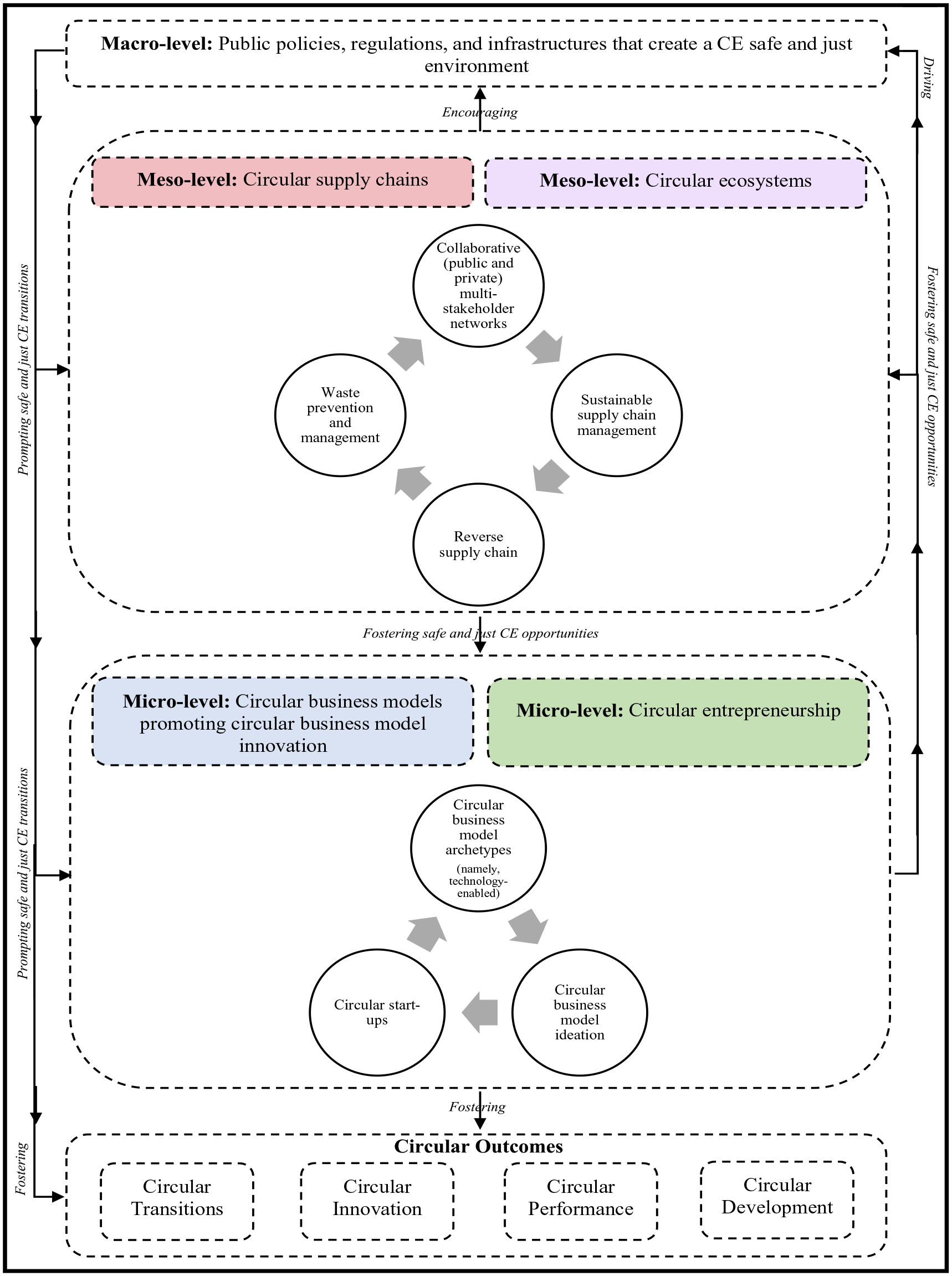
Integrative multi-level framework on start-ups and EE in CE for safe and just planetary boundaries.
The integrative multi-level framework aims to advance the understanding of the interconnections at the macro– (public policies, regulations and infrastructure that create a CE supportive environment for safe and just resource use and consumption)–meso (circular supply chains and circular ecosystems)- micro (circular start-ups and circular business models) levels that prompt the transition to CE considering safe and just planetary boundaries (Rockström et al., 2023). Transitioning to CE within safe and just planetary boundaries implies accentuating the interconnections safeguarding the earth’s system functions and its ability to support humans and all other living organisms at the same time so that future and present generations are protected from harm (Rockström et al., 2023). These interconnections are closely inter-related and undergo constant evolution to shape socio-ecological-economic systems that respond to society’s pressing needs and restore the integrity of the biosphere.
For the macro-meso and macro-micro interconnections, public policies, regulations and infrastructures prompt safe and just transitions to CE by developing incentives and guidelines for CE influencing the development of circular supply chains, circular ecosystems and circular entrepreneurship/start-ups addressing (more) social and environmental challenges; this is a transversal notion through the main themes identified. The macro-meso interconnections consider the influence of public policies and regulations in the national/regional/local contexts of circular supply chains and circular ecosystems, addressing safe and just planetary boundaries and prompting transitions to CE. Public policies and regulations are designed considering industries and societies and addressing CE barriers impeding the decoupling of resource use and economic growth through circular supply chains and circular ecosystems (e.g. regulating the use of synthetic chemicals and supporting water based chemicals). This is particularly relevant since societies face grand environmental and social sustainability challenges when considering safe and just planetary boundaries. Public policies and regulations reflect a close consideration of the national/regional/local contexts to prompt circular supply chains and circular ecosystems doing more good than less bad, thereby aiming at climate positive. Furthermore, extant literature underlines that the macro–micro interconnections refer to how public policies and regulations on CE strive to address CE barriers for the successful development of circular start-ups and the transitions towards CE.
Therefore, we suggest examining circular start-ups working with specific safe and just planetary boundaries (e.g. innovation diffusion about freshwater infrastructure or biodiversity restoration to prevent enhanced migration). Research can also address public policies and regulations seeking to remove CE barriers and prompting CE start-ups to develop opportunities that address circularity in consideration of the physical limits on resources (e.g. the loss of biodiversity, the potential collapse of freshwater or the affectation of ocean ecosystems), the technical challenges (e.g. resource reuse and related knowledge to sustain and recover native plants and eroding land or promoting human well-being) and the inclusion of justice criteria (e.g. minimising harm from firms in one country/region to another or supporting indigenous people) through appropriate mechanisms (that account for contextual factors and enable CE agendas). In this sense, public policies and regulations play an essential part in prompting (circular) industry standards for successful CE transitions through circular start-ups. The CE policy prompts social and environmental opportunities that (circular) entrepreneurs can leverage to advance the CE agenda. Ultimately, public policies and regulations are essential for prompting CE opportunities fostering circular outcomes of the CE system.
At the meso-macro and meso-micro levels, we observed multi-level interconnections within circular supply chains (a prevailing theme in the Red Cluster) and circular ecosystems (a central topic in the Purple Cluster), fostering CE opportunities. When it comes to the meso–macro interconnections, literature portrays the influence of collaborative public and private multi-stakeholder networks (including businesses, social enterprises, governments, cooperatives and NGOs) as critical in encouraging public policy and regulation for CE agendas in the national/regional/local contexts. In CE’s context, circular supply chain evolves through symbiotic networks and reverse supply chains (e.g. assuring collaborations that convert food waste into soil nutrients restoring forested land). The articulation of circular supply chain helps fostering CE opportunities that minimise harm, support biodiversity, restore ecosystems and consider inequalities, which in turn encourage the development of public policies for safeguarding the Earth’s functions and its ability to support humans and other living organisms.
Thus, waste prevention and management are pivotal areas for encouraging public policies on transitions to CE that account for distributive justice (Kaufman, 2012), requiring networks of (public and private) multi-stakeholder collaborations across sectors and communities (e.g. certain countries will no longer accept exports of metal waste). For the meso–micro interconnections (public and private), multi-stakeholder collaborations occur through (digital) platforms, supply chains and (symbiotic) networks, fostering the emergence of circular start-ups nurturing circular flow opportunities as critical components, as highlighted by extant research (namely, that in the Red and Purple Clusters). Accordingly, these (new) circular (eco)systems require (circular) start-ups and (circular) business model innovation; thus, CE opportunities and outcomes are fostered (for instance, starts-ups dedicated to the inclusion of people with different backgrounds by hand to the increase of the biodiversity in circular ecosystems).
For the micro–macro and micro–meso interconnections, literature portrays important influences from business model innovation (the Blue Cluster) and circular entrepreneurship (the Green Cluster). For the micro–macro interconnections, circular business models and the resulting circular business model innovation are fundamental CE drivers for developing public policies and regulations. In this sense, circular business model ideation could provide fundamental contributions in CE within safe and just planetary boundaries for developing opportunities – coin ideas, experiment with prototypes and defining markets – which drive the development of public policies and regulations, for instance regarding social and environmental sustainability issues based on the needs of societies while regenerating the biosphere. For the micro–meso interconnections, circular start-ups foster opportunities nurturing circular supply chains and circular ecosystems when safe and just boundaries are addressed, for instance, indigenous people foster opportunities incorporating their wisdom on the connections between nature and communities or unemployed migrants help in coining solutions decoupling resource use and economic growth while being integrated into the labour market.
Finally, across all the research themes identified, scholars underline CE’s potential in fostering circular outcomes, which we argue are relevant for addressing safe and just planetary boundaries. Thereby, transitioning to CE within safe and just planetary boundaries requires incorporating (more) social and environmental sustainability in innovations and performance and, specifically, investigating how it could provide significant results for all the (public and private) stakeholders involved in CE and, ultimately, for addressing social and environmentally sustainable grand challenges threatening the earth system’s stability and human well-being.
Research agenda and implications
Following the in-depth systematisation of the main themes identified in literature, Table 3 presents an agenda for future research based on the macro–meso–micro interconnections between start-ups and EE in the context of CE for safe and just planetary boundaries (Rockström et al., 2023). The research agenda leverages the findings from the review to suggest future research paths on the multi-level interconnections prompted by start-ups and EE for transitioning towards CE, considering social and environmental sustainability and just and safe close-loop production patterns. Table 3 introduces potential RQs exposing multi-level combinations that can help us understand transitions to CE and CE as a socio-ecological-economic system better. Addressing the multi-level interconnections is key to moving from individual to collective climate positive action and examining the directionally of the interconnections, that is, top-down or bottom-up.
Agenda for future research.
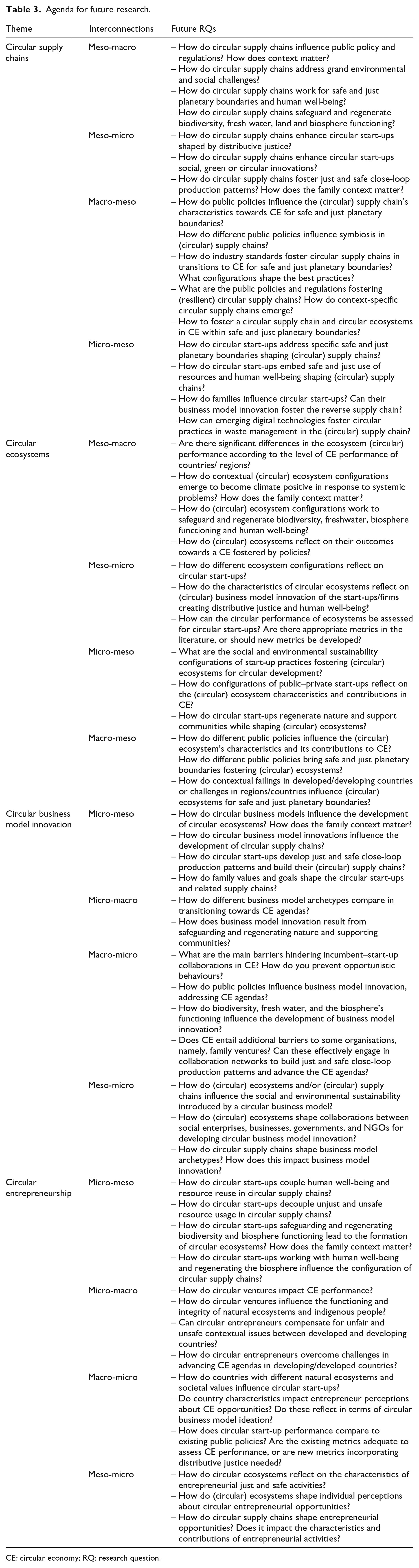
CE: circular economy; RQ: research question.
The comprehensive multi-level approach employed, that combined bibliometric and content analyses, addressed the RQ that motivated this review: ‘What key paths can be explored to advance the interconnections between start-ups and EE that prompt transitions towards CE?’ Accordingly, this study systematically reviewed literature on start-ups and EE in the context of CE based on a sample of 90 articles collected according to strict research steps (Tranfield et al., 2003). Following the bibliometric (Cobo et al., 2011) and content (Hassan et al., 2023; Wu et al., 2020) analyses, this study furthers knowledge on the macro–meso–micro interconnections prompted by start-ups and EE for transitioning towards CE, bridging a critical gap in literature by connecting with the planetary boundaries (Richardson et al., 2023).
An analysis of the descriptive data shows the research profile of literature on the topic. As portrayed by the yearly evolution of the publications, this is an emerging field, with the research being published from 2016 onwards stirring growing interest among scholars, as attested by the annual growth rate of 72.12% in the pattern of publications. In terms of the most influential articles both in terms of total citations and total citations per year, the review by Geissdoerfer et al. (2018) stands out. The articles by de Angelis et al. (2018), Tura et al. (2019), Jabbour et al. (2019), Leising et al. (2018), Todeschini et al. (2017) and Guldmann and Huulgaard (2020) are also of extreme influence, standing out in both indicators. All these influential articles have been published within the last six years, which also attests to a rapidly emerging field of research. The 90 articles included in the review resulted from 44 distinct sources. Outlets related to research on sustainable systems of production and consumption and related environmental issues stand out, including the Journal of Cleaner Production (30 published articles), the Business Strategy and the Environment (eight published articles) and the Resources, Conservation & Recycling (four published articles). These are the most productive on this topic. As to the methods used in the articles, qualitative approaches (mostly the case study methodology) stand out as the most common method (applied in 47 articles, corresponding to 52% of the sampled articles), further reinforcing that this is still a developing research topic (Kraus et al., 2020).
The bibliographic coupling of document analysis (Kessler, 1963) clustered the articles according to the main themes – Circular Supply Chains (Red Cluster), Circular Ecosystems (Purple Cluster), Circular Business Model Innovation (Blue Cluster) and Circular Entrepreneurship (Green Cluster). These are related research themes, as portrayed by the integrative multi-level framework of literature on start-ups and EE in the context of CE in consideration of safe and just planetary boundaries (Figure 5). The integrative multi-level framework advances our understanding of the macro (public policies, regulations and infrastructure that create a CE supportive environment for responsible resource use and consumption)-meso (circular supply chains and circular ecosystems)-micro (circular start-ups and circular business models) interconnections that influence the transition to CE. In line with this, Table 3 highlights future promising research avenues for studying the multi-level interconnections prompted by start-ups and EE working with just and safe close-loop production patterns and supporting the biosphere and human well-being (Richardson et al., 2023).
This study carries significant implications for theory, policies and practices. The study contributes to literature by integrating the macro-meso and micro-levels and addressing the directionality of the interconnections in our proposed framework (see Figure 5). In the framework, top-down interconnections are equally important as bottom-up interconnections. These interconnections shape CE as a socio-ecological-economic system, that is, the framework promotes the reconnection of the biosphere, societies and firms through safe and just close-loop production patterns. Hence, the multi-level framework contributes to literature by emphasising the need to better understand the theoretical causation between the macro-meso and micro-levels (Dzhengiz et al., 2023; Ghisellini et al., 2016). Multi-level research allows bridging discrepancies between a single-level explanation of the CE context. A focus on the macro-meso-and micro-levels moves the overall discussion from a fragmented discussion of CE’s separate pillars (i.e. either the macro-meso-or micro-level) to interconnections between these levels. Such a focus embraces a system-based rationale allowing us to link social with environmental challenges. Furthermore, the proposed research agenda (Table 3) leverages the findings from the review to suggest future research avenues on the multi-level interconnections between start-ups and EE and considers (more) social and environmental sustainability for safe and just planetary boundaries. We argue that addressing the multi-level interconnections is crucial for moving from individual to collective climate positive action, examining the directionally of the interconnections (top-down and bottom-up) and understanding transitions towards CE.
This study underlines CE’s potential and the role of start-ups and EE for policymaking (despite the scant research). Literature underlines barriers to developing CE and the central role of public policies that prompt CE agendas supporting the integrity and regeneration of the biosphere while supporting the development of inclusive societies and human well-being. In this sense, tailor-made contextual policies that prompt CE systems at the macro-level and account for the meso-(circular supply chains and circular ecosystems) and micro-(circular firms, namely, circular start-ups and circular entrepreneurs) levels are needed. Such policies must acknowledge the interplay between the multi-stakeholder collaborations with the biosphere required for fostering just and safe close-loop production patterns supporting the biosphere and human well-being. Policies, thus, encompass the public and private sectors and goes beyond value chains and industries to include the biosphere and human well-being. Developing CE requires systemic changes considering social and environmental sustainability (World Economic Forum, 2022; Wiesmeth, 2020), and therefore, systemic approaches in the service of safe and just futures are needed (Rockström et al., 2023).
This study has several implications for practitioners. The review highlights the importance of multi-stakeholder collaborations in the context of CE. Therefore, stakeholders from the public and private sectors need to consider their role in fostering CE agendas for sustainable development and fully engage in collaborative networks that translate into symbiotic interactions and circular outcomes safeguarding the biosphere and human well-being. Managers from incumbent firms need to consider (re)designing their climate positive business models to leverage the opportunities prompted by CE and shape circular business model innovation conducive to safe and just close-loop production patterns. In this sense, literature underlines the potential of incumbent firms – start-up collaborations. For entrepreneurs of circular start-ups, CE presents opportunities for developing circular business models and circular supply chains that foster circular outcomes addressing social and environmental sustainability from their inception. In this sense, circular start-ups, new circular supply ecosystems and circular EE can be central in fostering circular development, an area that, nevertheless, requires further studies, political support and multi-stakeholder collaborations.
Despite the implications provided, the conducted SLR is not without limitations. The first limitation is the constraint of the review itself, drawing from varying sources with no time restriction, which could result in subjective findings. To the best of our knowledge, we analysed valid research based on the literature review. Hence, although the SLR followed the three-stage-process with bibliometric and content analyses, the applied research protocol can carry unintended bias, resulting in the exclusion of some studies on the topic. Second, contextual aspects of the interconnections were not examined in detail, and contextual aspects feature CE systems. Such contextuality can influence, for instance, an enhanced focus on social sustainability issues like poverty, inequality and social injustices as compared to environmental sustainability (or vice versa). As such, future research could investigate the contextual aspects of the interconnections. This will support a more comprehensive understanding of the macro-meso- and micro-levels.
Footnotes
Declaration of conflicting interests
The author(s) declared no potential conflicts of interest with respect to the research, authorship, and/or publication of this article.
Funding
The author(s) disclosed receipt of the following financial support for the research, authorship, and/or publication of this article: «NECE-UBI, Research Centre for Business Sciences, Research Centre and this work are funded by FCT – Fundação para a Ciência e a Tecnologia, IP, project UIDB/04630/2020».«Ana Joana Candeias Fernandes acknowledges the financial support from Fundação para a Ciência e a Tecnologia, I.P. (FCT) under the PhD Research Studentship 2021.08043.BD».
