



Abstract
Transitioning from a linear economy to a circular economy (CE) supports the realisation of societal values towards more sustainable development. This article identifies mechanisms by which circularity can be embedded in entrepreneurial ecosystems (EEs) through the flow of relevant knowledge and values. It presents a dynamic model that illustrates how reverse knowledge spillovers from entrepreneurs can complement traditional technological knowledge spillovers from incumbents, ultimately advocating for CE values and validating circular knowledge. The validated circular knowledge, in turn, alters the knowledge filter of incumbents, leading to shifts in their research and development (R&D) focus and their willingness to embrace new knowledge. This symbiotic relationship of knowledge spillovers between circular start-ups and incumbents can significantly enhance the motivation of participants in EEs to adopt CE values and leverage circular knowledge. Overall, the article shows how knowledge spillovers can facilitate a wider adoption of circular knowledge and CE values within EEs.
Introduction
To promote start-ups, research on entrepreneurial ecosystems (EEs) has gained popularity. Stam and Spigel (2018: 407) defined an EE as ‘a set of interdependent actors and factors coordinated in such a way that they enable productive entrepreneurship within a particular territory’. The literature highlights that regional performance is shaped by collaborative network relationships and mutual dependencies. A regional EE links entrepreneurial start-ups with established firms, incubators, universities and other actors, lubricating knowledge flows among them (Brown and Mason, 2017; O’Connor et al., 2018) and making embedded firms more innovative. Knowledge is key to enacting new opportunities. Focusing on knowledge driven by large, established firm’s research and development (R&D), the knowledge spillover theory of entrepreneurship (KSTE) suggests that in an EE, knowledge is exploited by more than its creators; conversely, actors typically fail to exploit all their knowledge. It is important to note that the KSTE generally emphasises that technological knowledge is only one type of knowledge, albeit an important type. As the name suggests, the theory refers to all types of knowledge. Notably, large firms filter out knowledge items they deem unworthwhile. These spill over to entrepreneurs, who commercialise unexploited external knowledge (Acs et al., 2010; Audretsch and Keilbach, 2007) by creating entrepreneurial start-ups. Spillovers create new opportunities, facilitating economic growth (Acs et al., 2013a) and knowledge-based competition (Mack and Mayer, 2016), reinvigorating the ecosystem.
An ecosystem perspective is suitable for understanding the transition towards a more circular economy (CE) (Kanda et al., 2021). However, EEs are under-theorised when applied to sustainable entrepreneurship in general (Volkmann et al., 2021) and circular start-ups specifically. With circularity emphasising the reuse, repair, reconditioning and recycling of resources, aspiring to zero waste via a ‘closed loop of materials flow in the whole economic system’ (Geng and Doberstein, 2008: 232), CEs can foster environmental sustainability. Unlike the conventional, linear industrial model of ‘take–make–dispose’ production and consumption, CEs are closely linked to sustainable production and consumption and to sustainable business and value creation (Henry et al., 2021). It must also be noted, however, that circularity might not always enhance sustainability. For example, CEs could exacerbate the effects of climate change by setting incentives to transfer resources across distant regions (Skene, 2018) and maintaining a focus on primary production (Zink and Geyer, 2017).
Despite some concerns, the transition to a CE is underway. In 2020, aiming to enable more sustainable growth by preventing waste and achieving more sustained usage of resources through a mix of legislative and non-legislative measures, the European Commission adopted a ‘Circular Economy Action Plan’ (European Commission, 2020). In addition, several governments – including the Chinese (Mathews et al., 2018) and Finnish (Marjamaa et al., 2021) governments – have made the CE an integral part of their government programmes, committing resources and changing regulations to enable the transition towards a CE. Ultimately, the shift of policy ambitions towards a CE will trigger change in the various industries and sectors targeted by these programmes, including electronics and Information and Communications Technology (ICT), packaging, textiles, construction and buildings, and food (European Commission, 2020). Given the wide range of sectors involved, this shift will inevitably affect EEs embedded in the European Union and beyond. Although the EE in the linear industrial mode – driven by technological knowledge and economic value creation – is still followed by most existing firms, a transformation of ecosystems can be expected, with circular knowledge and competencies becoming increasingly relevant, as stipulated by policy regime changes.
However, the mechanisms whereby EEs can transition to circularity are unclear (Konietzko et al., 2020). Major challenges exist (Ghisellini et al., 2016). To achieve the ambition of policymakers, actors must align their knowledge and synchronise activities. Eradicating waste in production requires new and freer-flowing knowledge about frugal resource use (Niroumand et al., 2020) as well as much wider adoption of circular business models (Snihur and Bocken, 2022). As a result, we shift the focus from how changes in policy can force and incentivise large, established firms to better incorporate circularity in their global supply chains to entrepreneurial start-ups. It has been argued that entrepreneurial start-ups are in a better position to adopt business models based on circular knowledge and practices. This is because they do not face sunk costs resulting from legacy investments in old technology, practices and knowledge relevant to a traditional production model in a linear setting (Henry et al., 2020).
Aligning to CE values requires firms to change their knowledge filter towards circular opportunities. We label circular knowledge as the knowledge necessary for recognising and exploiting a CE opportunity: notably circular business models and practices and frugal resource use. Large, established global firms rarely carry out radical circular business model innovation (Bocken et al., 2017). This is because they can be rigidified by hierarchy, organisational inertia, aversion to uncertainty, legacy investments and shareholders pressing for financial returns (Bocken and Geradts, 2020; Bocken et al., 2017). At the same time, because they have extensive insights and control over their supply chain, as well as opportunities for scalability, adopting circularity may also advantage established firms. Circular knowledge is often embraced by start-ups to achieve a competitive advantage. Indeed, entrepreneurs might be central to tackling environmental degradation (Pacheco et al., 2010) and adopting circularity. Entrepreneurs weigh implications for nature and multiple other stakeholders and can trade off purely financial goals, which dominate linear logic, with the wider social and environmental values (Anand et al., 2021) of a CE. Entrepreneurial start-ups also make purposeful use of resources – for example, by innovating frugally (Prabhu, 2017). Thus, attention has turned to entrepreneurs as change agents to disrupt linearity (Muñoz and Dimov, 2015).
Questions persist as to how the commercial enactment of circular knowledge and CE values can gain wider and lasting uptake – let alone trigger ‘the next industrial revolution’ (Cohen and Winn, 2007: 30). Some argue that entrepreneurs can challenge power structures (Veleva and Bodkin, 2018) precisely because they can adopt disruptive and circular business practices and models (Hockerts and Wüstenhagen, 2010) better than most legacy firms. However, others counter that entrepreneurs who introduce circular business models often cannot scale (Kanda et al., 2022b). Worse, established firms defending their position (De Clercq and Voronov, 2011) with hard power might not only withhold cooperation but stifle upcoming entrepreneurs (Audretsch and Fiedler, 2023b). For policymakers to accelerate and embed CE transitions into EEs, researchers must first understand how these would enact the paradigm shift. As per Konietzko et al. (2020), however, we lack an understanding of the mechanisms whereby circular knowledge and CE values enter an EE and might spill over between its actors. More specifically, we do not know how entrepreneurship can be a catalyst for introducing, enacting and entrenching circular knowledge and CE values in EEs. Thus, this article addresses the following research questions: (i) How do circular knowledge and CE values enter the EE? (ii) How exactly does this knowledge spill over, particularly between entrepreneurs and legacy firms? (iii) How could spillovers facilitate a wider adoption of circular knowledge and CE values within EEs?
The purpose of this article is to theorise how knowledge spillovers can contribute to and help accelerate the development and adoption of circular knowledge within EEs. Our approach is to adapt an integration of KSTE with EE theory to the circular context. The article illustrates how entrepreneurship contributes to circular knowledge and the embedding of CE values in an EE. The starting point is that societal values are shifting. In the past, societies put a strong emphasis on economic value related to material well-being. However, more recently, the importance of social values, such as happiness, diversity and inclusion, as well as ecological values, which relate to the well-being of the planet, have been highlighted. Societal values encompass shared norms and principles about how resources and technology should be used to advance well-being. In this vein, Ostrom (2010) argued that society needs to recognise the value of common-pool resources of nature for humans. Although the emphasis of these values varies with context, there is a consensus in society that a better balance is needed between economic, social and ecological values to address pressing issues related to climate change (Jacobs and Mazzucato, 2016). To achieve this balance with regard to ecological value, a stronger emphasis on circular knowledge is needed to complement technological advancements.
Entrepreneurs launching circular start-ups are endogenous change agents who encourage other actors to embrace and enhance circular knowledge with their own complementary knowledge. Entrepreneurs translate societal values into commercial opportunities by innovating and validating circular business models through their start-ups. In particular, circular start-ups exploit underutilised material and energy resources from incumbents for value creation. In the linear economy, material and energy waste is often referred to as market failures and negative externalities. However, in the CE context, circular start-ups can reduce such negative externalities by closing the loops of incumbents through innovative business models (Grafström and Aasma, 2021; Kanda et al., 2022a). Hence, both traditional knowledge spillovers and the spillovers of externalities from incumbents are critical for creating CE opportunities for start-ups.
However, we also argue that reverse knowledge spillovers from entrepreneurial start-ups to incumbents accelerate the advancement of circular knowledge and CE values. Viewing innovative circular business models as both a threat and opportunity, the knowledge filter of established firms may start to erode, enabling their re-evaluation of waste. They may accept circular knowledge and lend their complementary market and process knowledge as well as their R&D capabilities to scale up circular business models, including in collaboration with entrepreneurial firms. We further argue that collaborations can be sustained and protected against acquisition by interlocked value creation, potentially across industries and regions, potentially protecting the EE from hardening into a business ecosystem.
The article is structured as follows. First, we integrated the literature on EEs and KSTE as a theoretical foundation centred on flows of various knowledge types, such as market and R&D knowledge. The heart of the article is in the following section. There, we developed four propositions related to mechanisms that support a wider adoption of circular knowledge and CE values within EEs. Then, we tabulated multiple dimensions of the difference between linear and CE ecosystems. Next, we developed a dynamic model describing the role of entrepreneurs in the transition of ecosystems towards adopting more circular knowledge and practices. The model shows how entrepreneurs, as key agents of change, enact shifting societal values through innovative business models and practices, leading to reverse knowledge spillovers. These reverse spillovers erode the knowledge filter of the ecosystem, including established firms, enabling these firms to shift towards more circular practices. Importantly, this facilitates established firms investing in R&D related to the CE needed for scalability. Finally, we discussed the key theoretical contributions of our model, limitations and future research opportunities before a short conclusion.
Integrating the KSTE into EEs
This review section integrates KSTE into the EE literature. For simplicity, our setting is the linear economy. EEs are shaped by regional system-level factors, including culture, policy and social or political institutions (Audretsch and Belitski, 2017). They involve multiple actors, from entrepreneurs, established firms, incubators and intermediaries to universities and research institutions (Audretsch and Link, 2019; Brown and Mason, 2017), dealmakers and financial entities (Spigel and Harrison, 2018). Value creation and ecosystem performance rely on actors and institutions interacting. Firms can better access and create value from external knowledge from nearby entities (Spigel and Harrison, 2018). Furthermore, the EE concept is often used to explain start-up growth in specific sub-national regions (Brown and Mason, 2017).
Positing that knowledge flows more freely in EEs, EE literature sees entrepreneurship as central to transforming and commercialising knowledge (Cantner et al., 2021). Integrating KSTE (Audretsch and Keilbach, 2007) identifies knowledge flow mechanisms within an ecosystem. KSTE centres on technological knowledge, entrepreneurs and established firms. Similar to Spigel and Harrison’s (2018) coverage of external knowledge in ecosystems, KSTE contends that R&D-poor start-ups mainly exploit opportunities from knowledge outside them (Audretsch et al., 2021). KSTE adds the knowledge filter concept: in pursuing their strategic goals, established firms consciously or subconsciously filter out some knowledge they create through R&D and other sources as holding no commercially worthwhile opportunities. Thus, an entity’s knowledge filter represents the gap between the knowledge available to it and the knowledge it commercialises (Acs et al., 2013b). Each actor has a filter. KSTE posits that incumbents, bound by legacy investments, shareholder expectations and top-down management, have a different knowledge filter than entrepreneurs. A societal knowledge filter also affects what type of knowledge is generally regarded as (non)commercialisable (Audretsch and Fiedler, 2023a).
Importantly, KSTE shows that exploiting new knowledge is not only a question of firm capabilities but also one of choice. It highlights that knowledge sieved out by established firms spills over to entrepreneurs who see in it commercial opportunities for themselves (Acs et al., 2010). Entrepreneurs also access external knowledge by actively collaborating with other ecosystem actors, such as customers, suppliers and universities (Audretsch et al., 2021). This article follows common usage in calling all such flows spillovers. Entrepreneurs then use this knowledge for new venture creation. Additionally, Qian and Acs (2013) have pointed out that whether entrepreneurs see the value of external knowledge and successfully commercialise it depends on their entrepreneurial absorptive capability. Entrepreneurs can strengthen this capability by investing in internal R&D and assimilation capacities and their own scientific and market knowledge. Overall, knowledge spillovers are facilitated by external collaboration and internal investment in knowledge.
Some important qualifications to the KSTE need to be emphasised. Firstly, entrepreneurship is only one of many conduits for the spillover and commercialisation of knowledge into innovation. Other, often overlooked, spillover modes include cooperation, agreement among companies and labour mobility (Audretsch and Keilbach, 2005). A second qualification is that the knowledge filter impeding the commercialisation of knowledge by established firms is not at all a given. Established firms can undertake dedicated strategies to harness the knowledge they create and transform it into innovation (Bogner and Bansal, 2007). Thirdly, context matters. The magnitude of the knowledge filter – and, therefore, the potential for KSTE – is undoubtedly shaped by institutional context (Audretsch and Belitski, 2017). Finally, traditional knowledge spillover often focuses on technological knowledge and does not sufficiently explain the processes of how new knowledge is created (Qian and Acs, 2013).
An ecosystem’s knowledge goes beyond scientific and technological knowledge. In addition to scientific knowledge informed by R&D, established firms know markets and, concomitantly, how to scale. The ecosystem perspective stresses multi-factor links, offers the importance of place as a source of knowledge and its valuation and proposes processes of evolution (O’Connor et al., 2018). In addition to knowledge in established firms, entrepreneurial process knowledge matters (Spigel and Harrison, 2018). Key sources include serial entrepreneurs and investors who champion or mentor start-ups. These dealmakers affect entrepreneurial performance and ecosystem connectivity (Pittz et al., 2021). Similarly, intermediaries such as incubators help collaborators access resources (Bank et al., 2017; Kanda et al., 2022b). Universities are another key source for knowledge spillovers within an ecosystem (Link and Sarala, 2019). Thus, although technological knowledge is crucial, other forms of knowledge – such as business and regulatory knowledge and market insights – are equally important for entrepreneurs, and there is an opportunity to extend the theory to non-technological knowledge.
KSTE emphasises that ecosystems must efficiently support knowledge flow for value creation (Audretsch et al., 2019; Audretsch and Link, 2019). Braunerhjelm et al. (2010) have argued that economic growth depends on the knowledge stock and its diffusion by entrepreneurial and established firms. Even flows not yielding commercialisation can foster new firm creation and the evolution of entrepreneurial firms with absorptive capacity. Human capital also transmits knowledge as employees move from established firms to spin-off subsidiaries, their own spinouts or entrepreneurial firms (Cantner et al., 2021). Over time, EEs evolve, requiring a dynamic, process-based model (Brown and Mason, 2017). Some authors propose a lifecycle model. Typical versions suggest three or four ecosystem phases. These are labelled, for instance, (i) ‘birth’, where structures and entrepreneurship emerge; (ii) ‘transition’ or ‘growth’, marked by knowledge spillovers, networking and faster firm birth and (iii) ‘consolidation’, ‘maturity’ or ‘sustainment’, where surviving actors embed deeply into the context (Cantner et al., 2021; Colombelli et al., 2019). In a possible fourth phase, (iv) ‘decline’, entrepreneurship loses support (Mack and Mayer, 2016).
Thus, entrepreneurial and more settled business ecosystems may be subsets of a regional ecosystem (Cantner et al., 2021). The EE is dominant in the birth and growth phases of a technology regime. Knowledge is mainly commercialised via entrepreneurial ventures and new firms spring forth. In maturity, established firms drive knowledge commercialisation via intrapreneurship. They acquire entrepreneurial firms and new firm creation slows. The decline phase completes the regional economic ecosystem’s transition to a business ecosystem – traditional firms dominate. However, an EE can re-emerge through a new technological regime, starting a new lifecycle (Cantner et al., 2021). Thus, EEs can be revived by technological advances sowing new entrepreneurial opportunities (Mason and Brown, 2014). These attributes demand adaptation and renewal. They also require a mix of actors, including large firms, to diversify and expand the knowledge stock (Ryan et al., 2021). Next, we explored how knowledge spillovers can support a wider adoption of circular knowledge and CE values within EEs.
Circular knowledge, values and spillovers in EEs: A model
New societal values and the transition of EEs towards more circular knowledge and practices
Because values guide which opportunities are worth pursuing and by whom, they are key to the CE context. We link knowledge to values in several ways. Firstly, value proponents may supply knowledge; non-government organisations (NGOs) advocating circularity might propose circular solutions. Secondly, and critically, an actor’s assessment of the commercial worth of knowledge decides their filter – once they value circular knowledge, their filter erodes to embrace it and they also may produce more such knowledge. An important distinction is that whereas performance goals and criteria are exogenous in the traditional linear model, goals and criteria in the CE are endogenous – the ecosystem’s stakeholder sets them. Baumol (1990) has argued that entrepreneurial outcomes range from productive to unproductive – activities of questionable value to society, such as rent-seeking – and, finally, downright destructive. Adopting Baumol’s (1990) division of entrepreneurial outcomes into productive, unproductive and destructive, scholars have argued that entrepreneurial activities can create or destroy societal value (Acs et al., 2013b), such as quality of life (Zahra and Wright, 2016). The CE focuses on the effects of commercial activities on societal value, specifically ecological value, as critical to the quality of life of future generations (Patwa et al., 2021).
In the CE, new knowledge and values that can inform firm an actor’s endogenous choice of goals originate exogenously from society and institutional actors, including the state, markets and other institutions. The World Economic Forum and the Ellen MacArthur Foundation, for instance, expound CE values (Esposito et al., 2017). Likewise, some charities, think tanks such as the Institute of Circular Economy, intergovernmental bodies such as the Organisation for Economic Cooperation and Development, NGOs and lobby groups, move societal values towards circularity and supply circular knowledge. Similarly, universities not only solve problems technically but also prioritise them based on subjective values. Currently, university creation and dissemination of knowledge and values support ecological values (Tasdemir and Gazo, 2020), underpinning a circular system. Whereas poor public participation threatens the CE (Geng and Doberstein, 2008), new knowledge and values emerging from the above sources both advance societal values towards sustainability and widen entrepreneurial opportunities to compete in accordance with circular business models. Such changes are shifting consumer demand, public education and entrepreneurial awareness and support. A community desire for a more sustainable ecosystem is a meta-enabler for change, facilitating partnerships between larger businesses and entrepreneurs for corporate venturing or spin-offs and developing shared visions for achieving a scale of circular business models (O’Shea et al., 2021). This paradigm shift erodes the societal knowledge filter vis-à-vis circular opportunities.
Two key aspects of societal values that affect EEs and the viability of opportunities are the state and changes in market demand. Regarding the state’s influence, we consider a highly directive state as an example. Chinese policymakers have embraced the CE concept (Mathews et al., 2018). Yuan et al. (2006) illustrated how China’s central State Environmental Protection Administration initially set guidelines for creating eco-industrial parks, improving waste recycling systems across different projects between 1999 and 2002. These projects grew circular knowledge, a focus on promoting new, CE-oriented technology and a more targeted industry policy. During the transition, researchers and industry professionals from various disciplines advanced China’s understanding of a CE (Yuan et al., 2006) and created new knowledge. Policy initiatives ensued, such as targets for the reuse of waste materials (Mathews and Tan, 2016). Pilot programmes sought to transform industrial parks into eco-industrial parks (Mathews et al., 2018). Public policy promoted network governance for parks to facilitate multi-firm cooperation, fostering collaborations among established firms, new ventures advancing circularity (Mathews and Tan, 2016) and several greening spin-offs from state-owned enterprises led by former employees (Mathews et al., 2018). Thus, the central government, as one embodiment of society, can be a change agent, eroding the knowledge filter of both established firms and entrepreneurs through green values (Tan et al., 2021). Evidence from Australia and Sweden shows that local governments can reinforce change by, for example, investing in infrastructure to recover and reuse waste and setting incentives for circular innovation (Bolger and Doyon, 2019).
Market demand influence is more diffuse and organic than state policy but acts as another mechanism that brings exogenous values from society to bear on how entrepreneurs use knowledge. For instance, concerns about pollution and other negative externalities of the fashion industry’s traditional business model have elicited sustainable fashion, including recycled and reused clothing (Pal and Gander, 2018). Celebrities such as former footballer David Beckham and actress Sienna Miller have helped create both opportunities for sustainable fashion entrepreneurs (Ryding et al., 2017) and business models (Pal and Gander, 2018). If changing market values translate into willingness to pay a green premium, then circular knowledge and business models that were cost-inefficient in a linear growth model will promise a commercial opportunity. Societal values ultimately drive market value. Overall, in the CE, shifts in societal values create new entrepreneurial opportunities in an ecosystem. Hence, we formulate our first proposition:
Proposition 1. New societal values of circularity erode the filter to CE opportunities in an EE.
Spillovers of circular knowledge and CE values from entrepreneurs back to large firms
How do CE values transmitted by state policy and market demand flow through an ecosystem? Despite rising demand for sustainable products, given their mandate to maximise economic value for investors without the risk of overhauling tried-and-tested linear models, established firms struggle to develop and implement circular business models (Bocken and Geradts, 2020). Managerial decision-making, especially in listed companies, favours financial performance measures, notably profitability and productivity. If, for example, pro-CE policy and regulatory settings mandate using recycled materials that are dearer to process than virgin resources (Geng and Doberstein, 2008), economic and sustainability values will clash. In this vein, Bocken et al. (2017) empirically found that although large global firms managed and recycled their waste, they seldom embraced radical circular business model innovation. Thus, although large established firms invest in circular knowledge and embrace CE values – such as improving the recirculation potential of product life cycles, recycling initiatives and closed-looped supply chains (Mathews and Tan, 2016) – they may not fully exploit the full potential of circular opportunities.
In contrast, by being arguably freer from fiduciary obligations to shareholders, entrepreneurs can better balance the short-term trade-off between financial and environmental goals; they can be more values driven. Rather than maintaining a purely financial aim, the main goal for entrepreneurs might be doing good through environmental innovation (Parrish, 2010). That said, entrepreneurs must still make the opportunity commercially viable and stay competitive. Entrepreneurs can internalise the cost of circular business models if customers are willing to pay the green premiums alluded to earlier (Hockerts and Wüstenhagen, 2010). For example, entrepreneurial outdoor clothing retailer, Patagonia, Inc., illustrates circular business models, holistically applying circular principles, such as incorporating elements of ‘reduce, repair, reuse and recycle’ in production (Rattalino, 2018). Importantly, during the transition from entrepreneurial firm to a large player, Patagonia maintained their commitment to CE values. Valued at US$3 billion in 2022, the company defied expectations by scaling up to exceed a local niche. With stores and factories now in multiple countries, Patagonia demonstrates the economic viability of circular business models at scale. Rattalino (2018) has suggested that when such entrepreneurial leaders gain a sustainable competitive advantage, followers will emulate them, nudging the ecosystem towards sustainability.
Whereas ecosystems scholars highlight technological knowledge regimes, and KSTE stresses technological spillovers, a CE allows opportunities for knowledge of circular business models and how to innovate in them to spill over from entrepreneurs to other actors. We name spillovers of circular knowledge from entrepreneurs to established firms as reverse spillovers. In a CE, established firms wait until viability has been proven for CE practices. Such firms have made legacy investments that discourage them from adopting CE business models. In addition, their past values prioritising shareholder value creation might not be congruent with the shifting societal values, making them hesitant to embrace CE values. From a KSTE perspective, this suggests that the knowledge filter of legacy firms not only prevents them from utilising international knowledge but may prevent them from absorbing changing external knowledge and values. Conversely, entrepreneurs are the first adopters of new values and circular business models. For instance, Todeschini et al. (2017) labelled eight innovative fashion start-ups ‘born sustainable’. From the outset, these start-ups engaged new knowledge and technical expertise to minimise waste, such as turning discarded vehicle tires or other byproducts into high-quality fashion items or textiles. This unique knowledge spawned opportunities to partner with more established firms – for instance, as suppliers of sustainable corporate gifts or consultants on green products and solutions. In circular business models, technological knowledge serves CE ends, not simply cost efficiency and product functionality regardless of waste.
Coordinated efforts in the ecosystem from entrepreneurs and other actors might also alter whether firms perceive circular business models as scalable. For established businesses, circular business models may raise uncertainties about growth: will they scale or be held back by reliance on subsystems and certain inputs, and can they adapt to future changes in market preferences and technologies (Linder and Williander, 2017)? When ecosystem actors develop a shared understanding of sustainability issues and co-develop strategies to address them through sustainable business models, opportunities can arise to scale up (Derks et al., 2022). Such value possibilities should also thin the knowledge filter of established firms vis-à-vis CE opportunities. For instance, Pal and Gander (2018) demonstrated that even niche markets can be large if globalised, challenging arguments that radically circular business models in fashion cannot scale. We have already shown how Patagonia, Inc. defied similar predictions. The global niche strategy also defines hidden champions – companies with a dominant global share of their niche. Established firms have, in addition, embraced recycling input materials. For instance, North Face®, part of the VF Corporation, has set a target to derive 100% of its fabrics from responsibly sourced and recycled materials by 2025 (VF Corporation, 2022). The firm has also established local sourcing networks, partnering with sustainable suppliers (Cernansky, 2019) and rewarding cotton growers who farm regeneratively (Makinson, 2021). Furthermore, to tackle garment waste, North Face® is part of an international consortium that has developed a technology for recycling textiles for use in garment factories in Cambodia (Firn, 2021). Other initiatives include demand-driven production using digital technology. In allowing established companies, such as NikeID and Zara, to tailor their output to changing demands – and thus limit overproduction waste and cut CO2 emissions – this is another example of a technological advance serving an ecological end (Pal and Gander, 2018). This leads to our second proposition:
Proposition 2a. Established firms invest in circular knowledge to respond to exogenous societal pressure, growing the stock of circular knowledge.
Proposition 2b. Reverse spillovers from CE entrepreneurs endogenously erode the knowledge filter of established firms, spurring circularity.
Circular knowledge complementarities and sustained collaborations
We now turn from innovation to collaboration in EEs. As already suggested by Todeschini et al.’s (2017) examples of partnerships in the fashion industry and Derks et al.’s (2022) mention of co-developed strategies, the value shift to circularity affects how firms collaborate and, thus, collaborator knowledge agreements. Whether self-generated by firms responding to green consumer demand or encouraged or imposed by state policy, coordination and collaboration are integral to CEs and go beyond linear interdependency. That is, coordination and collaboration connect firms at different stages of resource flow and can loop waste and input flowback in ways that may not occur spontaneously. Crucially, circular resource flow requires integrating production processes through interlinkages and, ultimately, loops so that one firm creates value from another’s waste (Mathews et al., 2018). Hence, circular business models demand that firms reassess the value of both waste and continuous collaboration or coordination, often on several levels and, according to scholars such as Derks et al. (2022), among various actors. This multi-actor, multilevel approach departs from a firm-centric approach, a point already reflected in EE literature. In the CE, because waste producers work with waste users, this process typically creates value across industries and regions. Generally, start-ups create value in unrelated industries, some of which is consumed overseas (Askew, 2022).
Consider fisheries. Customarily, even when not simply discarded, fish waste is used for low value-added products such as fish meal, despite scientists showing opportunities in other industries for more innovative, high value-added products (Coppola et al., 2021; Desai et al., 2022). The use of fish meal keeps the resource in the same industry, fishing. One example rejecting this tendency is the privately led EE of Iceland’s ‘circular blue economy’, which seeks zero waste in the seafood sector. Today, Iceland uses some 80% of its catch versus 50% to 60% use in Europe. It has achieved this through innovative products, often made from byproducts, such as fish leather for high-end belts and wallets made from fish skin, medical products, cosmetics and marine supplements. This EE is enabled by the Iceland Ocean Cluster (IOC), whose Ocean Cluster House hosts an ecosystem of approximately 70 firms, including small and medium-sized enterprises (SMEs), entrepreneurial start-ups and large companies, giving access to investors, designers, marketing experts, scientists, technicians and other human capital (Sjavarklasinn, n.d.). The IOC was developed to facilitate circular projects, the sharing of knowledge on waste reduction among multiple firms and spin-offs. For example, Iceland’s most popular health and energy drink, the collagen-rich Collab, exemplifies collaboration between fisheries, researchers and investors in the same location but different industries: lifestyle beverages, not seafood (Sjavarklasinn, 2022a). Finally, the IOC links with other international clusters such as the European BlueBioClusters (Sjavarklasinn, 2022b) and North America’s Council of Great Lakes Governors (Iceland Ocean Cluster, n.d.). This example suggests that EEs in the context of the CE create new entrepreneurial opportunities by spanning industries and contexts, enabling new input‒output combinations. Because these new combinations are developed from technological knowledge spillovers between actors within a specific ecosystem, they are likely to have been overlooked in a traditional ecosystem.
In contrast to the IOC, a state-led coordinated transformation of the ecosystem towards a CE through government incentives and investments might attack the fish waste problem purely from an ecological perspective aimed at reducing waste at a large scale. It would not necessarily also try to extract more economic value through innovation, a hallmark of an entrepreneur-led ecosystem such as an IOC. The latter might achieve social, ecological and economic sustainability. Reconciling goals that way is more likely to shift wider values and provide proof of concept of a commercial opportunity. This would allow more diverse businesses, including established firms, to learn from entrepreneurs how to maximise the CE value of resources – entrepreneurs would reshape the knowledge filter of established firms and society.
As circularity highlights new forms of collaboration and coordination, knowledge spillovers are likely to be sustained through established firms continuing to work with small entrepreneurial ones in an ongoing symbiosis. Spillovers are likely to be two-way and deliberate. Partners might exchange or rely on each other’s complementary knowledge, such as large-firm market knowledge and system thinking for scale and entrepreneurial expertise in converting waste to inputs. In EE lifecycle terms, this dynamic could lead to a continuing EE rather than a business ecosystem. Although entrepreneurs and established firms in the linear economy depend on each other as collaborators to achieve mutual benefits, but pursue their own (growth) aims; thus, the collaborator value creation process in the CE is mutually dependent, affecting their aims and suggesting heightened benefits of coordination. For instance, if one business depends on the waste of another for production, then the amount of waste affects the production potential. Although the lifecycle of EEs in the linear model peaks and declines (Mack and Mayer, 2016), a sufficient ongoing symbiosis between established firms and start-ups could keep ecosystems in CEs entrepreneurial; thus, preventing them from hardening into business ecosystems. Entrepreneurial collaborators are also more likely to escape being acquired by established firms when in different industries or regions. The literature supports our reasoning that collaboration in CEs will probably be ongoing (Centobelli et al., 2020), supporting the partnering of entrepreneurs and established firms (Veleva and Bodkin, 2018) in ways that boost circularity. Hence,
Proposition 3. Two-way knowledge spillovers in the CE lead to sustained collaboration between established and entrepreneurial firms in an ongoing EE.
New values, large firm R&D strategy and scaling up circularity
Value shifts are also likely to erode the knowledge filter of other actors in an ecosystem, including the established firm’s knowledge filter. That is, sustainable values will affect human capital within an ecosystem. Human capital carries not only objective knowledge but also subjective values. It is also mobile and can increasingly switch employment according to value-based preferences. Research points towards a shift underway today in the attitudes of knowledge workers, where a firm’s environmental commitments, such as reducing waste and pollution, can affect the recruitment of technological talent (Martín-de Castro et al., 2023). Just as existing, experienced employees are seeking meaningful work, higher education institutions that create emerging human capital may urge circularity (Tasdemir and Gazo, 2020) and devise ways of achieving it through innovation. These complementary processes will further recast the knowledge filter in established firms towards circular business models. With the transition of EEs to the adoption of CE values and knowledge already underway, the values of investors – another important ecosystem member – are also shifting with entrepreneurs adopting sustainable business models to mitigate externalities. For example, Bocken (2015) found that sustainable venture capitalists support ventures that deliver triple bottom line benefits, including financial and environmental returns. Thus, even though an investment might underperform financially, sustainability-oriented ventures have attracted some investors who prize ecological value creation (Mansouri and Momtaz, 2022). Finally, as opportunities within the ecosystem widen, investment by established firms in relevant R&D will enable the scaling of circular business models and practices. For example, to improve the efficiency and cost-effectiveness of recycling certain materials, such as silicon photovoltaic modules, R&D investments are needed (Heath et al., 2020). However, because small firms may lack the finance or human capital to develop relevant technologies, it has been argued that public R&D investments are needed to support circularity (Garrido-Prada et al., 2021). If established firms start pursuing circular opportunities and invest in relevant R&D, some of this technological knowledge will spill over to entrepreneurs and, therefore, advance the development and adoption of circular knowledge within EEs. This yields our final proposition:
Proposition 4. Investments in human capital and R&D will interact in growing the shared knowledge stock about opportunities in the CE, resulting in the creation of conditions for scalability.
What is the distinct contribution of entrepreneurship in the transition of EEs for adopting circular knowledge and CE values more widely?
How EEs apply to CE is unknown (Konietzko et al., 2020) in the extant literature. We, therefore, developed propositions on how CE values enter an EE and by which mechanism relevant circular values and knowledge start to spill over between the actors within an ecosystem. Table 1 summarises some key differences between EEs in linear and circular economies. It is important to note that the logic of the left column (the EE in the linear industrial model) will still be the dominating model for most firms and actors. Nonetheless, over time, we expect that the logic of the right column will be more widely embraced and compete with the linear model.
Key differences between EEs in linear versus circular economies (building on Spigel and Harrison, 2018).
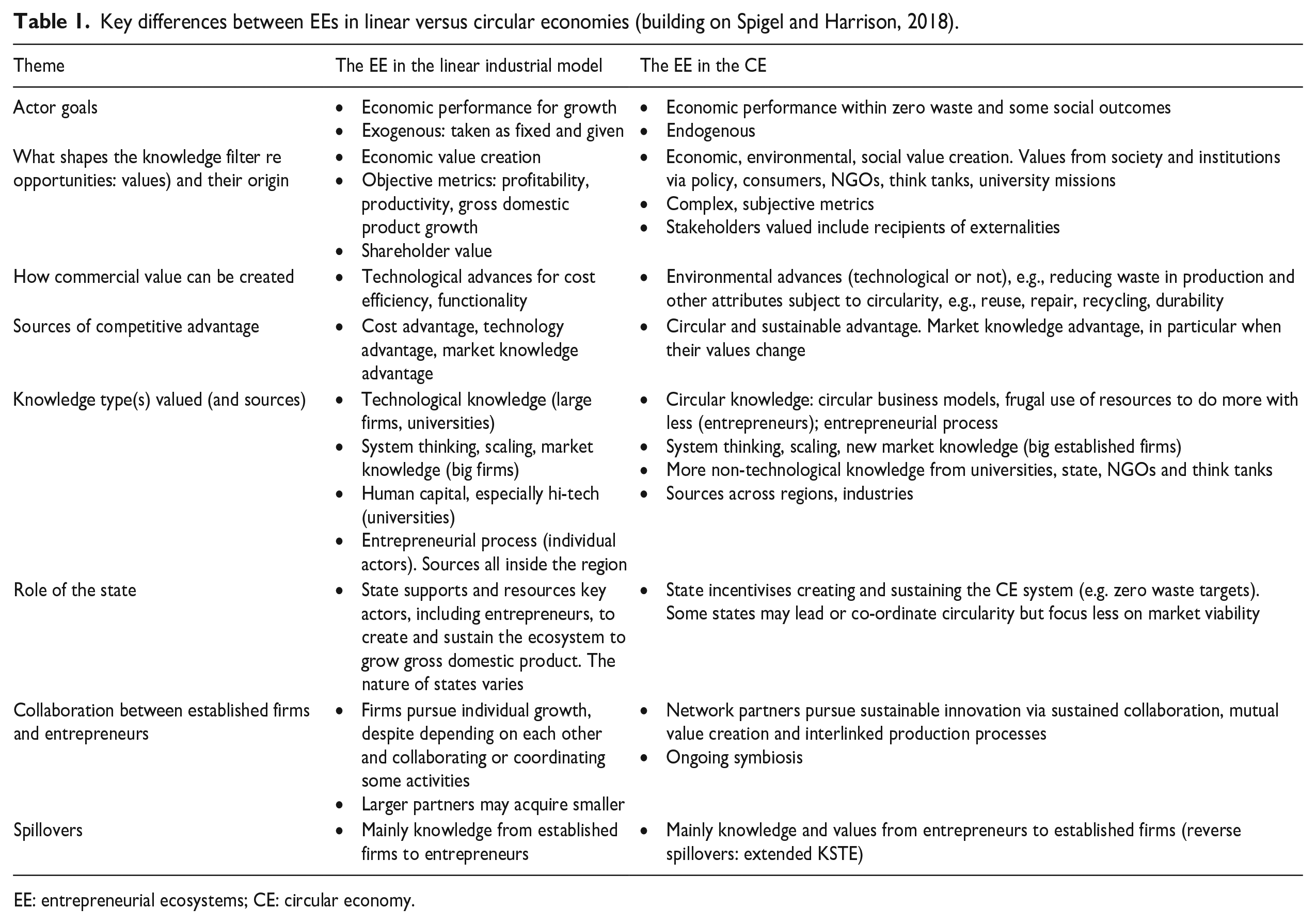
EE: entrepreneurial ecosystems; CE: circular economy.
As the table illustrates, the EE literature typically takes as given that all actors want to optimise their economic performance (Terjesen et al., 2017) and that the state’s primary goal is economic growth. In a CE, however, the goals of actors become set endogenously. They include not only economic but also environmental and social outcomes. Secondly, comes a change in what shapes the knowledge filter affecting opportunities: value(s) and their origin. New societal values factoring in multiple stakeholders qualify the previous sole emphasis on economic measures, namely, profitability, productivity and growth, which prioritised shareholders. If circularity values are proven economically viable by entrepreneurs, the filter of established firms as to what knowledge and opportunities can underpin a commercially viable business model should erode to embrace CE opportunities. As a result, firms may exploit new, more sustainable opportunities, and a shift can be observed in how value is created from mainly technological to wider environmental advancements through various means, including new circular business models. Thus, in CE, firms can achieve a competitive advantage based on a sustainable advantage (Rattalino, 2018) rather than purely cost, market knowledge or technology advantage. Furthermore, there is a change in knowledge type(s) valued and the sources. The linear model of production – centred on technological knowledge from large firms, university technical research and human capital – allowed spillovers to the engine of growth – entrepreneurs. Individual actors, including mentors, provided entrepreneurial process knowledge, helping start-ups grow. The CE still values these types and sources. However, echoing changes in how commercial value can be created, the CE also values capabilities to address the ecological concerns of many stakeholders, such as circular business model knowledge on minimising the wastage of raw materials, energy and other resources (Prabhu, 2017) – for instance, by using renewable resources and designing more durable or repairable products (Bocken et al., 2016). This may change the role of the state to one of setting incentives to achieve a CE. Additionally, key actors change from linear to CE ecosystems. Entrepreneurs alter from performing as engines of growth to change agents pursuing a new goal: circularity. Finally, the collaboration between established firms and entrepreneurs changes. In this setting, both established and entrepreneurial firms maintain important and distinct roles in increasing circularity. This is because, in the CE, value creation processes often span multiple industries and involve diverse organisations (Patala et al., 2022), making acquisitions of entrepreneurial firms less likely, compared with the traditional ecosystem perspective where established firms often acquire entrepreneurial firms to internationalise their innovation (Cantner et al., 2021). Finally, spillovers expand to include reverse spillovers and both circular knowledge and CE values as KSTE is extended.
Model: Transition from a linear to an EE that widely adopts circular knowledge and CE values via entrepreneurs and knowledge spillovers
We now outline a model that shows the contribution of (i) entrepreneurship to changes in circular knowledge and (ii) the adoption of CE values in an EE more widely for adopting circular knowledge, highlighting the role of knowledge spillovers. Knowledge spillovers become a mechanism to transform the ecosystem, rather than merely ushering in the next technological knowledge regime. Figure 1 depicts an illustrative model, showing how knowledge spillovers in an EE can contribute to the adoption of circular knowledge and CE values. The starting point is the societal value shift towards CE (Proposition 1, P1) on the left, which was shaped by society and institutional actors, including government policy, NGO campaigns and changing market demands. This shift increases opportunities within an EE related to circular knowledge and CE values (the core), which are enacted via twin cycles.
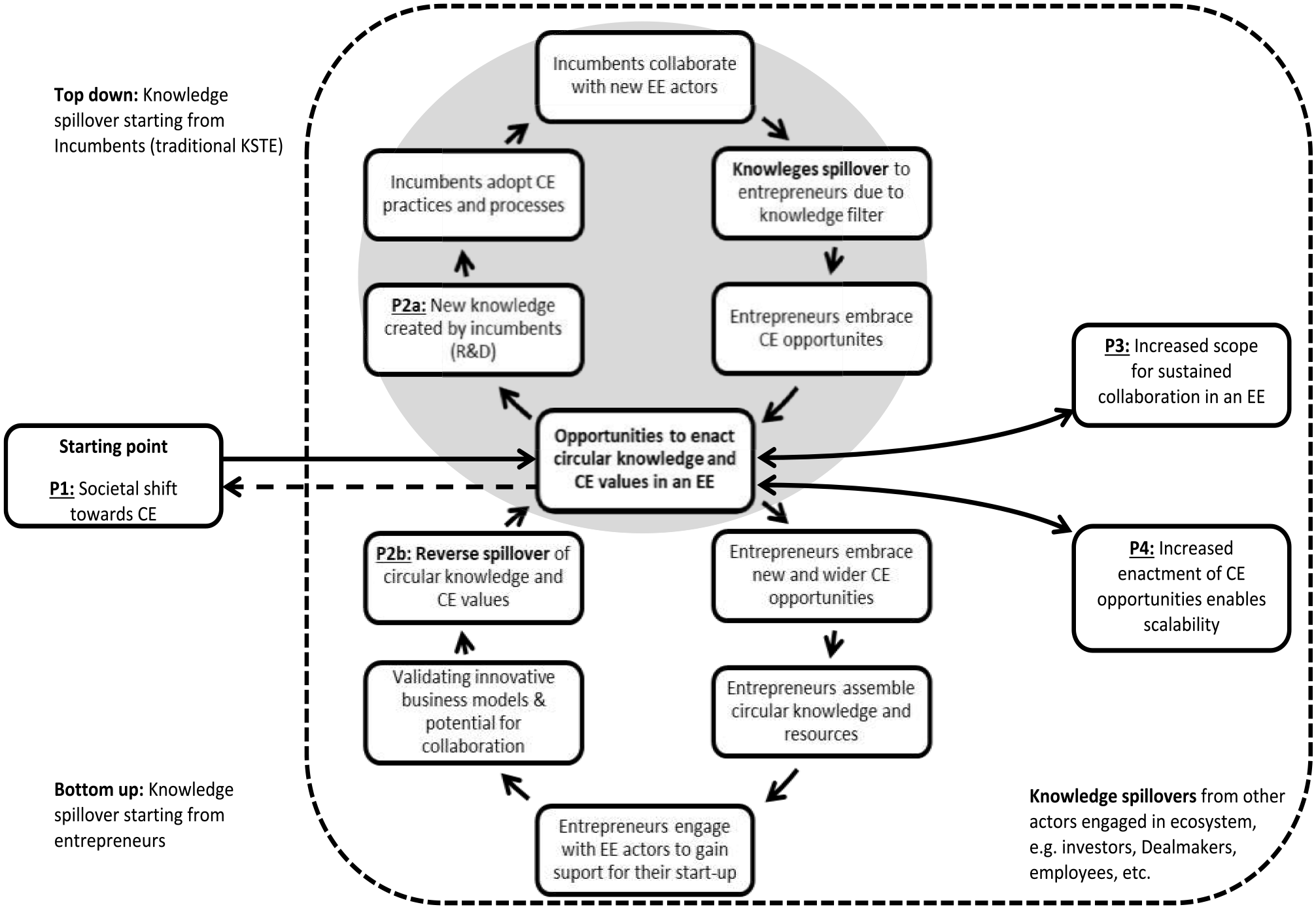
How entrepreneurship can contribute to circular knowledge and CE values in an EE.
The spillover cycle on the top resembles the processes familiar from KSTE. Entrepreneurship here is an endogenous force to exploit external technological and market knowledge largely created but discarded by incumbents: spillover R&D created by large firms and universities (Audretsch et al., 2021; Brown and Mason, 2017); modified to note that some will concern CE. In accordance with policy programmes and incentives – such as the ‘Circular Economy Action Plan’ by the EU – incumbents increasingly invest in circular knowledge (including R&D) (Proposition 2a, P2a) and adopt CE practices and processes. Incumbents collaborate with new actors in the ecosystem (Mathews and Tan, 2016). The KSTE suggests that entrepreneurs will also exploit previously unaddressed entrepreneurial opportunities available in accordance with the knowledge filter through their commercialising efforts. In this cycle, entrepreneurial process knowledge also spills over to entrepreneurs from various ecosystem actors, notably serial entrepreneurs, dealmakers, incubators, accelerators and risk-tolerant investors. Thus, entrepreneurial investments and networks accrue when entrepreneurial start-ups embrace new CE opportunities.
It is the novel reverse knowledge spillover cycle on the bottom, however, that adds to the understanding of entrepreneurship as a conduit for the transition towards more circularity. This recasts entrepreneurs as agents of change, an endogenous force to expand knowledge about CE opportunities in the EE. Entrepreneurs here enact the societal value shift by embracing CE opportunities through their start-up. Compared with incumbents, entrepreneurs perceive (wider) opportunities in the CE as commercially valuable and assemble circular knowledge and resources to pursue them. They engage with multiple supportive stakeholders, such as impact investors, in a widening pool of circular knowledge and knowledge sources. Those entrepreneurs who succeed in commercialising and validating innovative circular business models and practices through their start-up demonstrate the viability of circular knowledge and their potential to disrupt market segments. This causes reverse spillovers to large firms (Proposition 2b, P2b). Through these reverse spillovers, the knowledge filter of established firms is also expected to change, resulting in increased investment in R&D relevant for a CE. The combined threat of disruption and promise of profit incentivises established firms to create circular knowledge, which also erodes their knowledge filter. If closing the resource loop entails adding an industry, they may enter sustained collaborations with entrepreneurs (Proposition 3, P3) to achieve mutual benefits. Through such wider and more sustained collaboration, trust between ecosystem actors will also be strengthened, creating the potential for more complex opportunities related to circularity. This, in turn, widens the scope for enacting circular knowledge and CE values (represented by the curving upper arrow in the model back to the core).
During the transitions of ecosystems towards adopting circular knowledge and CE values, knowledge spillovers (represented in the top cycle) and reverse spillovers (represented in the bottom cycle) are accelerated and are likely to be complementary. Importantly, as the knowledge filter of established firms diminishes, these firms further embrace CE values and create their own circular knowledge through R&D investment related to circularity. This increases the stock of CE knowledge, which again can spill over to other actors. Indeed, over time, the complementarity between the two spillover cycles incentivises all actors – including dealmakers, workers and investors – to acquire CE-specific knowledge. As investment in human capital interacts with R&D, conditions for the scalability of circular opportunities are created (Proposition 4, P4). These, in turn, increase the potential of CE opportunities.
We expect that the model’s applicability will also vary depending on the specific context, such as the main industry relevant to the ecosystem, culture and developmental stage of a country, along with how an economic system and government are organised. Although we expect both cycles to be present in an EE, their strength will vary. Government incentives, laws and regulations targeted at circularity – as well as the wider economic, constitutional and legal make-up – are expected to initially have greater effects on the traditional knowledge spillover cycle. This is because they create incentives for established firms to invest in relevant R&D. Furthermore, entrepreneurial culture and wider societal shifts towards CE values will strengthen both cycles, including the reverse spillover cycle. Finally, the dynamics between different ecosystem actors are also shaped by the level of trust within the ecosystem (Kanda et al., 2022a) – trust being critical for collaboration and the sharing of resources and knowledge, as well as power dynamics (Audretsch and Fiedler, 2023b). An important limitation of our model is that it does not provide nuanced insights into the contextual factors and relational dynamics that would be expected to affect not only the interventions available but also the operating environment for all stakeholders. Nonetheless, the model describes two key processes by which knowledge spillovers facilitate a wider adoption of circular knowledge and CE values within EEs.
Discussion, further research avenues and conclusion
Through integrating the literature on KSTE and EEs, this article contributes to understanding the role of entrepreneurship in fostering circular knowledge and CE values in an EE. It proposes a model that shows how spillovers contribute to fostering circular knowledge and CE values in an EE. Knowledge spillovers from established firms might enable entrepreneurial start-ups to embrace radical circular business models through leveraging underutilised knowledge from established firms. Furthermore, reverse knowledge spillovers from entrepreneurs can facilitate the wider adoption of circular knowledge and CE values within EEs. Separately, EE theory and KSTE show the importance to entrepreneurs of knowledge flows from outside their firms. Neither explains, however, the mechanisms whereby entrepreneurs might speed up the adoption of circular knowledge and CE values within EEs. Being resource-strapped, entrepreneurial start-ups have a capacity to excel at frugal – less wasteful – use of resources (Krishnan and Prashantham, 2019). Unlike legacy firms, they can also reconcile trade-offs between economic, social and ecological values and goals (Anand et al., 2021) desired by society. We have proposed four mechanisms whereby entrepreneurs can trigger, accelerate and potentially help embed circular knowledge and CE values widely within EEs through a change in knowledge filters regarding CE opportunities. Our dynamic model fleshed out existing knowledge spillover mechanisms and added a second, driving cycle based on reverse spillovers from entrepreneurs to established firms.
First, the article makes an important theoretical contribution to the literature on KSTE in the CE. We link knowledge to values and introduce societal CE values and circular knowledge. We also add reverse spillovers of both knowledge and values from entrepreneurial start-ups to established firms. We posit that entrepreneurs are a critical force in commercialising CE opportunities enabled by a wider societal value shift. These value shifts can originate from a range of sources – including NGOs, policy and market demand – and will also affect resources available to entrepreneurs, such as capital and human capital. There can be a danger of cognitive dissonance between the existing values of established firms and the societal values of CE. By commercialising CE opportunities, entrepreneurial start-ups equilibrate societal values and CE business models. Through their CE practices, such start-ups enlarge the societal pool of related knowledge, which then erodes the knowledge filter of established firms against CE. Crucially, as a result, established firms become receptive to an entrepreneur’s circular business model knowledge that supersedes growth-oriented technological knowledge. This facilitates established firms investing R&D, market knowledge and systems thinking into scaling these models. Additional new social and environmental entrepreneurial opportunities may arise. Resources, knowledge and opportunities are re-evaluated, as illustrated by the example of Iceland’s fish wastage, which was re-valued ‘from problem to valuable resource’ (Coppola et al., 2021). Ultimately, societal values come to drive and define commercial value.
Second, the article contributes to EE theory by arguing that a CE setting may not follow the traditional lifecycle phases of an EE. The CE evokes partnerships between established firms knowledgeable in scaling and internationalisation and entrepreneurs knowledgeable in turning waste into valuable resources. Spillovers, including reverse spillovers, of complementary circular knowledge often occur across industries favouring ongoing symbiosis rather than acquisitions by incumbent partners, as do interlocked value-creation processes and looping between outputs and inputs. Thus, entrepreneurial CE ecosystems might not harden into business ecosystems through consolidation (Mack and Mayer, 2016).
Finally, the article makes inroads into how circular business models can escape the niche trap. Our model suggests that within CE ecosystems, resources and R&D shift over time towards circular knowledge and values. Through sustained collaborations, established firms supply systems thinking and new market knowledge, along with tailored technological R&D. Thus, by shifting the perception of established firms about the value of CE opportunities, investment in knowledge is encouraged, enabling the scaling of technical aspects of circular business model. We add to the KSTE that the knowledge filter of established firms can also regulate what outside knowledge and values flow in, what complementary R&D investments are made and what collaborations are pursued. This filter can change and, in the context of the CE, entrepreneurs may play a critical role in altering the perceptions of established firms about CE opportunities.
The article also has implications for practitioners, specifically policymakers, managers of established firms and entrepreneurs. Firstly, policymakers can influence entrepreneurial opportunities (Audretsch and Fiedler, 2023a). To incentivise the development of circular knowledge, they should use a range of policy tools to advance it, thereby creating possibilities for knowledge spillovers within the EE. Our model suggests that there is both a minimum threshold of investment required and a scale effect in accordance with the complementarity between the two cycles by which entrepreneurs promote circular knowledge and CE values in an ecosystem. Moreover, our model also suggests the benefits of targeting a wide range of actors with policy incentives, such as established firms, entrepreneurs, investors, dealmakers and workers. Secondly, managers of established firms need to embrace circular knowledge and CE value more proactively to gain sustainable advantages. Stakeholders increasingly expect value creation beyond profits. To achieve this, established firms should actively seek collaboration with various supply chain partners within and beyond their ecosystem to realign their operations for better integration of material flows and develop innovative business models based on circularity. To broaden the knowledge base of established firms, managers should also actively absorb circular knowledge from entrepreneurs through reverse spillovers. To effectively foster collaboration and share resources and knowledge, trust between partners is critical and needs to be actively fostered. Finally, entrepreneurs as change agents should seek collaboration with various ecosystem actors and build trust. They need to recognise that they have much to offer other ecosystem partners and should be confident about the positive contribution of their start-up embracing circular business models in shaping the EE towards more circularity. The scope of our article, however, has limitations and leaves several key questions unanswered. Outlined as follows, these provide future research opportunities for entrepreneurship researchers to advance our understanding of how knowledge spillovers can facilitate a wider adoption of circular knowledge and CE values within EEs.
Actor diversity in CE ecosystems research
We encourage research that examines the contribution of a more diverse range of entrepreneurs and actors to relevant value and knowledge sources in transitioning to circular economies. As noted above, in the CE, the entrepreneur’s role has changed from being a driver for economic growth to being an agent for change towards circularity. As a wider set of knowledge and values is expected to contribute to the transition to the CE, we call for scholars to embrace entrepreneurial diversity (Welter et al., 2017) and consider a more inclusive range of entrepreneurs and other actors in their investigations of CE EEs. Although our model highlights the importance of knowledge spillovers from established firms to entrepreneurial start-ups, and vice versa, other ecosystem actors, such as universities, research centres and incubators, might also develop and invest in circular knowledge and could help raise competence and CE values in the entire ecosystem. Here, relevant actors might go beyond those commonly referred to in the traditional EEs literature in a linear setting. For example, NGOs and non-profit organisations (DiVito and Ingen-Housz, 2021) are expected to be critical in the transition of ecosystems towards the CE, but their roles and influence within ecosystems are poorly understood. Thus, future research could investigate how the resources (Mickiewicz et al., 2017), legitimacy (De Clercq and Voronov, 2009), capabilities (Zahra et al., 2006) and power (Audretsch and Fiedler, 2023b) of different actors enable them to spread CE knowledge and lift circularity in the ecosystem.
Alternative theoretical foundations – such as the social capital and network approach – might also advance our understanding of how circular knowledge is transferred between actors in ecosystems. A social network perspective focuses on how various actors and organisations are linked in social network relationships for the exchange of knowledge and resources (Neumeyer et al., 2019), an important consideration in the CE context. Another challenge for future researchers is revaluing how circular knowledge widens the opportunity to utilise the traditional knowledge and value systems of indigenous entrepreneurs (Padilla-Meléndez et al., 2022). Indigenous peoples suffered social externalities through the linear growth of colonisers. In society, value statements such as the United Nations Sustainable Development Goals (United Nations, 2023) and the 2007 Declaration on the Rights of Indigenous Peoples (United Nations, 2007) remedially affirm indigenous rights. In commerce, some entrepreneurship already synergises indigenous circular knowledge with modern technology and trade. For instance, top fashion houses such as Jimmy Choo and Dior turn waste fish skin into valuable leather (Timmins, 2019) by integrating historical knowledge from Sweden’s indigenous Sami and the Ainu of Japan (Smithsonian, n.d.). Understanding the contribution of a more diverse range of entrepreneurs to circular knowledge and CE values may also require the adoption of new, indigenous methodologies.
Measuring successful EEs
Future research opportunities also relate to operationalising new EE goals and societal values. To assess the ecological and social contributions of entrepreneurs, policymakers and researchers need performance measures beyond convenient indicators focused on shareholder value, such as profitability, firm growth and productivity. Specifically, although dimensions of the triple bottom line of value creation consider economic, social and ecological value (Tate and Bals, 2018), evidence on the contribution of different ecosystem actors to those benefits is still limited. Firms already market using environmental claims. For instance, Nokia sells X30 smartphones for eco-friendly recycling (Saw, 2022). Further research is needed concerning not only what capabilities and technical knowledge are present within a CE but the wider values that guide actors and their goals.
Unless economic and other benefits coincide, trade-offs are involved. Policymakers will have to make some transparent, principled and evidence-based judgements. More objective indicators of circularity include the reduction of waste and pollution, material reuse and product durability, as well as the regeneration of national resources (Saidani et al., 2019). Other, more subjective indicators, such as inclusion and social effects, are also important values that need to be captured. For example, the Ellen MacArthur Foundation (n.d.) had offered the tool ‘Circulytics’ to help businesses assess their CE performance, but metrics are needed to capture relevant data at the systems level (Serna-Guerrero et al., 2022). Specifically, to capture the transition of EEs towards the CE, it is also important to investigate a wider range of factors related to the quality of the ecosystem itself, including system diversity, dynamism and support related to CE opportunities. In general, given Krugman’s (1991) observation that ‘knowledge flows are invisible’, measuring knowledge spillovers poses a daunting task. Nevertheless, scholarly research has not been deterred from attempting to measure knowledge flows in general (Jaffe et al., 1993) and KSTE in general (Plummer and Acs, 2014). Even so, the measurement and analysis of knowledge spillovers and KSE is in its infancy, although the importance of this work suggests a research trajectory that will continue to develop and improve. We expect that future research will also endeavour to develop measures for CE-related knowledge. Furthermore, as CE ecosystems evolve, goals might change, making it important to understand how these systems evolve over time. Our model suggests that the ecosystem lifecycles in the CE setting might become continuously entrepreneurial (part of Proposition 3). Future research that draws on longitudinal data is needed to track the lifecycle of EEs when advancing circularity.
There is a need to investigate the government’s role in transitioning an EE to circularity. Traditional EE literature casts policymakers as designing policies and structures to facilitate entrepreneurial and economic growth and support innovation and market access (Mason and Brown, 2014). Reconciling such focuses with environmental sustainability in a circular setting (Kirchherr, 2022) may require de-emphasising economic growth. Depending on the nature of the state, we expect the government’s role to range from non-intervention to hands-on coordination. Governments can, for example, exogenously stimulate the initial phase of transition through targeted investment in waste management systems. However, the case of China’s eco-industrial parks suggests that a radical shift of business models and circularity must also be adopted at the firm level and supported by a wider set of stakeholders (Su et al., 2013). In free markets, entrepreneurs are central drivers of the transition (Baumol, 2004). Indeed, research on circular business models already shows that entrepreneurs are critical to achieving radical, transformative change, and we expect that they will also play a central role in how EEs might advance the CE. Our example from Iceland’s ocean cluster suggests that entrepreneur-led governance might foster wider industry collaboration and knowledge spillovers with more added value. Given our model, we expect top-down state interventions to be less effective in stimulating innovative business models – that is, innovation requires collaboration and negotiation between entrepreneurs and incumbents rather than imposition. In our model, we have largely assumed a Western-style liberal state using market-oriented interventions. Country-specific or comparative political economy studies could rethink the model for very different states. One approach would investigate values-based changes in policy settings, such as increases in environmental regulations or restrictions of market freedoms. Further research is needed to understand differences between entrepreneur-led and government-led models, differences between national policy and regulation, as well as their respective opportunities and limits for wider diffusion and acceptance of circular practices.
Boundaries of EEs in the CE
Our evidence indicates that there is a need for researchers and policymakers to network across countries and industries to uncover complementarities, input‒output combinations and alignments of production processes for continuous flow and availability of material that can scale circular business models. The ecosystem literature emphasises place (O’Connor et al., 2018), but business models, such as Patagonia, Inc., spread their niches globally. Additionally, the existing empirical studies on the CE often focus on a single industry, such as fashion. However, successful circular ecosystems such as the IOC may cross both borders and industries. Clearly, supporting entrepreneurial opportunities will sometimes require complex networks (Kanda et al., 2021), and there is an opportunity to investigate the international linkages of EEs to understand circularity. A limitation of our current model is that it focuses on how circular knowledge enters the EE and supports its transition. Future research could investigate how circular knowledge might travel across single industries, industry parks and ecosystems. Similarly, we need a better understanding of how macrolevel factors such as globalisation will affect the shift towards the CE (De Angelis, 2021). When globalisation and trade competition are intense, cost pressures might squeeze sustainable alternatives. The opposite effect might be obtained during deglobalisation, which is characterised by degrowth and the emerging and limited connectivity of supply chain systems. Examining the developmental stages of a single economy might illustrate the changes between forced circularity during low-trade and extremely early subsistence stages, eventual adoption of a linear technological growth model and, finally, chosen circularity when societal values of a rich nation embrace concern for the environment and other casualties.
To conclude, centred on the integration of KSTE into an EE and its extension towards circularity, this theory article has proposed mechanisms – informed by knowledge and value spillovers – whereby an entrepreneurial-led transition of an ecosystem to a CE setting can occur. In a throw-away society, the knowledge filter translates to a cognitive level what commercial agents regard as superfluous. If our propositions and model are borne out, then a policy conclusion follows: that nurturing circular entrepreneurship will tend to recursively accelerate and embed the transition of EE to CE in a virtuous circle. Having been an engine to achieve linear growth, entrepreneurs also become vital agents of change to circularity. They are key actors in incorporating CE values from society into new business models. Proving that these firms are commercially viable will send circular knowledge and values back to established firms via reverse spillovers. Spurred by the promise of new opportunities and the threat of disruption, established firms will follow, reformatting their knowledge filter. They will change their R&D investment strategy towards producing and keeping more circular knowledge. Technological knowledge, systems thinking and new market knowledge are the necessary complements to circular business models. As incumbents pursue CE opportunities independently or form sustained collaborations with entrepreneurs far and wide who can, these attributes advance process knowledge to scale up circular business models out of the niche trap. As a result, within an EE based on the CE, a wider range of entrepreneurial opportunities offer interlocked value creation and new forms of sustainable advantage. Overall, entrepreneurial activities have the potential to advance circular knowledge and CE values within an ecosystem towards sustainability. Crucially, because the knowledge filter of established firms determines what knowledge they pursue, absorb and ultimately exploit, we conclude – in accordance with our novel reverse spillovers cycle – that entrepreneurship is an endogenous force that can reformat the collective knowledge filter, normalise the revaluing of waste as a resource and transition linear ecosystems towards circular opportunities. However, this transition depends upon entrepreneurs having to reconcile economic, ecological and social goals. Our model proposes that these entrepreneurs will stay essential to big players within a CE, thus avoiding acquisition. Over time, they will be joined by follower entrepreneurs feeding on spillovers from early entrepreneurs and established firms. This virtuous circle would keep the CE ecosystem entrepreneurial and, with a green market premium, ensure it is economically as well as environmentally and socially sustainable – a durable reconciliation of imperatives. Conversely, the example of China shows a state-led approach, where the state coordinates ecosystem activity. Although China has allowed for bottom-up entrepreneurial initiatives, the visibility of the state (Mathews and Tan, 2011) may displace a more diverse range of entrepreneurs who would drive to the transition endogenously. The state-led approach might also be more confined to the state’s own territory and heavily reliant on state-generated or state-induced knowledge. Without being sure how deeply state-led knowledge is diffused, such a top-down approach to eliminating waste might emphasise solving the ecological problem over the commercial potential of a transition to a CE. This could jeopardise the long-term, all-round viability of the state-led approach, further neglecting social values. In contrast, our model recognises and values entrepreneurs as key actors in shaping circular knowledge and CE values.
Footnotes
Funding
The author(s) received no financial support for the research, authorship, and/or publication of this article.
