



Abstract
The Entrepreneurial Society framework occupies a central role not only in research but also in policy discourse. It highlights the important role of new ventures in instigating transformational change to meet new challenges. Yet, the framework was developed in an era when there were few reasons to fear shocks to society. The only shocks theorised were Schumpeterian and those were seen as desirable. This article revisits the Entrepreneurial Society from the perspective of climate change as a cause of shocks that need to be mitigated urgently. The article makes three important contributions to the entrepreneurship literature. First, it explicates contemporary views of the Entrepreneurial Society including contemporary critiques. Second, it outlines key conceptual challenges for the Entrepreneurial Society posed by climate change. Third, it suggests updates to the Entrepreneurial Society framework to strengthen its relevance in the face of climate change to channel entrepreneurial efforts towards a circular economy.
Keywords
Introduction
With rising awareness of climate change, we have seen an increasing focus on how new ventures can contribute to sustainability through a circular economy 1 (Bocken et al., 2016; Laveren et al., 2020). Research in this vein has primarily focused on how policymakers and intermediaries (Kanda et al., 2018; Klofsten et al., 2020; Mian et al., 2016) can influence start-ups at the regional level (Etzkowitz and Klofsten, 2005; Lamine et al., 2018) or local level (Palm and Bocken, 2021) to create entrepreneurial ecosystems 2 that promote sustainability (Laveren et al., 2020). Yet, local and regional systems depend on macro-level frameworks that shape national and international systems. Within the entrepreneurship literature, perhaps the most salient such framework is the Entrepreneurial Society, which offers policy prescriptions for how entrepreneurship 3 can be fostered to effectively meet contemporary challenges (Audretsch, 2007, 2013). It is based on empirical observations of the role of entrepreneurship in society and a foundation of theoretical underpinnings (Acs et al., 2009a; Audretsch, 2009a, 2009b). Yet, like most of the literature on local and regional ecosystems (Acs et al., 2017), the Entrepreneurial Society framework was developed to solve issues related to economic growth and employment (Audretsch, 2007) not to promote a circular economy or sustainability. The purpose of this conceptual article is therefore to assess the urgent challenges that climate change poses for the Entrepreneurial Society framework and update it to promote sustainability and a circular economy.
The Entrepreneurial Society framework conceptualises entrepreneurship as the engine of growth (Acs et al., 2009a; Audretsch, 2009a, 2009b). It highlights the importance of new ventures as a driving force that is particularly beneficial when it disrupts the established order by introducing disruptive innovations that make established practices obsolete, so-called ‘creative destruction’ or ‘Schumpeterian shocks’ (Audretsch, 2012; Barney, 1991; Schumpeter, 1942). It is argued that Schumpeterian shocks benefit society because the new economic activity produces greater value and/or uses fewer resources than the practices it replaces. The framework is by now well established and influential. The framework and its associated theoretical underpinnings have been cited thousands of times and David Audretsch and Zoltan Acs received the Global Award for Entrepreneurship Research 2001 for their work with the framework. The framework has influenced prominent policymakers and inspired special issues, dedicated research programmes and books that outline and extend the framework (Audretsch, 2007; Elert et al., 2019; Economidou et al., 2018; Prodi, 2002).
The theories associated with the Entrepreneurial Society framework were developed in the aftermath of the fall of the communist bloc and the dissolution of the Soviet Union (Audretsch, 1995; Acs and Audretsch, 2001), concurrently with ideas about the ‘end of history’ (Fukuyama, 1992), which posited that liberal democracy and capitalism constituted the endpoint of human societal organisation. As the Entrepreneurial Society framework was developed in an era when major ideological conflicts were seen as a thing of the past, wars were in decline, and international trade and collaboration were on the rise, the Entrepreneurial Society framework did not see the need for policy agendas that sheltered societies from shocks or steered the economy in any particular direction. Rather, directions for society were less a matter of state direction and more a bottom-up approach based on where entrepreneurs and their innovations brought us. The only shocks in focus in the Entrepreneurial Society framework were Schumpeterian and the role of policymakers was in the least not to get in the way, and at the most, to provide inspiration and support. The Entrepreneurial Society framework has therefore tended to view shocks as neutral or positive events that may have winners and losers, but in the long run, they are seen as for the better (Audretsch, 2007, 2012). Thus, rapid, human-induced climate change is a challenge that the Entrepreneurial Society framework was not designed to deal with. The type of shocks that will follow in the wake of increasing climate change are different in kind and scale from the shocks anticipated in and theorised in the Entrepreneurial Society framework.
The ongoing climate change is disrupting communities by amplifying extreme weather events such as floods and droughts (IPCC, 2022; Wright and Nyberg, 2015). Such disruptions will increase substantially, leading to displacement of populations and extreme economic damage. However, these disruptions can potentially be mitigated by radical changes to how we structure our societies (Nyberg et al., 2022; IPCC, 2022). As a consequence of these disruptions, climate change will thwart much existing economic activity but also enable new economic activity, which is to say entrepreneurship (Davidsson and Wiklund, 2001). On the one hand, entrepreneurship is a mechanism by which we have unleashed climate change (Wright and Nyberg, 2015, 2017). Entrepreneurship, as an engine of growth, has stoked the extraction and combustion of greenhouse gases (Wright and Nyberg, 2015). For example, Henry Ford’s entrepreneurship made cars affordable to the masses, which had many positive effects, but it also contributed to increased greenhouse gas emissions (Lundmark and Westelius, 2014). On the other hand, entrepreneurship is integral to mitigating the impact of climate change (Embry et al., 2022). Not only has it been suggested that entrepreneurship is a critical mechanism for transitioning away from greenhouse gas emissions, which could mitigate the magnitude of climate change, but also that entrepreneurship is critical in managing the consequences of climate change (Gates, 2021; Kanda et al., 2019; Muñoz and Cohen, 2018; Shepherd and Patzelt, 2011; York and Venkataraman, 2010).
Yet, entrepreneurship theory would not suggest that entrepreneurship is automatically a mechanism for mitigating climate change and its consequences. The reason is that entrepreneurship can be productive, unproductive or destructive depending on the incentive structures entrepreneurs are facing (Baumol, 1990). Therefore, policymakers need to incentivise the kind of activities that mitigate climate change and its consequences and penalise activities that contribute to climate change and worsen its consequences. The interventions needed to create such incentive structures will in themselves constitute shocks to the economy. Consequently, our societies face a mix of at least three types of shocks related to climate change: first, shocks created by climate change such as the depletion and destruction of valued resources (e.g. water and agricultural land); second, shocks created by policy initiatives to change the incentive structure away from greenhouse gas emissions, which will change the relative costs of goods and services; and third, Schumpeterian shocks created by entrepreneurs as they introduce new innovations in response to policy and environmental enablers. These types of shocks are interrelated and the sooner we get the second and third types of shocks, the more we can mitigate the first type of shock (Gates, 2021), but there is no doubt there are and will be more shocks (Nyberg et al., 2022). 4 From an entrepreneurship theory perspective, all these types of shocks are entrepreneurial enablers, that is, they create conditions conducive to new economic activity (Cohen and Winn, 2007; Davidsson et al., 2020; Kimjeon and Davidsson, 2022). From the perspective of policymakers, however, these shocks have real and often negative consequences for many individuals, communities and societies and these consequences will influence people’s willingness to support the policy agendas that are urgently needed.
In this article, we first explore the policy implications of current conceptualisations of the Entrepreneurial Society and outline critiques of the Entrepreneurial Society and its policy recommendations. We then focus on the specific challenges that climate change poses for the Entrepreneurial Society framework and how the framework can be updated to better address these challenges. Our exploration homes in on two aspects of the Entrepreneurial Society framework; first, the neutrality principle which means ‘the state of not supporting or helping either side in a conflict or disagreement’ (Elert et al., 2019: 19); and second, the issue of inequality, which is generally seen as positively linked to entrepreneurial activity (Lippmann et al., 2005), but which poses several challenges to policy responses to climate change.
We make three important contributions to the literature. First, the article explicates contemporary views of the Entrepreneurial Society including contemporary critiques. This is important because new ventures, which sit at the centre of the framework, are critical for creating the kind of renewal needed to establish a circular economy (Kanda et al., 2022). Second, the article outlines key conceptual challenges for the Entrepreneurial Society posed by climate change. This is important because entrepreneurial societies do not in and of themselves support a circular economy (Alonso-Almeida et al., 2021). It is therefore, critical to establish how the theoretical underpinnings of the Entrepreneurial Society framework relate to the transition towards a circular economy. Third, the article suggests updates to the Entrepreneurial Society framework to strengthen its relevance as we are facing increasing climate change. This is critical to better understand how entrepreneurial efforts can be directed towards a circular economy rather than at extending business models that capture value at the expense of the environment and vulnerable communities (Lundmark and Westelius, 2019).
The article is structured as follows. In the next section, we summarise the Entrepreneurial Society framework. Thereafter, we outline current critiques of the policies associated with the Entrepreneurial Society framework and then focus on the specific challenges posed by climate change. This is followed by a discussion of how the Entrepreneurial Society framework can be updated to better support a circular economy and sustainable entrepreneurship.
The Entrepreneurial Society
Audretsch (2009a) labelled the period after the second world war up to the 1990s as the ‘managed economy’, characterised by a prevailing belief in large corporations and a lack of trust in independent entrepreneurs. Small firms were perceived as lacking the resources for research and development and economies of scale, leading to the assumption that they only offered lower-quality jobs. In the United States, the employment share of small manufacturing firms decreased by 25% between 1958 and 1977 with similar trends in other countries (Audretsch, 2009a). Contemporary growth models, such as those proposed by Solow (1956, 1957), focused on labour and capital as the primary factors of production. The proportion of capital controlled by the largest corporations increased, and by the end of the 1960s, the top 100 corporations in the United States controlled over half of the country’s manufacturing assets (Audretsch, 2009a). By the 1970s, however, a new source of economic growth emerged – human capital, at least in the context of the most developed countries. Accordingly, labour market policies were geared towards supplying large corporations with a skilled workforce. A somewhat more nuanced factor of production driving growth became the focus a decade later – knowledge (Lucas, 1988; Romer, 1986). Yet, in what was first labelled the ‘Swedish paradox’, and later the ‘European paradox’, it was noted that many countries invested heavily in knowledge production and education with seemingly low results in terms of economic growth (Audretsch, 2009a). In fact, many European countries struggled with lower economic growth than what they had grown accustomed to in the post-war era. The Entrepreneurial Society framework thus suggested that it is not liberal democracy, capitalism or knowledge per se that create economic growth, but that entrepreneurship is the mechanism that creates economic growth. This assumption forms a central part of the theoretical framework underlying the entrepreneurial society (Audretsch, 2009a). The Entrepreneurial Society thus offered a conceptual framework with policy implications for how to facilitate entrepreneurship-led growth in the context of expanding capitalist institutions and free trade.
These theoretical developments resonated with broader societal sentiments. During the 1990s, there was a shift in the perception of large corporations and independent entrepreneurs. As Audretsch (2009a: 508) stated, ‘the great steel and automobile corporations were supplanted by emerging entrepreneurial firms such as Amazon and Google. Entirely new industries materialized out of thin air – industries inconceivable in the 1980s’. There was also a divergence in economic growth performance on the opposite sides of the Atlantic opened up a rift concerning the sources of economic growth. On the one side, the Nobel Prize Laureate, Joseph E. Stiglitz (2004) gushed about astonishing rates of US economic growth in, The Roaring Nineties, as constituting ‘The World’s Most Prosperous Decade’. On the other side of the Atlantic, Europe remained bogged down with sluggish economic growth and rising unemployment. The difference was attributed to the different approaches to entrepreneurship on each side of the Atlantic. As the President of the European Union at that time, Romano Prodi (2002) observed, ‘Our lacunae in the field of entrepreneurship needs to be taken seriously because there is mounting evidence that the key to economic growth and productivity improvements lies in the entrepreneurial capacity of an economy’. With this shift in attitude followed a plethora of studies spanning a broad spectrum of diverse national and institutional contexts linking the entrepreneurial veracity of cities, regions, provinces and entire countries to a stronger economic growth performance (Aghion, 2017; Audretsch 2007; Braunerhjelm and Borgman, 2004; Fritsch, 2008; Glaeser et al., 2015; Lee, 2017).
The theory underlying the Entrepreneurial Society was the high propensity for entrepreneurs and their firms to commercialise knowledge and ideas for innovative activity that might otherwise been left unutilised (Acs et al., 2009b, 2013; Baumol et al., 2009). The attraction of entrepreneurship to public policy was not that it generated a strong economic performance and prosperity for the entrepreneur herself, but rather for her surrounding community (Audretsch, 2007; Economidou et al., 2018). However, the vast body of research linking entrepreneurship to economic growth at the spatial level, ranging from cities to regions, provinces and nations, almost exclusively assumed entrepreneurship as being exogenous and economic performance as endogenous (Audretsch and Lehmann, 2005; Glaeser et al., 2015). This literature succeeded in explaining spatial variation in economic growth performance but offered little in terms of insights as to how a place might bolster its entrepreneurial activity as a means for igniting economic growth.
With the introduction of The Entrepreneurial Society (Audretsch, 2007), entrepreneurship essentially became endogenous. Not only is economic performance, including economic growth, shaped by entrepreneurship, but entrepreneurial activity is shaped by a myriad of contextual factors, including institutions, policies and culture (Krzeminska et al., 2021). Thus, The Entrepreneurial Society is the antecedent for the entrepreneurship ecosystem (Acs et al., 2017) in that they both (1) view entrepreneurship as the driving force underlying economic growth performance and (2) entrepreneurship itself is shaped by factors, conditions and influences external to the entrepreneur and her firm. Not only is no entrepreneur an island, but it takes a village to create an entrepreneur. The better that village, the more resolute the ensuing impact of those entrepreneurs on economic performance.
The role of the state in the Entrepreneurial Society
During the second industrial era, which revolved around the application of physical capital and unskilled labour, bigger was better, in that competitiveness was achieved by attaining scale economies to minimise average costs (Chandler, 1990; Scherer, 1970). The role of public policy became how to deal with the trade-offs between the resulting market power on the one hand, and efficiency on the other hand (Piore and Sabel, 1984). A triad of policy strategies emerged that revolved around constraining the freedom of the firm to contract – regulation, competition policy and public ownership (Audretsch, 2007). Different countries favoured one policy strategy over the other two, but the common policy approach was the attempt to gain the benefits of size, scale and economic power, without succumbing to the loss in terms of democracy (Audretsch and Moog, 2022).
As the second industrial era gave way to its successor, the driving force of competitiveness shifted from scale and scope (Chandler, 1990) to innovation. Public policy in the Entrepreneurial Society correspondingly shifted from constraining the freedom of firms to contract, to creating a context that would enable people and organisations to discover, create and commercialise new opportunities, which is to behave entrepreneurially (Audretsch, 2007). Thus, the Entrepreneurial Society is predicated on pro-active government policy with a focus on policy strategies and instruments enabling entrepreneurship. The active and enabling role of public policy in the Entrepreneurial Society is the antecedent for the entrepreneurial ecosystem, with the primary focus on a pro-active role for government policy to create a context conducive to entrepreneurial activity (Audretsch, 2007).
There are two pivotal functions provided by public policy in the Entrepreneurial Society, both of which are focused on generating innovation through entrepreneurship. The first is to induce investments in new knowledge, either directly through government-funded research and education, or more typically indirectly, through private sector R&D and training for human capital (Acs et al., 2009b; Audretsch and Keilbach, 2007). The second key function of the public sector in the Entrepreneurial Society is to facilitate knowledge spill overs by creating a context conducive to entrepreneurship (Acs et al., 2009b; Audretsch and Keilbach, 2007; Link and Sarala, 2019). Knowledge spill over entrepreneurship generates innovation through the commercialisation of knowledge and ideas created in the organisational context of a legacy firm but not used by that organisation (Christensen, 1997). Thus, the role of government policy in the Entrepreneurial Society is to enhance both investments in knowledge and the commercialisation of those knowledge investments through knowledge spill over entrepreneurship (Acs et al., 2009b). The globalisation of trade, thus, becomes a mechanism for competition between countries where competitive countries build capabilities for innovation and institutional support for entrepreneurship and are rewarded by investments and trade.
Recent contributions to the Entrepreneurial Society framework (Economidou et al., 2018; Elert et al., 2019) recognise the importance of existing institutional contexts when developing policy in the vein of the Entrepreneurial Society framework. Elert et al. (2019) specifically outline the principles that should guide such policy making: neutrality, transparency, moderation, contestability, legality and justifiability. Neutrality implies levelling the playing field between actors in the market, and not supporting any side in a conflict nor any particular technologies or business models. Transparency implies being open to policy, its goals and consequences to reduce uncertainty for entrepreneurs and other market actors. Moderation implies avoidance of extremes particularly related to interventions in the market. Contestability implies that policies and policy objectives should be open to challenge. Legality implies the rule of law must be upheld and in line with the institutional framework. Justifiability implies that a balance must be upheld between public interests to justify interventions beyond a laissez-faire attitude.
Critiques of policies of the Entrepreneurial Society
Because of the influence of the Entrepreneurial Society framework on policymakers and political discourse, critique has been voiced against the theory underpinning the framework. Critiques of the Entrepreneurial Society and its view of the promise of public policy emanate at three different levels and they reflect ongoing areas of debate.
The first involves the link between policies and institutions on the one hand, and entrepreneurial activity on the other. In his highly influential book, Boulevard of Broken Dreams: Why Public Efforts to Boost Entrepreneurship and Venture Capital Have Failed, Joshua Lerner (2009) argues that public policy to stimulate entrepreneurship mostly fails because it either is unable to give entrepreneurs what they need to succeed, or more often than not, simply wastes resources on entrepreneurs who would be engaged in entrepreneurship even without the public support. Along the same lines, Storey (2006) estimates that the UK spent more on financial support for small businesses than they do on the police or on universities 5 and questions whether the money is well spent. Irwin and Scott (2023: 300) evaluate 50 years of entrepreneurship support in England and conclude that such support has generally been ‘poorly conceived, short term and without strategic coherence’. Their critique targets the execution of such support, not the principle that it is possible and desirable per se to support entrepreneurship. However, Fotopoulos and Storey (2019) argued that it is not only questionable whether public policy is capable of sustainably changing start-up rates, but also whether it is generally desirable. A recent report based on meta-studies and 50 high-quality evaluations by the Organisation for Economic Co-operation and Development (OECD) finds mixed results in evaluations of entrepreneurship and small business support programmes (OECD, 2023). Importantly, this report identifies a lack of evidence, clear objectives and cost–benefit analyses as key issues that need to be addressed.
The second level of critique involves the impact of entrepreneurship on economic performance, and in particular, economic growth. For example, Shane (2008) argued that support programmes do increase the number of start-ups, but that more start-ups per se are not desirable. Nightingale and Coad (2014) argued that new venture formation typically crowds out higher productivity and more innovative activity with lower productivity and less innovative activity. The result is a drag on economic growth resulting from increased entrepreneurship (Nightingale and Coad, 2014). This critique maintains that economies of scale are still important (Nightingale and Coad, 2014). Given that entrepreneurship often entails the starting of new organisations, which are generally small and thus lack sufficient scale, productivity and as a result growth suffers. Fotopoulos and Storey (2019) and Shane (2008) argue that links between entrepreneurship and economic growth often reflect reversed causality, that is, higher growth leads to higher start-up rates rather than the other way around. Blanchflower (2004: 30) argued that there is ‘no convincing evidence of any kind in the literature that either increasing the proportion of the workforce that is self-employed, or having a high level of self-employment produces any positive macroeconomic benefits’. Shane (2009: 142) argued that ‘Encouraging more and more people to start businesses won’t enhance economic growth or create a lot of jobs because start-ups, in general, aren’t the source of our economic vitality or job creation’. Recent studies within the Entrepreneurial Society framework highlight the importance of institutional context; start-up rates in and of themselves will not increase growth without an institutional context that supports productive entrepreneurship (Acs et al., 2018; Bosma et al., 2018). Thus, this debate hinges not only on the definition of entrepreneurship but also on the institutional context in which it is measured.
The third level of critique has to do with a prominent goal of the Entrepreneurial Society – economic growth. There are two versions of this critique. The first version maintains that, facing environmental change caused by our current resource use, we ought to consume less of these resources, which requires lower growth, or even degrowth (Goodland, 1995; Nyberg et al., 2022). The second version maintains that growth ought not to be seen as a uniform measure, but rather that we ought to be concerned about the direction of growth. In principle, this critique holds that it is not just the monetary denomination of a transaction that matters but also how much good is produced (assuming that these measures are not the same) and how much the transaction contributes towards the destruction of our environment (e.g. contributes to climate change). This second version goes beyond the immediate climate crisis that we are facing and maintains that many of the policies that have been adopted to spur entrepreneurship have also led to increased inequality, which can be questioned based on utilitarian and fairness premises (Piketty, 2014, 2020; Sandel, 2020). These critiques have not been extensively discussed in the literature on the Entrepreneurial Society. Although recent contributions stress that the Entrepreneurial Society should focus on ‘inclusive and sustainable growth’ (Economidou et al., 2018), what ‘inclusive and sustainable growth’ means, or how such growth is distinguished from other types of growth is not clear. Elert et al. (2019) mentioned climate change and proposed that we institute prizes to incentivise technologies that mitigate climate change but do not problematise the relationship between growth and climate change per se.
Given the importance of the challenge that climate change poses, the lack of attention it has received within the Entrepreneurial Society framework constitutes an important gap that deserves further attention. Therefore, we now turn to climate change, its consequences and what the implications are for the Entrepreneurial Society framework. We focus on how the Entrepreneurial Society framework can be updated to meet the challenges of climate change by decoupling growth from greenhouse gas emissions by transitioning away from greenhouse gas emissions towards a circular economy.
Climate change and the Entrepreneurial Society
A critical aspect of mankind’s response to climate change is to drastically reduce our greenhouse gas emissions in a short period of time (Gates, 2021). There is a broad commitment to keeping global warming well below 2°C compared to pre-industrial levels, which will require a reduction of net greenhouse gas emissions to zero by 2050. This commitment is captured in the Paris Agreement with 195 signatories, which includes virtually all countries in the world. While there is thus a global commitment to reducing emissions, there is still much uncertainty about whether the signatories will translate this into sufficient reductions. Projections indicate that the current commitments are insufficient and will likely lead to global warming well above 2°C compared to pre-industrial levels (UNFCCC, 2022), and instead of decreasing, emissions are increasing (Nyberg et al., 2022). The consequence is that we need to speed up current action to reduce emissions, increase our post-2030 emissions reductions drastically, or substantially increase the number of disastrous consequences (UNFCCC, 2022; Nyberg et al., 2022). An effective response to climate change must involve governments, existing and new businesses, research and innovation, and communities (Gates, 2021). Governments must establish and enforce incentive structures that penalise greenhouse gas emissions and reward behaviours and innovations that help us transition away from greenhouse gas emissions, and they must manage the effects of climate change to reduce the suffering it will cause (Gates, 2021). In democracies, government action will require building and maintaining coalitions in support of such policy initiatives (Klenert et al., 2018).
While support for research, innovation and the starting of new businesses is well in line with the Entrepreneurial Society policy recommendations, government intervention to steer the direction of innovation and economic activity is not. Such initiatives break the principle of neutrality (Elert et al., 2019). For example, effective government action to curb climate change may involve governments favouring low-, non- or negative-emission technologies over high-emission technologies (Gates, 2021; Kanda et al., 2019). Such action may also involve intermediary support (Kanda et al., 2018; Klofsten et al., 2020; Mian et al., 2016) at the regional level (Etzkowitz and Klofsten, 2005; Lamine et al., 2018) or local level (Palm and Bocken, 2021). At the highest level of policy abstraction, one could establish that greenhouse gas emissions constitute negative externalities (Pigou, 1920), that is, such emissions have costs beyond those borne by those producing them, who therefore should be made to pay for them. A price or a tax on greenhouse gas emissions could be justified based on the justifiability principle associated with the Entrepreneurial Society (Elert et al., 2019). That ‘only’ leaves us with the task of ‘neutrally’ calculating the cost of greenhouse gas emissions.
Hepburn et al. (2020) outline four reasons why carbon pricing alone will not be sufficient, which also underline why the idea of ‘neutral’ pricing of emissions is far from trivial. First, the situation is now so urgent that additional measures are needed to complement emission pricing. Second, emission pricing is insufficient to trigger the necessary structural change that is needed, such as supply chains and the design of cities. Third, the burning of fossil fuels generates air pollution that kills several millions of people annually, which makes pricing mechanisms dubious. Fourth, replacement technologies, such as solar power or energy-efficient appliances, are associated with learning and scale benefits, which are likely to justify additional regulation to speed up transitions. Yet, while not enough, emission pricing is an important mechanism for reasons well integrated in the Entrepreneurial Society – market mechanisms will coordinate reductions in a manner that is beyond the capabilities of human planners (Hayek, 1945; Smith, 1776).
Nevertheless, market mechanisms will not necessarily distribute emission reductions in a way that optimises utility or in a way that is fair. Markets allocate resources according to the wants and resources of market actors (Hayek, 1945, 1976). 6 The disconnect between utility optimisation and market allocation becomes particularly stark in situations of large income and wealth inequalities. For example, imagine that a particular shock or intervention triples the costs of staple foods such as rice and grains. For well-off people, such changes would barely be an inconvenience, for people who spend the lion’s share of their income on food, such price changes could mean starvation and death. By and large, emissions pricing alone would constitute a regressive mechanism (i.e. impact poor people more negatively than rich people) because poor people spend a higher proportion of their income on sustenance consumption that is carbon intensive such as food, heating and electricity (Flues and Thomas, 2015; Klenert et al., 2016; Grainger and Kolstad, 2010; Wier et al., 2001). For the purposes of the topic in this article, the point is that, regardless of what one thinks of inequality in and of itself, the distributional effects of climate action will have different effects on different people (and other types of political actors, Nyberg, 2021). These effects can, and often will, be large. The consequence is that distributional effects play an important role in the viability of any policy agenda with the ambition to make a meaningful difference in the development of climate change (Klenert et al., 2018). It is also far from clear that it is possible to be ‘neutral’ in developing a policy agenda to curb climate change given the needs, interests and power relationships in play.
However, the absence of government intervention to curb climate change is not a ‘neutral’ alternative. No intervention would lead to much worse effects in the not-too-distant future. Climate change will create its own shocks that will require government intervention. For example, we have already begun to experience water shortages where it has previously been seen as an abundant and free resource (Mekonnen and Hoekstra, 2016; Liu et al., 2017). While pricing water could be suggested as a ‘neutral’ mechanism that allows the market to allocate its use, inequality of wealth and income could lead to situations where some will not have enough water for basic household needs, whereas those with extensive means may use if for luxury purposes, such as watering large gardens or golf courses. Such outcomes are likely to meet strong resistance from those negatively affected as would any attempt at rationing or regulating use. Thus, even in the absence of government intervention to curb climate change, it would be problematic to uphold ‘neutrality’; rather, public policy must balance interests and needs beyond the ability to pay.
It is thus clear that government action is urgently needed and that such action will require careful consideration of a range of stakeholders in such a way that defining ‘neutrality’ is non-trivial even conceptually. In practice, this is further complicated by considerable effort exerted by incumbent fossil fuel producers, through political activities (Nyberg, 2021), to bend the rules to their advantage, to delay effective climate action and thus to create and extend opportunities for profitable fossil-fuel-based economic activity, which ultimately constitutes a process of ‘creative self-destruction’ (Nyberg et al., 2022; Wright and Nyberg, 2015). For example, the ExxonMobil lobbyist, Keith McCoy was caught on tape stating (quoted in Egan, 2021): Did we aggressively fight against some of the science? Yes . . . Did we join some of these “shadow groups” to work against some of the early efforts? Yes, that’s true. But there’s nothing illegal about that. You know, we were looking out for our investments. We were looking out for our shareholders.
Corporations are looking out for their shareholders by trying to influence government policy using a range of tactics, including campaign funding, collaborating with thinktanks, securing public and political posts with loyalists, and developing strong relationships with policymakers (Nyberg, 2021). In 2018, the fossil fuel industry contributed more than $84 million to US congressional candidates (Nyberg et al., 2022). Research shows that campaign contributions influence the voting behaviour of members of congress (Peoples, 2010), and a recent report by The International Monetary Fund estimated that fossil-fuel-related industries benefited from public subsidies of $5.9 trillion globally in 2020 (Nyberg et al., 2022).
The consequence of such corporate political activities is that deliberations about ‘neutral’ policy agendas are likely to be framed by incumbent political interests (Nyberg, 2021). From the perspective of climate change, the interests of the fossil fuel industry are likely to have the strongest inhibitive effect on effective action to curb climate change (Nyberg et al., 2022). Yet, ‘neutrality’ is problematic even if we focus exclusively on those who challenge the hegemony of the fossil fuel industry, such as entrepreneurs aiming to contribute to the transition away from greenhouse gas emissions. The reason is that many of the solutions that are introduced are dependent on complementary products and infrastructure changes. For example, electric cars constitute an alternative to fossil-fuel-dependent combustion-powered cars (Wilberforce et al., 2017). The viability of electric cars as an alternative depends on complementary products and services, such as electricity that is carbon neutral, the availability of charging and service stations, the availability of batteries and the carbon footprint of the production of cars and complementary products and services. Whether or not individuals adopt electric cars is thus dependent on how other individuals and market actors behave, which creates feedback loops. If more people buy electric cars, more charging and service stations would be opened, making electric cars more attractive, making more individuals buy electric cars, making the second-hand market more attractive, which makes the primary market more attractive and so forth. At some point, people would worry about buying a combustion engine car for fear that it cannot be serviced, fuelled or resold. Such dynamics could warrant policies to speed up the adoption of electric cars to phase out combustion engine cars. Yet, there are other non-fossil-fuel-based alternatives such as fuel cells (Brown et al., 2007; Wilberforce et al., 2017). Fuel cells are also dependent on similar, yet distinct, complementary products and services. That means that intervention to support some challengers to the status quo will have implications for other challengers.
Policymakers may therefore, be forced to choose which of competing technologies to support. In many cases, competing technologies may have clear winners which allow for speedy transitions due to feedback loops, but in other cases we may face competing technologies of equal strengths, which can slow down urgently needed transformation as individuals wait for information about which side is winning. There is nothing inherently better about driving on the left-hand side compared to the right-hand side of the road, but it is vitally important that we all do the same. In such situations, governments may need to intervene to break deadlocks and/or to speed up transitions. Ironically, such intervention may be most needed when it is most difficult to establish which side to support by ‘neutral’ calculation.
There are also important temporal dimensions to consider among solutions that contribute to reduced greenhouse gas emissions. Some solutions may reduce greenhouse gas emissions in the short run but increase them in the long run. For example, replacing a coal-fired powerplant with a natural-gas-fired plant will reduce short-run emissions (because gas-fired powerplants are more efficient than coal-fired ones), but have negative long-term effects because the long time-horizon of the investment will slow down the transition to zero-emission technologies (Gates, 2021). Consequently, temporal aspects of technology emissions as well as policy goals further complicate notions of ‘neutrality’.
The above discussion has focused on resource consumption and corporate production and political engagement. However, individuals are also involved in production as employees and entrepreneurs. As the climate changes, government policy and entrepreneurial innovations shift production patterns, many existing jobs will disappear. Such job losses may be related to regulation (e.g. stopping new coal mines), climate disasters (e.g. severe droughts or floods rendering productive land useless) or Schumpeterian shocks (e.g. self-driving vehicles). Such shocks, or just the threat of them, have important implications for climate-change-related policy development and the ‘neutrality’ principle. First, the fear of losing one’s job is a powerful source of resistance to change. This is used by fossil-fuel-based corporations as they highlight their shared interests with their workers to induce them to resist emission-reducing policies (Nyberg et al., 2022). This may require that policymakers steer jobs to regions that are hit by job losses resulting from decarbonisation to maintain support for urgently needed policy initiatives, which may conflict with the ‘neutrality’ principle.
There may be reasons for policy interventions to create jobs for those who lose out even when it is not strictly needed to achieve a sufficiently strong political coalition to enable urgently needed policy adoption. Research has shown that previous Schumpeterian shocks, such as those associated with the deindustrialisation of the US Rustbelt as manufacturing moved offshore, have caused substantial suffering as previous employees do not relocate to where there are jobs (Banerjee and Duflo, 2019; Case and Deaton, 2020; DeLong, 2022). The Entrepreneurial Society framework views labour mobility not only as a useful mechanism for diffusing knowledge between organisations and regions but also as a rational choice for displaced workers (Fornahl et al., 2005). Compensating people for their own lack of rational economic behaviour would conflict with the neutrality principle. 7 Yet, it turns out that in practice, many workers stay in declining regions even when there are few job prospects (Banerjee and Duflo, 2019), which has been linked to so-called deaths of despair, that is, deaths related to mental illness, opioids, alcohol and suicide (Case and Deaton, 2020). The consequence is that there may be reasons to provide government support for retraining, relocation and/or replacement jobs depending on the age and life situation of affected people (Banerjee and Duflo, 2019; Case and Deaton, 2020).
Lastly, it is not clear how the neutrality principle could or should be applied in an international context. It is clear that the countries and regions that are likely to be most negatively impacted by climate change have contributed the least towards the current concentrations of greenhouse gases in the atmosphere (Nyberg et al., 2022). These countries and regions are also the ones that typically have lower abilities to address the consequences of climate change. If we apply a price on greenhouse gas emissions, should it be equal across countries and how should we use the revenues created? It is not clear what a ‘neutral’ position would be.
Updating the Entrepreneurial Society to better address climate change
The raison d’être underlying the Entrepreneurial Society framework was to overcome both market failure and government policy that was impeding a positive response to what we now characterise as technological change and globalisation. In Made in America: Regaining the Productive Edge (Dertouzos et al., 1989), The MIT Commission on Industrial Productivity looked to the incumbent and legacy companies and institutions to provide the requisite response to restore ‘the productive edge’ by adapting strategies that had proven successful in Japan and Europe. While the United States did increase its global competitiveness, it was not achieved by restoring the global competitiveness of the legacy firms. Rather, it was through the breath-taking wave of entrepreneurship by new companies creating new industries, typically launched by entrepreneurs who were not a part of the incumbent companies and industries. This shift involved a myriad of new institutions and policies, ranging from the Bayh-Dole Act and the Small Business Innovation Research programme to venture and angel capital to provide the catalyst for entrepreneurs who perceived opportunities but needed the requisite resources.
As such, the Entrepreneurial Society provided a strategy for attaining the elusive goals of economic growth and employment, where the incumbents struggled in frustration in their new global and technological environment. In the circular economy, addressing climate change has emerged as the paramount value. Just as for the earlier crisis, legacy companies will tend to invest in rent-seeking activities to preserve the status quo, rather than embark on a new technological and social paradigm they know little about. In the absence of entrepreneurship, the sluggish response of legacy companies and institutions will thwart the realisation of the circular economy. Consequently, a re-directed Entrepreneurial Society, where the goal of addressing climate change takes priority over the traditional twin goals of growth and employment, is likely to emerge as the most efficacious way to usher change.
Entrepreneurship, in the Schumpeterian sense, the kind that triggers the process of creative destruction, where inefficient legacy companies and organisations are replaced by their more creative and innovative entrepreneurial counterparts, is now needed in a range of domains to address climate change. Yet, it has become increasingly clear that incumbents will fight for their narrow self-interest by delaying the transition away from fossil fuels. In that sense, the Entrepreneurial Society is perhaps better characterised as ensuring the process of creative destruction but not in the ‘neutral’ sense. Rather, the destruction needs to be directed specifically at the kind of economic activity that produces greenhouse gas emissions and the creative side needs to be directed away from such emissions and towards the kind of economic activity that helps us as individuals and communities to reduce climate change and live with its consequences. Legacy firms and institutions have ignored the problem and delayed action for a generation. The Entrepreneurial Society needs to update institutions and policies to help the next generation of entrepreneurs to create new organisations where they are part of the solution and not part of the problem. Table 1 provides an overview of the central tenets of the Entrepreneurial Society framework, current debates within the framework and suggested changes from a climate change perspective developed in this article.
Tenets of the Entrepreneurial Society framework, current debates and suggested changes in light of climate change.
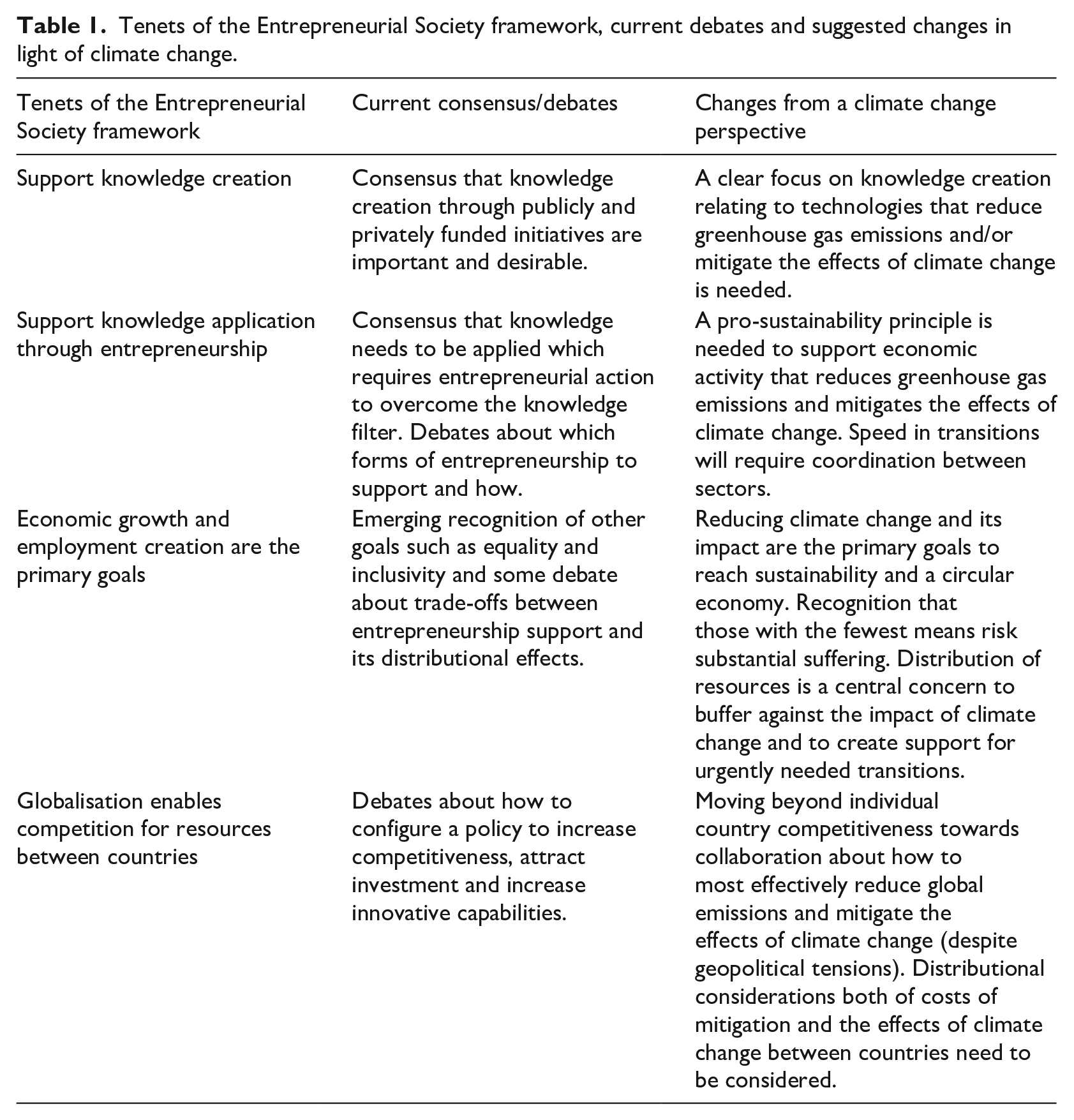
This article has outlined a number of reasons why the Entrepreneurial Society framework needs to reconsider its neutrality principle. Rather than being ‘neutral’, public policy needs to take a clear stance against economic activity that contributes to greenhouse gas emissions and in favour of activities that help us reach net zero emissions – a pro-sustainability principle. The pro-sustainability principle should be applied broadly and apply to both the knowledge creation process (publicly and privately funded research) and knowledge application in the form of entrepreneurship. Temporality is another important aspect of the transition away from greenhouse gas emissions. This transition is urgent, but the sense of urgency is yet to translate into a clear global trend towards decreasing greenhouse gas emissions (Nyberg et al., 2022). While we will not be able to reduce emissions to zero overnight, it is vital to price emissions and to communicate that emissions are going to become increasingly expensive. It is vital to demonstrate a shift from a ‘neutrality’ to a pro-sustainability principle, both in contemporary policy implementation and in clear commitments to future action. While entrepreneurs may be better than the rest of us at coping with uncertainty, this does not mean that more of it is better for entrepreneurs (Lundmark et al., 2020). Signalling commitment to increasing prices on greenhouse gas emissions helps entrepreneurs understand the viability of their products and services and thus reduces the uncertainty they face (Kanda et al., 2019).
In addition to calls for replacing the neutrality principle with a pro-sustainability principle, this article has argued that inequality of wealth and income, which have traditionally been seen as drivers of entrepreneurship (Lippmann et al., 2005), can constrain policy initiatives to foster a circular economy. Importantly, the suffering caused by the three types of shocks outlined in this article will disproportionally befall those on the lower end of the wealth and income distribution. Therefore, policy initiatives need to consider inequality both within and between nations. While such concerns may be justified in and of themselves (Piketty, 2014, 2020; Sandel, 2020), they have important implications for maintaining support for urgently needed policy changes (Klenert et al., 2018) and for reducing suffering (Nyberg et al., 2022).
In this article, we have argued that the principles underpinning the Entrepreneurial Society framework need to be reconsidered and updated in the face of climate change. It is vitally important to be clear about principles, yet principles need to be translated into concrete action. While it is beyond the scope of this article to outline specific policy suggestions, we stress the importance of such initiatives for future research. There are suggested and existing policy initiatives that target greenhouse gas emissions (Hepburn et al., 2020; Klenert and Mattauch, 2016; Klenert et al., 2018; Palm and Bocken, 2021; Nyberg et al., 2022), those that target inequality (Piketty, 2014, 2020), and those that target the functioning of democratic institutions (Nyberg, 2021; Peoples, 2010). Policy initiatives are likely to involve pricing and regulation of emissions and of infrastructure that supports emissions, support for climate change related research and application of such research, thorny issues about coordination within and between country borders about which technology systems to support, the integrity of political institutions, how to distribute the costs and benefits of policy initiatives and of climate-change induced disasters, etc. It is important for future research to continue to evaluate such policies and to disseminate information about their effects.
It is important to note that policies will never be perfect, but the leading principle should be effectiveness in steering us away from greenhouse gas emissions towards a circular economy, not ‘neutrality’. Yet, for many of the same reasons why it is difficult to establish ‘neutrality’ it is also difficult to establish the effectiveness of policy initiatives in achieving sustainability a priori. However, there are mechanisms for experimentation, evaluation and selection also in public policy and NGO settings (Harford et al., 2004; Lerner, 2009). The Entrepreneurial Society is based on notions of experimentation and selection, ideas firmly rooted in entrepreneurship theory (Lundmark and Westelius, 2014; Wennekers and Thurik, 1999). Given the centrality of the circular economy, the survival, not only of new ventures, but also of policy initiatives should depend on their impact on reaching sustainability. This means that policy initiatives need to be created with inbuilt mechanisms for transparent evaluation (OECD, 2023) of their implications for sustainability and the circular economy.
Conclusion
A generation ago, the developed countries in the West stood at the crossroads, seemingly paralysed by the twin developments of technological change and globalisation. The great legacy companies and organisations of that generation were rarely able to respond to new challenges with bold and innovative responses. Rather, it was the advent of the Entrepreneurial Society that enabled new technologies and approaches to be developed, ultimately transforming entire industries, regions and the globe.
The challenge of climate change presents another disruptive challenge. Legacy companies and organisations are ill-prepared to adjust to the demands of a circular economy, particularly the challenges inherent in solving the climate crisis. We need transformation and thus entrepreneurship in many domains. Yet, without updating the principles that underpin the Entrepreneurial Society, incumbent and new ventures will continue to engage in ‘creative self-destruction’ by finding ways of extending opportunities for profitable fossil-fuel-based economic activity (Wright and Nyberg, 2015). Now it is the Entrepreneurial Society that stands at the crossroads. We have argued that the Entrepreneurial Society framework needs to reconsider the neutrality principle in favour of a pro-sustainability principle and that inequality of wealth and income has important implications during the ongoing transformation towards a circular economy.
Footnotes
Acknowledgements
We want to thank the editorial team and two anonymous reviewers for a constructive review process and insightful comments. This article has also benefitted from insightful input during the Professional Development Workshop session titled ‘Start-up Support Promoting Circular Economy within Entrepreneurial Ecosystems’ at the Academy of Management Annual Meeting in Seattle, 5 August 2022. Most of all, we want to acknowledge the contribution of David Storey, who, during the last months of his life, cheerfully provided valuable insights into his and others’ research on entrepreneurship support programmes. The entrepreneurship field has lost one of its pioneers. We will miss him much.
Funding
The author(s) received no financial support for the research, authorship and/or publication of this article.
