




Abstract
Entrepreneurs form and grow businesses in relation to the localised context around them (structure) and also through their own choices and actions (agency). In this way, structure and agency intersect in the lived experiences of entrepreneurs. The purpose of this work is to explore entrepreneurial agency in two ecosystems that, as structures, constrain entrepreneurship within them: Newcastle Upon Tyne (UK) and Perth (Australia). We add to extant analysis that empirically looks at the active agency entrepreneurs participate in, as they attempt to overcome the structural level constraints they encounter. Methodologically, we draw on phenomenological data, arriving at a highly detailed insight, drawing attention to the strong local entrepreneurial communities and distinctive cognitive mindsets that entrepreneurs in the ecosystems we study have agentically developed and cultivated. We suggest how future analysis of entrepreneurial agency may unfold and consider the implications of our insight from a policy implementation perspective.
Introduction
An entrepreneurial ecosystem is the structural context and environment that exists in a particular space, in which entrepreneurs embedded in that space grow their business ventures in relation to. As extant scholarship shows, while some ecosystems provide circumstances that enable entrepreneurship, many ecosystems, as structural contexts, constrain entrepreneurship (Giazitzoglu et al., 2024; Jack and Anderson, 2002; Stam and Van de Ven, 2021; Welter and Baker, 2021). New York and Silicon Valley are identified in literature as ecosystems that are conducive to enabling entrepreneurship within them – primarily because of the resources (e.g. funding, skilled human capital, strong networks) they contain. But most ecosystems are not able to provide all, or even most, of the resources local entrepreneurs require. In these cases, entrepreneurs must participate in particular forms of agentic actions and behaviours to overcome and compensate for the (structural level) barriers and constraints their ecosystem imposes onto them (Acs et al., 2017; Anderson, 2000; Jack and Anderson, 2002; Refai et al., 2024; Sarker and Mateus, 2024). However, the qualitative dimensions that entrepreneurial agency takes are understudied. More work is needed to explore, empirically, how and why particular forms of entrepreneurial agency occur in particular ecosystems, and the extent to which this agency allows entrepreneurs to overcome the structural level challenges they face. As put: Despite growing interest in research on constrained entrepreneurship, it remains largely focussed on exploring structures and resources in which entrepreneurs operate, various intersections in which entrepreneurs are embedded and how those hinder or promote entrepreneurship, rather than stressing how agents operate to sustain and develop those constrained contexts. (Refai et al., 2024: 196, italics added)
The purpose of this study is to explore entrepreneurial agency. Our aim is to consider how entrepreneurs embedded in two ecosystems perceive those ecosystems and, most importantly for us, display active agency, in order to overcome the constraints these ecosystems, as structural contexts, impose onto them. Our analysis is guided by the research question: what sort of entrepreneurial agency occurs in the ecosystems of Newcastle Upon Tyne (UK) and Perth (Australia)? Through our analysis, we respond to calls for empirical insights into entrepreneurial agency to emerge and, building on our empirics, suggest ways future scholarship on agency may develop. We also explore the policy implications of our study and affirm the importance of collective agency (McMullen et al., 2021) as an emerging conceptual notion.
Newcastle Upon Tyne (UK) and Perth (Western Australia) are both urbanised ecosystems in developed economies which create structural level constraints and challenges for entrepreneurs embedded in them. Accordingly, each ecosystem potentially pushes entrepreneurs embedded in them to participate in typologies of active agency, as these entrepreneurs look to challenge structural level constraints. This makes both ecosystems highly salient ones to study entrepreneurial agency within.
Newcastle Upon Tyne and Perth are geographically distant from the centres of hegemony in their countries (being London and Sydney/Melbourne, respectively). They are thus marginal ecosystems, in the way Giazitzoglu et al. (2024) define marginal ecosystems, on the basis of their spatial proximity from ‘core’ national ecosystems. Distance ‘from the core’ creates particular constraints – especially constraints linked to a lack of local human and economic resources – that have to be overcome by entrepreneurs embedded in marginal ecosystems, via agency. Both ecosystems constitute the sort of ‘unglamorous’ ecosystems that Welter et al. (2017) suggested scholars should analyse, if the field is to provide accounts of ‘everyday’ entrepreneurial agency, that is, agency in ecosystems where the conditions for entrepreneurship are less obvious and formed in comparison to Silicon Valley and other ‘hotbed’ entrepreneurial contexts, and where expressions of entrepreneurial agency are, therefore, potentially more nuanced and complex, as local entrepreneurs look to alleviate the structural level constraints around them through innovative and novel actions.
Further, the mining industry is a significant factor that has shaped both ecosystems we study; mining is thus a defining part of both ecosystems’ ethnohistory. Mining dominated Newcastle's past. Mining in and around the city demised in the 1980s (see Giazitzoglu, 2010, 2014). This decimated Newcastle socio-economically, as the city adjusted to a post-industrial context. In turn, Benneworth (2004: 445) described the Northeast of the UK – which Newcastle is the business epicentre of – as a ‘peripheral industrial region’ with ‘a specific regional economic problem composed of several distinct elements, including its domination by mature manufacturing activity, high levels of unemployment and a poor track record in entrepreneurship and technology development’. In Perth, mining has historically been – and remains – the quintessential industry. Perth's (over)reliance on mining marginalises entrepreneurship in Perth's ecosystem. There is a reluctance to embrace and fund entrepreneurship in other, non-mining related industries in the ecosystem. An overreliance on one industry at the expense of other industries has been shown to exist in other ecosystems that – like Perth – are over-focused on one sector (see Jack and Anderson, 2002; Szerb et al., 2019). Both ecosystems are therefore germane ones to explore agency within. Particular forms of entrepreneurial agency will be expressed in each ecosystem, as entrepreneurs try and counter the constraints they encounter, in the structures they are placed, and in relation to the ethnohistories and ‘distance from the core’ that define each ecosystem.
Understanding how entrepreneurial agency expresses itself in particular ecosystems represents an important epistemological project. As others have pointed out (Giazitzoglu et al., 2024; Markowska and Lopez-Vega, 2018; Melin and Gaddefors, 2023; Refai et al., 2024) questions about how ecosystems – as structures – impose constraints on entrepreneurs embedded in them have been addressed, but less work has focused on the forms entrepreneurs’ active agency takes, as entrepreneurs respond to the constraints they encounter. This is problematic and positions entrepreneurial agency as an understudied qualitative aspect of entrepreneurship. In this study, we show how agency around the cultivation of a particular entrepreneurial mindset and the formation of strong, local entrepreneurial networks has been practiced in both ecosystems. We focus on these typologies of agency as, in interviews with entrepreneurs who live in the ecosystems we study, these forms of agency were consistently mentioned as significant, and are thus focused on here as iterative findings that were discovered in our research process. By so doing, we highlight that entrepreneurs are not passive in their ecosystems and unwilling or unable to challenge structural constraints around them. Rather, entrepreneurs actively respond to and shape the environment around them.
In the next section of this article, a selective narrative literature review is presented, to give readers contextual information on how past scholarship has understood and investigated entrepreneurial ecosystems, entrepreneurial agency and their intersection. The extent to which the agency remains under-investigated is emphasised. Then, a methodology section is presented. This section details the phenomenological underpinnings of our study and the related data collection and analysis processes we undertook. Empirical findings that inductively arose from our research process are then presented. These findings show two things. First, how those we interviewed phenomenologically understand the ecosystem around them and how structural level constraints exist within interviewees’ lived experiences as entrepreneurs because of them being embedded in their ecosystems. Second, and chiefly, how and why entrepreneurial agency – linked to the formation of local business network and the cultivation of a particular mindset – occurs in both ecosystems studied. We then discuss our findings, showing what our empirics add to previous studies. Finally, we conclude by outlining future research directions and by exploring the broader policy implications of our study.
Literature review
Entrepreneurial ecosystems
Entrepreneurial ecosystems are characterised by a combination of social, political, economic and cultural elements, all of which relate to the development and growth of business ventures embedded within them (Spigel, 2017). In this vein, Audretsch and Belitski (2021: 735) define an entrepreneurial ecosystem as ‘a set of interdependent actors and factors coordinated in such a way that they enable productive entrepreneurship within a particular territory’. The consensus in literature is that ten integrated elements must combine in an ecosystem to enable entrepreneurship in it: financial institutions, culture, networks, physical infrastructure, finance, leadership, talent, knowledge, demand, and intermediary services (Acs et al., 2017; Stam and Van de Ven, 2021).
Not all ecosystems are equally conducive to allowing entrepreneurship to occur within them. Often, ecosystems have too little or the wrong interplay of elements. Therefore, ecosystems as structures can constrain entrepreneurship (Anderson, 2000; Audretsch and Belitski 2021; Giazitzoglu et al., 2023; Roundy et al., 2017). As shown in Table 1, these constraints can be categorised into several broad areas: economic, infrastructural, social, and policy related (Audretsch and Belitski, 2021; Stam, 2015). All these factors impede an entrepreneur's ability to discover profitable opportunities and to marshal the necessary resources to launch and grow a business venture.
Constraints in peripheral ecosystems.
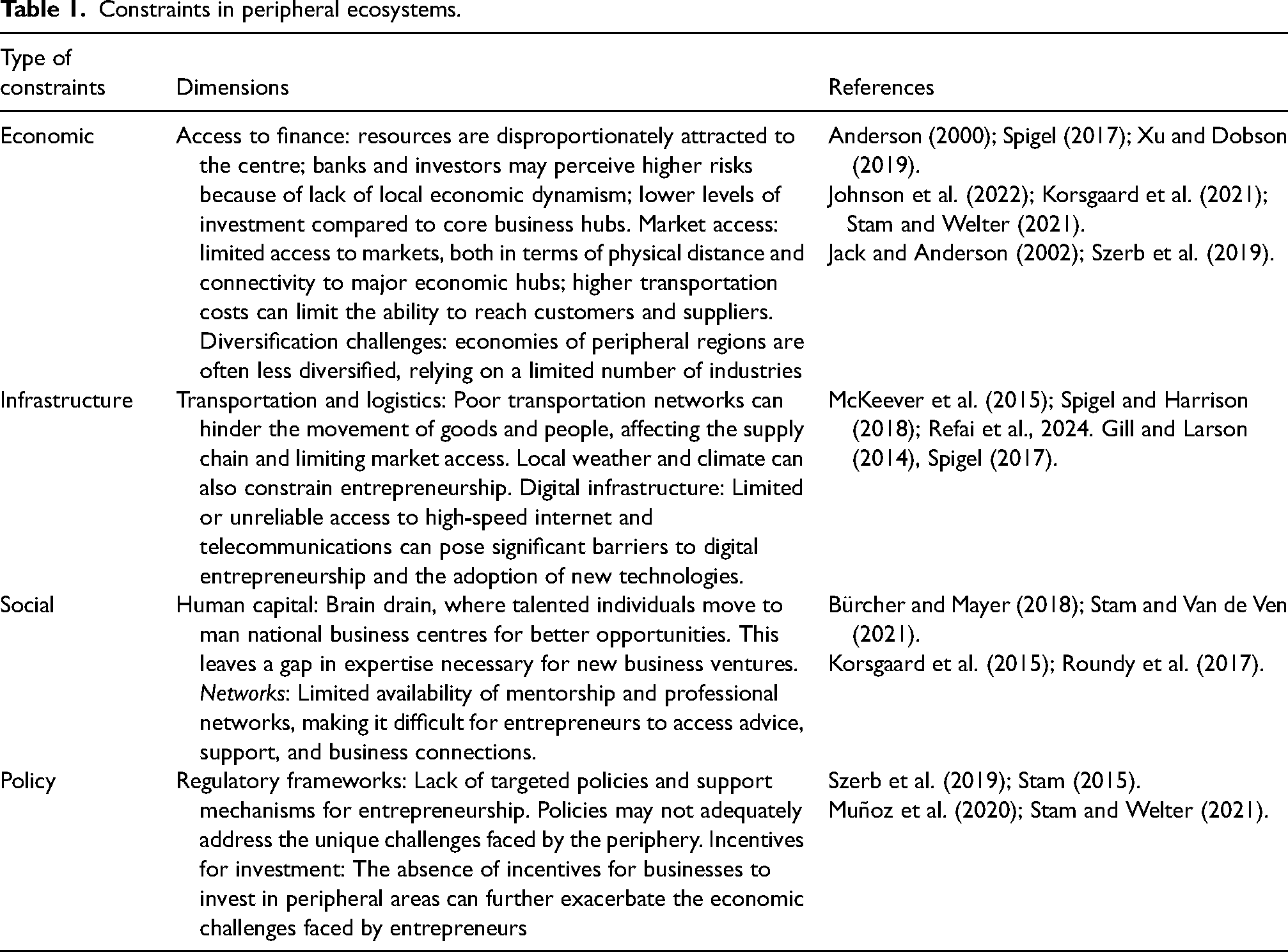
Extant work has thus established that ecosystems can constraint entrepreneurship, for various structural level reasons. Scholarship to date has focused on identifying how and why ecosystems constrain entrepreneurship at the level of structuration (see Stam and Welter, 2021; Welter and Baker, 2021).
What about agency?
However, less work has considered the agentic part of the structure/agency interplay. Put simply, we know lots about why structural contexts constrain entrepreneurs in them, but we know less about how entrepreneurs in constrained contexts react to the contexts around them agentically, via action. This lack of focus on agency is problematic and means ‘the field is limiting itself from recognising … and understanding the importance of the agentic role of entrepreneurs who navigate multiple constraints’ (Refai, 2024: 181). This is not to say that agency has been totally neglected in extant work (see, for example, Melin and Gaddefors, 2023 and McMullen et al., 2021). However, it is to say that agency requires more empirical and theoretical focus, so that the forms agency takes, the motivations for agency occurring and the implications of agency happening in particular structural contexts can be better contextualised.
Social scientists have defined agency broadly, as ‘a temporally embedded process of social engagement’ (Emirbayer and Mische, 1998: 962). A long list of terms have become associated with the concept including motivation, will, purposiveness, intentionality, choice, initiative, freedom and creativity. Within the context of entrepreneurship, agency refers to social engagement rooted in the ability and actions of entrepreneurs to identify, seize and implement new business opportunities (Shane and Venkataraman, 2000). Agency encompasses the initiatives and decision-making processes through which entrepreneurs mobilise resources, develop innovative ideas, and transform them into marketable products or services. These agentic actions are often characterised by risk-taking, creativity and the ability to recognise and exploit opportunities in a dynamic economic environment.
McMullen et al. (2021) identify two characteristics of entrepreneurial agency which distinguishes it from human agency in general. First, entrepreneurial agency is essentially cooperative by nature, because it requires the consideration of customers’ preferences in relation to entrepreneurs’ agentic actions. Second, entrepreneurs, through their agency, introduce novelty into the entrepreneurial ecosystem around them by providing creative, innovative and appealing offerings, thus disrupting the status quo. As we show, agency also sees entrepreneurs perform actions that challenge the structural level constraints that arise in the ecosystems in which they are embedded. This agency is cooperative not just at the ‘customer’ level but also at a collective entrepreneurial level, as it requires action and collaboration among multiple actors in a given ecosystem.
We noted earlier that work to date has focused on structure rather than agency. When work has looked at entrepreneurial agency in ecosystems that cause structural level challenges that entrepreneurs must try and challenge through their agency, salient empirical findings into what agency occurs have been presented. We build on this work. McKeever et al. (2015) ethnographically investigated entrepreneurs in two socio-economically depleted ecosystems based in the northwest of Ireland. They show how strong social bonds and deep affinity to community have been agentically negotiated in the ecosystems. This enables entrepreneurship to occur in these ecosystems despite the lack of opportunities and resources within them. Korsgaard et al. (2021) focus on two Danish peripheral ecosystems. They show how entrepreneurs agentically use storytelling, local sourcing and community involvement to compensate for the lack of resources that exists in the ecosystems in which they are embedded. Xu and Dobson (2019) explore an entrepreneurial ecosystem rooted in the digital gaming sector based in Guildford, UK. Though facing various challenges such as remoteness and lack of resources, the authors suggest that local entrepreneurs are in the process of agentically building a unique entrepreneurial ecosystem through collaborative approaches with each other, thus shaping the structure around them in a way which accommodates their particular, industry-specific need and aspirations.
With a focus on Deserttulip in Jordan, Refai et al. (2024) show entrepreneurs overcoming constraints their ecosystem creates for them; for example, by engaging in entrepreneurship in ways that reduce water consumption in a desert climate, where water is scarce and an ongoing constraint. Looking at the extremely constrained context entrepreneurs faced in the wake of the COVID 19 pandemic, Sarker and Mateus (2024) show how collaborative entrepreneurial agency expressed itself through digital technologies. This allowed entrepreneurs to respond to the COVID crisis through agility and despite their physical separation. A novel finding in Sarker and Mateus’ study relates to the ‘make do’ cognitive attitude that underpinned the agency identified. We return to this notion later, in mind of findings we found on agency linked to the cultivation of a particular mindset. Markowska and Lopez-Vega (2018) consider how agency expresses itself in a Spanish Wine region through storytelling. The agency identified is rooted in local winepreneurs actively engaged in storytelling, to give their customers narratives that are conducive to entrepreneurship unfolding.
The articles discussed above show how diverse and innovative agency is, as it occurs in different ecosystems. However, as the authors above indicate, more work is needed to better explore how and why typologies of entrepreneurial agency occur in particular ecosystems. Against this backdrop, our analysis unfolds.
Methodology
To answer the research question what sort of entrepreneurial agency occurs in the ecosystems of Newcastle Upon Tyne (UK) and Perth (Australia)? we took a qualitative approach. We conducted qualitative interviews with relevant entrepreneurs. Primarily, we are interested in answering our research question from the first-person perspective of entrepreneurs located in the ecosystems we study. We do not research agency as something to be measured or counted. We do not reduce agency to statistics. Instead, as a unit of analysis, we are interested in agency as something expressed and conceptualised by entrepreneurs, through their actions. To employ Gartner and Birley's (2002) methodological distinction, we study agency as something to be investigated in terms of how and why it unfolds, rather than as something to be measured, with a view to how many times it happens (Gartner and Birley, 2002). We concur that ‘action, as opposed to opportunity, should be the unit of analysis in entrepreneurship’ (McMullen et al., 2021: 1215; see also Dimov, 2011). The agency we study is the manifestation of actions which entrepreneurs display as they attempt to overcome the structural level constraints around them and give their ventures the best chances of growing or surviving.
Our approach to studying entrepreneurial agency qualitatively is in line with the methodological approach adopted by others who have investigated entrepreneurial agency. McKeever et al. (2015) utilised an ethnographic approach, which included observations and interviews, to study agency. Korsgaard et al. (2021) and Markowska and Lopez-Vega (2018) used qualitative interviews to get an insight into agency. Xu and Dobson qualitatively analysed secondary data, and Sarker and Mateus (2024) qualitatively analysed online cases. These studies benefitted from investigating agency through a qualitative approach, as the approach allowed a rich, textual understanding of agency to unfold, which is founded on the experiences of entrepreneurs who have themselves practiced agency.
Phenomenology
More specifically, we build on extant work investigating agency through a qualitative lens by employing a phenomenological approach to analyse agency. Phenomenology ‘allows for the unearthing of phenomena from the perspective of how people interpret and attribute meaning to their existence’ (Frechette et al., 2020: 1). In our case this refers to the unearthing of how entrepreneurs interpret and attribute meaning to their own agency, as it manifests via actions, in the ecosystems they inhabit. Phenomenology is an underutilised but a potentially highly valuable approach in entrepreneurship research because it allows the nuances and subjectivities of the lived dimensions of entrepreneurship to be articulated by entrepreneurial actors and contextualised by scholars working with phenomenological voices to iteratively present findings (Berglund, 2007). Phenomenology is focused on getting a deep, contextual understanding of how an aspect of entrepreneurship is lived and experienced from a relatively small number of actors. Our use of phenomenology – as our next section considers further – saw us ask relevant actors open-ended questions that encouraged them to articulate and reflect on how and why they practiced agency in the structural contexts they exist within.
Phenomenology has been applied successfully in previous studies to show how entrepreneurs interpret the structural contexts around them (Jack and Anderson, 2002; Korsgaard et al. 2021; McKeever et al. 2015). But phenomenology has not been used to consider entrepreneurial agency to the same degree. Our use of phenomenology helps us understand the ‘agency’ component of the structure/agency interplay, thus complimenting extant analysis.
However, phenomenology is open to criticism as a method. The phenomenological interviews we conducted took place with a relatively small number of respondents, in the belief that quality of data (by which we mean nuanced, in-depth data given by a smaller number of respondents) is more important than quantity of data (given by a larger number of respondents). This is typical of a phenomenological approach. Yet others lament phenomenology as a method. Small sample sizes are assumed to lack generalisability, while larger sample sizes are seen to be more rigorous and ‘valid’ (Berglund, 2007). How can findings on an aspect of entrepreneurship be definitive when based on such a small cohort of interviewees? Such critics see phenomenological data as anecdotal rather than a product of ‘rigour’. We present findings based on phenomenological voices that we feel are valid despite this criticism. We celebrate the richness of the voices we present and their ability to demonstrate how and why agency is lived and experienced at a deep, individual level. We do not see the smallness of our sample – or the smallness of other samples used in phenomenological research more broadly – as a weakness but, rather, as a strength. Like other phenomenologists, we forego a large sample size for highly lucid qualitative data given by salient entrepreneurs who have first-hand experience of the phenomenon we research.
Data collection
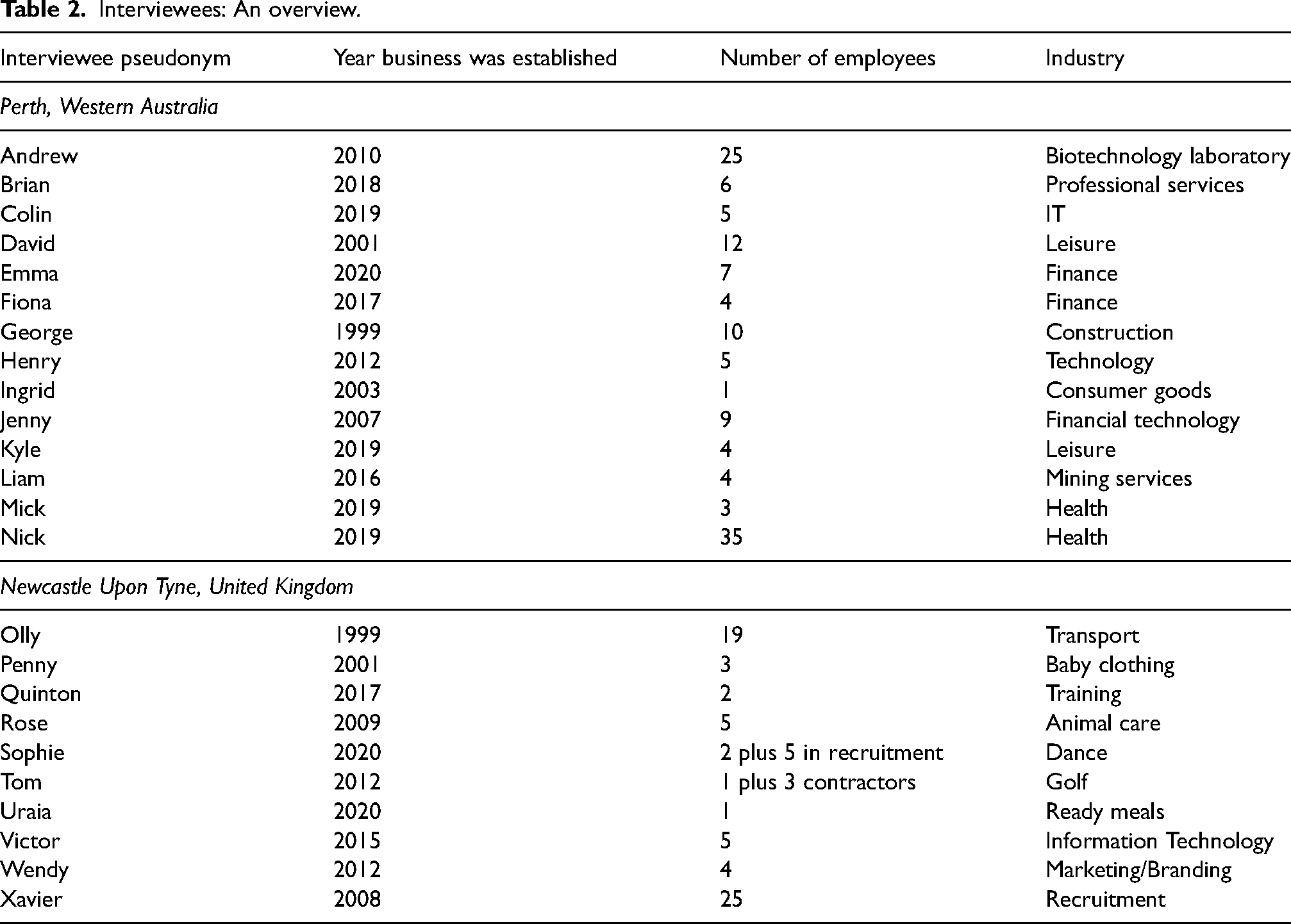
To collect phenomenological data on how and why agency is lived in the ecosystems, we conducted 24 semi-structured interviews. Interviews allowed entrepreneurs to articulate their personal, subjective experiences of being embedded in specific contexts, and how – through active agency – they have attempted to grow and establish businesses. A sample of 24 interviewees was established after the researchers asked entrepreneurs they know to take part in interviews. The authors live or have lived in one of the ecosystems studied for multiple years and have interacted with entrepreneurs in the ecosystems in previous research projects. They utilised their extensive local networks to identify entrepreneurs in the ecosystems to participate in the project. We stopped interviewing having interviewed 10 in Newcastle and 14 in Perth because, at this point, the authors had an abundance of phenomenological data on agency and repeated, consistent evidence that agency around ‘networks’ and ‘cognition’ are a significant feature in both ecosystems. Thus, at this point the researchers felt confident they could develop data they’d captured iteratively and inductively, to present findings grounded in interview data. Table 2 gives further details about our interviewees.
Interviewees: An overview.
We followed an interview template during interviews. The template was used to structure and guide interviews. During interviews, we allowed and encouraged interviewees to talk at length on how they experience the structural context around them and – most importantly to us – how they agentically relate to and overcome structural level constraints. We used open-ended questions in interviews. This allowed for phenomenological data to be expressed in interviews. In this way, the lived, experiential aspects of agency were articulated by relevant actors. This approach is in line with Cope's (2005: 176) recommendations of gaining ‘first-person’ data from interviewees: The goal of the phenomenological interview is to gain a first-person description of some specified domain of experience, where the course of the dialogue is set largely by the participant … The role of the interviewer is to provide a context in which participants feel free to describe their experiences in detail.
Data analysis
Data analysis occurred over stages. Stage 1 involved us transcribing all data recorded in interviews. We treated each transcribed interview as an individual case. We read the entire set of cases as part of a sense-making process. Stage 2 saw all coauthors code the transcripts, ordering data into first-order and second-order themes. This coding was centred on understanding how entrepreneurs in the ecosystems studied perceive the structural contexts around them. We used Skype to meet virtually and discuss which codes we felt best encapsulated the data. There was little conflict in terms of the research term agreeing which codes should be employed to encapsulate how the ecosystems are experienced. Figures 1 and 2 visualise the themes our coding structures revealed about how the ecosystems are experienced.
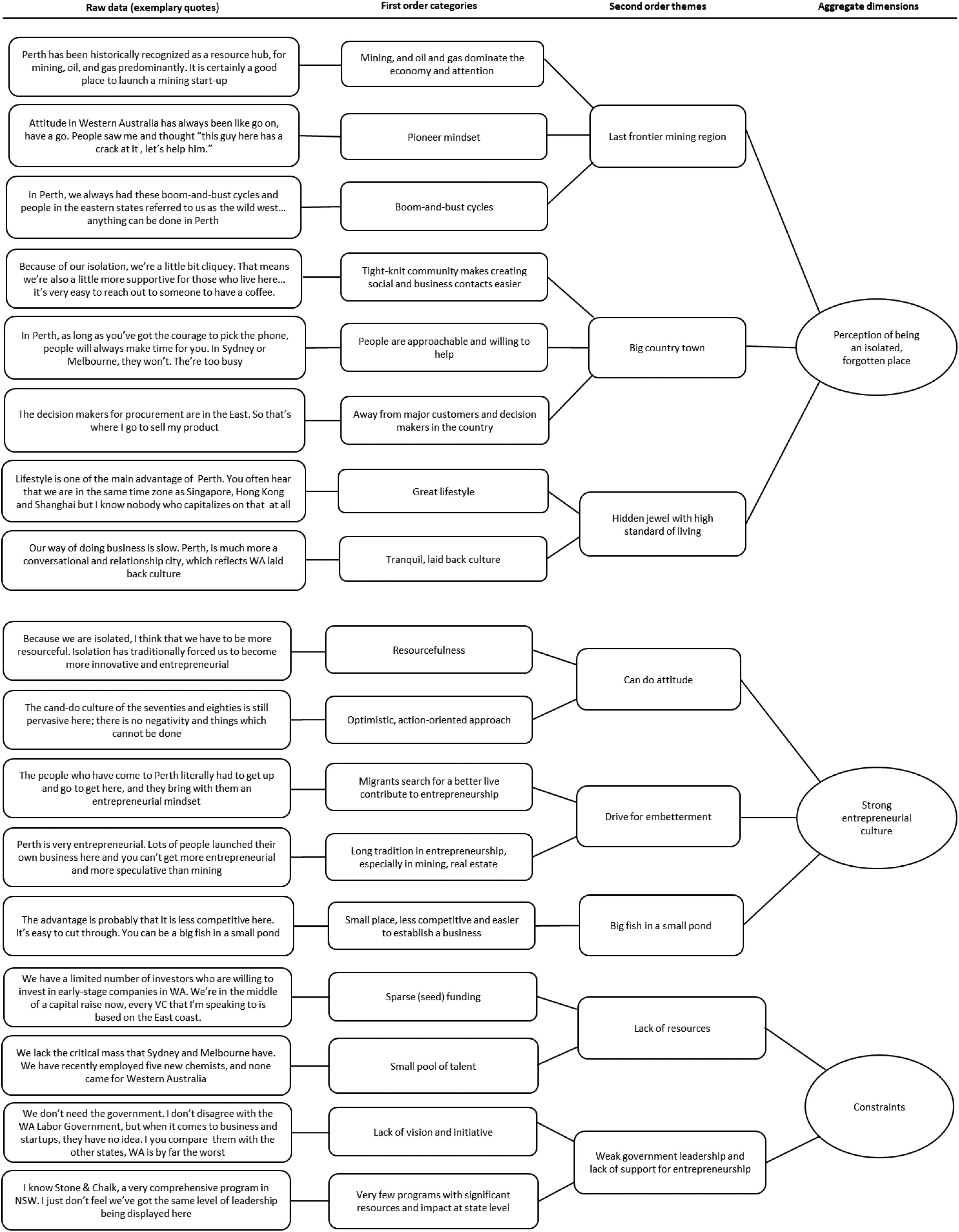
Coding structure for Perth.
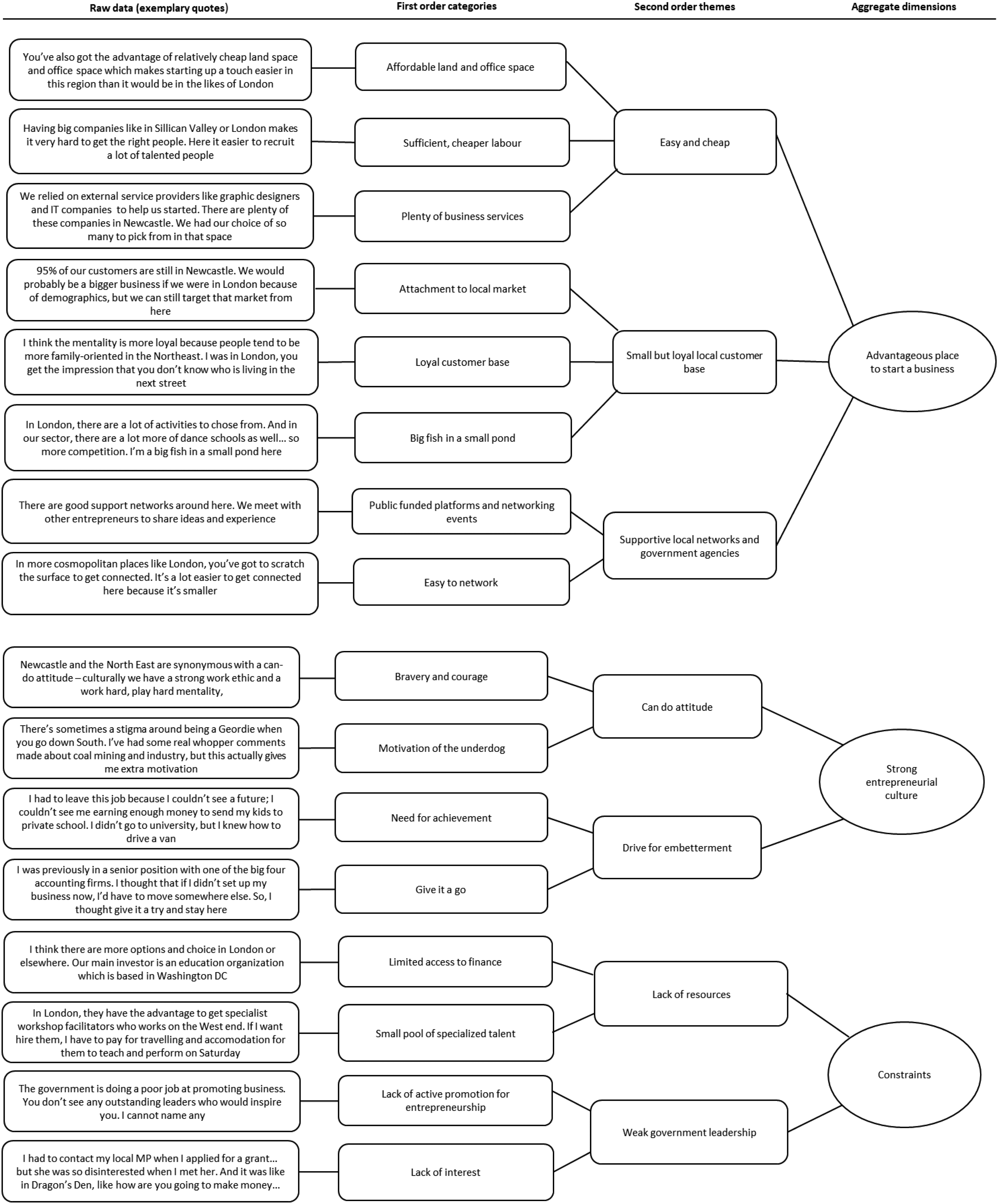
Coding structure for Newcastle.
The next stage of analysis saw us study the theme of entrepreneurial agency, as such, was expressed phenomenologically in the cases. After stage two of the analysis, it was apparent that a lack of finance (economic capital) and a lack of suitable people to employ when pursuing growth (human capital) were constraints that both ecosystems impose on interviewees (see also Anderson, 2000; Bürcher and Mayer, 2018; Stam and Van de Ven 2021 who also found these specific human and economic factors to constrain entrepreneurship in peripheral structural contexts). In stage 3 of the analysis, we wanted to explore how entrepreneurs react to these constraints via agency. We understood agency, as discussed in our literature review and following McMullen et al. (2021), as intrinsically linked to entrepreneurial action. Any examples of agency we saw in transcripts were identified. Phrases like ‘I do’, ‘I did’, ‘we implemented’, and ‘we planned’ were typically used in interviews to refer to and prelude examples of agency.
Having identified all examples of agency expressed in interviews, we met on a number of occasions to discuss what the examples of agency we revealed could tell us in terms of answering our research questions. In turn, we identified two primary findings on entrepreneurial agency inherent in our data. We identified these two findings as they are the most commonly expressed in both ecosystems and were also talked about in the most detail during interviews. First, that entrepreneurs in both ecosystems have agentically cultivated strong local business communities and must agentically engage with these networks. Terms like ‘acting with other entrepreneurs’, ‘being connected into the local entrepreneurial network’ and ‘bouncing ideas and things off other businesspeople in the area’ were associated with this typology of agency. Second, we identified phenomenological evidence which shows that entrepreneurs in both contexts have agentically developed strong cognitive views of themselves as entrepreneurs, with distinctive mindsets and mentalities that make them determined to succeed in business and participate in entrepreneurship in sometimes unusual industries and with somewhat unconventional styles. Words like ‘mindset’, ‘mentality’ and ‘attitude’ were used by interviewees to give context to this typology of agency.
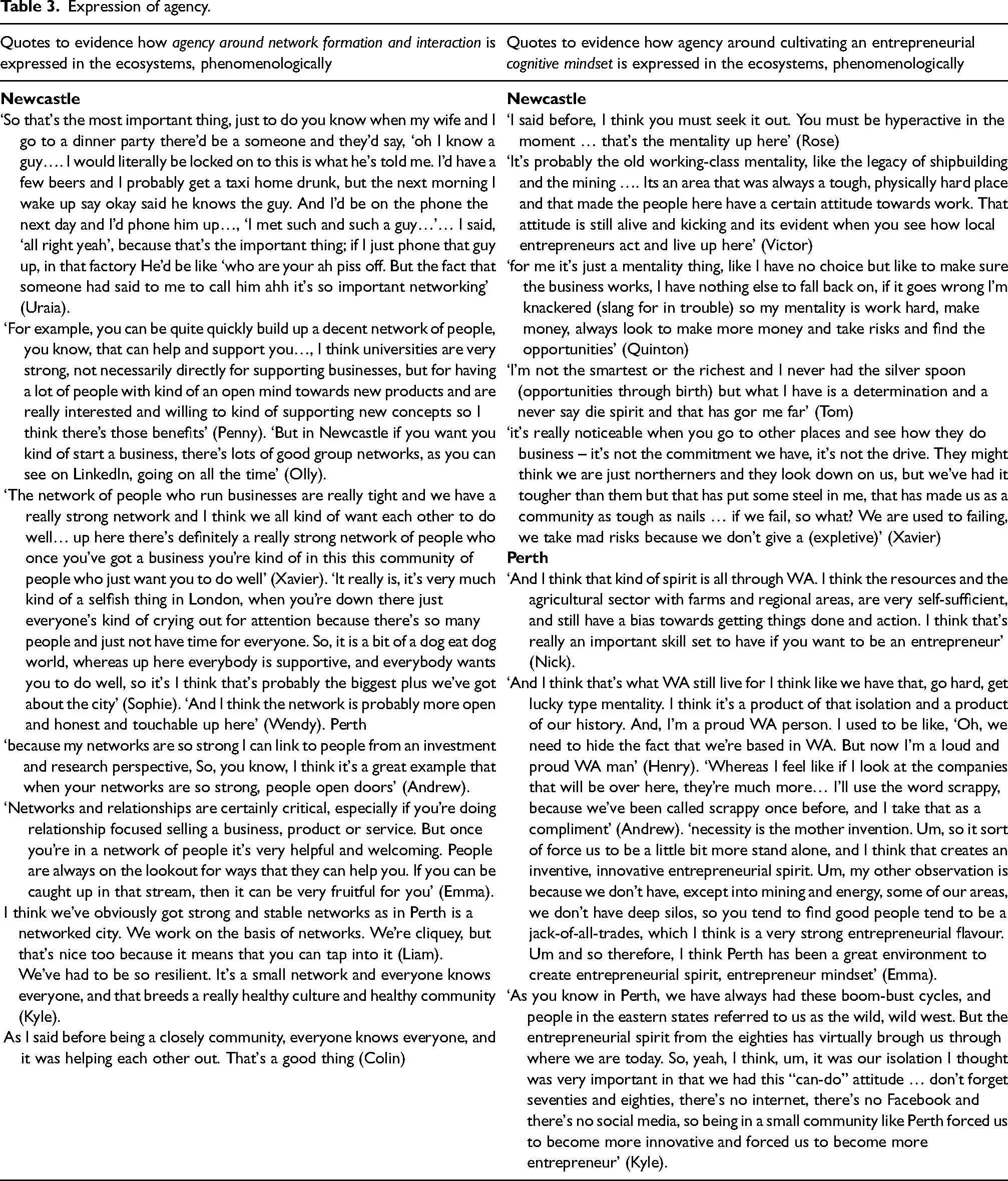
We did not expect or anticipate these findings. We had no prior assumptions about what interviewees would say. We were struck by how strongly both typologies of entrepreneurial agency were articulated in both ecosystems. In our fourth stage of analysis, we grouped direct quotes given in interviews (raw data) to show how these two typologies of entrepreneurial agency are phenomenologically articulated. Well spotted some relevant quotes in a table (Table 3), thus bringing our findings into agency to ‘life’, using the voices of those we interviewed.
Expression of agency.
Findings
Table 3 reproduces raw data in the form of selected quotes directly given by interviewees, which reveal how interviewees phenomenologically define and understand their agency in relation to network engagement and formation, and the cultivation of a particular cognitive mindset. We then present findings, outlining how each ecosystem is experienced, phenomenologically, as a structural context and how entrepreneurs in the ecosystems agentically respond to these structural level constraints.
How is Perth experienced as an ecosystem?
Perception of being an isolated, forgotten place
The most prevalent factor in phenomenologically experiencing Perth as an entrepreneurial ecosystem according to interviewees is the perception of being located in an isolated, forgotten place. Entrepreneurship in the ecosystem feels disconnected from the main national entrepreneurial ecosystems of Melbourne and Sydney. As Colin put it: ‘people in the eastern states referred to us as the wild, wild west’. Interviewees identified a lack of funding, a lack of talented local workers to recruit and a local government that seems unenthusiastic about supporting entrepreneurship locally as defining Perth as an ecosystem, with these factors constraining entrepreneurship in it. Mining was mentioned by all interviewees as the hallmark of Perth economy, with the implication that ‘Perth is a very good place … If you were launching a mining startup’ (Fiona), but outside of mining, the ecosystem is seen as problematic.
Agentic responses
Local networks and networking
These structural conditions drive entrepreneurs to the ecosystem to agentically ‘stick together’ (Brian), ‘help each other’ (Fiona) and ‘build a strong business community’ (Nick) – or network – in which ‘everyone knows each other’ (Brian) and ‘we are one not but many with strength in numbers and unity’ (Liam). There is a feeling that in Perth's ecosystem, entrepreneurs are more ready to ‘help each other out’ (Fiona) in comparison to big, established entrepreneurial ecosystems, with Melbourne being cited as an example of the latter. In Perth, entrepreneurs have actively, agentically created a tight-knit community. It is easy and beneficial to engage with this network. Entrepreneurs in the ecosystem are generally approachable and supportive. As put: Networks and relationships are certainly critical, especially if you’re doing relationship focused selling a business, product or service. But once you’re in a network of people it's very helpful and welcoming. People are always on the lookout for ways that they can help you. If you can be caught up in that stream, then it can be very fruitful for you. (George) I think we’ve obviously got strong and stable networks as in Perth is a networked city. We work on the basis of networks. We’re cliquey, but that's nice too because it means that you can tap into it. (Brian)
Cognitive mindset
Phenomenological data shows entrepreneurs in Perth's ecosystems have agentically developed a particular cognitive mindset that allows them to participate in a style and form of entrepreneurship. There is a ‘can-do attitude’ (Brian) in Perth, which exists as a cultural norm among the ecosystem's network of entrepreneurs. Entrepreneurs in Perth we interviewed feel they are ‘very resourceful, we have to be out here’ (Henry) and are willing to participate in forms and styles of entrepreneurship that may be eschewed in other ecosystems: I feel that if you look at the startups over here, they’re more much more… I’ll use the word scrappy, because we’ve been called scrappy before and take that as a compliment … We’re much more willing to have a go and say, well, we’ll build it ourselves. (Andrew) I really think that the ecosystem in Perth, has got a little bit of a maverick feeling about it. (Jenny) We never say die. We always keep going. (George)
The ‘scrappy’, ‘maverick’, ‘never say die’ mindset that has been agentically constructed and reproduced in Perth is, phenomenologically, discussed as a derivative of the ecosystem's geographical placing and ethnohistory: I think that kind of spirit is all through WA. I think the resources and the agricultural sector with farms and regional areas, are very self-sufficient, and still have a bias towards getting things done and action. I think that's really an important skill set to have if you want to be an entrepreneur. (Nick) that's what WA still live for I think like we have that, go hard, get lucky type mentality. I think it's a product of that isolation and a product of our history. And, I’m a proud WA person. (Henry) necessity is the mother invention. Um, so it sort of force us to be a little bit more stand alone, and I think that creates an inventive, innovative entrepreneurial spirit. Um, my other observation is because we don’t have, except into mining and energy, some of our areas, we don’t have deep silos, so you tend to find good people tend to be a jack-of-all-trades, which I think is a very strong entrepreneurial flavour. Um and so therefore, I think Perth has been a great environment to create entrepreneurial spirit, entrepreneur mindset. (Emma)
How is Newcastle upon Tyne interpreted as an ecosystem?
A legacy of ‘anti-entrepreneurship’
Interviewees perceived Newcastle as an ecosystem where there has traditionally been a reluctance and ‘lack of appetite’ (Olly) for entrepreneurship to occur. One even suggested Newcastle is ‘anti-entrepreneurship’ (Rose). Other contexts have also been perceived and described as places where a ‘spirit’ for entrepreneurship does not exist or is dimmed, such as some of the places in the central and eastern European countries described by Ireland et al. (2008) that are adapting to a capitalist culture having previously been Communist states. This notion of ‘anti-entrepreneurship’ in Newcastle was explained not in relation to communism, as above, but in relation to the area's industrial past, and propensity for people to enter paid employment, not self-employment. I think there's a massive nine to five mindset or be unemployed, but there are a small number of individuals who are innovative and do want to try new things. (Sophie) a lot of people want to see exciting new start-ups in the Northeast space, but yeah traditionally it hasn’t been a thing. I think, culturally it's still, well, like our parents, for example, or aunties and uncles doing a start-up business was never even on the radar for them. For them they just go to work at the nearest company, and they stay there their whole life. So it's not culturally ingrained but it is an up and coming thing. (Penny) it's a wage mentality – they went down the pits (coalmines), worked, got paid, then got pissed (drunk), repeat for forty years, retire and die. There is still that mentality, they just don’t have the pits anymore, that means people like us (entrepreneurs) are almost aliens around here. (Tom)
In addition, the entrepreneurs we interviewed identified two main constraints existing in Newcastle's ecosystem: limited sources of financing for them to ‘tap into’, and a small pool of specialised talent, meaning employing people who are able to help businesses grow is problematic. Newcastle's context was contrasted with London's, where these limitations are not perceived to exist to the same extent. Interestingly, these constraints are similar to those entrepreneurs identified in Perth.
Agentic responses
Cognitive mindset
Our data shows that entrepreneurs based in Newcastle we interviewed have agentically responded to the structural context around them – and given their business the best chance of growing despite structural constraints – by doing two things in terms of ‘action. First, they have agentically cultivated a ‘can-do attitude’ and a strong internal drive to achieve in business. This attitude is often associated, phenomenologically, with Newcastle's industrial past and working-class heritage. Culturally we have a strong work ethic and a work hard, play hard mentality and that helps a lot in business. (Tom) Newcastle has always been a working-class town with the ships and the mines, and it's still a poor place. So, I guess out of that comes creative people and people looking for ways to make money. (Rose) I’m working-class and a lot of us have now embraced a culture of entrepreneurship. (Quinton)
Strong local business community
Second, entrepreneurs in Newcastle have cultivated a strong local business community, giving local entrepreneurs ‘easy access’ to others. This network was described as follows: ‘The network is probably more open, honest, and touchable up here … It's a smaller market, so you get to know more people and the relationships are kind of deep rooted’ (Victor). The social ties between entrepreneurs in the ecosystem are perceived as strong. This facilitates information exchange and business dealings. ‘There are lots of good networks in Newcastle. I regularly attend the events organised by the entrepreneur forum’ a big network of people who are starting a business or who are currently running a business. You can share ideas, experiences, all sorts of things, which is very helpful for a startup like us’ (Sophie).
The necessity to agentically network in the space – while also finding acceptance in local networks – to create opportunities is expressed lucidly below: So that's the most important thing, just to do you know when my wife and I go to a dinner party there’d be a someone and they’d say, ‘oh I know a guy…. I would literally be locked on to this is what he's told me. I’d have a few beers and I probably get a taxi home drunk, but the next morning I wake up say okay said he knows the guy. And I’d be on the phone the next day and I’d phone him up…, ‘I met such and such a guy…’… I said, ‘all right yeah’, because that's the important thing; if I just phone that guy up, in that factory He’d be like ‘who are your ah piss off. But the fact that someone had said to me to call him ahh it's so important networking. (Uraia)
Discussion
In this study, we have looked at expressions of entrepreneurial agency in two ecosystems. In each ecosystem, particular structural level constraints exist for entrepreneurs embedded in them. We have shown how entrepreneurs attempt to overcome these constraints via agency. By so doing, we have responded to calls for empirical insights into the agentic aspects of the structure/agency/entrepreneurship interplay to unfold. We have shown that entrepreneurs are not passively located in their ecosystems and forced to accept structural level constraints, as inactive recipients and ‘cultural dopes’. Rather, we have shown entrepreneurs to be active agents, who are pushed into agentic action because of their structural context and who, via their agentic action, shape the structural context around them (and for others) and cultivate a cognitive mindset conducive to entrepreneurship.
In both of the ecosystems we studied, the type of agency we found is remarkably similar. Strong entrepreneurial communities and networks exist in Perth and Newcastle, according to the phenomenological voices of those we interviewed, and these networks emerged through collective agentic action. Significantly, other studies that examine entrepreneurial agency in peripheral ecosystems have also pointed to the proclivity for close-knit entrepreneurial networks to emerge in challenging structural contexts (e.g. Korsgaard et al. 2021; McKeever et al., 2015; Xu and Dobson, 2019). We suggest the agentic formation, interactions and reliance on networks of other entrepreneurs in marginal, constrained ecosystems are not random and coincidental. Instead, it is a product of systematic, purposeful agency practiced by collectives of entrepreneurs who recognise the need for close-knit networks to be established. This is not to suggest that entrepreneurs in all marginal ecosystems create localised networks via agency. Indeed, Korsgaard et al. (2015) and Roundy et al. (2017) both show that a lack of entrepreneurial communities and networks impairs entrepreneurship in the contexts they study. But it suggests that if networks can be agentically formed in marginal ecosystems, entrepreneurs have a better chance of realising growth despite structural level constraints.
Further, the novel empirical finding we identified relates to the particular mindset that entrepreneurs in the studied structures have agentically cultivated. In both ecosystems, entrepreneurs pride themselves on a ‘hard working attitude’ and their ability to participate in ‘scrappy’, sometimes unconventional forms of entrepreneurship. These mindsets are important, heuristic agentic responses. They allow entrepreneurs in the ecosystems to participate in entrepreneurship and not be phased by challenges that – without the right mentality – may, otherwise, seem somewhat insurmountable.
Extant work on entrepreneurial agency has rarely identified how important agency relating to cognition is. An exception is Sarker and Mateus’ (2024) study which shows how a ‘make do’ cognitive attitude underpins the agency they studied as it materialised via digital technologies during the COVID 19 pandemic. We suggest cognitive features of agency – which see distinctive mental states arise – are a significant though currently somewhat hidden and understudied dimension of the entrepreneurial structure/agency interplay.
More broadly, our findings are relevant to the emerging body of work that considers collective agency (Ben-Hafaïedh et al., 2024; McMullen et al., 2021). Collective agency is, ontologically, not interested in the actions of individual, lone entrepreneurs. Instead, it is interested in the collective behaviours and choices of entrepreneurs in space and time, and seeing how this collective agency translates to a wider entrepreneurial action. Reflecting on the two cases we studied, we encourage readers to see the agency we identified as a collective agency which – though channelled through individuals – sees a critical mass of entrepreneurs in the ecosystems agentically commit to establishing and maintaining networks and cultivating mentalities that mean the structural contexts that the entrepreneurs exist in are not able to constrain entrepreneurship to the extent they would, without collective agency occurring. Agency is contingent on multiple actors operating symbiotically.
Conclusion
To conclude we make suggestions about how future scholarship can build on our contribution. First, we encourage scholars looking at entrepreneurial agency to pay closer attention to how the ethnohistory of an ecosystem shapes agency in that context. Our study into agency has emphasised how mining has shaped both ecosystems we study. In this regard, we have shown how mining is intrinsically related to agency, via a willingness to participate in types of ‘scrappy’, sometimes unconventional forms of entrepreneurship and with a distinctive work ethic. Looking to the past – to see what cultural norms existed in a context – allows better understanding of how and why agency present manifests itself in that context in the present. Thus, we call for work that takes an explicitly historical focus to see how past cultural events shape entrepreneurial action (e.g. Giazitzoglu and Wilson, 2023). Research methods can be attuned to take a context's ethnohistory into account when studying entrepreneurship in the present more directly. For example, studies that employ qualitative interviews like ours can explicitly ask entrepreneurs if and how past ethnohistories linked to ‘their’ place impact their entrepreneurial action in the current.
Second, we encourage longitudinal studies into agency to emerge. Although these longitudinal studies will, by definition, take time to materialise, they will shed light on how, precisely, agency at one point in time comes to impact an ecosystem, at a later point. In this regard, we are especially keen to see generational studies emerge, which show how the agency of one generation impacts the entrepreneurial context faced and agency displayed by future generations. Through longitudinal research, time, chronology and agency can be seen as ongoing continuums in an ecosystem. As noted by Wurth et al. (2022: 732) ‘entrepreneurial ecosystems represent a renewed interest in localised conditions for entrepreneurship aligned with a focus on the agency of entrepreneurial actors to create and transform their own contexts’. How (micro-level and collective) agency comes to actually transform a context over time is a question worth pursuing.
Third, we know that female (Marlow and McAdam, 2013) and male entrepreneurs (Giazitzoglu and Down, 2017) encounter different norms and rules in the ecosystems they inhabit. In turn, expressions of agency may be highly gendered. Our interviewees include both male and female entrepreneurs. We found no difference between how agency is expressed at the level of gender. However, gender might be significant in the ways agency unfolds among other entrepreneurs and in other ecosystems. We suggest that future work considers how and why different typologies of entrepreneurial agency are displayed in the lives of male and female entrepreneurs as they agentically respond to the ecosystem(s) around them in gendered ways. For example, women may experience barriers in the form of sexism in the structural contexts around them. How particular forms of agency materialise in response to these structural level variables is an important line of inquiry. Likewise, how variables like immigration (Refai et al., 2023) and ethnicity (Giazitzoglu and Korede, 2023) create rules and norms for entrepreneurs – which impact the way they expression agency – is a line of questioning that should be pursued, with phenomenological voices providing rich insights into these lines of inquiry.
Fourth, our study is iteratively founded on voices captured during interviews. However, agency is observable. It materialises in everyday actions that can be viewed. Thus, we suggest future studies are open to utilising observational-based research to see agency occurs; relying not just on the voices of entrepreneurs to articulate their agency, but also on the observations of researchers, allowing researchers to ‘see’ agency unfolds in a place and time (see, for example, Giazitzoglu et al.'s (2024) observations of ‘cunning’ agentic entrepreneurial actions).
Both of the ecosystems we study, though peripheral for reasons we discussed in our Introduction, are urbanised ecosystems in highly capitalistic, developed western economies. How agency occurs in ecosystems that are of a different typology to those we studied – such as ecosystems in the Global South – provides a further counterpoint that we suggest scholars look at to further understand how structure, agency and entrepreneurship intersect at a lived, qualitative level.
Finally, we want to explore what our empirics mean in terms of policy design and implementation. Numerous policies have been implemented with the aim of bolstering entrepreneurship in given ecosystems, especially peripheral ecosystems. These policies can be seen as part of wider societal efforts to systematically bolster and support regions that are lagging economically, such as the UK's – polemically failed – Levelling Up Campaign, which hoped to grow the British economy through £48bn of funding aimed at regional economies. Though, as pointed out by Dodd and Anderson (2001), there is a paradox at the heart of this policy implementation. Despite the prevalence of policy implementation and the assumption entrepreneurship can act as something of a panacea in economically lagging contexts, implemented policies have shown very little success in terms of fostering entrepreneurship (see, also, Nielsen, 2016).
We suggest that a limitation of policy implementation, as it has been practiced to date, is that it has been designed and prescribed over generically. Policy has tried to reproduce the structural conditions that exist in established ecosystems within less established ecosystems. Policy has assumed that if certain structural-level factors exist in a given place, entrepreneurship will be enabled and fostered within that place. What this means is that policies have been designed in a simplistic, even schematic way, without thought to the localised cultural context and conditions they are being implemented in (see Korsgaard et al., 2021, for an extension of this line of thought). Put another way, policy implementation has over-relied on getting the structural conditions ‘right’ and has neglected the agency of entrepreneurs in a structure.
The analysis presented in this article has shown how agentic entrepreneurs are: they do not need policies to be imposed onto them from the top down. Instead, policy makers should listen to the voices of entrepreneurs in a given space to see how policies can complement entrepreneurs’ agency. In this way, policy should be designed in mind of local cultural norms and in the hope of affirming what is already working. For example, in the contexts we studied, policy should be focused on further cementing the strong local entrepreneurial communities that exist. Only rich qualitative data, like the sort we present here, can establish what type of agency is occurring in a place and, therefore, what type of policy should be designed and implemented in a place in order to support entrepreneurs in it. Thus, we concur with Muñoz et al.'s suggestion that policy be designed and implemented ‘from the ground up’.
Footnotes
Declaration of conflicting interests
The authors declared no potential conflicts of interest with respect to the research, authorship, and/or publication of this article.
Funding
The authors received no financial support for the research, authorship, and/or publication of this article.
