




Abstract
The well-being literature reveals that individuals experience increases in well-being leading up to marriage, followed by a return to pre-marriage levels shortly after marriage. In contrast, the relationship/marriage literature suggests that relationship satisfaction may steadily decline across time. However, it is unclear at what point relationship satisfaction may begin to decline. In the current study, we drew data from a nationally representative sample of diverse-aged adults to examine changes in well-being and relationship satisfaction prior to marriage, shortly after marriage, and post marriage. Data were utilized from 14-years of the New Zealand Attitudes and Values Study (N = 1,520). Participants received annual surveys and reported their well-being (life satisfaction, subjective well-being, belonging) and relationship satisfaction. We examined whether getting married was associated with average within-person changes in well-being and relationship satisfaction across the years before marriage, shortly after marriage, and across the years following marriage. Event-aligned piecewise latent growth models found similar patterns of change across marriage for well-being (life satisfaction, subjective well-being) and relationship satisfaction. On average, well-being and relationship satisfaction increased leading up to marriage, dropped significantly shortly after marriage, and continued to decline following marriage. By integrating well-being and relationship/marriage literatures, these findings provide novel insights that for continuously partnered individuals, the course of well-being and relationship satisfaction change in similar ways leading up to marriage, shortly after marriage, and years following marriage.
Introduction
Marriage has been positioned as a central component to a satisfying and successful life. Research examining well-being consistently reveals that individuals experience increases in life satisfaction leading up to marriage, followed by a return to pre-marriage baseline levels shortly after marriage (see meta-analysis by Luhmann et al., 2012; Clark et al., 2008; Clark & Georgellis, 2013; Lucas et al., 2003). This pattern suggests that increases in well-being associated with marriage may be limited to the years prior to, rather than the years following, marriage.
The pattern of change in relationship satisfaction leading up to and following marriage, however, is less clear. Relationship satisfaction may be high in the early stages of dating as couples are falling in love (Aron et al., 2002; Fisher et al., 2016). However, research focusing on the average trajectory across a sample of married individuals find that people tend to exhibit a steady decline in relationship satisfaction as marriages progress (Glenn, 1998; Karney & Bradbury, 1997; Kurdek, 1999; VanLaningham et al., 2001).
The point during which relationship satisfaction begins to and continues to decline remains unclear because extant longitudinal studies have examined people who are already months or years into their marriage (Glenn, 1998; Huston et al., 2001; Karney & Bradbury, 1997; Kurdek, 1999; VanLaningham et al., 2001) or only assessed and compared satisfaction immediately before marriage to many years after marriage (Lorber et al., 2015; Stanley et al., 2012). We are unaware of any studies that have examined changes in relationship satisfaction in the years leading up to and following marriage. The current study examines how well-being (life satisfaction, subjective well-being, belonging) and relationship satisfaction change pre-marriage, shortly after marriage, and post-marriage.
Marriage and changes in well-being
The theory of hedonic adaption has been used extensively to understand how people adjust to life events (Brickman & Campbell, 1971). According to hedonic adaptation, despite people expecting that some life events will make them happier (e.g., winning the lottery) and other life events will make them more miserable (e.g., becoming poor; Aknin et al., 2009), people have relatively stable levels of well-being even when experiencing these life events. For example, people tend to experience increases in happiness leading up to the birth of their child, but happiness returns to baseline levels shortly after children are born (Clark et al., 2008; Luhmann et al., 2012). Returns to baseline (i.e., hedonic adaptation) may occur because people tend to be inaccurate in assessing what makes them happy and often do not consider other factors involved in presumed “positive” life events (Aknin et al., 2009). For example, although having a child may be accompanied by excitement and meaning, people may underestimate the negative impact of sleep deprivation or relationship conflict that can also occur after the birth of a child, which likely contribute to the return to pre-marital levels of happiness.
Supporting the hedonic adaptation pattern, several studies have tracked within-person changes in well-being (life satisfaction, subjective well-being) before compared to after marriage and suggest that the well-being benefits of marriage diminish as people adapt to married life (Clark et al., 2008; Clark & Georgellis, 2013; Lucas et al., 2003). For example, meta-analytic research provides evidence that well-being increases leading up to marriage but returns to pre-marital levels shortly following marriage and subsequently maintains pre-marital levels over time (see Figure 1, Panel A; Luhmann et al., 2012). People may experience increases in well-being leading up to marriage because this is considered a “honeymoon” phase of relationships characterized by fewer relationship conflicts (Bradbury, 1998), more novel activities as a couple (Girme et al., 2014), and opportunities for self-expansion (Aron et al., 2002). The period prior to marriage may reflect a time in which people have many positive relationship experiences. It is also likely that people become excited about the prospect of marriage because marriage is a socially valued and celebrated milestone that forecasts a happy future (Dennett & Girme, 2024; Finkel et al., 2015). Several traditions are built into society as couples plan their wedding, bring friends and family together to celebrate (e.g., engagement parties), and anticipate a happy life as married partners. Thus, people may exhibit increases in well-being and relationship satisfaction prior to marriage that is influenced by both positive relationship experiences and excitement over the prospect of being married. Illustrations of possible changes in well-being and relationship satisfaction.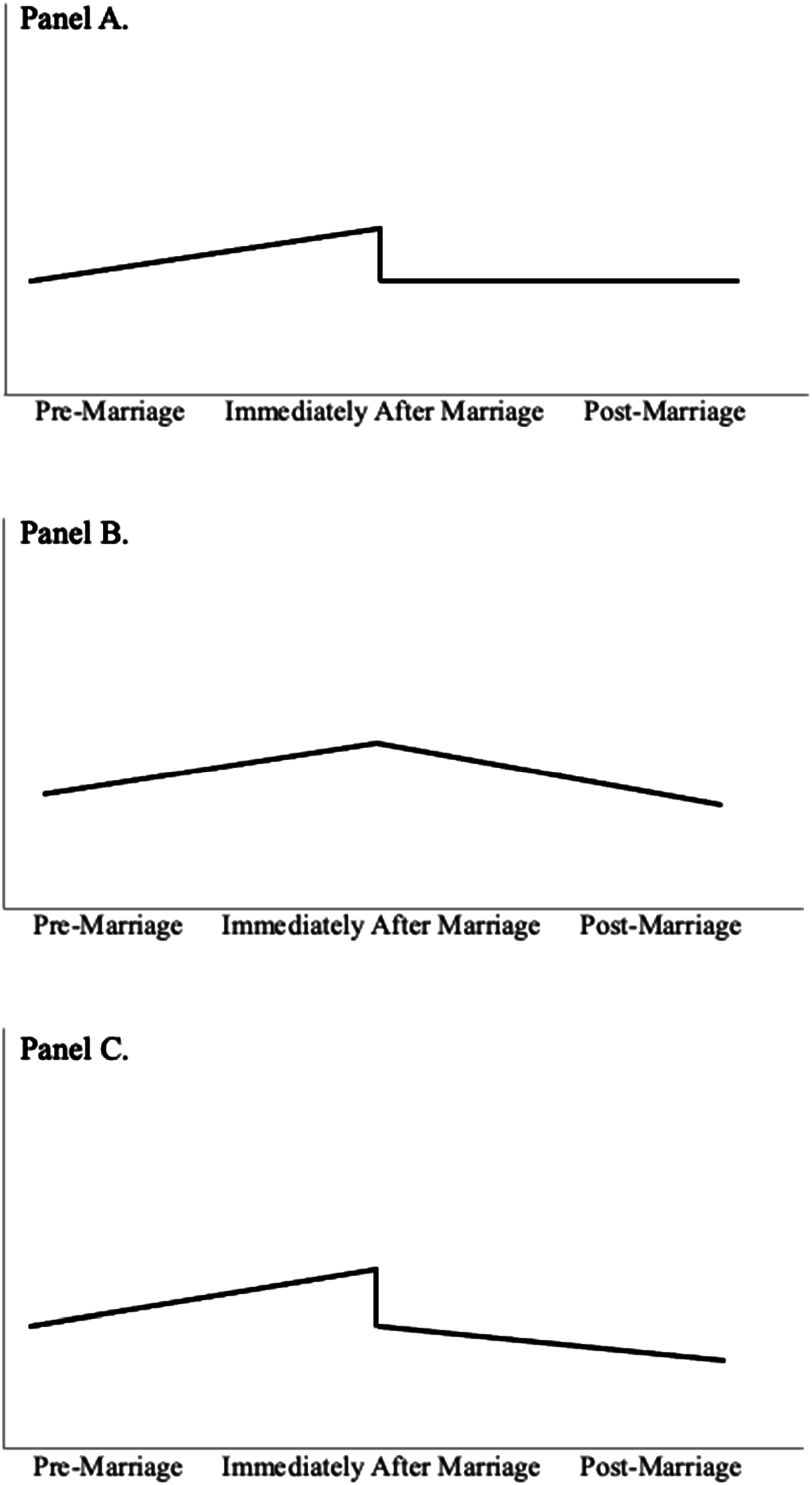
Notably, most studies that have examined well-being changes pre- to post-marriage have not controlled for relationship-relevant factors that may influence well-being, such as number of children or relationship length. Controlling for these factors is important given the robust evidence illustrating that, despite being an incredibly meaningful life experience, the transition to parenthood is accompanied by many challenges that can undermine peoples’ well-being and relationship satisfaction (Carlson & VanOrman, 2017; Luhmann et al., 2012). Transitions to parenthood or increased parenting responsibilities may explain why people tend to experience decreases in life satisfaction following marriage (Kurdek, 1999; Lucas et al., 2003). Similarly, compared to newer relationships, those who have been together longer prior to marriage may have lower relationship satisfaction, which could impact life satisfaction (Kamp et al., 2008; Stanley et al., 2012), or people may have already experienced the well-being boosts of being in a stable relationship some years prior to marriage, resulting in an elevated “baseline” (i.e., initial levels of well-being assessed in this study).
Marriage and changes in relationship satisfaction
In contrast to the breadth of literature examining changes in well-being, no studies (to our knowledge) have examined patterns of change in relationship satisfaction across the years before, shortly after, and the years following marriage. Extant research does suggest that, like well-being, relationship satisfaction is likely higher before marriage (see Pre-Marriage segment in all panels of Figure 1). During the early stages of romantic relationships, individuals experience many positive emotions about the relationship, likely because of the intensity of falling in love (Fisher et al., 2016) and because romantic partnerships fulfill self-expansion needs by offering opportunities to integrate partners’ perspectives, identities, and resources into one’s sense of self (Aron et al., 2002). Further, early on in relationships people have fewer conflicts (Bradbury, 1998), may present themselves more positively (Birditt et al., 2012), and view their partners more positively (Barelds & Dijkstra, 2011), which may promote relationship satisfaction. Relationship satisfaction may be further bolstered by beliefs about marriage. Leading up to marriage, people may hold assumptions about the kind of people they will be (e.g., caring, mature) and the kind of life they will have (e.g., stable finances, strong family bonds) after marriage (Carroll et al., 2009). Indeed, compared to people in a relationship who are not engaged or married, people who are engaged to be married appear to endorse more positive illusions about their relationship (e.g., superior conflict resolution, egalitarian roles; Bonds-Raacke et al., 2001). Thus, the trajectory of relationship satisfaction before marriage may mirror that of well-being as people are experiencing high relationship quality and are optimistic about their future together (see Figure 1, Pre-Marriage segment in all panels).
But what does relationship satisfaction look like shortly after and across the years following marriage? Three possibilities are represented graphically in Figure 1. First, relationship satisfaction may drop significantly shortly after marriage (i.e., within the first year of marriage) and remain at this level in the following years (see Figure 1, Panel A). The immediate drop in relationship satisfaction is in line with the hedonic adaptation pattern observed in well-being trajectories (Luhmann et al., 2012). Furthermore, some studies in the close relationship literature have found that relationship satisfaction may remain stable over time for most people (see Karney & Bradbury, 2020 for a review). For example, research utilizing person-centred approaches has found that two thirds of people who have been married for several months to 30 years maintained high levels of relationship satisfaction across the 20-year study, while only one third experienced consistently low satisfaction (Anderson et al., 2010). A stable pattern may be more likely to be observed when examining people who have remained married, given that those with declining relationship satisfaction may be more likely to divorce (Kanter et al., 2019; Lavner et al., 2012). Thus, consistent with hedonic adaptation patterns observed in well-being trajectories, increased relationship satisfaction before marriage may be followed by a significant post-marriage drop that remains stable in the following years (Figure 1, Panel A).
However, the prevailing view of close relationship scholars has been that, on average, relationship satisfaction among married people tends to steadily decline over time (Karney & Bradbury, 2020). This trend is supported by a breadth of longitudinal research examining average trends across samples of married people (Glenn, 1998; Halford et al., 2007; Huston et al., 2001; Karney & Bradbury, 1997; Kurdek, 1999; VanLaningham et al., 2001).
According to the emergent distress model, married couples face increasing stressors (Bradbury, 1998) that risk increasing conflict and negativity (Finkel et al., 2013; Gottman et al., 1998), which may undermine relationship satisfaction over time, especially if couples do not effectively resolve conflict (Bradbury, 1998; Johnson et al., 2018). Similarly, the disillusionment model proposes married couples experience increasing conflict due to reduced positive illusions and unmet expectations (Huston & Houts, 1998), possibly as couples stop presenting themselves or seeing each other in an overly positive light or cease trying to meet unrealistic ideals (Barelds & Dijkstra, 2011; Birditt et al., 2012). Thus, a breadth of research on relationship satisfaction supports that relationship satisfaction may decline as marriages progress.
What is unclear is whether these declines in relationship satisfaction capture short-lived reductions in satisfaction immediately following marriage or reflect ongoing declines after marriage. Rather than a drop shortly after marriage as in the hedonic adaptation pattern of well-being, relationship satisfaction may show a more gradual declining trajectory as people slowly adjust to new expectations and challenges following marriage, aligning with a “honeymoon-then-years-of-blandness” pattern (Aron et al., 2002). This second possibility is shown in Figure 1, Panel B: relationship satisfaction may increase leading up to marriage and steadily decline following marriage.
Lastly, declining relationship satisfaction could occur following an immediate hedonic adaptation effect. This third possibility is shown in Figure 1, Panel C: a significant post-marriage drop in relationship satisfaction may occur immediately following marriage (hedonic adaptation) which may then be followed by ongoing declines in relationship satisfaction as people face increasing marital stressors (emergent distress and disillusionment processes).
The current research
The current study examines whether marriage is associated with changes in well-being and relationship satisfaction in the years leading up to marriage, shortly after marriage, and in the years following marriage in a sample of continuously partnered people. We drew data from the New Zealand Attitudes and Values Study (NZAVS), which is a nationally representative sample of NZ adults spanning a 14-year period (2009–2023). Because we were interested in examining changes in well-being and relationship satisfaction after marriage compared to before marriage, we identified participants who reported on their relationship prior to entering marriage, got married, and remained married during the study period. Including divorced people would interfere with the aim of the study given that any declines in relationship satisfaction could be driven by distressed relationships that dissolve (Kanter et al., 2019). The current research aims to test whether declines in well-being and relationship satisfaction occur even among those who may be less distressed and remain married.
For participants who married and remained married, we applied event-aligned piecewise latent growth models to assess change in well-being (life satisfaction, subjective well-being, belonging) and relationship satisfaction (1) in the years leading up to marriage, (2) shortly after marriage (i.e., within the first year of marriage), and (3) across the years following marriage. We analyzed all well-being indicators available, including life satisfaction and subjective well-being, which align with the key outcomes examined in the life events and well-being literature, and an additional indicator of belonging that has not been previously examined in the well-being literature. Regarding well-being, we expected the patterns of change to replicate prior findings: (1) increases in well-being leading up to marriage, (2) a post-marriage drop shortly after marriage, and (3) a stable flat trajectory of well-being over time (see Figure 1, Panel A). We aimed to extend extant research by testing whether this pattern would hold even when controlling for important relational factors such as the number of children people have and the length of relationship at time of marriage.
Regarding relationship satisfaction, we explored three possible patterns of change. First, relationship satisfaction may replicate patterns of change in well-being: (1) increases in relationship satisfaction leading up to marriage, (2) a post-marriage drop shortly after marriage, and (3) a stable flat trajectory of relationship satisfaction over time (see Figure 1, Panel A). Second, declines in relationship satisfaction may reflect a more gradual rather than immediate post-marriage drop: (1) increases in relationship satisfaction leading up to marriage, and (2) steady declines in relationship satisfaction following marriage (see Figure 1, Panel B). Lastly, declines in relationship satisfaction may reflect immediate hedonic adaptation and continued declines over time: (1) increases in relationship satisfaction leading up to marriage, (2) a post-marriage drop shortly after marriage, and (3) continued declines in relationship satisfaction following marriage (see Figure 1, Panel C).
Method
Participants
The NZAVS is a longitudinal panel study of NZ adults sampled from the electoral roll, which is publicly available for scientific research and represents all citizens over 18 years of age who are eligible to vote. The first wave of the NZAVS in 2009 included 6,518 participants, but various booster samples have been collected in the following waves of the study to increase sample size and diversity. The NZAVS is reviewed and approved every three years by the University of Auckland. Participants provide informed consent before completing each survey. See https://osf.io/75snb/ for full sampling, procedure, and measurement information.
Online and postal surveys are sent to all active NZAVS participants annually. To be included in the current study, participants must have completed at least 2 consecutive annual waves in which their relationship status shifted from ‘not married’ in one year to ‘married’ the next year, and who then remained married in subsequent waves. Marital status at each wave is coded from responses to the item “What is your relationship status?” (0 = ‘not married’, 1 = ‘married’). At the latest wave completed in 2023, 52,705 participants had completed at least 2 consecutive waves, but 29,745 of those participants were already married when they entered the study. Of the remaining, we included participants whose relationship status remained ‘married’ after shifting from ‘not married’ because including participants who subsequently divorced would interfere with our aims to assess patterns of well-being and relationship satisfaction associated with marriage (Kanter et al., 2019). Moreover, the current modelling approach is not appropriate for on/off/on/off types of change. Note it is possible that included participants could have been married and subsequently divorced before they entered the study so, although we identify the new event of marriage in participants’ lives during the study, not all marriages will represent first marriages. Additionally, examining trajectories of relationship satisfaction prior to marriage could be undermined if participants reported their satisfaction within an earlier relationship that dissolved before the partnership that resulted in marriage. We excluded 105 participants who reported relationship satisfaction for a greater number of annual waves than the relationship length reported at marriage suggesting that some of their earlier waves of relationship satisfaction could have referred to an earlier relationship. 1
Demographic information.
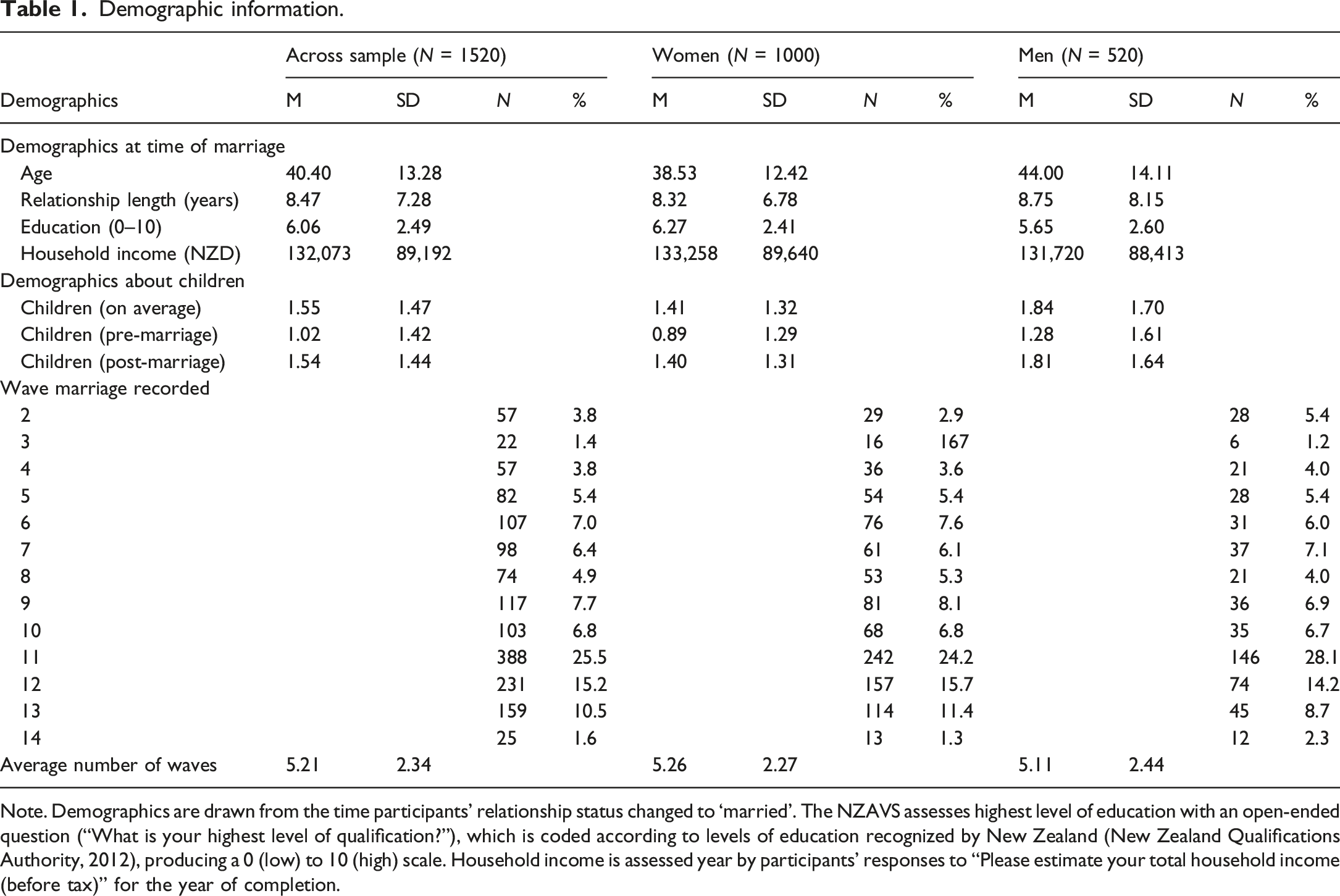
Note. Demographics are drawn from the time participants’ relationship status changed to ‘married’. The NZAVS assesses highest level of education with an open-ended question (“What is your highest level of qualification?”), which is coded according to levels of education recognized by New Zealand (New Zealand Qualifications Authority, 2012), producing a 0 (low) to 10 (high) scale. Household income is assessed year by participants’ responses to “Please estimate your total household income (before tax)” for the year of completion.
Measures
All measures were included within the larger NZAVS questionnaire at each wave of assessment. See https://osf.io/75snb/ for full list of measures. Life satisfaction (ω = .81 to .85) and subjective well-being (ω = .72 to .76) evidenced good reliability across waves, but reliability was lower for belonging (ω = .54 to .64). Notably, all measures included in the current study correspond strongly with longer scales assessing the targeted construct (Sibley et al., 2023) and have been used extensively in prior NZAVS studies assessing relationship processes and well-being (Girme et al., 2022).
Satisfaction with life
Participants rated 2 items developed by Diener et al., (1985): ‘‘I am satisfied with my life’’ and ‘‘In most ways my life is close to ideal’’ (1 = strongly disagree, 7 = strongly agree).
Subjective well-being
Participants rated 4 items indicating how satisfied they were (0 = completely dissatisfied, 10 = completely satisfied) with their “standard of living,” “health,” “future security,” and “personal relationships” (Cummins et al., 2003).
Belonging
Participants rated 3 items generated from work examining the effects of social exclusion versus inclusion (Williams, 2007): “I know that people in my life accept and value me”, “I know that people around me share my attitudes and beliefs,” and “I feel like an outsider” (reverse-coded; 1 = strongly disagree, 7 = strongly agree).
Relationship satisfaction
To minimize participant burden and maximize recruitment, the NZAVS assessed many constructs using single face-valid items, including relationship satisfaction: “how satisfied are you with your relationship with your partner?” (1 = not satisfied, 7 = very satisfied). Psychometric evidence supports the validity and reliability of single item assessments of relationship satisfaction, but test-retest reliability is not as strong compared to multi-item measures (Niehuis et al., 2022).
Results
Correlations for key variables and covariates.
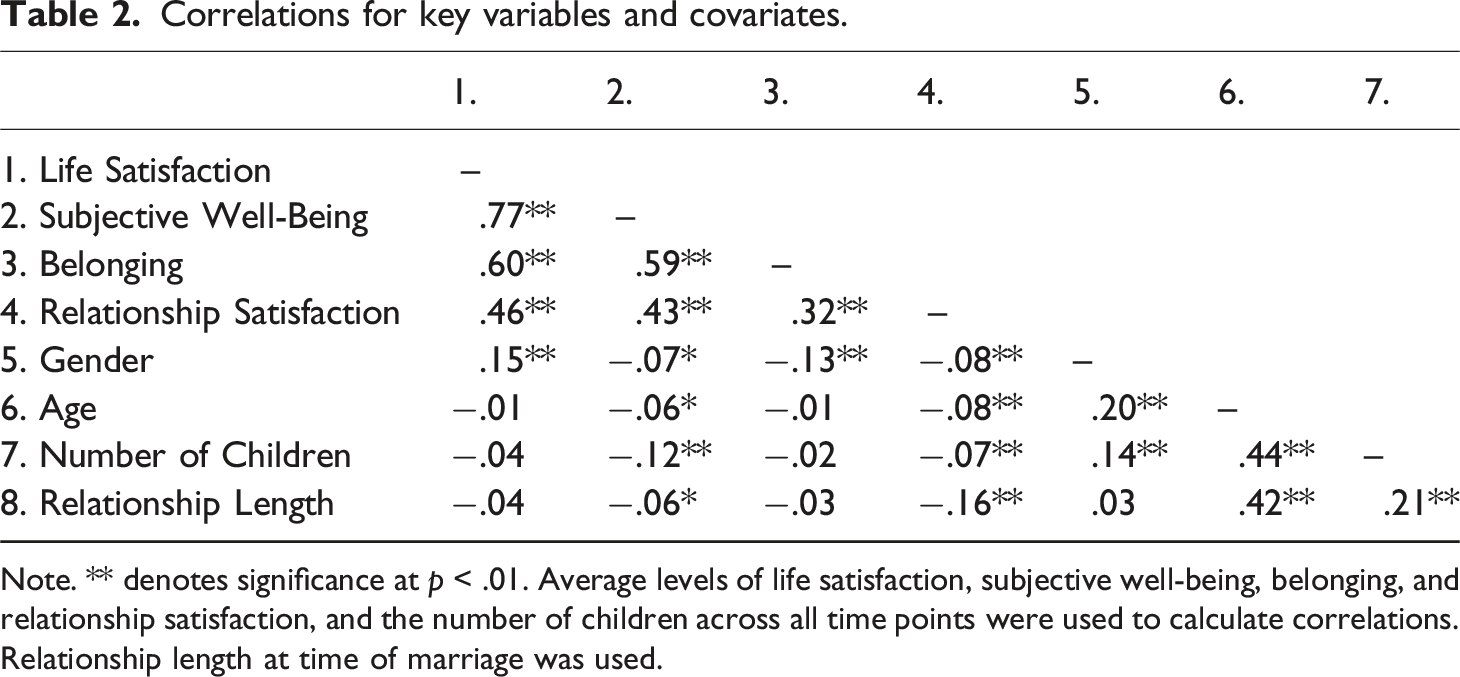
Note. ** denotes significance at p < .01. Average levels of life satisfaction, subjective well-being, belonging, and relationship satisfaction, and the number of children across all time points were used to calculate correlations. Relationship length at time of marriage was used.
The piecewise models were event-aligned because the point between waves when participants were married was modelled as the break point between the two slopes in the piecewise model regardless of the chronological wave marriage occurred. For example, the break point for a participant whose marriage was recorded at wave 10 of the NZAVS would be between wave 9 and wave 10, with the first slope representing the growth function up to and including wave 9 (before they married) and the second slope representing the growth function from wave 10 across the subsequent years after which they married. In addition to providing the estimates and significance of the slope in the years before and after marriage, event-aligned models provide tests of the difference between the immediate pre-marriage and post-marriage points (e.g., between wave 9 and 10).
The slopes are estimated on all available data. Participants who provide more (vs. less) waves of data pre- and post-marriage contribute more (vs. less) to the estimates of the pre- and post-marriage slopes. To illustrate, participants whose marriage was recorded in later (vs earlier) waves will contribute more to the estimates of the pre-marriage (vs post-marriage) slopes. For the small proportion of participants whose marriage was recorded in Wave 14, all data prior to Wave 14 contributed to the pre-marriage slope, and the data at Wave 14 (their immediate post-marriage data point) contributed fully to the estimates of the difference between immediate pre-marriage and post-marriage points but minimally to the estimates of the post-marriage slopes. Similarly, the small proportion of participants whose marriage was recorded at Wave 2 made minimal contributions to the pre-marriage slope, fully contributed to the immediate pre-marriage and post-marriage differences, and made greater relative contributions to the post-marriage slopes.
In each model, we controlled for the year in which marriage occurred as well as participant age and relationship length at the time wave of marriage (see Table 1). We also controlled for number of children at each wave to differentiate the effects of marriage from becoming parents or increased parenting responsibilities at any point either before or after marriage (similar results and conclusions emerged without this covariate). Finally, we also modelled gender (women −.5, men .5) as a predictor of the pre-marriage and post-marriage slopes to test for any differences across women and men given that some research has found gender differences in trajectories of relationship satisfaction, whereas other studies have not found gender differences in trajectories (e.g., Kurdek, 1999). Model syntax and output is available here: https://osf.io/75snb/
Results from piecewise latent growth models for changes in well-being and relationship satisfaction pre- and post-marriage.
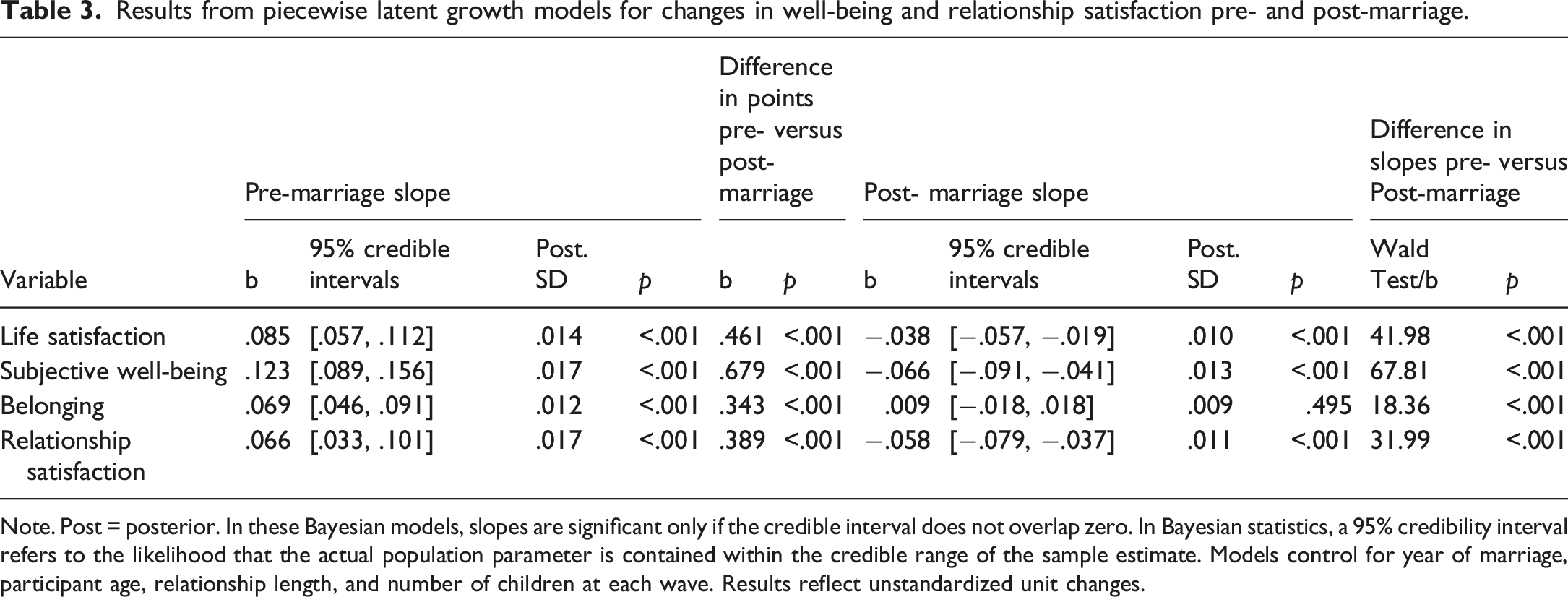
Note. Post = posterior. In these Bayesian models, slopes are significant only if the credible interval does not overlap zero. In Bayesian statistics, a 95% credibility interval refers to the likelihood that the actual population parameter is contained within the credible range of the sample estimate. Models control for year of marriage, participant age, relationship length, and number of children at each wave. Results reflect unstandardized unit changes.
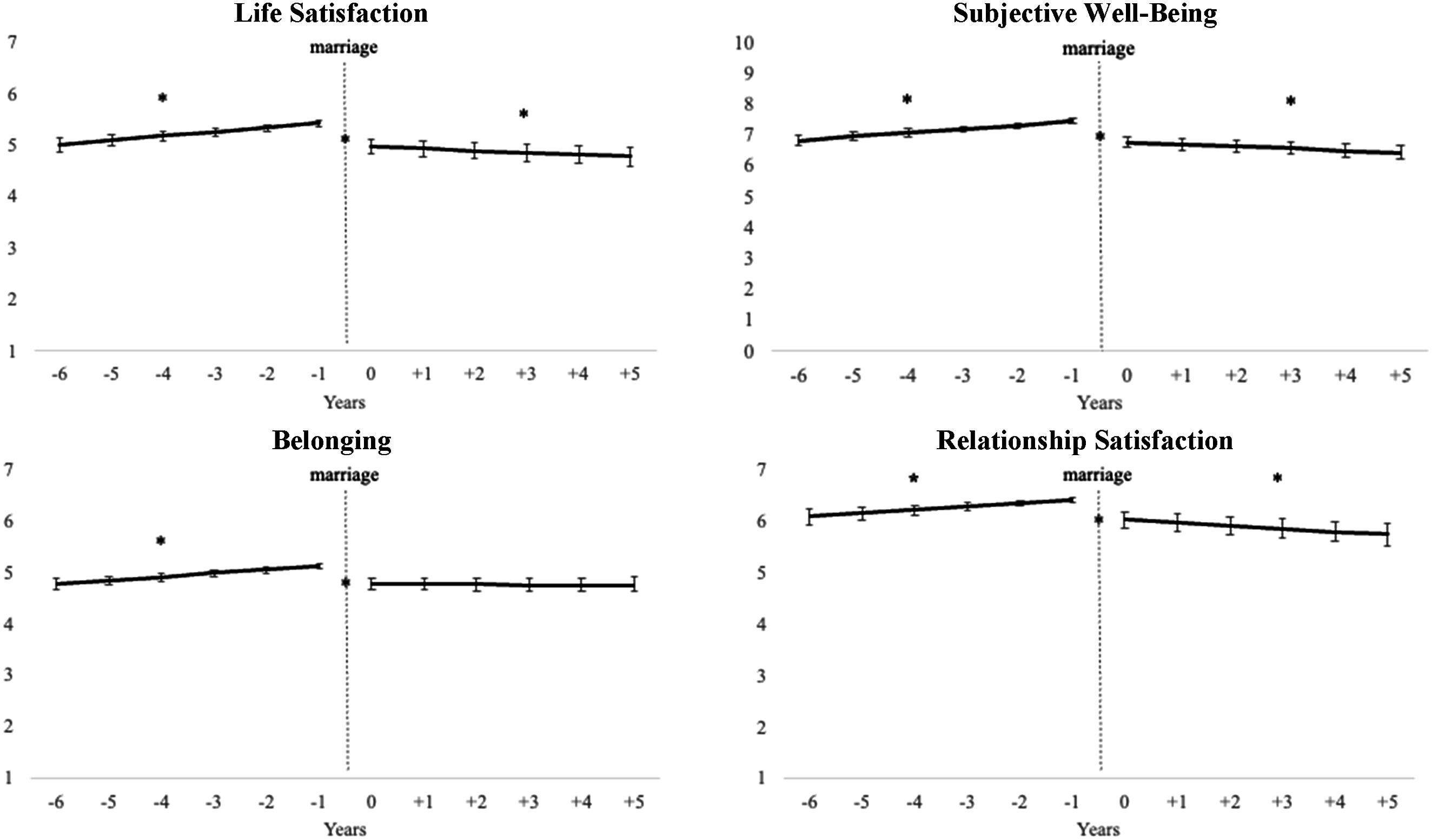
Piecewise Latent Growth Models Estimating Changes in Well-being and Relationship Satisfaction Prior to Marriage and Following Marriage. Note. Error bars represent 95% credible intervals. Asterisks represent significant slopes and significant changes in well-being and relationship satisfaction from prior to marriage to the first year following marriage.
Relationship satisfaction showed a similar trajectory to that of life satisfaction and subjective well-being. People experienced significant increases in relationship satisfaction leading up to marriage (see Table 3 ‘pre-marriage slope’), followed by a significant drop in relationship satisfaction from one year before marriage to one year after marriage (see Table 3 ‘Difference in Points Pre- vs Post-Marriage’). This provides valuable insight as to when relationship satisfaction begins to decline. Furthermore, in line with past research, relationship satisfaction continued to decline significantly in the years following marriage (see Table 3 ‘post-marriage slope’). In sum, the results are best represented by the pattern illustrated in Figure 1, Panel C: (1) increases in relationship satisfaction leading up to marriage, (2) a post-marriage drop shortly after marriage, and (3) continued declines in relationship satisfaction following marriage.
While our results hint at some between-person variation in the pre- and post-marriage slopes (see Table 3 ‘Post. SD’), our focal patterns were shown over and above any effects of age, gender, relationship length, wave marriage was recorded, and the number of children (see OSM for full covariate results). Notably, there were no significant gender differences in the pre-marriage or post-marriage slopes across outcomes with a few notable exceptions. Women reported steeper pre-marriage increases in subjective well-being (gender: b = −.06, p = .01) and life satisfaction (gender: b = −.05, p = .016) compared to men. However, these represent only 2 gender differences of 8 pre-marriage and post-marriage slopes, so do not offer the basis for strong conclusions. Furthermore, the number of children at each wave was associated with lower relationship satisfaction in the 2 years leading up to marriage and 2 to 5 years following marriage.
Discussion
The current research examined patterns of change in well-being (life satisfaction, subjective well-being, belonging) and relationship satisfaction in continuously partnered, diverse-aged New Zealand adults across the years before marriage, shortly after marriage, and across the years following marriage. In line with hedonic adaptation, well-being increased in the years leading up to marriage and dropped significantly shortly after marriage (Clark et al., 2008; Clark & Georgellis, 2013; Lucas et al., 2003; Luhmann et al., 2012). However, this work provides novel evidence that life satisfaction and subjective well-being (but not belonging), continued to steadily decline across the years following the transition to marriage. Extending prior evidence, this pattern of change in well-being was evident controlling for relationship length and number of children.
Like well-being, relationship satisfaction increased leading up to marriage, dropped significantly shortly after marriage, and continued to steadily decline in the years following the transition to marriage. These results align with a breadth of past research illustrating that when examining average trends across married people, relationship satisfaction declines over time (Glenn, 1998; Halford et al., 2007; Karney & Bradbury, 1997; Kurdek, 1999; VanLaningham et al., 2001). However, our findings provide novel insights about the onset of the decline in relationship satisfaction – both shortly after marriage and in the years following marriage.
Leading up to marriage: Increases in well-being and relationship satisfaction
The trajectories of well-being and relationship satisfaction showed similar patterns before marriage: life satisfaction, subjective well-being, belonging, and relationship satisfaction all increased in the years leading up to marriage. This pattern is consistent with prior well-being research illustrating that people experience a well-being boost leading up to marriage (Clark et al., 2008; Luhmann et al., 2012) but provides novel insights to the relationships/marriage literature by demonstrating that relationship satisfaction also increases across the years leading up to marriage. This pattern is consistent with existing theories about the “honeymoon” phase of relationships (Aron et al., 2002) and hedonic adaptation (Brickman & Campbell, 1971). The similarity in pre-marriage trajectories of well-being and relationship satisfaction also dovetails with research suggesting that life and relationship satisfaction influence each other (Kamp et al., 2008; Proulx et al., 2007).
We were unable to test for the mechanisms underlying the increase in well-being and relationship satisfaction prior to marriage. However, there are plausible explanations based on past research. It may be that the years leading up to marriage are a time marked by low stress and more fun activities that bolster happiness and relationship quality. For example, early on in relationships people tend to hide their flaws (Birditt et al., 2012) and see the best in their partner (“positive illusions”; Barelds & Dijkstra, 2011), which may lead to fewer conflicts and arguments that undermine relationship satisfaction (Finkel et al., 2013; Gottman et al., 1998). Moreover, prior to marriage, people may have more opportunities for self-expansion as they engage in new experiences and get to know each other (Aron et al., 2002; Girme et al., 2014). Thus, the period leading up to marriage may be a time in which people have more satisfying relationships.
However, the findings also show that average pre-marital increases in well-being and relationship satisfaction are sustained and peak at or right before marriage, suggesting that there may be something about the transition to marriage specifically that contributes to this pattern. It could be that immediately before marriage people often have opportunities to celebrate relationship milestones (e.g., engagement parties) and receive positive reinforcement from friends and family (e.g., showing people their engagement ring). Additionally, this period is likely influenced by social norms that endorse notions that marriage is a pathway to future happiness and a fulfilling life (Dennett & Girme, 2024). People may expect their romantic partner not only to offer them belonging and love, but also to continue to meet higher level needs such as self-expansion and personal growth (Finkel et al., 2015). Because of these beliefs, people may anticipate that marriage will offer them love, belonging, happiness, and personal growth (Carroll et al., 2009). Thus, approaching this presumed life and relationship altering milestone may lead to steady growth in well-being and relationship satisfaction leading up to marriage. Future research should tease apart which of these different explanations might be most important in predicting increases in well-being and relationship satisfaction leading up to marriage.
Hedonic adaptation: Drops in well-being and relationship satisfaction shortly after marriage
Shortly after marriage, both well-being (life satisfaction, subjective well-being, belonging) and relationship satisfaction dropped significantly. The “drop” in well-being shortly after marriage is consistent with hedonic adaptation, which demonstrates the tendency for well-being to decline soon after positive life events (Brickman & Campbell, 1971). Hedonic adaptation may arise because the higher levels of well-being and relationship satisfaction shown prior to marriage is reduced by the discovery that marriage may not be the key ingredient to happiness or the perfect relationship (Hall & Adams, 2011) as the positive illusions (Barelds & Dijkstra, 2011) and excitement decline (Aron et al., 2002). Much of the extant literature assumes that relationship satisfaction, on average, declines after marriage (Glenn, 1998; Halford et al., 2007; Karney & Bradbury, 1997; Kurdek, 1999; VanLaningham et al., 2001). However, without examining changes prior to marriage, and changes that occur from pre-to-post marriage, it has remained unclear whether average declines are a function of relationships simply progressing (i.e., a continual decline across committed relationships regardless of marriage), or a function of settling into married life when the “honeymoon” phase is over (Aron et al., 2002). The results extend the relationships/marriage literature by providing the first evidence of when relationship satisfaction begins to decline for continuously partnered people. First, relationship satisfaction followed a positive trajectory (on average) prior to marriage. Then, relationship satisfaction dropped shortly after marriage following the pre-marriage peak levels of relationship satisfaction.
Well-being and relationship satisfaction steadily decline following marriage
After the post-marriage drop, life satisfaction, subjective well-being, and relationship satisfaction (but not belonging) continued to steadily decline in the years following the transition to marriage. This contradicts the stable return to pre-marital levels exemplified by hedonic adaptation in the well-being literature (Clark et al., 2008; Clark & Georgellis, 2013; Lucas et al., 2003; Luhmann et al., 2012). Such continual average declines are consistent with the emergent distress and disillusionment processes, such that when exploring average change patterns within a given sample, relationship satisfaction declines over time (Bradbury, 1998; Glenn, 1998; Kurdek, 1999; VanLaningham et al., 2001). The similar post-marriage trajectories in life satisfaction, subjective well-being and relationship satisfaction also suggests that well-being and relationship satisfaction may be inevitably tied together and so examining relationship satisfaction alongside global well-being outcomes enhance understandings of these outcomes.
It is important to consider why the transition to marriage is associated with declines in life satisfaction, subjective well-being, and relationship satisfaction, even though individuals were in long-term relationships prior to marriage (average relationship length at the wave of marriage = 8.28 years). Indeed, while relationship satisfaction may decline due to many factors such as increased conflict (Finkel et al., 2013; Gottman et al., 1998), less sexual intimacy (McNulty et al., 2019) and boredom (Aron et al., 2002), these challenges are common even among unmarried couples. Although disillusionment or failed expectations (i.e., hedonic adaptation) about the relationship/partner may help explain the drop in relationship satisfaction and well-being shortly after marriage (Finkel et al., 2015; Huston et al., 2001), the continued decline in relationship satisfaction and well-being suggests additional ongoing dynamics are at play. For example, more frequent conflict and fewer constructive behaviours are associated with decreased future relationship satisfaction (Johnson et al., 2018). Of course, it is possible that these dynamics also are occurring before marriage, but the higher well-being and relationship satisfaction prior to marriage suggests that additional pre-marriage processes may counteract these potentially deleterious elements. Although challenging, comparing patterns of change in couples that differ in the intention and act of marriage, but are matched in relationship duration and commitment, may tease apart whether average declines also occur for unmarried couples who are not influenced by the excitement of marriage.
Caveats and conclusions
Despite the various strengths of the current research, there are important caveats to consider. Due to the sampling procedures, we are unable to identify the proportion of marriages that represented first marriages. The age of marriage was diverse, ranging from 20.1 to 93.8 years, with the average age of marriage being higher in this sample (38.5 for women and 44.0 for men) than the average age of first marriage in New Zealand (31.3 for women and 32.5 for men; Statistics New Zealand, 2023). Accordingly, some participants may have been previously married before entering the study. This is important because data from the United States suggests that first marriages tend to be more satisfying than second marriages (e.g., Mirecki et al., 2013). Relatedly, people were coupled for an average of 8 years prior to marriage, which may reflect an older sample and a culture where long-term dating and cohabitation before marriage are commonplace (Statistics New Zealand, 2018). These unique features of our sample may be why we found that life satisfaction and subjective well-being continued to decline years after marriage. This is in contrast with a breadth of literature that finds that after the initial post-marriage drop, well-being remains stable over time (e.g., Clark & Georgellis, 2013). Nonetheless, our findings dovetailed with prior work suggesting that after marriage, on average, relationship satisfaction continues to decline over time (e.g., Bradbury, 1998). Thus, these findings extend prior knowledge of well-being and relationship satisfaction among a diverse-aged sample of adults who may have been previously married (an under-investigated but increasingly relevant sample given global changes in marriage patterns; OECD, 2020).
Furthermore, the current study was limited to the use of a single item measure of relationship satisfaction. Single item measures may minimize changes in relationship satisfaction over time (Funk & Rogge, 2007), and so our results may have differed with a more comprehensive measure of relationship satisfaction. Additionally, the significant changes in well-being and relationship satisfaction before marriage (∆ = .12 to .38, M = 0.24) and life satisfaction, subjective well-being, and relationship satisfaction following marriage (∆ = −.40 to −.03, M = −0.16) were fairly small. Nonetheless, even small effects can aggregate over time to have meaningful practical outcomes (Funder & Ozer, 2019). Indeed, our findings do not capture changes in well-being or relationship satisfaction for the decades that some people remain married. For example, meta-analytic evidence integrating results from different samples that examined post-marriage satisfaction at different stages suggests that relationship satisfaction decreases throughout the first 10 years of marriage, increases between 10 and 20 years of marriage, and then begins to decline again (Bühler et al., 2021). This trajectory is usually theorized as high relationship satisfaction before couples have children, declines in relationship satisfaction after children are born, and an uptick in relationship satisfaction when children are older and less reliant on parents (Gorchoff et al., 2008). Taken together, an important avenue of future research is tracking individuals before and then several decades after marriage to determine how, and to what extent, marriage is associated with well-being and relationship satisfaction across the entire lifespan.
Additionally, we focused on average changes prior to and following marriage, rather than how this trajectory may vary across key individual or relationship factors. According to the enduring dynamics model, for example, dynamics within a romantic relationship are established early in the relationship and can influence subsequent trajectories of relationship well-being (Huston et al., 2001; Karney & Bradbury, 1997). In line with this theorizing, research has found subgroups of newlywed people who have high levels of relationship satisfaction at the beginning of marriage that remain high over time, and other groups of married people who report low levels of relationship satisfaction who experience significant declines (Lavner et al., 2012; Williamson & Lavner, 2020). Although our results did not find consistent moderation effects by individual or relationship covariates, future research adopting person-centered approaches may help visualize between-person variability in subgroups of married people and perhaps lead to differential patterns (e.g., Huston et al., 2001). Additionally, we excluded participants who divorced from our analyses, but such people may add variation in relationship trajectories that could be explained by enduring dynamics that put people at risk for divorce (Kanter et al., 2019). Notably, however, even prior studies examining married versus eventually divorced people have not examined the entire course of relationship satisfaction, including trajectories and levels prior to and after marriage, rendering it unclear whether enduring happiness versus increasing dissatisfaction could reflect differences in pre-marriage trajectories or different patterns of hedonic adaptation. Examining variations in within-person patterns of change in relationship satisfaction as people approach, enter, and then endure or thrive across marriage is an important avenue for future research.
The current findings highlight that continuously partnered New Zealand adults likely experience increases in well-being and relationship satisfaction prior to marriage and a significant drop in well-being and relationship satisfaction shortly after marriage. This pattern is in line with hedonic adaptation and may be reflective of the transition to marriage being associated with enhanced well-being and relationship satisfaction that quickly drop as people adapt to married life. Notably, life satisfaction, subjective well-being, and relationship satisfaction continued to steadily decline over time; perhaps because of increases in disillusionment, failed expectations, or marital stressors associated with long-term committed relationships. Taken together, our findings provide novel insight that the course of well-being and relationship satisfaction differ in the years before marriage compared to shortly after and years following marriage. This work pinpoints the first year of marriage as a vulnerable time for newly married people, during which additional support may be beneficial. Rather than focusing on premarital couples, interventions targeted to the early years of marriage may be important to promote happier and more stable marriages by mitigating average declines in well-being and relationship satisfaction following marriage.
Supplemental Material
Supplemental Material - Changes in well-being and relationship satisfaction in the years before and after marriage in a sample of New Zealand adults
Supplemental Material for Changes in well-being and relationship satisfaction in the years before and after marriage in a sample of New Zealand adults by Hannah E. Dupuis, Yuthika U. Girme, Nickola C. Overall, Emily J. Cross and Chris G. Sibley in Journal of Social and Personal Relationships
Footnotes
Declaration of conflicting interests
The author(s) declared no potential conflicts of interest with respect to the research, authorship, and/or publication of this article.
Funding
The author(s) disclosed receipt of the following financial support for the research, authorship, and/or publication of this article: The NZAVS is funded by a grant from the Templeton Religion Trust (TRT-2021-10418). The funders had no role in the preparation of the manuscript or the decision to publish.
Open research statement
As part of IARR’s encouragement of open research practices, the authors have provided the following information: This research was not pre-registered. The data described in the paper are part of the New Zealand Attitudes and Values Study (NZAVS). Full copies of the NZAVS data files are held by all members of the NZAVS management team and advisory board. A de-identified dataset containing the variables analyzed in this manuscript is available upon request by emailing  .
.
Supplemental Material
Supplemental material for this article is available online.
Note
References
Supplementary Material
Please find the following supplemental material available below.
For Open Access articles published under a Creative Commons License, all supplemental material carries the same license as the article it is associated with.
For non-Open Access articles published, all supplemental material carries a non-exclusive license, and permission requests for re-use of supplemental material or any part of supplemental material shall be sent directly to the copyright owner as specified in the copyright notice associated with the article.
